Book Review: Snuff by Terry Pratchett
Posted on January 2, 2017 17 Comments
“I tell you, commander, it’s true that some of the most terrible things in the world are done by people who think, genuinely think, that they’re doing it for the best, especially if there is some god involved.”

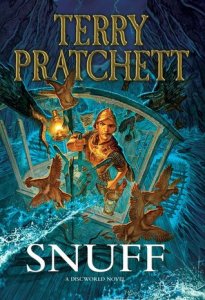 Snuff by Terry Pratchett
Genre: Fantasy
Series: Discworld #39, Ankh-Morpork City Watch #8
Publisher: DoubleDay UK (October 2011)
Author Info: terrypratchettbooks.com
Wendy’s Rating: 5 of 5 stars
Why did no one tell me Terry Pratchett was so awesome??? No, that’s not fair. A few people have said so, and a trusted advisor on all things geeky did recommend a few of Pratchett’s Discworld books to me, but only now am I finally getting around to reading one. And I am just about blown away!
As I understand it, this isn’t necessarily the best of Pratchett’s Discworld work, and as far as cop fiction goes, it is fairly rote. But after getting through 20% of the book with no actual plot happening, yet loving it all anyway, I figure Pratchett is definitely doing something right. I was immediately charmed by Pratchett’s dry wit and found myself genuinely LOLing several times, particularly in relation to poop, a subject which I certainly had not expected to learn quite so much about.
The story centres on Sam Vimes, commander of the Ankh-Morpork City Watch, who is off on vacation in the country side. As with any cop drama, it is impossible for a cop not to cop, even while on vacation, and especially when murder inconveniently happens during that time. In this case, the victim is a goblin. According to the mainly human perspective, goblins are barely worth anyone’s time, but Vimes is a man that respects life in its many forms, and especially in its living, breathing, thinking, feeling forms.
As my first introduction to Vimes, I am equally charmed by the man as I am with his creator. I am also quite fond of the relationship between Vimes and his not so gentlemanly gentleman, Willikins. The pair reminded me of Cesare and Micheletto from The Borgias, only, older, with more humour, less giving of fucks, and fewer angst-ridden forbidden romances.

Dropping into part 39/8 of a long-standing series isn’t generally wise, but the book does a fine job of not making me feel completely out of sorts. Certainly there are historical, political, and personal references, as well as some inside jokes, that I likely missed out on, but it was nothing that kept me from enjoying the book on its own. It just means that I have something to look forward to when I pick up more from the series.

Looking Ahead to the New Year: “Can’t Wait” Books of Early 2017
Posted on January 1, 2017 41 Comments

Happy 2017! As we get ready to begin another year, it’s time to look ahead and geek out over the Science Fiction and Fantasy reads I’m most excited about. Not only is it fun to organize my reading and to make lists, they also have the added benefit of focusing my attention to the highly anticipated releases that I’d like to check out. There’s already an impressive tower of books on my TBR pile, and these are only from the first quarter of 2017. While I’m under no illusions that I’ll be able to read them all, hopefully I can get to most of them (and also put some new books on people’s radars)!
What’s on your early 2017 reading list?
January


Dead Man’s Steel by Luke Scull (January 3) – The final installment in the Grim Company trilogy, and I can’t wait to see how it ends.
The Dead Seekers by Barb & J.C. Hendee (January 3) – A new series set in the same world as the authors’ Noble Dead Saga.
The Bear and the Nightingale by Katherine Arden (January 10) – A magical debut inspired by Russian fairy tales and folklore.
Little Heaven by Nick Cutter (January 10) – An epic horror tale set in midcentury New Mexico from the author who brought us The Troop. I wonder if it’ll be just as gory.
The Burning Page by Genevieve Cogman (January 10) – The third book in the Invisible Library series. Yay for more adventures with Librarian spy Irene and her dragon prince apprentice, Kai!
The Last Harvest by Kim Liggett (January 10) – This book was pitched to me as a horror novel set in Oklahoma that’s been described as Rosemary’s Baby meets Friday Night Lights. Awesome.
Heartstone by Elle Katharine White (January 17) – A historical fantasy that re-imagines Pride and Prejudice in an world of dragons and other mythological creatures.
Dreadnought by April Daniels (January 24) – A superhero novel about a trans teen who inherits the powers of the world’s greatest superhero.
Department Zero by Paul Crilley (January 24) – A book about a man who stumbles upon a network of universe-hopping gates, giving him access a secret multiverse of alternate realities.
Six Wakes by Mur Lafferty (January 31) – A space adventure where the murdered crew on a ship are resurrected through cloning, and they must solve the mystery of who their killer was.
Crossroads of Canopy by Thoraiya Dyer (January 31) – A fantastic looking debut that is set in the canopy of a giant mythical rainforest controlled by a pantheon of living gods.
The Hanging Tree by Ben Aaronovitch (January 31) – The sixth book in the the Rivers of London/Peter Grant sequence, which is one of my favorite urban fantasy series.
Behind Her Eyes by Sarah Pinborough (January 31) – A thriller-suspense about a love triangle from hell. Apparently, the ending is a shocker! I’m a huge fan of Pinborough and I’m really excited about this one.
Caraval by Stephanie Garber (January 31) – One of my most highly anticipated YA releases, Caraval is about two sisters who escape their cruel father to end up at Caraval, a once-in-a-lifetime magical show.
February


A Darkness Absolute by Kelley Armstrong (February 7) – The sequel to Kelley Armstrong’s most excellent City of the Lost, featuring Rockton town detective Casey Duncan.
With Blood Upon the Sand by Bradley Beaulieu (February 7) – The second book in the Song of Shattered Sands trilogy continuing the harrowing adventures of Çeda, now a Blade Maiden in service to the kings of Sharakhai.
Miranda and Caliban by Jacqueline Carey (February 14) – A retelling of The Tempest by one of my favorite authors, Jacqueline Carey.
In Calabria by Peter S. Beagle (February 14) – A new unicorn fable from Peter S. Beagle, whose books I’ve wanted to read for a while!
Winter of the Gods by Jordanna Max Brodsky (February 14) – I loved The Immortals and now I’m ready for even more myth-meets-reality in this high anticipated sequel.
Gilded Cage by Vic James (February 14) – A Young Adult novel about an alternate Great Britain controlled by aristocrats with magical gifts, and all commoners must serve them for ten years.
Luna: Wolf Moon by Ian McDonald (February 14) – Luna: Wolf Moon takes place eighteen months after Luna: New Moon. The first book was incredible, and I have a feeling this sequel will live up to it.
A Conjuring of Light by V.E. Schwab (February 21) – This final installment of the Shades of Magic trilogy will see the epic battle between four magical Londons come to a conclusion.
Star Wars: Aftermath: Empire’s End by Chuck Wendig (February 21) – The conclusion of the Star Wars: Aftermath trilogy. The second book was an improvement from the first one, so I hope the pattern continues for this finale.
Thunderbird by Chuck Wendig (February 28) – Wendig is on fire this month. Finally, we’ll be getting book four of the Miriam Black series. It feels like I’ve been waiting for this sequel forever!
Bane and Shadow by Jon Skovron (February 28) – The follow-up to Hope and Red. It’ll be interesting to see what our eponymous protagonists are up to in this sequel.
March


Sins of Empire by Brian McClellan (March 7) – A new epic fantasy series from the author of the Powder Mage trilogy, set in the same world.
Etched in Bone by Anne Bishop (March 7) – So sad this will be the final book of the series! But I am looking forward to see how everything ends.
Silence Fallen by Patricia Briggs (March 7) – March is an exciting time for urban fantasy, with another new installment of the Mercy Thompson series.
The Bone Witch by Rin Chupeco (March 7) – Witches and necromancy? Count me in. Really curious about this YA novel which is already getting tons of praise.
Empress of the Fall by David Hair (March 9) – The beginning of The Sunsurge Quartet, a sequel series to The Moontide Quartet, which I’m a bit behind on. Hopefully that won’t prevent me from enjoying this one!
Star’s End by Cassandra Rose Clarke (March 21) – A new space opera from Cassandra Rose Clarke. I love her books.
Phantom Pains by Mishell Baker (March 21) – The sequel to Borderline, which was an amazing book! Can’t wait to catch up with Millie and the Arcadia Project.
The Collapsing Empire by John Scalzi (March 21) – It feels a bit strange pondering a new space opera novel by Scalzi that’s not from the Old Man’s War sequence, but I’m looking forward to this start of a new series nonetheless.
April


Brimstone by Cherie Priest (April 4) – A new dark historical fantasy from Cherie Priest. This one sounds right up my alley!
Red Sister by Mark Lawrence (April 4) – Mark Lawrence begins another new series with Red Sister, an epic fantasy about a secret order of holy warriors.
Gauntlet by Holly Jennings (April 4) – Sequel to Arena, a sci-fi thriller about the world of competitive virtual gaming. I’m ready to plug back in.
Tyrant’s Throne by Sebastien de Castell (April 4) – I’m beginning to think Sebastien de Castell can do no wrong. This will be the fourth installment of the Greatcoat series, which I adore.
Waking Gods by Sylvain Neuvel (April 4) – I had mixed feelings about the execution behind the first book, but the story of Sleeping Giants itself was tantalizing enough that I am pretty intrigued by the sequel.
Star Wars: Thrawn by Timothy Zahn (April 11) – One of the most iconic villains in Star Wars history has returned to the new canon. I saw him in Star Wars Rebels and I’d love to know more about this reiteration of Thrawn.
Ararat by Christopher Golden (April 18) – A supernatural thriller set on Mount Ararat in Turkey. It seems I have a thing for horror novels set in cold places.
Skullsworn by Brian Staveley (April 25) – A new standalone epic fantasy by Brian Staveley that returns to the world of his Chronicle of the Unhewn Throne series.
Within the Sanctuary of Wings by Marie Brennan (April 25) – Another one of my favorite series will be coming to an end this year, with the fifth and final Memoir by Lady Trent book.
Wendy’s 2016 Happy Holidays Round-Up
Posted on December 31, 2016 12 Comments
Happy holidays everyone! I hope you are enjoying some peaceful family time on this special day. I’m being sarcastic. My Christmas holidays are anything but peaceful, but if you get to enjoy a silent night, then power to you! If the holidays just aren’t your thing, or you don’t celebrate them at all, perhaps a stroll through my 2016 reads might inspire some additions to your to-read pile to keep you occupied while everyone else is hungover on eggnog and bright lights.
Worlds Without End
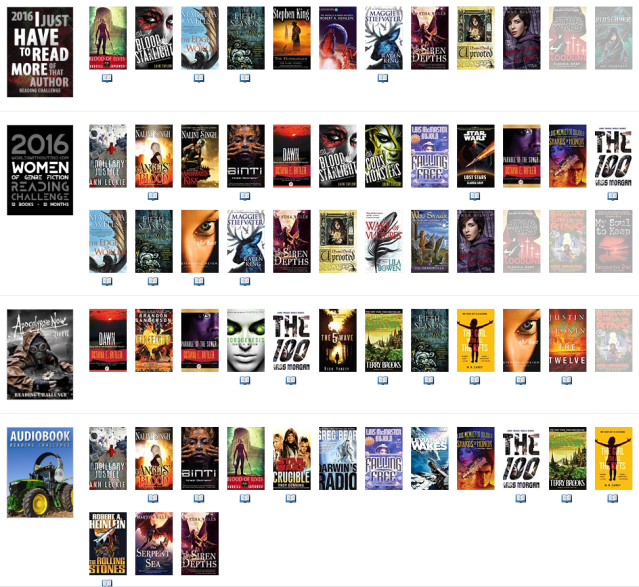
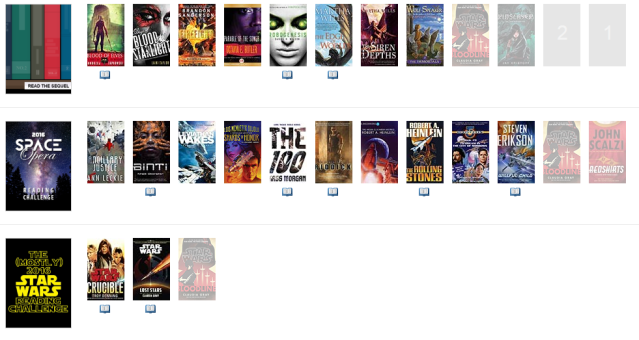
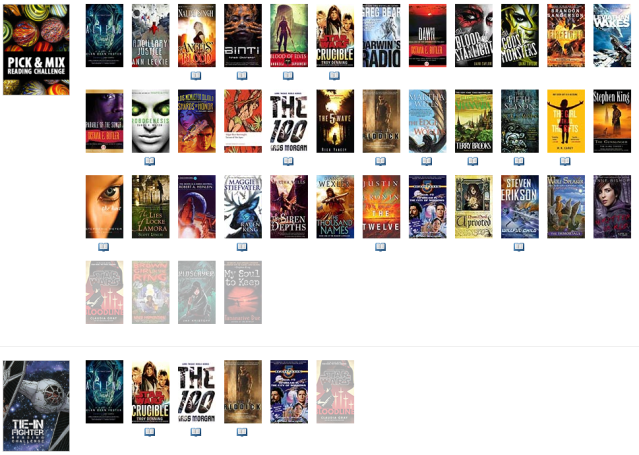
Worlds Without End houses all my challenge needs thanks to its Roll-Your-Own-Reading Challenge that people more diligent than I have put together a diverse collection of challenges to inspire readers. I particularly like these challenges as they help keep me focused on the books I already own, helping to curb the temptation to buy more (one of my resolutions next year is to stop impulse buying, but that doesn’t count for books, right?) . I am pleased with my results there year (I grabbed these images before I finished Star Wars: Bloodlines and Brown Girl In the Ring, so add those to the pretty — but I shamelessly admit to a few tweaks along the way to make sure my list is the best that it can be…).
Goodreads
Good old Goodreads never fails with its reading challenge. It’s a basic challenge — read X many books — but its simplicity is what makes it a constant for me. And now that they provide these fantastic summaries of the year, well, I’ll never leave you, Goodreads. Never. (I swear I only checked out Litsy for a few minutes.)
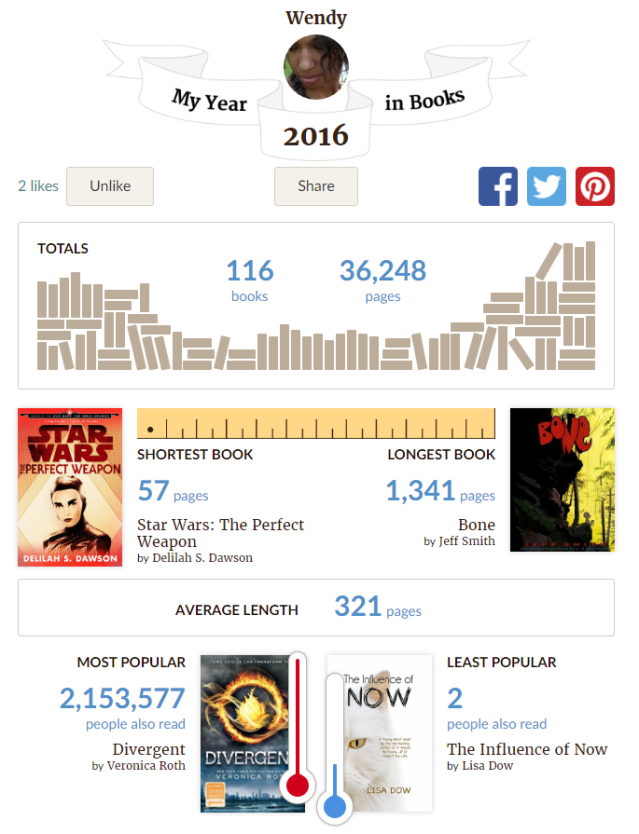
I keep my challenge goal at 100 books now to avoid over reaching. I usually don’t have a problem getting to 100, and the few that go over are a nice bonus. As I look forward to the new year, I’m already stacking my shelves for the next challenges. What will you be reading?
Mogsy’s Bookshelf Roundup: Stacking the Shelves & Recent Reads
Posted on December 31, 2016 25 Comments
Bookshelf Roundup is a feature I do every other weekend which fills the role of several blog memes, like Stacking the Shelves where I talk about the new books I’ve added to my library or received for review, as well as It’s Monday! What Are You Reading? where I round up what I’ve read since the last update and what I’m planning to read soon. Mostly it also serves as a recap post, so sometimes I’ll throw in stuff like reading challenge progress reports, book lists, and other random bookish thoughts or announcements.

Whew, Christmas celebrations are over and I’ve been enjoying a welcome break for the past week, spending time with my family with a nice staycation. It’s hard to believe that 2016 will be ending at the end of the day and soon we’ll be ushering in 2017. I hope everyone also had a wonderful time over the holidays, and I wish you all a happy new year!
Received for Review
It has been another light week of activity due to the holiday break, but there were still a handful new arrivals in the mail. Thank you to the publishers and authors for the following review copies received. For more details and full descriptions of the books, be sure to click the links to their Goodreads pages!

Hag-seed by Margaret Atwood – Shakespeare retellings seem to be all the rage these days. My thanks to LibraryThing’s Early Reviewers program and Crown Publishing for the opportunity to read Margaret Atwood’s modern day re-imagining of The Tempest.
The Liberation by Ian Tregillis – The third book of the Alchemy Wars trilogy. I approach this finale with both sorrow and excitement, since the series has been such an amazing journey so far. With thanks to Orbit.
Gauntlet by Holly Jennings – I can’t wait to check out this sequel to last year’s Arena, a futuristic action-adventure sci-fi novel about the gritty world of competitive virtual gaming. My thanks to Ace Books.
The Burning Page by Genevieve Cogman – Hooray for another highly anticipated sequel, this time the third novel in the Invisible Library series. I’m ready to jump back into the world of librarian spies! With thanks to Roc Books.
Dead Man’s Steel by Luke Scull – It feels like I’ve been waiting on this one forever! Finally, the third and final book in the Grim Company series is here, and perfect timing too; I’ve been hankering for some dark fantasy. Thanks again to Roc Books.
The Last Harvest by Kim Liggett – I’m so excited for this one! So grateful to Tor Teen for sending me this Young Adult horror novel which features football, wheat fields, cattle and Satanic panic.

Waking Gods by Sylvain Neuvel – While the first book was not without its flaws, it did succeed in leaving me curious about where the story will go next. The sequel was “Read Now” to me on NetGalley, so there went my self-control! With thanks to Del Rey.
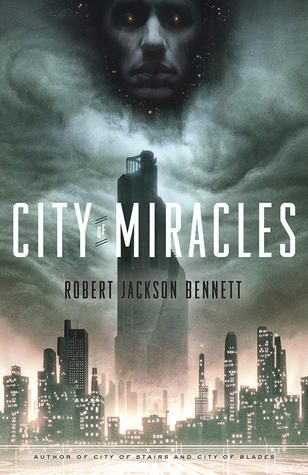
City of Miracles by Robert Jackson Bennett – Speaking of not being able to control myself, I also went ahead and requested this third book of The Divine Cities series. But you can hardly blame me, right? Thank you, Broadway Books and NetGalley.
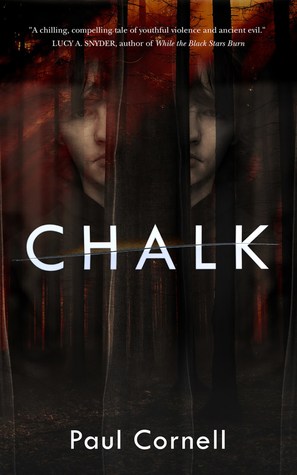
Buffalo Soldier by Maurice Broaddus and Chalk by Paul Cornell – More awesome novellas courtesy of Tor.com! They’re coming out with some great looking titles in the spring of 2017 and these are just two I’m very interested in checking out.
Reviews
A quick roundup of the reviews I posted since the last update:
A Closed and Common Orbit by Becky Chambers (4 of 5 stars)
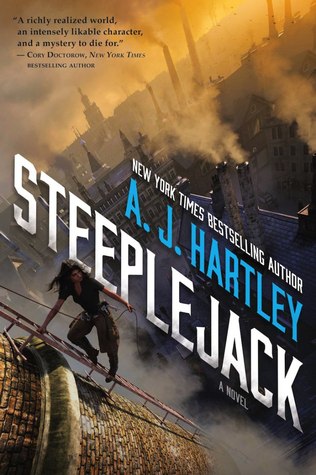
Steeplejack by A.J. Hartley (4 of 5 stars)
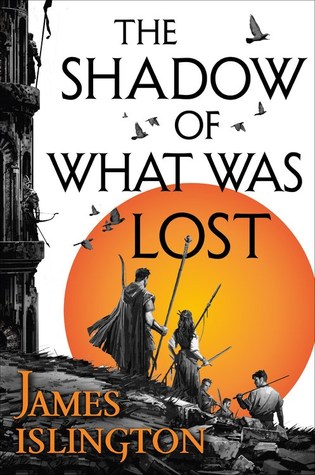
The Shadow of What Was Lost by James Islington (3.5 of 5 stars)
Ocean of Storms by Christopher Mari & Jeremy K. Brown (3.5 of 5 stars)
The Burning Isle by Will Panzo (3.5 of 5 stars)
Outpost by F.T. McKinstry (3 of 5 stars)
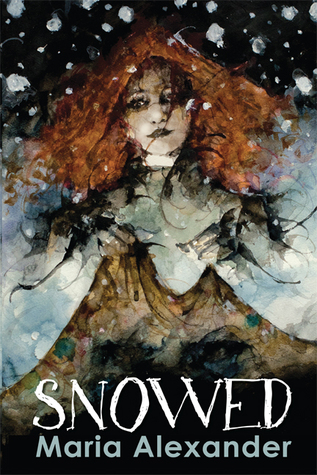
Snowed by Maria Alexander (3 of 5 stars)
What I’ve Read Since the Last Update
This past fortnight did a real number on my reading schedule. The week leading up to Christmas weekend I finished almost no books at all because I was so neck deep in holiday preparations, though I made up for it in the following week when it was more relaxing. There were a few last minute 2016 titles I managed to sneak in before the year was over, and I was even able to get a jump on some January 2017 releases. Reviews of those coming soon!

Have you heard of or read any of the books featured this week? What caught your eye? Any new discoveries? I hope you found something interesting for a future read! Let me know what you plan on checking out. Until next time, see you next Roundup!
Book Review: The Shadow of What Was Lost by James Islington
Posted on December 30, 2016 16 Comments
I received a review copy from the publisher. This does not affect the contents of my review and all opinions are my own.
The Shadow of What Was Lost by James Islington
Mogsy’s Rating: 3.5 of 5 stars
Genre: Fantasy
Series: Book 1 of The Licanius Trilogy
Publisher: Orbit (November 8, 2016)
Length: 693 pages
Author Information: Website | Twitter
Whenever I hear about an indie fantasy that makes the jump to a traditional publishing house, it always piques my curiosity and of course The Shadow of What Was Lost was no exception. Fast forward to the moment I finished reading the book, and I all I have to say is: I am impressed. This is James Islington’s first novel, and though that sometimes shows in the raw quality the writing, overall it is a solid series opener and I can certainly understand the reason for all the attention and praise.
The first part of the story introduces us to an interesting lore-filled world. Two decades have passed since the Augurs were defeated and wiped out. These were powerful individuals with god-like abilities which they used to enslave the Gifted, other magic users who were forced to serve their stronger masters. The Gifted themselves were only spared retribution following the rebellion because they agreed to uphold the Four Tenets, promising to adhere to the rules which would keep their own powers in check.
One of our main protagonists is a young Gifted named Davian who has always lived in the shadow of the war. He and his friends Wirr and Asha attend a school for those like them, a place where they are sheltered and trained to use their magic. However, even then they are in no way safe. At the end of their time at school, Gifteds are required to pass a final test to prove they can control their powers, and those that fail must face the lonely fate of being ostracized and forgotten—their memories and abilities wiped away. Now Davian’s final trial is fast approaching, and he still has not been able to master drawing on Essence, the element that fuels magic. Worse, he is beginning to suspect there is something wrong with his own gift, which sounds suspiciously like something that the Augurs used to wield.
If anyone finds out about his secret, it could spell very bad news for Davian. But before his test could come to pass, he is visited in the dead of night by a mysterious newcomer, who gives our young hero a quest to undertake that could change his own fate and that of the world.
Reminiscent of Wheel of Time? Definitely. At the same time, I didn’t get the sense that Islington was out to shake up the genre when he wrote this book, and in fact parts of it feel almost like a loving homage to the classic themes in epic fantasy. It was therefore no surprise when I went to the author’s bio and saw Robert Jordan listed among his influences. In a way, there’s actually something very refreshing about Islington’s straightforward approach as well as his unpresuming commitment to simply writing an enjoyable, down-to-earth character driven story. While I read a lot of epic fantasy and it’s always nice to come across something completely new and unique, at the same time I also have no problems with getting a dash of the classic quest narrative, as long as I know that’s what I’m in for.
Many reviews have also made comparisons to Brandon Sanderson, and his name also came to my mind while reading, though probably not in the way you would expect. Islington’s writing, especially the stark play-by-play style of his action sequences, reminds me of early Sanderson, around his original Mistborn trilogy era. The prose is simple but polished, and the characters that range from the reluctant hero to the royal son in hiding are relatively archetypal, but still sincere in their motives and purposes. The page count probably could have been pared down, it’s true, particular in the middle sections where pacing dragged a little. To the book’s credit though, the story eventually evolves into a more nuanced, politically and magically layered narrative. The plot overall might be on the predictable side, but there will still be plenty of surprises along the way to keep things interesting for the reader.
Like I said, The Shadow of What Was Lost isn’t out to revolutionize epic fantasy, but nevertheless it is an engaging read and a series-opener that starts off on the right foot. The story and characters might come across a little clichéd at the beginning, but from what I’ve seen so far, both aspects have the potential to grow into something more. I have a feeling we’ll be seeing even better things in the sequel, which I’m now looking forward to with great excitement and anticipation.


Book Review: A Closed and Common Orbit by Becky Chambers
Posted on December 29, 2016 15 Comments
 A Closed and Common Orbit by Becky Chambers
Mogsy’s Rating: 4 of 5 stars
Genre: Science Fiction
Series: Book 2 of Wayfarers
Publisher: Harper Voyager (October 18, 2016)
Length: 464 pages
Author Information: Website | Twitter
In the same spirit of The Long Way to a Small Angry Planet, its sequel A Closed and Common Orbit likewise tackles the themes of life, love, and the exploration of interpersonal, social, and cultural ideas. However, if you’re jumping on board this one immediately following the first book, you might also find yourself surprised by the many differences. The greatest departure is perhaps the novel’s format and style, which tightens the scope of the story to focus on the only two characters returning for this follow-up (explaining its standalone status and why reading the first book is not a requirement before tackling this one). In spite of this though, I have to say I most definitely enjoyed this book even more than its predecessor.
We first met Lovelace and Pepper from The Long Way, and while they might not have been among the key perspective characters, they nonetheless quickly won over readers’ hearts. Now through their eyes, we get to experience another chapter of the Wayfarers saga, continuing the story from another point of view. Without going into too much detail, Lovelace was once the A.I. of a starship, but due to complicated circumstances her programming had to be transferred into a highly realistic (and also extremely illegal) synthetic human body called a “kit”. Having been “reborn” into this new life, she also decides to take on a new identity, adopting the name Sidra. With her friend Pepper, the tech wizard who helped download her consciousness into her body kit, the two of them begin to work out how they will go about integrating Sidra into the greater galactic society without setting off suspicions or attracting attention from the law.
At the same time, this present narrative is interspersed with another story from the past, one following the incredible journey of a young girl named Jane 23. This was Pepper’s childhood, which began in a facility whose sole purpose was to churn out bio-engineered clones for use as cheap and disposable labor. The clones are treated poorly, kept sheltered and ignorant, and only taught enough to perform their functions. Though eventually Jane manages to break free of the factory, her struggles continue as she learns the hard way about the truths of the galaxy.
As much as these two narratives may differ on the surface, beneath them lies several unifying themes. The parallels are ultimately what makes this book so meaningful. Both Lovelace/Sidra and Jane/Pepper came into this world as creations, meant to serve a purpose. There are also those in the galaxy who don’t consider them human, or at least deserving of the full rights granted to citizens of the Galactic Commons. And yet, as we read of their hopes and desires, it is clear there’s more to being an artificial intelligence or a clone. As soon as Sidra and Jane are freed from their respective constraints, they face that age-old question that has been asked by sentient beings since the beginning of time: “Now what?”
This book is about learning who you are. It is also about taking control of your own destiny. It is about family, friendship, and finding a place to belong. In a galaxy so large, where aliens of all different shapes and sizes mingle, where all kinds of cultures and traditions co-exist, you would think it should be easier for those who feel on the outside to find acceptance, but the reality is much more complicated. Sidra and Janes’ stories illustrate how personal contentment also first needs to come from within, and I loved how their experiences mirrored and played off each other as they both reached to gain a deeper understanding. It’s touching and heartbreaking at the same time–a lot like the tone of the first novel.
Furthermore, even though the original crew of the Wayfarer do not return, I think readers will be equally charmed by the wonderful personalities of Sidra and Jane. Admittedly, there wasn’t as much to see or take in as the first book, and we followed only a few characters rather than an ensemble cast, but to tell the truth, Closed and Common worked better for me. Granted, The Long Way was arguably more about the character relationships than the overarching plot, but I had wanted more in terms of story and conflict. This sequel gave me a lot more of both, in addition to being more focused and coherent. In my opinion it’s also more cleverly written because of the connections and shared themes in the two narratives, leading to more reflection and feeling.
If you’re looking for feel-good science fiction, look no further than Wayfarers. Even though A Closed and Common Orbit is a standalone, I’d still strongly recommend reading The Long Way to a Small Angry Planet first. This will, after all, be a universe you’ll want to visit again and again, and it only makes sense to begin with the phenomenon that started it all. I can’t wait to see what Chambers has in store for the future of this series.

Waiting on Wednesday 12/28/16
Posted on December 28, 2016 7 Comments

“Waiting On Wednesday” is a weekly meme hosted by Breaking the Spine that lets us feature upcoming releases that we can’t wait to get our hands on!
Mogsy’s Pick
Age of Swords by Michael J. Sullivan (June 20, 2017 by Del Rey)
Michael J. Sullivan is one of my must-read authors, enough said. Looking forward to this sequel to Age of Myth, which I really enjoyed, and I’m simply blown away by the gorgeous covers to the books in this series so far.
 “In Age of Myth, fantasy master Michael J. Sullivan launched readers on an epic journey of magic and adventure, heroism and betrayal, love and loss. Now the thrilling saga continues as the human uprising is threatened by powerful enemies from without—and bitter rivalries from within.
Raithe, the God Killer, may have started the rebellion by killing a Fhrey, but long-standing enmities dividing the Rhune make it all but impossible to unite against the common foe. And even if the clans can join forces, how will they defeat an enemy whose magical prowess render them indistinguishable from gods?
The answer lies across the sea in a faraway land populated by a reclusive and dour race who feel nothing but disdain for both Fhrey and mankind. With time running out, Persephone leads the gifted young seer Suri, the Fhrey sorceress Arion, and a small band of misfits in a desperate search for aid—a quest that will take them into the darkest depths of Elan where waits an ancient adversary as fearsome as it is deadly.”
Top Ten Tuesday: Top Ten Favorite Debuts of 2016
Posted on December 27, 2016 38 Comments

Top Ten Tuesday is an original feature/weekly meme created by The Broke and the Bookish. They created the meme because they love lists. Who doesn’t love lists? They wanted to share these list with fellow book lovers and ask that we share in return to connect with our fellow book lovers. To learn more about participating in the challenge, stop by their page dedicated to it and dive in!
This week’s topic: Top Ten Favorite Debuts of 2016
Mogsy’s Picks
I’m always excited at the end of each year to have discovered favorite debut novelists or new authors who have broken onto the scene for the very first time, and 2016 was no exception. Today I want to shine a spotlight on these rising stars and thank them for their wonderful debuts.
 The Last One by Alexandra Oliva
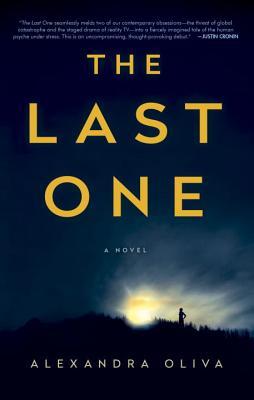
The Last One is a post-apocalyptic dystopian thriller about the world in shambles. There’s also a big-budget nationally televised survival reality show, with almost no lead time between filming and airing, starring twelve competitors. Only one of them can win. I can’t tell you how impressed I am that this is Oliva’s debut effort. She’s taken an incredibly unique idea and executed it in a very ingenious and ambitious way—and I think that boldness paid off in spades. I would definitely recommend The Last One to readers looking for a thought-provoking and eye-opening novel, especially if you like the idea of a very different kind of apocalyptic dystopian story. (Read my full review…)
 The Summer Dragon by Todd Lockwood
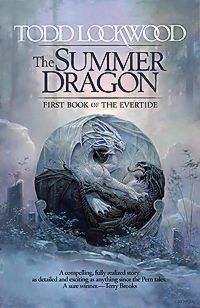
Todd Lockwood is one talented guy. Not only is he a professional illustrator and a painter of beautiful dragons, with his art gracing a number of science fiction and fantasy covers, apparently he’s one hell of an author too. For years I’ve been an admirer of his work as an artist, so when it was announced that DAW was going to be publishing his debut novel my interest was immediately piqued, especially when I found out that his book is about—what else?—dragons! If you enjoy fantasy and adventure and dragons, you definitely won’t want to miss this. (Read my full review…)
 The Wolf Road by Beth Lewis

I didn’t really know what I was getting into when I started The Wolf Road, but once it started going I couldn’t stop! And to be honest, I’m surprised more attention hasn’t been given to the book’s “Western” vibe, as that really deserves to be front and center. Out of the novel’s many strengths, its harsh and gritty frontier-like atmosphere was what really stood out—a definite plus for me, considering there’s certainly no shortage of post-apocalyptic settings in the speculative fiction arena. This is an outstanding debut, incredibly well-written and carried out with impressive finesse. (Read my full review…)
 The Facefaker’s Game by Chandler J. Birch
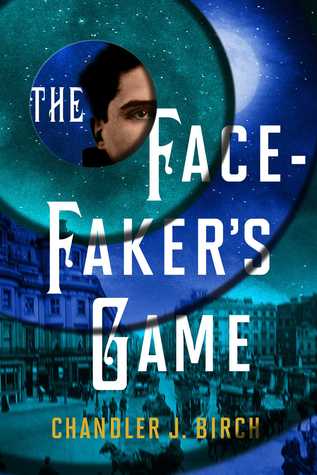
This impressive fantasy debut by Chandler J. Birch definitely did not let me down. His style is confident and easy on the eyes, making the story flow remarkably smoothly from one scene to the next. The pacing is strong and hit no lulls, making this one a relatively quick read for an adult fantasy novel that clocks in at almost five hundred pages. Birch also nails the mood of the setting, successfully portraying it as the rough, gritty, and merciless environment it is without painting it too darkly. Notwithstanding some of the grueling obstacles in our protagonist’s path, The Facefaker’s Game reads more like a fantasy adventure without the weight of cynicism dragging it down. I’m curious to see where Birch will take his characters next, and you can be sure I will be pick up his next novel. (Read my full review…)
 Roses and Rot by Kat Howard
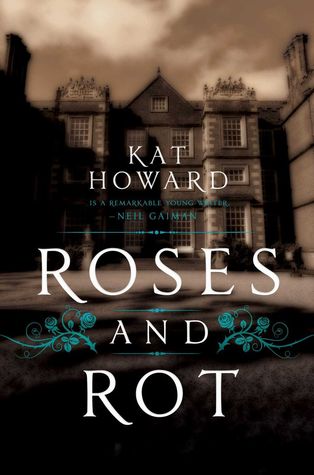
They say there’s a certain amount of truth in fairy tales. Despite their fantastical nature, the stories usually have some basis in reality, providing a moral compass during turbulent times, often teaching lessons which can be applied to one’s own life. If nothing else, the “trueness” may lie in the big picture rather than the details, such as the honesty of the character’s emotions or the essence of their relationships. Roses and Rot is a clever and emotional story of love, magic, and imagination. I loved it. I recommend Kat Howard’s debut highly, especially for creative types and lovers of all things Fae and fairy tale. A truly delightful treat for fans of contemporary fantasy who enjoy vivid settings, complex characters, and meaningful relationships. (Read my full review…)
 Admiral by Sean Danker

Admiral is part mystery and part space disaster story, with shades of Alien. The unknown is a powerful source of fear but also curiosity, which is what made this book so compelling from the start. I ended up finishing this book in a little more than a day, because when every page is filled with a sense of urgency, it’s kind of hard to stop reading. Sean Danker is a debut author whose writing career I will now be following with great excitement and interest. I could easily go on and on with my praise for this novel, but because so much of my enjoyment was from learning its secrets, it’s probably best to leave the rest a mystery for readers to discover. (Read my full review…)
 The Immortals by Jordanna Max Brodsky

In this remarkable debut fantasy novel by Jordanna Max Brodsky, Greek gods walk the earth. They’ve actually been with us since time immemorial, but with the arrival of science, technology and new forms of faith, their powers have faded throughout the ages so that the ones who still living among us are practically human, barely hanging onto their immortality. The Immortals mixes popular tropes freely and generously, but in spite of this, its greatness is diminished not one single bit. It also didn’t take much convincing to get me on board with its suspenseful mystery plot. Brodsky’s prose feels natural and elegant, infused with a hint of casual humor which made this one a rather light fare even in the face of darker themes, and as a big fan of Greek mythology, I also enjoyed her fantastic and often witty portrayals of the gods. (Read my full review…)
 Borderline by Mishell Baker

Borderline is special. Very special. It’s completely invigorating and just what I needed to rekindle my excitement for urban fantasy. All told, it was exactly what I wanted from the genre: entertaining, original, and even meaningful. The fantastic cast further highlighted this read for me. Millie Roper is an incredible character and a complex, fully-realized protagonist. Her borderline personality disorder sometimes makes her emotions volatile and her behavior unpredictable, but I also found her very genuine despite her moods and thoughts constantly swinging in different directions. I loved her unique voice and wouldn’t have wanted anyone else at the helm of this wonderful story. Everything about this debut was a delight, and I highly recommend it. (Read my full review…)
 The Last Days of Magic by Mark Tompkins

Diving into a debut novel is always a bit of a gamble, but it can also prove exciting and extremely rewarding—especially when a book ends up surprising me or blowing away all my expectations. These are the moments I live for and this is exactly what I felt with The Last Days of Magic, a breathtaking historical fantasy saga about mysticism and mythology through the ages. Mark Tompkins offers a tale that sparks the imagination and explores the multilayered relationship between truth and myth. He has also created an incredible world filled with vivid characters, capturing the complex nature of faith, love, and conflicting loyalties. A stunning, evocative debut. (Read my full review…)
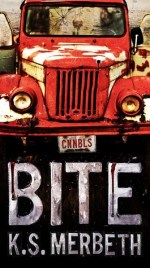 Bite by K.S. Merbeth

In this ruined world after the bombs fell, survival ain’t easy. Lack of food and lack of clean water can kill you as easily as raiders and crazies. Especially if you’re all alone. Our protagonist, known only as “Kid”, has been traveling by herself ever since her father died a few years back. On a lonely stretch of road, she finds herself weakening due to hunger and thirst, unsure if she’ll make it long enough to reach the next town where she can replenish her supplies. Desperation can make people do stupid things, she thinks to herself as she accepts a ride from two scary strangers who stop when they see her walking and offer her a ride in their truck. There was little reason for Kid to suspect that her chance meeting with the two of them would lead to an insane journey of many wild and bloody adventures. Bite does a fine job obliterating the lines between the “good” and “bad” guys, painting our main characters as the unlikely heroes of this fun and gory tale. (Read my full review…)
#SPFBO Book Review: Outpost by F.T. McKinstry
Posted on December 26, 2016 7 Comments

Phase 2 of The Self-Published Fantasy Blog-Off 2016 is officially underway! For the six-month period from November 1, 2016 to the end of May 2017, we will be reviewing the ten finalists chosen by the blogger judges from the first phase of the competition. For full details and the list of books, see our SPFBO 2016 page.

Mogsy’s Rating: 3 of 5 stars
Genre: Fantasy
Series: Book 1 of The Fylking
Publisher: F.T. McKinstry
Length: 370 pages
Author Information: Website | Twitter
There’s a lot to say about Outpost by F.T. McKinstry. Rich in detail and beautifully written, the book features incredible world-building, taking place in a fantasy setting that breaks the bounds of expectations. The cultures and concepts and creatures portrayed in this novel are also brought to life so vividly that they practically leap off the pages. That said though, if you’re looking for a story that grabs you right away, this one might not be for you; there are many things going on beneath the surface, and McKinstry arguably takes a slow-burn, tantalizing approach in drawing out its mysteries. It’s therefore a book that might require a fair bit of patience, but could be worth it.
Outpost introduces us to the world of Math, an epic fantasy realm steeped in both political and military conflict. Complicating the situation is the presence of unseen immortal warrior creatures called the Fylking, said to have originated from another dimension by coming through an ancient portal. The Fylking themselves are fighting a war with an enemy called the Niflsekt, using Math as a strategic outpost after training a select group of human seers as Wardens to guard the interdimensional gate that leads back to their home world. Wardens also have the ability to see the Fylking, who may take on the avatars of animals when they need to communicate, but generally they are invisible to the rest of the population. After two centuries though, human seers are disappearing, and without the eyes and ears of their helpful Wardens, the Fylking are threatened with the possibility of continuing their war blind.
The story follows three POVs. First is Othin, a Ranger sworn to protect the people of Math. A fierce fighter and a free spirit, he patrols across the land, guarding travel routes and enforcing peace in towns. His fellow Rangers respect and look up to him, and he also receives no small amount of attention from the smitten ladies wherever he goes. Othin’s heart, however, already belongs to a young woman named Melisande. Millie, as she is called, possesses a special kind of gift called Pattern Sense – a type of magic they say is touched by the gods. To the people who live in Millie’s village though, that kind of power is difficult to understand, and she becomes ostracized, distrusted, and labeled a witch. Finally, there’s the seer Arcmael, the disavowed oldest son of a prominent lord. Little did he know, being banished from his home would lead him on the path of becoming a Warden, trained by the Fylking and tasked to guard their gateway, even though Arcmael has sworn never again to take up the sword.
It probably comes as no surprise, one of the most alluring aspects of Outpost was the world of Math. This is high fantasy with a heavy emphasis on lore, highlighting the sense of age and intensity. This is, after all, a story involving a race of beings who have been around for a long, long time. They have changed the face of the world and influenced the culture of its people. Admittedly it’s a lot to take in, but the world-building being far more interesting than most, getting the hang of it was a lot easier than I expected. It might also help to check out the glossary in the back to familiarize yourself with the many names of places, people, and terms before you start, which would make the avalanche of information a little less overwhelming.
I guess in a way, the author’s love for detail can also be considered a double-edged sword. McKinstry writes gorgeously, but despite the excellent prose and the novel’s great setting, her style can take some getting used to. I mentioned the rich level of detail, but at times the overburden of information can come at the cost of potential confusion, as well as plot pacing. I confess I found the story to be on the slower side, and if you have a busy schedule that limits your reading time to short bursts here and there (like it did in my case), it’ll take a lot more motivation to pick up the book again and to keep pressing on.
I also enjoyed the characters, but did not take to them all equally. My favorite was perhaps Othin, whose “classic hero” persona belies a more complicated spirit beneath. He may come across a bold, somewhat rash fighter who works hard but plays harder, if his tavern habits are any indication. The truth is though, he’s a real softie. I liked this mellower, more romantic side of him—which might actually explain my eventual disappointment in Melisande’s character. So much of Othin’s motivations were bound up in his love for her, but I had a hard time feeling it, especially with his initial dismissal of their courtship as casual. They shared very little page time together too, which didn’t help. I also wished Millie had a more active role in the story, especially since her Pattern Sense is so interesting. My least favorite character was Arcmael, however, whose chapters were the toughest to get through, which is ironic considering how much I enjoyed reading about the Fylking (as a Warden, Arcmael’s POV gave us the most information about them). I think most of my problems with his character stem from the fact that we don’t get to know the truth of his origins until closer to the end of the book, and so many of his early motivations are hard to understand.
Despite my issues though, I definitely enjoyed Outpost. To sum up, it’s a solid self-pubbed novel. McKinstry can write, and she has the imaginative vision to create this incredible, fascinating world to stoke the envy of fantasy writers everywhere. To truly grab me though, the story could have used some streamlining to improve the pacing, and the characters probably needed more impetus. But overall, I had a good time.

Rating: 6/10
YA Weekend: Steeplejack by A.J. Hartley
Posted on December 25, 2016 12 Comments

I received a review copy from the publisher. This does not affect the contents of my review and all opinions are my own.
Mogsy’s Rating: 4 of 5 stars
Genre: Fantasy, Young Adult
Series: Book 1 of Alternative Detective
Publisher: Tor Teen (June 14, 2016)
Length: 336 pages
Author Information: Website | Twitter
A.J. Hartley sure knows how to open a book with style. A public national and historical treasure of Bar-Selehm called the Beacon is stolen, and our protagonist, seventeen-year-old Anglet Sutonga, finds one of her fellow steeplejacks murdered hours before she finds herself becoming the guardian of her sister’s newborn infant—all in the same night.
Ang knows she’s in way over her head. And to make matters worse, she soon loses her job and becomes a target for her former boss. Which is why when politician Josiah Willinghouse gets in touch with her and offers a business proposal, Ang is inclined to hear him out.
Turns out, what Willinghouse is looking for is something Ang would like to know for herself as well. As news of the stolen Beacon continues to dominate the headlines, everyone seems to have forgotten about Berrit, the steeplejack who was murdered, and who happened to have been Ang’s new apprentice she was supposed to train. Knowing that she owes it to the boy to find out what really happened, Ang agrees to help Willinghouse investigate the death, using her many skills and contacts to shake out the truth.
One of the greatest things about Steeplejack is the world-building, and we’re talking about the full package. The setting is Bar-Selehm, a fictional city inspired by the history of South Africa, peppered with a fantasy flavor including some steampunk elements. I could have stayed forever in this story’s world. The society is mostly made up of a white colonist population and an indigenous black population, while Ang’s people, the Lani, are a third cultural group who live on the margins. The Lani have their own long history and keep many of their traditional customs, one of them pertaining to the number of daughters in a family. It is said that a first one is a blessing, the second a trial, and third is a curse.
Ang, being a third daughter, has had to live with some of that stigma her whole life. That said, she has not allowed this to dampen her independent spirit or strength of character. Being seen as a “curse” has also influenced her perspective on many matters, especially when it comes to family. Her experiences are what led to her sympathies and compassion for her sister’s fourth daughter, who would have been discarded and doomed to a harsh life in an orphanage had Ang not stepped in to take care of her—though that fateful decision will later on result in many heart-wrenching and emotional moments. Our protagonist is also proud to be a steeplejack, the name given to the nimble young workers who brave the heights to repair the city’s many chimneys, towers, and spires. At seventeen, she’s already one of the older ones, and a female to boot. In a city that rife with racial tensions, Ang’s background also factors into her unique role of steeplejack-turned-private investigator once she agrees to take on Willinghouse’s assignment.
Which brings us to the book’s overarching plot. There are two big questions here: 1) who killed Berrit, and 2) who stole the Beacon? It will probably come to no surprise that these two threads are connected, though Hartley saves all the shockers and best bombshells for the wild, twisted journey to get down to the bottom of this mystery. I also loved how Ang’s investigation involved a cast of vibrnat supporting characters, especially with Josiah Willinghouse’s snobby yet outrageously entertaining younger sister Dahria stealing the show.
All told, Steeplejack is an entertaining and fast-paced action-oriented story with a compelling mystery, which made it very quick read overall. The world-building was what impressed me the most though, along with a cast of engaging characters. Anglet Sutonga is an admirable though flawed protagonist who will nonetheless win over the hearts of readers no matter where they fall on the Young Adult to Adult spectrum, and same goes for the story which can be enjoyed by wide audience. This isn’t your typical YA, and that why I had such a great time with it. I understand sequel is on the horizon already, and I will most certainly be reading Firebrand for more of Ang’s adventures in Bar-Selehm.


 The BiblioSanctum