Book Review: Steel Gods by Richard Swan
I received a review copy from the publisher. This does not affect the contents of my review and all opinions are my own.
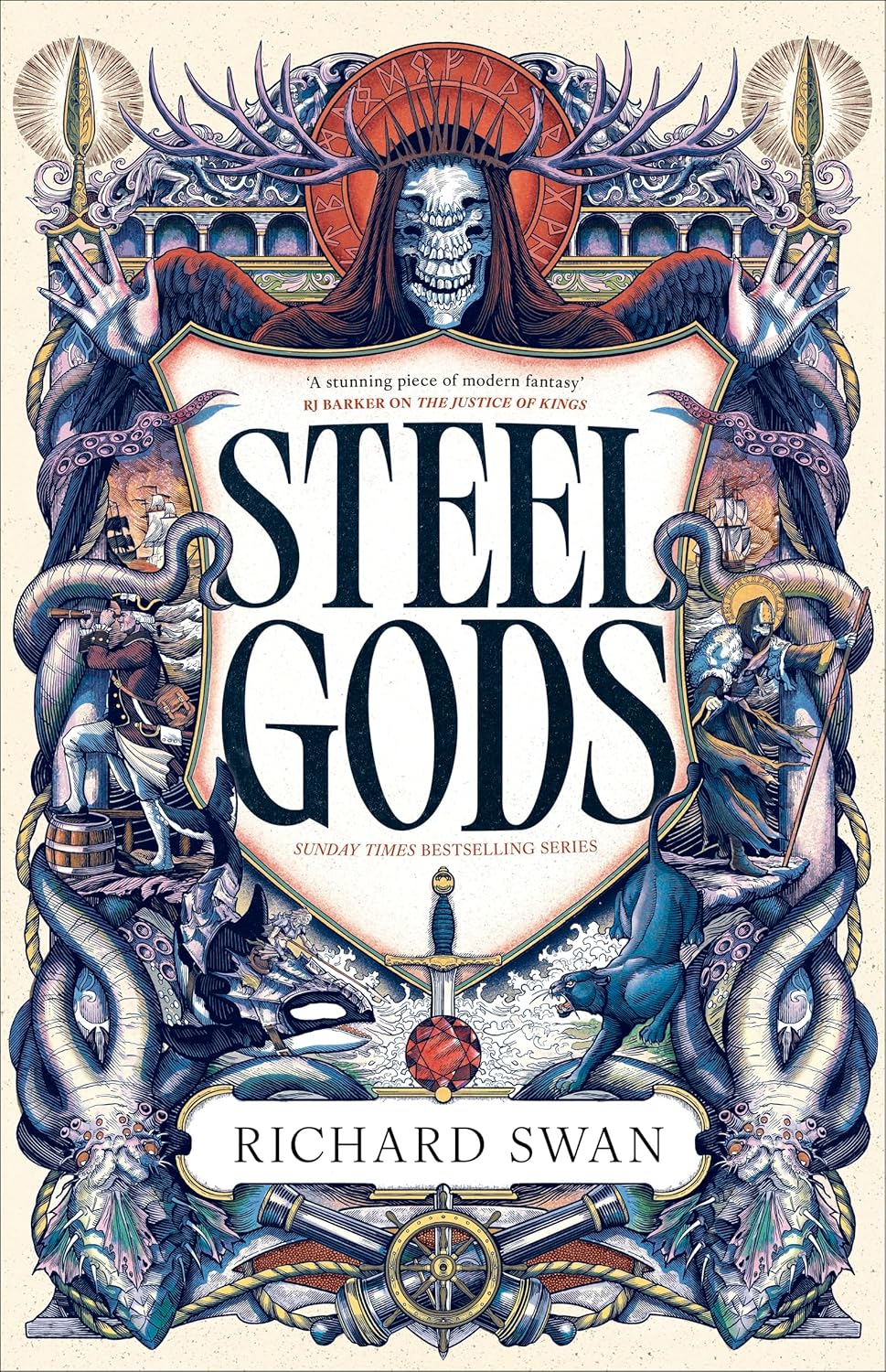
Mogsy’s Rating: 2 of 5 stars
Genre: Fantasy
Series: Book 2 of The Great Silence
Publisher: Orbit (March 31, 2026)
Length: 448 pages
Author Information: Website
This review is probably going to be full of unpopular opinions, but the thing is, I don’t get it either. In recent years, I have become a big fan of Richard Swan, I also absolutely loved the first book of this series, and yet, Steel Gods ended up being a huge disappointment. While I devoured Grave Empire effortlessly, I spent most of this second novel struggling to stay interested and wondering when it was finally going to click, forcing myself to keep going because I genuinely believed it would eventually get better. Just stick with it, I told myself, and when you’re done, you’ll be glad you can roll straight into book three. But heck, by the end, I honestly wasn’t even sure I wanted to continue the series at all.
Picking up after the events of the previous novel, the world of The Great Silence continues devolving into more chaos as the boundaries between the mortal realm and the afterlife begin to break down. The big baddies, the Vorr, which are horrifying interdimensional beings that fed on souls, have breached the land of the dead and invaded the world of the living. Their influence spreads through the empire like a plague, inflicting mind rot upon their victims, turning them into soulless, hollowed-out husks like zombies.
But instead of working together to try to stop the infection, those with power begin looking for ways to exploit it. Among them is Count Lamprecht von Oldenburg, who uses thaumaturgy to turn the mindless horde into his own personal army. He’s also batshit insane. Meanwhile, Ambassador Renata Rainer is continuing her diplomatic mission, traveling to the heart of enemy territory in the hopes of recruiting new allies. Lieutenant Peter Kleist, on the other hand, has managed to survive the treacherous wilds, despite his youth and lack of experience being constantly tested along the way. Now he finds himself back in the haunted wilderness, compelled by the need for answers, even as the weight of everything he has already endured begins to catch up with him. Across the wider series arc, the story continues to unfold through multiple POVs scattered around a rapidly destabilizing world, each trying to prevent it from slipping into total collapse.
This sequel should have been a slam dunk, but what surprised me most was how different this book felt compared to Grave Empire. Same world, same continuity, many of the same characters, and yet for me, the energy was completely off. For one, the focus of the first book was much tighter, whereas this one felt sprawling in a way that diluted a lot of what originally hooked me. The character perspectives are diverging once more, introducing more threads but also more distance. It gave the book a disconnected quality, like everyone was wandering through separate stories instead of participating in the same one.
The pacing also dragged for me. Oh boy, did it really drag. Looking back, quite a lot actually happens, but very little of it feels impactful in the moment. Any reveals arrive with surprisingly little weight behind them, or maybe it was just my bored state of mind making major developments seem like they fizzled rather than explode. Entire sections feel bogged down in exposition without much payoff. Chapters would go by where I realized I had been reading for quite some time without feeling any real momentum carrying me forward. Honestly, if the first book hadn’t been so good, making me feel invested in this series, I probably would have DNFed this before the halfway mark.
Part of the issue may simply be that this installment feels much more transitional. It spends a lot of time repositioning the characters, which might explain why they didn’t work nearly as well for me this time around. Here, a lot of them felt strangely flattened or pushed aside in favor of laying down groundwork for future events, leading to less balance and more confusion. I’d thought I had a strong grasp of the characters’ motivations, but after this book, I don’t feel as confident anymore. Not because they suddenly changed, but because much of the book feels emotionally flat and they don’t really develop in particularly exciting ways.
To be fair, Swan still writes well on a technical level. The prose is polished, and the world-building is detailed. Here and there are flashes of genius like the political complexity or the grim atmosphere that reminded me why I loved the first book. But ultimately this sequel just never came alive for me. Whatever momentum Grave Empire had going for it, I simply didn’t feel it here.
In the end, if I had to boil it all down to one thing, I’d say that Steel Gods has a pretty serious case of middle book syndrome. The series began with a much stronger sense of tension and direction, so I know what it’s capable of, but this installment never really comes close to reaching those same heights. I’m now on the fence about whether I’ll continue with the series, but I suppose time will tell.


More on The BiblioSanctum:
Review of Grave Empire (Book 1)


I’m sorry that this one didn’t work for you. I totally agree about the increased separation between the characters leading to a feeling of disassociation.
LikeLike
Definitely a very different review than your one for the first book.
Good luck deciding if you want to chance Book 3 or not. I don’t envy you that.
LikeLike
Ooof, sucks when a book is such a disappointment.
LikeLike
Dang, some serious middle book syndrome going on here
LikeLike
Pingback: Ebook Evaluation: Metal Gods by Richard Swan - The Home of WEBFILMBOOKS
Oh no im so sorry to see that this one was such a major letdown. Its especially disheartening when an anticipated sequel ends up letting you down in such a way. I can see how the distance between characters could make it harder to connect. Ive oddly loved books with that element in play but I know I’ve seen other reviews for those same books saying that aspect made it tricky for them. I hope the next one hits much harder if you do decide to carry on with it.
LikeLike
Ouch! But that reminds me of my reaction with The Strenght of a few after having adored The Will of the many!
LikeLike
I haven’t started reading this series yet, but it’s interesting how your review of this book differs from many others who has read it. Your review is a stark reminder that not everyone is going to feel the same way about the same book; and, that’s okay.
LikeLike
What a shame this sequel didn’t deliver! That said, the old saying that the second book is far harder to write than the first tends to hold true – especially when writing a series. And especially if the author isn’t all that experienced. That said, shame on the editor for not sorting out the pacing and narrative tension.
LikeLike
Yes, I feel you. I read almost 50% of this and then put it down and to date I haven’t had the inclination to pick it back up – and your review makes me feel relieved not to have pushed myself. Obviously though, I need to make a choice about whether to continue with the series – in which case I need to get back to Steel Gods. We’ll see.
Lynn 😀
LikeLike