An Artificial Night Read-Along Week No.2
Posted on April 16, 2016 8 Comments

We’re journeying through the third book in the October Daye series. If you’re interested in joining this Read-Along, visit the SF/F Read-Along group for more information and to join the discussion.
“October “Toby” Daye is a changeling-half human and half fae-and the only one who has earned knighthood. Now she must take on a nightmarish new challenge. Someone is stealing the children of the fae as well as mortal children, and all signs point to Blind Michael. Toby has no choice but to track the villain down-even when there are only three magical roads by which to reach Blind Michael’s realm, home of the Wild Hunt-and no road may be taken more than once. If Toby cannot escape with the children, she will fall prey to the Wild Hunt and Blind Michael’s inescapable power.”



Week 1: Saturday 9th April, Chapters 1-7, hosted by Over The Effing Rainbow
Week 2: Saturday 16th April, Chapters 8-17, hosted by Books By Proxy
Week 3: Saturday 23rd April, Chapters 18-24, hosted by Lynn’s Book Blog
Week 4: Saturday 30th April, Chapters 25-End, hosted by Over The Effing Rainbow

1. Toby makes her journey to Blind Michael’s realm with the aid of the Luidaeg – who is back and on form and has, as yet, decided to hold off on killing Toby. What did you think of Toby’s journey by candlelight and her first encounter with the Wild Hunt? What do you think this favour is going to cost her with the Luidaeg?
I found Toby’s journey really fascinating, and I was just as surprised as she was when she realized that she’d been transformed into a child. The whole angle with Blind Michael and everything being basically a children’s game to him is such an interesting spin on The Wild Hunt.
2. As a prisoner of Blind Michael, Toby encounters a disturbing number of altered and transformed children and, assisted by Quentin, discovers the children who are yet to be toyed with. What were your thoughts when Toby discovered these child monsters and other detainees? Do you think there is any hope for them? And what did you make of Quentin’s bargain with the Luidaeg?
To be honest, Toby’s encounter with the children was more horrifying that I thought it would be. Up to this point, I knew that Blind Michael altered the children in some way, but I hadn’t really been expecting just how horrifying they’d become in his care. I want to take the warning and think that maybe the children can’t be saved who have been with Michael for some time. At the same time, though, I hope they can be saved. I feel like if they can be saved that maybe they could be blessed with some semblance of a normal life with the help of the community. Children are resilient if nothing else, and while it would take some time, I think they could be okay… if they can even be saved at this point.
Quentin’s bargain with the Luidaeg struck me as very simple, too simple even. I mean, i know he said he has nothing else to give, but it sounds like she was bending her own rules in her own way to give Toby the help that she needed while in Blind Michael’s knowe. I feel like telling Toby not to turn around wasn’t so much to protect Toby from something more than it was to allow Quentin to not be caught. I don’t know if she could have truly known that Quentin was with Toby, but that seems to make the most sense for telling her to not look back.
3. In spectacular style, Toby swoops in and relieves Blind Michael of his prisoners and vows to put an end to his evil ways. How do you think Blind Michael will react when he discovers Toby and the children are missing? What do you think Toby will do for those she left behind?
Toby didn’t play by the rules, and I don’t think he’ll forget that. As it’s mentioned over and over again in this section, children believe in fairness and not much about what’s right. He seems to have a way of hunting Karen in her dreams, so I’m going to assume that since he doesn’t leave his knowe except for once every hundred years, that he’s going to use that against her in some way. And who knows… maybe he will outright hunt her himself. Then again, knowing Toby, she’ll make herself easily accessible by trying to go back. I really do think she will find a way to help the other children, so he might only have to wait her out until she’s back on his lands.
4. Whilst straying into the forests within Blind Michael’s realm, Toby encounters Acacia whose revelations regarding Blind Michael and her own daughter are nothing short of astounding. Were you expecting this? What were your thoughts and reactions?!! How does this change your view of the characters involved?
I really wasn’t expecting to hear that Luna isn’t actually a kitsune or that she was a daughter of one of the firstborn. That opens up a whole host of other questions including how and why Luna’s taking that form. Does it have something to do with the kitsune that Toby keeps seeing in her dreams about Karen? What transpired to make her leave (aside from wanting to grow roses)? What is her relationship with Acacia like? That is a pretty big secret to hide all these years, and I really want to hear an explanation. It also would explain why Luna was acting stranger than normal given them circumstances. I wonder if she worried that Toby would find out her connection to Acacia. Also, does this mean that Lily knows about Luna’s heritage? She directed Toby toward her. At first, it seemed a bit strange that she did and a bit strange that Luna had all this information. Sylvester’s reaction made sense now in context as well.
5. Toby seems to have escaped Blind Michael’s clutches – for now! – and is currently enjoying the company of her Fetch, May. What do you expect will happen from here? Do you expect her to pursue Blind Michael to the end? And what are your thoughts on Toby’s sentient portent of death and its implications for her future?
I do expect her to try to get the children back because that’s what Toby does. She is noble–some might call it stupid–in that way. I can’t say that I blame her. There’s something about the innocence of children that makes you want to rescue them. Other than that, I’m not sure. Obviously, she’s not going to die or if she does, she’s going to come back some kind of way or face near death (more than usual) maybe? We’ll see where this goes!

Cruelty always came easier to the children of Titania; the only survivors of Maeve’s line are the ones who let themselves learn how to become monsters. Titania’s children are cold and hard and beautiful. Maeve’s children are hot and strange and come in every shape imaginable. Oberon doesn’t claim most of his descendants, leaving them to the mercies of their mothers. Those few races that he does claim . . . those are Oberon’s children. And Oberon’s children are heroes.
* * *
Sometimes I think the Luidaeg never ends a conversation; she just puts them on hold until you come back into range.
* * *
“Children’s games are stronger than you remember once you’ve grown up and left them behind. They’re always fair, and never kind. Remember.”
* * *
Children don’t care about good or evil; all that matters is that you play fair and follow the rules.
* * *
There’s nothing more stubborn than youth, with the possible exception of old age.

This book gets 37894783 million points for using my favorite Shakespeare quotes from A Midsummer Night’s Dream! “If we shadows have offended…”
Rosemary and Rue by Seanan McGuire (October Daye #1)
Rosemary and Rue Read-Along Week No.1
Rosemary and Rue Read-Along Week No.2
Rosemary and Rue Read-Along Week No.3
Rosemary and Rue Read-Along Week No.4
A Local Habitation by Seanan McGuire (October Daye #2)
A Local Habitation Read-Along Week No.1
A Local Habitation Read-Along Week No.2
A Local Habitation Read-Along Week No.3
A Local Habitation Read-Along Week No.4
An Artificial Light By Seanan McGuire (October Daye #3)
An Artificial Light Reader-Along Week No. 1

Audiobook Review: Salvage Merc One by Jake Bible
Posted on April 16, 2016 6 Comments
 Genre: Science Fiction, Military Science Fiction
Publisher: Severed Press (January 17, 2016)
Information: Website | Twitter | Goodreads
Tiara’s Rating: 3.5 stars of 5 stars
A review copy of this book was provided by the author, narrator, or publisher in exchange for an honest review. All opinions expressed are my own.
Narrator: Andrew B. Wehrlen | Length: 6 hrs and 56 mins | Audiobook Publisher: Jake Bible Fiction (March 11, 2016) | Whispersync Ready: Yes
Joe Laribeau is an ex-Marine sergeant who was discharged after losing both his legs. His legs are replaced with battle legs (metal legs that allow him to run pretty swiftly and hold up well), but the military still feels that he’s too expensive an asset to keep and discharge him despite his “battle clarity” which is kind of like a self-contained, discount version of Jedi Battle Meditation. Joe starts collecting a pension and roves the galaxy for a while before being recruited by Salvage Merc Eight, Hopsheer Balai, for the Salvage Merc Corp. The SMC was created to fill a void in the galaxy. They’re a neutral entity that came into its own during the height of a galaxy wide war between the Galactic Fleet–which I think is a military conglomerate of like-minded aliens–and a warlike alien species known as the Skrang.
The SMC salvages important technology, supplies, and people (among other things) while doing retrieval mission and obtaining information that may be valuable to others. Being neutral means they give both sides a fair chance at obtaining some of the things they salvage by auctioning them off to the highest bidder. They also try to maintain fairness by not allowing one side to get more powerful than the other and acting in the interest of non-aggressive planets. Following an attack that Joe survives, he’s tasked with finding the merc to rule all mercs–Salvage Merc One.
To say that this book didn’t get go where I was expecting at all would be an understatement. Okay, that’s not exactly true. As far as space-faring mercenary stories go, this one did follow the basic formula. However, based on the synopsis, I expected a more serious tone than what the story actually gave me. This was largely a humorous story that brimmed with action and a little intrigue. Joe was a funny, endearing character, and it was an excellent decision to tell this story from his POV as it makes it very easy to connect with Joe. Narrating Joe’s story is Andrew B. Wehrlen, and he was a great choice for this book. He does an admirable job of capturing the humor of the story and Joe’s personality. He managed to find distinctive voices for most of the characters, and I thought he did a fair job on the female voices which can be a little hit or miss with me where male narrators are concerned.
The supporting cast of characters aren’t as fleshed out as Joe aside from maybe Joe’s partner who is described as a mix between an armored beetle and a Great Dane and tends to spout random facts. Regardless, Bible introduces us to many new races in this story, and while we learn a little about some of their physical characteristics, we don’t learn much about them beyond that. Given that this book is supposed to be a fast-paced military merc story, I don’t think these characters suffer from not being explored as the action is the driving force behind this book, and it doesn’t fail to entertain.
There are a few portions of the story that left me a little foggy. One very big instance is when a story that is being told to Joe, but readers are never actually told the story. It’s skimmed over, and all I know is that it involves a questionable death. Beyond that, there’s no revelation or consideration for the reader even though it leaves Joe speechless. Then, there’s the ending. I have mixed feelings about it. It sort of dived over into the science-fantasy genre for a bit there, which I love, but I don’t know if that was exactly the best ending for a book of this nature. It felt too whimsical, a little too overpowered for this, even with the considerations made for the story.
I enjoy military science fiction, but I don’t get to read it as much as I’d like. This definitely appealed to that part of me that enjoys stories in this setting. This sets up an interesting universe for a series (I’m assuming this will be a series), but works well as a standalone book. Now, if you excuse me, there is some Mass Effect calling my name after reading this. Time to go save a galaxy!
Story

Performance

Overall
Book Review: Saint’s Blood by Sebastien de Castell
Posted on April 15, 2016 21 Comments
***Welcome to the final stop of the Saint’s Blood blog tour, and I hope you’ll enjoy my review! Be sure to also check the other hosts’ thoughts on the book, and head on down to the end of this post for info and links to join in on the big competition sponsored by Jo Fletcher Books!***


A review copy was provided by the publisher in exchange for an honest review. All opinions are my own.
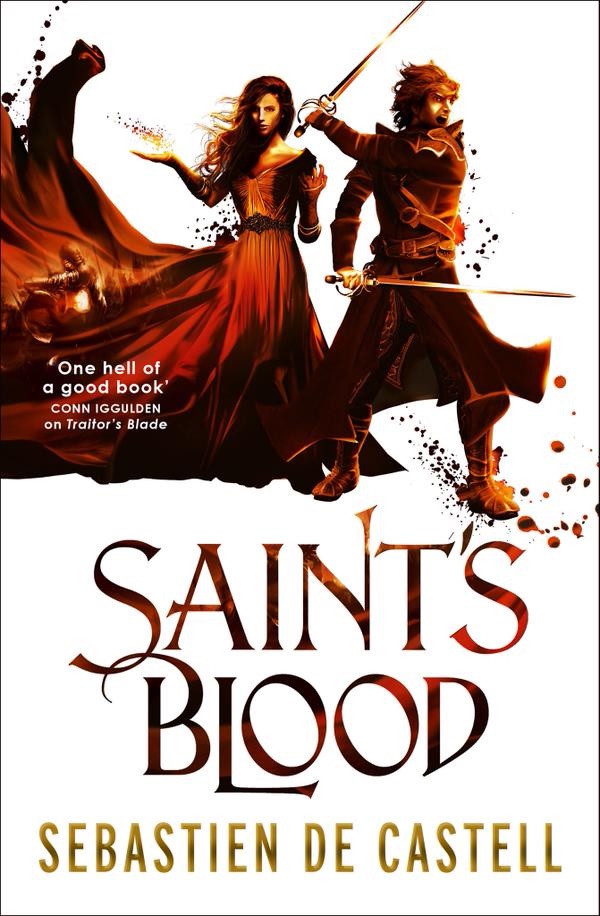 Saint’s Blood by Sebastien de Castell
Mogsy’s Rating: 5 of 5 stars
Genre: Fantasy
Series: Book 3 of The Greatcoats
Publisher: Jo Fletcher (UK: April 7, 2016)
Length: 576 pages
Author Information: Website | Twitter
Damn it, Sebastien de Castell, keep this up and you’ll end up giving all your readers heart attacks, because this book simply DOES NOT STOP. Practically every page is filled to the brim with swashbuckling action, edge-of-your-seat suspense, and laugh-out-loud hijinks from our magnetic hero Falcio val Mond and his loyal band of companions. In other words, this was exactly the kind of sequel I wanted! Saint’s Blood pulls out all the stops in this newest installment of the Greatcoats series, bringing all our favorite characters back for another round of epic excitement and adventure.
Just when you think things can’t get any worse for Falcio, Kest, and Brasti, the situation in Tristia plunges further into disaster. The country was already on the verge of tearing itself apart, with its people close to revolt and the dukes still looking for ways to depose their young queen, and nothing the Greatcoats have been doing for the last six months seems to have made any difference. Now a new threat has emerged, and whoever their shadowy enemy is, they’re targeting the Saints of Tristia. To Falcio’s horror, the first victim they find is none other than Birgid the Saint of Mercy. Weakened and dying, all her powers seem to have been negated by a cruel iron mask locked around her face to prevent her from fighting back against her attackers.
On top of the murdered Saints, rumors are also spreading through the countryside that the Gods themselves are displeased with the way things are going in Tristia, further undermining Aline’s claim to the throne. Churches and religious sanctuaries are being desecrated everywhere and thousands of pilgrims are pouring into the capital campaigning for their faith, leading to the return of the Inquisitors, a holy order of warriors charged to enforce the Gods’ Laws. Unfortunately, the Greatcoats and the Inquisitors don’t see eye-to-eye on a lot of matters. Whoever is orchestrating all these events—which are too well-timed to be coincidental—seems bent on bringing back the conditions to turn the country back into a theocracy, which would undo everything the late King Paelis had worked so hard to accomplish.
Well, you can bet Falcio’s not about to let that happen. And while his quest to bring the King’s Laws back to Tristia may seem more hopeless now than ever before, he’s got his old friends to count on to help him out, not to mention a new ally or two to keep things fresh (five words: I love you, Quentis Maren!) As always, I adore the usual suspects, starting with the down-to-earth Kest and the hilarious Brasti, Falcio’s two best friends. Our terrific trio maintains the heart of this series, fueling the novel’s energy and running jokes. Then there’s the fantastic cast of female characters. Though Aline, Valiana, and Darriana all have smaller roles in this book, Ethalia gets to step up and become a force to be reckoned with. I even enjoyed witnessing the transformation of those we used to think of as villains, such as the mercurial Duke Jillard.
As you can see, the characters in these books are always growing, their relationship dynamics constantly in flux. As a character-oriented reader, I can never get enough of seeing them adapt and form new bonds. Falcio is a man who draws people into his orbit and changes them without him or any of them even noticing it, but he also has a major blind spot when it comes to those closest to him. His powerful need to protect the important people in his life—especially the women, who most of the time don’t even want or require his stepping in—is something I find to be an ongoing conflict in spite of the other evolving aspects of his personality, and I hope it will resolve in time as he realizes that he need not save the world all by himself, and that his friends are definitely stronger than he thinks they are.
Story-wise, Saint’s Blood follows in much the same vein as the previous novel, but for me, there was a key difference. Looking back, I didn’t rate Knight’s Shadow as highly as the first book Traitor’s Blade because I felt the plot meandered somewhat, and perhaps didn’t flow as naturally as it could have. However, Saint’s Blood takes things back on track, hitting the ground running and never once does it stray from its course.
Moreover, the book is playing to its strengths, focusing on the type of in-your-face action and humor that first drew me to Traitor’s Blade. Granted, no one said that this series would be all sunshine and lollipops, and in fact, Falcio’s dogged tenacity in the face of dark times and overwhelming odds is what makes these novels so addictive and fun to read. But Knight’s Shadow took the darkness and hopelessness to extremes, with chapters devoted to scenes of torture and suffering, and I won’t deny that it put a major damper on things. It’s probably no surprise then, that what I appreciated most about Saint’s Blood is the fact it brings back the balance, presenting another nigh impossible challenge for the Greatcoats while still keeping the atmosphere lighthearted and adventurous. I laughed more than I did for either of the previous books, and all the funny moments and rousing fist-pumping scenes reminded me all over again why I fell in love with this series.
Needless to say, this was an incredible sequel on all levels, echoing the exciting fast-paced structure of Knight’s Shadow while bringing back the themes and vibes that made Traitor’s Blade so successful. Wildly entertaining and thoroughly intense, Saint’s Blood is the kind of book that makes you wish all epic heroic fantasy can be this awesome. This is the genre at its finest and Sebastien de Castell is to be congratulated for bringing us another fantastic installment to the Greatcoats saga. Honestly, I’m not sure how I will survive the wait for book four.



To celebrate the release of Saint’s Blood in style, Jo Fletcher Books is giving one lucky winner the chance to get their Greatcoat name in the next book in the series! See more details on the contest and how you can enter here!
More on The BiblioSanctum:
Review of Traitor’s Blade (Book 1)
Review of Knight’s Shadow (Book 2)
Book Review: Pathfinder Tales: HellKnight by Liane Merciel
Posted on April 14, 2016 12 Comments
A review copy was provided by the publisher in exchange for an honest review. All opinions are my own.
 Pathfinder Tales: Hellknight by Liane Merciel
Mogsy’s Rating: 3 of 5 stars
Genre: Fantasy
Series: Pathfinder Tales
Publisher: Tor (April 5, 2016)
Length: 432 pages
Author Information: Website
I’ve dabbled in the Pathfinder roleplaying game for a few years now, but this is actually the first time I’ve actually tried one of the books in the Pathfinder Tales series. To be honest, I don’t know what took me so long, since seeking out tie-in novels or any kind of related literature spawned by the movies, games, etc. that I enjoy is something I do quite frequently. Part of it might have to do with the fact that it’s such a HUGE world, and when it comes to what I know of Golarion (the main world of Pathfinder where most of its campaign and events take place) I’ve only begun to scratch the surface. It’s all just a bit intimidating, especially when you consider how often new volumes are being released (about every few months or so), and currently the series is sitting at more than thirty novels and that’s not even counting all the novellas and short stories. Though I was assured that the majority of the books are standalone adventures, I still felt uncertain.
Finally, I decided to simply take a chance and go for it. It helped that the book I was interested in, Pathfinder Tales: Hellknight, had an interesting premise and was written by Liane Merciel, an author whose work I’ve been wanting to check out for a while now due to the fantastic things I’ve heard about her Dragon Age novel. More importantly, I was happy to find that Hellknight is indeed a book anyone can jump into and enjoy, no matter what your familiarity is with the Pathfinder franchise. The story is really easy to pick up, and you don’t need to have any prior knowledge at all.
At its heart, this book is about a murder investigation. There’s an organization of warriors called the Hellknights who are charged with maintaining the law and order of the land, and one of them, a hellspawn woman named Jheraal, is dispatched to a nobleman’s estate to investigate the brutal murder of its heir. Meanwhile, the victim’s brother is being called back from the front lines, now that his presence is required at home. Ederras, disgraced and exiled for his part in a rebellion when he was younger, is now an experienced and battle-hardened paladin. For his part, he’s actually quite reluctant to leave his post, but what choice does he have? Now that his brother is dead, someone needs to inherit his family’s title and take care of their lands and holdings.
As Jheraal and Ederras team up to find the murderer, they uncover a deeper conspiracy leading to more death and destruction. A trail involving some missing servants leads to a gruesome find, as it appears that their serial killer has been targeting hellspawn, cutting out their hearts in a magical ritual thus leaving them in a state of lifelessness-but-not-quite-dead. The two of them end up recruiting the services of Velenne, a crafty diabolist who has a history with Ederras, and it seems she is not quite done with the paladin yet.
For a book based on an RPG, I was pleasantly surprised at how much I enjoyed Hellknight. Based on my experience with tie-in novels, I’ve found that the quality of them can vary greatly, and I admit I wasn’t expecting much from this one, but I ended being quite impressed by the high standard of storytelling. The writing is also superb. Liane Merciel does a fantastic job setting up the stage for a mystery, creating a very immersive environment at the same time. It’s the little details that make a difference, masterfully showing without telling us right out what kind of society our characters live in. It is not a very pleasant place, especially not for hellspawn, who live as second class citizens in this world, mistrusted and abused.
I also enjoyed the characters, who come into their own and set themselves apart even when they’re being obviously written to conform to RPG/fantasy archetypes. Again, I was surprised at the depth of their personalities and the complex ways they are impacted by the events of this novel. Both protagonists have interesting backstories and are haunted by their pasts, with Jheraal hiding a secret daughter and Ederras struggling to come to terms with the mistakes he made in his youth. The themes of this book are made fuller by their two tales of sacrifice.
My only criticism is that the story’s pacing is very uneven. Hellknight started off strong, but the momentum tapered off as we entered the middle section, and then plateaued until we reached the last hundred pages or so of the novel, where things fortunately started picking up again as we moved into its climactic ending and resolution. For this reason, I can’t quite justify giving this book more than a solid three stars, though overall it was very enjoyable. Its quality is easily heads and shoulders above a lot of media tie-ins out there, and despite its pacing issues I thought this was a really good story and well worth the read.
So don’t let the Pathfinder name scare you off, which is probably the key point I wanted to emphasize, because tie-in fiction can be great fun and I think most will have no trouble diving into this world and appreciating it like any other fantasy novel. I look forward to reading more by Liane Merciel, and I definitely see more Pathfinder Tales in my future.

Week 2: The Lies of Locke Lamora Read-Along
Posted on April 14, 2016 9 Comments
“Come along on an epic adventure! Flights (of fancy), accommodation (ethical) and food (for the imagination) included. Poison not guaranteed. All travel is at your own risk. Late nights, sore eyes, and an overwhelming desire to spend hours in the kitchen creating something wonderful may ensue. All belongings are the responsibility of the traveller; travel will not be reimbursed if limbs are lost to sharks, or hearts to thieves.”
You are cordially invited to join The Lies of Locke Lamora read-along. Our itinerary is as follows:
- April 7th: Prologue and Book 1 – hosted by Imyril at X+1
- April 14th: Book 2, Ch4-6 – hosted by Imyril at X+1
- April 21st: Book 2, Ch7-8 – hosted by Wendy at The Bibliosanctum
- April 28th: Book 4 and Epilogue – hosted by Lisa at Over the Effing Rainbow
1) Last week we saw the Capa in theatrical mode taking young Locke’s oath on his enchanted shark’s tooth. This week we see the former scholar carving up the surviving Full Crowns and swearing vengeance on the Grey King. What do you think of his responses to the Grey King’s assaults?
Wendy: His response is most certainly understandable. Considering the epic long con he initiated to take up this role in the first place, he knows exactly what is at stake and has every right to be afraid. His paranoia is justified, but it has moved him beyond reason and he is showing weakness in trying to keep himself and his family safe, as everyone else around him seems to be aware. It was frustrating to read the scenes with him torturing the member’s of Tesso’s gang when they obviously didn’t know what happened. But my frustration comes from knowing that there are ways to delete memories, or drugs that can make you lose time. Alchemy and magic are known to exist, but do people like Capa Barsavi know what those things can truly do?
Tiara: The Capa is paranoid, but I guess anyone would be. In our reading last week, the Grey King didn’t even seem to register on anyone’s–or well, at least the Gentlemen Bastards’–radar. In the Bastards view, the Grey King seemed… I don’t want to say harmless, but he was mostly a non-issue to them despite the fact that there seemed to be some stirrings. However, it seems that the Grey King has been ruffling feathers more than they thought, and it’s now starting to spill over into their business as shown with the Capa. I felt a little perplexed like Locke as I was reading the section where Nazca was trying to explain to Locke just how far gone her father was since the reader is only learning as Locke is learning. Macbeth came to mind as I was reading the Capa’s paranoid ramblings. It was like listening to a Macbeth rant. Also, nothing summed up my current (this could change) thoughts better than these lines from Macbeth:“Double, double toil and trouble. Fire burn and cauldron bubble […] By the pricking of my thumbs, something wicked this way comes. “ Let’s see what that something is.
2) We get our first glimpse of magic this week. What do you make of the Bondsmagi (and especially of the Falconer and Vestris)?
Wendy: My immediate thought was of the Technomages in Babylon 5 whom I have just recently met in my first time watch of the series. Alchemy permeates this world, as well as ‘alien’ architecture. I get the sense that there is a lot that the vast majority don’t know about these things and those in the know could be using that ignorance to their advantage. Basically, at the moment, I believe that the Grey King and the Bondmagi are masters of sleight of hand, alchemy, and illusion. If you look too closely, you might spot the man behind the curtain, but because their reputation is so solidly steeped in blood and fear, no one is going to be looking at anything except the direction they are running, which would hopefully be far, far away.
Tiara: First, let me say how much I LOL’d at the memory of Chains telling Locke to be deferential to a Bondsmage if he should ever come face to face to one, and the first thing Locke says to the first Bondsmage he meets (in the present day) is: “Nice bird, asshole.” Then, when I think it couldn’t get worse, he follows up with, “So eat hemp and shit rope, Bondsmage.” Oh my God, Locke, can you not? I mean, I felt pretty impressed with the gall because fuck that guy that’s why, but Locke, no! I don’t like this the Falconer or his damned bird right now. So, no matter how much I typically tend to like (and be impressed by) mages because magic, I reserve my right to be a petty bitch right now. I mean, Kanye West level petty. I’m with Bug on this one. Let’s get to poisoning fools. Yeah, I can go from Shakespeare to petty in less that five seconds flat.
3) The Gentleman Bastards make plans for a hasty exit, but resist the urge to drop everything and go, because reasons. Seemingly entirely reasonable reasons. Do you think our boys are right to stay?
Wendy: Locke seems to have learned his lessons well from Chains and others and understands that in this case, the cut and run might buy time for the moment, but he’s become very good at looking at the consequences such actions will bring upon himself and the others. He’s even factored in the need to continue with the current con they are working on — not just because they want more money (well they do, but not out of need), but because he wants to ensure a solid conclusion to this job. It might seem silly to stay when the situation is so volatile, more so when the Grey King actually pulls Locke into it in the most unexpected way, but the result of running away would leave Locke in ignorance of what is going on, and I don’t get the feeling the Locke deals well when he can’t analyze all the bits and pieces of the puzzle to determine how to make those pieces work for the Gentlemen Bastards.
Tiara: I come from the Master Shake Aqua Teen Hunger Force School of Philosophy when it comes to things like this:
“Master Shake: I’m goin’ to Mexico, until all this bill business chills out.”
Except replace “bills” with this undesired scenario. Any undesired scenarios. All the undesired scenarios. However, there wouldn’t be much of a story if they ran. I can’t decide if I think they’re smart or foolish not to run. I feel like they’re being pretty foolish, but at least there are some half-assed contingencies in place if things don’t go as planned. I’m sure things aren’t going to go as planned. Why would they?
4) We’ve now seen a lot more Eldren architecture, including the spectacular rooftop ‘rose garden’ Don Maranzalla trains his students in. Do you think the Elderglass is a creation of magic, science or something else entirely?
Wendy: It seems to me that the Eldren understood science well enough to make things like appear magical to those who don’t understand the intricacies of such construction.
Tiara: Right now, I don’t know what I think about it. It could be some amalgam of both. I feel like, at this point, it’s one of those unexplained things that we may or may not find the origin of in the long run.
Book Review: Sawbones by Melissa Lenhardt
Posted on April 13, 2016 28 Comments
A review copy was provided by the publisher in exchange for an honest review. All opinions are my own.

Mogsy’s Rating: 4.5 of 5 stars
Genre: Historical Fiction
Series: Book 1 of Sawbones
Publisher: Redhook (March 29, 2016)
Length: 358 pages
Author Information: Website | Twitter
Sawbones was a book that caught my eye the moment I saw it, because HELLO! Western setting? An independent, determined woman doctor as its protagonist? Only problem was, its genre was straight-up historical fiction without even the ittiest bittiest hint of a speculative element, and I was already being crushed under the weight of review books that I’ve committed myself to on behalf of my Sci-fi & Fantasy book blog. Reluctantly, I decided to give Sawbones a pass at the time, and probably wouldn’t have thought about it again if it weren’t for a strong recommendation I received weeks later, from someone whose bookish opinions I highly respect. Now I’m on the other side of reading it to say how utterly thankful and glad I am to have given this one a try after all, because it was damn brilliant and I absolutely loved it!
The book’s blurb likens the story to “Outlander meets post-Civil War unrest” which is a comparison I find both very appropriate and also a little misleading. Like I said, Sawbones is completely devoid of any magic or sci-fi, time traveling or otherwise, but that said, I believe it would indeed appeal to fans of Diana Gabaldon’s series who might be looking for a similar blend of romance and adventure set in a very harsh time and place, whose brutal realities we are not spared from at all. It is especially hard for our protagonist Dr. Catherine Bennett, a New York woman practicing medicine in the 1870s in spite of those who regard her profession as scandalous and highly unseemly for someone of her sex.
That is why when Catherine is falsely accused of murder, she finds little support in her societal circles and is forced to go on the run with a $500 bounty on her head. And for anyone looking to start a new life or to disappear, the answer lies west. With her loyal maid Maureen in tow, Catherine escapes to Texas and joins the Warren wagon train under the new identity of Dr. Laura Elliston. Even though female doctors are rare enough to draw attention, Catherine—now Laura—loves her work too much to give it up, and hopes to start fresh with her own practice out in the uncharted territories of Colorado where no one will know her face.
But of course, things don’t go as planned. Those who already know what became of the Warren wagon train can probably guess, but if not, I’m not going to spoil the details of the plot’s early bombshell. I think up until this point, I was still expecting a whole different kind of book, but afterwards it finally hit me what I was really in for. Suffice to say, if you’re like me and picked this one up thinking it would be your typical lighthearted historical romance, you’re going to be in for a huge surprise. To tell the truth, the first 20% of the novel didn’t impress me overly much, but when things took a graphically violent, traumatic, and heart-wrenching turn for our protagonist, that was the moment I realized the kind of story author Melissa Lenhardt has set out to tell, and she’s not pulling any punches. This book had my full attention after that.
The first thing you should know about Sawbones is the merciless, no holds barred portrayal of life on the frontier. Lenhardt confesses to taking a few minor liberties with history in order to make the story work, but a lot of the people, places and events in this book were real. Much research and effort was clearly put in to bring the setting and historical era to life in all its harshness. Racism was rampant. Women had very little say about anything, even when it came to their own business. Settlers in this part of the country were frequently raided by native tribes and white bandits alike. People were raped, killed, mutilated, abducted and abused in the worst of ways. The injured often did not survive, succumbing to infection, bad weather, poor nutrition, or any number of factors that could doom you. This book does not gloss over any of those gory, gut-twisting details.
The second thing you should know is that the characters are amazing. Told from Laura’s point of view, readers are accorded a real treat going deep into the mind of an unconventional protagonist who has followed her heart and given up so much to keep pursuing a dream. Her personal growth as a character follows a riveting arc made even more complex by the subtler themes, which come full circle by the end of the book when Laura is forced to acknowledge that life is not so clear-cut in the isolated wilderness of the west. As a doctor, her principle tenet is to save lives and do no harm, but when push comes to shove, she is also capable of making the difficult choices. Even in her stubbornness, she is likeable and relatable, and I wanted to see her succeed.
There’s also a fantastic love story, featuring a forbidden romance that is at once passionate and convincing. From the moment Laura saves the life of Captain William Kindle, they set off an undeniable chemistry. I enjoyed their sweet interactions and the well-written dialogue between them, making it easy to get on board with their blossoming relationship. Kindle himself is a dedicated and honorable soldier, good to his men and kind to Laura, so I’m glad that the romantic interest in this novel ended up being someone worthy of our protagonist’s devotion and respect.
It was this mix of loveliness with the book’s vicious, ruthless side that made Sawbones so compelling. I must emphasize again that this one is not for the faint of heart, but if you have a strong stomach for some of the more unpleasant things I described in this review, you might find plenty to like in this splendid hidden gem of a historical novel. The story is pretty much self-contained, even if the ending felt just a tad abrupt, but I was ecstatic to find out that there will be a follow-up called Blood Oath coming out later this year. You can be sure I’ll be devouring it as soon as I can get my hands on it.

Waiting on Wednesday 04/13/16
Posted on April 13, 2016 12 Comments

“Waiting On Wednesday” is a weekly meme hosted by Breaking the Spine that lets us feature upcoming releases that we can’t wait to get our hands on!
Mogsy’s Pick
Star Wars: Bloodline by Claudia Gray (May 3, 2016 from Del Rey)
I’m a big Star Wars fan, and I make it no secret that I enjoy reading the tie-in novels. With the new canon, I had originally planned only to hit up the adult titles, but last year I ended up picking up Claudia Gray’s young adult Star Wars: Lost Stars due to the interesting things I heard about it and it turned out to be one of the best Star Wars books I’ve ever read. When I found out Gray will be penning another SW novel (not a YA this time) I immediately put it on my reading list. Star Wars: Bloodline will be hitting shelves later this spring on May 3, just in time for Star Wars Day.
 “WITNESS THE BIRTH OF THE RESISTANCE
When the Rebellion defeated the Empire in the skies above Endor, Leia Organa believed it was the beginning to a lasting peace. But after decades of vicious infighting and partisan gridlock in the New Republic Senate, that hope seems like a distant memory.
Now a respected senator, Leia must grapple with the dangers that threaten to cripple the fledgling democracy — from both within and without. Underworld kingpins, treacherous politicians, and Imperial loyalists are sowing chaos in the galaxy. Desperate to take action, senators are calling for the election of a First Senator. It is their hope that this influential post will bring strong leadership to a divided galaxy.
As the daughter of Darth Vader, Leia faces with distrust the prospect of any one person holding such a powerful position — even when supporters suggest Leia herself for the job. But a new enemy may make this path Leia’s only option. For at the edges of the galaxy, a mysterious threat is growing…”
Book Review: The Palace of Glass by Django Wexler
Posted on April 12, 2016 11 Comments
A review copy was provided by the author in exchange for an honest review. All opinions are my own.
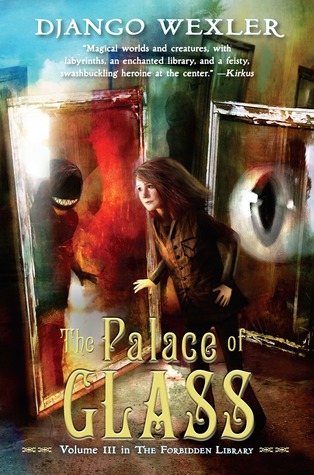 The Palace of Glass by Django Wexler
Mogsy’s Rating: 4.5 of 5 stars
Genre: Fantasy, Middle Grade, Children’s
Series: Book 3 of The Forbidden Library
Publisher: Kathy Dawson Books (April 12, 2016)
Length: 368 pages
Author Information: Website | Twitter
Middle Grade fiction really isn’t an age category I delve into all that often, but two years ago I discovered The Forbidden Library and never looked back. At the time, I was already a big fan of Django Wexler’s adult epic fantasy series The Shadow Campaigns, so I thought I would try more of his work even if I’m not the target audience. Now we find ourselves three books into the series, and I am completely hooked.
The Palace of Glass puts us right back on track, beginning with Alice’s newfound resolve to do something about her situation. For one thing, a terrible truth has been revealed to her; now she knows that “Uncle” Geryon, the master Reader who took her in, actually had a role in the disappearance of her father. Stricken with grief, Alice begins to plot her revenge.
But Geryon is a powerful Reader, and Alice is just an apprentice. To have any chance to succeed at all, Alice will need someone to teach her some new tricks. Enter the labyrinthine called Ending, the mysterious giant black cat that guards the estate’s forbidden library. Ending offers to tell Alice how to trap Geryon, but it involves a spell from a book rumored to be kept in the notorious Palace of Glass, a prison for dangerous magic.
When Geryon announces that he is leaving on a week-long trip, Alice decides to make her move, secretly traveling through a portal book to begin making her way to the Palace of Glass. However, her task may be more difficult that she first thought. Geryon’s sphere of influence is vast, and there’s no telling what would happen to all the magical creatures under his control, even if Alice does manage to take her master out of the picture.
After the wild ride that was The Mad Apprentice, which was a relatively self-contained adventure set in a twisty dark labyrinth, The Palace of Glass once again sees Alice back to doing what she does best—jumping through portal books, discovering new worlds, and meeting new races of magical beings. A lot happens in this book, as the plot surges ahead to take us through the molten tunnels of the fire sprites to the frozen kingdoms of the ice giants before taking us into the Palace of Glass, where our protagonist must face the challenges that await her. But that’s not all! The excitement continues to build until it reaches its peak at the end when Alice is forced to take a stand, leading to the book’s final epic showdown. There’s no coming back from some of the huge decisions she makes, and I’m thrilled at the overall climactic tone of this novel.
Plus, Alice gets to forge some new alliances along the way. First, she meets Flicker, a young flame sprite. Here, Wexler’s sheer imagination is on full display again as he comes up with creative ways to describe Flicker’s appearance and culture, such as using fire metaphors to explain the way the fire sprites procreate, or even likening a clearing of a throat to a the sound of flames crackling in the hearth. Then there’s Erdrodr, the ice giant girl who would prefer to draw rather than fight, much to the chagrin of her warrior mother. Alice, Flicker, and Erdrodr have some great moments in this book together, including the time where they find out that turtles are the world’s biggest jerks.
The Palace of Glass comes together in a great mix of humor and adventure, but there are some deeper, more sobering themes to it as well. Alice of course continues to grow as a character, asking the important questions about her powers and responsibilities as a Reader. Now that she knows Geryon can’t be trusted, she’s also starting to understand why Readers are feared by the magical portal community. After all, being able to bind all kinds of exotic creatures to your will and use their magical abilities might sound like a pretty cool idea in practice, but in order to gain the power of a creature, a Reader has to kill it or force it to submit.
Plus, have you ever wondered how some of the creatures—some of which are intelligent, sentient beings—got into their prison books in the first place? The answers revealed in this book are pretty unsettling, involving a cruel tribute system. For the first time, Alice’s eyes are opening to all of this, and she begins to truly think about the morality behind the things Readers do, which is a significant development for her character.
The author has said that The Forbidden Library will be a four-book series, and judging by the way The Palace of Glass ended, I’d say we’re in for some pretty big things in the fourth and final installment, which of course I’ll be reading. Looking forward to getting my hands on the sure to be epic conclusion, I really can’t wait to see how it all ends!
More on The BiblioSanctum:
Review of The Forbidden Library (Book 1)
Review of The Mad Apprentice (Book 2)
Exploring the Forbidden Library: An Interview with Django Wexler
Book Review: Masks and Shadows by Stephanie Burgis
Posted on April 11, 2016 23 Comments
A review copy was provided by the publisher in exchange for an honest review. All opinions are my own.
 Masks and Shadows by Stephanie Burgis
Mogsy’s Rating: 4 of 5 stars
Genre: Fantasy
Series: Stand Alone
Publisher: Pyr (April 12, 2016)
Length: 300 pages
Author Information: Website | Twitter
This spring, Masks and Shadows rocketed its way up to my most highly anticipated list. With its themes of palace intrigue, passionate romance, secret conspiracies and dark magic, the book sounded right up my alley and I am pleased to say that Stephanie Burgis’ first adult historical fantasy did not disappoint.
The story takes place in 1779, transporting readers to the extravagant court of Nikolaus I, Prince Esterházy of Hungary. Charlotte is a widowed young baroness, invited to stay at the palace during her mourning period by her sister Sophie, the prince’s mistress. The entire place is also abuzz with the arrival of Europe’s foremost castrato singer Carlo Morelli, here to enjoy the operas and grand musical productions that have made the Eszterháza so famous. Other visitors and guests that have come from afar include a Prussian spy and a notorious alchemist, setting the stage for the main event.
However, tragedy strikes as the prince’s opera troupe loses two of its most important performers. Franz Pichler, another actor, is punished in connection to his colleagues’ disappearance, while Anna, a young maid in Charlotte’s employ is suddenly vaulted to stardom when she is chosen to replace one of the missing singers. A sinister plot is hatching in the hands of a shadowy group at the palace, and as both Charlotte and Carlo are drawn into their mysterious web, the two of them are in turn drawn to each other even though they know deep down that a future together is forbidden. Still, if the threat to the royal family is not stopped, there might not even be a future for anyone at the Eszterháza.
Even though Masks and Shadows features a large cast of characters, it was surprisingly easy to follow along with the story. In fact, the book was a very fast read, thanks to its great plot and smooth pacing. And despite being a historical fiction novel, never once did I feel that the narrative was bogged down by extraneous historical detail. The story’s main focus was on the characters and their relationships, which worked really well for me.
Two of the more prominent players were Charlotte and Carlo, whose interactions provide the basis for the main romantic arc in this novel. Their romance is a deliciously slow-burning one that doesn’t feel like it overshadows the rest of the story, which I found really refreshing. The two of them are also unconventional protagonists, one being a noble woman who has just lost her husband and the other being a common born castrato singer. Despite his incredible talent and fame, few people at court see Carlo past the fact he is a castrated man and his lower status as a performer. Meanwhile, Charlotte is prevented from following her heart by her selfish flake of a little sister, to whom she still feels loyal even though the younger woman treats her like crap. I despised Sophie, and wished that Charlotte had shown more backbone in the face of her sister’s disparaging, but this also underscored how Charlotte’s personality was shaped and why her actions later on in the book are so significant.
Like I said, the romance is just one thread in a story which also features a mystery plot as well as a coming-of-age tale. The speculative element comes in the form of an alchemist’s dark magic and ability to summon entities from another realm, and gradually it is revealed how this plays into the larger picture. Anna the 16-year-old former-maid-turned-opera-singer also has a strong presence throughout the novel, making me think Masks and Shadows might be as much about her as it is about Charlotte. I was impressed at how flawlessly everything came together and resolved the story without leaving any loose ends.
You also don’t have to be a history buff to enjoy the story; I knew next to nothing about this period or the historical figures, but I had a great time with the book all the same. And actually, it was fascinating to learn more about the setting afterwards to find out how much of real history Burgis had incorporated into her story, like how 1779 was indeed a watershed year for famous composer Joseph Haydn, whose principle patron at the time was Nicolaus I, or the fact that the Eszterháza main opera house did burn down that very same year (though the book has a much more interesting explanation for that fire!) There must have been a lot of research devoted to this novel.
On the whole, I was really pleased by the balance. It feels like there’s something for everyone in this enchanting novel, whether you’re a fantasy reader, an enthusiast of European history, or even a music lover. Masks and Shadows is a captivating read with genuine wide appeal, which I’m sure will garner Stephanie Burgis many new fans.

An Artificial Night Read-Along Week No.1
Posted on April 10, 2016 5 Comments
We’re journeying through the third book in the October Daye series. If you’re interested in joining this Read-Along, visit the SF/F Read-Along group for more information and to join the discussion.
“October “Toby” Daye is a changeling-half human and half fae-and the only one who has earned knighthood. Now she must take on a nightmarish new challenge. Someone is stealing the children of the fae as well as mortal children, and all signs point to Blind Michael. Toby has no choice but to track the villain down-even when there are only three magical roads by which to reach Blind Michael’s realm, home of the Wild Hunt-and no road may be taken more than once. If Toby cannot escape with the children, she will fall prey to the Wild Hunt and Blind Michael’s inescapable power.”
Week 1: Saturday 9th April, Chapters 1-7, hosted by Over The Effing Rainbow
Week 2: Saturday 16th April, Chapters 8-17, hosted by Books By Proxy
Week 3: Saturday 23rd April, Chapters 18-24, hosted by Lynn’s Book Blog
Week 4: Saturday 30th April, Chapters 25-End, hosted by Over The Effing Rainbow
1. The book opens with Toby at a birthday party for Mitch and Stacy’s youngest child, and follows with an early-morning meet-up with Connor. Both scenes serve to keep previously introduced characters in play and show us how life is progressing for Toby, but in very different ways. What do you make of these scenes after all that’s gone before?
Honestly, I am tired of Connor. After three books, that song and dance is starting to get a little old between Connor and Toby. I really tried to sympathize with him because his life is privileged, but he’s obviously not happy. Maybe if I truly believe that he needed a friend and not someone to fall in bed with, I might really feel some sort of sympathy for him.
I was glad to see more about some of Toby’s friends, and I love that her life is moving forward slowly yet surely. It’s nice to see her actually interacting with others and having a life. I know everything isn’t perfect for her, and she still has many threads in her life that’ll eventually need addressing (such as her issues with her own daughter). However, it was nice to see her in such a relaxed setting actually enjoying herself. Also, seeing how she interacted with her friends gave the later scenes more impact because we know how close she is to Stacy and Mitch.
2. As we may have come to expect by now, things rapidly go downhill from there… What are your thoughts right now on this interpretation of the Wild Hunt?
I love the Wild Hunt in stories. One of my favorite interpretations is from The Witcher series. I’m very curious about these children that Blind Michael takes. She’s repeatedly told not to trust them by Luna, so I’m going to assume that she’s going to be faced with some of them later in the book. I was also interested in this idea of using human children as steeds. I’m wondering how that works. It’s mentioned that they’re changed. Does that mean that they’re changed into some kind of beasts? I’m hoping so because I keep laughing at the mental image of fae children riding piggyback on other children. LOL.
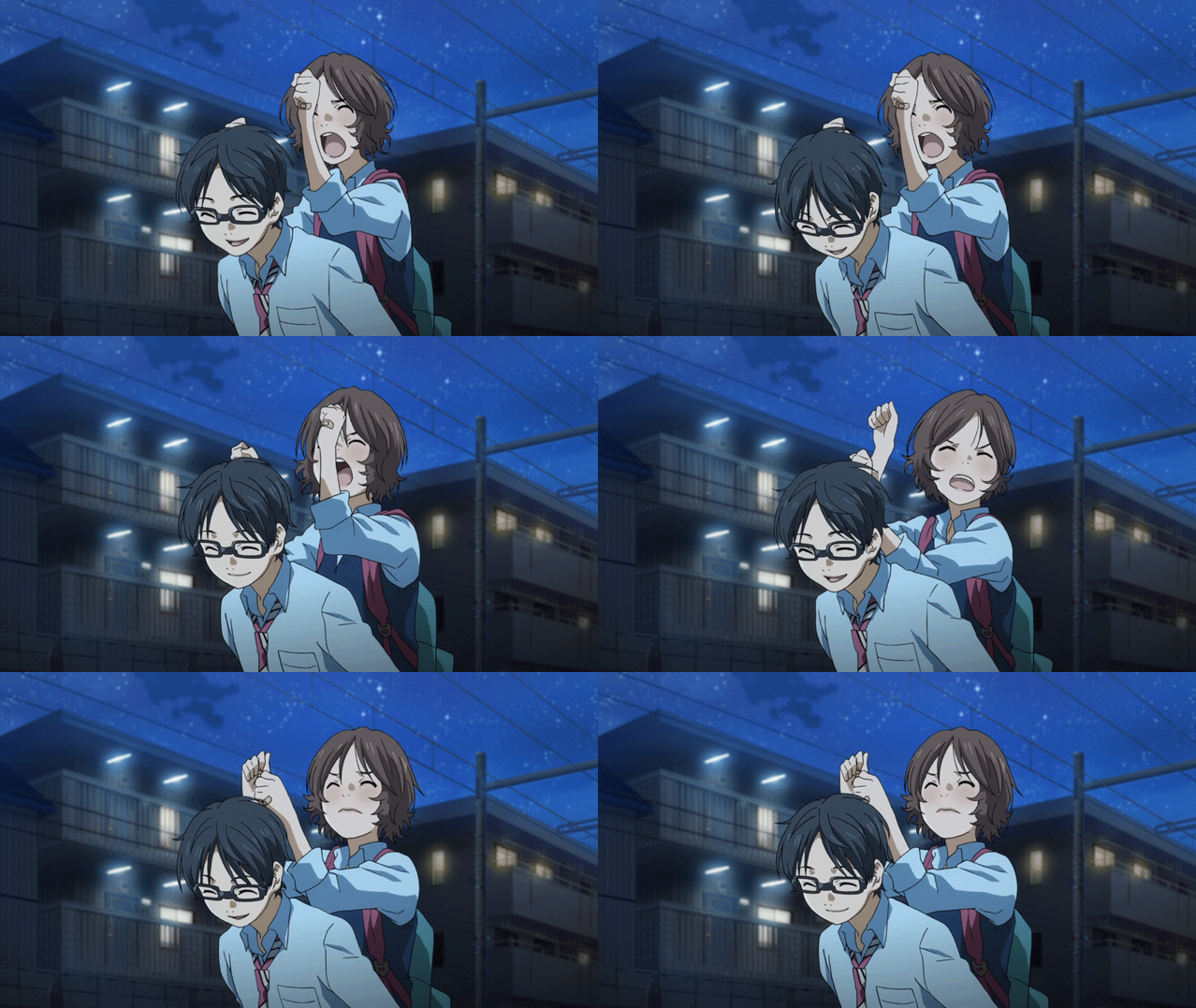
FORWARD TRUSTY STEED!
3. And (because it wouldn’t be a Toby read along if I didn’t celebrate him) Tybalt is back! After what was apparently a lengthy absence… What do you suppose kept Tybalt away after the events in A Local Habitation…?
Hello there, Tybalt!

I’m not sure. Maybe since he’s been having all these weird interactions with Toby he decided to take a step back. Maybe he had something important to do. Or maybe he’s a cat and therefore capricious and was probably doing whatever it is that cats do such as sticking themselves in things they shouldn’t be in and sleeping.

This is probably what Tybalt was doing.
4. Back to the real drama – Toby (eventually) gets some answers from Luna after a non-starter meeting with Lily. Everyone’s being mysterious, but Luna is acting especially strangely – as is Sylvester, who is openly unhappy with her about something… Any thoughts? Guesses? Suspicions?
I don’t know what to think quite yet. All I could think is that Luna was acting very, very strange, even after she explained what was going on it seemed really odd. It feels like Toby still isn’t getting a complete story despite knowing that the Wild Hunt is now involved. I’m interested to see where this is going.
“Got it. And you think about what I said. Getting out more couldn’t hurt.”
“With who? Mitch and Stacy have kids, Kerry’s always busy, Julie hates me, and you have a cab to drive.”
He shrugged. “I don’t know. How about you call that King of Cats guy I used to see you with? Take him out, get him drunk, and see if you can make him sing karaoke.”
* * *
There are certain basic rules of survival in my world. One of them is that you don’t live to a ripe old age by ignoring the warnings you get from your pets. Cats who live with the fae tend to get a little touched by strangeness, and the things that get that kind of reaction from them are usually looking for worse reactions from me. Reactions such as screaming, running, or going for a weapon. Whoever or whatever was out there probably didn’t intend anything good.
* * *
“I’ve never shopped naked,” I said.“I thought you were my Fetch. Aren’t you supposed to know these things?”
“Of course. I know everything there is to know about you, right up until the universe decided you were destined to die and created me to be your guide.”
“Everything?” I didn’t like the sound of that. There are some things I don’t want anyone to know.
“Everything. From what you got on your sixth birthday to what kind of flowers you leave on Dare’s grave. I even know what you were thinking about Tybalt after you saw him in those red leather pants—”
I held up my hand. “Stop. I believe you.” “I thought you might.”
She smirked, adding, “I didn’t even need to get detailed.”
* * *
One of the stranger tenets of the fae moral code says that the phrase “thank you” implies an obligation beyond the acts already performed and is thus to be avoided at all costs. Faerie is fond of avoiding obligations. I guess that’s part of why the mortal world has always dismissed us as flakes and tricksters; we only thank you if you owe us.
* * *
“Ah,” he said, softly. “I should have known it would be something of the sort.”
Before I had a chance to react, he stepped forward, kissing me on the forehead. “I have to return to my Court and let the parents of the missing ones know that you’ve agreed. I’ll come to you later.”
I stared at him, stunned. “What . . . ?”
“Open roads, Toby. Find our children.” He hesitated like he was about to say something else, but he didn’t; he just turned and walked to the edge of the parking lot.
I don’t know how I feel about all this talk about Ray being crazy. I mean, I don’t doubt that she is, but I haven’t really seen her do anything to make me think that she’s batshit crazy. I’ve only been taking Connor and Toby’s word for it. This excuse of having to tip around Ray is just starting to get old and tired, too, until I really see her doing more than just being overly bitter as she was in the first book.
Rosemary and Rue by Seanan McGuire (October Daye #1)
Rosemary and Rue Read-Along Week No.1
Rosemary and Rue Read-Along Week No.2
Rosemary and Rue Read-Along Week No.3
Rosemary and Rue Read-Along Week No.4
A Local Habitation by Seanan McGuire (October Daye #2)
A Local Habitation Read-Along Week No.1
A Local Habitation Read-Along Week No.2
A Local Habitation Read-Along Week No.3
A Local Habitation Read-Along Week No.4


 The BiblioSanctum