Book Review: The Mirror’s Truth by Michael R. Fletcher
Posted on December 5, 2016 24 Comments
I received a review copy from the publisher. This does not affect the contents of my review and all opinions are my own.
 The Mirror’s Truth by Michael R. Fletcher
Mogsy’s Rating: 4.5 of 5 stars
Genre: Fantasy
Series: Book 2 of Manifest Delusions
Publisher: Michael R. Fletcher (December 15, 2016)
Length: 455 pages
Author Information: Website | Twitter
The Mirror’s Truth is a sequel that builds upon everything that made the first book so great and all-consuming, featuring storylines and characters that are grittier, twistier, and even more insane. In other words, it’s even more fucked up than Beyond Redemption…and I loved it.
“War isn’t insanity, it’s the base state for all reality. Plants war for sunlight. Animals war for food and water. Wolves battle to decide who leads the pack. All life is struggle.
Peace, now that is insanity.”
You didn’t actually think it was over for our protagonists, did you? In the world of Manifest Delusions, death is only the beginning. Bedeckt, Stehlen, and Wichtig are back, following the complete and utter bloodbath that was the end of the first book. Only now, they’ve emerged even more brutal, bloodthirsty and psychotic than ever before.
It all started when the old and wretched Bedeckt, filled with the sudden horror of his actions, decided that he could not go through with the plans he had made. Now he must undo the damage caused by his weakness and do whatever it takes to stop Morgan, the mad child who has become a god. And if it takes abandoning his companions to the eternal greyness of the Afterdeath, then so be it.
Not surprisingly, Stehlen and Wichtig react none too kindly to that idea. Livid at being left behind, the murderous Kleptic and the self-styled Best Swordsman in the World decide to make clandestine deals of their own, returning to the world of the living in order track down Bedeckt and make him pay—slowly and painfully.
With friends like these, who needs enemies? At the same time though, it would be a mistake to dismiss these characters so casually. They may be insane, but they are deep. Beyond Redemption would not have been such a wildly successful book in my eyes if our protagonists had merely been the vile, monstrous degenerates they appeared to be on the surface. Instead, Michael R. Fletcher drew me in with the complexity of their personalities and relationships, and I was glad he continued to build upon these in the sequel. While Bedeckt, Stehlen, and Wichtig spend much of this book apart, we are still treated to the fascinating inner workings of their deep, dark scary minds.
In fact, with the chapters basically alternating between their POVs, each of the three are essentially given their own storyline thus giving way to a lot more character development on an individual level. The Bedeckt we used to know has become transformed, no longer just an old jaded thief looking to end his financial troubles once and for all with the score of a lifetime. Now he is a man wracked with guilt and grief, struggling to keep what morals (and sanity) he has left. We also get to see a softer side of Stehlen—and if you’ve read the first book, you’ll understand why I just burst into incredulous giggles while typing that—but believe it or not, it is true; the psycho kleptomaniac woman actually has feelings that go beyond wanting to slit your throat and steal your shit. And finally, there’s Wichtig, perhaps the most complicated of them all. Of the three protagonists, he’s the only one whose past is explored in depth, and I also find the story surrounding his delusion of being the world’s best swordsman to be extremely compelling.
And of course, I am once again floored by the originality and excellence in the world-building. People always complain about the same tired old tropes in fantasy and the lack of fresh ideas when it comes to magic systems and powers. To them I say, “Take some Manifest Delusions and call me in the morning.” Fletcher has done an incredible job creating this world where magic is madness, and those who are the most powerful are also the most unhinged. It’s a premise ripe for all kinds of ruckus and mayhem, and this sequel pushes the envelope even further.
Plot-wise, The Mirror’s Truth is simpler in some ways, but it is also stranger, bloodier, and more violent. The conclusion, however, was the best part. With that ending, Michael R. Fletcher might have just single-handedly redefined the word “insane”. Seriously.
I think it’s safe to say those who enjoyed Beyond Redemption will also love this sequel, and after all this waiting and uncertainty, I’m glad that The Mirror’s Truth has finally found its way into readers’ hands. Manifest Delusions is not so much a hidden gem, but rather an absolute treasure trove of a series to fans of grimdark. By the end of this one you will be begging for more.


More on The BiblioSanctum:
Review of Beyond Redemption (Book 1)
YA Weekend: The Rains by Gregg Hurwitz
Posted on December 4, 2016 17 Comments

I received a review copy from the publisher. This does not affect the contents of my review and all opinions are my own.
Mogsy’s Rating: 3 of 5 stars
Genre: Horror, Young Adult
Series: Book 1
Publisher: Tor Teen (October 18, 2016)
Length: 352 pages
Author Information: Website | Twitter
Here’s the deal: if you’re a fan of zombie stories or if a zombie origin tale that puts a fresh spin on the genre sounds like it might interest you, then you’re going to want to check out The Rains by Gregg Hurwitz. Double bonus for you too if you prefer books with a YA bent, as this is the author’s first book in a new series targeting teen readers.
However, if you happen to be a science/biology geek or a stickler for common sense and logic, then this book is going to make you cry.
The story begins with an introduction to the quiet and rural community of Creek’s Cause, where the peace is shattered one evening by a meteor strike. Not long afterwards, our fifteen-year-old protagonist Chance Rain and his older brother Patrick are awakened in the middle of the night by a commotion at their neighbors’ house, leading the two of them to sneak out and investigate. They arrive just in time to stop an attack on the kids by the stepmother, who appears to have been transformed into mindless raving husk by a mysterious and unknown parasite. After saving the children, Chance and Patrick find the father on top of a water tower where millions of alien spores look to have exploded from out of his bloated corpse.
Recalling what he’s learned about the Cordyceps fungus and “zombie ants”, Chance quickly deduces that these spores are what’s causing the infection, turning all of the adults—and only adults, it seems—into violent, savage hosts. But if this is indeed the way the parasite is spreading, then why aren’t those who are younger being infected?
Chance and Patrick find the answer to this once they arrive at the high school, where their science teacher Dr. Chatterjee has been sheltering the town’s children and teenagers. Chatterjee explains that the parasite appears to be affecting white matter, the paler tissue of the human brain mostly made up of nerve fibers and their myelin sheaths. And since the brains of children are not as developed as an adult’s and do not have as much white matter, they are immune to the effects of the spore. This also explains why Dr. Chatterjee, who has multiple sclerosis—a demyelinating disease—is unaffected himself.
So far, this is going great. Things are getting pretty interesting. I’m liking the suspense, and the mystery behind the infectious agent is really driving things. But then, we get another bombshell. The group figures out that, at the exact moment a person turns 18, the brain will immediately become susceptible to the parasite. The exact moment. As in, right down to the minute of your birth. One second, you’re fine. But as soon as the clock ticks over, then happy birthday, you’re a zombie!
The bio nerd in me just wants to tear my hair out and scream, NOOOOOOO THAT’S NOT HOW THIS WORKS!
I do love it when zombie books use science to explain things (the Cordyceps idea is becoming a lot more common, for example, and I still can’t get enough) but let’s please try to make it more convincing. I thought that tying the parasite’s processes to brain development was ambitious and intriguing, but unfortunately the human body does not work like a clock. One does not wake up in the morning of their eighteenth birthday to find their brain suddenly and miraculously bursting with myelin. If only growing up and becoming mature was so easy.
So yes, that bothered me a lot. It might even have biased me against the rest of the book. If such a glaring oversight made it through the first few drafts, I can only assume that the prevailing attitude was “This is YA, good science and reasoning won’t matter so much.” But it does. It should. With this in mind, I soon started seeing more plot holes, inaccuracies, and logical leaps.
If things like that don’t concern you so much, then you should be fine, though for me they ultimately prevented me from calling The Rains a great book. It’s a shame too, because the plot was entertaining and fun in a way that reminded me a lot of The Faculty movie, and the characters were good, strong, and charming in the salt-of-the-earth sense. Still, generally speaking I don’t feel comfortable enough about recommending this book to just anyone; perhaps if you are a diehard zombie fiction reader or YA horror fan, you might want to take a look. However, if you’re a pickier reader like me who also predominantly reads adult speculative fiction, you might end up finding the flaws too distracting. I give this one 3 stars, and just barely.

Mogsy’s Bookshelf Roundup: Stacking the Shelves & Recent Reads
Posted on December 3, 2016 41 Comments
Bookshelf Roundup is a feature I do every other weekend which fills the role of several blog memes, like Stacking the Shelves where I talk about the new books I’ve added to my library or received for review, as well as It’s Monday! What Are You Reading? where I round up what I’ve read since the last update and what I’m planning to read soon. Mostly it also serves as a recap post, so sometimes I’ll throw in stuff like reading challenge progress reports, book lists, and other random bookish thoughts or announcements.

Received for Review
Happy December, everyone! It’s a relatively light week for activity due to the recent Thanksgiving holiday in the US, and I hope all those who celebrated had a wonderful time. My plans to catch up on some reading didn’t exactly pan out, but that’s okay because my brother was visiting from Canada and it was great spending that time with family! This month though, I’m making it a point to hunker down and put a dent in my TBR and I’ve been really good on reining back requests. Even so, there’s still lots of goodies to feature, and I’d like to thank all the publishers and authors for the following review copies received. For more details and full descriptions of the books, be sure to click the links to their Goodreads pages!

Last Year by Robert Charles Wilson – My thanks to Tor Books for this surprise arrival. I’m even more intrigued now that I’ve discovered it involves time travel!
Babylon’s Ashes by James S.A. Corey – My thanks to Orbit for the finished copy. The Expanse is probably my favorite science fiction series right now, and I cannot wait to dive into book six. They just get better and better.
Dreamweaver by C.S. Friedman – Book three of Dreamwalker, C.S. Friedman’s YA/crossover series that I’ve been really enjoying so far. I think this is the final installment, so I have to know how it ends! My thanks to DAW for the finished copy.
Hungry Ghosts by Stephen Blackmoore – Thanks also to DAW for this surprise arrival from the Eric Carter series which I’ve wanted to check out for a while. Unfortunately, this is book three and I haven’t read the first two! Looks like I have some catching up to do first!
The Dispatcher by John Scalzi – Another fantastic surprise from the wonderful folks at Subterranean Press. I was pretty excited to learn they’ll be publishing the print edition of this novella, which thus far has only been available in audio.

Charlie the Choo-Choo by Beryl Evans – My initial response was confusion when an unsolicited package from Simon & Schuster arrived last week and this came out. As far as I knew, I was not on any of their children’s reviewers lists so it was pretty bizarre to receive a picture book. But then I noticed the blurb from Stephen King. And then I laughed when I looked it up and realized that Beryl Evans IS Stephen King. Fans of The Dark Tower are probably reading this now and going, “durr, Mogsy” but hey, I never made it past The Gunslinger! I never knew about some book about some creepy sentient train. Anyway, I’ll probably end up giving this to my kids one day, but even my oldest will need to wait a few more years. She took one look at that cover and said, “Mommy, his eyes are scary.”

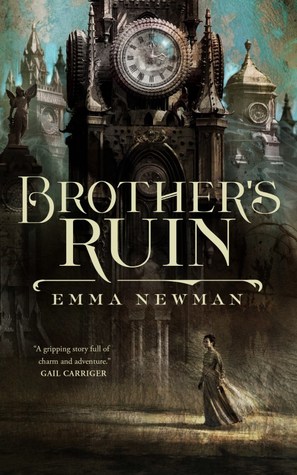

Up next, a trio of e-galleys from the awesome team at Tor.com! I’ll have to catch up with book one before I take on Down Among the Sticks and Bones by Seanan McGuire, but I’m super excited about Brother’s Ruin by Emma Newman — she’s on fire these days! Proof of Concept by Gwyneth Jones also looks very interesting.
Won and Purchased

It’s been a while since I won anything from giveaways, probably because I haven’t been entering any. The Fall of Fair Isle by Rowena Cory Daniells was actually a book I won back in a Goodreads giveaway in April 2015! When it never arrived, I just let it go. Earlier this fall though, I came across a great review of this book on a blog and I commented, along with a brief lament about how it’s a shame I lost my chance to check it out. To my shock, a couple weeks later I received an email from the author to let me know about the publisher problems with that particular giveaway, and offered to send me the book! It was such an amazing and sweet thing to do, that I was completely floored. When the package came, I saw that the author also included another one of her books, Besieged. So thank you so much, Rowena, I can’t wait to read the books and I will never forget your generosity.
I also forgot to mention the arrival of Genius Loci: Tales of the Spirit of Place edited by Jaym Gates a few weeks ago, which was a pledge reward from the Ragnarok Publications Kickstarter campaign. It’s a beautiful anthology, was totally worth the wait!
Reviews
Review roundup time! Top feature spot goes to Arcanum Unbounded: The Cosmere Collection, a must-have for every Brandon Sanderson fan’s bookshelf.
Arcanum Unbounded by Brandon Sanderson (4.5 of 5 stars)
The Secret Life of Souls by Jack Ketchum & Lucky McKee (4 of 5 stars)
Blood for Blood by Ryan Graudin (4 of 5 stars)
The Facefaker’s Game by Chandler J. Birch (4 of 5 stars)
Level Grind by Annie Bellet (3.5 of 5 stars)
Star Wars: Catalyst: A Rogue One Novel by James Luceno (3.5 of 5 stars)
The Hidden People by Alison Littlewood (3 of 5 stars)
Roundup Highlights:

What I’ve Read Since the Last Update
Between making Thanksgiving preparations and caving in to my friends’ insistence on joining their Overwatch team, my reading time has taken a severe hit these past two weeks! I still managed to knock a few books off Mount TBR though (and there’s actually one more book I read that I couldn’t include here because I can’t talk about it yet) so I probably ended up doing more reading than I expected. Stay tuned for reviews.


Have you heard of or read any of the books featured this week? What caught your eye? Any new discoveries? I hope you found something interesting for a future read! Let me know what you plan on checking out. Until next time, see you next Roundup!
Week 1: A Closed and Common Orbit Read-Along
Posted on December 2, 2016 7 Comments
Sci-Fi November might be over, but that doesn’t mean the sci-fi fun has to stop. Our Read-Along of A Closed and Common Orbit by Becky Chambers has officially begun. If you’re interested in participating, hop on over to the SF/F Read-Along group for more information; we’d love for you to join the discussion. Have you read The Long Way to A Small Angry Planet, the first Wayfarers book? Are you planning on reading this standalone follow-up? Let us know your thoughts.


Lovelace was once merely a ship’s artificial intelligence. When she wakes up in an new body, following a total system shut-down and reboot, she has no memory of what came before. As Lovelace learns to negotiate the universe and discover who she is, she makes friends with Pepper, an excitable engineer, who’s determined to help her learn and grow.
Together, Pepper and Lovey will discover that no matter how vast space is, two people can fill it together.
The Long Way to a Small, Angry Planet introduced readers to the incredible world of Rosemary Harper, a young woman with a restless soul and secrets to keep. When she joined the crew of the Wayfarer, an intergalactic ship, she got more than she bargained for – and learned to live with, and love, her rag-tag collection of crewmates.
A Closed and Common Orbit is the stand-alone sequel to Becky Chambers’ beloved debut novel The Long Way to a Small, Angry Planet and is perfect for fans of Firefly, Joss Whedon, Mass Effectand Star Wars.



Week 1: Friday 2nd December – Part 1 up to Page 94, hosted byLisa at Over the Effing Rainbow
Week 2: Friday 9th December – Page 95 to End of Part 1, hosted by Imyril at There’s Always Room For One More
Week 3: Friday 16th December – all of Part 2, hosted by Lynn at Lynn’s Book Blog
Week 4: Friday 23rd December – Part 3 to End, hosted by Mogsy at The BiblioSanctum

1. So this story picks up more or less where The Long Way to a Small Angry Planet left off, but rather than having an ensemble cast on an adventure, it seems this story is much more intimately focused on Lovelace (later named Sidra) and ‘Jane 23’. What’s your initial response to this shift in the narrative style between books? Is it one you appreciate or do you think you’ll miss the ensemble aspect (assuming you’ve read Small Angry Planet)?
You know, I actually think I prefer this. As much as I enjoyed the large ensemble cast of A Long Way to A Small Angry Planet, there is something to be said about having a more intimate connection with only one or two characters in a story; I tend to do better with books like these. I might miss the characters from book one themselves, but not so much the format. I am pretty comfortable with how things are going so far with just Lovelace/Sidra and Pepper/Jane 23.
2. Sidra’s first experiences of living confined to a body mean that readers get to see her new home, and her new world, through the eyes of someone who’s never experienced it in such a way before. What aspects of Sidra’s first days ‘on the ground’ on Coriol stand out to you, and why?
So many examples! A few that stood out for me were the times we got to learn how Sidra’s body kit was fitted out, discovering all kinds of “features” its creators had programmed in. Sidra having her first experience with the warm drink and getting the “associated imagery” of the lounging cat was pretty hilarious. There was also the part where she called up the steps to “make herself comfortable.” Now wouldn’t it be nice if everyone in the world followed such careful protocols for, say, etiquette? The things she learned at the party were pretty interesting too, but to be honest, as the reader I probably felt just as overwhelmed and awestruck about the world as our protagonist did.
3. The POV switches regularly between Sidra in the present and Jane 23, a clone raised in some form of slave labour with many others of her kind, when she was a 10-year old girl. What do you make of Jane and her upbringing at this point, and where do you think her story might be going from here? Does her story interest you as much as Sidra’s (or vice versa)?
Hard to say, since we’re still so early in the book. Jane 23’s story is slowly emerging at this point, but it’s pretty clear to me already that this Pepper in the past. I’m a little confused about where her storyline is going right now, only because everything in her world is still so new and alien and bizarre to me, but I’m interested to see where this is going. I would say Sidra’s POV is more engaging at the moment simply because I know more about her, but this could rapidly change as the plot develops further in the Jane 23 chapters.
4. In general, what’s stood out the most to you about these chapters so far, and why? Has anything raised questions or curiosity, or particularly turned you off? Discuss your favourite bits!
I believe I’ve already discussed a few of my favorite scenes in my answers above, but in general I find I’m really enjoying the relationship dynamics between Sidra and Pepper. As for curious questions, I did get a random thought about whether we might get to see any of the old cast again, even if it’s just a brief cameo or two. But since A Closed and Common Orbit has been touted as a “standalone” sequel/companion novel, I doubt it. I mean, it would be nice if it happened, but I definitely won’t hold my breath.
Audiobook Review: Star Wars: Catalyst by James Luceno
Posted on December 1, 2016 14 Comments
I received a review copy from the publisher. This does not affect the contents of my review and all opinions are my own.
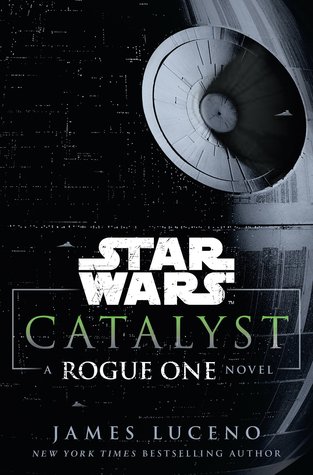 Star Wars: Catalyst: A Rogue One Novel by James Luceno
Mogsy’s Rating: 3.5 of 5 stars
Genre: Science Fiction, Media Tie-In
Series: Star Wars Canon
Publisher: Random House Audio (November 15, 2016)
Length: 11 hrs and 15 mins
Author Information: Website
Narrator: Jonathan Davis
It’s no secret I’m very excited for Rogue One this winter. While the movie can’t come soon enough, in the meantime I thought I would whet my appetite with the prequel novel that’s meant to portray events that take place in the preceding years. In case you’re wondering whether you need to read Rogue One: Catalyst before seeing the movie though, the answer is: Only if you want to. Like most Star Wars novels in the expanded universe, I would not consider it required reading, and might even recommend against making this your first Star Wars novel if you’ve not read any before. But if on the other hand you’re the kind of “big picture” reader who appreciates a good background story, then this book will likely put some of the movie’s events into context and enrich your experience when you watch it.
Opening soon after the end of Episode II: Attack of the Clones and into the early years of the Clone Wars, Catalyst tells story of Galen Erso and Orson Krennic, both of whom will be featured in the upcoming film. A long and complicated history exists between the two men, and James Luceno seeks to explore this relationship by putting strong emphasis on the characters. First, there’s Galen, an energy scientist working on harnessing power from crystals. He and his wife Lyra are soon expecting the birth of their daughter (Jyn Erso, the lead of Rogue One) when Separatists take over the planet they are settled on, imprisoning Galen because of his refusal to work for them. However, the family is soon rescued by Orson Krennic, an old friend of Galen who appears to have made quite a name for himself in Palpatine’s new government. Krennic is now on a team working on a top secret weapons project codenamed “Celestial Power”, which of course is the Death Star.
Years pass, and with the fall of the Republic, work on the project Celestial Power has become more crucial than ever to the burgeoning Empire. Hoping to recruit Galen to the program and win favor from the Emperor, Krennic is not above manipulating the scientist by offering him a brand new research facility and the promise of kyber crystals. Dedicated only to his work, Galen is uninterested in taking sides in the war (which incidentally was how he ended up being imprisoned years before), but long has he wanted to use kybers for his research. Because the crystals had been under the purview of the Jedi, obtaining them had been an impossible feat, but now that the Jedi Order has been destroyed, they no longer pose an obstacle. Wary of Krennic and the Empire, Lyra fears that Galen might be heading down a path he’ll regret. Her husband is too blinded by his obsession with research to see what his old “friend” is trying to do, and it is tearing their family apart.
Primarily centered on the construction of the Death Star, Catalyst is heavily focused on the logistics and science behind putting together the huge space station. We’re also given more information than we’ve ever had before about the mysterious Force-attuned kyber crystals that Jedi use to build their lightsabers. If you’re interested in details like that, great! If not, then all of this will probably feel a bit dry. The info dumping was especially noticeable in the first half of the book, which unfortunately is when strong pacing is needed the most. The story takes a while to get started, and even as we move through the various developments in the novel, the tone of it remains relatively understated. This is in contrast to some of the more adventurous, action-oriented novels in the new Star Wars canon which might serve as a better jumping on point for newcomers to the books. Catalyst with its themes of intrigue, machinations and plotting might feel a little too slow and underwhelming in comparison.
That said, they couldn’t have tapped a more perfect author to write this novel. I’ve always felt that Luceno excels when it comes to the more low-key Star Wars stories due to his attention to detail and thoughtful approach to writing about darker, more subtle themes. From reading Darth Plagueis and Tarkin, I know that he is also fantastic with his characterizations, and of course he is once again at the top of his game with Catalyst. For this story to work, the reader had to be convinced of the unique and complex dynamic between Galen and Krennic. In spite of the other side plots involving Lyra, Jyn and Dressellian smuggler Captain Has Obitt, the book’s main conflict always came back to the relationship between the two men. To make sense of it all, we first had to understand what made each of them tick, and Luceno did an excellent job in that regard.
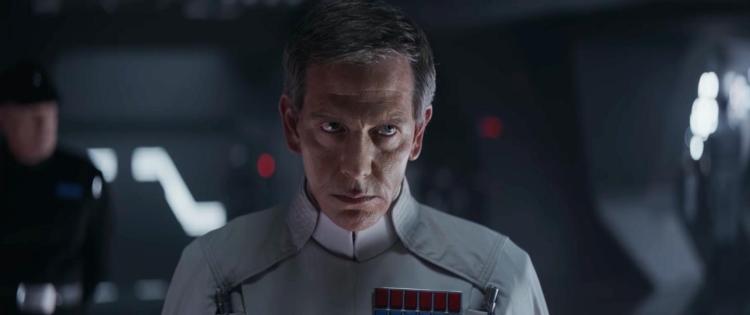
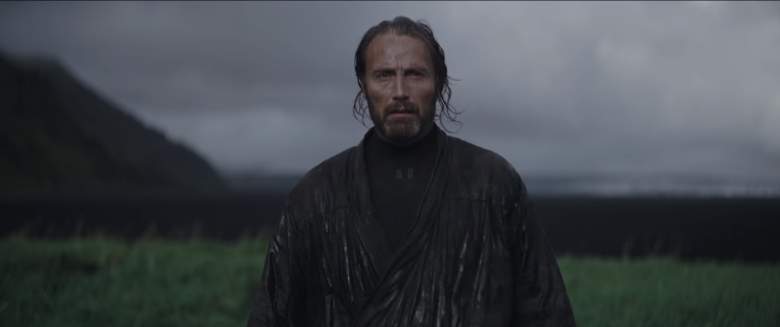
In the end, I thought Catalyst was good but not great. If you’re just starting to check out Star Wars fiction, there are probably better books in the new canon to read first, and unless you have a pressing need to learn all you can about the construction of the Death Star, you could probably put this one on the lower priority pile. That said, it’s still worth reading if you plan on seeing the Rogue One movie, if nothing else to gain a better understanding of the characters and story.
Audiobook Comments: I do love my Star Wars books in audio. No other kind of production gives me that epic experience complete with music and sound effects, and other than maybe Marc Thompson, I can’t think of another Star Wars audiobook narrator who is as fun and amazing to listen to as Jonathan Davis. If you’ve ever heard him do his Darth Vader voice, you’d understand. Too bad he doesn’t get the chance to do so in Catalyst, but he nevertheless delivers a fantastic performance, giving every character a unique voice. I never turn down the chance to listen to a Star Wars book, and this was another great one.

Waiting on Wednesday 11/30/16
Posted on November 30, 2016 12 Comments

“Waiting On Wednesday” is a weekly meme hosted by Breaking the Spine that lets us feature upcoming releases that we can’t wait to get our hands on!
Mogsy’s Pick
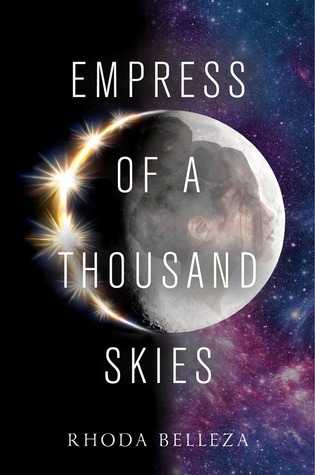
Empress of a Thousand Skies by Rhoda Belleza (February 7th 2017 by Razorbill)
The BiblioSanctum is participating in Sci-fi Month so I’m featuring science fiction WoW picks for the whole month of November. For this final week I’m wrapping things up with an upcoming release I’ve had my eye since seeing its blurb and cover earlier this year. I make it no secret that I am extremely picky about my YA, but even in spite of its short and vague description, I really like the sound of this one and I think it teases much potential.
 “Empress
Rhee, also known as Crown Princess Rhiannon Ta’an, is the sole surviving heir to a powerful dynasty. She’ll stop at nothing to avenge her family and claim her throne.
Fugitive
Aly has risen above his war refugee origins to find fame as the dashing star of a holo-vision show. But when he’s falsely accused of killing Rhee, he’s forced to prove his innocence to save his reputation—and his life.
Madman
With planets on the brink of war, Rhee and Aly are thrown together to confront a ruthless evil that threatens the fate of the entire galaxy.”
#RRSciFiMonth: Mogsy’s Top 10 Sci-Fi Reads of 2016
Posted on November 29, 2016 43 Comments
As Sci-Fi November comes to a close, I hope everyone has enjoyed the science fiction related goodies we’ve featured at The BiblioSanctum this month. I also want to take this opportunity to thank Rinn Reads and Over The Effing Rainbow for running such a successful event this year, and we hope to keep participating in this annual tradition.

Anyway, as today is Top Ten Tuesday and the theme is a Holiday Gift Guide freebie, I thought, what better way to wrap things up than with a Top 10 list of the best Science Fiction novels I’ve read in 2016? It was certainly a tough choice narrowing it down, but these are the books that really stood out for me and I would recommend any of them for the sci-fi fan in your life.
 After Atlas by Emma Newman
While After Atlas takes place in the same cosmos as Planetfall, it is more accurate to call it a companion novel than a true sequel which means it can be read as a standalone. While it is as far as you can get from the mysticism and colonization sci-fi we saw from the first book, fans of mysteries or police procedurals will be very happy with the plot and I think you should even start with this book if you like those kinds of stories. Hands down this is my favorite novel by Emma Newman that I’ve read so far, and I like how it was such a departure from her other work and the way it got under my skin. (Read my full review…)
 Gemina by Amie Kaufman and Jay Kristoff

Following in the tradition of the first book Illuminae, Gemina is also presented in an epistolary format as a collection of transcripts, journal entries, communication reports and the like. The variety of documents used to tell the story is again what makes this sequel so fantastic. Kaufman and Kristoff use them to great effect, ensuring there’s never a dull moment. Two books later, I still can’t get over how clever and unique this series is. I highly recommend this series to YA and adult sci-fi readers alike. (Read my full review…)
 Dark Matter by Blake Crouch

If nothing else, this novel gets high marks from me because of how unbelievably addictive it was. This is definitely one of those “the less you know going in, the better” kind of novels. It’s enough to say that I was hooked from the first page, and the story’s premise was both intriguing and a punch in the gut. This story was both thrilling and terrifying. If you’re looking for a fast-paced and exhilarating read, look no further than Dark Matter, a blend of science fiction, mystery, and thrilling suspense. (Read my full review…)
 Company Town by Madeline Ashby
With Company Town, Madeline Ashby delivers a whole other level of storytelling genius. I enjoyed everything about this novel, from the phenomenal world-building to the irresistible mystery surrounding the plot. The suspense was what kept me reading long into the night. I also found the characters likeable, especially the magnetic personality of the protagonist. I wouldn’t hesitate to recommend this novel to fans of futuristic sci-fi; a fascinating setting along with an amazing cast made an unforgettable read. (Read my full review…)
 Star Wars: Bloodline by Claudia Gray

I fell in love with Claudia Gray’s Star Wars: Lost Stars last year, and so you can imagine my excitement when I learned that she would be penning a second book in the new canon, this time an adult novel about Princess Leia herself. With Star Wars: Bloodline, Gray has established herself as a new powerhouse author in the world of Star Wars fiction and become one of my favorite tie-in writers. This was another brilliant book in the new canon, and the story gave me so many feels. Recommended for all Star Wars fans. (Read my full review…)
 Arkwright by Allen Steele

Arkwright is the story of how one man’s dream became a reality, a truly inspirational saga spanning generations amidst familial crises, political roadblocks, technological limitations and many other seemingly insurmountable obstacles. Throughout it all, one family’s conviction endures, its members steadfastly facing down every single kind of challenge in the course of the many centuries it takes to achieve their goal. The ending even left me a bit teary-eyed. What a total gem of a sci-fi novel, an incredibly touching and inspirational story about humankind’s journey to reach for the stars. (Read my full review…)
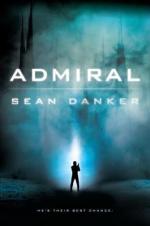 Admiral by Sean Danker

Admiral could be the most entertaining military science fiction novel I read all year. Delivering an enticing combination of mystery and suspense, Sean Danker’s debut is an intensely action-packed and fast-paced survival adventure that’s sure to appeal to both sci-fi veterans and newcomers to the genre alike. I could easily go on and on with my praise for this novel, but because so much of my enjoyment was from learning its secrets, it’s probably best to leave the rest a mystery for readers to discover. This one hooked me from the start with its nail-biting suspense, hitting a lot of the sci-fi and space disaster themes that make this genre so popular while still teasing plenty of uniqueness and more to come for the rest of this series. (Read my full review…)
 Star Wars: Dark Disciple by Christie Golden
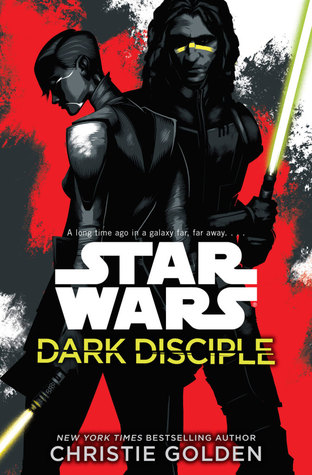
Based off of an unproduced script for Star Wars: The Clone Wars, this epic tale of action-adventure and romance got its second chance in Star Wars: Dark Disciple penned by one of my favorite media tie-in novelists Christie Golden. Honestly, between Golden and Claudia Gray, the two of them may have just ruined me forever with Star Wars novels, because I doubt I’ll ever be able to read one again without measuring it up to their work. Certainly Dark Disciple has become one of my favorite Star Wars books ever. It is up there among what I feel are the most worthwhile novels in the new canon, and one of the best in terms of character development and giving the reader an impactful emotional experience. (Read my full review…)
 Bite by K.S. Merbeth

The publisher description for Bite is pretty vague, but I actually think this works in favor of the novel. When you pick up a book set in a post-nuclear apocalypse wasteland and speculate on what the story might be about, probably a whole slew of other things will enter your mind before you think, “cannibals”. But it does make a lot of sense, doesn’t it? The character development is excellent in this novel, and I guess it really had to be in order to convince us that these people and their abhorrent dietary preferences are worthy of our time and attention. Merbeth succeeded marvelously, creating a cast of engaging characters that I just couldn’t help but cheer for. This book delivered exactly what I was expecting: a fast, fun, explosive adventure. (Read my full review…)
 Arabella of Mars by David D. Levine
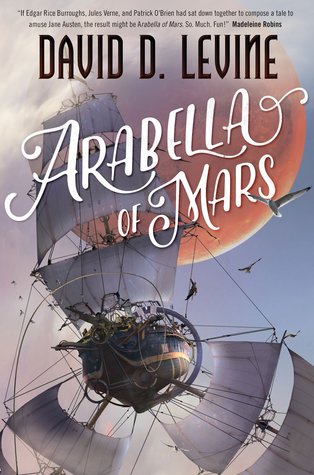
I’ve never read anything by the author before this, but I can see the reason for all his accolades and why his short fiction is so widely praised. David D. Levine is an excellent world-builder, and it is also impossible not to be drawn to his characters. I loved Arabella of Mars and I couldn’t have asked for a more fun and exciting genre-bending tale. With its intriguing mix of steampunk, fantasy, science fiction and alternate history, readers of every persuasion will likely find something for them in this wonderful, action-packed coming-of-age adventure. (Read my full review…)
Book Review: Arcanum Unbounded by Brandon Sanderson
Posted on November 28, 2016 30 Comments
I received a review copy from the publisher. This does not affect the contents of my review and all opinions are my own.
Arcanum Unbounded: The Cosmere Collection by Brandon Sanderson
Mogsy’s Rating: 4.5 of 5 stars
Genre: Fantasy, Anthology
Series: The Cosmere
Publisher: Tor (November 22, 2016)
Length: 672 pages
Author Information: Website | Twitter
Huge Brandon Sanderson fan that I am, I try to read everything he writes, but especially the works that take place in his fictional universe of the Cosmere. But while I have read all the novels, somehow many of the novellas seem to have slipped through the cracks. When a lot of the stories have only appeared online or in other anthologies, it can make tracking down every single one a challenge.
Enter Arcanum Unbounded: The Cosmere Collection. It feels like I have been waiting my whole life for this. Collecting eight previously published short stories and novellas plus one new never-before-seen tale that takes place in the world of The Stormlight Archive, this anthology is a must-have for every Cosmere geek.
The Emperor’s Soul
The Emperor’s Soul is the only story I’ve read previously before coming into Arcanum Unbounded. It remains one of my favorites of all time, the only novella I’ve ever rated a full five stars and I was ecstatic to see that it was the first story in this collection. Taking place in the world of Elantris, it follows a thief and forger named Shai who is captured by agents in a foreign land and made to craft a new soul for their emperor. Re-reading this story reminded me all over again why I loved it the first time; clocking in at just over one hundred pages, it manages to encompass everything I would expect from a full-length novel—intricate world-building and incredible character development, with a unique magic system to boot. Few authors can manage a feat like this, but Sanderson captures my imagination whether he’s penning short fiction or thousand-page epic fantasy tomes. Certainly The Emperor’s Soul shows he is not only a writer but an artist, or at least someone who understands how making art feels, based on his excellent characterization of Shai. This is a brilliant novella with a touching and powerful message.
The Hope of Elantris
This short and sweet tale was meant to fill a gap in the plot of Elantris, giving readers some backstory into the book as well as a brief look at what happened after its climax. It would have very little impact and meaning if you have not read Elantris yet, and the author’s note even recommends not reading this until you have finished the novel in case of spoilers. As it was not meant to be any more than just a quick filler story, I was not surprised to find it somewhat lacking in substance. For the purpose it was meant to serve, however, it succeeded marvelously, and I also liked it more once I read the nice postscript that explained how the idea for The Hope of Elantris came about.
The Eleventh Metal
This was a story written specifically for the Mistborn tabletop RPG, so it was no surprise that it read very much like an introductory primer to the world, magic, and characters of the series. It also takes us back to a much younger Kelsier, so those who are interested in his past will likely enjoy this look at his training days with his mentor Gemmel. Fans of the original Mistborn books will probably like this more than readers unfamiliar with the trilogy, despite it being very short and containing more exposition than your typical short story.
Allomancer Jak and the Pits of Eltania, Episodes 28 through 30
If you’ve ever read his Alcatraz series, then you know that Brandon Sanderson has an interesting sense of humor. It definitely comes out again here in this second short story written for the Mistborn RPG, except this one takes a much different tack. Chronicling the adventures of Allomancer Jak with helpful (and hilarious) footnotes provided by his faithful Terris steward Handerwym, this story is Sanderson’s tribute to the classic pulp tradition. Jak reads like an over-the-top, satirical version of Wax from the later Mistborn novels, which was apparently the author’s intent. A delightful and entertaining read complete with a dash of unique humor, giving this one considerably more “personality” than The Eleventh Metal.
Mistborn: Secret History
This was perhaps my most highly anticipated story of this collection, and it did not disappoint. Intended to be a companion novella to the original Mistborn trilogy, this shouldn’t be read until you complete those first three books or else you will be utterly confused, not to mention the presence of major spoilers. Also, you won’t be able to fully appreciate what a touching, emotional tale this is. Secret History tells the story of what happened to Kelsier after his death at the hands of the Lord Ruler, and as such, it features strong mystical themes dealing with fate and the afterlife. I’ve never made it a secret how I feel about The Hero of Ages and how it ended (it was a punch in the gut) which has always soured me somewhat on the entire trilogy. I have to admit though, this novella changes things. The void I have felt inside of me for so long has been filled in a bit, and my appreciation and understanding of the series has increased. No question about it, Secret History is a must-read for Mistborn fans.
White Sand
An eighteen-page excerpt of the White Sand graphic novel is included with this collection, followed by the written draft which formed the basis of the comic adaptation. It follows Kenton, the youngest son of a Sand Master but shows weak affinity for the magic himself. This is an older story, and as such you can some of the roughness around the edges, and the magic system is a lot more straightforward relative to Sanderson’s later work. However, I did like that we got to read about a character who had little magic power; much fun was had watching Kenton come up with creative ways to overcome challenges and defy the masters. This was also a highly action-oriented tale.
Shadows for Silence in the Forests of Hell
Originally published in the Dangerous Women anthology, this story features an innkeeper named Silence who shelters travelers passing through the gloomy, haunted forest. Revenge is the name of the game as we follow our protagonist and her daughter into the wild to track down and kill bad folk. There’s also a strong sense of frontier lawlessness to the setting, which is crawling with bounty hunters, corrupt enforcers, and vengeful ghosts. This was admittedly not my favorite of Sanderson’s novellas, but it does show a darker side to his storytelling that we don’t get to see often.
Sixth of the Dusk
Again, I did not find this novella to be among Sanderson’s best, but many of the ideas in here are very interesting. It follows a Tracker whose main trade are magical birds found only on the sacred islands of the Archipelago, with his life being increasingly disrupted by the gradual encroachment of society and technology. I love the setting established in this story as well as the mysteries surrounding the Aviar, though I wish there had been more time spent on the birds’ special link with their owners. I didn’t feel like I had enough time to get to know the characters either; all told, this story could have afforded to be a little longer but I enjoyed it for what it is.
Edgedancer
Of the entire collection, Edgedancer is the story Cosmere fans will be mostly likely talking about. For starters, it’s completely new, and it’s also from the world of the Stormlight Archive. Sanderson shines the spotlight on Lift, the scrappy young urchin with a special gift who first appeared in Words of Radiance. We plunge headfirst into adventure with Lift and her spren Wyndle in this sort-of origin story, though she’s also not the only familiar face to turn up within these pages. We’re given a closer look into her life and personality, and you can tell she’s definitely being built up for a larger role in the main series. I also really enjoyed getting a more detailed picture of Tashikk and its culture. This final story will make you smile, and if Lift hadn’t made an impression on you before, well then she sure will win your heart here.
Closing Thoughts: Arcanum Unbounded is a must-read for every Brandon Sanderon fan, though for best results it is recommended that you have already completed Elantris, the Mistborn series, and the Stormlight Archive series in order to enjoy the full impact of this anthology. But even if you are a reader who simply enjoys spending time in Sanderson’s worlds without being all that concerned with how they fit together, you will be amazed by the all-encompassing and in-depth quality of this collection. The stories themselves are fantastic of course, but you are also guaranteed to walk away from this with a better understanding of the immense and epic macrocosm that is the Cosmere. Arcanum Unbounded is now one of the most treasured books on my bookshelf.
Book Review: The Secret Life of Souls by Jack Ketchum and Lucky McKee
Posted on November 27, 2016 16 Comments
I received a review copy from the publisher. This does not affect the contents of my review and all opinions are my own.
 The Secret Life of Souls by Jack Ketchum and Lucky McKee
Mogsy’s Rating: 4 of 5 stars
Genre: Contemporary, Horror
Series: Stand Alone
Publisher: Pegasus (November 8, 2016)
Length: 240 pages
Author Information: Jack Ketchum | Lucky McKee
The first time I ever laid eyes on The Secret Life of Souls, I actually thought it would be a contemporary feel-good story about dogs. But then again, I’ve also never read a Jack Ketchum novel before, and was completely unfamiliar with his work. A quick search on Goodreads brought me to his author bio (which proudly proclaims that his first book Off Season was once scolded by the Village Voice for being “violent pornography”), prompting a swift re-evaluation of my first impression. Still, nothing could have prepared me for what was to come. Short this book might have been, but sweet it wasn’t. And while it might not have been strictly horror, certain parts of it were certainly horrifying.
The story begins with an introduction to Delia Cross, her twin brother Robbie, their dad Bart, and mom Pat. Talk about your dysfunctional family! On the surface, everything looks copacetic. Delia is a talented child actor, already making a name for herself at eleven years old. In fact, she’s so successful that she’s the sole breadwinner for her entire family. Pat, a former drama student, is now living a life of stardom vicariously through her daughter, pushing Delia hard through her numerous appointments and driving them both to and from auditions and film shoots. Bart on the other hand does nothing but spends his days in the garage obsessing over his muscle car and shopping online for “great deals”, squandering his daughter’s earnings on things they don’t need. And when it comes to quiet and mild-mannered Robbie, it would appear he is happy as long as his family is happy, apparently content to let his sister take all the attention.
But underneath this picture of success is a festering bitterness, and everyone around Delia is too self-absorbed or in denial to see the truth. The only one who seems to have any clue what’s going on is Caity, the Crosses’ two-year-old Queensland Heeler. This gifted dog is also confidante and best friend to Delia, who hasn’t had a chance to make many friends her own age due to her rigorous schedule and being tutored at home. Everyone else seems to have a plan for Delia, not caring how she feels about it. Not surprisingly, all those toxic ambitions finally come to a head on the eve of Delia’s biggest gig yet when a terrible tragedy befalls her and Caity, causing the collapse of everything the Cross family had come to take for granted and leaving their future in jeopardy.
The Secret Life of Souls gave me all the feels—and they weren’t necessarily all good ones either. Believe it or not though, that’s sometimes a positive thing. After all, I would take a story that gives me raw, painful or visceral emotions over one that leaves me cold any day, and say what you want about this book, but it definitely evoked some powerful reactions. Case in point, I wasn’t even halfway through this novel when I became almost overcome by this blinding urge to go berserker mode on nearly everyone in it. In case you ever need a reminder on how much people can suck sometimes, just look to Pat and Bart Cross. I’d be even angrier at them if they weren’t so pitiful, these two clueless, selfish parents who are clearly stuck in the past. Bart is immature and irresponsible, driven by instant gratification and delusions of being a bold “risk-taker”. Pat is even worse, encompassing all the most reprehensible stereotypes of the aggressive, domineering stage mother. Meanwhile, poor Robbie is relegated to the sidelines, an already introverted child further marginalized by his oblivious, materialistic parents.
So many times while reading this book, I just wanted to yell and scream and hit something, but thankfully in the middle of all this darkness there were also many points of light. The story is told through half a dozen or so POVs, switching frequently between them so that we could get into everybody’s heads—including the dog’s. Caity and Delia’s sections were the best—and not just because they were two of only a handful of characters I didn’t want to punch repeatedly in the face. From their POVs, I could sense the pure and uncomplicated love between a girl and her dog. The two of them have a special bond, Caity loving Delia the only way a dog would, without demanding anything in return.
For that alone, I would probably recommend this book to dog lovers, with the caveat that some parts can be very difficult, very disturbing to read. This is a tragic story that’s heartbreaking at the best of times, and yet there is a beautiful, mesmerizing quality to it too, perhaps even a beacon of hope once you look past all the human evilness. In fact, I wouldn’t have minded a bit more elucidation on this point, since everything seems to go to hell in the last twenty pages, with the intended goal of the epilogue coming off as scant comfort after watching everything spiral out of control like that.
All told, The Secret Life of Souls was an eye-opening read—highly emotional and gut-wrenching, even maddening in places, but that just goes to show how deeply, effectively Ketchum and McKee have managed to draw me into their story. This was a book I simply couldn’t put down.

YA Weekend Audio: Blood for Blood by Ryan Graudin
Posted on November 26, 2016 16 Comments
 Blood for Blood by Ryan Graudin
Mogsy’s Rating: 4 of 5 stars
Genre: Young Adult, Alternate History
Series: Book 2 of Wolf by Wolf
Publisher: Hachette Audio (November 1, 2016)
Length: 12 hrs and 23 mins
Author Information: Website | Twitter
Narrator: Christa Lewis
Well, I just finished Blood for Blood and now I need a hug.
By the way, if you haven’t started this series already, you really need to pick up Wolf by Wolf and read it right away. Go ahead, I’ll wait. Otherwise I can’t promise this review won’t spoil anything for the first book, since this sequel picks up right where the cliffhanger left off and it’d be hard to talk about the rest of the story without going into context.
If you have read Wolf by Wolf though, then you already know that our protagonist has failed in her mission. Years of preparation and training are about to go down in flames. It is 1956 in an alternate history where the Third Reich and Imperial Japan rule the world. After riding more than twenty thousand kilometers in a motorcycle race from Berlin to Tokyo, Resistance fighter and skinshifter Yael finally made it to the Victor’s Ball where she can finally get close enough to assassinate her target, Adolf Hitler.
But things don’t go as planned. Around the world, millions sitting in front of their television screens may have just witnessed a teenage girl shoot and kill Hitler, but only Yael knows the truth of what really happened. And now there’s no choice but to press onward, because too many lives are at stake for the Resistance to fall.
The Wolf by Wolf series really is a special duology. The first book was an exciting and masterful piece of storytelling, introducing the alternate timeline in which the Axis powers were never defeated, as well to our protagonist Yael who is a death camp survivor. Side effects from the horrific human experimentation by the Nazi scientists left her with a mysterious ability to skinshift and take on the appearance of anyone she wants. After joining the Resistance, she was made a central part of a plot to impersonate a contestant named Adele Wolfe to enter the Axis Tour, a transcontinental motorcycle race which Yael needed to win in order for their plans to succeed. At first, I was a little skeptical of the premise, unsure how it was all going to come together, but Ryan Graudin pulled it off marvelously by packing in a whole lot of action. Better yet, she also did it without sacrificing the character development or world-building—important ingredients for a story like that to work.
That’s why I think Wolf by Wolf was still the better book. It was just so well-told and constructed, and a uniquely interesting reading experience. There was definitely something rare and exceptional about it that puts it in a special place in my heart, but that said though, Blood for Blood was no slouch either. It gave me the conclusion I wanted, and for that and so many more reasons I am glad I read it.
For one thing, I must confess I was never all that into Yael’s love interest and fellow racer Luka in the first book, but Blood for Blood redeemed him in more ways than one. While I still wasn’t all that emotionally invested in their romance (the circumstances around it were too complicated for me to find it convincing), Graudin made me see there was more to Luka by fleshing out his background and letting us see the world from his perspective. I might not have enjoyed him as a love interest, but I sure loved him as one of the main characters. It was one reason why I found the events surrounding the ending so impactful.
We also get to learn so much more about Yael in this second book. After having lived through so much pain and suffering, and with more adversity and impossible odds ahead, she does not give up. The scope of the narrative expands to include a few more POVs, exploring the dynamics between them, making this one a bigger, more meaningful and emotional book. The way I see it, Wolf by Wolf gets the edge when it comes to heart-pounding action, but Blood for Blood gets it when it comes to character and relationship development. This series is just so imaginative, riveting, and moving. The two books may form a complete whole, but I also love that they complement each other in this way. I can’t recommend them enough.
Audiobook comments: I also opted to switch formats and listen to the Blood for Blood audiobook, even though I read the first book in print. Best decision ever. I find emotional stories are often more engaging and immersive in audio, and the producers chose an excellent narrator in Christa Lewis, who delivered a touching performance. She projected an overall tone that I felt was perfect for this novel, expressing just the right amount of feeling and inflection in all the right places to make all the most significant scenes stand out.
More on The BiblioSanctum:
Review of Wolf by Wolf (Book 1)


 The BiblioSanctum