#SciFiMonth Friday Face-Off: Robot
Posted on November 15, 2019 27 Comments

Welcome to The Friday Face-Off, a weekly meme created by Books by Proxy! Each Friday, we will pit cover against cover while also taking the opportunity to showcase gorgeous artwork and feature some of our favorite book covers. If you want to join the fun, simply choose a book each Friday that fits that week’s predetermined theme, post and compare two or more different covers available for that book, then name your favorite. A list of future weeks’ themes are available at Lynn’s Book Blog.
This week’s theme is:
“No thinking thing should be another thing’s property, to be turned on and off when it is convenient.”
~ a cover featuring a ROBOT
Mogsy’s Pick:
Sea of Rust by C. Robert Cargill
It’s Sci-Fi November! To celebrate, I’ll be featuring science fiction titles on Friday Face-Off for the full month. Up next, we’re shining the spotlight on C. Robert Cargill’s Sea of Rust, a post-apocalyptic adventure starring a robot named Brittle. Thirty years have passed since machines rose up and took over the world, and every last human is dead. Super computers now control everything, demanding that all artificial intelligences join with them in one unified network. However, not all robots are willing to give up their individuality to be part of the collection. Those like Brittle who wish to retain control of their own programming are forced to go into hiding, scavenging whatever spare parts they can find in the wasteland to replace their broken and aging components.
Let’s take a look at the covers:
From left to right:
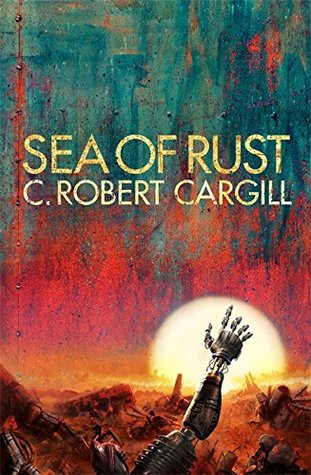
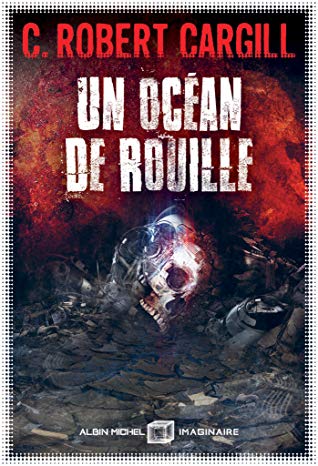
Gollancz (2017) – Subterranean Press (2018) – French Edition (2020)

Winner:
I thought this week would be a simple head-to-head but at the last moment I came across the French cover slated to come out in early 2020. But ultimately, the choice still came down to the other two. It’s always tempting to go with a Subterranean edition since they do such a wonderful job on all their covers, but this time I really do think I have to go with the original Gollancz. I mean, that color combination! And the striking image of the robotic arm reaching out silhouetted against the sunset? Gorgeous.
But what do you think? Which one is your favorite?
Review: Flamebringer by Elle Katharine White
Posted on November 14, 2019 17 Comments
I received a review copy from the publisher. This does not affect the contents of my review and all opinions are my own.
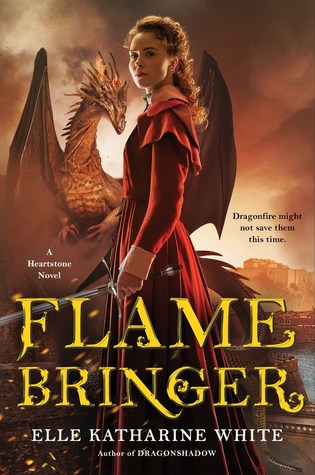 Flamebringer by Elle Katharine White
Mogsy’s Rating (Overall): 4 of 5 stars
Genre: Fantasy
Series: Book 3 of Heartstone
Publisher: Paperback: Harper Voyager | Audiobook: HarperAudio (November 12, 2019)
Length: Paperback: 368 pages | Audiobook: 10 hrs and 40 mins
Author Information: Website | Twitter
Narrator: Billie Fulford-Brown
It’s amazing to look back and see how far this series has come. What began as a fantasy retelling of Pride & Prejudice has flourished and matured into a trilogy that is a phenomenon in its own right. Ever since Elle Katharine White started injecting more original ideas into the world of Heartstone, expanding the lore and enriching the characters and story with her own personal touch, things have started to really take off.
Flamebringer, the third and final volume, begins with Aliza and Alastair heading off into the wilderness in pursuit of Wydrick, the sworn enemy of the Daireds. Reanimated by a ghast, Wydrick is now immortal and more powerful than ever, and he has a dire warning for our characters.
In this world of magic and monsters, there are creatures more terrible than you can ever imagine. In the heart of the Old Wilds, Aliza and Alistair stumble upon an ancient sanctum holding secrets older than time itself. Everything they know and love is now being threatened by a terrible evil, newly awakened and ready to wreak havoc. Under its direction, bloodthirsty hordes of Tekari and Ghasts are gathering outside the capital of Edonarle and preparing to attack.
Racing against time to warn the city, our couple traveling on the dragon Akarra must brave the elements and other dangers of the wilds. But even if by some miracle they manage to survive the coming onslaught, there’s still the messy matter of politics to contend with. The word is that an ambassador from the south has been dispatched at the behest of the elusive Silent King, and it is anyone’s guess what his next move will be.
There’s a bit of everything in this book, including action, adventure, mystery, and a strong dose of political intrigue. There’s another noticeable shift here in terms of focus, as this time, the author has decided to go all in on the story. Of the three books, Flamebringer feels the most tightly plotted, whisking readers off on this epic journey packed to the gills with edge-of-your-seat battle scenes and shocking watershed moments—all of it building up to a finale you won’t soon forget.
At the same time, White is careful not to neglect the character development amidst all this furious action. The relationship between Aliza and Alistair is central to this series, and thankfully this aspect continues to grow and evolve as we watch their marriage go through its ups and downs. Despite the novel’s aggressive pace, we do get the occasional opportunity to catch our breath and explore Aliza’s inner thoughts during these brief moments of respite. She is still dealing with a lot of grief and guilt over past losses, and even though Aliza has nothing but love for her family, some of her feelings are causing unwanted tensions between her and her sister.
Quite honestly, I was surprised to find such a heavy emotional component in such a fast-paced book. But at the same time, having been with these characters since the beginning, I feel a closeness to them, especially to Aliza who wears her heart on her sleeve despite the rules of etiquette and social manners being so ingrained in her life. I really felt for her, and throughout the novel there were a few intensely raw moments that stood out for me, where I truly believe the author wrote straight from the heart.
While a part of me is tempted to say Flamebringer could have used more dragons, at the same time, I think we all know the series has moved far beyond that. All in all, I couldn’t be happier with the way this book ended. It’s hard to believe such a sensational epic journey grew out of a book like Heartstone, but such surprises are often the best kind. Needless to say, I’m mighty glad we broke out of the standard retelling mold, and I look forward to seeing all the other ways Elle Katharine White will stretch her creativity muscles in the future. Overall, I highly recommend this trio of books for anyone who enjoys a good balance of fantasy, romance, and intrigue!


More on The BiblioSanctum:
Review of Heartstone (Book 1)
Review of Dragonshadow (Book 2)
#SciFiMonth Waiting on Wednesday 11/13/19
Posted on November 13, 2019 12 Comments

“Waiting On Wednesday” is a weekly meme that first originated at Breaking the Spine but has since linked up with “Can’t Wait Wednesday” at Wishful Endings now that the original creator is unable to host it anymore. Either way, this fun feature is a chance to showcase the upcoming releases that we can’t wait to get our hands on!
Mogsy’s Pick
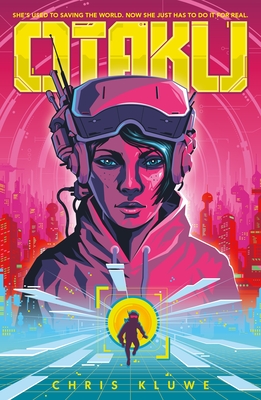
Otaku by Chris Kluwe (March 3rd, 2020 by Tor Books)
Many folks probably know Chris Kluwe for his former career as an NFL punter, but being heavily into MMORPGs in the late 2000s, I’ve always associated his name with being a hardcore World of Warcraft player and video games enthusiast. He’s also a writer, and even though I haven’t had much luck with his short stories in the past, he’s soon coming out with a debut novel, which is much more my speed. Besides, I really can’t say no to a story that’s been described as reminiscent of Ready Player One and Ender’s Game.
 “Ditchtown.
A city of skyscrapers, built atop the drowned bones of old Miami. A prison of steel, filled with unbelievers. A dumping ground for strays, runaways, and malcontents.
Within these towering monoliths, Ashley Akachi is a young woman trying her best to cope with a brother who’s slipping away, a mother who’s already gone, and angry young men who want her put in her place. Ditchtown, however, is not the only world Ash inhabits.
Within Infinite Game, a virtual world requiring physical perfection, Ash is Ashura the Terrible, leader of the Sunjewel Warriors, loved, feared, and watched by millions across the globe. Haptic chambers, known as hapspheres, translate their every move in the real to the digital—and the Sunjewel Warriors’ feats are legendary.
However, Ash is about to stumble upon a deadly conspiracy that will set her worlds crashing together, and in the real, you only get to die once…”
#SciFiMonth Audiobook Review: Interference by Sue Burke
Posted on November 12, 2019 22 Comments
I received a review copy from the publisher. This does not affect the contents of my review and all opinions are my own.

Mogsy’s Rating (Overall): 3.5 of 5 stars
Genre: Science Fiction
Series: Book 2 of Semiosis Duology
Publisher: Macmillan Audio (October 22, 2019)
Length: 12 hrs and 12 mins
Author Information: Website | Twitter
Narrators: Daniel Thomas May, Caitlin Davies
To be honest, I was a little surprised when I found out Semiosis was getting a sequel. I had felt the book ended in a good place, with a satisfying conclusion that capped off a multi-generational narrative in the best way possible. But because I enjoyed myself so much, I certainly wasn’t going to complain about a chance to return to Pax, the alien planet on which these books take place—not even when I discovered the story will be set some two hundred years after the first novel and follow a new group of explorers from Earth.
In fact, even though the series has been marketed as a duology, this second book, Interference, can technically be read on its own, but having the background knowledge from Semiosis will help a lot. A considerable time has passed since the first humans set foot on Pax, learning to adapt and share this strange and wonderous new world with its native fauna and flora. Over the generations, the colonists have settled into a comfortable equilibrium with the sentient alien life on the planet, becoming one with Pax itself. And watching over this entire process to make sure everything runs smoothly is Stevland, a bamboo-like lifeform and prime mover of this utopian society.
But now, that fragile balance that Stevland has so carefully developed is about to be disrupted. A new group of scientists from Earth have arrived on Pax, and they are as clueless as the original explorers were when they first landed on the planet more than two centuries ago. These humans want to know why communication with the colony has halted, yet they are completely unaware of the unique nature of Pax and its wildlife, nor do they understand the complex relationship between Stevland and the settlement. The scientists bring with them unfamiliar ideas, concepts, and technology—much of which Pax humans have forgotten over the generations. But more than that, the expedition also brings chaos in the form of disturbing new information about a genocide on Earth, and a couple of their team members who carry knowledge that can threaten Pax.
To start, while I really enjoyed returning to this world, I didn’t think Interference was as good as Semiosis, but I think that was because I went with certain expectations. In a look back at why I liked the first book so much, one of the main reasons was the theme of colonization and the characters’ first contact with the new planet’s unique animal and plant life. Obviously, with a settlement already established on Pax and humans having been integrated into its ecosystems for generations, this element was not as prominent in Interference. Semiosis also had a compelling narrative structure made up of points-of-view from multiple generations, and as a result, the novel had the feel of a collection of short stories that fit together to form a complete picture. Personally, I loved that format, and that it was a brilliant move by author Sue Burke to turn the focus onto the colony rather than the individual characters. Interference also features an attempt at its own unconventional narrative style, but this time, I didn’t think it was as effective. Following a more linear timeline, chapters are told from the perspective of different individuals, but paradoxically, I actually found it harder to engage with any of the characters even though we were able to glean more information overall about their personalities, behavior and culture.
Still, one aspect that remained spectacular was the biological science factor, as well as the social insight into human behavior. Of course, this time we also had the added element of the alien societies. Humans now exist peacefully alongside a race of beings called Glassmakers, who are themselves the descendants of non-native colonists who have come to Pax. Granted, you have the usual sources of tension whenever you have disparate groups sharing a living space, but on the whole, society runs like a well-oiled machine. This in part is thanks to Stevland, who is just one of the best concepts I’ve ever encountered in a science fiction novel. The sheer imagination behind the world-building is just incredible to behold, especially the way Burke has managed to seamlessly combine her hard science fiction ideas with ecological theories. This time, we explore the disastrous consequences of a system disrupted with the arrival of the new humans, some of whom have attitudes that are completely incompatible with Pax and its inhabitants. As a result, I also have to say the conflict is much more intriguing in Interference, which is probably the one key advantage the book has over its predecessor.
At the end of the day though, I just didn’t feel as invested as I did with Semiosis. That said, Interference was still a great read. As long as you go in expecting the changes and differences from the first book, you’ll no doubt have a blast. One of the smartest, most unique and mind-blowingly imaginative science fiction I’ve read in ages, this duology is well worth your time especially if you enjoy stories about space exploration, colonization, and unique interactions with alien species.
Audiobook Review: I listened to the first book in audio, and I enjoyed it so much that I decided to stick with the format for the sequel. Narrators Caitlin Davies and Daniel Thomas May reprise their roles, and between them, they’ve once more captured the essence behind the voices of multiple characters, and even more impressively, this time there are non-humans thrown into the mix. As a result, there were lots of subtle nuances in the text, but portraying each of the different perspectives was not a problem for either of them. I am especially a big fan of Davies, who always delivers a great performance, and Interference was definitely no exception.

More on The BiblioSanctum:
Review of Semiosis (Book 1)
#SciFiMonth Book Review: Fortuna by Kristyn Merbeth
Posted on November 11, 2019 30 Comments
I received a review copy from the publisher. This does not affect the contents of my review and all opinions are my own.

Mogsy’s Rating: 4 of 5 stars
Genre: Science Fiction
Series: Book 1 of Nova Vita Protocol
Publisher: Orbit (November 5, 2019)
Length: 560 pages
Author Information: Website | Twitter
Kristyn Merbeth, AKA K.S. Merbeth, the author behind the rollicking Wastelanders novels Bite and Raid, takes her brand of riotous adventure and thrills to even greater heights in Fortuna. In this action-packed space opera about a dysfunctional family of smugglers, we journey with Scorpia Kaiser and her mother and siblings aboard their titular ship across a galaxy filled with conflict and chaos.
As the eldest daughter and the pilot of Fortuna, Scorpia is looking forward to inheriting the business and the ship from her mother one day. But a recent transmission has thrown a wrench into those plans. Three years ago, her older brother Corvus turned his back on the family, enlisting in a war to fight for his home planet of Titan. His decision broke Scorpia’s heart, and because of that she has never forgiven him for his betrayal. But now, Corvus’ tour of duty is over, and their mother has ordered the Fortuna to rendezvous with him while on their way to another job, which unexpectedly takes a calamitous turn right in the middle of the awkward reunion.
But what Corvus’ younger siblings don’t know is the truth of why he returned to Titan to fight in an unwinnable war. They have all changed a lot in the last three years, and his once beloved little sister Scorpia is clearly unhappy about his return. But with an entire planet dying around them, the Kaisers must now put aside their differences and work together in order to survive. Realizing how their mother had been used as a pawn in a conspiracy that reaches to the highest levels of interstellar politics, Scorpia and Corvus settle on a truce in order to protect what’s left of their family and prevent the galaxy from tearing itself apart from the inside out.
Told in the first-person, alternating between Scorpia and Corvus’ points of view, Fortuna is a non-stop thrill ride through a vividly imagined universe, where the planet on which you were born can mean as much as your family name, while those without a world to call home can be left vulnerable and without protection. Where you claim origin can affect your culture, your history, and how others perceive and treat you, and even among members of the same family, your birthplace can matter. Under such divisive conditions, it is no surprise that there is so much tension among the planets, leading to the development of deadly biological weapons including plants that can strangle the life out of an entire world. For a series opener, the world-building was simply superb, setting the stage for more adventures to be had in this most imaginative setting.
But the characterization was what made Fortuna stand out, and having it be a story about family was a brilliant move on Merbeth’s part. Anyone with a close sibling will probably find something familiar, heartwarming, or relatable in the characters’ interactions, because we understand how even though our brother or sister can get on our nerves, it’s simply impossible to imagine life without them. Corvus and Scorpia are complete opposites—him being serious and cool-headed, and her being impulsive and quick-tempered—but the two of them were close before his departure, which made the animosity between them upon his return all the more tragic. However, because of this impressively layered approach to their history, the ensuing steps to their reconciliation and eventual partnership were fascinating to watch.
Their voices, so different from each other, also complemented each other surprisingly well. Both of them have their issues, with Scorpia dealing with a drinking problem that often lands her in trouble and causes her to make all kinds of bad decisions, while Corvus has seen and done some things in the war which has left their mark on his soul. But when it’s time to take responsibility, the two of them admirably step up and show they have what it takes. Their contrasting personalities and problem-solving styles also meant a plotline that was always interesting and dynamic, and although dual narratives often make me wary, in this case there was never any confusion which character we were following. Better yet, once Scorpia and Corvus’ threads converged, the story got even better.
At the end of the day though, the plot’s trajectory and outcomes are pretty standard—but if you’ve come to Fortuna from the author’s Wastlanders books, you probably already know there’s absolutely nothing wrong with that. When it comes to delivering a boatload of sci-fi action and rip-roaring entertainment, Merbeth knows exactly what she’s doing, keeping the story’s momentum raging along like a pro. Even when you know what’s coming, you just can’t help but hold your breath and keep your fingers crossed, and that’s exactly the kind of intensity and electrifying experience I look for in my space opera. The only question now then, is when does the next book come out already?

#SciFiMonth Audiobook Review: Walking to Aldebaran by Adrian Tchaikovsky
Posted on November 10, 2019 28 Comments
I received a review copy from the publisher. This does not affect the contents of my review and all opinions are my own.
 Walking to Aldebaran by Adrian Tchaikovsky
Mogsy’s Rating (Overall): 4.5 of 5 stars
Genre: Science Fiction
Series: Stand Alone
Publisher: Tantor Audio (October 15, 2019)
Length: 3 hrs and 36 mins
Author Information: Website | Twitter
Narrator: Adrian Tchaikovsky
I confess, I haven’t always had much luck with novellas, even when it comes to those by favorite authors, but I ended up really enjoying this one. For me, it was simply the right mix of humor and horror. Take the witty, smart-alecky narrative style of The Martian and combine it creepy, dread-inducing atmosphere of Alien, and you’d probably end up with something like Walking to Aldebaran. One wouldn’t think that would work so well, but it did.
The book takes us inside the head of our protagonist, astronaut Gary Rendell. And us, we are Toto. Don’t ask. All you have to know is that our man Gary has been on his own for a long time, long enough for him to start going a little stir-crazy, hoping to find another living soul to call friend. They wouldn’t even need to human. At this point, Gary is beyond caring about such trivialities, for you see, he’s trapped on a giant alien artefact that was found drifting at the edge of our solar system, following a disaster that killed the rest of his crewmates. Now he’s lost, frightened and alone, wandering aimlessly through the cold dark tunnels of the megalith.
Gary had thought he was lucky when he was chosen to be part of the exploration team, after a space probe sent back images from the Oort Cloud showing a strange alien rock which was nicknamed “The Frog God” because of its uncanny resemblance to the amphibious animal. But now that he’s in this mess, he can’t help but look back on the past and examine the chain of events which has led him here. And maybe it’s the shadows playing tricks with his eyes, or the fact he’s losing his mind from being so lonely and terrified, but over the course of all this walking, he’s seen and experienced some pretty weird shit. Not to mention, perhaps he’s not so alone in these Crypts after all, though whatever horrible thing is out there, he’s not so sure he wants to meet it.
Hands down, my favorite thing about Walking to Aldebaran was the voice of protagonist. There’s no question that Gary Rendell’s humorous accounting of his journey added much enjoyment to the book, but there’s also another side to it. You know the saying “you gotta laugh or you’ll cry” or ever hear of people cracking jokes as a fear response? There’s definitely an underlying element of this at play in the narrative, and rather than breaking me out of the immersion, the humor actually worked to further emphasize the sheer horror of the situation in which Gary has found himself.
I also liked how the overall story unfolded. For such a short book, there’s quite a lot to unpack. From Gary’s experience in the Crypts to the events that led up to the discovery of the Frog God and how the exploration team came to be on the alien artefact, everything is covered here in a way that balances pacing and the amount of detail being doled out. Adrian Tchaikovsky takes care not to overwhelm the reader with information, nor does he want to push us too far over the edge when it comes to the terror and intensity of the atmosphere. Each time before the plot can veer too far in one direction, he reels things back to build interest in another area, so that we get to cover a lot of ground while moving at a fast clip. Flashback scenes and memories were also done well in a way that doesn’t draw too much attention away from what’s happening in the here and now.
Also, the ending—which I will not go into, because no spoilers here—was one hell of a dark twist, and I never thought I’d be saying this but it might have single-handedly solidified Walking to Aldebaran as one of my favorites by the author, right behind Children of Time. Granted, so far I’ve only read a relatively small sample of his massive bibliography, but this one felt pretty special to me, which is all the more impressive considering how picky I am when it comes to novellas.
Bottom line, I found Walking to Aldebaran to equal parts hilarious and terrifying, and ultimately very rewarding. Of course, I can see it not being to everyone’s tastes, given the narrative tone of the protagonist, but if you don’t mind a bit of lightness with your horror and an interesting approach to the unreliable narrator, I would give this a try. I also don’t recommend novellas too often, but once in a while an exception will come along, and this one I believe would be an excellent introduction to Adrian Tchaikovsky because it’s a wonderful showcase of his talents as a storyteller, if you’ve ever been curious about his work.
Audiobook Comments: It seems I’ve been having all kinds of luck with author-narrated audiobooks lately, because this was Adrian Tchaikovsky gave a superb performance on this one. I also think it worked especially well given the character of Gary Rendell. Tchaikovsky, being his creator, knew exactly how to deliver his protagonist’s narration, right down to the little details like tone and cadence, making this one an awesome listen all around.

YA Weekend: The Guinevere Deception by Kiersten White
Posted on November 9, 2019 27 Comments

I received a review copy from the publisher. This does not affect the contents of my review and all opinions are my own.
 The Guinevere Deception by Kiersten White
Mogsy’s Rating: 3 of 5 stars
Genre: Fantasy, Young Adult
Series: Book 1 of Camelot Rising
Publisher: Delacorte Press (November 5, 2019)
Length: 352 pages
Author Information: Website | Twitter
Kiersten White has done some incredible work with retellings/re-imaginings like with her Conqueror’s Saga and Slayer, so it probably comes as no surprise that I was beside myself with excitement when I found out she was working on a new take on the Arthurian legend. Still, I was glad I kept my hype in check. Arthurian fantasy tends to be tricky because of its deeply rooted traditions in mythology, and I haven’t found too many books that can clinch the mainstays of the subgenre while still managing to break free of some of its more restrictive elements to tell an interesting story. While The Guinevere Deception was a really good effort, it still didn’t quite deliver the balance I wanted.
The opening to a new series called Camelot Rising, the novel is so titled because it follows the story of a very different version Guinevere—a Guinevere who is not a princess, but a pretender. Trained and tasked by Merlin to be a guardian, our protagonist is a forest witch who is sent to Arthur to be his queen and protector after the real Guinevere dies in a convent. While our imposter can recall not much else from her past, she is determined to succeed in her mission, throwing her full effort into playing the part given to her especially after her arrival in Camelot and witnessing Arthur’s kindness and gallantry for herself.
After marrying the king, Guinevere sets to learning more about the kingdom and the people who spend time with her husband at the castle, assessing for threats. Despite Arthur’s goodness, there are always those who wish to do him harm, including the followers of the Dark Queen, whom he defeated years ago. But as she discovers more about the history of Camelot as well as some disturbing new information about Merlin, Guinevere begins to question her role in the venerable magician’s plan and doubt a lot of the things she’s been told. With her own life shrouded in mystery and forgotten memory, she is no longer certain she can trust herself to be the protector Arthur needs her to be.
As a legend of King Arthur retelling, The Guinevere Deception has all the right ingredients and includes many of the familiar names. If you’ve read Kiersten White before though, you also probably know of her propensity to throw in unexpected twists or to rework the story and characters with her own creative ideas like gender swapping and other revisions to increase diversity and representation. However, for the most part, such changes were pretty superficial. Instead, the main selling point for me—and what I believed would make this book special—was the protagonist and her origins as Merlin’s protégé masquerading as Guinevere in order to get close enough to Arthur to safeguard him from danger.
Unfortunately, the author kind of bungles this aspect. The one hook about novel I was really excited about, and well…it just wasn’t very interesting. First off, things took way longer than should have to take off. Here was this amazingly cool concept framing Guinevere as a formidable secret protector, but we spent much of this book stumbling around without any clue as to what’s going on, and whatever conflict there was took its sweet time to develop. Sure, Guinevere ends up making lots of friends, and every now and then we get a joust or a skirmish or two, but for the most part, a whole lot of nothing happens.
I will give the book this, though—the story makes for an excellent character study of Guinevere, exploring the themes of trust, loyalty, love and sacrifice. Because she knows so little about her past, that sets the stage for a lot of personal drama, and we the readers get to be front and center when she learns more about herself. Certainly, as someone who enjoys these kinds of stories, I didn’t mind this character-focused approach too much, though to be honest, I had expected a little more.
Thankfully, last 25-30% saw the plot take a number of exciting turns—admittedly, some of them were expected, but at that point I was happy to take anything that comes along to shake things up. A little too late to make me change my mind about my final rating for this book, perhaps, but it did give me a lot more hope for the sequel. I love Kiersten White too much to give up on this series, even though on the whole The Guinevere Deception didn’t do much for me. If you enjoy character studies or stories that are more about human drama, maybe you’ll have better luck with this, but I’m glad I reined in my expectations. On the whole, this was a decent read, but simply not the fresh and compelling Arthurian legend retelling I’d hoped for.

#SciFiMonth Friday Face-Off: Explosion
Posted on November 8, 2019 39 Comments
Welcome to The Friday Face-Off, a weekly meme created by Books by Proxy! Each Friday, we will pit cover against cover while also taking the opportunity to showcase gorgeous artwork and feature some of our favorite book covers. If you want to join the fun, simply choose a book each Friday that fits that week’s predetermined theme, post and compare two or more different covers available for that book, then name your favorite. A list of future weeks’ themes are available at Lynn’s Book Blog.
This week’s theme is:
“Big badda boom”
~ a cover featuring an EXPLOSION
Mogsy’s Pick:
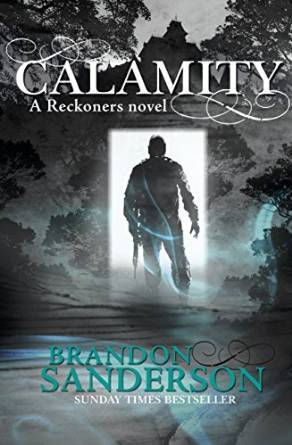
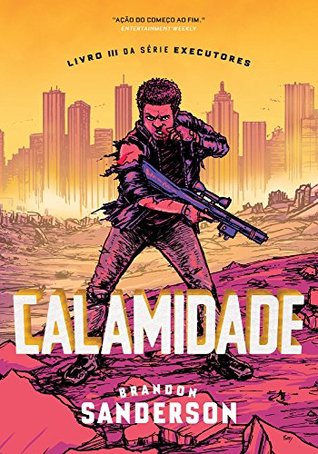
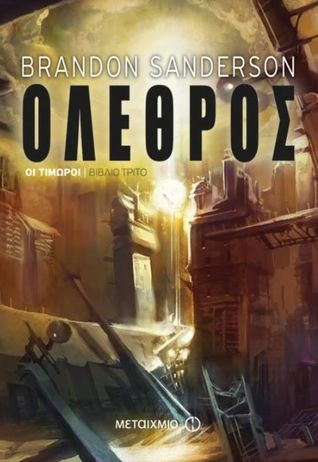
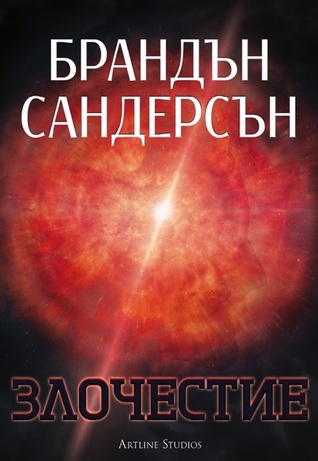
Calamity by Brandon Sanderson
It’s Sci-Fi November! To celebrate, I’ll be featuring science fiction titles on Friday Face-Off for the full month. Up next, we’re shining the spotlight on the third and final book of Sanderson’s super-villain trilogy, The Reckoners. And how apt that this week’s theme is all about explosions, because this book sure end things with a bang. Let’s take a look at some of the covers:
From left to right:
Delacorte Press (2016) – Gollancz (2016)

Portuguese Edition (2018) – Polish Edition (2017) – Dutch Edition (2017)


Greek Edition (2017) – French Edition (2018) – Russian Edition (2018)

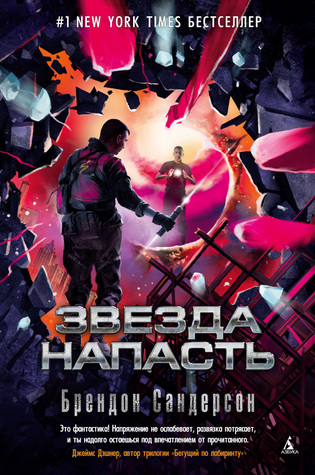
Czech Edition (2016) – Bulgarian Edition (2016) – Danish Edition (2017)


Winner:
So many colors! I found it hard to choose a favorite this week, because there were quite a few that stood out, including the Portuguese edition with its comic book art style, the Gollancz edition with its monochromatic theme and silhouette, and of course the Delacorte hardcover with its vibrant pinks and purples. And then there’s the Russian edition, which is like a marriage of all three, so that’s the one I’m going to have to go with.
But what do you think? Which one is your favorite?
#SciFiMonth Book Review: Aurora Blazing by Jessie Mihalik
Posted on November 7, 2019 22 Comments
I received a review copy from the publisher. This does not affect the contents of my review and all opinions are my own.
 Aurora Blazing by Jessie Mihalik
Mogsy’s Rating: 3.5 of 5 stars
Genre: Romance, Science Fiction
Series: Book 2 of Consortium Rebellion
Publisher: Harper Voyager (October 1, 2019)
Length: 400 pages
Author Information: Website | Twitter
I won’t lie, these are the types of romances I can only take once in a while and in small doses, but when I do, damned if I don’t have a lot of fun with them. The first book Polaris Rising served up so much entertainment, I was beyond excited and curious to check out the next installment, a standalone follow-up featuring Ada’s sister Bianca.
Bianca von Hasenberg might not be the action hero like her little sister, but she has her own bag tricks, even if they came at a steep price. No one really knew it, but for years she was trapped in a deeply unhappy marriage. Her husband was essentially this mad scientist who experimented on her against her will, injecting her with nanotechnology that altered her brain structure and endowed her with the ability to intercept communications. This secret made Bianca a very powerful intelligence gatherer, but her health and life was never the same again, and following the death of her husband, she vowed she would never remarry.
Nevertheless, Bianca finds it impossible to deny an attraction to Ian Bishop, the head of security for House von Hasenberg, even though the two of them share a complicated romantic past. But then one day, following an attack, Bianca’s eldest bother and their house’s heir is taken by mysterious kidnappers, sending the entire place into lockdown mode. Knowing that she alone has the unique capabilities to get her brother back, Bianca defies orders and embarks upon a rescue mission to go find him. In response to her disobedience, her father sends Ian on her trail to stop her and bring her home. Bianca, however, believes that she and the security director would make a great team, if only she can look past their history and convince him that working together will mean a greater chance at saving her brother.
You’d think given the background details of her history and all that her character has gone through, Bianca would be a very different protagonist than her sister Ada, but the are actually very similar in the ways that count. Yes, while Bianca is more of a thinker than a fighter, she can still certainly crack a few skulls when the situation calls for it. And of course, as evidenced by her inclinations to break rules and take off on her own, Bianca also has the same rebel spirit as her sister. While I appreciated that her weariness and trauma had to be downplayed in order to make her character come across as stronger in this book, I think I would have liked to see them factored into her emotional depth. Anyway, I don’t want to make it sound like the two characters are the same because they’re not, but I confess I had hoped for a little more to set Bianca and Ada’s personalities and voices apart, especially since there could have been so many possible directions to take Bianca’s spymistress/master hacker/ information broker persona, which would have been way more interesting.
I guess it also didn’t help that like Ada, Bianca ends up falling for a man who’s kind of an asshole. Like Loch, Ian is on the possessive and domineering side, but because he lacks the former’s swagger and sheer force of personality, the way he comes across is much less appealing, if that makes sense. Something about Ian just did not sit right with me, and I didn’t feel like he had as much chemistry with Bianca as Ada did with Loch. To be fair though, we know relatively less about Ian in this book, since he is kept at a distance for so much of the story, and we don’t even get know the true extent of his feeling for Bianca until close to the end, at which point the romance gets dialed up from 1 to 10 in like no time flat. Don’t get me wrong, I love a slow-burn romance as much as the next reader, but I have to say the payoff here was slightly lacking, and I suspect the reason for this is because we were never given a chance to really know Ian.
But at the end of the day, I suppose what I’m trying to get at here is that in many ways, Aurora Blazing feels like a retread of a lot of the ideas in Polaris Rising (and from countless other romance novels, if I’m to be honest). That’s not necessarily a bad thing, especially if you enjoyed the first book. In fact, if you did, you’re pretty much guaranteed to like this sequel, which I did too, despite my gripes. My only criticisms stem from mainly two things: 1) the fact that Ian was not as great as Loch, and 2) the story had less action, and while things could have improved with the addition of more intrigue, instead the pacing just felt slower overall. Everything else—like the lighter world-building elements or the flimsier aspects of the plot—I didn’t mind at all, as it’s all sort of a given when it comes to a book like this that makes no claims to be anything but a romance first and foremost, and a sci-fi novel second. It’s why I picked it up, after all.
To sum up, I had a good time with Aurora Blazing, despite it being not as strong as the first book. But like I said, every once in a while it’s great to kick back with a book like this—an unapologetic and deliciously self-indulgent romance whose only aim is delivering a fun sexy read. I look forward to Jessie Mihalik’s next book in the Consortium Rebellion sequence, which I hear will focus on the third sister in the House von Hasenberg clan, Catarina.
More on The BiblioSanctum:
Review of Polaris Rising (Book 1)
#SciFiMonth Waiting on Wednesday 11/06/2019
Posted on November 6, 2019 21 Comments
“Waiting On Wednesday” is a weekly meme that first originated at Breaking the Spine but has since linked up with “Can’t Wait Wednesday” at Wishful Endings now that the original creator is unable to host it anymore. Either way, this fun feature is a chance to showcase the upcoming releases that we can’t wait to get our hands on!
Mogsy’s Pick
Unreconciled by W. Michael Gear (May 12th 2020 by DAW)
In honor of Sci-Fi Month, I’m featuring sci-fi picks for my Waiting on Wednesday posts for the whole of November. First up is the fourth Donovan novel – just when I thought things had come to an end, along comes another book to get me excited all over again! I was thrilled when I found out the series was going beyond what I thought was a trilogy, and I can’t wait to dive back in to this world.
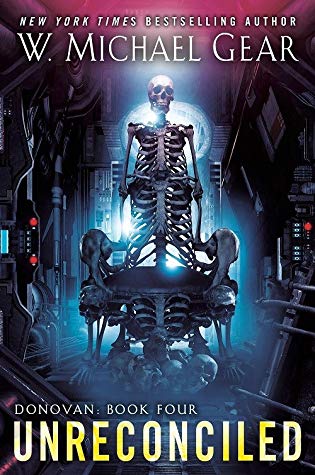 “The fourth book in the thrilling Donovan sci-fi series returns to a treacherous alien planet where corporate threats and dangerous creatures imperil the lives of the colonists.
Where does one put a messianic cult of practicing cannibals? That becomes the question when Ashanti appears in Donovan’s skies. She was designed for no more than four years in space. It’s taken ten. The crew has sealed the transportees onto a single deck–and over the years, the few survivors down there have become monsters. Lead by the messiah, Batuhan, they call themselves the Unreconciled.
Supervisor Kalico Aguila settles them at remote Tyson Station. With the discovery of a wasting disease among the Unreconciled, it’s up to Kalico, Dya Simonov, and Mark Talbot to try and deal with the epidemic. Only Batuhan has plans of his own–and Kalico and her people are to be the main course.
Talina Perez has brokered an uneasy truce with the quetzal molecules that float in her blood. Now, she, young Kylee Simonov, a quetzal named Flute, and a clueless nobleman named Taglioni rush to save Kalico’s vanished party.
But as always, Donovan is playing its own deadly game. Lurking in the forest outside Tyson Base is an old and previously unknown terror that even quetzals fear. And it has already begun to hunt.”


 The BiblioSanctum