#RRSciFiMonth: In the Beginning, There Was H.G. Wells
Sci-Fi November is a month-long blog event hosted by Oh The Books and Rinn Reads this year, created to celebrate everything amazing about science fiction! From TV shows to movies, books to comics, and everything else in between, it is intended to help science fiction lovers share their love and passion for this genre and its many, many fandoms.
 I’m making a point of reading the classics, and when it comes to science fiction, where better to start than with them an considered to be the father of the genre, H.G. Wells?
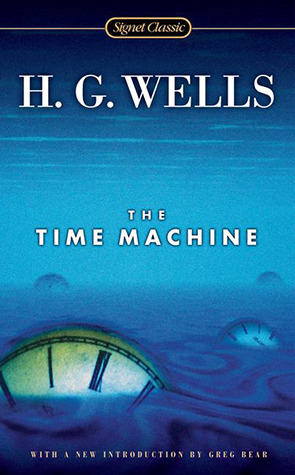
Published in 1895, The Time Machine is Wells’ first book, which I read in 2012. It was a difficult read for me initially, because of all the scientific and mathematical chatter in the first chapter. But I managed to trudge through, as this did not last long and the Time Traveller was off and returned from his adventure soon enough.
The narrative then became quite verbose and descriptive, as is to be expected since the Time Traveller was describing his experience. At times, it perhaps felt a bit over embellished, but not enough for me to truly claim that to be a negative in the story.
![The Time Traveller's Time Sled [Source]](https://bibliosanctum.com/wp-content/uploads/2014/11/time-machines-through-er-time-20100325065957774.jpeg)
The Time Traveller’s Time Sled [Source]
In light of this being considered by some to be the first true science fiction novel, I can see it being rather impressive at the time of its publication. A whole new world and the reader gets to listen to the Time Traveller’s story in the same manner as the journalists, medical men and scientists whom he tells it to. I imagine the reaction of the readers at that time was very similar to those in the book.
Speaking of reactions, Wells’ second book, The War of the Worlds, inspired quite an intense one when Orson Welles narrated the book on the radio in 1938, causing wide spread panic.

The fallout from Orson Welles’ narration of The War of the Worlds [Source]
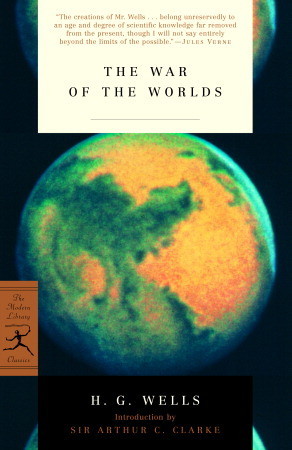 While the Time Traveller went to a distant future, The War of the Worlds brings martians to earth. For what purpose? Why, our destruction of course!
Some say that true science fiction must involve real science. Wells set that precedent with his works. But while I had trouble with the influx of science in the first book, it is more organically used in this book, which is told from the point of view of a philosopher in the midst of writing when the first martian cylinder arrives. He survives the chaos wrought by the martians and their deadly heat rays. Through his eyes, we see the human struggle for survival — the fight, flight, or succumb instinct.
The most fascinating thing about Wells’ writing is that he spends no time on characterization. Indeed, characters aren’t even named, much less described. Those details are unimportant, yet through the narrator’s eyes, we gain so much.
Even more fascinating? Wells wrote all of these out-of-this-world tales long before humanity ever took to the skies.


Nice write up. But why would you consider this the first true Science Fiction Novel? I am curious what criteria, not trying to be a contrarian know it all =)
LikeLike
I read it somewhere on the internet and we all know that the internet never lies!
Wikipedia includes Jules Verne and Hugo Gernsback as the other authors considered the fathers of scifi, so I need to update my bucket list.
LikeLike
You’ve totally made me want to go back and read some classic SF. I think I read The Time Machine years ago, but it’s probably time to read it again.
LikeLike
Another classic i have not tried
LikeLike
I’m so ashamed to say that even if I heard a bout about the author I haven’t read any. I’ll really have to do that some day.
LikeLike
I love books that allow you to speculate 🙂 Really interesting how none of the characters are named! 🙂
LikeLike
Two classics. My 12-year old son just read “War of the Worlds”. Considering the special effects eye candy that his generation grew up with, I was afraid that a 116-year old story wouldn’t appeal to him, that it would seem dated. But he told me this morning that he loved it. 🙂
LikeLike
That’s wonderful that he can still appreciate it! There’s hope for this new generation yet 😉
LikeLike
It amazes me how right some of those classic authors were about the future, like 20,000 leagues under the sea. It’s been so long since I read the time machine I don’t remember much about it other than I thought it was just okay.
LikeLike
It loses a lot with the times, but it’s still an interesting read.
LikeLike
I confess I loved the Time Machine – although a reread could be in order. I read it in the days of mainly reading classics and amongst the bonnets of Austen and the windswept moors of the Brontes this little slice of sci fi was quite welcome.
Lynn 😀
LikeLike
Oh I wish we could have read more science fiction and fantasy in school. In grade 10, we got to select from a bunch of books including The Hobbit and Ender’s Game, which was cool, but you only got to pick one. Of course we could read them ourselves later, but I didn’t have an appreciation for school books then to be willing to try other stuff teachers tell me to read….
LikeLike
I really like H.G. Wells, although I also struggled with The Time Machine…it was a bit slow moving for my tastes. You know, it’s interesting that you mention the view that the inclusion of actual science is what makes a text science fiction because a bunch of my professors at uni believe this. We were reading a short story by Octavia Butler – set in space and about aliens – and my prof was adamant that it wasn’t sci-fi because it was “literature.” No one in my class was impressed with that response. >.>
LikeLiked by 1 person
Actually, Octavia Butler would have agreed with your professor. She did not class her work as science fiction, however, she recognized the marketing requirements of her publisher and therefore didn’t argue it.
LikeLiked by 1 person
Thanks for taking a look back at the classics. I too had a hard time reading the HG Wells when I was a kid. Maybe I should give him another shot, though two of the commenters remind me that I should be reading Octavia Butler — Kindred has been on my TBR list for far too long.
Thinking about classics though I’ve always been persuaded by the argument that Mary Shelly deserves a lot of credit for creating a novel that explores the consequences of science, how an experiment on life affects not only how we think about what it means to be human, but also has a deep impact on the scientist. And her Frankenstein — which I recommend — was published in 1818, many decades before HG Wells.
LikeLiked by 1 person
I really do need to read Frankenstein, for this reason and many others. It’s interesting that Wells, along with a few others are considered the fathers of science fiction, yet we hear little about the mothers, since, as you point out, Shelly wrote this well before.
And yes to Butler. An absolute must. She doesn’t pull punches with her themes, so it’s not for the squeamish, but still so good. I actually still need to read Kindred–which really isn’t science fiction, save for the fact that she uses time travel…
LikeLiked by 1 person
Pingback: #RRSciFiMonth: Skeptical About SciFi? Try These | The BiblioSanctum
The War of the Worlds is one of my favourite sci-fi books, but I haven’t actually read any of Wells’ other work yet. He was so ahead of his time, it’s incredible.
LikeLike