Book Review: The Elves of Cintra by Terry Brooks
Posted on April 24, 2013 4 Comments
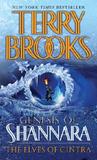
The Elves of Cintra by Terry Brooks
This is the second book in the Genesis of Shannara series so expect spoilers if you have not read the first, Armageddon’s Children, which I reviewed here. The second thing to note is that I am not a previous fan of the Shannara series. When I first attempted to read it, I gave up due to boredom. My brother told me this series was really good, so I’m working my way through with an eye on possibly attempting the original Shannara books again.
The Elves of Cintra jumps right in where Armageddon’s Children left off, with the various groups all coming together and separating in new and interesting ways to pursue their now clear-ish quests. Logan Tom, now with the Ghosts, is searching for Hawk, with the once-men hot on their trail. Meanwhile, Hawk awakens in the presence of a magical being who cryptically explains his new status as the gypsy morph and his destiny to save everyone by taking them to the promised land. The elves Kirisin and Erisha, now joined by Kirisin’s sister Simralin, are still seeking the elfstones and trying to convince Erisha’s father, the king of the importance of their mission to move the Ellcrys to a safe location. They are aided by an old historian elf named Culph and they are joined by Angel Perez and her fae conscience, Ailie. Angel is still pursued by the demon Delloreen, now fully transformed into a wolf-lizard creature.
The previous book spent a lot of time introducing the characters and giving them all backstories that made it clear that every human had suffered horrible childhoods that have led them to their currently place in this dystopian world of mutation and violence. They are all survivors in their own way. At the end of the last book, everyone has been set on the quests mentioned above so now, we are reading about how they survive the various pitfalls they meet along the way. Despite the efforts made to define the characters, I have not yet come to care about many of them. The ones that died in this book were not overly memorable and I can’t say a I felt like their friends’ reactions to their deaths were well written enough for me to feel their loss.
A new character was introduced, Catalya, and she alone is the bright spark in the series. A survivor just like the others, she actually doesn’t get one of the melodramatic backstories. Her actions and personality in the face of danger and contempt make up for that loss and easily make her a favourite. When she teams up with one of the Ghosts on a rescue mission, things perked up a bit, but that part of the story continues in the sequel.
But what about the elves? The title implies that this is their story and their quest to find the elfstones and the Loden certainly seems important. But Erisha, Kirisin and Simralen are so unmemorable. Some of the elves they deal with on their journey are quite interesting, but they are not around nearly long enough.
I previously listened to the audiobook, but chose to read the hardcover to see if it affected my judgment. I can conclude that listening to an audiobook would definitely have made the tedium more tolerable, however, it’s much easier to skim over pages when actually reading. The Elves of Cintra did not impress me enough to care about the future of Shannara, but I’m still just interested enough to at least find out how this trilogy ends. Eventually.

Book Review: Overkill by Robert Buettner
Posted on April 20, 2013 Leave a Comment

Genre: Military Science Fiction
Series: Book 1 of Orphan’s Legacy
Publisher: Baen
Author Information: Website
Tiara’s Rating: 4 of 5 Stars
Narrator: MacLeod Andrews | Length: 9 hrs and 21 mins | Audiobook Publisher: Audible Studios | Whispersync Ready: Yes
I originally bought the book as an impulse buy from Audible because they kept taunting me with a deal on certain books. This was one of those books whose description was written in a way to capture the reader’s attention while still managing to be vaguely suspicious. I wasn’t sure if I liked the cover (recovering cover snob that I am), but I decided to give this a try, even if my brain did try to tell me that this was probably going to be Space Rambo. However, since this was my science fiction month and I wanted to round out my selection and adding to the fact that the reviews were mostly favorable, I decided to give it a chance. Surprisingly, it was an interesting listen.
Twenty three year old Jazen Parker agrees to go to a planet known colloquially as “Dead End” with a rich tycoon to hunt one of the deadliest animals in the universe. The payout from this job will help Parker to get a new identity and start his life anew without the threat of the former mercenary group he worked for since he was a teen or the bounty hunters who want to take him back to his home planet to answer for his “crime.” He was born illegally on his home planet, and even though that wasn’t his fault, he can still be punished for his parents’ crime.
It’s really hard to talk about this book without spoiling most of it. You think you’re going into the book just getting a straightforward sci-fi military story with lots of action, and you do get that. However, you also get a well crafted sci-fi story that won’t allow itself to be shoehorned into just another shoot-em-up story. This story explores human nature and the similarities and differences that could exist between two intelligent races by giving us chapters from the alien’s point of view. He finds much of human behavior complex and needless. His own race is at an apex where they are absolutely on top of the food chain on their home planet and don’t need many of the behaviors that humans possess. The longer he travels with his human companions the more he learns about things such as empathy and sacrifice, notions he doesn’t have in his own culture because individuals in his race live solitary lives. They’re firm believers in allowing an individual to meet his destiny alone.
We also learn more about this other race in the process. We learn about their loose society structure and how they’ve managed to thwart genocide by humans by pretending to be dumb creatures. As stated in the book: “Overall the human species tolerated dangers in nature. What they did not tolerate were rivals.” Even though they know they are more intelligent and capable than humans. Humans possess knowledge and skills that make them very dangerous, especially to a territorial, solitary species like his where teamwork is downright disrespectful because it means encroaching on each other’s boundaries. However solitary they are, there is a thread of unity between them, a way they exchange knowledge, history, and ideas among themselves. They’re stubborn about their worldview being the only view and humans are obviously delusional in their opinion until circumstances causes one of them to embark on a pivotal journey.
Humans in this book have conquered most of the known galaxy, becoming so numerous on some planets that it’s a crime to reproduce without consent. (And I don’t really understand why Parkers parent traveled to a planet where it’s a criminal offense to have Parker, but maybe they had no other choice.) It’s even mentioned that they have destroyed other intelligent species after being given resources they needed and have turned back to warring against each other, but with more dire consequences (such as slavery, even though it’s supposedly humane, is a fate for the conquered). Humans are detached from earth, most having never seen earth and know little of its history.
Humans not knowing about their history, even if they’ve never laid eyes on earth, pains me. Parker will sometimes gripe about how trueborns think earth is the cultural apex of the universe and how names like George Washington mean nothing to him. While I can understand the sentiment, there are no other cultures present since it seems that humans have wiped out any other intelligent species, and the culture Parker complains about is the same culture who opened up the universe to humans. Just as Parker’s home world should be just as important to trueborns because it the collective history of humanity. Why wouldn’t the history of earth and humans be some kind of required reading? I’m over thinking this thing.
I didn’t know if I was going to enjoy the narrator at first, but he did very well and I think his characterization of Parker is what really stood out to me. He really made him feel distinct and alive for me. He managed to capture the youth and battle weary aspects of Parker’s personality. Parker is young and naive about many things outside of battle like women, but he’s seen so much war and death as a legionnaire. And MacCleod Andrews did a great job of capturing that.
This was an excellent story. There were a few parts that seemed kind of mystifying (Parker’s parents’ decision on where to have him) and parts that seemed to be quickly cobbled to the story as it neared its end. However, Buettner is knowledgeable about military and made it work in a way that isn’t overwhelming for readers. He also knows how to make characters engaging, and I thought more than once he’d probably be a great writer for the Mass Effect series. I’ll be moving on to book two in this series soon, hopeful that some mysteries remaining are solved.

Book Review: Falling Free by Lois McMaster Bujold
Posted on April 18, 2013 Leave a Comment
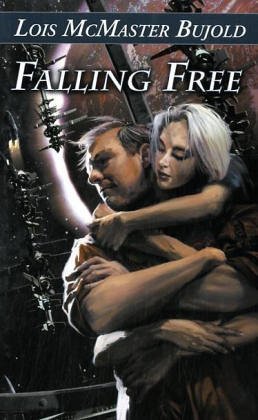 Falling Free by Lois McMaster Bujold
Genre: Science Fiction, Space Opera, Biopunk
Series: Book 4 of the Vorkosigan Saga
Author’s Information: Website
Tiara’s Rating: 3 of 5 stars
Leo Graf a talented engineer who finds himself pulled from his current station to a habitat operating in a system on the fringes of intergalactic law. Leo is chosen to teach welding to a group of special cases. He doesn’t learn how special until he reaches the habitat and witnesses just how loose and fast his employers have played with genetics. Soon, Leo finds himself placed in the center of a revolution, forcing him to confront the ambiguous morality that plagues the Cay habitat, forcing him to take a stand where he’d once only wanted to do his job and stay under the radar.
The quaddies (the experimental humanoids who are classified as “post fetal experimental tissue cultures”) are considered little more than inventory, and the company who funded the project to create them are equally as anxious to find a way to get rid of them once they’re proven to be obsolete. They don’t have standings as human beings. They shouldn’t exist and aren’t protected under intergalactic law. Leo, who has only worked with the quaddies for a few months, seems to be the only person who acknowledges that they are people despite their appearance. He hatches a plan to save them and allow them to live life on their terms. Leo’s plan to help the quaddies gain freedom is enormous in scope and seems a bit too ambitious, but the alternative is far worse. Read More
Princeless and Beyond: An Interview with Jeremy Whitley
Posted on April 17, 2013 3 Comments

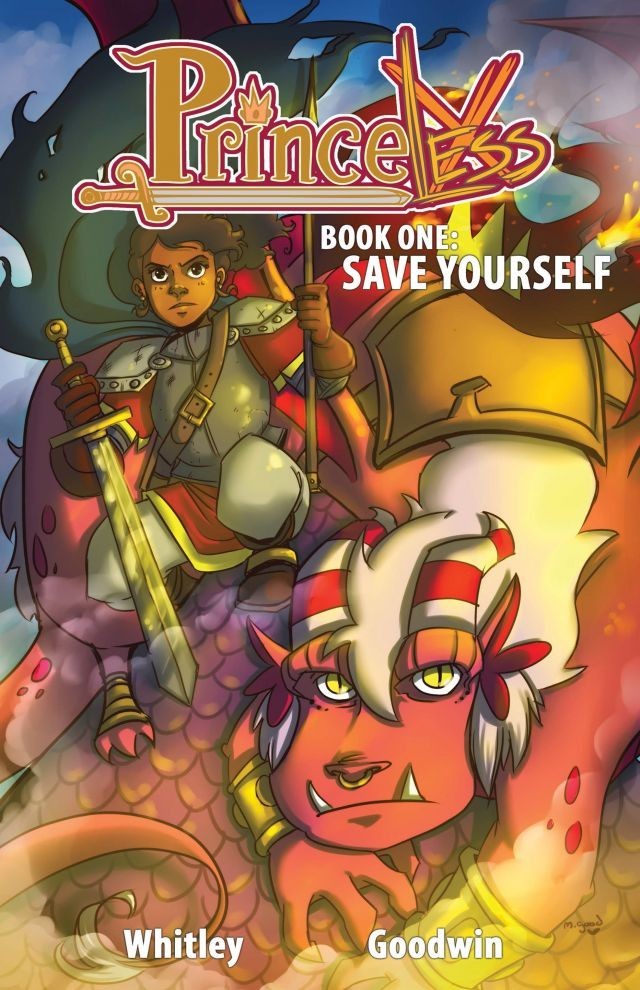 We’ve read Princeless Volume 1: Save Yourself almost every day since I picked it up at the beginning of the month, so when I told my daughters that I’d be interviewing the creator, Jeremy Whitley, they demanded participation. Izzy (4) was eager to learn about Jeremy’s daughter and proudly show off her hair, which is “poofy” just like Princess Adrienne’s. Ivy (7) cut right to the chase and asked Jeremy why he wrote Princeless.
“I wanted to write a book about a girl that was strong, smart and independent – like I want my daughter to be when she grows up.”
Sixteen year old Princess Adrienne Ashe is definitely all that and more. As a princess locked in a dragon-guarded tower, she decides to take her fate into her own hands and save herself rather than wait for some prince to do it for her. Having a strong female person of colour as the main protagonist is certainly a refreshing change, but I hadn’t expected Princeless to cover so many other issues common to the comic book industry, such as sexism and gender stereotyping. These problems were presented in a way that my girls could easily understand and discuss with me, which is exactly what Jeremy was aiming for. “I wanted to put it out there to get adults and kids talking.” The pervasive sexism and, to a slightly lesser extent, racism are issues that have always troubled Jeremy since he began collecting comics. He felt these were significant issues that Adrienne needed to talk about within the context of the story. Some critics complained that the commentary was inappropriate for a younger audience but Jeremy argues that kids can handle a lot more than we give them credit for. Obviously the Eisner Awards agreed, nominating Princeless in the Best Publication for Kids category. Issue #3, the one featuring the call to armor regarding sexism in the industry was nominated in the Best Single Issue category. Not that Jeremy intends for Princeless to be preachy. He promises that volume two of the series, illustrated by Emily C. Martin and available now, will lay off the commentary to allow more focus on the action, characters and story. Well, mostly, he says, sheepishly pointing out the parody cover of issue #2.
Jeremy has a lot in store for us with Princess Adrienne as she and her friends, Bedilia the blacksmith and Sparky the dragon continue their quest to rescue other princesses. It’s an all girls adventure that passes the Bechdel Test, even if he hadn’t purposely put together this female cast with the test in mind. “I didn’t want to create a book about girls with only one girl who may fall into the trap of still having to be rescued.” He cites the current incarnation of Wonder Woman as an example of this problem. Wonder Woman is mainly surrounded by males who’s focus is moving the plot forward instead of the female lead.
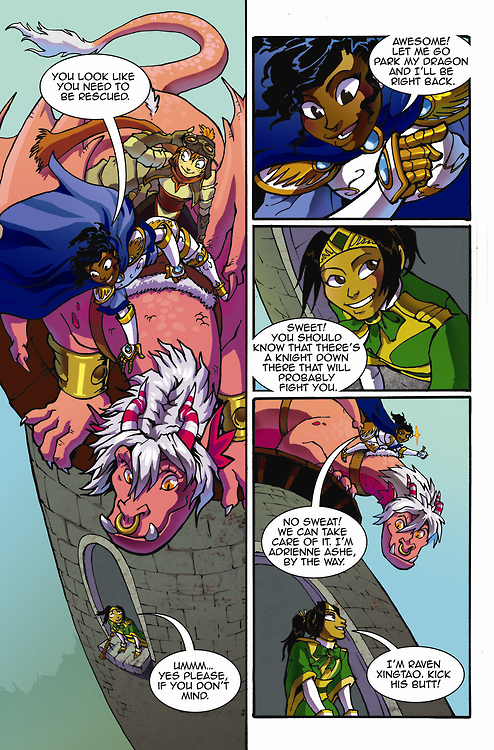 |
| Illustrations by Emily C. Martin
Colours by Soojin Paek |
On Free Comic Book Day (May 4, 2013), we’ll meet Asian princess Raven Xingtao in a Princeless story called “Girls Who Fight Boys,” along side Jamal Igle’s Molly Danger. Like the other princesses, Raven is trapped in a tower awaiting rescue. Her tower is guarded by one of the knights hired to hunt for Adrienne’s “killer” who has no interest in fighting girls. While there are similarities in their plight, Raven offers a different perspective that will give Adrienne something to think about. “Adrienne doesn’t have a feel for the fact that not everyone wants what she does,” which tends to be an issue for headstrong people, Jeremy points out.
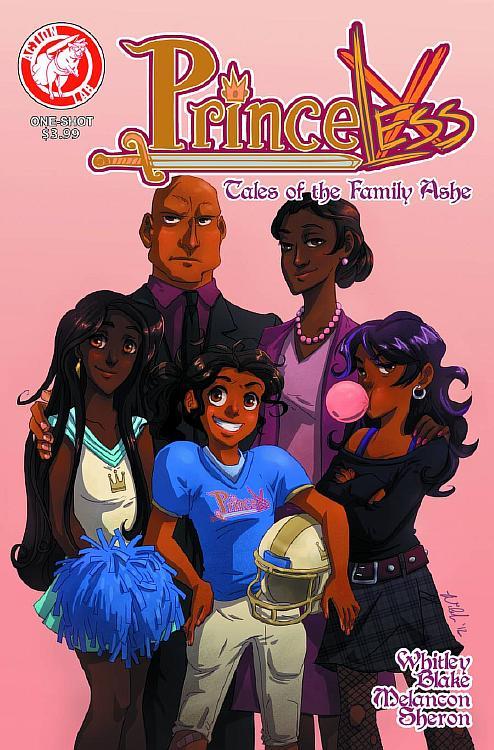
Jeremy hopes to do a story arc featuring Raven and Adrienne, but in the mean time, we’ll be seeing a lot more of Adrienne’s sisters in the main story, as well as in Tales of the Family Ashe. This one-shot will show “what makes them tick and give them a chance to shine.” It will also give some insight into the young King Ashe. Turns out he wasn’t always so curmudgeonly.
While Princeless is very much about breaking the gender stereotype for girls, it also touches on the problems boys have to deal with. Volume 1 features a short story on Prince Charm school and Adrienne happens to have a twin brother named Devin who is constantly reminded of his unkingly ways by his father.
“Devin is a smart kid with a lot of talent, it’s just not a talent his father is at all interested in. Devin is a poet, a designer, a thinker, a creator, and an excellent speaker. All of these would be excellent qualities for a king to have, but his father is interested in having someone that he knows can ride into battle and lead his troops.” [X]
Devin does not feature in Tales of the Family Ashe, but hopefully we will see much more of him some time in the future. Perhaps even in a Princeless cartoon…?
Jeremy recently put out feelers about the possibility of putting together a Kickstarter for a Princeless animated pilot. He would love to see this happen, not for the sake of vanity, but for the same reason he created the comic in the first place. Unfortunately, research and chatting with those who have gone through the process indicate that putting together a Kickstarter is a full time job that requires a “good chef to handle so many ingredients,” which puts the prospect a lot further into the future than Jeremy would like it to be.
Jeremy explains that he has always been fascinated by Lex Luthor and the two personas that have been presented over the years. There’s the Gene Hackman version “who is a crazy smart guy that does things sometimes for profit, sometimes just to be evil.” Then there is the Lex Luthor best portrayed in the animated series, voiced by Clancy Brown where he “may be evil, but is mainly a genius who doesn’t take well to guidance. He’s a self-made man who is irritated by the concept and existence of Superman.”
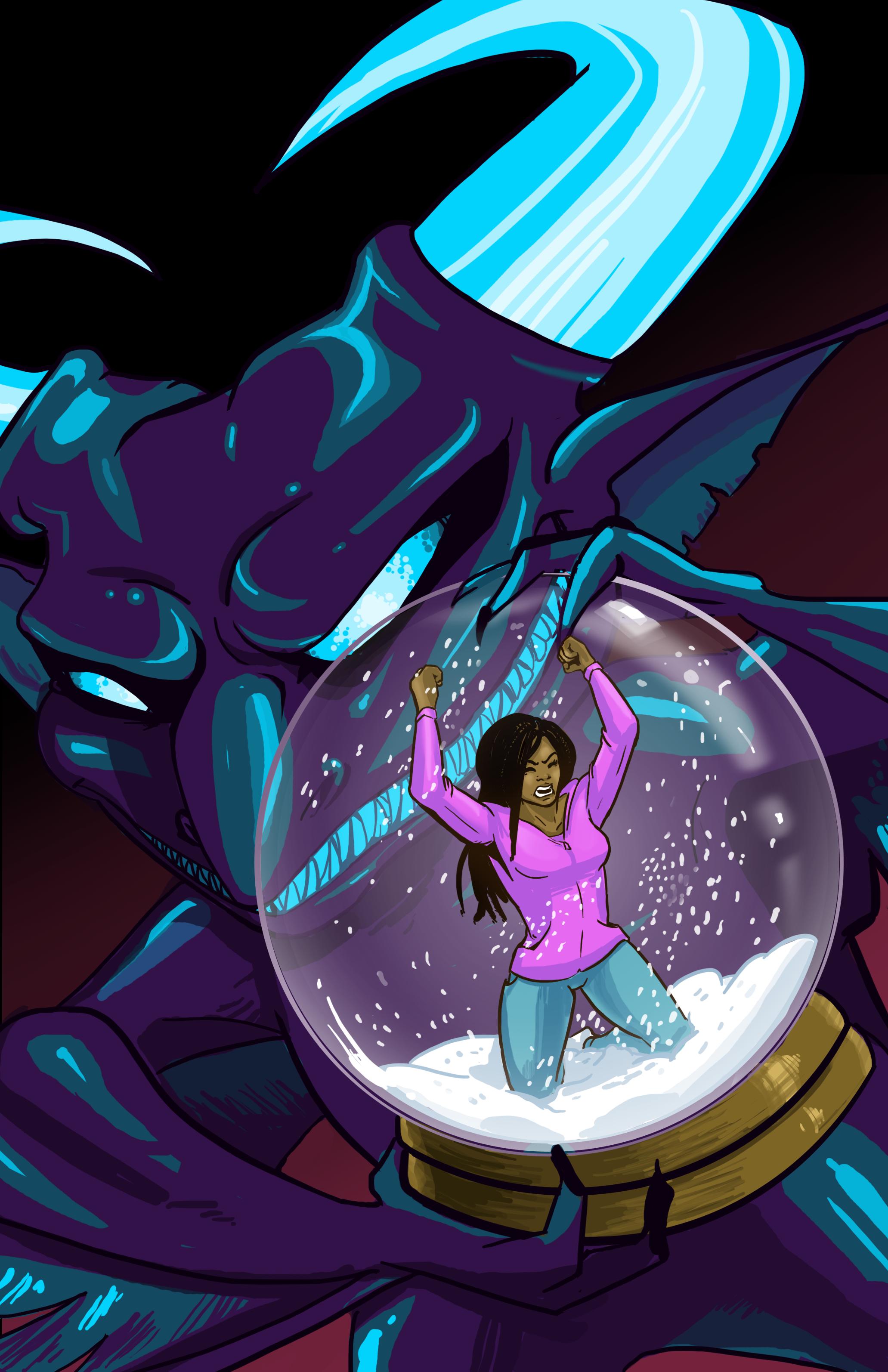 |
| A Bibliosanctum exclusive! Cover concept
for Snow Illustrated by Jessi Sheron |
Jeremy’s worked with Action Lab Comics on an NFL Rush book and GlobWorld and is working with artist Jessi Sheron on a dark fantasy children’s book tentatively titled Snow. The main character is a normal young girl who wakes up to find everyone in her house gone and mythical, magical creatures have taken over. Her sister is some how significant to these creatures and the girl goes on a quest to find her.
It’s a pity that Jeremy hasn’t been approached by either of the “big two” publishers in the industry — yet. He is a huge Storm fan and would love to write a book where she features far more prominently than she current does. (We’re pretty big fans of Storm at The BiblioSanctum so excuse me while I put together a politely worded proposal to Marvel…)
And then there’s a secret script that he’s been passionately writing for some time that has yet to see the light of day…
Book Review: Awakening by Karen Sandler
Posted on April 9, 2013 Leave a Comment
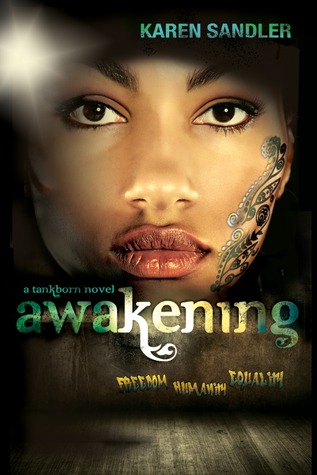
Genre: Science Fiction, Biopunk, Young Adult
Series: Book 2 of the Tankborn Trilogy
Publisher: Tu Books (April 9, 2013)
Author Information: Twitter | Website
Tiara’s Rating: 3.5 out 5 stars
First, I wanted to thank Netgalley and the publisher for allowing me to read an advance reader copy of this book in exchange for an honest review.
This book picks up some months after the events in Tankborn. Kayla is part of an underground movement working toward freeing GENs from the life of oppression. Kayla, along with her lowborn companion, travel from sector to sector retrieving and delivering information for the kinship (a network of trueborn, lowborn, and GENs working together). While Kayla believes her overall work is good, she wonders if the kinship is truly as dedicated to this cause as they say. Are they truly willing to risk so much for GENs? She knows that most members of the kinship, no matter their social rank, hold her in high regards, but she wonders if this because she’s proven herself. When they look at her, they see an individual. She’s not some insignificant GEN girl. Kayla also continues to struggle with her feelings for Devak, the trueborn boy whose grandfather (and prominent member of the kinship) she cared for in Tankborn. Read More
Audiobook Review: Fool Moon by Jim Butcher
Posted on April 5, 2013 8 Comments
I’m not much of an audiobook person, but I need to do something with this Audible account. After unsuccessfully trying to listen to N.K. Jemisin’s The Killing Moon, due to not caring for the narrator’s voice, I decided to give Jim Butcher’s Fool Moon a chance. It’s narrated by James Marsters (yes, of the BtVS fame).
The second book in The Dresden Files takes place a bit after the events in Storm Front. After business slows down resulting in Harry taking some odd magical jobs here and there, Karrin Murphy contacts Harry for his help on a murder case. She takes him to a crime scene where one of Marcone’s men has been brutally murdered and strange paw prints are left at the scene. Add the fact similar murders have been taking place during and around the full moon for a few months, and you have a formula.
I’ve read the first book twice now, and even though I liked it, I hadn’t ventured any further in the series until now. I just get so bogged down with other books I want to read. I had to work out of town for two days, and I figured this would be the perfect read for my trip since I wouldn’t be able to do much book reading. I try not to listen to anything too heavy and this was the perfect audio book with it’s fast, easy pace. I found myself quickly caught up in the story.
I thought Butcher’s take on werewolves was refreshing, especially how he used “lycanthropes,” who aren’t really werewolves, but people born with the ability to tap into the spirit of rage. When they are under the power of the spirit, they are more aggressive, stronger, and they heal quickly. His four definitions of werewolves in the story gives them real weaknesses and strengths (other than the silver bullet bit, but it comes into play as well) with the werewolves we typically think of, called loup-garou, not being as common in Harry’s world as the other three types.
And Harry, good ol’ self-deprecating Harry. He had me arguing with him so much in this book. His sense of heroic honor seems to make him do the dumbest things and aptly illustrates the point in one of my favorite quotes about just how much dumb luck the good guys have. I’m sure I would’ve been much more annoyed with him if I’d been reading this instead of listening to it because I would’ve spent a ridiculous amount of time rereading and trying to make sense out of the Harry’s madness.
Regardless, I can’t help but like the guy, even when I wish I could reach my hands into the book and throttle him while screaming, “Why would you do that?” That means I care about the character. It’s only the characters I don’t want to suffer so much that I argue with. But I do have to give him credit for the really ingenious things he did do during the course of this story. Also, he half quoted Spider-Man when he went on his “Knowledge is Power. And Power comes with responsibility!” rant. How can I hate a man like that?
Also, I’m glad that Harry was able to understand that he shouldn’t withhold information about the supernatural from people like Murphy. They need that information to have a fighting chance. It’s not enough to say, “It’s dangerous,” and leave it at that, especially when Murphy’s job is to deal with the unknown. They may not use this information as intended, but he would be giving them the knowledge they need to try to stay alive. I’m not saying that he should spill everything he knows. He knows what’s pertinent and what’s not. How can he expect anyone, such as Murphy, to truly understand the gravity of the supernatural when he is only giving them half-information?
James Marsters is a wonderful narrator. True, I did balk a little at first, and I’m sorry for that. I was one of those people who got into the series because of the old Syfy show, and it’s pretty much branded into my mind that Harry is Paul Blackthorne. Marsters really brought the characters to life for me after we crossed that Blackthorne hurdle. He did his best to give each character a distinct personality and a distinct sound, even the women. I loved the voice, the clipped, immaculate pronunciation, he used for Tera. It was like someone who learned English as a second language and still doesn’t understand all the nuances of the English language, which I guess that would describe Tera to a “T.” I love his Murphy as well.
I heard one glaring mistake, though. When the lycanthropes captured Harry, during that moment when he was goading Parker, he called Parker by Marcone’s name. It wasn’t dialogue, just Harry’s narrating/thinking part. He said, “Instead Marcone spun in his heel, picked up a tire iron, and turned back to me…” He meant Parker spun on his heel. Marcone hadn’t even showed up yet at this point. But overall, Marsters’ narrating pretty much made this story for me. I’ve already decided that I’ll listen to the rest of the series, except for the book he didn’t narrate.



Book Review: The Forest of Hands and Teeth by Carrie Ryan
Posted on April 4, 2013 1 Comment
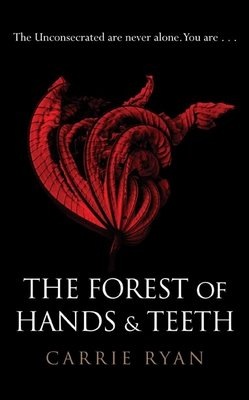
The Forest of Hands and Teeth by Carrie Ryan
This story is told through Mary’s eyes. It’s well-written, but it took me forever to read this and not because I was busy. For me, this is the sort of book that can be depressing to read through. It’s just a knot of darkness. The religious oppression along with the situation they’re in just didn’t leave me feeling very hopeful for the characters.
Now, I enjoy dark stories, but this story just seemed to be bleak and not offer much else for readers to feel—if you don’t count exasperation at Mary’s selfishness, but I’m getting to that.

Book Review: The Cloud Roads by Martha Wells
Posted on April 4, 2013 5 Comments
 The Cloud Roads by Martha Wells
Moon has spent his life working to fit into the other societies, but when he finds his own, he has difficulty. I appreciated the way Wells balanced Moon’s need for acceptance with his suspicion and discomfort without making him come across as petulant or annoying. Actually, there a few characters whose disagreeable personalities initially seem like they will just be annoying and troublesome, but all the significant characters have purpose and reason and are able to change and grow with the situations presented.
Orphaned at a young age when his mother and siblings were killed by predators, Moon has moved from groundling village to groundling village trying to fit in. Unfortunately, his inconvenient secret always comes back to haunt him: Moon is not a groundling. He can take their form, but he can also shift into an armoured, winged, clawed, spined being that looks far too much like the Fell, the intelligent predatory species that feed on everything else in the Three Worlds. Moon knows he’s not a Fell, but has no idea what he is until he meets another shifter and agrees to go to his home to learn about his own species, the Raksura.
Moon is, unsurprisingly, very hesitant to get comfortable with what are apparently his own people, especially when he discovers that he has a very specific status among them that instinctually causes conflict. Add the ever present stench (literally) of the Fell. And we’re in for obvious trouble!
Don’t worry. The story is not quite as predictable as it might seem. Moon’s discovery of his people happens almost right at the beginning and we quickly move into the politics of his people, which we learn along with him, and deal with the Fell, who refuse to leave anyone alone and worse, seem to have even deadlier plans up their sleeve.
The plot moves along at a comfortable pace, but what really made me love this book was the incredible world that Wells has weaved, complete with very unique races of people. Moon’s travels have introduced him to several villages of groundlings and the Raksura turn to him for advice dealing with them. Many of the groundlings look somewhat similar or are accepting of outsiders, hence Moon’s ability to find places to live. They also have very unique cultures and Wells intricately describes them all through their appearances, their native language, foods and food preparation, building structures and living arrangements and even naming conventions. As the main species of the story, we learn most about the Raksura and the Fell, but I found myself wishing that Wells would publish a great big codex containing information and images on all the species we learn about within the book.
I loved the transition Moon makes. He begins the story living in a groundling village where we can easily relate to their human-like activities, if not their lizard-like skin and colours. Moon has spent almost his entire life doing his best to fit in within these groundling societies. But when he gets to the Raksuran court where he no longer has to hide his other form, instinct kicks in and watching him react and the others react to him was absolutely fascinating. Wells smoothly transitions us from the human-ness we understand, to a more animalistic society. Violence and dominance through violence or intimidation is not uncommon, but it is not purely bestial. The intricacies of the Raksuran society and how it differs from our own are truly a highlight of the book as they unravel through Moon’s interactions and relationships.
I particularly enjoyed the Raksuran male/female roles. It is a matriarchal society with significant power granted to the male consort, but while dominance battles do occur, they are never about gender issues. It was refreshing to read a book that did not require males or females to prove themselves worthy of their gender. In fact, I loved the way Moon, who by our standards represents an alpha male, could give himself over to the comfort of his mate when he needed it, without any implication that he was “less of a man” for doing so. Everyone in the society had their roles and could perform equal duties regardless of gender.
Wells does not skimp on the details of their physicality, either. Particularly in their winged Raksuran form where she skillfully describes the full range of their movements, even in flight and in battle where it could have been easy to skim over such detail.
I have already obtained the other two books in the series, as well as several other books by Wells. You can take that as indication of how I feel about The Cloud Roads!

Character Appreciation Post: Anna Korlov from Anna Dressed in Blood
Posted on April 1, 2013 Leave a Comment

“… there she is, my goddess of death, her hair snaking out in a great black cloud, her teeth grinding hard enough to make living gums bleed.”
– Cas Lowood, Anna Dressed in Blood
A Song I Associate with Anna
Dig up her bones, but leave the soul alone
Let her find a way to a better place
Broken dreams and silent screams
Empty churches with soulless curses
Bones by MS MR
Why I Love Her
Admittedly, the main reason I wanted to read these books was because of the covers, and while I do love Cas and his misfit group of friends, Anna Korlov, a girl relegated to an unfortunate fate, is the real hero of the story for me.The thing that really stood out for in these books is that Blake kept Anna consistent in general character and in the ghostshipping (the romance) that’s presented in the book.
In so many books, once a male counterpart enters the story, the female character becomes a bit useless, especially in young adult books. Let me stop here for a moment to clarify “useless” in the sense that I mean. Anna has fears. She has desires, wants, and needs. She has feelings that run deep. She is not a shell of a person… er… ghost. I’m not saying that she shouldn’t be allowed these things and feelings. Quite the contrary.
A strong character for me doesn’t mean they shouldn’t be allowed their weaknesses or that they shouldn’t need someone to save them from time to time. I don’t mean that, sometimes, they don’t break when things overwhelm them. However, when a character loses complete sense of self and suddenly becomes nothing more than “that chick that needs saving by her oh-so-strong man all the time,” I get pissed. Vulnerability as well as strength should be shown. There needs to be a balance, and I think Blake did an excellent job with that. She also seemed to do a great job of having Anna and Cas complement each other.
In the story, Anna did not suddenly become a weepy girl ghost who needed Cas to protect her after he helps her reconcile her duality, which makes her a near unstoppable force. Anna already outpaces the average ghost with her strength and awareness (most vengeful ghosts in the story don’t realize they’re dead and are unaware that the world has changed at all). She becomes Cas’ protector in some ways. She doesn’t run in always saving him. She allows Cas to be the person that he is, and she doesn’t underestimate his abilities or formidability.
Cas gives her the same respect. But they both are there for the other to lend strength when needed. And there have been scenarios when they have both needed the other in extreme cases. Anna doesn’t ignore her feelings for Cas, but she tries not to mourn what she can’t have with Cas. It pains her and she quietly shows it, but she she is more willing than Cas to accept that a relationship between them is impossible. I really liked the dynamics between Cas and Anna, and I appreciate the love story didn’t eclipse the rest of the story.
Anna doesn’t excuse herself from what she’s done. She understands that she’s taken lives and she’s disgusted and saddened by it. Her living companions–Cas, Thomas, and Carmel–are much more sympathetic to her and her plight than Anna is to herself even though they’ve seen what her fury can do firsthand. She doesn’t know if she’s deserving of the kindness that she’s given. She doesn’t know if her final rest should be peaceful because of the horror she’s perpetrated over the years.
Anna is presented as a realist, and she’s pragmatic about her situation and the situations surrounding her. She won’t lie to herself or to any of the others just to dull an ache. She’s not some over-romanticized wisp of a ghost who spends time sighing about life and the living. She seemed more practical about what was going on than her living companions. And this doesn’t seem like something she only gained in death. In the brief glimpses of her life we are given, Anna was respectful and kind, but she would not be cowed.
She shows impossible courage along with the rest of the gang. Despite her fears, she stands her ground, even in one of her weakest moments, and she makes a sacrifice far greater because she knows she’s the only one who can despite the fact that she may be sending herself to some unknown fate. Anna has earned her place on my list of favorite fictional characters.
Graphic Novel Review: Captain America: The Chosen by David Morrell
Posted on March 31, 2013 1 Comment
 Captain America: The Chosen by David Morrell
Before I get to the Captain America gushing, I need to get this out of the way. I don’t like the setting for this. No, I’m okay with the war environment, but I didn’t like that it specifically had to be Afghanistan and Al Qaeda related with the 9/11 references. That felt, in my opinion, felt like a cheap sympathy grab on Marvel’s part, making it feel more like an US versus THEM problem, which can distract from what I felt was the true message of this story.
This story is mostly told from the POV of James Newman, a young soldier serving in the United States military. He wants to help his country and the country he’s fighting in, but he’s no longer sure how to help when he can’t distinguish those who need help from those he needs to fight. He misses his wife and infant son. And he’s also becoming jaded toward fear because he’s living in a constant state of fear. During a fight, Captain America shows up on the battlefield and “helps” Newman to save some of his squad. The only problem? No one else saw Cap. In fact, he’s many miles away dying.
The super soldier serum has finally “failed” for Captain America. Not only is he losing all the physical conditioning he had, but he’s regressing to a state far more frail than he was even before the serum. He’s initially given 6 months to live, but his health degrades in weeks instead of months. Captain America agrees to submit to one last test, an experiment that allows him to telepathically project himself in any location, but causes him to expend a lot of energy, which speeds up his regression.
He’d been using this ability to find and map out terrorist hideouts, but then he learns that he can project himself into the consciousness of others, making them believe that he was standing right there with them. Not only that, but apparently, this also gives him access to their thoughts, feelings, and memories. He uses this to cause fear at first, but changes his focus to inspire ordinary heroes to be courageous. He says that courage isn’t the absence of fear, but a motivation for it. Fear will make you do things you didn’t think possible, which is true.
I appreciated the idea of Captain America expending himself to help people in any way he can even after his body starts to fail him. Captain America pushes himself so hard and takes it so personally when he feels he failed the people he swore to protect. Despite his rapidly deteriorating state, he still puts everything he’s got into helping others. This does feel like something that Captain America would do—defending others until he just couldn’t any longer.
The idea of the serum finally catching up to him and proving that it wasn’t a complete success was an interesting angle. It’s never fully discussed in the comic how that might’ve happened. If he hadn’t been frozen in ice, would he have burned out a few months later? Had the experiment actually been a complete success and his time in the ice had subtly degraded the effect of the serum? Did he overextend himself? It’s a mystery, but I’m not upset there isn’t some drawn out explanation about why this might’ve happened. It leaves readers to speculate for themselves.
However, I wasn’t too crazy about how that story was told. In some panels, there was too much back and forth going on trying to get Newman to keep it together. I know it was necessary, but it started to feel a bit filler-ish after a while. And I’m not even going to touch that part of the ending where Newman went full Rambo (and this was written by the author of the Rambo books), and it was a bit too hackneyed in some panels.
Many of the lab scenes didn’t really feel necessary, especially since he was basically telling Newman his story from beginning to end at the same time. The lab scenes added too many questions that weren’t addressed like when they wanted to know who he chose. Chose for what? To become the next Captain America? To fetch his dinner? How were they supposed to make a new Captain America, if they were hoping he’d choose an heir, to be able to perform physically on the same level? Or were the hoping for someone to continue this new experiment they started?
The government obviously didn’t care about—or was blind to—the fact that it took more than physical prowess to make Captain America, if that’s what they were going for. But part of, maybe even a large part of, the traits that make Captain America who he is doesn’t have to do with physical conditioning, but his indomitable will and the virtues he holds close to his heart, and this was something he had even before he became Captain America. This is something that anyone can have and extends beyond beliefs, race, citizenship, etc. Captain America knew this and admired the people who didn’t have his conditioning, but performed their duties every day. He questioned if ordinary people could go out there and risk their lives to help others, what made him any different? What made him better? Just because he may be physically superior to them didn’t make him better.
After Captain America did his final heroic deed in the book, the first question posed was, “What will we do without him?” But I can see this question being the opening for them to start relying on their own strengths, a wakeup call to the fact that you can’t always rely on a superhero to save the day. Quite often, you can only rely on yourself, and you have the necessary “powers” to do so.
I thought this was a good story, but it could’ve been better. Some of the ideas behind it were magnificent in theory, but were not executed to their full potential.
In the end, I felt like the story’s main goal was to show how there are ordinary people doing extraordinary things every day. Even though we only see him with Newman, he is actually inspiring many others at the same time, encouraging them to use their strengths to help their fellow man. You don’t have be Captain America to embody the virtues of courage, honor, sacrifice, and loyalty. You can find these same “hero” traits in doctors, teachers, farmers, any average person in the world. Everyone has the potential to be a Captain America. It’s not always the strength of body that makes a hero.


 The BiblioSanctum