Tuesday Tea with Island Beneath the Sea by Isabel Allende
Posted on June 18, 2013 Leave a Comment

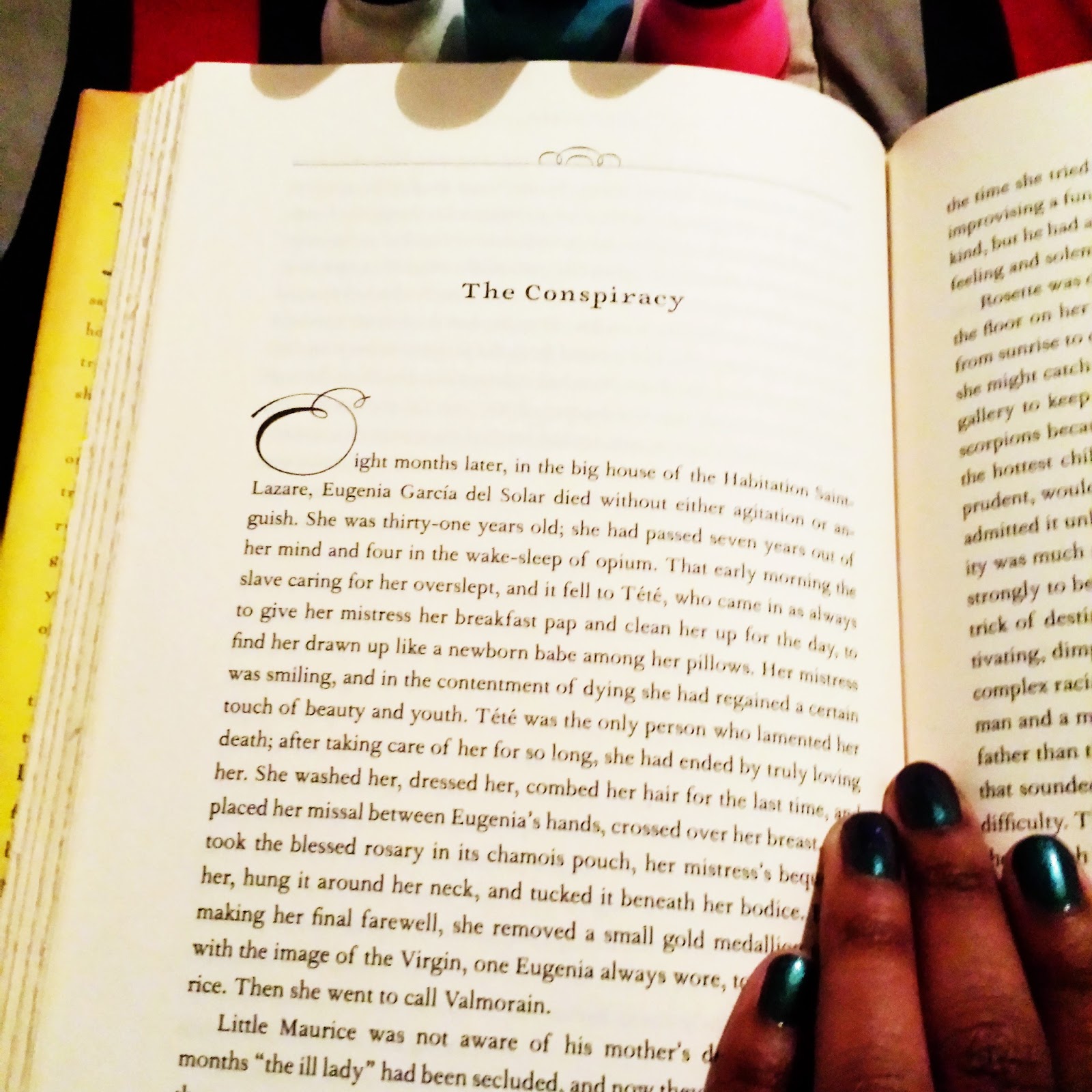
What I’m Drinking: Mango Green, Passionfruit, and Hibiscus chilled with a side of mint and a squeeze of lemon for a summery, fruity taste
What I’m Listening To: Two Become One by Govinda
What I’m Reading: Island Beneath the Sea by Isabel Allende
Quote: “I strike the ground with the soles of my feet and life rises up my legs, spreads up my skeleton, takes possession of me, drives away distress and sweetens my memory. The world trembles.”
Comic Review: Jim Henson’s The Storyteller by Dennis Calero
Posted on June 18, 2013 Leave a Comment
Despite my love of Jim Henson, I never did watch his Storyteller series. I’ve made up a bit for that now with this collection of retold myths and legends by various artists and writers. Some of the stories are familiar, with new twists, while some might be a little more off the wall or new, depending on your background and upbringing. No matter the source material all of the stories are uniquely pieced together in this collection.

Cover Lover: King of Thorns
Posted on June 18, 2013 Leave a Comment

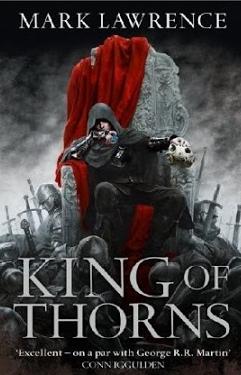
Mark Lawrence recently posted the many covers for his King of Thorns, offering fans a chance to vote for their favourite of the eight. This is my favourite, a variation of the most common cover image for this book. I love the brilliance of the red draped across the throne, a sharp comparison to the otherwise monochromatic theme. The US cover, which I am used to, features an almost white “sky,” while the UK hard cover brings in the clouds. But I really like the way the “clouds” work in this UK paperback version because they also give me an impression of smoke, bringing the image indoors. It strikes me more because it means the bodies he rests on aren’t merely on a battlefield where piles of bodies are expected, but inside some sort of ominous building. And as he sits contemplatively on this throne, the world burns behind him…
To reach greatness you must step on bodies, and many brothers lie trodden in my wake. I’ve walked from pawn to player and I’ll win this game of ours, though the cost of it may drown the world in blood…
Audiobook Review: Medicus by Ruth Downie
Posted on June 18, 2013 Leave a Comment

This story follows military medicus (doctor) Gaius Petreius Ruso who is a Roman man living in Brittania (England). He’s escaped to the Brittania to heal from a disaster of a marriage that ended in divorce and the death of his father that left the family with many undue debts to pay. Brittania is considered a backwater town but important nonetheless. It’s too small to be considered grand, but too large to be ignored by the Romans. As if going from everything to having nothing wasn’t bad enough, women continue to bring trouble for Ruso after he examines a dead woman found in the river and rescues a slave from her callous owner.
This story takes place during a time when modern medicine was just beginning to emerge. Doctors were regarded as suspicious conmen and “healers” still ruled surpreme. I loved how Downie weaved that into the story, showing how doctors began to record treatment and discover new ways to deal with various medical ailments and conditions. One of my favorite scenes in the book is when Ruso ushered around the new doctors in training and reveled in their naïveté after one fainted (and the others just barely made it out) when Ruso showed them a particular gruesome case. The description made me chuckle because it was just so Ruso-like.
Ruso is a bit cynical and serious, but he does have a little bit of a dry comedic side. He’s very sure of his abilities as a medicus almost to the point of cockiness, but unlike his friend and fellow medicus, Valens, he keeps to himself in a world where knowing the right people means everything. He often feels awkward in social situations and almost always says the wrong things in his mind, so he tends to keep to himself. His bedside manners are cool because he’s a man of logic, even by his own admission, but Ruso cares more about people more than he shows. This care extends beyond mere medical interest, but he’s not sure how to “fix” people beyond what physically ails them.
Ruso complains that he shouldn’t get involved in certain matters, but still he finds that his underlying compassion and concern causes him to do the exact opposite, which is how he ends up “investigating” a murder that he insists he’s not investigating. He’s also terrible at being a hard ass as shown when he became Tilla’s “master.” Tilla is just one of a group of ragtag friends he picks up during the course of the story which includes the charming Valens who thinks that Ruso needs a new wife, an overenthusiastic scribe named Albanus, and a dog he claims not to care for. He complains about them, of course, but I don’t think he’d know what to do without them.
Despite all the elements that could make this a complicated story to listen to, it was very easy to follow. Nothing really went beyond my grasp or caused me to pause and rewind just to make sure I was understanding what I’d heard. Downie didn’t use language that was too complicated, and the things that seemed a little unfamiliar she was able to explain in the simplest terms, even when it didn’t really seem necessary. However, this was a surprisingly light listen. I was afraid that I would get partway in and decide that I need to read the book rather than listen to the audiobook.
One of the chief complaints I’d heard about this book was that the language was “too modern,” but that’s the usual complaint of many historical fiction settings ranging from books to television. I wasn’t surprised to hear the complaint, but it just seems like old news now since many shows and books take this approach. I think that’s because it makes it easier on the reader and the writer. How many people would really be interested in reading this if written in the style of that time? What writer would stick to writing a story in such a style? It would be tedious for both the reader and the writer. I agree that maybe some word choices absolutely were too modern, but that’s such a nitpicky thing. However, I can only say that it doesn’t bother me. Your mileage may vary.
As far as the narration goes, Simon Vance is quickly becoming one of my favorite narrators. He has a voice that is perfect for reading. This will be the third book I’ve listened to with him as the narrator and he never fails to impress me with his read. He’s remarkable; his narration is always so impeccable. I have never encountered a narrator with such clean narration skills. Also, he understands that timbre not pitch determines how realistically a female voice will come across when reading, and even when faced with multiple female speakers in one scene, he gives them all their own personality that makes them easily discernible one from another.
The only real complaint I have is that he’s a fast talker. I tend to speed up my audiobooks between 1.25 to 2.0 times faster than normal. With him, I have to get used to the pace he’s keeping before I can speed it up, but that’s really a trivial complaint when compared to how extraordinary he is as a narrator.
This was a great opening for the series, and I look forward to following more of Ruso’s misadventures as narrated by Simon Vance.



Tiara: Favorite Quote from Your Favorite Book
Posted on June 17, 2013 Leave a Comment
“In a way, her strangeness, her naiveté, her craving for the other half of her equation was the consequence of an idle imagination. Had she paints, or clay, or knew the discipline of the dance, or strings, had she anything to engage her tremendous curiosity and her gift for metaphor, she might have exchanged the restlessness and preoccupation with whim for an activity that provided her with all she yearned for. And like an artist with no art form, she became dangerous.”
― Sula, Toni Morrison
Book Review: The Magicians’ Guild by Trudi Canavan
Posted on June 17, 2013 Leave a Comment

The Magicians’ Guild byTrudi Canavan
Trudi Canavan is an author I’d been looking forward to read for a long time, which is why she’s pretty high on my list for the WWEnd Women of Genre Fiction Reading Challenge. Thanks to my book hoarding habits, I found that I actually own the first books from both her Black Magician Trilogy and the Traitor Spy Trilogy and didn’t know which to tackle first. Then I found out that the latter series is a continuing story of some of the characters in the former, which ultimately decided it for me. I always I prefer to read things chronologically and in publishing order, so The Magicians’ Guild it is!
The book centers around the life of Sonea, a young vagrant girl caught up in the disturbance which occurs every year during the Purge, an event which expels all the city’s poor, homeless, beggars and other undesirables from within its boundaries. Sonea sees a group of children trying to annoy the guild magicians in charge by throwing stones at their magical shield, and decides for fun to join in. In a moment of anger, however, the stone she throws somehow manages to pierce the magicians’ protection, beaning one of them on the side of the head. Then everything explodes into chaos.
The Magicians’ Guild immediately launches a manhunt for the little girl who so effortlessly foiled their shield spell, because it must mean she possesses magical ability as well. No untrained magic user can be trusted to roam unchecked around the city, for the results of that uncontrolled power can be dangerous for all. Not knowing this, Sonea flees and goes deeper underground with the help of her friends, but a time will soon come when she won’t be able to escape anymore, neither from the magicians nor herself.
At first, I wasn’t sure if I was going to like this. I spent a good chunk of the book wondering when the story will get to the part where the Magician’s Guild and Sonea meet up with each other, so that they can finally get on to training her properly in the ways of magic. That’s how these kinds of stories usually go, right? Then I realized that the hunt for her was actually the whole point for the entire first half of the novel, dashing any preexisting expectations I had for the plot.
Going to be honest here, the book still didn’t quite hook me until the Magicians do eventually end up finding Sonea, and that was around the halfway mark. Everything that occurred before this point detailing the search and Sonea’s struggle to control her magic felt like this huge, unnecessarily drawn out introduction, but the good new is, I started to enjoy myself a lot more. It’s almost like, “Okay, now that all that’s out of the way, we can finally get this show on the road.” The conflicts in the plot started to get more interesting, and I found myself drawn to characters like Rothen, for whom I previously felt nothing.
It also wasn’t until I finished this book that I heard this series had been re-marketed for the young adult market. If so, that actually made a lot of sense. Assuming that a YA audience probably wouldn’t be as critical as I’m being, I thought the story and characters were strong but could have done with a little more depth, especially since a few sections of the plot felt thin to me and not very convincing. As general fantasy though, I liked this book well enough and I think it can be appreciated by all.

Book Review: Will in Scarlet by Matthew Cody
Posted on June 16, 2013 Leave a Comment
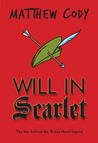
Will in Scarlet by Matthew Cody
I really enjoy books about famous fictional heroes that aren’t actually about the famous fictional heroes.
Will in Scarlet is a Robin Hood story told first and foremost through the eyes of the young lord, William Shackley. Later, the voice of Much, the miller’s daughter turned son, is added. Their stories and the paths that lead them to the Merry Men of Sherwood Forest shape the lore around the infamous Robin Hood. But while we get a glimpse into the wanted bandit, it’s Will and Much who the reader gets to know and care about, though we do get to see Robin Hood through their eyes. Turns out, the leader of the Merry Men isn’t quite what we expect him to be.
It only took me a few pages to really like this story and the characters. I’ve never really Will Scarlet in a particularly positive light in the various mediums I’ve previously met him in, but this one sets out to give him heart and soul and easily achieves it. Robin might lead the Merry Men, but Will is the one who gives them their purpose and helps to define the vast division between nobility and the regular folk without being preachy or petulant.
I also liked how the Sheriff of Nottingham, while not necessarily a likable character overall, is one that I could sympathize with to some extent. His actions are given greater reasoning than him simply being a greedy and evil jerk.
This was a fun read, with well thought out characters, lots of interesting action and a fair bit of humour.

Book Review: Darkly Dreaming Dexter by
Posted on June 15, 2013 Leave a Comment

Darkly Dreaming Dexter by Jeff Lindsay
I picked up this book because I love the series. The premise of a serial killer killing other serial killers was just too interesting to pass up. You actually root for Dex, even though you know that he’s the bad guy as well. The beginning of this book was just like watching the series. The series mirrored it perfectly. I could hear Michael C. Hall in my head just as he sounded on that first episode while reading the beginning of this.
Dexter spends a great deal of time trying to make us believe that he is completely incapable of any kind of human emotion, even as he does express a certain amount of elation while he’s butchering others and while he’s admiring the work of this new killer, and while that seemed repetitive for some readers, I interpreted it as a mechanism to make himself truly believe that he has no feelings because many of his actions and thoughts say otherwise. Yes, I do believe that he’s partly right in his assessment of himself. It takes a certain kind of uncaring, broken person to do the things he does, even if it IS to others like himself. However, I don’t believe that he’s really as uncaring as he tries to paint himself to believe.
This book was like a personal look into the dark side of a person’s psych (same with the series). It makes you wonder if that bright smile from the mailman is really hiding something sinister behind it.

Book Review: A Princess of Mars by Edgar Rice Burroughs
Posted on June 15, 2013 1 Comment
 A Princess of Mars by Edgar Rice Burroughs
John Carter is awesome. I know this, because John Carter told me so. Everyone is impressed by John Carter. I know this, because John Carter said so. Dejah Thoris is beautiful. I know this, because John Carter said so. Dejah Thoris is incomparable. I know this, because John Carter told me so.
And for these reasons of awesome impressive incomparableness, these two fine specimens of Earthan and Martian perfection fell in love. The fact that they wear very little clothing may also have had something to do with their fated romance.
 |
| Oh who am I kidding. I’d totally fall for this too. Dejah Thoris by Artgerm |
To be fair, this is pulp fiction and I assume the “story” told here is standard for the time and genre. Maybe if I read it back then, I’d appreciate it more. Maybe if read the comic version instead, I’d appreciate Dejah Thoris’ jewel covered pretty bits and John Carter’s manly manliness more. For now, I can safely confirm that this style of writing just doesn’t work for me, though I’ll give credit to Burroughs’ rich descriptions of the planet and its inhabitants. Plus “Barsoom” (a.k.a. Mars) is really fun to say.
My husband and I watched the movie prior to me reading the book and it wasn’t bad at all. Clearly it suffered from Disney’s poor marketing decision, but otherwise, it was a passable film and thankfully it did not follow the story it originated from too closely, at least in terms of characterization. I don’t think it would have translated very well in our times. Instead, they opted to make the story a bit more interesting and slightly less about John Carter being awesome. Most importantly, Dejah Thoris got to serve a greater purpose than mere trophy princess.

Cover Lover: Maggie Stiefvater Edition
Posted on June 15, 2013 Leave a Comment

Welcome to Cover Lover, a feature on this blog dedicated to book covers! For a long time, I’d wanted a place where I can share some of my favorite covers, or talk about any that might have caught my eye. So when I came across this idea on fellow gamer/book lover Angelya’s site The Oaken Bookcase, I jumped at the opportunity to adopt it as well. The “meme” was originally created by another friend of mine, Jaedia, on her book blog Once Upon A Time, so be sure to check out both their sites and take a look at some of the covers they have featured.
Today I want to share several of Maggie Stiefvater’s books that have had a way of attracting my attention by their cover images alone. My eyes immediately went to them amidst the dozens of other books the shelf, and I’m always amazed at how they all manage to do so utilizing a single color scheme.
Take The Wolves of Mercy Falls trilogy, for example. Years ago I borrowed the audiobooks from the library, even though at the time I hadn’t even heard of the series, and I’ll admit it was all because I thought the covers were gorgeous, especially the first book Shiver. The first time, I almost missed that wolf silhouette in the corner!


Then there is The Scorpio Races. Between reprints and international editions there’s a whole slew of covers for this title, actually, but interestingly enough most of them tend to play on the color scheme red.
I’m actually not all that fond of the original hardcover image now that I’ve seen the others; it’s a little too Spirit: Stallion of the Cimarron for me, I guess!

Now that I’ve seen the other versions, I think I much prefer any of those. But still, I gotta ask, that’s with the heart on this Scholastic paperback edition? Seriously.

My favorite cover for this book though, is probably the new one from Scholastic. Simply gorgeous.
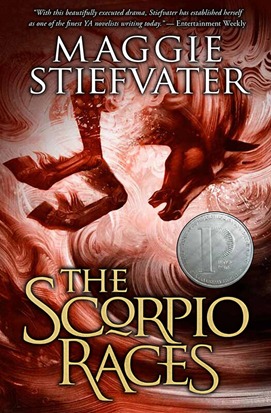
If interested, you can check out my review for The Scorpio Races here.


 The BiblioSanctum