Mogsy’s Book Haul
Posted on March 9, 2014 Leave a Comment

The beginning of every month always sees a ton of amazing new releases, so I may have picked up a couple of those this week…and then some. This week also saw more than the arrival of just books though, for my highly-anticipated package filled with The Iron Wolves–related goodies arrived from across the pond! Included in it is this really awesome shirt, a couple of signed photos and a bunch of bookmarks. My thanks to the author, Andy Remic!
The Copper Promise – another lovely from across the pond, this book was on my to-read list for the longest time and I finally got tired of holding my breath for a US release date. Being on the wrong side of the ocean be damned, I just went ahead and bought the book. Book Depository to the rescue! I look forward to tackling this one very soon.
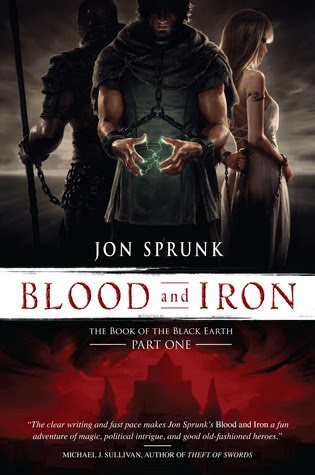
Blood and Iron – this week’s awesome is brought to you by Pyr Books. First up was this copy of Blood and Iron. I’d actually written a review for the ARC which went up earlier in the week, check it out! I like what the story did to set up the series.
Nebula Awards Showcase 2014 – up next we have this volume which collects and reprints the winning and nominated stories in the Nebula Awards. I’m not a big reader of anthologies, but I’m definitely not averse to them either. This looks like one that I’d happily dive into.
The Silk Map – this is the sequel to the first book The Scroll of Years featuring the much beloved couple Persimmon Gaunt and Imago Bone. I thoroughly enjoyed the first book, so I was really excited when this one came.
The Leopard – I am so excited about this one! Featured as one of our top anticipated SFF novels of 2014 written by women The Leopard isn’t the first book written in the world of Marakand created by K.V. Johansen, but it is the beginning of a new series and can be enjoyed even if I haven’t read her earlier work. I can’t wait, and just look at that gorgeous cover art. Thanks, Pyr!


Second Star – kicking off the digital pile is this one I requested from NetGalley and I credit Tammy at Books, Bones & Buffy for putting Second Star on my radar (she is making a habit of loading books on my TBR!) I’m not generally into contemporary YA, but this is a sort of retelling of the Peter Pan story and I couldn’t resist when I heard. I also heard it boasts a love triangle between Peter, Wendy and Hook and now I’m just too damn curious for my own good.
Omega Days – a review copy of this was actually offered to me, but I’m already quite loaded down for the month. Still, the premise looks really interesting and I’m in the mood for some zombies, so ultimately I decided to just buy this one on my own.
Written in Red – the sequel of this just came out, which was probably the reason for the Kindle price drop! Anne Bishop’s The Others series been recommended to me many times by many people, so I jumped on this as soon as I saw.
The Tropic of Serpents – and now for the new releases, I adored Marie Brennan’s A Natural History of Dragons when I read it last year so of course I had to pick up book two. I’m regretting not getting the physical book now though, since if it’s anything like the first book it’ll have some gorgeous illustrations in it as well. Regardless, this is pretty high on my list to read soon.
Words of Radiance – so you might have heard Brandon Sanderson’s Book 2 of The Stormlight Archive was released on Tuesday (Thursday in the UK). I already finished my review copy, but I’m weird in that when it comes to books I love, I enjoy having multiple copies in different formats. So earlier in the week I picked up the audiobook version of this as well and it is brilliant, the narrators did an amazing job. My review of Words of Radiance will be going live tomorrow so be sure to keep an eye out for that.
Book Review: Talus and the Frozen King by Graham Edwards
Posted on March 9, 2014 Leave a Comment

Talus and the Frozen King by Graham Edwards
Genre: Mystery, Fantasy
Series: Stand alone (so far)
Publisher: Solaris (March 25, 2014)
Author Information: Website | Twitter
Mogsy’s Rating: 4 of 5 stars
Well now, this book was a pleasant surprise. Meet Talus, touted by the book’s description as the world’s first detective, which is indeed as marvelous as it sounds. The book has the feel of a Sherlock Holmes type mystery set in an icy Iron Age inspired fantasy world, but what really clinches this one that our “detective” is a bard! If you don’t know, I have a serious soft spot for those traveling poets and teller-of-tales types.
Written in the tradition of the classics by Arthur Conan Doyle or Agatha Christie, I found Talus and the Frozen King to be a very enjoyable whodunit complete with all the ingredients that makes a good mystery. Talus, a wanderer and collector of stories, is a clever man and not without his little quirks. Then, because every good detective needs a trusty friend and assistant, we have stalwart Bran, who is the Watson to his Sherlock. And just to tease this book even more, let’s just say a true detective also needs an arch nemesis a la Moriarty, but that’s all I’ll say about that in this review!
I very much enjoy stories like this. Talus and the Frozen King is a quick read, tightly told with a clear direction and goal in mind, but the author still leaves plenty of room to develop the characters and define the world around them. The setup is admittedly simple but still very well done; after all, most of the activity is mainly confined to an island, where the king of the local settlement has been found murdered under bizarre circumstances. No one is above suspicion in this plot-driven mystery, not even the king’s six grieving sons, the women who love them, or the tribe’s shaman, who all have their reasons to see the old ruler dead.
As the reader, I was given the chance to engage in the very same process of deduction as Talus carries out his investigation, through interviewing suspects or gathering and interpreting the clues. In the interim, I also got to learn more about Talus and Bran individually, discovering the motivations that drive them as well as the details behind their unique relationship. It added an extra layer to this story, rendering the situation more than just another mystery to be solved, because along the way I grew to care about these characters and became invested in them.
Nothing is as it seems. Names are a continually added to the suspect list, then scratched off again as more clues come to light. As death strikes left and right, you can practically feel the urgency in the atmosphere as times begins to run out. Of course, you’re not going to be getting a ton of information about the wider world out there due to the tight focus of the plot, but we still get plenty about the culture, traditions and myths of Creyak island and its people, and for such a relatively short novel, I think it packs a lot of emotion and tension.
There aren’t a lot of books like this out there, that’s for sure. While there’s a strong element of fantasy in this one, at it’s heart it really is a variety of your good old detective story. The prehistoric ice age setting garners huge points from me, and like I mentioned, so does our protagonist being an eccentric bard. I think both mystery and fantasy readers alike will feel right at home with this one. A very entertaining and fast read.

YA Weekend: Falling Kingdoms by Morgan Rhodes
Posted on March 8, 2014 Leave a Comment

Falling Kingdoms by Morgan Rhodes
Genre: Young Adult, Fantasy
Series: Book 1 of Falling Kingdoms
Publisher: Razorbill (December 11, 2012)
Author Information: Website | Twitter
Mogsy’s Rating: 4 of 5 stars
I’ll admit, I had some serious doubts when I first heard about this young adult novel styled as an epic fantasy. I’m more of an adult fiction reader, so when I think about epic fantasy I can’t help but picture vast sweeping sagas in big fat tomes, and I have no doubt it was this bias making me skeptical as I eyed this relatively thin volume.
So you can imagine my surprise when it turned out I quite enjoyed this book. Still, I did don my YA hat as I was thinking about how to rate and review it. And furthermore, you should know that any time anyone anywhere compares anything to George R. R. Martin’s A Song of Ice and Fire, I take it with a grain of salt. On several levels, I suppose I can understand the reasons for some of the comparisons, or why a story like this would appeal to fans of Game of Thrones. And yet, to date I’ve never actually encountered anything else quite like Martin’s epic series and I didn’t anticipate it would happen now.
As such, you could say I went into Falling Kingdoms with a realistic outlook, along with an expectation for some of the usual YA trappings and perhaps a more delicate, dialed-down version of my beloved epic fantasy tropes. But putting it like that would also be doing this book a great injustice, because it also turned out to be a deeper and more intricate reading experience than thought. Despite having a central cast of mostly teenagers, some of the more mature and darker themes also took me by surprise.
The scope of the story was certainly extensive and far-reaching enough for my tastes; here we have a land where the rulers of three separate kingdoms are locked in a bitter struggle for power, thus creating a hotbed for intrigue, conspiracy, scandal and all that good stuff. I wasn’t expecting to see too much complexity, and indeed, the plot felt strained in certain places, I found myself questioning character motivations a lot, and some of the world building and story elements were lighter than what I’m accustomed to. And yet, when I look at the overall big picture, I was quite impressed with what I saw. It’s a lot more than I’d hoped to find in a YA novel, that’s for sure.
In a sense, this book reads exactly as it is described: an epic fantasy for teens. Since that was how I approached it, I thought it delivered everything that was promised and much more besides. If anything, the plot’s overall simplicity and straightforward nature of the narrative actually worked in the novel’s favor. It’s very accessible, easy to get into even if you aren’t an epic fantasy reader, and the story is just layered enough to be interesting but not confusing or overwhelming.
Falling Kingdoms proved to be a highly enjoyable read for me. Keeping in mind it is a YA novel, it’s probably not ideal if you’re looking for a more powerful, substantial epic fantasy, but I had a lot of fun nonetheless!
Book Review: The Chronicles of Amber by Roger Zelazny
Posted on March 7, 2014 3 Comments
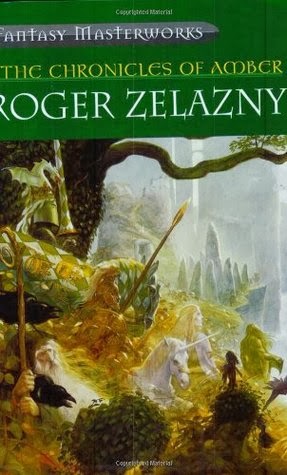
The Chronicles of Amber by Roger Zelazny
Genre: Fantasy
Publisher: Gollancz
Publication Date: January 1978
Wendy’s Rating: 4 of 5 stars
“…and while I had often said that I wanted to die in bed, what I really meant was that in my old age I wanted to be stepped on by an elephant while making love.”
This book was fervently recommended by a friend, and, being an obsessive compulsive book shopper, I bought it almost immediately. When I started reading it, I was both surprised and impressed by the responses I got to my posts on Facebook, Twitter, Goodreads and Google+ – all praising the Chronicles of Amber and/or Zelazny himself. Clearly I had missed out on something very important and my impulse shopping was not in vain.
Amber is a realm that casts hundreds of shadows of itself, each one easily manipulated by those of royal blood, including Corwin, whom we first meet as an amnesia patient in the hospital under questionable circumstances. Despite his memory loss, his wits slip him out of captivity and into the home of his sister, where he slowly tries to piece his history together. Knowing nothing of Amber, who’s trying to kill Corwin, or the Trump cards that he finds, each depicting a person he comes to recognize as a sibling, the reader gets to tag along on this curious journey of discovery. Corwin is soon joined by his brother Random who is fleeing mysterious and deadly assailants. Together they make their way back to Amber in a bizarre process that sets the tone for the unusual way magic works in Zelazny’s world.
As the threads unwind and Corwin’s memory returns, we learn that the king of Amber is missing, presumed dead, and one of the nine princes, Eric, has assumed the throne. Corwin is determined to usurp his brother’s rule and sets about building an army.
After the first book, which managed to go from memory loss, to walking the Pattern, to all out war in such a brief time, I quickly came to understand that nothing would be as I expected – including the motivations of each of the siblings and their companions. Zelazny fashions an unbelievably intense story of sibling rivalry, within a fantasy setting unlike any other. The transitions between worlds is so smooth and the language a perfect blend of contemporary and everything else. But the most striking thing for me was the way, as each book progressed, I felt like Zelazny was simply writing everything that spilled from his mind. It felt like he was adding twists and turns and new elements as they came to him – but everything fit in place like the world’s most perfect Tetris game. And when I got to the end of book four’s big reveal. Well .. fuuuhhh….
Side note: The book focuses mainly on Corwin and his interactions with his male companions and brothers. Initially, his sisters and the other women who vaguely show up are considered little more than useless fools. Fortunately, Zelazny seemed to gain a bit more respect for females by book four and five and the women at least served a bit more purpose and earned the respect of the nice men in their lives.
I actually bought the The Great Book of Amber, which includes ten stories within this world. The first five deal with Corwin’s incredible journey, while the second half follows his son Merlin. I have heard that the second half is not quite as good as the first. While this doesn’t deter me from continuing on eventually, I decided to focus on Corwin alone for this review.

Book Review: Those Poor, Poor Bastards by Tim Marquitz , J.M. Martin, Kenny Soward
Posted on March 7, 2014 Leave a Comment
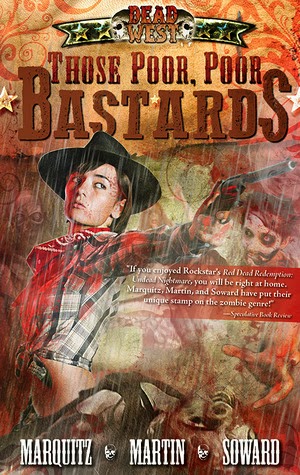 Those Poor, Poor Bastards by Tim Marquitz, J.M. Martin, Kenny Soward
Genre: Horror, Western
Series: Book 1 of Dead West
Publisher: Ragnarok Publications (February 19, 2014)
Mogsy’s Rating: 4 of 5 stars
I didn’t think I was going to enjoy this book at first. Thank goodness I was wrong! Still, can you really blame me for having my doubts? After being inundated in recent years with the dozens upon dozens of movies, TV shows, video games etc. all featuring the same mindless gory battles against the shambling, moaning hordes of the undead, my initial thought was: been there, done that, now what more can this zombie book offer?
Well, this is the review where I happily eat my words! I should have known better anyway, because Ragnarok Publications has never let me down. As it turned out, Those Poor, Poor Bastards had a lot more to offer than I’d anticipated, in addition to that charming little title. The book did contain some of the usual trappings you’ll find in a lot of zombie stories, but there were some twists as well, and I loved how the authors took the familiar and created something new. Also, while I haven’t read enough of the Weird West sub-genre to consider myself a fan, a description like “Zombie Western” wasn’t really something I could resist.
It is 1868, in the Sierra Nevada. The book begins with Nina Weaver and her father Lincoln riding into Coburn Station only to find that everything has gone to hell in a chuckwagon. The “Deaduns” have arisen and are sowing bloody carnage all over town, forcing the living to band together in order to survive. In typical fashion, you end up with a large, diverse ensemble cast. And like watching The Walking Dead, you just know before you even begin that many of them are going to end up zombie food before this whole thing is over.
Put a big group of people with disparate personalities into a stressful situation and you’ll also inevitably get your clashes and alliances within the ranks. There are the good folks like Nina and her pa, the priest Father Mathias as well as the charming James Manning. On the other side of the fence you have the less savory types and troublemakers like the Daggett brothers or the scummy Mister Strobridge. Then there are those caught in the middle who just aren’t sure. With tensions this high and a swarm of Deaduns at the door, it’s the perfect set up for explosive conflict. Emphasis on explosive.
So far, with the exception of the western setting, things might be sounding rather familiar. But then, the authors work their magic and you suddenly realize there is way more to this story. Bucking tradition, we’re actually given an explanation into the Deaduns and how they came to be. Their origins and motives, not to mention the actual reveal itself, were so unique that it completely threw me for a loop — in a good way! I have to say this ended up being a delightfully fun read, in all its blood-splattered glory.
Those Poor, Poor Bastards also taught me something important about myself — that I will never be too old or too jaded for a good ol’ zombie story! What a fast-paced, crazy wild book. I think I’ll just end this review with a suggestion to the potential reader: there are a lot of characters, so definitely try to tackle this novel all in one go if you can, ensuring that the dozen or so identities will always remain fresh in your mind. Besides, it shouldn’t be too difficult — because once you start reading, you just might find it hard to stop!
Book Review: The Magician’s Apprentice by Trudi Canavan
Posted on March 6, 2014 Leave a Comment
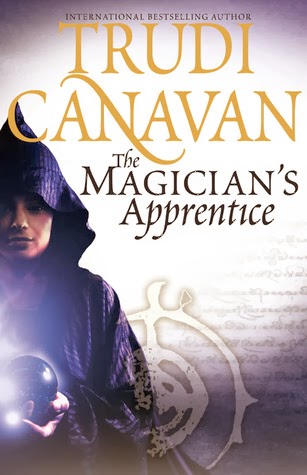
The Magician’s Apprentice by Trudi Canavan
Genre: Fantasy, Magic
Series: The Black Magician Trilogy
Publisher: Orbit
Publication Date: February 2009
Wendy’s Rating: 2.5 of 5 stars
The Magician’s Apprentice is considered #0.5 in Trudi Canavan’s The Black Magician Trilogy. It was written after, but serves as a set up for The Magicians’ Guild, which I have not read. It mainly follows the story of Tessia, a young healer apprenticed to her father, who discovers her magical abilities when she deflects the advances of a Sachakan mage. She becomes apprenticed to Lord Dakon, joining his apprentice Jayan, who initially disdains the fact that he must share his education with a woman.
There are two other characters who occasionally get to tell their story, namely Stara, a Sachakan noble daughter who is forced into an unwanted marriage in order to produce an heir for her father, and Hanara, the slave of the Sachakan mage who tried to take Tessia. While I appreciated the effort to reveal the other sides of the story, these characters weren’t particularly strong enough in their telling. I’m not sure where Hanara’s story is supposed to lead, though Stara is obviously meant to connect this prequel to Canavan’s other series, The Traitor’s Spy.
The use of magic is one of the most interesting aspects of this book. Through Tessia’s training, we get a peek into the process of how magic works in Canavan’s world. I was surprised by the idea of magical wars entirely fought by mages. Unfortunately, when the battles are fought in the story, they are very anti-climactic. In fact, I had to reread several of them, believing I must have missed something because they were so brief. Something happens, mages on one side or the other die, but despite all the descriptions that go into Tessia’s training, we get no insight on the battle magic. Then certain magical items and practices – that I assume have significance in the future books – are introduced like deus ex machina.
As the war with the Sachakans rages on, things really started to unravel for me. Characters suddenly seemed to be forced into certain roles with no previous indication of why that would be so. Along with the magical elements, several guilds and factions are mentioned, and several relationships are forced awkwardly into place. All of this comes piling in toward the end in a jumble that made me feel like I should have read the other books in order to at least appreciate the significance of these things within the greater picture. I didn’t need to read the other books to understand what they were or understand what was going on in this book, but things might have held more meaning, rather than feeling like a sudden rush of elements meant to connect the past to the present.
I’m sure the rest of the series is quite interesting and I did appreciate the glimpse I got of it here, but I sense that this backstory would have better served as a wiki entry instead.

Graphic Novel Review: Cemetery Girl by Charlaine Harris and Christopher Golden
Posted on March 5, 2014 Leave a Comment

Cemetery Girl: The Pretenders by Charlaine Harris, Christopher Golden
Genre: Graphic Novel, Paranormal
Series: Volume 1 of The Cemetery Girl Trilogy
Publisher: Jo Fletcher Books (January 2, 2014)
Author Information: Charlaine Harris | Christopher Golden
Mogsy’s Rating: 4 of 5 stars
Despite reading my fair share of comics and graphic novels, I usually leave the reviewing of them to Wendy and Tiara. Theirs are always really good, whereas I wouldn’t even have any idea where to begin! So, you’re going to have to bear with me here. This will be my first ever comic review for the site, but I’m also really excited because it is for none other than Charlaine Harris and Christopher Golden’s Cemetery Girl from Jo Fletcher books. Come to think of it, it’s a first for JFB too. This title is the first ever graphic novel published by them, and I was pretty thrilled when they sent me a copy.
The summary of it is as follows: the body of a young nameless woman, presumed dead, is dumped from the trunk of a car into a cemetery. But oh, actually she was still very much alive! In the rough landing, she hits her head and wakes up with no memory of who she was, or anything about her past. All she knows is that someone tried to kill her. Lost and alone, the girl decides to take shelter in a mausoleum, and as the days pass the place eventually becomes home. Combining the names from different tombstones and from the cemetery itself, the girl comes up with a new identity: Calexa Rose Dunhill.
The main plot of Cemetery Girl really gets going when Calexa witnesses a murder but is unable to go to the police, fearing that it would draw attention to herself, especially since her unknown would-be killer is still somewhere out there. But there’s a bigger mystery arc here too, invoking questions like, Who is Calexa, really? Who’s out to get her and why? On top of that, she seems to have developed a strange ability to see things, ever since waking up not-dead from her brutal attack. Basically, this volume contains a wonderful self-contained story, but you can also tell that the best has yet to come.
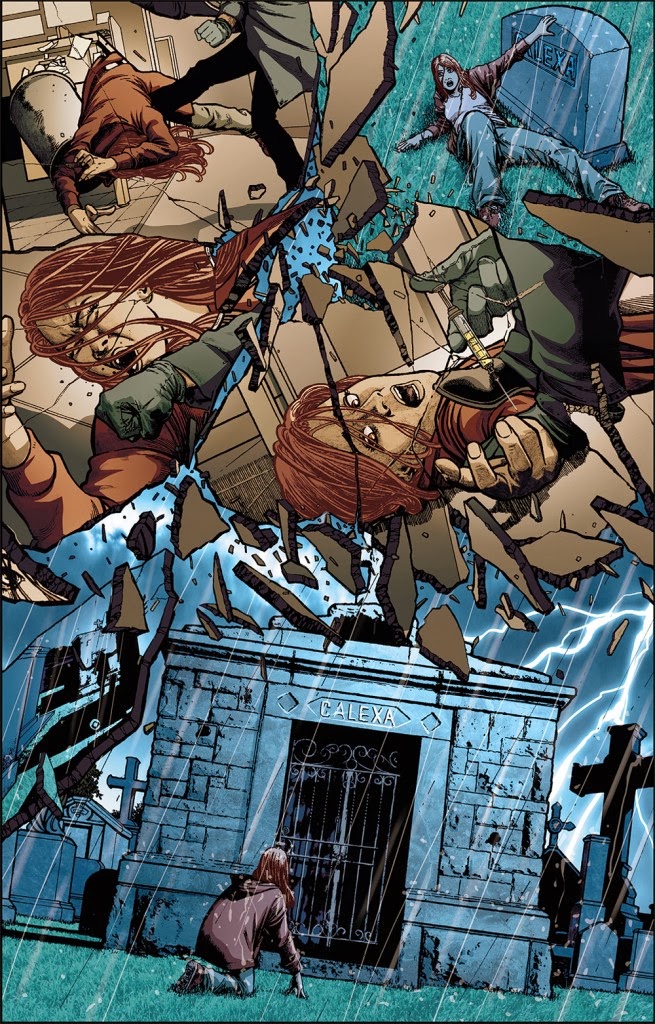
Anyway, you might think, oh what’s the big deal, Mogsy! Just review a graphic novel like you would a regular novel! But I don’t know. Being presented with a story visually, particularly in sequential art form, really changes things for me, especially since I have had experience penciling comic art in the past. In comics, there’s of course the added factor of how well the art meshes with the writing. So when it comes to questions I ask myself while writing a review, I have to reference them to the effectiveness of the illustrations as well. You gotta check this out, though:
 |
| From: http://www.jofletcherbooks.com/2013/11/cemetery-girl |
From this awesome panel alone, you can tell that Kramer’s art and Rudoni’s colors definitely “click” with the tone of the story. Cemeteries are a tricky setting to pull off in art, since they are places of such emotion. You could say getting the atmosphere just right here is very important, since that’s where most of the story takes place. I think the artwork does the setting justice though, and the night time and stormy scenes are especially well done. The art in general is quite easy on the eyes.
As for the story, I felt it fit nicely with the format. With graphic novels, you could arguably get away with rushing the pace a little. Still, even as the days fly by for Calexa (Night one, Night two, Night twenty-six, Night sixty-eight, etc.), the story never loses sight of its goals. Sometimes, just a panel or two and a few lines of dialogue are enough to convey the more complex feelings, not to mention the writing makes use of quite a few silences as well, to good effect. I was most impressed by the way both writers and artists were able to develop the minor characters, like the cemetery caretaker or old Lucinda, and make them stand out for the reader.
Can graphic novels can have a “young adult” feel? If so, then Cemetery Girl definitely has a bit of that. Most likely this is due to the apparent age of the protagonist, not to mention the story also involves a group of trouble-making teens. The plot is relatively straightforward and character development may on the lighter side, but for a first volume this was extremely well done. Quite promising, too. Like I said, there are still many questions that need answering, and I find myself eager for news of the next volume!
Waiting on Wednesday 03/05/14
Posted on March 5, 2014 Leave a Comment
“Waiting On Wednesday” is a weekly meme hosted by Breaking the Spine that lets us feature upcoming releases that we can’t wait to get our hands on!

Now the nation’s fate rests with a broken Sun Summoner, a disgraced tracker, and the shattered remnants of a once-great magical army.
Deep in an ancient network of tunnels and caverns, a weakened Alina must submit to the dubious protection of the Apparat and the zealots who worship her as a Saint. Yet her plans lie elsewhere, with the hunt for the elusive firebird and the hope that an outlaw prince still survives.
Alina will have to forge new alliances and put aside old rivalries as she and Mal race to find the last of Morozova’s amplifiers. But as she begins to unravel the Darkling’s secrets, she reveals a past that will forever alter her understanding of the bond they share and the power she wields. The firebird is the one thing that stands between Ravka and destruction—and claiming it could cost Alina the very future she’s fighting for.”
Book Review: Blood and Iron by Jon Sprunk
Posted on March 4, 2014 Leave a Comment
Genre: Fantasy
Series: Book 1 of The Book of the Black Earth
Publisher: Pyr (March 11, 2014)
Author Information: Website | Twitter
Mogsy’s Rating: 3.5 of 5 stars
When trying to make a good impression, the saying goes you should put your best foot forward as soon as possible, and that’s definitely true for books as well. The fact that Blood and Iron was a bit slow in doing so may have weakened it a little in my eyes, but it is by no means a bad book. Indeed there are a lot of strengths, ones that I think would have made this book even better if the narrative had seized full advantage of them and taken things all the way.

Book Review: Titan by John Varley
Posted on March 3, 2014 2 Comments
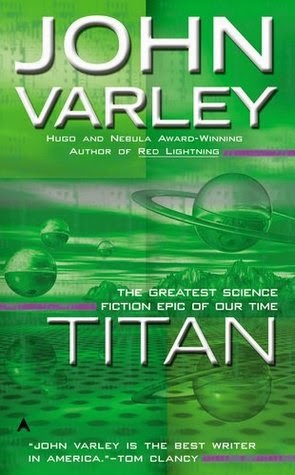
Titan by John Varley
Publisher: Berkley Books
Date of Publication: March 1979
Author Information: website
During an exploration expedition to the planet Saturn, Cirocco “Rocky” Jones–captain of the space vessel, Ringmaster–and her crew encounter an anomalous satellite revolving around the planet. The closer they get to the anomaly, the more they begin to realize that it’s actually a habitat of some sort. While trying to report their findings back to NASA, they are pulled into the satellite. The Ringmaster is destroyed, and Cirocco and her crew are rendered unconscious.
After spending some time in darkness, with no idea of how much time has passed for them in that unconscious state, the crew wakens naked, hairless, and separated (at first) in this strange habitat. The descriptions used during their time unconscious and their eventual awakening sort of seems to be some analogy to birth. However, their time in the darkness is terrifying for them, and instead of coming into this new world innocent, they still have much of their personality and memories in tact.
The planet has changed them, though, and some of them learn this faster than others. Many of them learn, they are able to communicate with various intelligent species that live on the planet. Cirocco learns that she’s able to communicate with a centaur-like race called Titanides who speak a music based language. The Titanides are locked in a bitter war with a race of winged creatures called Angels. They don’t know why they fight. They only know that when they’re close to one another they’re compelled to fight.
Cirocco learns about a controlling deity called Gaea from the Titanides. She takes a journey to confront this being.
Gaea is an interesting paradox. She really is something of a goddess to the planet. She is capricious and curious, and she uses her powers to satisfy her whims. She programmed the Titanides and Angels to fight for practice. She has a keen interest in humanity and knows that one day, because it’s in our nature, we will declare war on her. She doesn’t know how to fight, and fears that, even though she is powerful, she still would not withstand an attack from humans. She feels that humans are better prepared and better tacticians than she will ever be.
Because she doesn’t have the knowledge to prepare for war, she hopes that her warring races will be able to create the things–strategy, tools, and knowledge–needed for war through their own struggle.
However, she is facing another obstacle that complicates things. She’s going insane, and her “children” are rebelling. Here we have a being who is essentially a god whose “mind” has started to fracture into parts. She acknowledges that she is losing control of herself. There are other intelligent godlike beings on the habitat, beings that she spawned and calls her children–one of whom she considers her most rebellious and volatile, the one she blames for Cirocco’s crash.
This book wasn’t quite what I expecting. The first pages was all about the sex life of the crew, and I started wondering what I’d gotten myself into. Then, it settled into a more serious tone, but continued to throw me for a loop throughout the story. One minute, they’re having a very technical talk about a subject and the next they’re gawking at seeing their first centaur penis, which I’ll admit had me chuckling like a 12-year-old, but that’s what I liked about this book. While there is plenty of science for the sci-fi lover, Varley also incorporated mythic fantasy and quite a bit of humor into this story. He played around with the idea of gods, their relationship with their creations, and how fickle they can be.
This story challenged gender, race, and sexuality roles. Given the period it was written, when I compare it to some other science fiction books written around the same time and how they handled similar subjects, Varley’s stands out as being a bit more progressive and imaginative than most. I’d complained about another popular science fiction writer from that same period not knowing what to do with the women in his books and the distasteful direction he took with sexuality. So, I was a little afraid that this might be the same.
I really appreciated that Varley was able to write this book and realize that the hang-ups that people had about various social issues at that time probably wouldn’t matter much in the year 2025. He didn’t erase the issues or try to make everyone seem so PC about everything. There are moments when ignorance rears its head, but mostly, these issues are not taboo.
Of course, this book didn’t do everything right. There were times when it felt a bit too childish, campy, and kitschy. I could see where this book might annoy someone who wants a strict hard science/first encounter type story. It may be be a bit too whimsical and fantastic in scope for some science fiction readers. Personally, I didn’t like how one of the character’s eventual sickening and evil actions were explained and sort of pitied, for lack of better word, because it was easier just to blame the planet for his actions.
If you like science fiction stories that heavily blend science and fantasy, this book is worth checking out.



 The BiblioSanctum