Tough Traveling: Hidden Kingdom
Posted on May 22, 2014 Leave a Comment

The Thursday feature “Tough Traveling” is the brainchild of Nathan of Review Barn, who has come up with the excellent idea of making a new list each week based on the most common tropes in fantasy, as seen in The Tough Guide to Fantasyland by Diana Wynn Jones. Nathan has invited anyone who is interested to come play along, so be sure to check out the first link for more information. Compulsive list-maker that I am, I’m very excited to take part!
This week’s tour topic is: Hidden Kingdom
Usually reached through CAVERNS or after an arduous trek into the heart of the central masssif, this is often the object of the Tour QUEST…
I’ll be honest, when I saw this week’s topic, I drew a big blank. There are plenty of hidden worlds I can think of, but most of those involve jumping through portals and planes existing on completely different realms. A lot of the ones I can think of that are hidden beneath the earth or in a mountain are actually ruins or untamed “lost worlds” that aren’t exactly kingdoms. Maybe I’m overthinking things, but I was only able to come up with a few this week. Hey, just be glad I didn’t whip out Otoh Gunga from The Phantom Menace novelization!
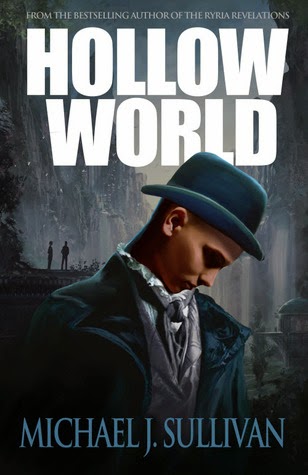
Hollow World by Michael J. Sullivan
The first book I thought of when I saw this topic was of course Hollow World, a cross-genre novel about a man with a terminal disease traveling into the future to find a cure. What he finds is an earth overgrown, seemingly devoid of much activity on the surface. But then he is brought below ground into a hollow world, where the denizens of the time had created an impressive civilization beneath the earth, complete with its own solar source.
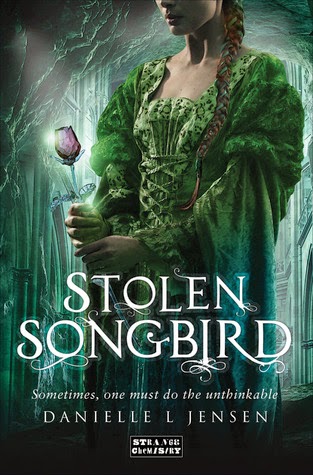
Stolen Songbird by Danielle L. Jensen
Stolen Songbird is a book I recently read that fits the theme. Though later we find out that Trollus isn’t completely hidden, since some merchants know the way to trade there, but for the most part the existence of the troll city is but a mere rumor. This kingdom was buried under the ruins of Forsaken Mountain five hundred years ago by a witch’s curse, and since then the trolls have been bound to this place beneath the earth and rock. The main character Cécile was kidnapped and brought here through an underwater passage and a series of confusing caverns. This one totally counts!
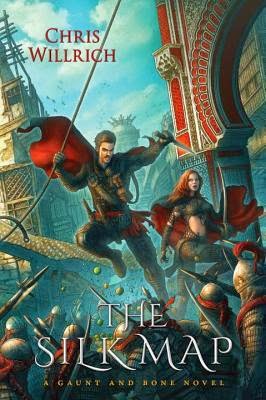
The Silk Map by Chriss Willrich
Dammit, now I’m second guessing myself. Does this book really count? I know in this latest installment of the Gaunt and Bone series our dynamic duo have to travel far to the west to find the mythical land of Xembala. These books have a bit of a surreal quality to them, so it was a bit hard to follow exactly how our heroes actually managed to make it to Xembala. But it is a kingdom and it did actually exist and it was well-hidden. That, and because I’ll only have a paltry two entries otherwise this week is why I’m gonna count it!
Book Review: The Remaining by D.J. Molles
Posted on May 21, 2014 Leave a Comment
 The Remaining by D.J. Molles
Genre: Science Fiction, Horror
Series: Book 1 of The Remaining
Publisher: Orbit (May 27, 2014)
Author Information: Website
Mogsy’s Rating: 4 of 5 stars
The Remaining is a great zombie book. Originally self-published in 2012, it quickly became an internet bestseller before being picked up by Orbit, and there’s a damn good reason for that. By now you’ve probably seen a lot of the positive reviews it has garnered, though I’m willing to bet few of them have praised this story for being terribly original. But does that make this a bad book? Heck no. In fact, I would argue that its devotion to the classic zombie survival-horror tradition is a massive part of the appeal.
The Walking Dead fans, this one would be right up your alley. No joke. The “zombies” in this book might not be the traditional mindless shambling hordes we’re used to seeing – the victims of the FURY plague are still capable of talking and strategizing up to a point before the virus degrades their brains (which makes them even more terrifying) – but the overall spirit and style of the narrative is still the same. It’s not out to knock you off your feet with any new or unusual or experimental ideas, but if its goal is to provide a fast-moving, action-packed and entertaining zombie story then I must say it has succeeded rather swimmingly.
Here’s what you basically need to know: the main character of The Remaining is a US Army captain named Lee Harden, who as part of a secret government program is sequestered in his bunker after the sudden outbreak of a new deadly and infectious virus. It’s not the first time this has happened. Lee and about four dozen other soldiers like him (one for every state) are placed in their bunkers every time the country experiences an emergency of national crisis. If the government falls, their job is to come out after the bunker, take stock of the situation and try to gather survivors in order to rebuild. But things in the past have never gone so far or gotten this bad before. When the lockdown period passes without an all-clear or any further instructions from his superiors, Lee emerges from the bunker and prepares to start his mission.
As a character, Lee took a while to grow on me – but he did. Strangely, the moment came when I was finally able to appreciate his faults. To understand, you must realize the few chapters really tried my patience. The entire lockdown period featured Lee being in denial, going back and forth between his decisions and second guessing his instructions. And then there were those long and wearying paragraphs about his guns. The deadline came and went. I kept tapping my foot waiting for him to stop describing the contents of his impressive arsenal, get his waffling butt out there and actually put all that stuff to good use on some hapless Infected.
Then I realized, I was being too harsh. Dude is stuck in a bunker. Not knowing what’s going on because he’s cut off from all communication. No human interaction at all because it’s just him and his dog. If the world outside has indeed gone to hell in a hand basket, he’s probably also scared to death of the responsibility waiting for him on the other side of that tunnel.
So maybe I was being a tad unfair to poor Lee. And really, what a shame it would have been if he was just another archetypal action hero, full of empty bravado rushing out headfirst to save the world? Lee is more realistic this way, even if he did end up doing some questionable things. But then, who wouldn’t make a mistake in the middle of a zombie apocalypse? Contrary to what all the zombie survival guides want you to believe, there’s no instruction manual for stuff like this. Wrong decisions or no, Lee has to make some pretty tough calls as well. The guy has a good heart, but he’s sure as hell also capable of showing no mercy to those who don’t deserve it. I love that in his character.
Bottom line, if you’re a fan of type of zombie apocalypse survival movies that Hollywood does so well, this is that in book form. After a relatively sedate start, the novel picks up and will not slow down, with always some kind of disaster or new setback waiting around the corner for the characters to overcome. No other bells and whistles or fancy-schmancy embellishments, just pure zombie fiction fun.

Waiting on Wednesday 05/21/14
Posted on May 21, 2014 Leave a Comment
“Waiting On Wednesday” is a weekly meme hosted by Breaking the Spine that lets us feature upcoming releases that we can’t wait to get our hands on!
Blue Lily, Lily Blue by Maggie Stiefvater – October 28, 2014 (Scholastic Press)
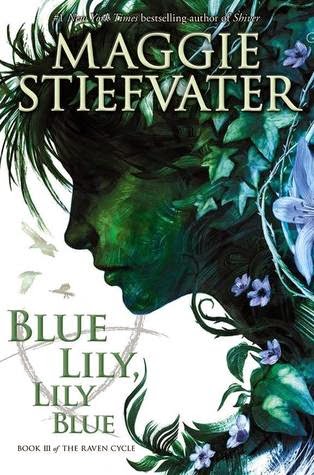 With thanks to Mogsy for alerting me to the fact that the third book in Maggie Steifvater’s Raven Cycle finally has both a cover and a title and will be coming out just in time for my birthday! Well, the day after, but that’s fine! There’s no information posted for the book yet, so you’re just going to have to settle for my bookflail!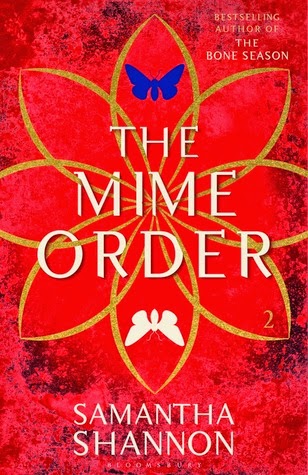
As Scion turns its all-seeing eye on Paige, the mime-lords and mime-queens of the city’s gangs are invited to a rare meeting of the Unnatural Assembly. Jaxon Hall and his Seven Seals prepare to take center stage, but there are bitter fault lines running through the clairvoyant community and dark secrets around every corner.
Then the Rephaim begin crawling out from the shadows. But where is Warden? Paige must keep moving, from Seven Dials to Grub Street to the secret catacombs of Camden, until the fate of the underworld can be decided. Will Paige know who to trust? The hunt for the dreamwalker is on.”
Book Review: Night Terrors by Tim Waggoner
Posted on May 20, 2014 Leave a Comment
Genre: Urban Fantasy
Series: Book 1 of Shadow Watch
Publisher: Angry Robot (May 27, 2014)
Author Information: Website | Twitter
Mogsy’s Rating: 3 of 5 stars
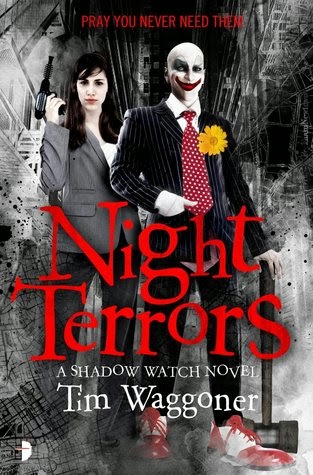
I think reading this book gave me better insight into coulrophobia. I mean, clowns are kinda creepy I guess. But I’ve also always found it hard to look at them and not see beyond just some guy in colorful clothes and makeup. Supernatural clowns on the other hand, are a whole other matter. Especially when they are someone’s nightmare literally come to life.
But in spite of what the title and cover initially led me to believe, this is not a horror novel. Night Terrors would probably fit more comfortably in the urban fantasy and paranormal section. That said, it’s also darkly comedic and not just a little bit unhinged. Think buddy cop movie meets Tim Burton, quirky and fun but also a little macabre.
The book’s protagonist is Audra Hawthorne, an officer of the Shadow Watch, the supernatural agency dedicated to patrolling the border between our world and the dream realm. Their units are generally organized into pairs made up of an Ideator and their Incubus – in other words, the dreamer and the living manifestation of their worst nightmare. For Audra, dreams of the psychotic clown Jinx has terrorized her ever since she was a child, but now they are partners working together to keep both Earth and Nod safe from rogue Incubi.
Because they are essentially the products of our dreams, Incubi come in all shapes and sizes. You’ll see some pretty wild dream-folk in this book, like Candy, the Incubus made completely out of – you guessed it – chocolate and other yummy sweets (rumored to have been dreamt up by a dentist’s son) or the Deathmobile, a nightmare hearse. I really enjoyed the originality of these crazy manifestations and the idea that our mortal realm exists in parallel with the zany world of Nod.
And yet, I didn’t feel as excited about this book as I thought. The awesome premise aside, the plot was mediocre not to mention formulaic with all the usual elements of an urban fantasy thrown in. As a detective story it was rather predictable, which is disappointing especially given all the other cool ideas in here. And while I appreciated the contrast between the level-headed Audra versus the insane and unpredictable Jinx, I found a lot of the action to be over-the-top and mostly exaggerated slapstick. On the one hand, I loved the delightfully creepy way Jinx was portrayed. But personally, that kind of humor just isn’t my style.
I’ll also admit I might be just a bit picky with my urban fantasy. On the whole, Night Terrors is a pretty good book, if nothing else a quick and entertaining read with a few rather neat, never-seen-before ideas. The story itself didn’t take off for me, mostly because the style isn’t my cup of tea, but I actually think it could click with most people.

Guest post: Intrigues of The Untheileneise Court by Katherine Addison
Posted on May 19, 2014 Leave a Comment
Whether you know her as Sarah Monette or by her pseudonym Katherine Addison, one thing’s for certain — her latest book, The Goblin Emperor, is a clear winner. We here at the BiblioSanctum are pleased to have her join us today to talk about the art of politics in the novel’s Imperial Court. Be sure to also check out the review to see why this is one of the most unique and dazzling fantasies to come out this year.
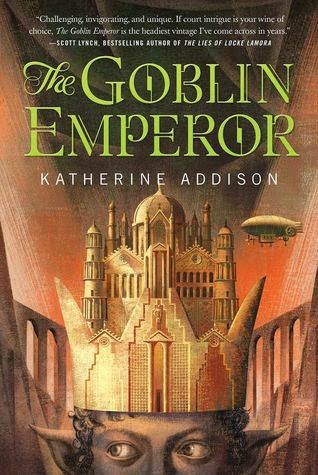 The Goblin Emperor begins with my protagonist, Maia, discovering that because of a dreadful airship accident, he is now the Emperor of the Ethuveraz, the Elflands, and must leave the shabby, unhappy hunting lodge where he has grown up and go to court, and much of the novel deals with his culture shock.
The Untheileneise Court, the seat of the Elvish government, is–pretty obviously–based on Versailles and the court of Louis XIV. L’etat, c’est moi, Louis said, and while it’s easy to translate the words, it’s hard to translate the exact meaning and nuances of the phrase into English. “I am the state,” is maybe closest, but it has none of the elegance of Louis’ words and it puts them the wrong way round. It matters that the subject of Louis’ sentence is l’etat, because what he means isn’t that the king is synonymous with the state (Shakespeare’s history plays are a series of arguments with and about that idea), but that the state is synonymous with the king. The king is the center around which everything else must revolve.
The Goblin Emperor takes place in a world where the emperor who consolidated power in himself ruled thousands of years ago, and instead of his reign being followed by Louis XV and Louis XVI, it was followed by rulers as canny and power-hungry as himself. So by the time the novel starts, the Untheileneise Court has had centuries to accrete and flourish around the person of the Emperor. He’s still the center, but he cannot possibly oversee–or even be aware of–everything that happens. This is an atmosphere in which intrigue flourishes, like man-eating orchids in a hothouse.
Being the emperor, Maia is largely shielded from the intrigues of his court; we get suggestions of the infighting among the imperial judges and hints of the animosity between the two houses of Parliament, the House of Commons and the House of Blood, and I think it’s very clear that the court is a pit of vicious, grudge-holding vipers, but we don’t see the political maneuvering that must be going on in every corner.
The intrigues of the Untheileneise Court are elegant. There is no poison involved (not anymore, although there are people still alive who remember the great feuds of the reign of Edrevechelar XVI and the night known as the Poisoners’ Ball). Rumor and innuendo are the favored weapons, and defamation dealt with a glittering smile. No one can keep a secret in the Untheileneise Court, and a weakness found is a weakness exploited. If I’d had more space, I would have liked to have explored the role of the imperial couriers, who go everywhere and see everything and who are somewhere in-between servants and courtiers, in a sort of indeterminate space that is both uncomfortable and extremely useful. If anyone knows where all the bodies are buried, it’s the couriers.
We see even less of the goblin court, only the ambassadors and envoys from the Corat dav’Arhos, but goblin politics, while no less involved, are more straightforward. As von Clausewitz said, war is the continuation of politics by other means, and the goblins have developed a system which rocks back and forth over the line, as intrigues erupt in duels or skirmishes between the avarsin, and then fall back into negotiations and schemes. They have no civil wars, but the possibility for internecine violence is never far away. The elves consider the goblins barbarians; the goblins are exasperated by the elvish inability to say anything straight out.
Louis XIV instituted the court at Versailles as a way to keep the French nobility fighting among themselves instead of uniting in a bloc to negotiate with–or issue ultimatums to–the king. He was sufficiently successful that when change came, as change always does, it came from the working class and it came with catastrophic violence. Elvish society hasn’t hit the French Revolution yet; hopefully Maia’s reign will mean that they never do, that reform can come peacefully. But nothing will stop the intriguing and the politics.

ABOUT THE AUTHOR
Katherine Addison is a pseudonym for Sarah Monette. She grew up in Oak Ridge, Tennessee, one of the three secret cities of the Manhattan Project, and now lives in a 108-year-old house in the Upper Midwest with a great many books, two cats, one grand piano, and one husband. Her Ph.D. diploma (English Literature, 2004) hangs in the kitchen. She has published more than fifty short stories and has two short story collections out: The Bone Key (Prime Books 2007–with a shiny second edition in 2011) and Somewhere Beneath Those Waves (Prime Books, 2011). She has co-written two novels with Elizabeth Bear, and they are working on a third. Her first four novels (Melusine, The Virtu, The Mirador, Corambis) were published by Ace. Her latest novel, The Goblin Emperor, came out from Tor in April 2014.
Book Review: Blood Song by Anthony Ryan
Posted on May 18, 2014 2 Comments
Genre: Epic Fantasy
Series: Book 1 of Raven’s Shadow
Publisher: Ace (July 2, 2013)
Author Information: Website | Twitter
Mogsy’s Rating: 4 of 5 stars
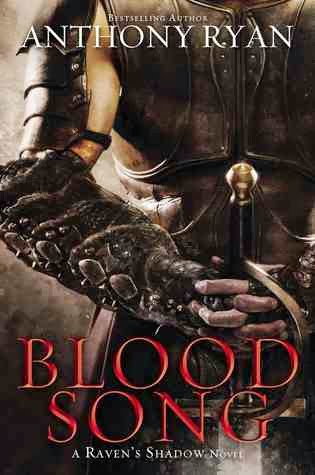
The story of Blood Song is about a young boy who trains and grows up to become a leader and one of the greatest warriors in the kingdom. It’s a tried-and-true formula in epic fantasy which by all rights I should be sick to death of by now, but Anthony Ryan manages to pull it off without making me feel like I’m getting the same old, same old.
Take how the book starts, for example, opening on an encounter between a scribe and a prisoner who is being transported across the sea to answer for his crimes. A duel to the death is the only end left for Vaelin al Sorna, also known as “Hope Killer”. With a sobriquet like that, I couldn’t help but wonder at his character, but I was also intrigued by his soft spokenness and eloquence. More puzzling is the fact that everyone seems to be treating him with respect and deference, in spite of his chains.
Vaelin’s story is recounted by the scribe, a mode of storytelling which is not uncommon even outside other mediums of fantasy, but in this case it is deftly executed, providing a deeply immersive experience for the reader. As a child, the main character is sent to the Sixth Order to train in the martial ways of the Faith. It’s a harsh life fraught with peril, as Vaelin and his peers are driven relentlessly by their instructors to learn everything from doctrine and history, to survival methods or ways to wield a sword.
In general, I’m not a big fan of this trope. More often than not, I find the training and “growing up” phase of the hero’s story to be the most tedious part, and so I’m usually looking forward to getting it over with. Not so with Blood Song, though. Imagine my surprise when these sections of the book turned out to be the most rewarding aspect. I loved reading about Vaelin’s experiences in the Sixth Order, especially some of the more challenging trials. I very much enjoyed the bonds he shared with his fellow brothers of the Faith, the fact that any conflicts between the boys are negated by the knowledge that they are all in this together.
In fact, I liked this section a lot more than the later parts of the book, in which we see Vaelin go off to fight big battles and become embroiled in political plots and magic. Normally that would be the kind of stuff I live for in my epic fantasy, so you can see just how much I enjoyed the first half of the novel to consider it my favorite. Not that the second half is a slouch — I think most people would find it more interesting, actually. For myself, I just couldn’t help but develop a soft spot for Vaelin back when he was just a boy, when he still retained some of his innocence.
As you’ve probably guessed, I have nothing but good things to say about the portrayal of Vaelin and the other characters in this novel. You will see the relationships forged early on between him and his brothers evolve as they face their hardships together year after year. And when enemies become friends or friends become enemies, the transformations are both a surprise but also believable. Vaelin himself is a good and honorable person, and his desire to transcend the expectations of his order and be a better person for those around him is an engrossing study into the themes of sacrifice, morals and personal beliefs.
Highly recommended. I can just imagine the thrilled reactions of readers who picked this book up back when it was still independently published. A gem like this doesn’t come along every day, and I’d say it stands out even beside some of the major epic fantasy novels today.
YA Weekend: Earth Girl by Janet Edwards
Posted on May 17, 2014 2 Comments

Earth Girl by Janet Edwards
Genre: Young Adult, Science Fiction
Series: Book 1 of Earth Girl
Publisher: Pyr (March 5, 2013)
Author Information: Website | Twitter
Mogsy’s Rating: 4.5 of 5 stars
When I think about Young Adult books from Pyr, words that spring immediately to mind are “distinct”, “unconventional” and “unique”. I guess that’s why I’ve been counting on this book to lift me out of my YA slump. I’ve been feeling rather burned out by the love triangles, broody heroes, and paranormal/fantasy settings in this category lately, and Earth Girl looked like the perfect cure to this particular malaise.
My instincts proved correct.
The story of Earth Girl takes place in the far-flung future, narrated by eighteen-year-old Jarra. There are many names for people like her. Handicapped. Throwback. Nean. Ape. All of them mean one thing: that she is among the one in a thousand born with an immune disorder that confines her to earth. Humans have developed portal technology at this point, using it to colonize a multitude of worlds, but Jarra can’t visit any of them. If she traveled anywhere she would go into anaphylactic shock in seconds, and die if not returned immediately to earth’s atmosphere.
But even in the year 2788, humanity has its bigoted attitudes. So when the time comes to enroll in university, Jarra chooses her preferred subject History, but decides to invent a fake military background for herself to apply at a school on another planet whose class of norms who would be on earth for the first year of practical studies. Jarra is sick and tired of being looked down on for being handicapped, and she’s determined to show a bunch of stupid Exos just what an ape girl is capable of.
There is therefore nothing subtle about the social message in Earth Girl. This is a book infused with emotion and meaning. But even beyond this, there is so much more to love. While the plot may be a bit predictable at times, very little else about this novel falls prey to clichés, especially when it comes to the characters. You meet Lecturer Playdon, for example, and might immediately label him a hardball professor, bent on giving our protagonist a hard time – because adults obviously are in YA novels just to get in the way! Or take Dalmora Rostha, daughter of a rich, famous vid director. She’s totally going to be the snooty, spoiled and annoyingly fake arch nemesis in this story, am I right? Now the lascivious pair of Betas though, surely they are there just to provide comic relief, cause trouble and flunk out?
Nope, nope, and nope, wrong on all counts. This book will surprise you at every turn, and I can’t tell you how refreshing that is.
I also confess, I have another reason for loving this book. For you see, in the context of Earth Girl, Jarra’s “practical prehistory studies” is just another word for Archaeology. And I love Archaeology. While studying it and going on digs in college, I’d always entertained thoughts of future archaeologists excavating our modern cities and wondered what they would make of our civilization from the things they find. It’s like the author was reading my mind! When Jarra and her class dig up the ruins of New York, the methods and technology they use may be very different, but still the systematic methods are there and so is the culture and spirit of a dig site. World building is fantastic in terms of creating a great atmosphere.
My only quibbles are minor. The dialogue can be stunted at times, making Jarra and her friends sound and act like they are much younger than their eighteen years. Fian, the romantic interest, is probably the worst offender. Jarra also seems to be an expert at everything. A character even makes a joke about this at one point in the novel. As well, there is a tendency to tell instead of show and moments of overt info-dumping, but as many of these instances are worked into a classroom setting, they were easily forgivable. Other than that, as you can see from my rating, this book was close to perfect.
Thank you, Janet Edwards, for breathing some new life into YA for me. Earth Girl was a very enjoyable read and I’m looking forward to the next book.

Series Review: Bronze Gods and Silver Mirrors by A.A. Aguirre
Posted on May 16, 2014 1 Comment
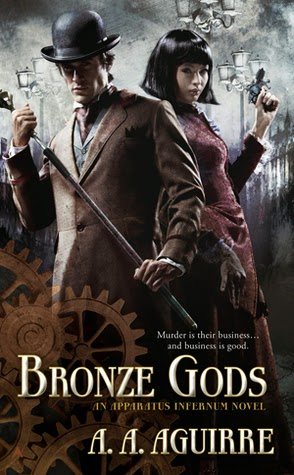
Genre: Fantasy
Series: Book 1 of Apparatus Infernum
Publisher: Ace (April 30, 2014)
Author Information: Website
Mogsy’s Rating: 3.5 of 5 stars
What an offbeat, curious little novel. I wasn’t surprised to discover that it was a Victorian-inspired steampunk urban fantasy type mystery, but it’s the other little pleasures thrown in that endeared me to this book. The sprinkling of magical elements combined with other fantasy aspects make the world of Bronze Gods more special and enchanting.
Meet Janus Mikani and Celeste Ritsuko, a detective team for the Criminal Investigation Department. He is a magical expert and brings his own uncanny Ferisher (they’re like the Fae) powers to the case. She is the first female detective in her division and pushes herself to prove herself. Together, they are tasked to solve the disappearance of a young girl from a noble house, and catch the one responsible before he can strike again.
But there’s more to this story than just police work. If you enjoy a little romance or like a bit of sexual tension to spice things up, then you’re in for a treat. I got a major “Mulder and Scully” vibe from Mikani and Ritsuko, with their mutual attraction and feelings for each other smoldering beneath the surface, gradually warming up in a slow burn that’s both oh so sweet and delicious. The writing team of Ann Aguirre and her husband Andres Aguirre has succeeded in writing a very convincing romance between the two main characters.
So, here you have awesome world (check!), awesome characters (check!) and awesome chemistry between said characters (check!). But what I struggled with a little was the plot and pacing. If you’re a mystery buff, you’ll probably find yourself frustrated by the seemingly lackadaisical pace of the investigation, not to mention the police procedural aspects are a bit light. To be fair, a full-out detective story isn’t what Bronze Gods was meant to be, but just one major facet of the story. I was also a bit dissatisfied by the ending and the “twist” regarding one of the suspects, but seeing as that took place in the final scenes, it didn’t take away from my overall enjoyment of the book too much.
More importantly, Bronze Gods was an entertaining and action-filled read, with well-developed characters that actually gave me reasons to continue caring about their unresolved relationship. I like how there is no rush to get Mikani and Ritsuko together, because when it finally happens I’m sure it’ll just be all the more satisfying. I want to continue the series to see what other mysteries our duo will have to solve, but I’m also very interested in seeing where their feelings for each other will eventually take them.

 Silver Mirrors by A.A. Aguirre
Genre: Fantasy
Series: Book 2 of Apparatus Infernum
Publisher: Ace (April 29, 2014)
Author Information: Website
Mogsy’s Rating: 4 of 5 stars
The adventures of Janus Mikani and Celeste Ritsuko continue in Silver Mirrors, but the second novel of the Apparatus Infernum series takes a decidedly different tack. Of course, our two CID investigators have another mystery to solve, but their mission this time takes them across the ocean, over the treacherous peaks of the mountains, and deep into the fire elemental mining tunnels of the north.
Needless to say, I found Silver Mirrors to be a much more exciting novel than the first. The premise of the story – that the world’s elementals are unsettled and running amok as a result of the destructive events of the last book – is perhaps tenuous at best, but it hardly mattered. The important thing is, we get to go on an adventure out of the city and onto the high seas with our two protagonists. And thar be pirates!
Also threaded into this thrilling ride is the ever-present romantic side plot, with the sexual tension between Ritsuko and Mikani about to boil over and explode any second. Seriously, these two have it BAD for one another. And of course, everyone sees it except for them. If you prefer slow-burn romances and delayed gratification when it comes to love stories between characters, I can’t recommend these books enough. But it also behooves me to say it probably wouldn’t hurt to be prepared for how oblivious they are. Reading about the two of them dancing and flailing around each other’s emotions is a bit like watching a couple of hopeless players at game of charades. It’s hard to believe they actually make a living doing detective work and solving mysteries. But you know what they say about good things coming to those who wait. I think that goes for the characters and the readers both, and for now all we can do is root for Ritsuko and Mikani.
But I’m glad I decided to read this sequel not just for the progression of their romance, because there’s a lot more to the world of this series. Silver Mirrors expands it by having the characters travel afar, and not for the first time I wished a book would include a map. We also learn more about the magic and its limitations. For instance, when the behaviors of elementals are disrupted, the different instruments and devices they help power can also become unstable or fail spectacularly altogether. It wasn’t until this novel that I finally got a sense of the living, breathing connection between the mortal and the mystical.
The Aguirres are clearly not afraid to take their books into new territory. While Bronze Gods was more of a whodunit murder mystery, Silver Mirrors reads like an action-adventure with the characters embarking on a perilous quest. Book two may be a continuation of book one, but even so, the two stories can’t be any more different. It mixes things up and keeps this series interesting. Obviously, the Mikani and Ritsuko situation is something I’d like to keep an eye on, but I’m also looking forward to seeing what the authors will do in future installments and where they will take us next.
Book Review: The Hallowed Hunt by Lois McMaster Bujold
Posted on May 15, 2014 1 Comment
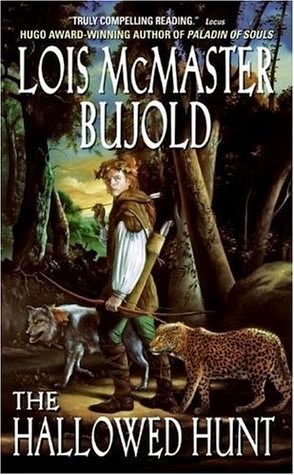
The Hallowed Hunt by Lois McMaster Bujold
Genre: Fantasy
Series: Chalion #3
Publisher: HarperCollins
Publication Date: 2005
Author Info: www.dendarii.com
Wendy’s Rating: 2.5 of 5 stars
“Free will is sacred. The meaning of yes is created by the ability to say no”
When I stepped into the world of Chalion, I was introduced to its five gods—Father, Son, Mother, Daughter and the Bastard—and some of the rituals surrounding them, but I mistakenly assumed these gods were much like ours: believed in by some, but with little proof of their existence. But as with everything else in The Curse of Chalion, Bujold politely allowed me my assumptions, then gently pulled the rug out from under me and moved on before I even had time to catch my breath. Subsequently, I leapt into the second book, Paladin of Souls, eager to learn more about her world and her gods, and soon fell in love with the Bastard himself. I grabbed Hallowed Hunt hoping for more of the same, but while this did offer more insight into the supernatural and a new form of possession, that of spirit animals, the story and characters themselves were disappointing.
The story begins with the death of a prince, murdered in self-defense by the woman he meant to rape. Ijada is less concerned about her fate before judges who are unlikely to see her side of the story, than she is about the sorcery that the prince had involved, resulting in her acquiring the spirit of a leopard. She is to be delivered to her trial by Ingray, the gruff and deadly sword of a noble lord, who happens to possess an animal spirit of his own. He came by his wolf under traumatic means, but has since suppressed the creature, despite its strength. Their journey together quickly leads them to the realization that their spirits are some how bound together, and they must unravel the mystery.
After Paladin of Souls, where the character of Ista became my new hero, I apparently set my standards too high for Ijada. Not that Ijada wasn’t a good character. As usual, I am impressed with the way Bujold handles her women within a male patriarchal society. Her women are all aware of the inequality and may comment on it, but they aren’t desperately raging against it. They all overcome or out-manoeuver within the rules, and they all show an consistence strength of will and an inspirational endurance. As this is told entirely through Ingray’s point of view, you don’t get much from Ijada beyond his views of her stoicism and his disbelief in her willingness to accept him so easily when most people are intimidated by his harsh demeanour.
It’s obvious early on that Ijada and Ingray are meant to be together and, despite a few obstacles, that progresses more or less as expected. Bujold’s books often involve romances with unusual attractions, but the pairings are usually much more interesting and the build up to the realization that the one has feelings for the other is usually far more subtle.
I didn’t enjoy these characters and therefore did not become invested in them or in the story itself. By the time things were revealed and proceeded on to the epic not-quite-showdown and ghostly turn of events, I was rather bored.
However, I did enjoy the insight into demon possession, which mostly came through an encounter with a pregnant sorceress. Since demon possession and the subsequent sorcery status had negative connotations for the people in Paladin of Souls, it was interesting to see the counter view, since this takes place in another land where sorcerers are respected and their abilities are trained.

Tough Traveling: Fairground
Posted on May 15, 2014 Leave a Comment
The Thursday feature “Tough Traveling” is the brainchild of Nathan of Review Barn, who has come up with the excellent idea of making a new list each week based on the most common tropes in fantasy, as seen in The Tough Guide to Fantasyland by Diana Wynn Jones. Nathan has invited anyone who is interested to come play along, so be sure to check out the first link for more information. Compulsive list-maker that I am, I’m very excited to take part!
This week’s tour topic is: Fairground
This is like a MARKET, except it is much, much bigger and planted somewhere right in the middle of nowhere so that everyone can get to it. There will be rows and rows of TENTS and BOOTHS…
Geez, way to choose a hard one for this week, Nathan. I had a pretty tough time with this one. Too bad circuses don’t count immediately because I’ve sure got plenty of those! But hey, if a book features a circus with a fairground, I say that’s FAIR GROUND. Har har, I’m hilarious.
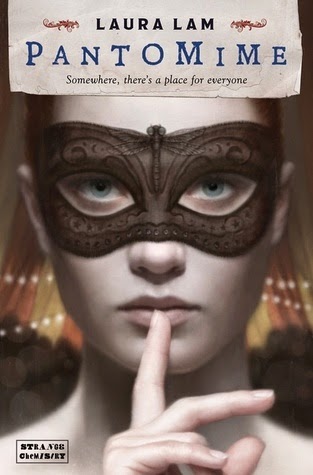
Pantomime by Laura Lam – Like a lot of circuses, the one in this book includes a funfair. Protagonist Gene makes frequent visits to explore the fair grounds after shows to visit the different booths for games and delicious carnival food like roasted hazelnuts, popping corn and caramel apples. Yum! (Review)
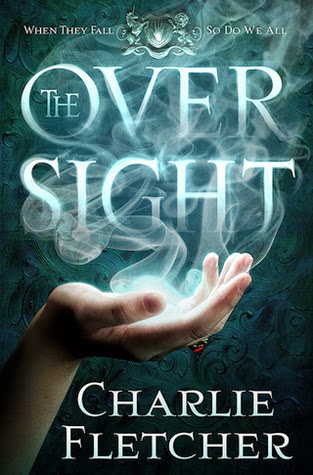
The Oversight by Charlie Fletcher – We’re transported from the London streets to a funfair in the countryside when Lucy Harker gets into a bit of trouble and finds herself traveling with a troupe of performers. She learns that an upcoming “wizard battle” between two rival magicians has become the fair’s biggest attraction. (Review)

Moth and Spark by Anne Leonard – I almost forgot about this! If I hadn’t picked up my copy the other day and looked at the back cover, which actually shows a short excerpt from a scene where Corin and Tam are riding atop wooden horses on a carousel. The two lovers had donned masks to sneak out to the fair. (Review)
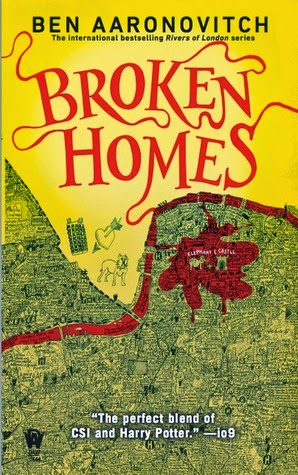
Broken Homes by Ben Aaronovitch – One of the best scenes in this novel is the the Spring Court held by the God and Goddess of Thames. A large celebration in the park, the event featured games, vendors hawking food and trinkets, and even an antique steam-powered carousel and a jazz tent! As the closest thing to magical law enforcement, constable Peter Grant of the Folly has to man a Metropolitan Police booth. (Review)

Hang Wire by Adam Christopher – Most people think of fairgrounds as fun, cheery places, but the one in this book is anything but. Instead of whimsical rides and attractions, there’s a creepy circus here with a funfair featuring mechanical devices and structures suffused with pure evil, and they hunger for the blood of carnival goers. (Review)
Honorable Mentions:
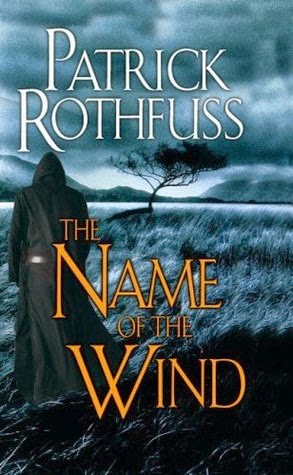 The Name of the Wind by Patrick Rothfuss – While I can’t recall an actual fairground in these books, Kvothe spent his childhood with his family, a troupe of traveling players that traveled from town to town performing songs and theater acts at fairs and large gatherings. He describes his early days as happy, like growing up in the center of an endless fair.
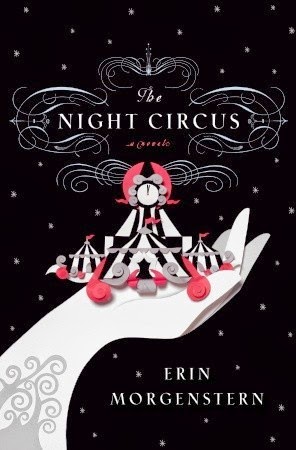
The Night Circus by Erin Morgenstern – I think Le Cirque des Rêves is more of an actual circus, featuring tents that are larger and more elaborate, unlike the little stalls and booths you’d find on normal fairgrounds. But the sights within are just too awe-inspiring not to include this book here. (Review)


 The BiblioSanctum