Comic Stack 03/04/15: Leading Ladies
Posted on March 4, 2015 3 Comments


This week’s stack (which should’ve been last week’s stack, but I got all caught up in my emotions about another leading lady, Silk) features some leading ladies in comics. We take a trip with five girls at a camp for Hardcore Lady Types. We learn that a third-rate cosmetic company will likely be the cause of a zombie outbreak that only affects women and only men get eaten. Finally, we put on our spiked leather jackets and brass knuckles to team up with The Fever!
Bonus: There’s music! (Thanks to Lumberjanes for inspiring this, and okay, there are three comics and I only made 2 playlists. LANGUAGE WARNING on some of these songs.)
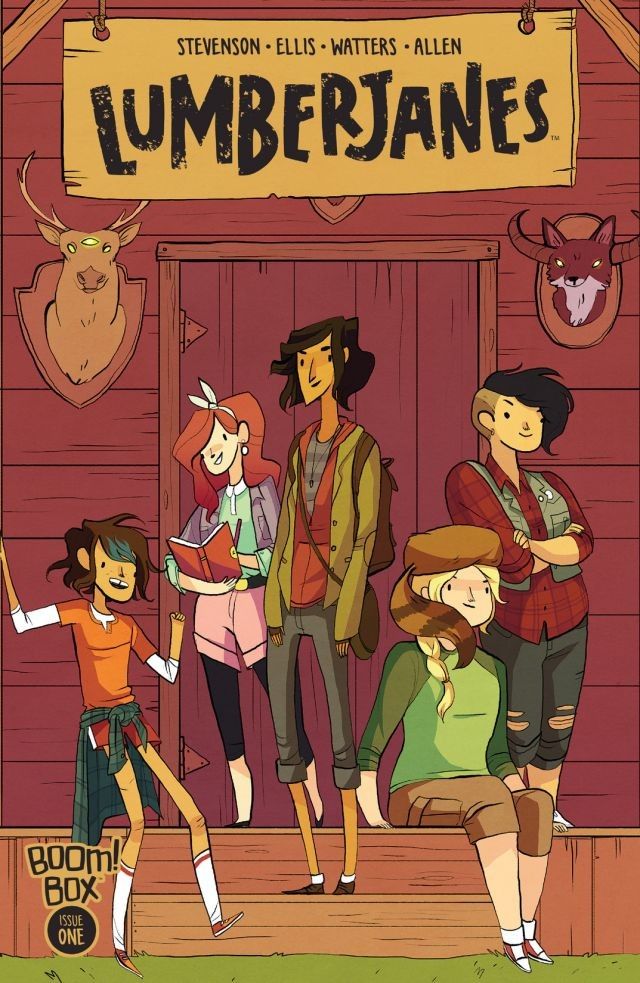 Lumberjanes #1 by Grace Ellis
Publisher: Boom! Studios
Genre: Leading Ladies, Action-Adventure, Comedy
Friendship to the max is what this book promises and is also one of the mottos for Miss Quinzella Thiskwin Penniquiqul Thistle Crumpet’s Camp for Hardcore Lady Types. Five friends go into the woods after camp curfew after encountering an old lady outside of their bunk that turns into a bearwoman. Of course, they had to investigate, which ends in an epic fox fight where they’re warned by the three-eyed foxes to “Beware the holy kitten,” but not before one of the girls totally punches one of the foxes into stardust or something.
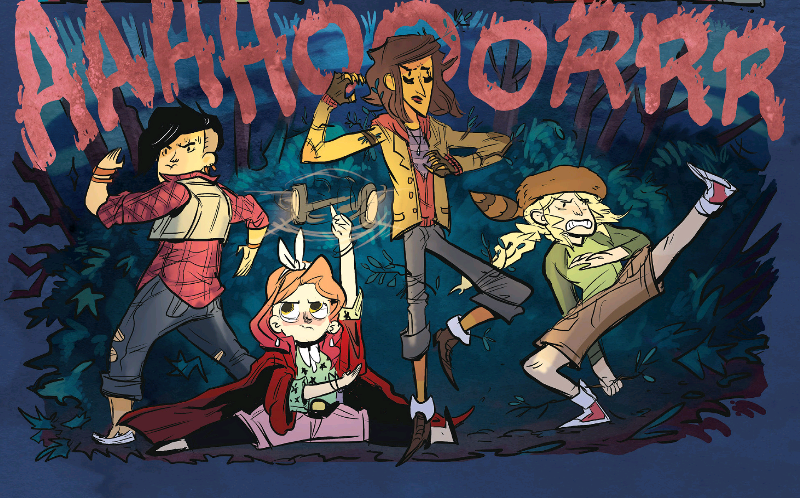
For their effort, they’re scolded by their bunk leader, Jen, who takes them to their camp leader, Rosie, where they recount their adventure in true teenage girl fashion. They’re not punished for breaking eight camp policies, which is a relief because who wants their parents called.
I don’t even know what’s going with this one, but it seems fun. There’s already a strong message of friendship and adventure in the book. I’m going to keep reading it for that reason alone. I think there is a first volume out, so I plan to read it soon because I think this could end up being the type of book that my daughter would enjoy, too. Also, there’s a soundtrack at the end of the book, so that’s important.

Listen to this WONDERFUL playlist (that I didn’t even have to make up myself because they did it for me) Fox Fight Jams!
I’m an audiophile and I’m easy like that.
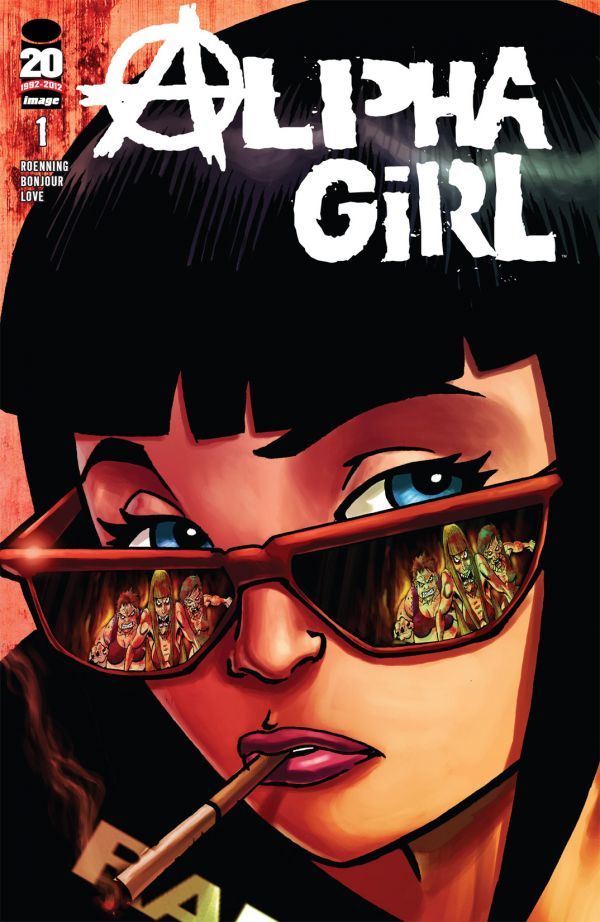 Alpha Girl #1 by Jean-Paul Bonjour, Jeff Roenning
Publisher: Image Comics
Genre: Leading Ladies, Zombie Horror, Comedy
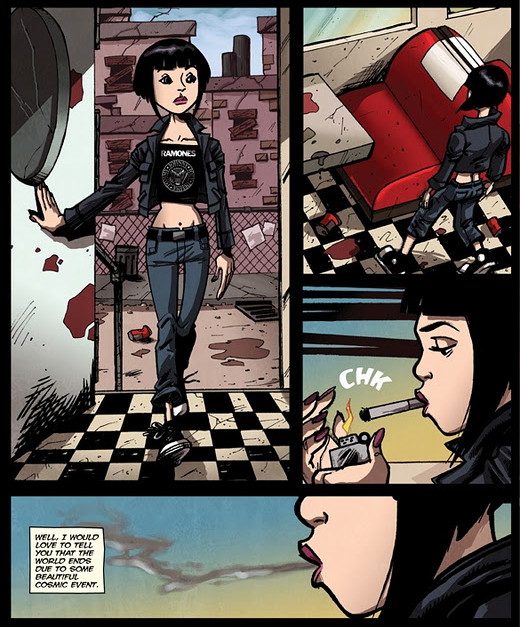
“Well, I would love to tell you that the world ends due to some beautiful cosmic event.”
The world is in chaos, overrun by female zombies who attack men thanks to a (third-rate) cosmetics company who thought it would be idea to start messing around with pheromones for a project. Judith and her little brother, Buddy, are wards of the state. A brief backstory reveals that they’d always fended for themselves. Their mother was a drug addict, and after she overdosed, Judith was bounced from home to home for a while before settling in one. Buddy, on the other hand, wasn’t so lucky. After being preyed on twice and defending himself, he ends up in juvenile hall where he won’t be paroled until he’s eighteen.
This is a zombie story. I hate zombies. I hate zombie stories. Correction, I usually hate zombie stories. There have been exceptions to this, as with anything else. I tend to like zombie stories that seem to be more about the people of the story rather than the zombies themselves. The Walking Dead for instance, I enjoy that because of the characters and the stories they have to tell. I’m more interested in how people are shaped by a zombie apocalypse than the actual zombies. I also enjoy stories that provide some interesting take on zombies such as a virus being the actual cause or have some technological basis rather than death or give some interesting perspective from the zombies’ POV.
This book doesn’t go too much into Judith’s role in this story. It only serves to give us a glimpse of what’s going on in the world and where Judith comes from. These are important things we to know since we need to know how the virus started and we need to know what factors will motivate her to do something about the situation she’s in now. Despite there being an interesting premise of cosmetics being at fault, I’m a little on the fence. I’m curious, but it’s not the type of curiosity that would compel me to pick up another book.
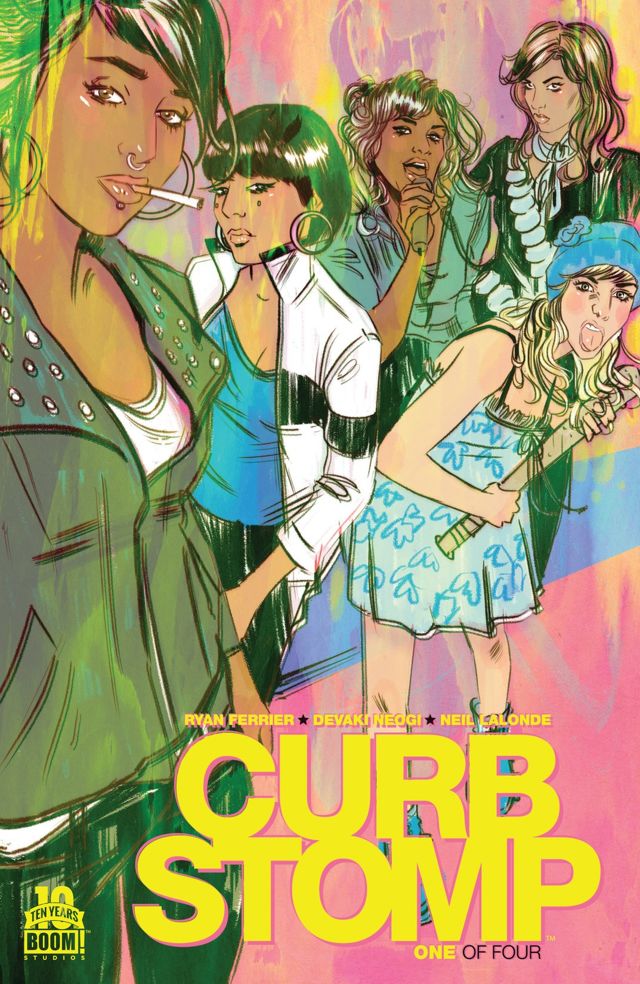 Curb Stomp #1 by Ryan Ferrier
Publisher: Boom! Studios
Genre: Leading Ladies, Action-Adventure, Crime
In an unnamed city surrounded by three boroughs, three gangs protect their respective turfs. While the city sleeps safely, the surrounding areas are left to fend for themselves with little to no protection. The Wrath protect Newport, the Bayside Five protect Bayside, and the Fever protect Old Beach. The Fever is the main focus of this story.
They’re group of tough women who’ll do whatever it takes to protect their home and each other. The Fever consists of Daisy Chain, Bloody Mary, Derby Girl, Violet Volt, and their leader, Machete Betty. In a moment of self-defense against some encroaching rival gang members, Machete Betty loses her temper and makes one bite the curb setting off a chain of events that threaten to be disastrous for the women, but they’re going to see each other through this–whatever it takes.

I loved, loved, loved this book and everything about it. I love the art. I love the gritty, visceral story. I love the girl power message that’s steeped in an aggressive, take-no-shit attitude. While the women of this book are tough, I have to love the tender moments between them showing their sisterly love, too. There was literally nothing I didn’t like about this book except that it was too short. It reminds me of how I felt about Saga when I first started reading it. Instantly hooked and ready for the next book in this series. I am so enthusiastic about this series.
Waiting On Wednesday – 03/04/2015
Posted on March 4, 2015 8 Comments

“Waiting On Wednesday” is a weekly meme hosted by Breaking the Spine that lets us feature upcoming releases that we can’t wait to get our hands on!
Mogsy’s Pick:
Shadows of Self by Brandon Sanderson: October 6, 2015 (Tor)
Sanderson’s original Mistborn trilogy features a more epic and elaborate story and gets a lot of love from fans, but I confess I probably enjoyed book four The Alloy of Law more than the first three books put together. Set 300 years after the events of The Hero of Ages, I was just really taken by the western-like setting and the mild hints of steampunk, not to mention the cleverly named duo of Wax and Wayne. I’m really looking forward to the next book of their adventures.
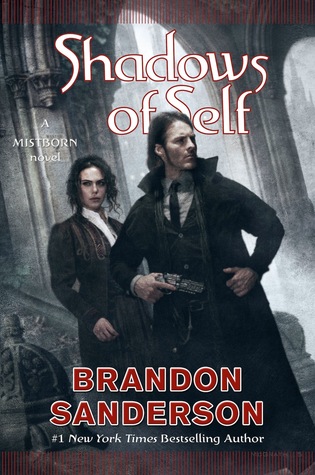 “With The Alloy of Law, Brandon Sanderson surprised readers with a New York Times bestselling spinoff of his Mistborn books, set after the action of the trilogy, in a period corresponding to late 19th-century America.
The trilogy’s heroes are now figures of myth and legend, even objects of religious veneration. They are succeeded by wonderful new characters, chief among them Waxillium Ladrian, known as Wax, hereditary Lord of House Ladrian but also, until recently, a lawman in the ungoverned frontier region known as the Roughs. There he worked with his eccentric but effective buddy, Wayne. They are “twinborn,” meaning they are able to use both Allomantic and Feruchemical magic.
Shadows of Self shows Mistborn’s society evolving as technology and magic mix, the economy grows, democracy contends with corruption, and religion becomes a growing cultural force, with four faiths competing for converts.
This bustling, optimistic, but still shaky society now faces its first instance of terrorism, crimes intended to stir up labor strife and religious conflict. Wax and Wayne, assisted by the lovely, brilliant Marasi, must unravel the conspiracy before civil strife stops Scadrial’s progress in its tracks.
Shadows of Self will give fans of The Alloy of Law everything they’ve been hoping for and, this being a Brandon Sanderson book, more, much more.”
Audiobook Review: The Sword of Shannara by Terry Brooks
Posted on March 3, 2015 32 Comments
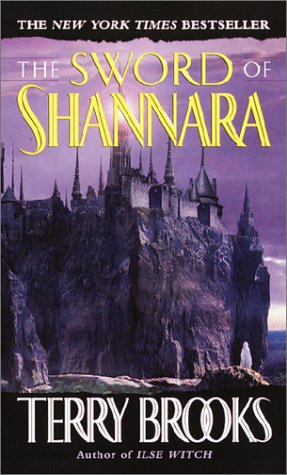 The Sword of Shannara by Terry Brooks
Genre: Fantasy
Series: Book 1 of The Sword of Shannara Trilogy
Publisher: Del Ray Books (1977)
Author Information: Website | Twitter
Tiara’s Rating: 2.5 of 5 stars
Narrator: Scott Brick | Length: 26 hrs | Audiobook Publisher: Books on Tape | Whispersync Ready (as of this posting): Yes
I have a dirty secret to confess. I am no fan of Tolkien’s writing. If you were to check out my Goodreads profile now, you’d see that I’ve one-starred almost everything he’s ever written. This may be a seeded dislike due to the fact that I had to read these books in high school (even though I wasn’t one of those kids who was normally traumatized by high school reading experiences), but even attempting to reread them again as an adult was a labored effort, a true test of my patience, an effort that I am willing to admit was a disgraceful defeat. However, I do love the movies very much if that’ll grant me any measure of immunity.
The Sword of Shannara gained popularity in the late 70s and early 80s and is often used in the same sentence as Tolkien, which may tempt some readers but is a little off-putting for me. This seems to be one of those divisive books with readers either decrying it for being a Lord of the Rings rip-off or lauding it as a brilliant epic fantasy adventure. There are few people who seem to walk the middle road with this book.
I’ve been making it my mission to read classic speculative fiction. After reading The Lathe of Heaven for my science fiction pick and The Haunting of Hill House for my horror pick, I started searching for a classic fantasy pick and settled on this after reading a brief blurb on it. It sounded interesting enough, and believe it or not, I’d never actually heard of the series before now.
From the beginning, yes, it’s pretty obvious that this is influenced by Tolkien. I’d started jokingly calling Allanon by Gandalf’s name and Flick by Sam’s name even before I knew about the Tolkien connection. However, I didn’t say these things to necessarily be condescending toward this book. That’s just the way things are. So many books regardless of the genre, especially a first novel for a writer, contain elements that are similar to others in that same genre.
When I started publicly saying things like that, then people came out the woodworks saying that it really was “just like Tolkien.” I didn’t even realize I knew so many people who read this series. Even opinions from friends ranged from “5-star read” to “turn back, dead inside.” So, reading this book has been quite the journey from the actual reading to the various interactions I’ve had with people thanks to this book.
On with the review. I should warn you. This review is a little derpy if you haven’t figured that out by the Adventure time gif following this, and I can’t promise it’s completely spoiler free.
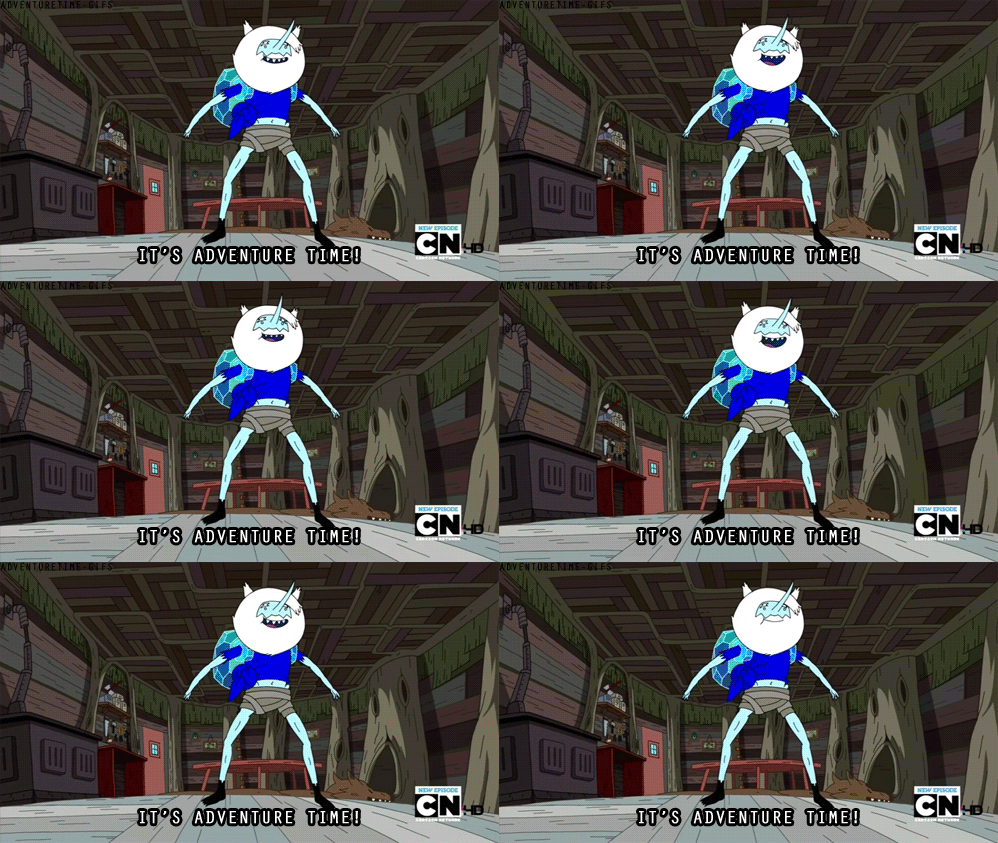
Let’s go find us a ring! I mean… a sword… we’re looking for a sword, Mr. Frodo.
The Sword of Shannara follows the adventures of Shea Ohmsford, a half elven man living in Shady Vale with his adopted father, Curzad Ohmsford, and his adopted brother, Flick Ohmsford. One night when Flick returns from peddling his merchandise in the nearby town of the Shire (because I am absolutely sure it was the Shire), he encounters Allanon, a tall, mysterious man who saves him from a shadowy creature in the woods. Flick takes Allanon to his village where Allanon insists on meeting Shea.
More importantly to this narrative, Allanon looks like Manu Bennett because MTV said so. Who am I to fight MTV about this? [Insert heavy breathing.]
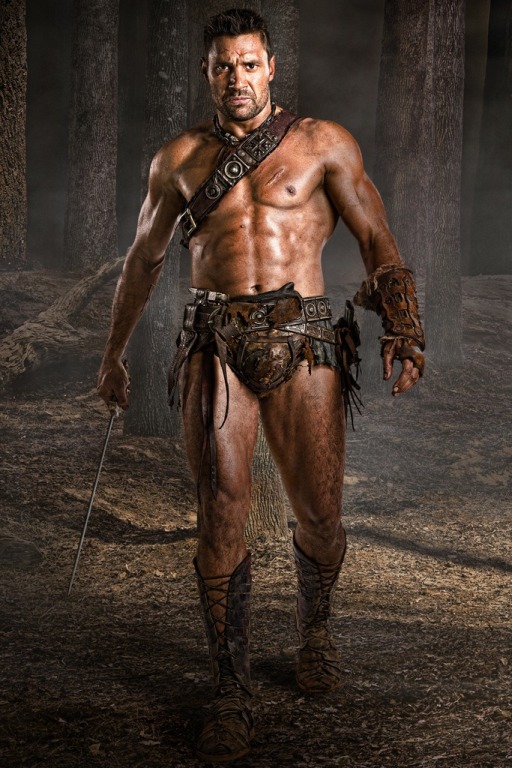
Actual Allanon the Druid in actual practical questing gear. Hey, Allanon, heeeeey…
Anyhow, Allanon tells Shae that he is a direct descendant of a line of royal elves. These elves are the only ones able unlock the power of the sword of Shannara. I imagine that to be a lot like He-Man powering up. The Druids have kept this relic, believed to be a myth by many, locked away in their keep. The sword was originally created to defeat Brona, whose name I kept seeing as Brony when I was reading portions during immersion reading, 500 years before the start of this book. Brona is a powerful Druid-turned-sorcerer. However, just as they had traitors within when Brona attacked 500 years ago, the Druids find themselves attacked again by traitors (who’d think that would happen again?), and Brona has returned to finish what he started, but I kind of forgot what it was he wanted during the course of the story. World domination? Probably. Isn’t that what they all want either to control or destroy the entire world. Much of their hope to defeat Brona, now called the Warlock Lord, rests on Shae’s shoulders and what slim shoulders they are we are reminded repeatedly throughout the story.
The quest starts with the brothers, Shae and Flick, leaving the Vale to escape the Warlock Lord’s minions, the Skull Bearers. Along the way, they pick up Menion Leah, a friend of Shae’s and the prince of Leah, Balinor Buckhannah, the prince of Callahorn, Hendel, a dwarven warrior, Durin and Dayel, elven brothers sent to accompany them on their journey from the elf kingdom, Orl Fane (very briefly and more a foil than anything), a gnome who has deserted his cause and invokes shades of Gollum, and the thief Panamon Creel and his rock troll companion, Keltset. Together they face countless obstacles including murderous gnomes, haunted tombs, a large water serpent that shoots lasers from its eyes (I may be slightly exaggerating because I’m sure it only shot fireballs from its mouth), and giant monsters made of flesh and steel before facing the Warlock Lord himself with THE SWORD OF SHANNARA!
I finished this through a combination of reading the book on Kindle and listening to it on audiobook, but the bulk of this was completed through the audiobook. The narration of this by Scott Brick wasn’t spectacular. He did a fine job with the story, but I wasn’t moved by his reading. I don’t fault him for that more than I fault the unspectacular nature of the book itself. The story was clunky for me. There was so much of it that was nonsensical with shaky plot direction. Not to mention the parts that were inconsistent with what was happening in the story. I can remember rereading certain passages numerous times and thinking, “This is literally impossible in the context of this story.”
There’s just something about most classic fantasy, especially fantasy from the 70s and 80s, that always makes me think that I’m not really going to get a story that’s much better than the old Dungeon & Dragons cartoon (which I still cry about because they never produced that last episode and the ending of the script gives me goosebumps). I love that damn cartoon.

Actual representation of Menion helping brave Balinor’s cape billow. Friendship is magic.
This book was ridiculous, but I never went into this story seriously either. If you check my Goodreads updates for this book, you’ll see many of my statuses are silly in regards to this story. Aside from the obvious lame Lord of the Rings analogies, there was lots of stream crossing (where I interject elements of other things into what I’m currently reading/watching). There were such thoughtful musings as: “Balinor Buckhannah and his bountiful, billowing cape of boon-filled bravery standing boldly before the baleful beast…” and saying Menion probably looks like the wrestler Seth Rollins, which means curb stomps for everybody.
I also concluded that Panamon Creel masquerades as Dragon Age: Inquisition‘s Dorian in his free time while twiddling his mustache and compared the bit about Balinor’s homeland and it’s impregnable walls to Attack on Titans: “On that day mankind received a grim reminder…”
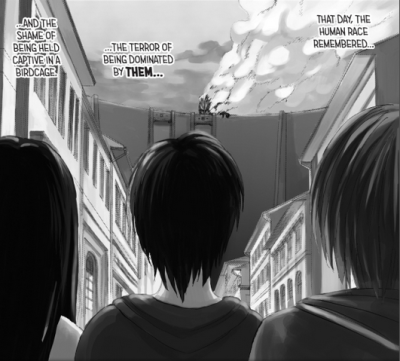
Just pretend that’s about Balinor with his walls and that’s the Warlock Lord peeking over about to smash them. C’mon, people, use your imagination.
So, in other words, my bar is set pretty low in that regards, and I rolled with it. I went into this story expecting it to be schlocky fun, and that’s what it was. I was entertained, and there’s nothing more that I could ask for from this book. I don’t need savant-like brilliance from a story to be entertained.
The most annoying part of this book to me was Brooks’ incessant need to remind me how lithe, agile, slim, or lean such characters as Shae, Menion, Durin, and Dayel were. Sure, he’d mention how tall characters were often, especially Allanon who is freakishly tall, but not nearly as much as he liked pointing out how lean theses characters were. Okay, I get it. They’re fit. You could make a drinking game out of this, but it’s also likely you’d get alcohol poisoning if you did. Also, I don’t mind head jumping, but sometimes, he was jumping in multiple heads in the same paragraph, which can be a bit much. Finally, I am so disappointed that the final battle didn’t end with Tyrion in chainmail using the power of DOOM metal to defeat the Warlock King (who by this time had started being called the Skull King randomly after hitting the 60% mark in the book).
You know what? Forget that. As far as I’m concerned that is exactly how this battle ended. I have my headcanon. You can’t take it away from me.
I like to think of this as being Lord of the Rings for Dummies by Tolkien Lite if we have to go that route. It’s not nearly as heavy to digest as Tolkien’s books. Despite the hefty page count (726 according to my Kindle), there’s not all this meandering prose. It moves fairly quickly. I’m not going to say it doesn’t have its rambling moments, though, because I did start getting restless toward the end. However, to be fair to Tolkien, this isn’t nearly as inspired as his books either. On the other hand, to be fair to Brooks, I feel like his writing and fictional situations have probably improved since this initial offering. He’s not a terrible writer, so I’m curious to see how his writing has evolved over almost 40 years.
While I wasn’t bowled over by this (I can be so wishy-washy about fantasy, especially in this vein), this was a palatable enough experience for me and fit well within my expectations for it. I had fun with it. Besides, there are tentacles in it, and tentacles are relevant to my interests and gives this book an automatic 2 stars. Will I finish this trilogy? I think perhaps I will, and yes, all my reviews for this series will probably be derpy.

Book Review: Evensong by John Love
Posted on March 2, 2015 23 Comments

Genre: Science Fiction
Series: Stand Alone
Publisher: Night Shade (January 6, 2015)
Author Information: Website
Mogsy’s Rating: 4 of 5 stars
At first I didn’t think this would be my type of book, with its convoluted politics, bio-engineered super killer soldiers, dispassionate violence and casual sex, not to mention at times the narrative seemed more invested in the technicalities of hand-to-hand combat rather than the time it takes to build a convincing world. I know I’m not exactly selling it so far, but hear me out – because now that I’ve finished Evensong, the heavy emotional impact this book had on me is something I just can’t ignore.
Novels like these remind me why it’s important to step out of my comfort zone, for I ended up liking it a lot. Its dark and cynical futuristic cyberpunk-ish style reminded me a little of Richard K. Morgan’s Altered Carbon, mixed in with a bit of that 007 Casino Royale vibe when it comes to the main protagonist. A biologically-enhanced operative, Anwar Abbas is an introspective character as raw and edgy as an unpolished stone, hardened by his life and work, but who nonetheless cares about standing up for what’s right.
Anwar is disgruntled when assigned bodyguard duties for Olivia del Sarto, the archbishop of the fast-growing New Anglican Church, but finds himself both repelled and intrigued by his charge’s abrasive candor. The morally ambiguous Olivia has an aggressive demeanor completely at odds with Anwar’s stubborn and systematic approach, but that doesn’t stop the two from plunging headfirst into a torrid affair – albeit one that is initially all sex and no feeling. Anwar is more than happy to satisfy Olivia’s voracious appetites, but stays by her side out of a sense of duty more than anything else, tasked to protect her from shadowy enemies who have threatened to assassinate her during a high-profile U.N summit on water rights.
Character development isn’t exactly strong, with both Anwar and Olivia’s personalities coming across as rather stunted and flat, causing me to constantly question their motivations especially when it comes to their relationship. And yet, somehow their affair manages to evolve into something much more nuanced. It’s not a love story, but at times it sure felt like one, even in all its twisted and dysfunctional glory. Here you have two characters on opposite sides of the spectrum; the harder they resist each other the more they are drawn together, becoming like one another. It sounds deceptively simple, but there’s a lot of synergy happening between the lines. It makes Evensong the perfect example of a story where the whole is much greater than the sum of its parts.
John Love’s writing style also strikes me as a bit eccentric, especially since he utilizes a third person omniscient point of view for this novel, and is quite stark as he goes about his storytelling. For my part, I prefer a more personal touch, but admit that the author’s approach is also well suited for the story and its themes. I enjoyed my fair share of contemplation into the book’s more philosophical subjects – religion, human nature, etc. – but as I’d alluded to in my previous paragraph, I was mostly fascinated with the character dynamics and interactions. The author gradually adds layers to everything, so that the longer you read the novel, the more rewarding the experience gets. Like I said, there’s a combined effect at work here. At some point you’ll definitely get the feel of every piece snapping neatly into place, and suddenly it all makes sense.
I did say the novel had a huge impact on me emotionally. The revelations came at me like an explosion at the end, like one moment you’re traipsing down a sunny country lane and the next you’re blindsided by a Mack truck barreling into you at a hundred miles an hour. As the dust settled, I was left with a numbness, a melancholy that even now I find hard to explain, mixed with shock and disbelief…like, did I just read that?!!! The story definitely touched something deep inside me though, especially in light of the nature of Anwar’s character and the decisions he ultimately decided to make.
Certainly I never expected to be so powerfully affected by Evensong, since it’s such a departure from what I normally read. I can’t believe I almost dismissed this book as “not my thing”, and what a tragic mistake that would have been. I’m profoundly glad that I ended up ignoring my instincts, because against all odds, this book ended up working surprisingly well for me.

A review copy of this book was provided to me by the publisher in exchange for an honest review. My thanks to Night Shade Books!
Posted on March 1, 2015 Leave a Comment
Grant knew that people could not imagine geological time. Human life was lived on another scale of time entirely. An apple turned brown in a few minutes. Silverware turned black in a few days. A compost heap decayed in a season. A child grew up in a decade. None of these everyday human experiences prepared people to be able to imagine the meaning of eighty million years – the length of time that had passed since this little animal had died.
Jurassic Park by Michael Crichton
Mogsy’s Bookshelf Roundup: Book Haul, Backlist, What I’ve Read
Posted on February 28, 2015 22 Comments
It’s been a very busy couple weeks when it comes new books:
Received For Review:
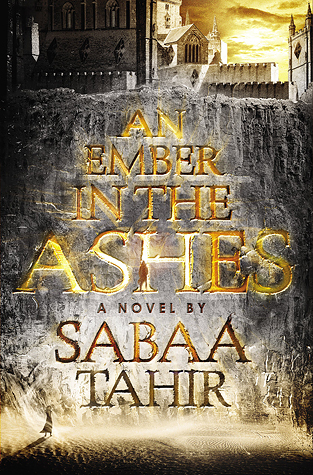

An Ember in the Ashes by Sabaa Tahir – From First to Read. Every year there are a ton of Young Adult novels that get a lot of buzz and I honestly can’t keep up with them all. An Ember in the Ashes caught my attention though; it really looks like a special one and I have really high hopes for it.
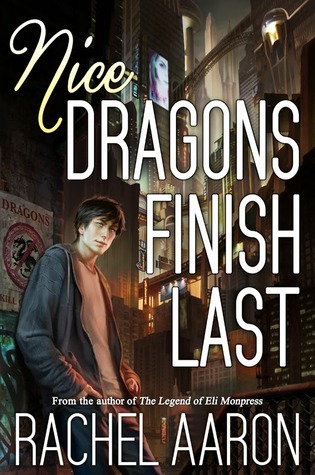
Nice Dragons Finish Last by Rachel Aaron – Audiobook, with thanks to Audible. Rachel Aaron is also known as Rachel Bach, the author of the rollicking Paradox sci-fi trilogy which I had a great time with last year, and Nice Dragons Finish Last looks to be another fun one.
Grave Matters by Lauren M. Roy – Review copy, with thanks to Ace/Penguin. The sequel to Night Owls, an urban fantasy series about a book store owner and her Scooby Gang of friends who battle the evil creatures of the night!
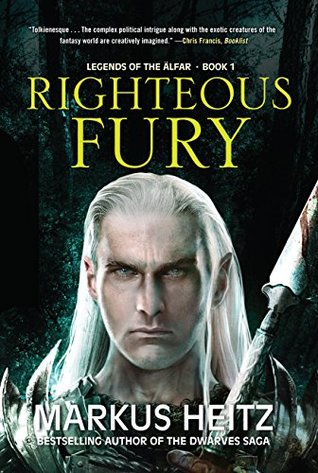


Righteous Fury by Markus Heitz – Review copy, with thanks to Jo Fletcher Books/Quercus. Markus Heitz is probably best known for his Dwarves saga which I haven’t had the pleasure of reading yet, but I’m very curious and interested in reading his stuff, starting with this!
The Exile by C.T. Adams – Review copy, with thanks to Tor. This unsolicited but very welcome surprise showed up on my doorstep earlier this week. It is on my list of 2015 Most Anticipated SFF by Women Authors! Definitely checking this one out.
The Doll Collection edited by Ellen Datlow – Review copy, with thanks to Tor. Also unsolicited, but I’m going to read this and you know why? Because DOLLS FREAK ME THE HELL OUT. Personally, I believe the whole point of reading Horror fiction is to scare myself, and I’m always on the lookout for a book that’s up to the challenge. I’m also normally not into short stories, but I’m happy to make an exception for this anthology.
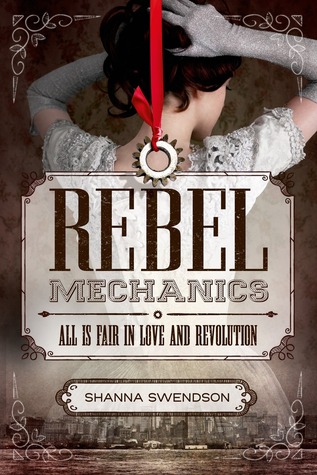

Rebel Mechanics by Shanna Swendson – From NetGalley. Here I am taking a chance on another Young Adult novel, but I’ve had good luck with steampunk lately and I’m really feeling this one.
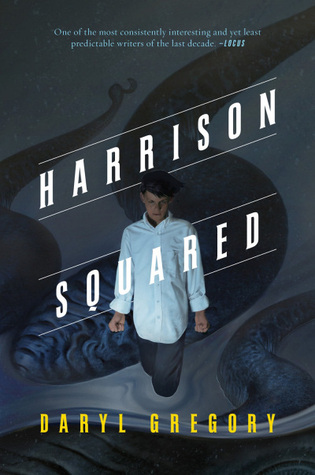
Harrison Squared by Daryl Gregory – From NetGalley. I’ve actually completed this book already; it was a fast read and a great Lovecraft-inspired novel that was weird-but-not-in-the-way-I-can’t-stand-weird. I rather enjoyed it, to tell the truth.
We Are All Completely Fine – From NetGalley. I enjoyed Harrison Squared so much that I requested another Daryl Gregory title — and as a bonus, I found out that Harrison Squared is actually a prequel to this one!
Purchased:
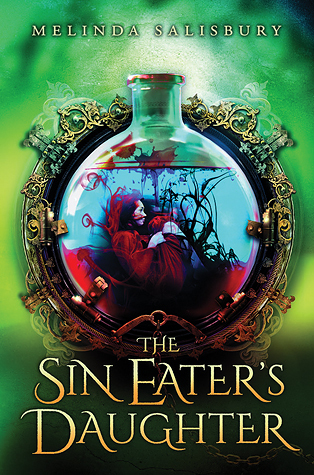

The Sin Eater’s Daughter by Melinda Salisbury – A specially low priced pre-order for the e-version of a brand new book, I just couldn’t resist.
Faith by John Love – I recently read Love’s Evensong and enjoyed it so much that when I saw a sale on the ebook of his first novel, I just had to jump on it.
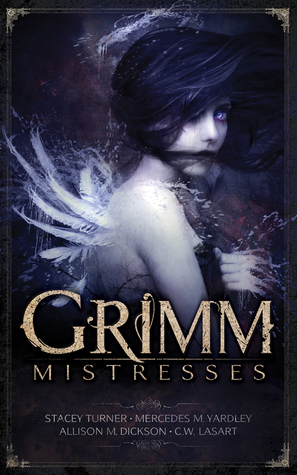
Grimm Mistresses by Various Authors – I’d wanted to accept this anthology for review, but as you can see I was a bit overloaded this week. But hey, doesn’t mean I can’t buy it to read on my own time, and that’s exactly what I did as soon as the ebook was released. Looking forward to checking this out, especially Mercedes M. Yardley’s story as I’ve enjoyed her work in the past.
Back to the Backlist:
Here’s what’s on tap from the backlist bar this week. My reading schedule is getting heavy, I sure hope I’ll be able to fit this one in!
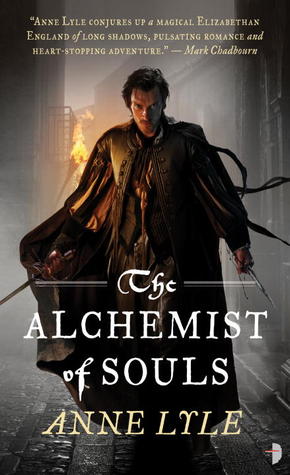
The Alchemist of Souls by Anne Lyle – This book has been on my TBR since March 18, 2013 according to my Goodreads shelf. I’m finally going to get to it this year, and I also have Lisa at Tenacious Reader to thank for the encouragement. She’s had great things to say about this book, and I can’t wait to read it.
What I’ve Read Since the Last Update:
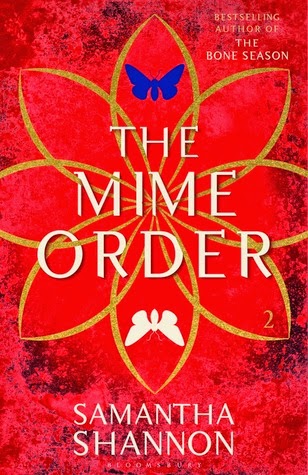
Keep an eye out for my reviews of these books in the coming weeks! A couple of them are already up.


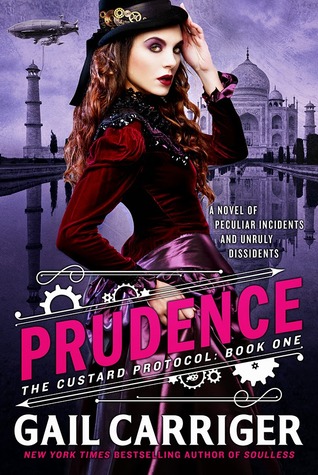
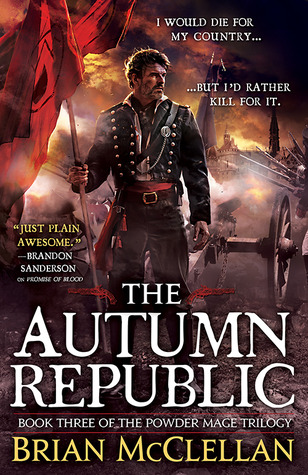

Cover Reveal: The Rebirths of Tao by Wesley Chu
Posted on February 27, 2015 7 Comments
Today I’m excited to break out a cover reveal for a book I’ve had my eye on for a while. Not only have I been eagerly waiting the release of Wesley Chu’s The Rebirths of Tao to find out how the trilogy ends, I’ve also been quite impatient to see the cover.
Anyway, if you’ve seen the covers for the first two books, then you’ll probably notice that this one is quite a bit of a departure from the theme they’ve set. Usually I like all my book covers in a series to “match” (I’m not the only one, am I?) but then I have to say I dig this one. It may be a little different, and while I loved the other covers for their quirkiness, I think this one and its stark nature actually does a better job capturing the “urban sci-fi, spy thriller” vibe of the Tao series. Here it is! Thoughts?

Cover by Stewart Larking
Many years have passed since the events in The Deaths of Tao: the world is split into pro-Prophus and pro-Genjix factions, and is poised on the edge of a devastating new World War; the Prophus are hiding; and Roen has a family to take care of.
A Genjix scientist who defects to the other side holds the key to preventing bloodshed on an almost unimaginable scale.
With the might of the Genjix in active pursuit, Roen is the only person who can help him save the world, and the Quasing race, too.
And you thought you were having a stressful day…
I’ve had a great time with this series so far. I’m glad that Angry Robot is back from their break and this book is on the horizon once again, set to drop in April.
Backlist Burndown: California Bones by Greg Van Eekhout
Posted on February 27, 2015 13 Comments
As a book blogger, sometimes I get so busy reading review titles and new releases that I end up missing out on a lot previously published books, so one of my goals for this year is to take more time to catch up with the backlist, especially in my personal reading pile. And it seems I’m not the only one! Backlist Burndown is a new meme started by Lisa of Tenacious Reader. Every last Friday of the month, she’ll be posting a review of a backlist book and is inviting anyone interested to do the same. Of course, you can also review backlist books any day you want, as often you want, but be sure to watch for her post at the end of the month to link up!
For this month’s Backlist Burndown, I’m reviewing…
California Bones by Greg Van Eekhout
Genre: Urban Fantasy, Dystopia
Series: Book 1 of Daniel Blackland
Publisher: Tor (June 10, 2014)
Author Information: Website | Twitter
Mogsy’s Rating: 4 of 5 stars
Have I mentioned how much I love a good heist? I definitely would have jumped on this book a lot sooner had known the treat I was in for. But there’s also a lot more to California Bones aside from being the ultimate fantasy crime caper novel. Author Greg Van Eekhout also wraps it all up in a cool package featuring some amazing magic, setting his story up in a savage dystopian world.
The magic system is based on osteomancy, the drawing of energy and power from the bones of humans, animals, and even mythical creatures. Fossilized remains of extinct animals are the rarest of all, worth vast fortunes on the black market. But the users of bone magic – called osteomancers – who can get their hands on them are capable of the most powerful spells. A chunk of sabertooth can grant great speed and agility; a bit of sint holo, the ability to turn invisible; some essence of firebird can allow the user to breathe flames; and so on.
The most straightforward way to extract magic from a piece bone is to consume it – literally. Our protagonist Daniel Blackland was only six when he ate his first bone fragment, a piece of kraken spine fed to him by his osteomancer father. Little did young Daniel know, Sebastian Blackland was already preparing his son for survival against his enemies. After the elder Blackland was murdered by the brutal Hierarch of the Kingdom of Southern California, Daniel is forced to go into hiding, eking out a living with petty thievery…until he and his friends are offered the job of a lifetime. The score? Caches of untold osteomantic treasures in the Heirarch’s heavily guarded storehouse, including a magical sword that holds immense personal significance for Daniel.
So yes, California Bones has everything I want in a heist novel: a diverse crew with each member equipped with specific, specialized talents? Check. High stakes? Check. Innovative solutions to get around alarm systems, physical barriers and other security measures? Check. And last but most importantly, lots of plot twists to set up an explosive final act. Double check. This book was plenty of fun to boot, with great characters and great dialogue infused with plenty of humor. But that’s also counterbalanced with some pretty dark, nasty stuff. I mean, we have cannibalism and examples of human beings butchering other human beings to ingest the magic in their flesh and bones. An interesting idea, but also icky and horrible.
Van Eekhout also makes his novel special by setting it in a version of Los Angeles where we have canals and waterways instead of streets, and everyone gets around in boats and barges. The world of this alternate southern California is revealed gradually, letting the mystique of it filter through to us little by little. For example, the Hierarch’s allies include historical figures like Walt Disney, but instead of being the creator of cartoons beloved by children everywhere, this world’s Disney is an evil bastard whose corruption knows no bounds. The fossil record is also replete with all manner of legendary creatures, as varied and fantastical as any medieval bestiary. From phoenixes to venomous seps, you never know what you’ll be exposed to next.
That said, there are a few things that didn’t fully work for me. I mentioned earlier that I like heist stories, mainly because I enjoy reading about the entire process of theft, from planning to execution. There’s a lot of problem solving involved for the characters, learning the layout of the location to be robbed, figuring out the best way past seemingly insurmountable defenses, etc. Hence in a way, the richness of the magic system in this book is both a positive and a negative. What happens when there are a countless number of creature bones that can endow an osteomancer with a countless number of abilities? Well, that means no barrier is impossible. Granted, there are a lot of neat problems that the thieves in the novel have to overcome, and plenty of awesome ideas. But still, I knew that anything the author could throw at our characters, there’s bound to be some sort of magical solution. It takes a lot of the challenge and excitement out of the heist, as a result.
The second half of the novel also doesn’t read as smoothly as the first half. This might be due to the shift in story focus, because the plot does progress from the heist to something much bigger by the end. The climax and conclusion felt a bit rushed, and I can’t really put my finger on why, but the characters didn’t feel as natural or fleshed out either. All told, however, I want to stress that these are rather minor quibbles in the greater scheme of things.
In the end, I thought California Bones was a great book and I’m glad I finally got around to reading it. This is a fun, inventive and very clever series that holds lots of potential, and by all accounts the second book is already living up to expectations. I’m definitely going to make the effort soon to tackle the sequel Pacific Fire so I’ll be all caught up, because I hear there is already a book three (Dragon Coast) on the horizon.

Sci-Fi Short Story Review Bites
Posted on February 26, 2015 6 Comments
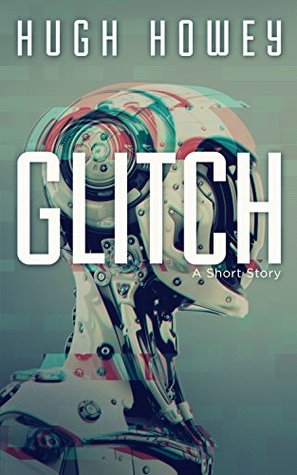 Glitch by Hugh Howey
“I remember holding Sarah for the first time, marveling at this ability we have to create life where before there was none.”
In a world that craves the brutality that come with robot bouts (basically brutal cage fights between robots), Sam, Peter, and Greenie investigate why their prize fighter, Max, refuses to obey their orders. Their future depends on him being combat ready since these bouts seem to determine what contracts they land with various companies who want the best tech their money can buy. However, Max refuses to comply with their orders. Is it a glitch or is it pointing to something more?
This story seems to be a hail to stories like Asimov’s I, Robot, and much of the story is a matter of philosophical debate where Max is concerned. However brief, you still get some sense of who the characters are, particularly Samantha, and because the story is told from Sam’s point-of-view, you see how her experiences, especially her motherly feelings, which I related to so much, shaped her feelings for Max and what she feels must happen now.
Much of the story puts a more human slant on robots, describing the thirst for violence the spectators have and the viciousness of these fight in terms that makes you feel sorry for the combatants, even though they’re only machines. A scene with Max brings to mind a fighter whose instincts have kicked into survival mode, making him hard to bring back to reality once the threat is over:
As I looked over Max, his wounds and welds provide a play-by-play of his last brutal fight–one of the most violent I’ve ever seen […] Max had to drag himself across the arena with the one arm he had left before pummeling his incapacitated opponent into metal shavings. When the victory gun sounded, we had to do a remote kill to shut him down. The way he was twitching, someone would’ve gotten hurt trying to get close enough to shout over the screeches of grinding and twisting metal. The slick of oil from that bout took two hours to mop up before the next one could start.
This was an overall excellent story, and my first real taste of Hugh Howey. I have other books of his on my reading pile, but I took a chance with this one because it would be a quick read.

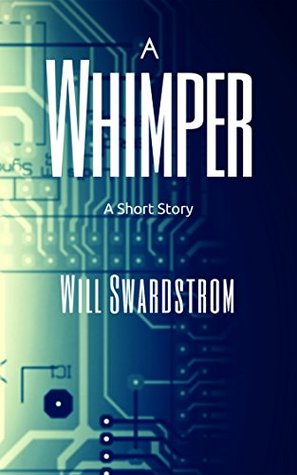
“Thomas was wrong. The human race didn’t rage against anything in the end.”
Sometime in the near future, a future where Jennifer Lawrence may or may not sill be alive, humanity is on the verge of extinction. Technological advances have gone beyond smartphones and even smart glasses. 99% of the world has had Personal Chips, known as PIPs, implemented into their brains which gives them the power of the internet right in their head. Many of these people have had them since birth. However, a price comes with something so invasive as the PIPs, including your expected government invasion veiled under “safety” measures, but other moral and technical complications arise as well with the invention of the PIP.
A whimper is a cautionary tale. It’s not just a “technology gone bad” story, but one that warns of human complacency as well. With the rise of technology, there’s less empathy in the narrator’s world. If it’s not a Facebook notification or a retweet, what does it really matter in the grand scheme of things? If something doesn’t have a “use” technologically speaking, then when it disappears, even in the most violent of ways, it’s seen as a tragedy, but not a loss. This includes human lives as well.
The technology itself doesn’t turn on its users, per se. This isn’t a rise of the machines type story. The chips don’t suddenly become these sentient parasites living in their brains. Human manipulation, the need to create better and better technology, the (supposed) need to help third-world countries catch up with the rest of the world, is what taints the technology, the need to institute so-called pragmatic safety measures, is what eventually corrupts the technology. Competing “apps” eventually just cause people to shut down completely, leaving them aware but unable to do anything to survive.
In the beginning, this story is told with a sort of cool detachment from the narrator as he makes blasé statements like: “I haven’t heard from Kit in over a year. I think she’s dead.” Kit is his sister. He continues to narrate the fall, and as the story goes on more and more emotion begins to show through in his words. At first, I didn’t think I’d rate this as high as I did, but there’s was something in those last few pages and his desperate plea that made me rate it higher.
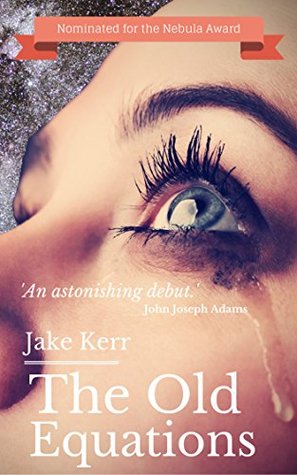 The Old Equations by Jake Kerr
Let’s get the science-y portion of the review out the way before I review this novelette, and I’m trying to simplify this as much as I can, so you get a general idea. The basis of this story builds on the idea that Albert Einstein died before he could put forth and advocate his complete theory of relativity. Because of this, in the year 2193, he’s considered a minor thinker who had ideas that stimulated scientific thought, but didn’t challenge thought. Some people even consider Einstein a bit of a crackpot. (Nerd note: Einstein’s teacher, Hermann Minkowski, actually put forth the theory and Einstein built on it.)
You’re asking: “What’s the point, Tiara?” The point, my friends, is this. Without the theory of relativity, you don’t get space-time continuum. Without space-time continuum, you don’t get the theory that time slows for people as they approach the speed of light. That means, without the theory of relativity, a person wouldn’t be aware that time is progressing much, much slower for them in space than it is on earth because they’re traveling at such an immense speed. For a rough example without any mathematical basis and just to give a general working idea, 8 hours on earth would be only 1 hour for a person moving in space. This is also touched on in the story just not in as much detail as I gave you.
This short story follows an astronaut known as James as he embarks on a 10 year space voyage. The story is told through a series of transmissions over about a year or so between James, his wife (Kate), and a few of his coworkers. In the beginning, they keep their transmissions limited so they don’t stress the communication links. However, as the story goes on, the realization that James is losing time as time progresses normally on earth becomes a pressing matter. They revisit Einstein’s old theories and figure out that the mission will only take James 5 years, but 41 years will have progressed on earth by that time. They refuse to about mission.
It’s funny to think a story like this one would be so utterly heartbreaking, but it is. James and Kate begin this story with Kate trying to reassure herself that 10 years would be no time. However, even in James’ first year away from earth, he managed to miss so much life as seen when Kate updates him on their friends and family. They believe they’d get to live all the life James missed once he returned, but then, science happens. I actually teared up a little bit reading this as James and Kate tried to exchange their last messages to one another on a communication system that had been giving them problems since the beginning of the mission and was rapidly breaking down.
There’s just so much going on emotionally in this little story that hits hard and fast. Kate’s desperate need to “see” James’ words while he reassures her that he’ll always love her no matter what, that he’ll still want to hold her and be with her despite the fact that he’ll only be in his mid-thirties and she’d be nearing her 70s when he returns. The grim explanations from his coworkers on what was happening and how he’d just become a sort of focus point for this “new theory.”
My main problems come from the science part of the story and having a little trouble suspending belief where it’s concerned. While Einstein’s early death certainly presents an interesting conundrum, I don’t know if I can truly believe that no one at all in the scientific community couldn’t have come up with the theory by 2193, especially working on the fact that that theory wasn’t Einstein’s in totality and apparently, there was enough data out there on it for someone to have expounded upon earlier.
Also, it’s a little unclear whether space travel, even short space travel, has happened before this point. I’m going to assume it hasn’t since they still haven’t figured out time-space continuum, and it seems like, if space had been traveled even briefly before this point in the story, they’d have some working idea that something was going on with the time stream before sending James into space.
Despite that, this is one of those stories that will stay on my mind for quite a while as I contemplate James and Kate’s future. Can you even begin to imagine coming home after spending 5 years in space to an earth that has aged 41 years in your absence?
I read this through Kindle Unlimited, but it’s available to read for free on Lightspeed Magazine‘s website here.

Tough Travelling: Chessmasters
Posted on February 26, 2015 15 Comments


The Thursday feature “Tough Traveling” is the brainchild of Nathan of Review Barn, who has come up with the excellent idea of making a new list each week based on the most common tropes in fantasy, as seen in The Tough Guide to Fantasyland by Diana Wynn Jones. Nathan has invited anyone who is interested to come play along, so be sure to check out the first link for more information.
This week’s tour topic is: Chessmasters
A true master knows where all the pieces are at all times. Others may think they have taken control but alas, the master knew their last move before they played it.
Mogsy’s Picks:
This week is dedicated to all the lovely schemers!
 Half the World by Joe Abercrombie
Prince Yarvi is now Father Yarvi, serving as minister to the king of Gettland. He may be royalty no longer, but his new position behind the scenes allows him to wield even more power. To broker political deals and form alliances, you have to plan well ahead and be able to predict the most likely outcomes.
 Kushiel’s Dart by Jacqueline Carey
The primary antagonist of the story, Melisande Shahrizai loves manipulation and playing games. This makes her a deadly opponent to anyone who challenges her. Fellow Unseen Guild member and constant rival Anafiel Delaunay learned that the hard way.
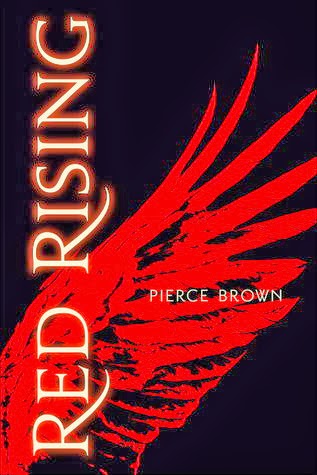
Fitchner, the proctor of House Mars, doesn’t appear to have much status among the Golds but he is a lot more than he seems (but no spoilers here!) During the academy war games, he plays the mentor and the trickster, being only helpful to Darrow when he asks the right questions, but in truth he knows more than he lets on.
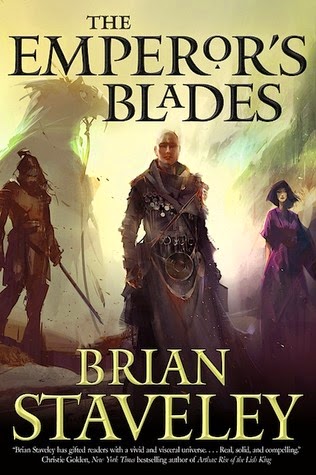 The Emperor’s Blades by Brian Staveley
As kenarang, Ran il-Tornja may be Annur’s highest-ranking general, but his talents extend beyond the battlefield. He’s also suave and charismatic, manipulating Adare Malkeenian while acting as regent in the wake of her father the Emperor’s death. As it turns out, there’s a big secret about him that gives him a huge advantage as a chessmaster.
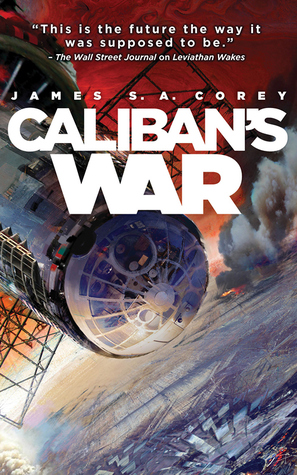 Caliban’s War by James S.A. Corey
No list of chessmasters would be complete without Chrisjen Avasarala. As the United Nations Assistant Undersecretary of Executive Administration, she is privy to a lot of political secrets and intelligence. She also maintains a network of spies and is instrumental in the outcome of a lot of major events, including elections and important diplomatic negotiations.
Wendy’s Picks
 Acacia: The War with the Mein by David Anthony Durham
Leodan Akaran thought he had everything going for him in his empire of Acacia, but perhaps it was his arrogance and his ignorance that allowed Hanish Mein to sneak in and take it all away. And Hanish just might get away with it too, if it isn’t for those pesky Akaran kids.
 The Chronicles of Amber by Roger Zelazny
The princes of Amber vie for the throne their father left behind. The brothers scheme and manipulate each other and the very threads of Amber itself–but who’s really pulling the strings?
 Harry Potter by J.K. Rowling
Nope, not that conniving Voldemort. I’m talking about that jerk Dumbledore who has played Harry against Voldemort for all the years of his young life, honing the young boy through abuse and abandonment until he was ready to face down the ultimate evil.
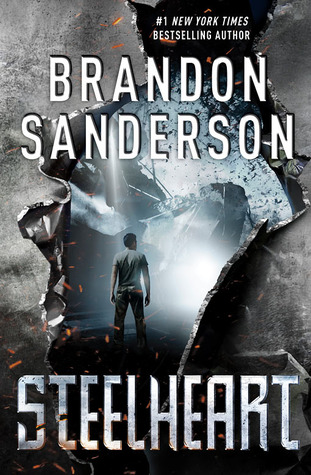 Steelheart by Brandon Sanderson
How do you defeat an invincible epic? Well, David has seen Steelheart bleed once, and is determined to do just that, with the help of the Reckoners and his extensive research.
 A Song of Ice and Fire by George R. R. Martin
Oh that Littlefinger. He’s so crafty that he can even predict people’s emotional reactions and thereby manipulate them into starting wars and getting their husband’s heads chopped off. There are many other chessmasters playing the Game of Thrones, but the one Littlefinger really needs to watch for is the Spider.


 The BiblioSanctum