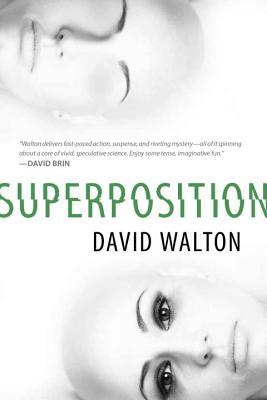
#RRSciFiMonth Book Review: Superposition by David Walton
Posted on November 25, 2015 15 Comments

Sci-Fi November is a month-long blog event hosted by Rinn Reads and Over The Effing Rainbow this year, created to celebrate everything amazing about science fiction! From TV shows to movies, books to comics, and everything else in between, it is intended to help science fiction lovers share their love and passion for this genre and its many, many fandoms.
A review copy was provided by the publisher in exchange for an honest review. All opinions are my own.
Genre: Science Fiction
Series: Book 1 of Superposition
Publisher: Pyr (4/7/15)
Author Information: Website | Twitter
Mogsy’s Rating: 4 of 5 stars
I admit, I have a love-hate relationship with hard sci-fi. To clarify, I am mostly talking about science fiction with heavy emphasis on science and technology. If an author can ease me gently into a story like this, it is certainly possible for me to become absorbed and enjoy myself. On the other hand, overwhelm me with techno-babble and science that I don’t understand, and you will see my eyes glazing over faster than a donut on a conveyor belt at Krispy Kreme.
Happily, Superposition turned out to fall in the former category. Of course, I did experience a momentary spike of panic when I realized how heavily the story relies on the various theories in quantum physics (let’s just say my area of study and interest is Biology; I’m a Life Sciences kinda gal, and I did everything that was humanly possible to get out of taking any Physics courses in university) but somehow this book made me feel completely comfortable. David Walton is an author I’ve known of for a while, but have never read until now, and I have to say I’m beyond impressed with the way he made quantum physics easy to understand, even for a “physics phobe” like me. Also, he managed to make it entertaining!
This novel opens with the words “Up-spin” below the first chapter heading, with the narrator Jacob Kelley telling a story about how everything in his life changed the night Brian Vanderhall, an old friend he hasn’t seen in years, shows up at his house babbling about aliens and quantum intelligences, and then proceeds to pull a gun at Jacob’s wife Elena. Brian shoots, but the bullet somehow passes through Elena, leaving her unharmed while punching a hole through the wall behind her. In a rage, Jacob chases Brian out of his house.
But then there are also the even-numbered “Down-spin” chapters. These chapters follow Jacob in a courtroom setting, and we discover that he is on trial for the murder of Brian Vanderhall, who was apparently found dead the same night he visited the Kelley residence, just hours after he shot at Elena. The reader is made to understand that a long time has passed between the Up-spin and Down-spin chapters, and that something significant must have occurred after Brian was chased out of Jacob’s house, which then lead to Jacob’s arrest and prosecution. Did Jacob really kill his old friend or not?
You might be surprised by the answers. I know I was. The truth is weirder than you can imagine, but it will also become much clearer as the story unfolds, told between these two alternating timelines. So, in one thread, we have the “past” where Jacob trying to figure out why Brian came to his house and how he was able to shoot at and not harm Elena, as well as the “present” thread which essentially is a riveting courtroom drama. The trial scenes were actually my favorite, because they captured the tensions of the setting so well, and even injected a bit of humor.
The fact you have a genuinely interesting and entertaining storyline along with all the science is what makes Superposition such a great book. It’s a murder mystery with a quantum physics twist, one that truly excited me, and I’ll be honest here, before this book came along, I would have been hard pressed to imagine myself using the words “excited” and “quantum physics” in the same sentence. Sure, there were some explanations in this that were so complicated that they nearly made me go cross-eyed, but those moments were few and far between. Walton made learning about the topic fun and accessible, using language and other methods that were easy to understand without dumbing things down, and gave the reader enough to follow the story without overcomplicating things.
All in all, I’m really glad I read this novel because I enjoyed it a lot, and yes, that includes all the science-y parts—a good thing, since it was so integral to the plot…the plot that I don’t want to say anything more about, because the more left to secrecy the better. I was utterly addicted to the story, a tightly written tale with a pace that never let up. The use of quantum physics in this murder mystery was simply ingenious, and I’m amazed at Walton’s talent and ability to establish such a fascinating premise. Even if you’re wary about hard sci-fi, I strongly encourage you to give this one a chance; I think you’ll be pleasantly surprised!

#RRSciFiMonth Waiting on Wednesday 11/25/15
Posted on November 25, 2015 17 Comments

“Waiting On Wednesday” is a weekly meme hosted by Breaking the Spine that lets us feature upcoming releases that we can’t wait to get our hands on!
Mogsy’s Pick:
Time Siege by Wesley Chu: July 12, 2016 (Tor Books)
For my final sci-fi themed Waiting on Wednesday of the month, I am wrapping things up with this follow-up to Time Salvager, which was a great book and I’m super excited to check out the sequel! It’s funny though, because I think the cover actually looks a bit “fantasy-ish” (am I the only one?) Regardless, the art is gorgeous, and I’m really looking forward to finding out what happens to James and the gang.
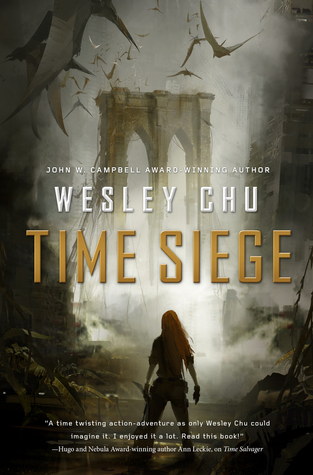 “Having been haunted by the past and enslaved by the present, James Griffin-Mars is taking control of the future.
Earth is a toxic, sparsely inhabited wastelandthe perfect hiding place for a fugitive exchronman to hide from the authorities.
James has allies, scientists he rescued from previous centuries: Elise Kim, who believes she can renew Earth, given time; Grace Priestly, the venerated inventor of time travel herself; Levin, James’s mentor and former pursuer, now disgraced; and the Elfreth, a population of downtrodden humans who want desperately to believe that James and his friends will heal their ailing home world.
James also has enemies. They include the full military might of benighted solar system ruled by corporate greed and a desperate fear of what James will do next. At the forefront of their efforts to stop him is Kuo, the ruthless security head, who wants James’s head on a pike and will stop at nothing to obtain it.”
Guest Post: “Writing Crazy” by Michael R. Fletcher
Posted on November 24, 2015 16 Comments
Today I’m pleased to present a guest post from the one and only Michael R. Fletcher, author of Beyond Redemption and also Grandmaster of the Insane! *whispers* Trust me, folks, he knows what he’s talking about. Don’t believe me? Just get a load of his crazy post! And also don’t forget to check out his book, which is bar none the best grimdark fantasy novel I’ve read this year, out now from Harper Voyager.
* * *
WRITING CRAZY
by Michael R. Fletcher
Beyond Redemption takes place in a world where reality responds to the whims of humanity. If enough people believe the same thing, that belief will manifest. The twist is that crazy folks, the demented and insane, are capable of believing things so strongly they can alter reality all on their own. They are also capable of believing all manner of impossibilities and manifesting it as reality. Cotardists—folks who believe themselves to be rotting or dying—will actually begin to rot. Pyromaniacs can spark fires with their thoughts. Kleptomaniacs know where all your left socks are. You get the idea. I’ve taken real world mental disorders and turned them into wizards. Kind of. If you’d like to read more on the background I’ve done a series of posts detailing the workings of the world of Manifest Delusions.
Part One: http://beauty-in-ruins.blogspot.ca/2015/11/rules-of-responsive-reality-by-michael.html
Part Three: http://bookwraiths.com/2015/11/12/guest-post-the-rules-of-a-responsive-reality-by-michael-r-fletcher/
 While the vast majority of the world’s population are sane, I chose to focus on the bent, those capable of twisting reality with their delusions.
A quick aside if I may: If you believe something with absolutely no evidence, and in-spite of a fair amount of proof contrary to whatever it is you believe, do you really qualify as sane? Or is this more of an intelligence question? If someone blindly believes something with zero evidence, can they possibly qualify as intelligent? I honestly don’t know. After all, it’s not like I am without my own delusions.
Anyway. Where was I? Oh, yes!
So here I was with this world I’d dreamed up and a story I wanted to tell and virtually every single one of the characters involved was one flavour of crazy. Some were two or even three flavours. On the one hand this seems like a writer’s dream: My characters are crazy, they don’t have to make sense!
There are two possible issues with this.
1) You allow the idea to run rampant and end up with a book that has no discernible plot. Your crazy characters make crazy choices and your book reads like an insane asylum where the inmates have been dosed with LSD and allowed to run rampant. Damn. That sounds like an awesome book.
2) No one can relate to any of your characters because all their choices are insane.
Today I am going to—very briefly—look at how I handled each of these issues. And I’m going to pretend it was all intentional. Just imagine me sitting down and thinking all this through before I started writing the book. Contemplate the amount of planning and forethought I might have used. Consider the sheer genius involved in figuring all this out before a single word was written! Revel in my— What? You’re not buying it?
Fine.
The thing with crazy people is that, while they might not make sense to sane people like you and me, they do tend to be consistent within the parameters of their delusions. Having an insane character doesn’t give the author freedom to write whatever wandering insanity pitches its tent in their demented little imaginations. In fact, quite the opposite. To write madness you must delve deep into the wounded psyche of your characters. What made them this way? Is it genetic, or the result of childhood trauma? Was it caused by physical brain damage, or is it due to narcotic and/or alcohol abuse? Background is everything. It determines your character’s choices. Santayana may have said, “Those who forget the past are condemned to repeat it,” but let’s face it, for most people, their past is their future.
To write the mad character you must be the mad character. You must see every event through their eyes, filtered by their delusions.
And now for the truly difficult part. How do you write an insane character so that readers will relate to them and not think your book is irredeemably depressing and populated by delusional psychotics no sane person could ever relate to?
Muahhahahahah! (that, by the way, is an evil laugh)
You don’t.
If you do the first part right, if you write so that your characters are true to themselves, consistent with their nature, readers will relate. Readers want struggle, they want characters with flaws. They want your characters to make mistakes. Give it to them, but do it honestly.
Or maybe there are so many crazy people out there, people who are able to bury deep their delusions and make it through each day mistaken for one of the sane, that you can write crazy characters and get away with it. Or maybe sanity is itself a delusion! What if the reason so many folks enjoy Beyond Redemption is because they see something in the struggles of my mad characters mirroring their own daily struggle through the split-pea soup of reality?
In truth, I have no idea.
* * *
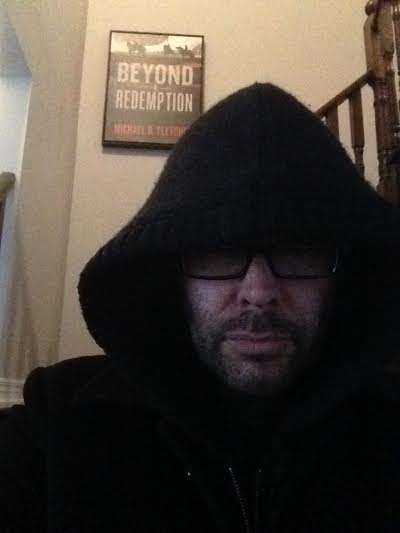 ABOUT THE AUTHOR
Michael R. Fletcher is a science fiction and fantasy author. His novel, Beyond Redemption, a work of dark fantasy and rampant delusion, was published by HARPER Voyager in 2015.
His début novel, 88, a cyberpunk tale about harvesting children for their brains, was released by Five Rivers Publishing in 2013.
The next two Manifest Delusions novels, The Mirror’s Truth, and The All Consuming, are currently in various stages of editing while Michael tries to be the best husband and dad he can be.
Michael is represented by Cameron McClure of the Donald Maass Literary Agency.
#RRSciFiMonth Review Bites
Posted on November 23, 2015 17 Comments
Sci-Fi November is a month-long blog event hosted by Rinn Reads and Over The Effing Rainbow this year, created to celebrate everything amazing about science fiction! From TV shows to movies, books to comics, and everything else in between, it is intended to help science fiction lovers share their love and passion for this genre and its many, many fandoms.
 Ready Player One by Ernest Cline
Narrator: Wil Wheaton
Length: 15 hrs and 46 mins
Publisher: Random House Audio
Ready Player One follows the adventures of Wade who has the misfortune of living in a desolate United States in the year 2044. Despite earth sounding like a wasteland, years earlier a game developer created a large MMO known as OASIS that allowed user to escape into a virtual world, hiding behind their avatars. OASIS quickly expanded into an intricate freemium service that could be used for a variety of things, including attending public school. Most people regardless of income status have access to OASIS and a great deal of the population stays plugged in. It is so engrained in the culture that the name is synonymous with Internet. After the death of the developer (who happens to be an heir-less billionaire), the denizens learn that he has hidden a game in OASIS consisting of a series of riddles. The first one to solve his puzzle becomes the heir to his empire.
This follows the typical 80s teen RomCom adventure format, even going as far as to include the “boy meets girl” thing. I’m probably in the small majority here when I say that this didn’t do it for me. I’m all for nostalgia and nostalgia is probably the only reason I rated this as high as I did. Mostly this felt ham-fisted to me, though. I’m not sure I even really enjoyed the plot that meandered along around all the 80s tribute. This was just one of those moments when I wanted to say, “It’s not you, book. It’s me.” Except I’m pretty sure it’s the book and not me. However, if you’re looking for something light and fun packed with plenty of 80s trivia and homages, this book will be right up your alley. This was the complete novel I’ve listened to by Wil Wheaton (I’d listened to a short story narrated by him earlier this year). He didn’t do too bad with this story.

 The Martian by Andy Weir
Narrator: R.C. Bray
Length: 10 hrs and 53 mins
Publisher: Podium Publishing
I’m almost the last person to read this book. Thanks to one of the recent Top Ten Tuesdays, I found out that I am at least still ahead of a few people when it comes to reading this book. 😉 After a series of unfortunate events during a mission to Mars, Mark Watney finds himself stranded on the planet after his crew mistakenly leaves him behind. Now, he’s on a personal mission to survive on the planet for the next 4 years until the next Mars mission crew arrives on the planet.
There’s plenty of technical jargon in this that most people won’t even pretend to understand (and that’s okay!), but there’s not so much of it that readers are pushed away from the story. You get the sentiment–everything is fucked!–even if you don’t understand the science. Being a big science nerd, I definitely enjoyed this for the way Weir weaved the science and the story together. Now, admittedly, I can understand where this might get redundant. Given the type of story this is, like most survival story, this relies on everything that could possibly go wrong doing just that. That can get old as something breaks and Watney then proceeds to “science the shit out of it” until he gets a solution. I can also see where people might find it dry despite the humor interspersed in the story. R.C. Bray was an excellent narrator, though, and I’m sure his narration made all the difference. I won’t say that R.C. Bray is flawless, but his narration made it feel real, like this was a story being related to me by a friend who’d been stranded on Mars. Sometimes, that personable style of narration is more important than an immaculate narration.

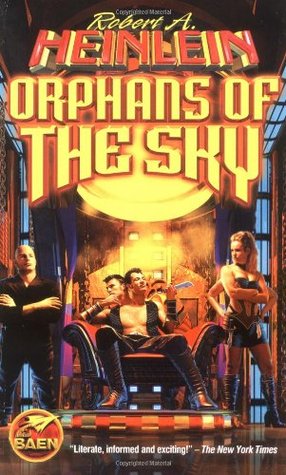 Orphans of the Sky by Robert Heinlein
Narrator: Eric Michael Summerer
Length: 4 hrs and 42 mins
Publisher: Audible Studios
This novel is actually two of Heinlein’s novella’s–Universe and Common Sense both published in 1941. A man named Hugh is the main character of this book, living on a generational ship with multiple levels. The inhabitants of the ship believe there’s nothing beyond the metal of the ship, believing their “journey through space” is an allusion to spiritual enlightenment. However, after Hugh encounters the “mutants” that live on another level of the ship, he learns that they are in fact on a ship floating aimlessly through space, a ship that went off some generations before he was born. Now, he wants to fly the ship, but will Hugh’s own people believe his story?
This wasn’t my favorite Heinlein book, but I’d be lying if I said I didn’t love the premise behind this one. I don’t read enough stories about generational ships. I found everything about this fascinating from the ship-based religion which is much like Christianity fused with various other religions. There were moments when you just wanted to smack the characters and tell them to take a chance. They’re so resistant to what Hugh tries to get them to see, but that can be said of real life as well. So, while I wasn’t over the moon about this story, I did really love the ideas it played with.

Audiobook Review: Press Start to Play edited by Daniel H. Wilson and John Joseph Adams
Posted on November 22, 2015 11 Comments
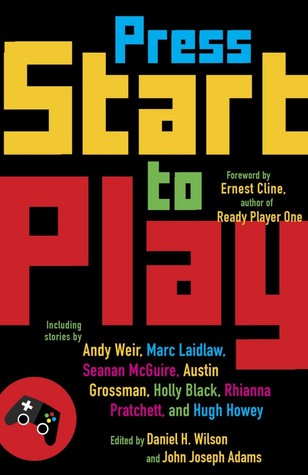 Press Start to Play edited by Daniel H. Wilson and John Joseph Adams
Genre: Anthology, Video Games
Publisher: Audible Studios (9/29/15)
Author/Editor Information: Daniel H. Wilson (Twitter) | John Joseph Adams (Twitter)
Mogsy’s Rating (Overall): 3 of 5 stars
Narrators: A.T. Chandler, Tanya Eby, Jesse Einstein, Emily Beresford | Length: 9 hrs 32 min
At first, I was hesitant about listening to an anthology in audio format, but it actually turned out working really well! I really enjoyed how multiple narrators were involved in this project, and for the most part the actors and actresses were all well-matched to the stories they read. All the narrators delivered impressive performances, considering how not every story here was written in a conventional style, or at least in one that would easily translate to audio.
The stories themselves, though, were another matter. Press Start to Play was a good anthology, but I admit I didn’t like it as much as I thought I would. I’ve always been picky with short stories, but I really thought my interest in the topic of video games would help me with this one, but in the end this was just a very average collection, with most stories falling in the mediocre to good range. More disappointing is the presence of a few stories that only had a tenuous link to the subject, and even a couple that I felt had no place in an anthology that should be a celebration of video games. That said, there were a handful of exceptional ones that I felt really stood out. For a more in-depth analysis and my feelings for each story, see below:
“God Mode” by Daniel H. Wilson – 2.5 of 5 stars
The protagonist of this story is an American studying abroad in Australia. He starts dating a fellow American student named Sarah, who one day suddenly fall and hits her head, and all of a sudden the stars in the sky start disappearing. I think the ending was meant to be more heartfelt and profound, but the delivery really fell flat. Quite frankly, I was disappointed by such a mediocre opener for this anthology, and even now I can barely remember that many details from this first story.
“NPC” by Charles Yu – 2 of 5 stars
The title of this story gives us all the clues we need as to what it’s about. What happens when an NPC experiences an epiphany and isn’t sure if he wants to be something more? This was an interesting premise, but sadly neither the story nor the character was fleshed out nearly enough to be interesting.
“Respawn” by Hiroshi Sakurazaka – 3 of 5 stars
A regular guy discovers when he is killed that his consciousness has “jumped” into the body of his killer. This story reminded me a little bit of Claire North’s Touch. It was a cool concept, and I would have liked to see it carried further, but whether it really belongs in a video game themed anthology is debatable.
“Desert Walk” by S. R. Mastrantone – 4 of 5 stars
This was a nifty little ghost story, which started out one way and ended in a way I totally did not see coming. When I started this anthology, I expected to get a lot of different kinds of stories, but I admit I didn’t expect anything with a horror element. This one was pretty awesome and creepy.
“Rat Catcher’s Yellows” by Charlie Jane Anders – 3 of 5 stars
One of the best things about this anthology was getting a chance to read work from authors I’ve been curious about for a long time. I enjoyed this story, at least in the beginning. It’s a quirky and interesting take on a social game and a subset of its players with a unique disease that causes dementia. I was a little disappointed by the ending, though. I’d thought there would be more and was surprised when the next story started up.
“1UP” by Holly Black – 3.5 of 5 stars
This was another story by an author I’ve wanted to check out for a while! Three teens go to the funeral one of their online gaming friends, and find a text-based game that he wrote on his computer. It turns out to be a clue to solve his apparent murder. Again, I loved the premise but this definitely would have worked better as a full-length novel. What a great YA mystery it would have made!
“Survival Horror” by Seanan McGuire – 2 of 5 stars
I suspected and later confirmed that this story is based on the world of McGuire’s InCryptid series, which I confess I know absolutely nothing about. No wonder I felt so confused. To be honest, I hate finding these types of stories in anthologies like this, because as hard as the author tries to catch you up with the world and who’s who in it, it just doesn’t feel the same. If you are familiar with InCryptic you might find yourself enjoying this one, but personally I felt no connection to any of these characters and couldn’t make myself care what happened to them.
“Real” by Django Wexler – 3.5 of 5 stars
I’m a big fan of the author, so I was pretty excited to read this. Our mysterious protagonist tries to track down the creator of a game that lets its players feel involved by using social media to discover demons and hidden runes. The idea gave me ARG vibes. A very cool story with an interesting twist ending.
“Outliers” by Nicole Feldringer – 2.5 of 5 stars
I think I would have liked this one more if I had understood it. Unfortunately, I found it a bit too technical. The main character is a woman who is obsessed with a game that tracks weather patterns for the government, and was even willing to skip her brother’s wedding to play it, which really didn’t help me sympathize with her.
“End Game” by Chris Avellone – 3.5 of 5 stars
I thought this was fun! A very interesting execution using the idea behind text-based games, but unfortunately, all the suspense eventually built up to…a fizzle. This is one of the biggest issues I find with the stories in this anthology; so few of them have real or satisfying endings.
“Save Me PLZ” by David Barr Kirtley – 4 of 5 stars
A sweet little story that starts with a young woman named Meg getting in to her car to find her ex-boyfriend, Devon. The real world and the virtual world collide as she is tasked to embark on a quest to rescue him. This was one of my favorite stories in the anthology.
“The Relive Box” by T.C.Boyle – 3.5 of 5 stars
A bittersweet story about a character obsessed with using a device called a Relive Box to keep experiencing the joys and heartbreaks of his past, meanwhile ignoring his daughter and his work in his very real present and future. I like its sad message about why we might want to relive old memories instead of going out to seize the day, creating new ones. It ended rather abruptly, which was my only criticism.
“Roguelike” by Marc Laidlaw – 4 of 5 stars
Repetitive and simple, but oh so hilarious! Again, it makes use of the text-based game format to tell a little tale about a very persistent resistance and the fates of all their doomed agents. The story reads like an elaborate joke, but I loved the punchline. I found it very enjoyable in spite of myself.
“All of the People in Your Party Have Died” by Robin Wasserman – 3.5 of 5 stars
A darkly comedic tale about The Oregon Trail as a game of life lessons to prepare you for the death of all the people you know and love to tragic accidents, and just bad shit in general. The character in this story discovers the game and becomes obsessed with it after the game starts doing strange things. I really liked where it was going, but then everything started unraveled towards the end. Definitely didn’t like the second half as much as I did the first.
“Recoil” By Micky Neilson – 4 of 5 stars
This was one of the more complete and coherent stories in this collection, and the author created a very suspenseful atmosphere to boot. Jimmy is our protagonist, staying late at the office to test a new game, and suddenly finds himself in a hostage situation. This story also had a twist ending, but this one I actually liked. Another of my favorites in this anthology.
“Anda’s Game” by Cory Doctorow – 3 of 5 stars
Anda joins a band of elite girl gamers and kicks ass in the virtual world, but in real life she is an average and unassuming schoolgirl. Her online teammates are everything to her, but then something happens that might jeopardize all her newfound happiness. An interesting story about taking a stand for what you believe in, but not one that really stood out for me.
“Coma Kings” by Jessica Barber – 3 of 5 stars
A touching but depressing story about two sisters who bond in game, but one is in a coma so she has to play via an implant in her brain. For the protagonist, this is the only way she can have any interaction with her sister. I enjoyed the premise and thought this story showed great promise, but I wish the ending had been stronger and more meaningful.
“Stats” by Marguerite K. Bennett – 3 of 5 stars
Don’t you just hate it when your stats get nerfed? The character Joey in this story is not a very nice person, so I didn’t feel too bad for him when his body started changing. I love the attitude behind this story, and it was okay in its execution.
“Please Continue” by Chris Kluwe – 1 of 5 stars
My least favorite story yet, and frankly it annoyed the hell out of me. Essentially it was a warning not to let gaming take over your life, but it came across really preachy and pretentious. The message is good, but why go about it in such a clichéd and uninteresting way? And oh, yet another unfunny application of the old “arrow to the knee” joke. How awkward. By the end, this didn’t even read like a story, more like a lecture from some nagging parent. It didn’t feel like a good fit for this anthology.
“Creation Screen” by Rhianna Pratchett – 3 of 5 stars
Speaking of stories that have messages about becoming too obsessed with gaming, here’s another one. However, it was much more creative and elegant than “Please Continue”, and the beginning actually amused me a great deal. I happen to be one of those finicky MMO players who take an inordinate amount of time trying to get my character “just right.”
“The Fresh Prince of Gamma World” by Austin Grossman – 3 of 5 stars
A gamer gets transported to an alternate world which has experienced a nuclear apocalypse. It’s a pretty interesting story, though once again, it didn’t fully engage me or stand out. I enjoyed the premise and setting, and perhaps I felt a greater affinity for it since Gamma World takes place in a post-apocalyptic Boston and I happen to be neck-deep in Fallout 4 right now.
“Gamer’s End” by Yoon Ha Lee – 3 of 5 stars
The title of this story should tell you something about what it is about, i.e. the use of war games for training. Nothing much I can say about this one, other than it was okay but didn’t blow me away either, and nothing about it really stood out.
“The Clockwork Solider” by Ken Liu – 4 of 5 stars
Alex is a female bounty hunter who captures a runaway named Ryder to bring back to his family. This is the first time in this anthology where I actually felt something more than ambivalence for the characters in a story. It’s another one that uses text-based gaming for its premise, but I found it philosophically deeper and a lot more thought-provoking than all the other stories in here.
“Killswitch” by Catherynne M. Valente – 3 of 5 stars
In this story, Killswitch is a game that starts off like any other first-person adventure game. But it doesn’t end that way. I liked what this story had to say about games versus real life, about having one shot, one chance to experience a moment before it becomes a memory. I appreciated its poignant message, but for some reason I had a very hard time staying focused throughout. Maybe it’s just the style in which this story was written, but I found it really hard to connect to the prose.
“Twarrior” by Andy Weir – 3 of 5 stars
This is a real short one, and feels more like snippet or an introduction to a bigger story, but hey, it got a few laughs out of me and that counts for a lot in my books. Andy Weir is one funny guy.
“Select Character” by Hugh Howey – 4 of 5 stars
Play as thou wilt—a message I strongly support. Maybe that’s why I liked this one so much. It’s a very enjoyable story showing how different people approach games, and reminds me a lot of the conversations I’ve had with others about different gameplay styles. Only one thing matters: that you play the way you want and have fun doing it. Also, be open to other gaming styles. Sometimes when you play only one way, you might even miss things that you’d never have known until you talk to someone else who has a whole other perspective. What a great story to end the anthology.
Story:  | Performance: | Overall:
Mogsy’s Bookshelf Roundup: Stacking the Shelves, NaNoWriMo, Recent Reads
Posted on November 21, 2015 25 Comments
Bookshelf Roundup is a feature I do every other weekend which fills the role of several blog memes, like Stacking the Shelves where I talk about the new books I’ve added to my library or received for review, as well as It’s Monday! What Are You Reading? where I round up what I’ve read since the last update and what I’m planning to read soon. Mostly it also serves as a recap post, so sometimes I’ll throw in stuff like reading challenge progress reports, book lists, and other random bookish thoughts or announcements.
* * *
RECEIVED FOR REVIEW
Some truly fantastic books found their way into my mailbox this last fortnight, and I’m really excited about them. My thanks to the wonderful publishers for these review copies!
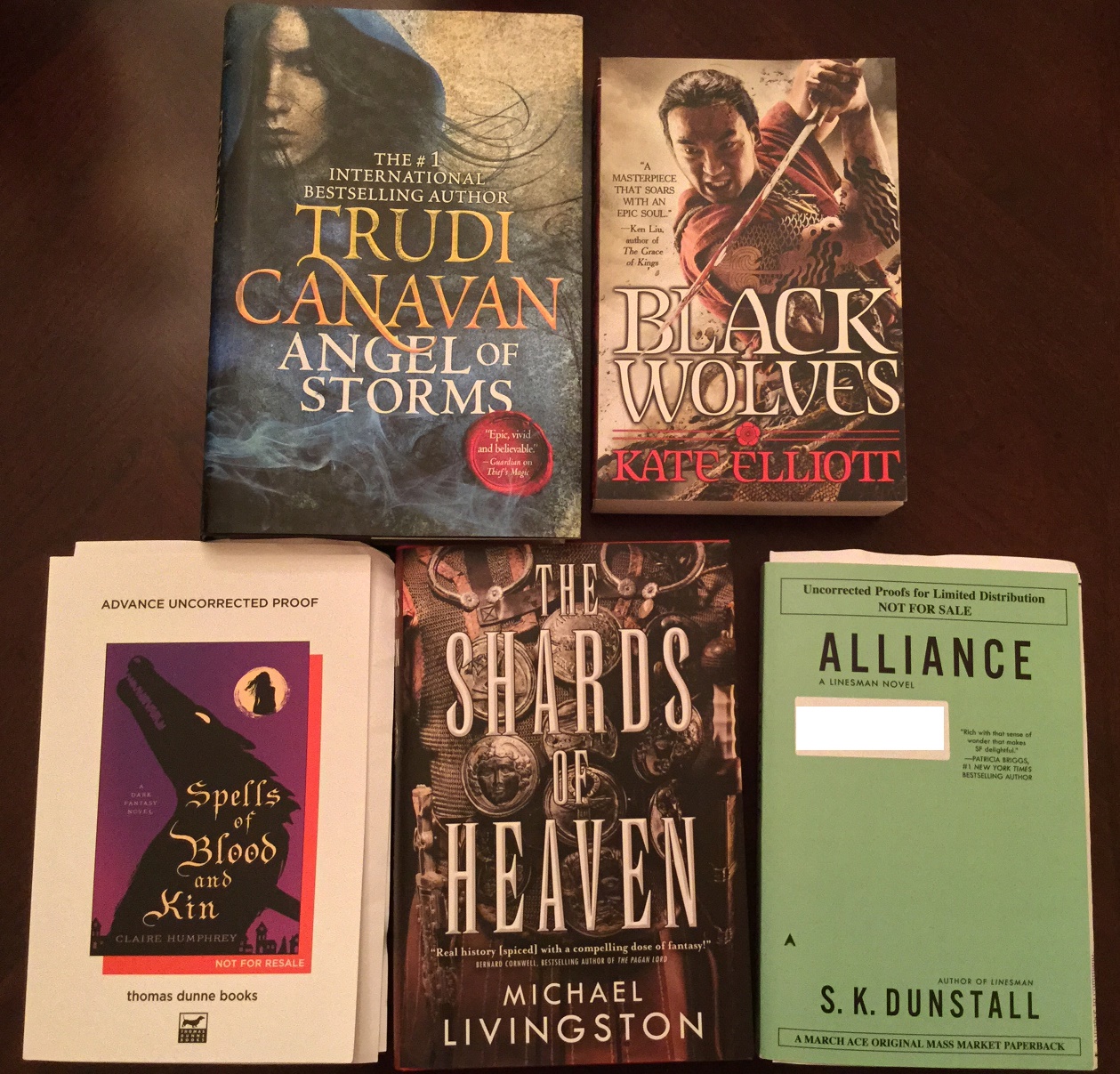
Angel of Storms by Trudi Canavan – Hardcover, with thanks to Orbit. This is the sequel to Thief’s Magic which I enjoyed very much last year, and I am eager to see if the two different storylines in the first book will finally resolve/come together in this one!
Black Wolves by Kate Elliott – Orbit was also so kind to send along this beauty of a book a couple weeks back. Its modest size actually belies its huge page count, almost 800! I’m actually about a third of the way through it right now, and I’m digging the story. So far it’s on its way to becoming my favorite book by Kate Elliott.
Spells of Blood and Kin by Claire Humphrey – Earlier this summer while I was chatting with a publicist at St. Martin’s Press about another book, she also asked if I would be interested in this other fantasy novel, something contemporary set in Toronto featuring Russian folk witches. Toronto happens to my hometown so I said, heck yes, sign me up when an ARC becomes available! Well, earlier this week it showed up. As soon as I saw the cover I recognized it as a book I’d been eyeing for the last few weeks, but until then I just hadn’t made the connection that it and the description of the book I’d been given was one and the same! So that was a real treat, to say the least. My thanks to Thomas Dunne Books!
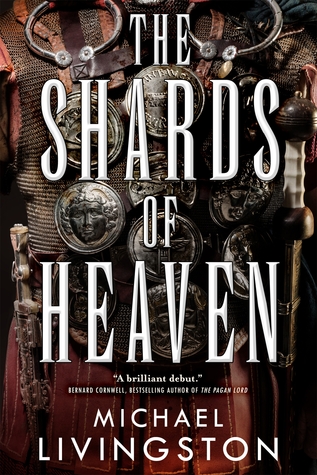
The Shards of Heaven by Michael Livingston – Hardcover with thanks to Tor, who are awesome for sending me this finished copy. In case you missed my review for this book, you can see it here. This novel is a must read for fans of historical fantasy, especially if you like the Ancient Rome time period/setting.
Alliance by S.K. Dunstall – ARC with thanks to Ace Books. An unsolicited copy, but I couldn’t have been more pleased when I opened the package and saw it. I have the first book Linesman in audiobook format to review soon, so after I finish that I’ll be getting right to this one.
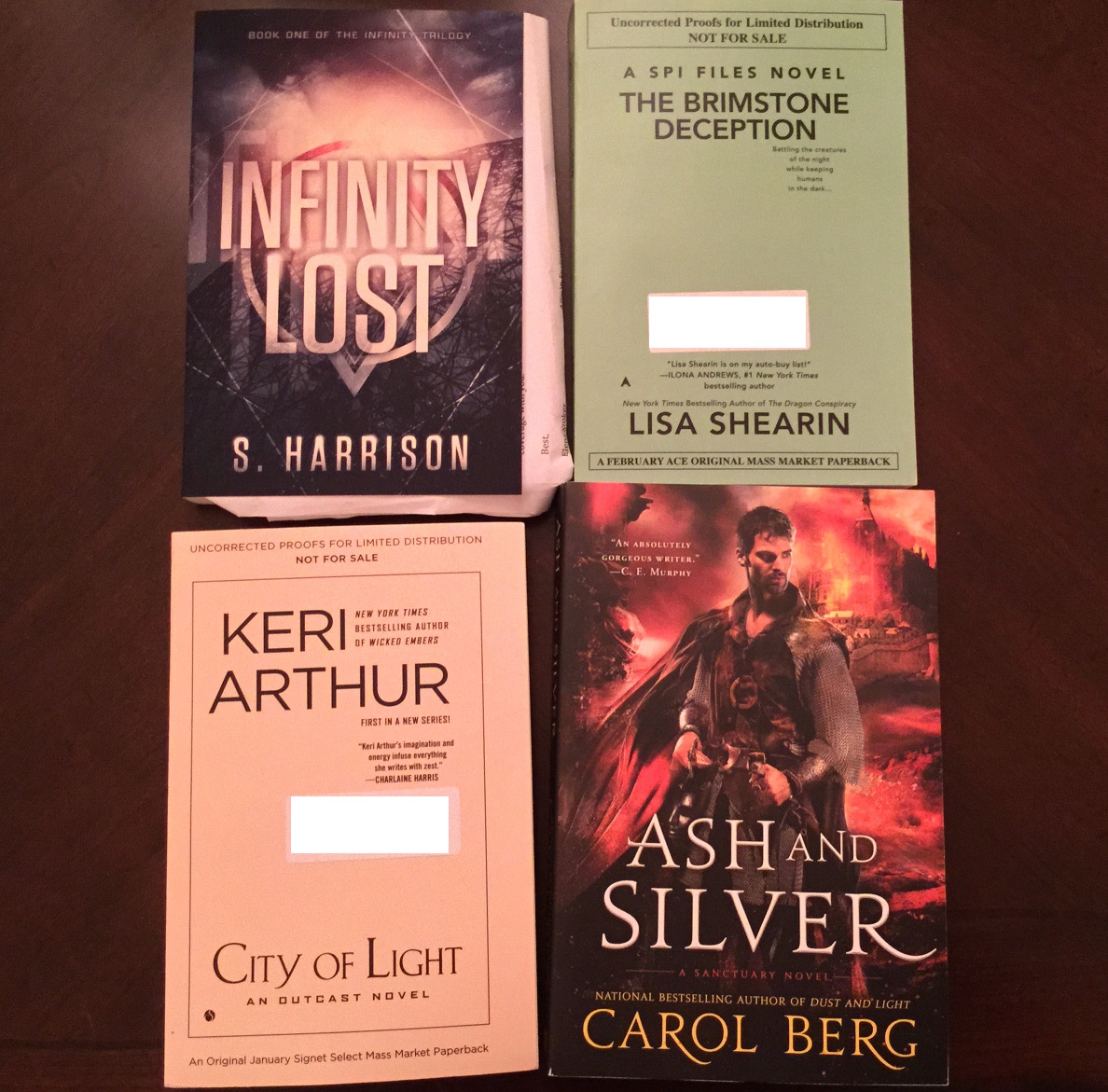
Infinity Lost by S. Harrison – Paperback with thanks to Skyscape and Wunderkind. See this book on the sidebar to the right, underneath CURRENT GIVEAWAYS? If you’re in the US, click it for more info on how to enter, as well as to read an excerpt that we’ve included as part of a special feature for Sci-Fi Month! You know you want to check out this book! It sounds fascinating, and I hope to read it myself, later this winter.
The Brimstone Deception by Lisa Shearin – ARC with thanks to Ace Books. I’ve been debating whether or not to continue with this series, though with the unexpected arrival of this third book, I guess my decision has been made for me! I’ve actually been enjoying this series a lot, I just wish I had a time-turner to read all the things!
City of Light by Keri Arthur – ARC, with thanks to Signet. I’m super excited to read this one! I’ve never read Keri Arthur before, but I’ve always been curious. Since this is the first book to a new series, I thought it would be a great place to start. Keep an eye out for my review and a giveaway in early January!
Ash and Silver by Carol Berg – Paperback with thanks to Roc. This is the second half of the Sanctuary Duet and I’m looking to find out how it ends! Isn’t it nice when a series is done in two books? I should have a review up sometime in early December, so be sure to watch for that.

Press Start to Play edited by Daniel H. Wilson and John Joseph Adams – Audiobook with thanks to Audible Studios. I’ve wanted to read this for a while, and I’m grateful to be offered the book in audio format since traditionally I’ve always struggled with anthologies. But truly, I think listening to it made it easier. My review will be posted tomorrow, so get your game on.
Lustlocked by Matt Wallace – Digital galley with thanks to Tor.com. I was so excited when this appeared in my inbox! Ever since finishing Envy of Angels I’d been waiting on the next Sin du Jour novella. It’s just so wild and quirky, I love it.
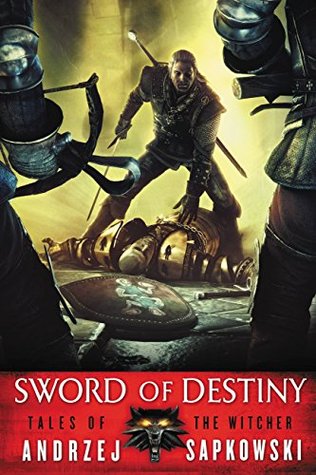
Sword of Destiny by Andrzej Sapowski – Audiobook with thanks to Hachette Audio. Remember my lament earlier this summer about no more Witcher books until more are translated? Thank goodness there’s Sword of Destiny to tide me over this winter, even though it’s not the next novel but a collection of short stories that precedes the main series. I’m not complaining though; I’ll take what I can get, and I’ve also wanted to read this one for a long time for completion’s sake. I’ve been listening to the audiobooks and they’re amazing, so of course I had to continue with this format.
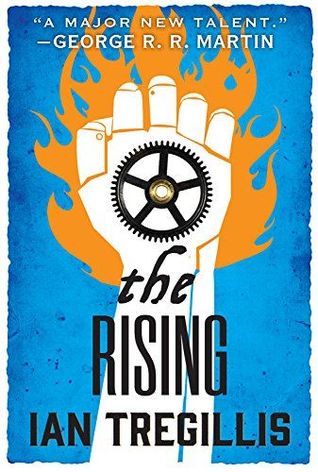
The Rising by Ian Tregillis – And Hachette Audio keeps on being amazing. This week they also sent along a review copy of this audiobook, sequel to The Mechanical, which I absolutely adored! I’ve heard amazing things about the audio of the first book, so I thought I would try listening to The Rising this time.
NANOWRIMO
In other news, I’m still plugging away at NaNoWriMo. They say slow and steady wins the race, and that’s exactly the strategy I’ve adopted. I find it easier to write at least the daily target word count for each day, even if I have to push myself to do it sometimes. It’s less panic-inducing when I know I won’t have to struggle to make up for it the next day. and if I can pull it off, sometimes I even aim for 2000 words. In this way, I’ve been keeping ahead, and that means I can also afford some downtime once Thanksgiving rolls around. We’ll have family coming over to visit again this year, and in my experience doing NaNo in previous years, I’ve learned never to count on getting any writing done during the holidays.
Here’s what my progress looks like so far. We’re entering the final stretch!

REVIEWS
Here are the reviews I’ve written and posted since the last update, gathered together and listed here for your convenience and viewing pleasure. Lots of sci-fi (and Star Wars!) this fortnight, because of Sci-Fi Month.
Luna: New Moon by Ian McDonald (4.5 of 5 stars)
Star Wars: Lost Stars by Claudia Gray (4.5 of 5 stars)
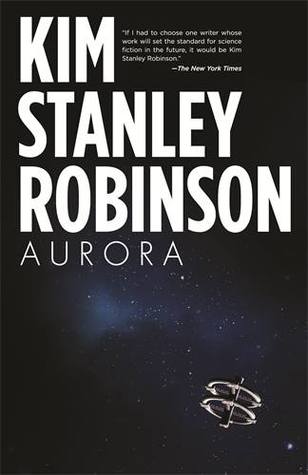
Aurora by Kim Stanley Robinson (4 of 5 stars)
The Shards of Heaven by Michael Livingston (4 of 5 stars)
Star Wars Psychology edited by Travis Langley
Towers Fall by Karina Sumner-Smith (3.5 of 5 stars)
Star Wars: Aftermath by Chuck Wendig (3 of 5 stars)
Star Wars: Battlefront: Twilight Company by Alexander Freed (3 of 5 stars)
Dreamseeker by C.S. Friedman (3 of 5 stars)
Binti by Nnedi Okorafor (3 of 5 stars)
A Borrowed Man by Gene Wolfe (2.5 of 5 stars)
AUTHOR SPOTLIGHTS
My thanks to the wonderful authors who stopped by these last couple of weeks. Earlier this week we had a very special Sci-Fi Month/Gaming post organized by my co-blogger Wendy featuring all of us here at The BiblioSanctum talking sci-fi games with authors Kristi Charish and Brianna Shrum!
Getting Our Game On With Kristi Charish and Brianna Shrum
WHAT I’VE READ SINCE THE LAST UPDATE
NaNoWriMo has been eating into my reading schedule. Basically, any free time I have has been going towards writing. Not gonna lie, as much fun as I’m having with my NaNo project, it’ll be nice when November is over and I can do more of everything else again!

* * *
Have you heard of or read any of the books featured this week? What caught your eye? Any new discoveries? Nothing makes me happier than sharing my love for books, so let me know what you plan on checking out. I hope you found something interesting for a future read! Until next time, see you next Roundup! 🙂
~Mogsy/Steff~
#RRSciFiMonth Book Review: Lord of All Things by Andreas Eschbach
Posted on November 20, 2015 4 Comments
Sci-Fi November is a month-long blog event hosted by Rinn Reads and Over The Effing Rainbow this year, created to celebrate everything amazing about science fiction! From TV shows to movies, books to comics, and everything else in between, it is intended to help science fiction lovers share their love and passion for this genre and its many, many fandoms.
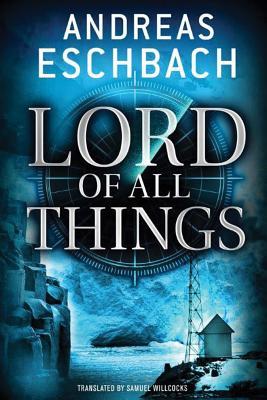 Lord of All Things by Andreas Eschbach
Genre: Science Fiction
Translation: Samuel Willcox
Publisher: AmazonCrossing (January 2014 – originally published in January 2011)
Author Info: andreaseschbach.de
Wendy’s Rating: 3 of 5 stars
This is a difficult book to recommend. The ratings on Goodreads vacillate between 1-2 stars and 4-5 stars. Either you love it or you hate it. I’m going to go right down the middle. I didn’t love it, but nor did I hate it, and I can see why readers on either side of the scale feel the way they do about it.
The prologue offers an enticing hook: A young boy, Hiroshi, the son of a cleaning lady, promises his new friend Charlotte, the daughter of the French ambassador, that he will change the world by removing the distinctions between the rich and the poor. It seems like the promise of an idealistic child, as the story progresses from their childhood to adulthood, Hiroshi’s genius and determination seems to be set to make his dream a reality. And though Charlotte does not believe as Hiroshi does that they are intrinsically bound together by fate, their paths continue to cross as Hiroshi sets about bringing a new world order.
The story is mainly told through the eyes of Hiroshi and Charlotte, but several other people in their lives get PoV chapters to continually support or throw cogs in the wheels of Hiroshi’s plans. It begins with the pair as children, then slowly moves through pivotal moments in their lives where they come together and separate. At first, this deterred me, as the next step in their process was a very annoying college age where too much time was spent with a particular character obsessed with making good use of his penis. It established the character well enough, and his return later made sense, but I could have done with less of him during his young adult years. I also didn’t quite understand how this transition worked for the overall plot, until further, less annoying time transitions were introduced and Hiroshi’s plans really started to come together.
This is also where the science fiction aspect slowly started to slip in, as Hiroshi works to perfect his self-replicating robots that can do anything. Also of note, there is, as I understand it, real science involved, but Eschbach does not overwhelm with the descriptions. Often times, science fiction featuring brave new worlds begin when this world has already begun. Here, we see it being built from idea, upward–but we also discover, through links to Charlotte’s unique paranormal ability, that perhaps things have been churning long before anyone ever imagined.
This is a slowburn book. Neither the relationship between Hiroshi and Charlotte, or Hiroshi’s world changing plans ever moves at a fast pace–nor do they go where one might expect based on the usual genre tropes. For this, I really did appreciate Eschbach’s process, and I certainly liked his characters and their bittersweet lives.

#RRSciFiMonth The Long Way to A Small Angry Planet Read-Along Week No.3
Posted on November 20, 2015 4 Comments
For SciFi Month I’m participating in a special Read-ALong of The Long Way to a Small Angry Planet by Becky Chambers. If you’re interested in joining in, visit the SF/F Read-ALong group for more information.

Banner by Anya @ On Starships and Dragonwings
Week 1 (Friday, November 6th): “Transit” to “The Job” – hosted by Over The Effing Rainbow
Week 2 (Friday, November 13th): “Port Coriol” to “Cricket” – hosted by Chris @ Galleywampus
Week 3 (Friday, November 20th): “The Last War” to “October 25” – hosted by Claire Rousseau
Week 4 (Friday, November 27th): “Heresy” to end – hosted by Over The Effing Rainbow

***Warning: there may be spoilers contained in the questions and answers.***
1. There is a lot of focus on some of the different alien races in this section, from Dr Chef recounting the story of his people’s decline and Sissix introducing Rosemary to her families, to the surprise visit from the Aeluons and the much less welcome search by the Quelin. What are your thoughts on the various beliefs systems we encounter? Does anything specific pique your interest more than the rest?
It’s definitely interesting to see the differences in the alien cultures. Dr. Chef’s story is a very unsettling reminder of that humans could have easily gone down that same route of violence and self-destruction. I thought it very appropriate that he was sharing his memories with Rosemary, especially given the circumstances of her own father. One point Rosemary brought up really stuck with me, though: the fact that Dr. Chef’s people fought among themselves in a very personal war, and each side knew the costs and experienced their own losses. Rosemary’s father on the other hand sold weapons from afar, without having to sacrifice anything of his own. I’m not sure if this speaks more about the callousness of some humans or their ignorance; one hopes that if Rosemary’s father had been forced to witness firsthand the destruction and death in the war he fueled, he might have reconsidered his decisions.
On to happier things, I really enjoyed the scene where Sissix brought Rosemary and Ashby down to meet her family. What can I say, but her species’ customs are fascinating. They are like the opposite of Vulcans. In fact, to Sixxix, we all must seem like Spocks.
I really wish we’d gotten more of Aeluon and Quelin cultures though! To be honest, I’m still a bit mystified as to why the relationship between Ashby and Pei would be so taboo to the Aeluons. An explanation was given earlier on in the book, but I’m not sure I find it all that convincing; watching Pei and her crew act so affably towards the the Wayfarer gang, I can’t really imagine the Aeluon holding such views in response to relations with other species. (By the way, I also have to add: I find it funny how the entire galaxy finds the Aeluons beautiful. They actually sound pretty creepy according to their descriptions, but that might just be me! I guess they are like the Asari from Mass Effect.)
2. Ashby gets the chance to give Pei a tour of his ship and introduce her to his crew, meanwhile Jenks and Lovey decide not to risk transferring the AI into a body just yet, and Rosemary initiates a relationship of sorts with Sissix. Were you happy to see any of these developments, or not so fussed?
Ah, I felt so bad for Ashby and Pei. I just wanted to yell, JUST KISS DAMMIT WHO CARES WHAT EVERYONE THINKS! But I guess you have to some forbidden love to spice things up. Speaking of which, I actually found myself sighing with relief that Jenks decided to forgo the plan with Lovey and the body kit. There would have been way too many complications, and I had a feeling that if they’d gone ahead with it, Ashby would have forced them to leave the ship, as reluctant as he would have been to do it. We saw with the Quelin what could happen if someone was caught breaking intergalactic law. It’s just too much risk for the Wayfarer. Plus, Jenks’ reasoning not to do it makes perfect sense. I’d rather see them both safe.
As for Rosemary and Sissix, I love their new “arrangement”! I couldn’t have been happier with this turn of events. To tell the truth, if it had been me on the Wayfarer I would have jumped Sissix’s bones the very first week. Sissix is just such a kind, gentle and open soul; it doesn’t matter what gender or alien species you are, it’s a sexy trait and I’m really attracted to that.
3. Cloning technology exists and is used in many sci-fi universes, but the GC does not look kindly on it and it is abomination to the Quelin. Did the reveal of Corbin’s nature change your view of the character?
A jerk is still a jerk even if he’s a clone, so my opinion of his personality hasn’t really changed all that much. Now we have some answers as to why he is the way he is, though–even if I don’t entirely believe it should excuse his rude behavior. But I have to admit, the whole fiasco with the Quelin made me feel pretty angry at how he was abused and humiliated. Even a jerk doesn’t deserve that kind of treatment.
I also liked how the whole crew came together to save Corbin (I guess it’s one of those “He may be an asshole, but he’s our asshole!” kind of situations.) In truth, I’m also glad this plot twist happened so that I can finally relax, because up until this point I’ve been pinning Corbin down as a villain, just waiting for the moment he betrays the Wayfarer some way or another. I mean, not that it still couldn’t happen that way, but it’s much less likely now.
About time that Corbin got to play a bigger role in this book too. Up until this point, he’d always been relegated to the backseat. When I was answering last week’s questions, I’d actually forgotten his name.
4. Each chapter told a different and fairly self-contained story, without any big cliffhangers from one to the next. How did you feel about the pacing of the story so far? Are you satisfied with how long the long journey is taking or are you impatient for the crew to finally get to their destination and do some tunneling?
I’m really glad this question was asked because it’s something I’ve been wondering, and I’m curious to see if I’m the only one who feels this way. As much I I’ve been enjoying this book, I’m definitely ready for things in the book to move on from “The Long Way” and get going to the part involving “A Small Angry Planet.” I can’t deny I’m feeling a bit antsy, and this sensation has been nagging at me since about a third of the way through the novel. I’m quite anxious for the crew to get tunneling, and to see what all this fuss with the Toremi is about.
I think I would have been more bothered though, if I hadn’t noticed the term “episodic” in the book’s description some time last week. It made me wonder if the author hadn’t written this novel in a serial format of some sort, imagining it akin to a series of short stories, or something that could unfold like a TV show? Not that I don’t want to see things get moving along, because I do! But basically, once I realized that the style and structure could be by design, I was able to understand the laid-back pacing a bit more.
Book Review: Towers Fall by Karina Sumner-Smith
Posted on November 19, 2015 5 Comments
A review copy of this book was provided to me by the publisher in exchange for an honest review. All opinions are my own.
Towers Fall by Karina Sumner-Smith
Genre: Fantasy, Science Fiction, Young Adult
Series: Book 3 of The Towers Trilogy
Publisher: Talos (11/17/15)
Author Information: Website | Twitter
Mogsy’s Rating: 3.5 of 5 stars
Karina Sumner-Smith’s genre defying Towers trilogy draws to a close with Towers Fall, a series-ender that successfully lives up to the potential promised by the first two books. I remember being impressed when I first read Radiant, surprised that it was the author’s novel debut. I went on to read Defiant and was again blown away by the story’s premise and world building, and it feels deeply satisfying now to have come this far with our protagonists Xhea and Shai.
Things really started heating up in the second book, but now they are at a boiling point. The people of Lower City thought they would be given time to rebuild after the recent catastrophic events, but instead they are handed an ultimatum: Those on the ground will have three days to leave their homes, or the Central Spire will destroy them all.
Xhea and her ghostly companion Shai find themselves in the middle of the conflict again, attempting to rally the people to fight back and defend their homes. Through their experiences together, both have learned much about their special connection and respective magical abilities, but will it be enough? The Lower City has been revealed to be something more than anyone realized, and the Spire will stop at nothing to harness its magical energies. Now the girls will have to find out why, because the secrets of the towers may hold the key to stopping the oncoming destruction.
Once again we follow the structure introduced in book two, with chapters alternating back and forth between Xhea and Shai’s POVs. This is good for balancing the perspectives, especially since Shai’s role has grown to become just as important as Xhea’s after the first book. However, the book also follows this alternating pattern very rigidly, a stylistic choice that also has its downsides. For example, sometimes we’re forced to follow up with a character even when they aren’t doing much on the page to further the story. In these sections they were left there just to spin their wheels, and like the previous book, I felt more often that Shai’s chapters were weaker and had less direction when compared to Xhea’s. We lose some momentum in the middle of the book because of this.
Still, the bond between the two girls remains strong, which is great because their friendship is clearly the theme that defines this whole trilogy. This is in stark contrast to a lot of Young Adult novels these days that mainly focus on the emotional perils of romance. There’s also not enough YA fiction out there with strong female friendships; so many YA novels I read this year featured the female protagonist surrounded by only male friends, and if there is the presence of another prominent female character, often they aren’t the protagonist’s equal or they ultimately become her main rival. It’s very refreshing to see a series like this come along, showing how things can be done differently.
At this point, there’s also really nothing more I can say about the world building, other than it rocks. I’m still having a hard time deciding whether to categorize this series as science fiction or fantasy; after all, the towering skyscrapers and post-apocalyptic dystopian vibes make me lean towards the former, while the heavy emphasis on magic makes me think the latter. But at the end of the day, who cares? This trilogy has elements from a lot of different genres, and even includes ghosts and “walkers” that act very much like zombies. The important thing is finding balance, and I think the author achieved that marvelously.
My only complaint about this book is that the plot doesn’t feel as tight compared to the first and second novels—possibly related to the alternating POV issues I mentioned above. The pacing suffered slightly in the middle where certain chapters dragged on unnecessarily, and there just seemed to be more filler in this one, which made the story run a tad too long for my tastes. But other than that, I can think of little else that detracted from the experience.
All told, Towers Fall finished off the trilogy nicely, wrapping things up with a powerful and thought-provoking ending. If you’re ever in the mood to check out a truly unique series, be sure to give this these books a look.

*** Originally reviewed at The Speculative Herald ***
More on The BiblioSanctum:
Review of Radiant (Book 1)
Review of Defiant (Book 2)
Guest Post by Karina Sumner-Smith
#RRSciFiMonth: Getting Our SciFi Game on With Brianna Shrum and Kristi Charish
Posted on November 18, 2015 16 Comments
Sci-Fi November is a month-long blog event hosted by Rinn Reads and Over The Effing Rainbow this year, created to celebrate everything amazing about science fiction! From TV shows to movies, books to comics, and everything else in between, it is intended to help science fiction lovers share their love and passion for this genre and its many, many fandoms.
As you all know, we at BiblioSanctum are avid gamers. We love gaming as much as we do reading, and we love it even more when our hobbies intersect. Whether through books about gaming, expansions on gaming lore, or books inspired by gaming, we love it — and we love authors who share our passions. Both Kristi Charish, author of Owl and the Japanese Circus, and Brianna Shrum, author of Never Never, have written about how gaming has influenced their writing:
Characters and Choices: Games as Stories by Brianna Shrum
“I play games, I write books, because I want to live someone else’s incredible life for a while.”
One RPG at a Time by Kristi Charish
“Video games, particularly some of the RPGs […] are fast becoming one of the most emotionally engaging interactive experiences on the planet.”
Kristi and Brianna are also hopelessly obsessed with Bioware games too and, while we could all spend hours talking about any or all of those games, for the sake of #RRSciFiMonth, we’ll do our best to keep our flailing focused on science fiction gaming.
What is your favourite science fiction video game and why?
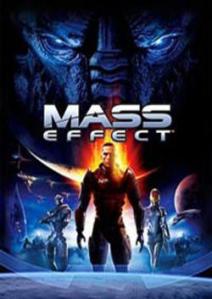 Wendy: I’ve played a few scifi games, but Mass Effect stands out for so many reasons. First of all, it was the first game I truly played on the PC, and I’ve never looked back. I will still play games on the console, but I’m definitely addicted to the PC now. As a game, Mass Effect also introduced me to the wonderful world of games that are rich with characters to care about and choices to make that affect relationships with those characters, as well as the entire story. I had played other games with beloved characters and great stories, but being able to truly play a part in that story beyond just pushing the buttons was something entirely new.
Mogsy: I’m definitely more of a Fantasy kinda girl at heart, so this question is hard for me. All my absolute faves tend to be games in the fantasy genre, so I don’t know if there’s any one sci-fi game I can single out but rather a whole bunch vying for top spot. Mass Effect’s definitely up there though! And it’ll keep Wendy from strangling me… 😉
 Brianna: I’m actually more of a fantasy gamer too, so this is tough! I’m taking a writing break pretty soon to focus on gaming and this is my DEEPEST DARKEST SECRET, but I’ve never played Mass Effect. (WHAT??? I know) During the Great Gaming Catchup of 2015/16, the entire Mass Effect series is on my list, because basically everyone says it’s incredible. At this moment, my favorite game of ALL TIME is Knights of the Old Republic. I am such a massive Star Wars fangirl, and I remember just not being able to stop thinking about it. KotoR’s story, the environment, the characters (except Carth. Eh. Team Canderous) blew. Me. Away. *stops so I don’t spoil anything* BUT KOTOR, GUYS.
Kristi: Ohhhhh….seriously? We’re doing this?? Ok, well at least we stuck with Sci-Fi. The Mass Effect Trilogy is one of the best out there.

I’ve said it before and I’ll say it again — I think this is hands down one of the best pieces of Science Fiction written in the last twenty years. Why? Video games takes the sci-fi genre to an entirely new level. Science fiction is all about imagining the possibilities based on the science and technology we have before us and how our future could be affected. It requires immersion to convince your audience that the world is real. Man, oh man are video games ever brilliant for that. Mass Effect doesn’t tell you a story like a book or movie, it let’s you live the story — and more importantly interact with it. The Bioware team has a stable of amazing writers. These guys aren’t leading you through a quest to get the next item (there is a lot of that- it is a video game) but they’re developing characters and weaving their emotional and personal journey’s into the game. If you are a fan of sci-fi, or writing sci-fi, this game is a must, must, must play. It didn’t set the benchmark for where sci-fi is going. It is the benchmark.
 Tiara: Good question. I love Mass Effect, but before I loved Mass Effect, I loved Gears of War. (Side note: Ask me about my Dom feelings and I’ll be crying all over the place.) It took me a while to actually play Mass Effect, even though I’d played every other Bioware game ever. For some reason, I thought it was about something totally different than what I got when I actually played it. It took a couple of friends teaming up on me and saying, “If you liked Gears of Wars, you’re going to love Mass Effect.” I played the Mass Effect 2 demo on PS3 (because it had recently come out) to test it out and decided that I definitely had to play the series from the beginning after being wrapped up in that short session. The problem was I didn’t have an Xbox at the time, and the only other way I could play the first game was on PC. I wasn’t much of a PC gamer, but Mass Effect definitely changed that. I’m such a fan that I got a Mass Effect Spectre tattoo and plan to get a renegon (a character who’s renegade and paragon, but probably more renegade… See also: Paragade) tattoo soon. I’m a big fan of Knights of the Old Republic. I’m actually replaying that right now along with Mass Effect.
What other scifi games have grabbed your attention?
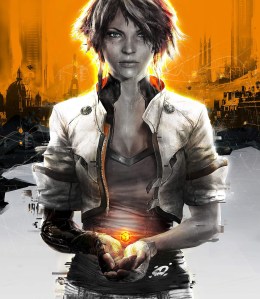
Remember Me
Wendy: Remember Me is a stunning game. It’s the first game from DONTNOD and I will love this game developer forever for the way they stood up to big executives who felt this game would not work well with a female lead protagonist. The game itself, though beautiful and innovative in ways, is still obviously a first work, but as DONTNOD has shown with their latest game, Life is Strange, they aren’t afraid to push buttons as well as envelopes in an industry in desperate need of a mainstream shake up. I also love the Borderlands games, which seem like mindless shoot’em up violence on the surface, but are actually an intricately detailed series of stories and characters. My husband plays Starcraft, and I’ve become invested in the Queen of Blades. Oh and Final Fantasy 7 was probably my first scifi game — and my first epic RPG. I love the way the series so smoothly combines fantasy (which actually is my preference too) and science fiction. Oh oh and then there’s the Knights of the Old Republic series and the The Old Republic MMO which feeds into both my Star Wars love, as well as my obsession with all things Bioware.
Mogsy: Okay, here we go. *takes a deep breath* Starcraft. Bioshock. Half-Life. Portal. (AMAZING!) Deus Ex. Gears of War. Star Fox 64. Doom. (I know I’m going back in time with some of these, but I have a lot of fantastic childhood memories associated with them.) And would Dishonored count? Because OMG, Dishonored.
Wendy also mentioned Star Wars games and of course being a big fan of Star Wars, Knights of the Old Republic also gets a mention from me, along with Dark Forces, Rogue Squadron (“Rogue Squadron, where’s our cover?!?!”), Jedi Academy, X-Wing, TIE Fighter, you name it. I’m also super excited about Star Wars: Battlefront.

I’m big on MMOs these days too, so SWTOR, Star Trek: Online, EVE Online.
Brianna: Did I mention I’m obsessed with Star Wars? Because SWTOR is fantastic. I’m doing a playthrough with a bounty hunter, which I’m loooving. But I’m super ready to run through it as a Sith Inquisitor. I love the combination of traditional RPG with MMO and think that’s super innovative. Another sci-fi (zombies are sci-fi, right? Let’s go with that) I just started is LAST OF US, and wowwwwwwww is it incredible.
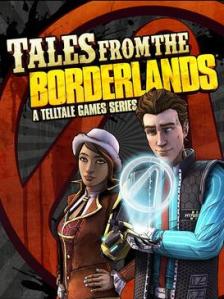 Kristi: Hehe. You expected us to all say Mass Effect :-). I’m definitely more of an RPG gamer — I like my stories. I actually just finished playing TALES FROM THE BORDERLANDS a couple nights ago. We marathoned through the first season over the weekend. It’s from Telltale Games and is a cross between a video game and an interactive story. I’ve been watching what games they’ve got coming out and they’re good, but The Borderlands edition blew me away. Bonus: the soundtrack is pretty fantastic too — get Shazam ready.
Another one not on this list yet is WOLFENSTEIN — Alternate history sci-fi where the Nazi’s win. Considering it is a first person shooter the story is AMAZING.
I will also second THE LAST OF US, except it is TOTALLY not zombies. It is a parasitic fungi that invades its hosts and takes over the nervous system etc. It’s like Cordyceps! Seriously look it up- talk about awesome use of real life parasites!
Tiara: I’m a huge fan of Borderlands. I absolutely adore Tales from the Borderlands, which I worried would be a weird addition to the series, but Telltale nailed it. I pretty much started giggling just seeing Kristi mention it. I like Quantic Dream’s Beyond: Two Souls and Fahrenheit, which play more like interactive movies than games. Deus Ex: Human Revolution is high on my list even though I wasn’t a big fan of the first games. Beyond Good & Evil is another great game. I’m an undercover Crysis player, but don’t tell anyone I told you that. Christine Love’s Analogue: A Hate Story and its sequel Hate Plus tore me apart, too. Same for Transistor and Bastion by Supergiant Games.
I can’t leave without mentioning Thomas Was Alone, which is the craziest puzzler about blocks, but there’s a story that I got invested in. Why does a game about bouncing blocks have a story that I care about? LOL. If it’s science fiction, I’ve probably tried it.
What makes a great game for you? What makes for a great science fiction game, specifically?
Wendy: A great game, like a great book or show, needs to take me away. I want to get lost in the story and become BFFs with all the characters so that I can spend every day thereafter talking about them obsessively with anyone who will listen. When it comes to great science fiction, I’m not too hung up on there being actual science involved, though I certainly respect the stories that do make an effort to make the science believable. I’m fine with accepting giant space dragons as long as you make me feel for them.
Mogsy: As you can see from my list of sci-fi games that have caught my attention, I don’t think there’s any one element or even several that I can narrow down when it comes to what makes a great game for me. Honestly, it just has to be fun.
Brianna: I’m all about the characters, baby. I want companions I totally fall in love with, and more than anything, I just really want a story that I can get obsessed with. Twists that I’m talking about for ages, and characters I can’t stop thinking about. That’s across the board with games for me, and for scifi specifically, I can really get swept away by a great atmosphere.
Kristi: I’m seconding Brianna on this one. The characters. More Garrus!! But it’s just not the awesome character prototypes, for me it’s also how they change through the story. I also think the real power of video games is the immersion experience. No other storytelling medium can do that — or allow you to influence the characters or game. Take Dragon Age for example. Your cohorts can love or hate you, and it will influence some of the outcomes. That leads to the second thing for me — I play video games for the story, and sci-fi is no exception. I love a good story so pair that with a great immersible sci-fi world with characters that have some depth and you have me hooked. Oh yeah, and the romance options are always fun…I just described Mass Effect, didn’t I? …Maybe we should rename this chat to ME and other games 😉
Tiara: It’s usually a combination of things for me. Typically characters and story. Honestly, I think it’s going to really boil down to what I perceive happening. What I mean is? You have people who call a game’s story or characters shallow, and I play the game and I see a world filled with background, characterization, and story based on how I interact with the game. Likewise, people can say that a game is simply amazing storywise, and after I’m done playing, I’m left asking, “What is this filth you recommended me?” I’m a peculiar person like that. Look, I got attached to bouncing blocks.
Do you partake of science fiction within other mediums?
Wendy: For sure. I’ll scifi wherever I can find it. I’m really pleased to see so much science fiction on mainstream television these days, and I do love that real scientists like Neil de rasse Tyson are becoming such prominent figures in circles well outside the scientific community, and I’m particularly fond of all the Canadian scifi that is going on lately on television.
Mogsy: Yes. Books, movies, shows. Probably not as much as I should though. Like I said, I’m more into Fantasy; my husband’s the one who’s more into scifi at our house. He’s gotten me to appreciate a lot of the classics, while I introduce the newer stuff to him.
Brianna: Of course! Mostly in movies (i could list the ones I love foreverrrr) and TV (STILLLLLL weeping over the early cancellation of Firefly. Holla.) but I’ve read some YA sci-fi I’ve really loved. I especially adore space opera in basically *any* medium.
Kristi: Oh yeah. Definitely TV and movies — give me space cowboys! (Dark Matter and Killjoys atm). I also write and read scifi — I tend to keep to the space cowboy genres as opposed to space opera. Gimme a spaceship and a couple blasters any day!
Tiara: Books. Games. Television shows. Podcasts. Music. ALL SCIFI EVERYTHING!
Roleplaying is a big part of many of the games we play and that’s certainly a major part of Bioware games where you can design your own main character and make decisions that affect everything from romance to the fate of the galaxy. Let’s conveniently bring this back to Mass Effect and talk about our Commander Shepards. Tell us who they are and how they handle what life throws at them.
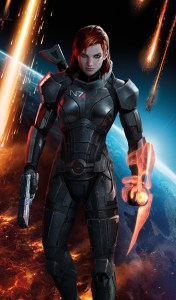 Wendy: My legacy Shepard is Molly, a ruthless space cadet. She’s truly her father’s daughter, and Admiral Hackett knows that he can always count on her to get the job done and make the tough decisions. She’s known as the Butcher of Torfan, but the moniker and her more renegade actions does not mean she is heartless. She remembers the names and faces of everyone who has died under her command. Her greatest regret is that she could not die for them, but she knows that their deaths were all a part of the greater battle and that people like her are needed to stop the galaxy’s ultimate threat: the Council. I mean, the reapers.
Mogsy: In the RPGs I play, I’m almost always the warrior with the big sword, or the soldier with the huge guns. In sci-fi games like Mass Effect, I typically subscribe to the “run in, shoot first and ask questions” later style of gameplay (this is why I suck so hard at stealthy games…I am like the world’s unstealthiest gamer) so my Commander Shepard was a bit of livewire!
Brianna: Ah, my great shame once again. I plan on playing a female Commander Shepard when I play in a few months for sure, and I really love to play somewhat darker, conflicted characters. Thinking spectre, maybe? And she’ll be all…edgy and stuff. And sneaky. Hi this was a wildly unspecific answer. *confetti*
Kristi: Oh I wish I had a photo. Ok, so my Commander Shepard is a redhead who keeps her head shaved. She’s the lone survivor or a colony that was wiped out. She is definitely more on the grey area of the lawful scale, more inclined to go with what she thinks is right versus what everyone else thinks is right (I mean, survival instincts, right?).
On her first mission out she accidentally ended up in a romantic relationship with Kaidan (it happens — particularly in Bioware games…I mean, in her defense, Shepard didn’t know he was serious about showing up in her cabin, and then he was there…it seemed like a good idea at the time…). That worked out fine though since Kaidan had a bit of a stick up his rear and couldn’t handle the whole resurrected by Cerberus thing…that’s ok, Shepard found a soul mate in Garrus who had gone rogue and totally became cool after the first installment…
I should probably mention that Commander Shepard (all of them) has a minor sexual harassment problem when it comes to dealing with crew. She/he has a bad habit of hitting on her crew and phrasing otherwise innocuous sentences into sexually loaded ones…No one ever complains about this… ever…which is odd…But then again, it works for her, so…
Ok, have I fanned out enough? 😉
Tiara: I have so many Shepards, but a holy trinity of Shepards–Jane, Chance, and Natalia–are my main three. Jane was my first Shepard. I customized her, but left her name the same because I wasn’t really sure what I was getting into at the time. She was my true blue paragon. An infiltrator turned soldier. Chance was my Jane Shepard gone wild renegade (okay, more like a renegade for two games and then, renegon for ME3). She’d like to think she was more of a consequentialist.She went from being a soldier to an infiltrator to a vanguard. (In fact, I figured out I liked vanguarding so much that I changed her class in ME2 in a second playthrough with her. CHARGE!) Natalia was an experiment of sorts, but then she grew on me because I had this intricate backstory that made her sort of this nature-loving woman from Mindoir who scared everyone when she joined the military, but here she is this bad ass engineer who happens to want to save the trees. She also might have decided that reciting Shakespeare was the only way to get to the love hiding in the Krogan heart.. “But, soft! What light through yonder window breaks?” It wasn’t very effective.


 The BiblioSanctum