YA Weekend: Truthwitch by Susan Dennard
Posted on January 23, 2016 26 Comments

A review copy was provided by the publisher in exchange for an honest review. All opinions are my own.

Mogsy’s Rating: 3.5 of 5 stars
Genre: Young Adult, Fantasy
Series: Book 1 of The Witchlands
Publisher: Tor Teen (1/5/16)
Length: 416 pages
Author Information: Website | Twitter
I typically try to approach ultra-hyped books with caution especially when it comes to the Young Adult fantasy genre, but I admit, when it came to Truthwitch by Susan Dennard I caved like an old sinkhole. This is the first time I’ve read the author so I had no idea what to expect, but her fans have so many lovely things to say about her Something Strange and Deadly series and Truthwitch also had such a wonderful description filled with all these promising elements, I knew I had to give the novel a try.
All told, I’m pleased that I did, for while there were plenty of mixed feelings, on the whole I could see where a lot of the excitement and love for this book is warranted. Truthwitch is often lauded for having a strong female friendship at its core, though for me the magic was by far the most notable aspect, the novel’s crowning glory. In the Witchlands where this story takes place, many individuals are gifted with powers called “witcheries” and these can manifest in many different ways. Some are pretty straightforward—among an Airwitch’s arsenal of abilities is control over winds and air currents, for instance—but others are more complex.
Take Iseult, who is one of our main protagonists and also a magic user called a Threadwitch, which means her powers allow her to read people’s emotions and see the literal ties that bind relationships. Ironically, the only threads Iseult can’t read are her own, so she can’t even see the bonds that tie her to her own best friend Safiya, for example. Safi herself has a witchery too, and hers is a rare one, for she is a Truthwitch, someone who can tell truth from lie. For obvious reasons, Safi’s power makes her highly coveted by powerful people, like rulers who believe having a Truthwitch will give them an advantage over their adversaries. For this reason, Safi’s witchery must remain a closely guarded secret.
War, however, has other plans. Safi and Iseult are “threadsisters”, which actually makes them closer than friends and in some ways even more than family. The two young women want nothing more than to be left alone to live their own lives, but the encroaching politics of the world will snatch those dreams away, making it difficult to hide. When Safi is promised to the emperor against her will, she refuses to be a pawn and devises her own escape, placing her fate and her friend’s in the hands of Merik, a dashing prince and sea captain. Unfortunately, their hasty retreat has also caught the attention of a Bloodwitch, and everyone knows there’s no running once one has got your scent.
First, the pros: As I alluded to before, I was very impressed with the magic, especially when the straightforward names of the individual types of witcheries often belied their hidden intricacies and other uses. Some witches are more powerful than others, or may exhibit different talents at varying strengths. This means that not all Airwitches will have the same air-manipulating abilities, and it’s common for one Airwitch to be able to do something that another can’t. Some kinds of witcheries also involve powers I never would have expected. Apart from controlling fire, for example, some Firewitches are also healers, but only if they have the training and aptitude for it. And they can’t heal all manners of injuries either, only some of them. So, if you have muscle damage, a Firewitch might be able to help, but for certain maladies of the blood, a Waterwitch might be a better bet. The different “rules” of the systems are all very elaborate and fascinating.
There’s also a lot to take in when it comes to the story, and personally, this was something I welcomed. Too often, I find myself frustrated with YA novels that feel overly simplistic or jejune, so it’s always nice whenever I encounter a YA fantasy with a more substantial plot and multiple layers to the narrative. There’s a whole web of complicated politics here that I did not expect and was pleasantly surprised to find, and I thoroughly enjoyed taking in the underlying conflicts between the three rival empires.
Now, the cons: Quite frankly, the biggest disappointment I had with this novel were the characters themselves. My favorite was the sensible and level-headed Iseult, and to my dismay she had a much more passive and diminished role compared to Safi, even though I believe the author tried to balance both of them equally. In reality though, Safi with her recklessness and hot temper dominated the show, but her personality frequently bordered on annoying. Her burgeoning romance with Merik also did very little for me, because I often found his character just as exasperating, if not more. You can tell this is a guy who tries hard to be an Alpha, but instead he comes across as an overbearing and insensitive blowhard.
Finally, as much as I admire Dennard’s vision to write a YA novel where female friendship takes center stage, I honestly didn’t feel much of it. Sure, the story tries repeatedly to drill Iseult and Safi’s closeness into your head, but the truth can be gleaned in the first third of the book where the girls get separated and spend much of the time apart. Here’s what ends up happening: Safi spends a lot more time in her head pondering the handsome and charming Prince Merik than she ever does being concerned with her threadsister’s wellbeing and whereabouts. Which actually shouldn’t have surprised me at all, though for moment I did hope that romance would take a backseat to sisterhood and friendship. Simply put, it’s not enough for the narrative to tell me Iseult and Safi are BFFs, I need to feel it.
There’s immense potential for the series though, and in spite of my issues with this book, the parts I did enjoy really stood out for me. And in truth, the characters started to improve for me towards the end of the novel, especially when it comes to Safi, and that really shows growth in her personality. My interest is piqued enough right now that I’m actually quite curious about the next book, and I hope that Iseult will have a more significant presence in the sequel and that the girls’ friendship will truly have a chance to shine.


Short & Sweet Audio Review: Should We Drown in Feathered Sleep by Michael Merriam
Posted on January 22, 2016 3 Comments

 Should We Drown in Feathered Sleep by Michael Merriam
Series: Standalone
Publisher: Carina Press (November 10, 2010)
Memorable Quote: “They hated to watch another be in pain, but it was necessary for her to die in order to be reborn.”
TL;DR Review:

Tiara’s Rating: 4 of 5 Stars. M A G I C A L!

Narrator: Cris Dukehart | Length: 1 hrs and 48 mins | Audiobook Publisher: Carina Press (December 9, 2010) | Whispersync Ready: Yes
In a war torn United States, people have regressed to a bartering system in order to trade goods such as jewelry, dye, and clothing. Grace Kriske is the crippled daughter of traders who has a fierce sense of independence and tries to help her family by making trinket and sewing/knitting other items to trade for good. Grace is an anomaly in her community, an outspoken woman who has no interest in kowtowing to the local religious leaders. Every year, though, a young man, sometimes a woman, is sent to the loons in the lake, chosen by a lottery. Every year, the last remaining loons hope to receive the one who will rebuild the world, the one who will bring their children back, and with it the world before it was war ravished. Being a sacrifice to the loons comes with grave consequences. Despite Grace’s disability, the loons call to her as they have for the past seven years of her life. While Grace is independent, she understands duty, and in her own selfish way she hopes the loons can fix not only her broken body but her broken soul.
I really enjoyed this story. There was so much going on despite the short length. It was nice to see a disabled protagonist whose disability is acknowledge, but she’s not made less for it (at least by the author). She has a lover who wants to give her so much more, but she sees herself only as a broken thing that couldn’t be the wife he needed. Her inability to walk has no bearing on his feelings for her, which was refreshing. She does the best she can and refuses help. While her family life isn’t fleshed out, you still catch glimpses of the family they are. They have their troubles, but they love one another. Life is just hard in their post-war era. This story in a way is a myth, combining many ideas and thoughts about swan, other water myths, women being the center of creation, and what they mean. Due to the war that isn’t fully explain (and that’s not an issue), readers learn how the religious orders have changed and desperation for the world to be fixed have made them more accepting of what they once might’ve called heretical. Cris Dukeheart did an excellent job giving this story a dreamy, mythical tone, a very beautiful narration with a twist of dark. This was a beautifully weaved story whose brevity doesn’t hurt it, but I wished it’d been longer.

– Features a protagonist with a disability in a positive light
– Beautifully mythic story where every word is used to its full extent

– Maybe be too brief for those who’d like more background
– Not a great fit for those who don’t like fairy tale like stories
Story:

Performance:
Overall:
Book Review: Winterwood by Jacey Bedford
Posted on January 22, 2016 37 Comments
A review copy was provided by the publisher in exchange for an honest review. All opinions are my own.

Mogsy’s Rating: 4.5 of 5 stars
Genre: Fantasy
Series: Book 1 of Rowankind
Publisher: DAW (February 2, 2016)
Length: 432 pages
Author Information: Website | Twitter
Winterwood and I were love at first sight, and all you have to do is take a gander at the book’s myriad subjects to see why: Magic. History. Fantasy. Romance. Fae. Ghosts. Shapeshifters. PIRATES. It’s like an irresistible smorgasbord of all my favorite themes and fantasy elements all in one place, and a strong, compelling female protagonist was the cherry on top.
Set in Britain in the time of King George III, Winterwood tells the tale of Rossalinde Tremayne, a young woman gifted with magical abilities. Seven years ago, she eloped with privateer captain Will Tremayne along with the Heart of Oak, the ship meant as her dowry, and Ross’s mother hasn’t forgiven her since. Now Will has been dead these past three years, and Ross has taken on the mantle of the Heart’s commander, adopting her late husband’s identity and disguising herself by wearing men’s clothing.
The book begins with Ross returning home to visit her ailing mother on her deathbed. In doing so, she learns more about her family than she ever bargained for, including the fact that she has a half-brother named David, who was fathered by the household’s rowankind bondservant. Ross also inherits a beautiful winterwood box, an object of great magical power that she is told only she can open, but the repercussions of that may be far-reaching and dire. Add to that, a shadowy enemy is on the hunt for Ross as well, and he would do anything to stop her from unlocking the box’s mysteries. With the crew of the Heart and the help of her newfound brother and a dashing wolf shapeshifter named Corwen, Ross sets off on a swashbuckling chase across the high seas to seeks answers and uncover the truth about her family’s secrets.
In news that I’m sure will surprise no one, I absolutely adore stories about women characters disguised as men, and even better when the book is a maritime fantasy and the protagonist is a capable heroine who captains her own ship. I love how Rossalinde is a strong and intelligent woman, but that she also listens to her heart. She gave everything up to marry the man of her dreams, and even though she and Will only had four short years together, she doesn’t regret her decision one bit. Interestingly, while Will’s death occurs before the book even begins, we still get to meet him in Winterwood in the form of his ghost. Back when her grief was still a raw and open wound, Ross unwittingly summoned him and now his spirit is a constant presence in her life. Will’s ghost and Ross share some humorous moments, but for the most part his appearances are a reminder of tragedy; he is a symbol of her past at a time when she should really be looking to the future. Being torn between two paths is devastating for a woman like Ross who is so in tune to her emotions, which is why I felt for her.
In addition to offering a well-crafted main protagonist, Winterwood also offers an altogether tantalizing blend of fantasy and historical fiction. Jacey Bedford’s prose is elegant and evocative of the setting, which is an alternate version of early 19th century Britain steeped in magic. The world feels familiar yet new, plus we get the added benefit of being on the ocean for a substantial part of this book, deeply immersed in the life of privateering during this time period. The battles at sea against pirates and French ships alike are thrilling and dramatic, where victory may come at a high cost but the rewards are well worth it. The dialogue is also superbly done, especially when it comes to the crew of the Heart and their nautical jargon and rough accents.
In terms of magic, this book is practically full to brimming with it. Perhaps the foremost fantastical element comes in the form of the rowankind, a docile and subjugated race of people exploited for their labor. Britain’s entire economy is dependent on these unpaid servants, and yet their history and origins are mostly unknown, lost to time. However, there are rumors that connect them to the Fae, who also have a large role to play in this story. Moreover, the realm of the Fae is completely separate from the domain of The Green Lady, who rules over the natural world. While the inner workings of the various kinds of magic go largely unexplained, it is clear that there are many sources of it, and their powers mingle and react in very interesting ways.
Also, when a book’s tagline reads “A tale of magic, piracy, adventure and love”, you’d be correct to expect a heavy dose of romance. Love is something Ross is just starting to allow herself to explore again after losing Will, and Corwen proves to be a good match for her, with lots of chemistry and sexual tension between the privateer and the wolf shapeshifter (just don’t call her a pirate, or him a werewolf—them’s fightin’ words!) But to my surprise, there’s more to this book than just romantic love. Familial love is an important part of this story too, with Ross accepting her half-brother David, becoming overprotective when he is threatened or treated poorly because of his rowankind heritage. I was impressed with the emotional level and complexity of the relationships in this book, as well as its unique perspective on social prejudice.
The best thing about Winterwood is its many fascinating components, which Jacey Bedford weaves into one amazing story of magic and adventure. Rollicking action is expertly balanced with passionate romance in this novel which will leave you salivating for more, and I loved every moment! I’m already looking forward to the next installment and dreaming about a return to this exciting, magical world.

Interview with Lawrence M. Schoen, Author of Barsk: The Elephants’ Graveyard
Posted on January 21, 2016 10 Comments
 As you’d recall, last month I reviewed the weird and wonderfully cerebral sci-fi novel Barsk: The Elephants’ Graveyard, and as promised we have a fantastic interview to share with you today, with none other than author Lawrence M. Schoen himself. Lawrence was kind enough to stop by and talk about his book, his writing, the Klingon language, and much, much more. It’s a fascinating journey and I hope you’ll enjoy reading our discussion as much as I enjoyed asking the questions!

Mogsy: Hello Lawrence, and welcome to the BiblioSanctum!
Lawrence M. Schoen: Thank you, I’m really excited to be here. If I had a trunk, I’d be trumpeting.
Mogsy: I can’t tell you what a pleasure it is to have you with us today. I had a fantastic time with your new novel Barsk: The Elephants’ Graveyard so I can’t wait to pick your brain about it. But also, I don’t think I’ve ever had the honor of hosting an expert in the Klingon language before! My family and I are huge Star Trek fans, so this is really exciting for me. Let me just say, “qaqIHmo’ jIQuch!” Was that right? I didn’t just make fun of your shoes or challenge you to a duel, did I?
Lawrence M. Schoen: No, that was perfect. But… how did you know my hovercraft was full of eels?
Mogsy: Yeah, ah, clearly I’m not too good with languages. So kudos to you! To get started, can you tell us a bit about your new book? How would you describe Barsk: The Elephants’ Graveyard, and what can prospective readers expect?
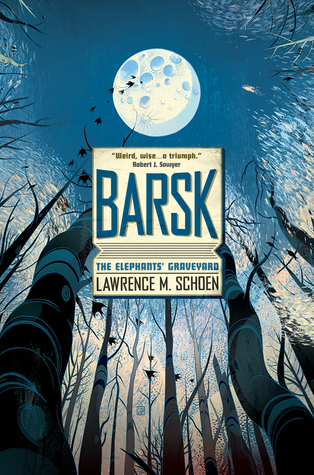 Lawrence M. Schoen: Rather than take up our entire time here trying (and likely failing) to give you a really comprehensive answer, I’m going to fall back on the elevator pitch version. Ready?
Barsk can be described as Dune meets The Sixth Sense. With Elephants. In Space.
Mogsy: Now that’s a tagline I can get behind. So, after reading this book, I was just burning to know, what was the impetus behind the ideas of Barsk? What inspired you to feature anthropomorphic animals as your characters?
Lawrence M. Schoen: The very first thoughts of the book came as an off-the-cuff response to an invitation to participate in an RPG based on a popular anthropomorphic comic book of the time. Although the major characters were mostly all cats, I was told I could roll up any species I wanted. For some reason I chose elephants, but then I was told that my choice was not included in the rules. Rather than shrug and pick something else, I began conjuring up the rainy world where these elephants dwelled, a place no traditionally furry race would want to live. And then I was off and running.
Mogsy: In the book’s Acknowledgements, you mentioned how you began writing Barsk almost 30 years ago. Seriously, that’s amazing. What has that journey been like, and were there any surprises along the way? How does it feel now to hold the finished book in your hands, and did Barsk end up the way you’d envisioned it?
Lawrence M. Schoen: The most amazing thing was discovering how little I knew about writing and that I didn’t let that stop me from completing a novel. It’s also what contributed to that original version being a very bad novel. Seriously, it was terrible, chock full of overused literary devices and shameless exposition. The ideas were good, but the execution just wasn’t there. Thankfully, despite my best efforts at the time, no one bought it and I put it away in a drawer and turned my attention to writing other things and acquiring the skills and craft that I needed to tell the story in an effective and compelling way.
I think it’s fair to say that the final book was everything I’d imagined it would be, while at the same time being quite different. There are a couple pieces that are virtually unchanged from the earlier version — most notably the epilogue — but then too the impact of that final scene resonates much more powerfully because of differences that have been made to everything that leads up to it.
The oddest bit is the feeling of suddenly being an overnight success after more than two decades in the business.
Mogsy: Did you have to do any specialized research for the book? What’s the most interesting tidbit you came across?
Lawrence M. Schoen: As you can imagine, I did a lot of research on elephants. The most fascinating thing to me is their ability to generate and respond to infrasonics—frequencies of sound far below the level of human hearing. These sounds can carry for miles! It explains how young elephants can call to their mothers when they become lost in a forest and how females who are receptive to mating can alert males far away.

Mogsy: Speaking of animal behavior, while reading Barsk, it really struck me how all the characters – Jorl, Lirlowil, Druz, etc. – felt at once familiar but also alien to me at the same time. Partly, I think this is due to the fusion of things we know (how animals look and act, for example) along with the strange and unexpected sci-fi elements. What is your approach to the creation of interesting and convincing aliens, and what advice would you give to writers who want to do the same?
Lawrence M. Schoen: Writing about Anthropomorphics is a lot like writing Aliens. The trick is to balance the ways in which they are not like us — whether it be trunks and flapping ears or a silicon-based biochemistry or a language system that requires the ability to emit odors like fifty kinds of spoiled cheese — with familiar things. With Barsk this took a surprising reverse because the familiar bits were the animal traits and behavior and the unfamiliar aspect was seeing how these same things manifested in a sapient, humanoid being.
Mogsy: Can we also geek out about the cover for a bit? I really want to get your comment for this one, because I was stunned when I saw the beautiful art by Victo Ngai. Do you recall your reaction when you first saw it?
Lawrence M. Schoen: When I first saw the cover, I swear to you I laughed, I cried, I fell down, and there’s no doubt that it changed my life. I can’t lie, I simply lucked out. We’ve all heard the horror stories of authors getting covers depicting characters or scenes that couldn’t possibly occur in the novel, and instead here I am, my first time out with a major publisher, and I get what is probably the best art I have seen in more than a decade. I cannot praise Victo Ngai enough, and along the same lines I’m hugely indebted to Tor’s art director, Irene Gallo, for making this happen.
Mogsy: Going back to your involvement with Klingon and the Klingon Language Institute (because I still think that’s the coolest thing ever), what led you to the interest? And out of curiosity, did any of your Star Trek or Klingon experiences play into or influence the making of Barsk?
Lawrence M. Schoen: When I was a young teen, I fell in with a group of college-age and older folk who were amateur linguists playing with Tokien’s Eldarin languages. This was so long ago that he was still alive, and The Silmarillion had not quite come out. Those early experiences marked me, and doubtless started my interest in linguistics. Fast forward twenty years, and I was a psychology professor at a small liberal arts college in northern Illinois, one which was experiencing shrinking enrollments and the need to reduce the size of its faculty to make ends meet. I was the newest hire in the largest department, which meant I was one of four people they marked to let go, but only after giving me a year’s notice so I could try and find another position. While waiting for that to happen I went looking for a distraction. Someone had given me a copy of Marc Okrand’s The Klingon Dictionary and I thought back to that time of playing with Elvish and how it might be fun to do the same thing with Klingon for a few months. It all exploded when the media found out about it and here I am, more than twenty years later.
I don’t doubt that Star Trek in general had an influence in Barsk, if for no other reason than that it shaped my early interest in what we might call space opera. And too, there may be a few Easter eggs in the book that a Klingon speaker could find. Maybe.
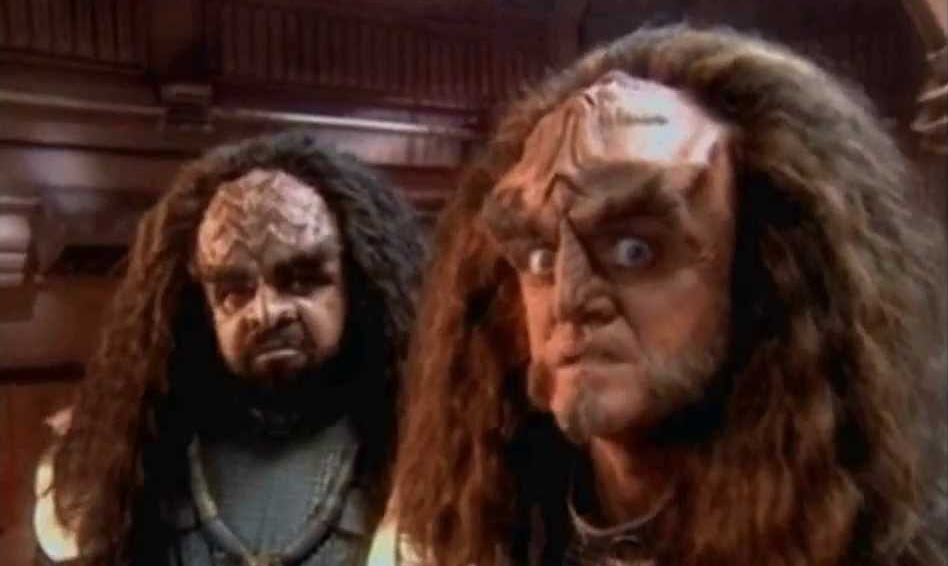
Mogsy: Ah, now I wonder. I may have to go back and scour the book for them on my next reread. Continuing with your academic and teaching background, your author page also talks about your career in cognitive psychology with a focus in psycholinguistics, as well as your research into human memory, language, and behavior. How have your professional experiences influenced your writing and storytelling?
Lawrence M. Schoen: As a rule, most of my fiction includes mention of some cognitive or linguistic process. I’m fascinated by memory and language and that can’t help but leak into everything I write.
To go a bit deeper, if more abstract, I need to tell you about the work I did for my master’s thesis and doctoral dissertation. This involved a theory of semantic flexibility that I developed, basically hypothesizing how we represent changes in meaning in the mind. That’s a great background for appreciating the power of narrative in general and the transformational and creative potential of figurative language in particular. So much of storytelling can be described as the manipulation of meaning. Couple that with an appreciation and understanding of the broader cognitive processes that underlie our use of memory and language, and it completely changes the way you think about writing.
Mogsy: What are your future plans? Do you have any other projects you’re working on currently or coming up soon, either writing or non-writing related?
Lawrence M. Schoen: I want to continue to push myself as a writer. The experience of producing Barsk has been incredible and if I had to do it over again it would be a very different book because I think I’ve grown a lot in the process.
I have quite a few books I’m looking forward to writing, including sequels to Barsk; a new Fantasy series that explains the driving force behind civilization and lets me play with cities across seven thousand years of history; a YA book about the modern day descendants of humans who were removed from Earth and enhanced by aliens back during the Bronze Age; and hopefully the remaining books in the story arc of my near-future xenophilic stage hypnotist and his alien companion animal, because they’re always light and fun. So, basically, I’d like to spend the rest of my days as a novelist.
Mogsy: Very excited to hear about your future projects…especially sequels to Barsk! Lawrence, on behalf of the BiblioSanctum, I would like to thank you again for dropping by and answering my questions! Congratulations on your new book and I definitely look forward to reading more by you in the future. Qapla’!
Lawrence M. Schoen: Thank you so much. And remember, laDlu’meH QaQ DaHjaj!
Lawrence M. Schoen holds a Ph.D. in cognitive psychology and psycholinguistics. He’s also one of the world’s foremost authorities on the Klingon language, and the publisher of a speculative fiction small press, Paper Golem. He’s been a finalist for the John W. Campbell Award, the Hugo Award, and the Nebula Award. Lawrence lives near Philadelphia. You can find him online at LawrenceMSchoen.com and @KlingonGuy.
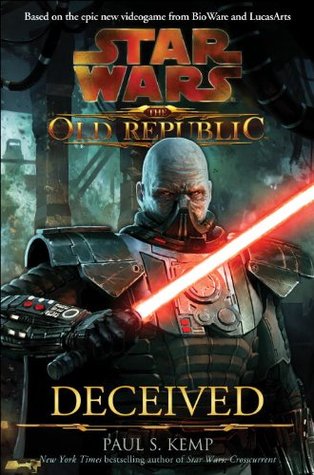
Audiobook Review: Star Wars: The Old Republic: Deceived by Paul S. Kemp
Posted on January 20, 2016 13 Comments
 Genre: Science-Fiction, Gaming, Media Tie-In
Series: Star Wars: The Old Republic #2
Publisher: Del Ray (March 22, 2011)
Author’s Information: Website | Goodreads
Tiara’s Rating: 4 of 5 stars
Narrator: Marc Thompson | Length: 9 hrs and 26 mins | Audiobook Publisher: Random House Audio (March 22, 2011) | Whispersync Ready: Yes
Second book set in the gaming canon for Star Wars: The Old Republic (SWTOR), but not dependent on readers having read the previous entry in this series, Fatal Alliance, to understand what’s going on. I’m going to assume that all the books in the SWTOR series can be read as standalones, especially given their source material and how this is meant to help pad the game lore.
 While peace talks between the Sith and the Jedi take place on Alderaan, a ruthless Darth named Malgus sacks Coruscant, believing it his destiny to raze the planet based on a vision he had when he was younger. He has an insatiable need for chaos and believes understanding of the Force only comes through strife and conflict. The only hint of humanity in him comes from the interactions with his slave and lover, Eleena Daru, who acts a sort of voice of conscience for him. However, after a completed mission, he learns that the Emperor has no intentions of razing the planet, planning to use an important seat within the Republic as a bargaining chip during the talks. Malgus is furious at this revelation.

Credit: Wookieepedia
Attending these peace talks is Aryn Leneer sans her master. Aryn’s Force abilities give her a special empathetic ability to feel the emotions of others, a power that requires her to keep up walls to keep the emotions out. Aryn is more prone to emotion because she can feel emotions so intimately. Calmness is something that she has to work hard at, but she often betrays herself. When her master dies during the attack on Coruscant, an event she felt deeply despite being on Alderaan, Aryn becomes a rogue Jedi intent on confronting the Sith who killed the man she loved as a father, refusing to abide by the Order’s “nonattachment” indoctrination. She turns to a friend, an ex-soldier turned smuggler named Zeerid Korr, for help in completing her goal.
This book was much less heavy handed than Fatal Alliance with making obvious nods toward things in the game, but this story does focus heavily on characters from the game such as Darth Malgus, Eleena, and the female Mandalorian, Shae Vizla. I’d be lying if I said I didn’t chuckle a little when they introduced Lord Baras, a Darth my lighside Sith marauder has a long and storied history with in game. Yeah, you read that right. Lightside Sith, which shamed my husband for a whole mess of reasons. I deal in the incongruous even in my games. Not all her lightside choices have actually been that “good,” and she may have her own motives for going against the grain. She is a Sith after all, but I digress.
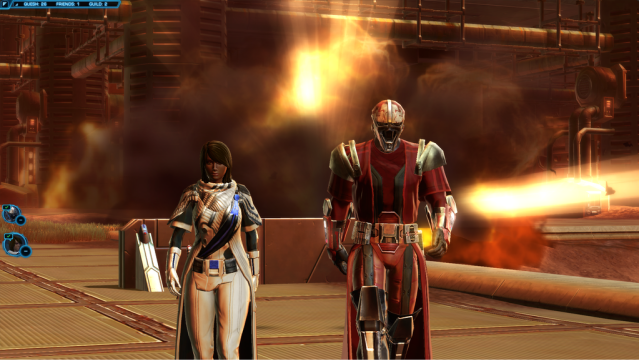
But the husband and I did find common ground in blowing shit up and agreeing we look flawless.
This book took things, even power moves we know from the games, and weaved it in much better than Fatal Alliance. It was fun naming the in-game moves used just by the description in action scenes. Some of the relationships mirror similar relationships in the game that the player’s character can have with their companions. Scenes from the cinematic trailer for the game show up here described in all their glorious details. It was pretty awesome and one of my favorites from the game to date. It was fun to get the blow by blow of one of my favorite fights from the trailer.
However, none of this was done in a way that would alienate readers who haven’t played the game (or those who started the game after that particular cinematic was no longer used to open the game), but it’s a nice nod for those of us who have played.
Aryn and Malgus offered an interesting dichotomy of each other as Aryn rebels against Jedi “nonattachment” and Malgus struggles with his passionate feelings that don’t serve his purpose. Ironically, despite differing beliefs, there is that one moment they can meet in the middle and admit that they’re disillusioned by the respective Orders.

“Jedi nonattachment.”
This conflict with both Aryn and Malgus presented a compelling story, especially where Aryn was concerned. Readers are pretty used to Sith drawing on emotion, especially rage, so it was nice to see this delving into how some Jedi might really feel about this “Jedi nonattachment.” The exploration of Aryn realizing that emotions and emotional attachments were important to her really was fascinating, and while Malgus can come off as typical Sith, his struggles with the softer emotions he feels add a new layer to an old story. In this respect, there’s a bit of a romantic plot/subplot going on in this book that manages not to suffocate the story and adds to Malgus’ conflict with himself and emotions most notably, and I enjoyed this exploration of conflicting emotions in a Sith and a Jedi took center stage rather than trying to quell them. This presents them as human despite vows they’ve taken for their respective orders instead of making it easy for them to overcome emotions that make them “weak” and “vulnerable.”
I think it goes without saying that Marc Thompson did an excellent job with the narration as usual. I won’t rehash all his virtues since I think I pretty much exhausted that in my review of Fatal Alliance. What I really appreciated with this book is that it did better with the background ambiance. Where I sometimes had a hard time hearing Thompson over the din in the last novel, which is a common complaint I have about many full production books even though I enjoy the added touch, I can’t say that I had that issue with this book.
The story had more depth to it, and the action scenes were choreographed well with words. Yeah, this story still has its corny scenarios, cheesy dialogue, and contrived plot points like the last novel, but overall, this was a stronger, better crafted novel than Fatal Alliance.
Story:  | Performance:
  | Overall:
Click here to see more Star Wars related reviews and posts from us!
Waiting on Wednesday 01/20/16
Posted on January 20, 2016 19 Comments

“Waiting On Wednesday” is a weekly meme hosted by Breaking the Spine that lets us feature upcoming releases that we can’t wait to get our hands on!
Mogsy’s Pick:
The Summer Dragon by Todd Lockwood: May 3, 2016 (DAW)
If you read fantasy, chances are you’ve come across the art of Todd Lockwood, whose paintings and illustrations have graced a number of book covers and interiors, like the Memoir by Lady Trent series by Marie Brennan. He’s famous for his beautiful dragons, and now he’s written his own novel about them (and yes, he painted his own cover too)! I’ve always admired the his talent for bringing these majestic creatures to life as an artist; now I’m excited to see what he can do with them in fiction with his debut coming out this spring.
“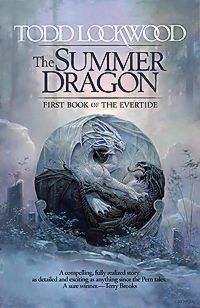 The debut novel from the acclaimed illustrator—a high fantasy adventure featuring dragons and deadly politics.
Maia and her family raise dragons for the political war machine. As she comes of age, she anticipates a dragon of her own to add to the stable of breeding parents. Her peaceful life is shattered when the Summer Dragon—one of the rare and mythical High Dragons—makes an appearance in her quiet valley. Political factions vie for control of the implied message, threatening her aspirations, her aerie, her entire way of life.
The bond between dragons and their riders is deep and life-long, and Maia’s desire for a dragon of her own to train, ride, fly, and love drives her to take a risk that puts her life at stake. She is swept into an adventure that pits her against the deathless Horrors, thralls of the enemy, and a faceless creature drawn from her fear. In her fight to preserve everything she knows and loves, she exposes a conspiracy, unearths an ancient civilization, and challenges her understanding of her world—and of herself.”
Tiara’s Pick
Paper Tigers by Damien Angelica Walters: February 29, 2016 (Dark House Press)
Two words: predatory ghost. *pulls up a chair* Tell me more, book.
 “In this haunting and hypnotizing novel, a young woman loses everything—half of her body, her fiancé, and possibly her unborn child—to a terrible apartment fire. While recovering from the trauma, she discovers a photo album inhabited by a predatory ghost who promises to make her whole again, all while slowly consuming her from the inside out.”
Book Review: The Rogue Retrieval by Dan Koboldt
Posted on January 19, 2016 13 Comments
A review copy was provided by the publisher in exchange for an honest review. All opinions are my own.
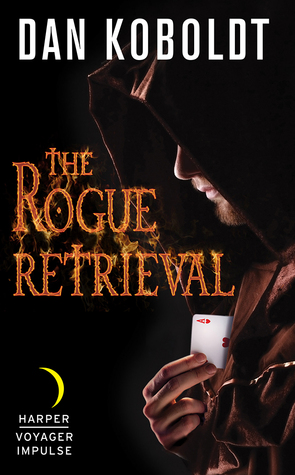 The Rogue Retrieval by Dan Koboldt
Mogsy’s Rating: 3.5 of 5 stars
Genre: Urban Fantasy
Series: Book 1
Publisher: Harper Voyager Impulse (1/19/16)
Length: 384 pages
Author Information: Website | Twitter
This year, I’m resolving to do a much better job at controlling my TBR and a big part of that will involve being a lot more prudent with the books I choose to accept for review, but when I was contacted about The Rogue Retrieval, I knew there was no way I could resist giving it a try. The book’s main character is a Las Vegas stage magician who one day hopes to make it big and headline at a Strip casino! Call me cheesy, but I have a real fascination for illusionists and magic shows. Fantasy is fantasy, but watching a skilled magician at their art is always fun because if nothing else, you can suspend your disbelief and imagine—even if it’s just for a moment—that you’re experiencing something beyond the realm of possibility.
In fact, that explanation might also be analogous to why I love urban fantasy. I love imagining our real world with magic in it. The idea of the contemporary mixed with the paranormal appeals to me, and I also enjoy asking the question, “What if?”
Perhaps that is why I had so much fun with The Rogue Retrieval, because at its core, that’s what this book is—one big “What if?” story. What if a whole other world was discovered, connected to ours via a secret portal? What if everything we think of when we think “fantasy world”—like magic, sorcerers, sword-wielding warriors, etc.—is all a reality in this secret realm? And what if someone, just an average guy from our own world, was tasked to go over there to on a real-life quest?
Though, calling our protagonist “just an average guy” wouldn’t be entirely accurate, because Quinn Bradley is actually an extremely talented and ambitious illusionist. But on his big night, instead of being scouted by one of the big Vegas hotels, representatives from CASE Global, a powerful corporation, make him an offer he can’t refuse. The company has discovered a portal to another world called Alissia, a place where magic is real, and they need Quinn to be as good as the real thing so he and a team can travel there and capture a rogue scientist whose actions threaten to put all of them at risk. However, what CASE has neglected to tell Quinn is that impersonating a magician in Alissia is serious crime with fatal consequences.
What makes The Rogue Retrieval special is that it doesn’t read like your typical urban fantasy. In truth, most of the book actually takes place in Alissia, a world closer to what readers would regard as a “high fantasy” setting. But while Quinn and his companions go through the portal in disguise pretending to be native Alissians, they also carry with them advanced technology and other high-tech gadgetry to help them in their quest. So in essence, you get an interesting mix of traditional fantasy, urban fantasy, and even some science fiction thrown in.
This makes The Rogue Retrieval a very different sort of read, one that might appeal to fans of UF who are looking for something that breathes new life into the genre. At the same time though, it retains a lot of the characteristics that makes UF fun—namely the fast pacing, lots of laugh-out-loud humor, and plenty of thrilling action scenes. For better or worse, it also doesn’t take itself too seriously, forgoing much world-building so that Alissia feels like your very generic fantasy world. The book has a feeling of satire at times, reminiscent of A Connecticut Yankee in King Arthur’s Court, where a present-day person is transported to another world where he is able to fool its inhabitants into thinking he is a bona fide magician with his knowledge of modern technology. Nothing too deep here, but the story is admittedly tons of fun.
That said, there were a few puzzling issues with the plot. I was never entirely convinced why CASE specifically needed a stage magician for the mission, though a big deal was made about an aspect of Quinn’s background and the reasons for that might be revealed in the next book. But on the whole, I was hoping Quinn’s talents would’ve had more relevance to the story. There’s also the prospect of a romance that I’m not sure was really required. By the end of the book, nothing really gets resolved either, and there were a lot more loose ends than I would have liked.
Still, it’s clear we’ve only scratched the surface here, and hopefully the next installment will develop things further and give more answers. A few minor issues notwithstanding, I’m definitely interested in reading the sequel. Dan Koboldt’s new book is an entertaining urban fantasy with a fascinating angle, great if you’re in the mood for something light, fluffy and fun. I’m looking forward to see where the story will go.





Short & Sweet Review: Rose Point by M.C.A. Hogarth
Posted on January 18, 2016 7 Comments
 Rose Point by M.C.A. Hogarth
Series: Her Instruments #2
Publisher: Studio MCAH (October 7, 2013)
Memorable Quote: “Human steel had always trumped faerie magic. Reese set her face and marched in.”
TL; DR Review:

Tiara’s Rating: 4.5 of 5 stars. OMG, I loved this series. Space elves. *cries*
Short & Sweet Review:
I finished this book and the 3rd book in one night. In 2015, I reviewed a book called Earthrise by this author that featured a female protagonist of color named Theresa “Reese” Eddings, a human cargo ship captain that hauled cargo across the galaxy for various employers along with a misfit crew of creatures such as bipedal feline twins, a ninja phoenix, and a science nerd centaur-like creature. In Earthrise, Reese was contacted by a very important client some years after their initial contact to retrieve some very special cargo. Rose Point follows the aftermath of that story as the crew becomes accustomed to having an Eldritch (the reclusive space elves/fairies sort of) aboard their ship, but their Eldritch is starting to have issues with the psi-abilities that are somewhat common among his people. His are starting to manifest in him in unique ways. There’s only one place he can receive help. Home.

Actual Hirianthial
I enjoyed Earthrise a great deal, even with my complaints. With this book, I feel like she toned down the excess on things that didn’t seem as pivotal, such as focusing so much on the twins’ libertine lifestyle, and told more of the story. I love that this is such a role reversal. Even though Hirianthial (the Eldritch) is more than capable, Reese, who can barely fire a gun, often runs off to rescue the “lord in distress,” and she often has to use her own wits rather than physical strength. There’s a wealth of character growth in this story for Reese and Hirianthial as they navigate their feelings for one another and their personal fears/beliefs/wounds as their relationship causes a mutual transformation between them. They make each other better, even if they seem slow to realize it. Reese, who in the beginning of this trilogy fetishized Hirianthial’s people, comes to learn much about them, their troubles, and why Hirianthial left. Hirianthial comes to learn more about species and people who are much more short-lived than his own, groups that show a strength of will and just plain stubbornness when faced with the seemingly impossible–a trait that seems absent in most of his people. AND THAT ENDING. I loved this book so much that I immediately read the next book after this one. I didn’t go to bed until the wee hours of the morning thanks to these books.
Yays!
– Diverse characters including human and non-humanoid races with a protagonist of color
– Slow burn romance that doesn’t overwhelm the story and has just the right amount of tension
– A little bit planetary romance, a little bit space opera, a lot bit good
Nays!
– May seem a bit uncomplicated in execution even when the characters are facing some dire situations
– On that note, things seem to work out a little too well at times in these same situations where you’d expect more pressure and difficulty
– Has some scenes that may be triggering for abuse/rape survivors, but these scenes are not gratuitous, insensitive, or graphic

Other Reviews of This Series: Earthrise
Book Review: City of Blades by Robert Jackson Bennett
Posted on January 18, 2016 23 Comments
A review copy was provided by the publisher in exchange for an honest review. All opinions are my own.
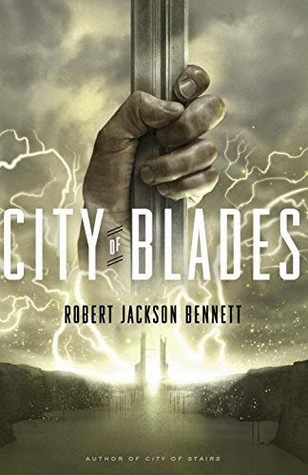

City of Blades by Robert Jackson Bennett
Mogsy’s Rating: 5 of 5 stars
Genre: Fantasy
Series: Book 2 of The Divine Cities
Publisher: Broadway Books (US: 1/26/16); Jo Fletcher (UK: 1/7/16)
Author Information: Website | Twitter
City of Blades is the second novel in Robert Jackson Bennett’s The Divine Cities sequence featuring my favorite character from City of Stairs…and it might surprise you to know it’s not Sigrud! I know the big Dreyling was a fan favorite from the first book, but for me personally, the most intriguing and admirable character has always been and will always be General Turyin Mulaghesh. I was already waiting on pin and needles to get my hands on City of Blades after the amazing time I had with City of Stairs, but my excitement went through the roof after the publisher description came out and I found out that the good general was going to star as the main protagonist.
Anyway, you’ve been duly warned. I promise I will try and make this review more than just a love letter to Mulaghesh. But no promises.
Taking place approximately five years after the first book, City of Blades opens in a tropical paradise where General Turyin Mulaghesh has quietly retreated to after her retirement from the Saypuri army. But thanks to a bureaucratic mishap, she finds herself pulled back into the service of Prime Minister Shara Komayd, who sends her to the ravaged city of Voortyashtan on a covert mission. Once the home of a death goddess and her legions of fearsome warriors, the city has become a stricken ruin after the downfall of its Divinity. Now it is the site of much change but also rising tensions: the construction of a new harbor has caused violence to erupt among the local tribes; the Saypuri military presence is on edge trying to keep the peace; and unknown to all but a few, a seemingly miraculous new type of metal has been discovered in Voortyashtan whose properties may potentially alter the face of the world.
Mulaghesh has been tasked to not only investigate this new ore but also to track down the last ministry agent who traveled to Voortyashtan to poke around only to end up missing. But while the general knows she’s been thrown into a veritable rat’s nest of secrets and lies, her loyalty has always been to Saypur and her fellow troops. Justifiably miffed that she’s been dragged out of her isolation and retirement, Mulaghesh is nonetheless determined to get down to the bottom of this mystery, because deep down in her heart of hearts she is still a true soldier—and a true soldier knows what it means to serve her country and her people.
However, the more she digs, the more dark secrets she unearths about Voortyashtan, and the more unpleasant memories resurface from her violent past. What I love about this book is that there are so many significant revelations about my favorite character, some of which were interesting to discover, and others which may chill your blood. In City of Blades readers get to see a whole different side to Turyin Mulaghesh, one that we never knew existed. At the end of the day, she’s a much deeper and more complex character than even I gave her credit for, but Robert Jackson Bennett also did a great job moderating her development, keeping her genuine and flawed. Mulaghesh is in Voortyashtan to do what needs to be done, but once you peel back the layers you can’t help but think there might also be a part of her seeking some kind of redemption for the atrocities she once committed.
This should come as no surprise, but I liked City of Blades even more than the first book (and I liked City of Stairs plenty, so that’s really saying something). Structurally, I felt this sequel read more like a mystery, with Mulaghesh reluctantly playing the detective/secret agent role—an idea that appealed to me immensely—but thematically I also found the story to be heavier and more profound than its predecessor. There are important moments in this book that touch upon topics like post-traumatic stress disorder, the price of victory, and what it means to be a soldier. Philosophically, it goes deeper in exploring the individual and collective beliefs related to the divine and to the afterlife, and this is also where the author greatly expands upon the world building. Bottom line, Bennett pulls no punches in this one, and City of Blades is bolder and harder hitting in almost every aspect.
Still, for me it all comes back down to General Turyin Mulaghesh. In fact, Bennett does a fantastic job with every single one of his characters, as we’ve seen we’ve seen with Shara and Sigrud from the first book, both of whom make appear in City of Blades again along with a fascinating new cast of supporting characters. But Mulaghesh? Mulaghesh is in a league of her own. She is simply—bar none—the best character I have ever encountered. It’s so rare to find a fantasy novel with a middle-aged woman as the protagonist, rarer still to find one who is also a veteran living with a disability. Not that losing her hand has slowed her down one bit, of course…and she’s liable to punch me in the face for even suggesting that might be the case. To be honest, I can’t remember the last time I’ve felt such appreciation for a character in a fantasy novel, and it’s a true testament to Bennett’s talent for building such a strong, believable and engaging protagonist.
What more can I say? I know it’s only January, but I am already sure this book will end up being one of my favorites of 2016. It was everything I hoped for and more, giving me so many reasons to be happy that I got to revisit The Divine Cities. In a word, City of Blades is perfection. This one gets full five stars and my hearty recommendation.

More on The BiblioSanctum:
Review of City of Stairs (Book 1)


 The BiblioSanctum