Podcast Review: Levar Burton Reads
Posted on August 3, 2017 10 Comments

I credit three people with my love of reading:
- My brother, who gave me a dinosaur book at two-years-old and proudly presented me to family as I recited the names of all the dinosaurs.
- My mom, who not only read to me every night, but also encouraged me to read to her.
- Levar Burton, who introduced me to butterflies in the sky.
It’s no secret that I love Reading Rainbow, growing up with Levar Burton reading to me and introducing me to all sorts of new worlds and adventures. It means the world to me to know that Mr. Burton has continued to promote literacy long after the PBS television series left the air. I threw all the money I could at the Reading Rainbow Kickstarter and was in tears along with Mr. Burton at the response from others who shared my love of his passions and his goal of promoting literacy for every child.
But why should kids have all the fun?
Levar Burton Reads is a new podcast built on a simple concept: Levar Burton reads short stories. For grownups. Many of us grew up with the dulcet tones of his narrations but now, growing up doesn’t mean we have to move aside for the next generation.
As always, the stories are chosen by Mr. Burton himself, spotlighting a particular theme or style that has caught his attention. These particular stories are all of a science fiction lean, which is Mr. Burton’s preference. These are all short stories, the writing of which he rightly identifies as a unique and challenging skill. The ability to encapsulate a whole story with fully developed plot, setting, and characters in so few words is in deed a talent worthy of praise.
I’ve listened to the first three stories so far and love the variation in the themes and styles. A woman who defies the conventions placed upon women to chase her dreams, a boy who hires an alien assassin to protect his sister, and a two-part adventure featuring rogues and wizardry. Each story has its own merit, but Mr. Burton’s narration takes them up several notches. My favourite thus far is the quiet introspection of the deadly alien and his relationship with the young boy in “Kin” by Bruce McAllister.
You can listen through the Apple Listens or Stitcher app, or through the website’s playlist. I did the latter and was initially frustrated because there is no option for speeding up the narration. I normally listen to my audiobooks at 1.5 to 2x speed, but my frustration soon fell away, lulled by Mr. Burton’s eloquent narration and sound effects.
This podcast is sponsored by Audible so you’ll have to endure Mr. Burton promoting the audiobook company before and after the story. Annoyingly, this also occurs halfway through the story. It’s a bit of a jolt, but forgivable. Advertising isn’t the only that that frames the reading. He also talks about the themes the particular story presents and what few him to it and how those themes and characters relate to him personally, adding further depth to the experience.

Waiting on Wednesday 08/02/17
Posted on August 2, 2017 16 Comments

“Waiting On Wednesday” is a weekly meme hosted by Breaking the Spine that lets us feature upcoming releases that we can’t wait to get our hands on!
Mogsy’s Pick
Star Wars: Phasma by Delilah S. Dawson (September 1, 2017 by Del Rey)
For me, Star Wars fever is a chronic disease so you’ll always find me looking forward to the next canon novel release. I’m especially excited about this one though, for a couple of reasons. Captain Phasma is a fascinating character but little is known about her, and her appearances in the new official canon so far have been very brief and few. Even the book’s description is frustratingly vague, so this should be very interesting indeed. Second, I’m a fan of Delilah S. Dawson, and this is her first full-length Star Wars novel. After the great fun I had with her short story Star Wars: The Perfect Weapon, I’m looking forward to reading more of her work in this universe.
 “Discover Captain Phasma’s mysterious history in this Journey to Star Wars: The Last Jedi novel.
One of the most cunning and merciless officers of the First Order, Captain Phasma commands the favor of her superiors, the respect of her peers, and the terror of her enemies. But for all her renown, Phasma remains as virtually unknown as the impassive expression on her gleaming chrome helmet. Now, an adversary is bent on unearthing her mysterious origins—and exposing a secret she guards as zealously and ruthlessly as she serves her masters.”
Tough Traveling: Strongholds
Posted on August 1, 2017 15 Comments
Back in 2014, the idea for Tough Traveling started with Nathan of Fantasy Review Barn who came up with the excellent idea of making a new list each week based on the most common tropes in fantasy, as seen in (and inspired by) The Tough Guide to Fantasyland, a tongue-in-cheek parody of the fantasy genre by Diana Wynn Jones. It was widely successful, with over fifty bloggers participating at one point before it went on hiatus. But now Tough Traveling is back, with huge thanks to Laura from Fantasy Faction for reviving the feature! Every first of the month we’ll be posting a list of books that fit a particular theme, with the next month’s theme also to be announced. Interested in participating? Well, grab your traveling packs and come along! You are welcome to post your Tough Traveling lists anytime during the month.
August’s topic is:
Strongholds
The Tough Guide offers information on various kinds of fantasy strongholds. For example, you might be looking for CASTLES, complete with ‘frowning battlements, slit windows and multiple defensible spiral stairways inside’ and which ‘occasionally adorn the heights for pictorial effect’. Or perhaps TOWERS, which ‘stand alone in WASTE AREAS and almost always belong to wizards.’ Towers are often ‘several storeys high, round, doorless, virtually windowless, and composed of smooth blocks of masonry that make them very hard to climb. The Rule is that there is also a strong no-entry SPELL, often backed up by a guardian DEMON.’
Weisshaupt, Dragon Age
Weisshaupt is the formidable fortress built in -305 Ancient to battle the First Blight. This is the Grey Warden stronghold that BioWare refuses to let players visit, save for in the Fade or in books like The Last Flight. This is where the griffons hung out. I know my Grey Warden from Dragon Age: Origins is all up in there researching how to stop the darkspawn once and for all, but for now, I must content myself with dealing with them damn mages and templars and their pesky dispute.

Indigo Cloud Court, Books of the Raksura
 For Moon, home is where he won’t be mistaken for a Fell and chased away. He finally finds that when he learns that he is a Raksura and becomes consort to the sister queen of the Indigo Cloud Court. Unfortunately, the actual Fell are crafty creatures and they successfully infiltrate the Raksura’s home. Though the Raksura eventually defeat them, their home is destroyed and they must find a new stronghold to call home.
The Death Stars and Starkiller Base, Star Wars
I know it’s a pretty big galaxy, but you’d think someone would have noticed the Empire or the First Order gathering up a whole lotta supplies and building materials to construct not one, but three massive world destroying contraptions. Good thing someone keeps building them with exhaust ports, perfect for sneaking in and blowing up the whole thing, or the good guys keep making friends with janitors who know a thing or two.

1407 Graymalkin Lane, X-Men
The X-Men and their friends and foes have had several strongholds over the years. But nothing is stronger than the place you call home. Okay maybe it’s not that strong, since the Xavier Mansion is a constant target and has been destroyed several times. Maybe the X-Men should consider going Magneto’s route and taking up residence on an asteroid.

Everywhere in The Walking Dead
When the zombie apocalypse hits, you don’t really want to be wandering about in it. It’s important to find a strong base of operations to work with. Rick Grimes and his team are pretty good at finding such places. Unfortunately, there’s always someone around to mess things up. We’d like to blame them walkers, but the truth is, it’s you, Rick. You’re the one who keeps ruining everything. Let’s lead the zombie hord away, he says. Let’s go fight Negan, he says. Please just die and let everyone live in Alexandria in peace?


This week, I’m going to tackle this topic a little differently, focusing on a single type of stronghold — Towers. These tall structures can be places to keep your treasures safe, but they can also be prisons to keep the bad stuff locked up. Sometimes, fantasy characters badly want to get their hands on what’s inside, while other times, they’re desperately trying to break free from its walls. In any case, most towers in Fantasyland are usually considered good strongholds because of how tough it is to get in or out, as some of my examples will illustrate:
 Theft of Swords by Michael J. Sullivan
This omnibus collects the first two books of the Riyria Revelations series, the second of which is Avempartha, a story about our heroes Hadrian and Royce who are thieves hired to break into an ancient, inaccessible elven tower to steal a legendary relic — a sword that is said to be the only weapon capable of slaying a magical beast that has been terrorizing the nearby countryside.

 Red Seas Under Red Skies by Scott Lynch
This second book of the Gentleman Bastard series also features a tower that our thieving protagonists have to try and break into, though this time the target in question is the Sinspire, the largest and most luxurious gambling house on the island city of Tal Verrar. Run by a ruthless man named Requin, the casino has a strict rule that anyone caught cheating would be killed, though this policy has never stopped Locke and Jean. Determined to get at the Sinspire’s riches, the two have hatched up an elaborate plan to con their way up all nine floors to the top of the tower where Requin’s vault is kept.

 Tower of Thorns by Juliet Marillier
My last two examples feature towers holding priceless treasures and wealth that characters want to steal. Some towers though, you simply don’t want anything to do with. In Tower of Thorns, our protagonists Blackthorn nd Grim are approached by a noblewoman, who claims that a howling creature has taken up residence in an old tower on her land. Its mournful calls driving the surrounding populace to depression and madness, and as unpleasant as the idea might be, something must be done about it. However, the tower is inaccessible due to a hedge of thorns surrounding its base, and it soon becomes clear that any means to vanquish the monster would have to be magical.
 The Emperor’s Knife by Mazarkis Williams
Like I said, some towers can also be used as prisons — tough to break in, even harder to break out — and you’ll find an example of one of these in The Emperor’s Knife. One would definitely not want to be a younger male child of the royal family in this book. Following tradition, the Emperor Beyon’s brothers were all killed the day their father died and he took the throne in order to prevent any challengers to his rule. That is, all except Prince Sarmin, who was kept locked up in a tower as a secret backup. You know, just in case.
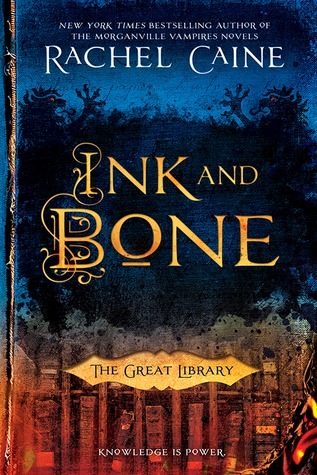
You’ll find another example of a prison tower in Ink and Bone, a tale of alternate history where all books are the property of the Great Library of Alexandria, that powerful bastion of knowledge that never succumbed to destruction in this reality. The scholars of the Library strictly govern the distribution of books to the public, using a complex alchemical process to deliver content to an individual’s personal Codex. Few of their alchemists, called Obscurists, are born every generation, which is they are kept collared and locked up. When Jess’s friend Morgan is found to be an Obscurist, he must stop her from ending up in the Iron Tower, where she would be forced to live for the rest of her life, breeding future alchemists.

Book Review: The Clockwork Dynasty by Daniel H. Wilson
Posted on July 31, 2017 17 Comments
I received a review copy from the publisher. This does not affect the contents of my review and all opinions are my own.
 The Clockwork Dynasty by Daniel H. Wilson
Mogsy’s Rating: 4 of 5 stars
Genre: Science Fiction, Fantasy
Series: Stand Alone
Publisher: Doubleday Books (August 1, 2017)
Length: 320 pages
Author Information: Website | Twitter
When I first heard about A Clockwork Dynasty, I confess I was intrigued. With its mix of steampunk and robotics and history and magic, it sounded like quite a departure from Daniel H. Wilson’s previous novels and I was curious to see how the author would tackle something different.
Well, I’m happy to report that it turned out great. Weaving together the past and present, this story actually works on two levels, alternating between the perspective of a young anthropologist in modern day Oregon and that of a mechanical avtomat resurrected by a Russian machinist the early 1700s. The book opens with a scene featuring young June Stefanov, listening at her beloved grandfather’s knee as he tells her the story of his encounter with a mechanical soldier in World War II. Upon his death a couple years later, he leaves her with a keepsake from that confrontation, a piece of relic that June wears close to her heart even as she grows to adulthood and becomes a leading expert in ancient technologies. The focus of her latest research project is the amazing discovery of a three-hundred-year-old mechanical writing doll, whose secrets June is anxious to unlock before the extraordinary machine can fall into wrong hands.
Meanwhile, between June’s chapters, an even more mysterious narrative is unfolding. Peter Alexeyvich remembers his life beginning in the court of Peter the Great for whom he was named, awakened by the Czar’s loyal mechanician Giacomo Favorini. But in fact, his origins might date back to even more ancient times. Together with his “sister” Elena Petrova, a clockwork girl that he meets in Favorini’s lab, the two mechanical beings spend the next hundred years fleeing their enemies and attempting to fit into society, all the while struggling with nagging existential questions and trying to find out more about themselves.
Unlike Amped or Robopocalypse which are the author’s other novels I have on my shelves, The Clockwork Dynasty is less involved with futuristic technologies and more concerned with history and magic. However, it is clear that his love for writing about intelligent machines is still as strong as ever. Wilson also brings the past to life with careful precision, allowing his readers to experience everything from early 18th century Russia to Victorian-era London. I was surprised to find myself actually favoring the chapters that transported us back in history, following Peter’s harrowing journey to escape the political turmoil that followed his czar’s death in 1725. His character has seen so much in all the centuries, with his chapters always containing something fascinating and new. However, that’s not to say June’s chapters were uninteresting or not as fun to read—good thing too, since the other half of the story is told from her point-of-view. This is where Wilson’s talent for writing action comes in. As June attempts to unravel the mysteries behind the writing doll, she unwittingly stumbles into a world of danger and deception. Before long, we’re being treated to plenty of exhilarating Terminator-style scenes as she becomes the target of a relentless mechanical assassin.
Still, I won’t lie; the constant back-and-forth switching between the past and the present was somewhat distracting, though in all fairness I have never been that good with non-linear storytelling. The format took some getting used to, but thankfully the author made it easier with his excellent characterization and plot development.
My favorite aspect of the story was hands down the relationship between Peter and Elena. Forever trapped in a synthetic body looking like a 12-year-old girl, the character of Elena was very reminiscent of Claudia from Interview with the Vampire, and likewise Peter’s fierce protectiveness of her reminds me very strongly of Louis. Exiles in more ways than one, the two clockwork humans are forced to hide their true nature wherever they go, and Peter must also face the consequences of Elena’s choices as she grows more and more frustrated with the limitations imposed on her because of the outward appearance of her age and sex. Likewise, in the present, June has to overcome her terror and confusion to deal with the threat hunting her, and her eventual alliance with Peter is the impetus that drives the evolution of her character. It was definitely nice to discover more to this book than cheap action and thrills, and beneath the surface is a thread that actually explores deeper issues like the search for purpose and what it means to be human.
If you have enjoyed Daniel H. Wilson’s books in the past, I think it’s a safe bet that you’ll enjoy this one too. The Clockwork Dynasty is, on its surface, two stories in one, but the two narratives are woven so cleverly together that what we have here in the end is a saga worthy of a Hollywood blockbuster, packed with action, intrigue, and heartfelt moments.


Book Review: Where Loyalties Lie by Rob J. Hayes
Posted on July 30, 2017 18 Comments
I received a review copy from the author. This does not affect the contents of my review and all opinions are my own.
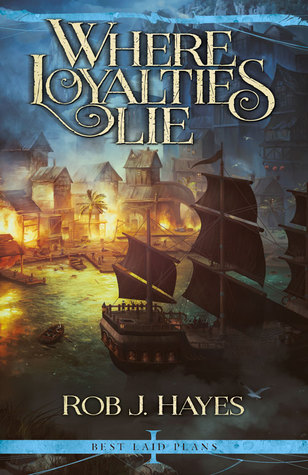 Where Loyalties Lie by Rob J. Hayes
Mogsy’s Rating: 3.5 of 5 stars
Genre: Fantasy
Series: Book 1 of Best Laid Plans
Publisher: Rob J. Hayes (May 24, 2017)
Length: 372 pages
Author Information: Website | Twitter
Grimdark on the high seas! Sweeter words have never been spoken. I’ve always had a taste for maritime fantasy, so when the chance arose to review Where Loyalties Lie, how could I say no? And the fact that it has pirates in it was simply the icing on the cake.
But while I’d never before had the pleasure of reading Rob J. Hayes, I’m familiar enough with his style to know that his pirates would be the real deal—not the watered down, unobjectionably mild sort you usually see catered to general audiences. His protagonist Captain Drake Morass is exemplary of this, being one of the most brutal and bloodthirsty bastards sailing in these fair isles. Needless to say, he’s also not a man who takes too kindly to being hunted. As Drake and his crew stand witness to a pirate town being slaughtered and burned to the ground by naval forces, he realizes that his way of life may be fast coming to an end…unless someone decides to rise up and fight back. Quickly, an idea begins to hatch in his mind. First, he will unite all the pirates. Next, they will form their own little pirate kingdom, where they will be able to govern and defend themselves. And naturally, Drake will be their glorious leader.
However, Drake’s plans are not without their obstacles. For one thing, his reputation as a dastardly pirate precedes him, and getting any of the other captains to sign on to his campaign will be difficult—unless, of course, he can find someone trustworthy to vouch for him. This is where Captain Keelin Stillwater enters the picture. A practical man, Stillwater is not your typical pirate, preferring more civilized resolutions to conflicts over bloody mayhem if at all possible. He is also one hell of a swordsman and holds a certain level of respect among his fellow pirates, so his word would go a long way to legitimizing Drake’s grand scheme. Together, the two of them will also have to come together to face another threat—Tanner Black. As leader of the most feared pirate fleet on the open seas, Black is setting his sights to dethrone Drake Morass even before he can establish his pirate utopia. To complicate matters is also Tanner’s daughter Elaina Black, who has a past with Stillwater. Torn between her feelings for Keelin and her loyalties to her father, she is something of a wild card who will play a significant role in determining the outcome of this epic ocean-faring saga.
Passion, pride, and fierce ambitions come together in this enthralling adventure full of violence and grit. After a slow-burning start, the surprises come at us fast and thick as the plot takes off in the second half, all set against a backdrop of tensions and hostilities. It’s interesting to note that the pirates of this world have their own politics, so with that also comes the mercurial alliances and betrayals, not to mention their own set of rules and piratical codes of conduct. Anything can happen at all, which makes one wonder if Drake Morass might be in way over his head trying to unite this rough bunch of thieves and miscreants, most of whom are only out for themselves.
After all, it’s not easy being a pirate, especially in the world of Hayes’ First Earth. As I mentioned before, Where Loyalties Lie was my first introduction to the author’s distinctive brand of dark fantasy—which I found to be as brutal and visceral as it was reputed to be. If you’ve come for the raging sea battles and bloody ship takeovers, then you’ll be in for a treat. However, be forewarned as well that depictions of murder, torture and rape are frequent, tossed out almost nonchalantly and often described in graphic detail—not in a way that’s intended to be flippant, mind you, but simply because this is the way of this novel’s world. It’s best, therefore, to avoid this one if you don’t think you can stomach these kinds of horrors, for the threat of violence is an everyday reality for the characters, and the story never lets you forget it. This book is grimdark in its purest form, and it is not ashamed to flaunt the fact.
For the genre, the characters are also as you would expect—most of them are capable of doing great evil, with a few who have some admirable qualities. Admittedly, as with a lot of grimdark novels I wish there had been more variety in the personalities, though there were still enough surprises to keep me guessing at their motives and actions. I also didn’t get a good feel for Drake Morass until later in the novel, largely because the slow build-up in the first half, though I’ve also heard that he is a character—albeit a minor one—from Hayes’ The Ties That Bind trilogy and I can’t help but wonder if not having read the previous series might have played into my initial disconnect with him. That said, the good news is that this is merely a minor issue; by the time the story got going, there is no doubt that I became fully engaged with every single one of these characters, especially once all their potential and intentions were revealed.
Bottom line, for fans of grimdark and pirates, Where Loyalties Lie will be like your dream come true, capable of satisfying the most ferocious appetites for gritty, brutal, and violent nautical fantasy. It is a solid first volume, doing a superb job of establishing the series’ colorful characters and themes, and I am looking forward to the next installment.

Mogsy’s Bookshelf Roundup: Stacking the Shelves & Recent Reads
Posted on July 29, 2017 52 Comments
Bookshelf Roundup is a feature I do every other weekend which fills the role of several blog memes, like Stacking the Shelves where I talk about the new books I’ve added to my library or received for review, as well as It’s Monday! What Are You Reading? where I round up what I’ve read since the last update and what I’m planning to read soon. Mostly it also serves as a recap post, so sometimes I’ll throw in stuff like reading challenge progress reports, book lists, and other random bookish thoughts or announcements.

Received for Review
Thank you to the publishers and authors for the following review copies received. For more details and full descriptions of the books, be sure to click the links to their Goodreads pages!

With thanks to Orbit Books for the following new arrivals: The Stone Sky by N.K. Jemisin is the third and final volume of The Broken Earth series which I’ve been enjoying so far, but I think how I feel about this trilogy as a whole will depend highly on how this one turns out. I’m also looking forward to Strange Practice by Vivian Shaw, a fun looking debut featuring a cool mash-up of urban fantasy and classic gothic literature elements. Hoping I can start this soon! And finally I also received an ARC of The Tethered Mage by Melissa Caruso, the first volume of a new epic fantasy series coming out this fall. I’m really curious about this one.

Thanks also to Pyr for sending me this finished copy of A Kiss Before Doomsday by Laurence MacNaughton! In case you haven’t seen my review for the book yet, check it out! From the amazing Tor team, I also received an ARC of Last Chance by Gregg Hurwitz, the sequel to last year’s The Rains. It’s a zombie series with a pretty absurd premise, but the first book was fun so I might give the second a try. And speaking of sequels, Communication Failure by Joe Zieja is the follow up to Mechanical Failure, a comedic sci-fi adventure in space. With thanks to the author and Saga Press for the ARC.

Earlier this month I also received a finished copy of Halls of Law by V.M. Escalada from the kind folks at DAW Books. And late last week, literally just a few days after my request on NetGalley was accepted for Artemis by Andy Weir, I actually received a surprise ARC in the mail! I always love having a physical copy to curl up with though, thanks Crown Books! Finally, you might recall from one of my book hauls last month where I received an unsolicited ARC to the sequel of The Supernaturals by David L. Golemon. I had lamented the fact I haven’t read the first book, but to my joy, the publisher actually came to my rescue and sent me a copy. Big thanks to Thomas Dunne Books!


After a couple months of nothing that interested me, First to Read finally got me to part with my points for Nyxia by Scott Reintgen and Beasts Made of Night by Tochi Onyebuchi, two highly anticipated YA fall releases that I had on my radar. I’ve also been on a mystery-thriller kick lately, which is why I just couldn’t resist when I was sent an invitation to read The Blackbird Season by Kate Moretti. The book’s description sounds amazing and it really piqued my interest. From NetGalley I also requested House of Ash by Hope Cook after learning about it from another blogger, because I’m always on the lookout for good YA Horror. My thanks to all the publishers.
And if you’re a fan of sci-fi and/or audiobooks, then you’ve also probably heard about the breakout hit We Are Legion (We Are Bob) by Dennis E. Taylor. With the third book on the horizon, I was recently offered the full trilogy in ebook format for review. Pretty much everyone I know who has read/listened to this series has been raving about it, so I’m really excited to check it out. With thanks to the Ethan Ellenberg Literary Agency.
In the audio stack: Raid by K.S. Merbeth is a companion novel to the post-apocalyptic canabaliscious thriller Bite that I really enjoyed last year, with thanks to Hachette Audio. Next up, it’s media tie-ins galore, starting with The X-Files: Cold Cases, a full-cast audio-drama from Audible Studios based on the graphic novels by Joe Harris – and yes, David Duchovny and Gillian Anderson as well as many cast members from the original show are involved with the narration!
Then it’s Star Wars time with Battlefront II: Inferno Squad by Christie Golden, a novel that takes place in the aftermath of Rogue One. It also serves as a prequel to the upcoming video game Star Wars: Battlefront II, which I’ll be playing the crap out of come this November, if my experience with the first game is any indication. Last but not least, Minecraft: The Island by Max Brooks is the first official Minecraft novel written by none other than the author who brought us World War Z. This audiobook actually has two editions, one narrated by the funny and talented Jack Black and the other narrated by Samira Wiley of Orange is the New Black fame (I chose the Jack Black version, in case anyone’s curious). My thanks to Random House Audio for feeding my geek.
Reviews
Review roundup time! As you know, I don’t give 5 stars lightly (in fact, I didn’t even have my first 5-star read this year until March), which is why it’s so incredible that these last two weeks saw me post not one, not two, but THREE 5-star reviews. It was tough choosing which book to highlight, but I’m going to have to go with The Punch Escrow, which is currently vying for the top spot in my list of best books read in 2017 so far.
The Punch Escrow by Tal M. Klein (5 of 5 stars)
Badlands by Melissa Lenhardt (5 of 5 stars)
You Die When You Die by Angus Watson (5 of 5 stars)
A Face Like Glass by Francis Hardinge (4.5 of 5 stars)
Lost Boy by Christina Henry (4 of 5 stars)
The Witchwood Crown by Tad Williams (3.5 of 5 stars)
Graveyard Shift by Michael F. Haspil (3.5 of 5 stars)
Skitter by Ezekiel Boone (3 of 5 stars)
Wilders by Brenda Cooper (3 of 5 stars)
Roundup Highlights:

What I’ve Read Since the Last Update
Here’s what I’ve “unstacked” from the TBR since the last update. Reviews for a couple of these are already up, and the rest are coming soon!


Have you heard of or read any of the books featured this week? What caught your eye? Any new discoveries? I hope you found something interesting for a future read! Let me know what you plan on checking out. Until next time, see you next Roundup!
Friday Face-Off: Knife
Posted on July 28, 2017 25 Comments
Welcome to The Friday Face-Off, a weekly meme created by Books by Proxy! Each Friday, we will pit cover against cover while also taking the opportunity to showcase gorgeous artwork and feature some of our favorite book covers. If you want to join the fun, simply choose a book each Friday that fits that week’s predetermined theme, post and compare two or more different covers available for that book, then name your favorite. A list of future weeks’ themes are available at Lynn’s Book Blog.
This week’s theme is:
“The kindest use a knife, because the dead so soon grow cold”
~ a cover featuring a KNIFE
Mogsy’s Pick:
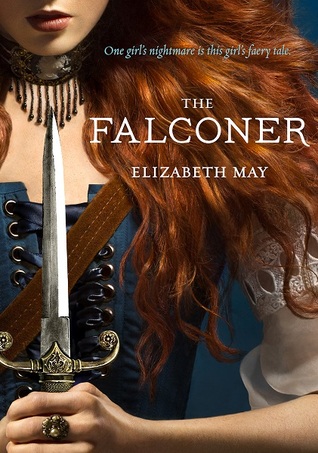
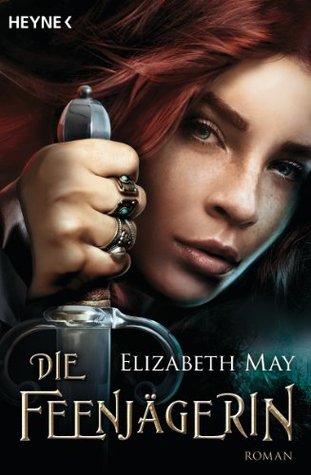
The Falconer by Elizabeth May
Even though I am behind on this trilogy, I loved the first book. And since there are also several editions that fit the theme, I decided The Falconer was the perfect book to feature for my Friday Face-Off post this week. Actually, it’s quite apropos, considering that I was actually first drawn to this book because of its striking cover…
From left to right, top to bottom: UK: Gollancz (2013) – US: Chronicle Books (2014) – German (2015) – Portuguese (2014) – Italian (2014) – Spanish (2014)




Winner:
That’s quite an impressive gallery of knife-wielding redheads, but I think I’m going to have to go with the Gollancz cover as my favorite. Like I said, it was the cover that initially motivated me to find out more about this book, and it was this edition that I ended up winning in a giveaway hosted by the publisher. When the sequel came out, I even made a special trip to the Book Depository so I could get the UK copy of The Vanishing Throne with the matching cover, because I loved the design so much.
What do you think? Which one is your favorite?
Book Review: The Witchwood Crown by Tad Williams
Posted on July 27, 2017 25 Comments
I received a review copy from the publisher. This does not affect the contents of my review and all opinions are my own.
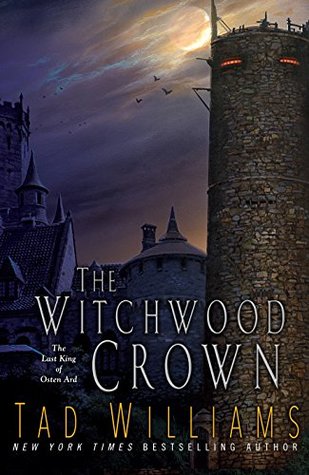 The Witchwood Crown by Tad Williams
Mogsy’s Rating: 3.5 of 5 stars
Genre: Fantasy
Series: Book 1 of The Last King of Osten Ard
Publisher: DAW (June 27, 2017)
Length: 721 pages
Author Information: Website | Twitter
This was a very long, very dense read, but I really don’t mean that in a negative way. Quite the contrary, in fact; it has been a while since I’ve sunk my teeth into an epic fantasy so rich and layered, and it felt incredibly refreshing to fall into a meaty novel like this and just let it consume me completely.
The Witchwood Crown is the start of a new series set in the universe of Tad Williams’ Memory, Sorrow, and Thorn trilogy, though I believe it would serve as a decent jumping on point for readers new to the author and his books. This was my first experience with his work and I found I was able to follow the story quite easily, excepting some initial confusion over the lore of Osten Ard and the different inhabitants that make the continent their home. Thankfully, in a lengthy novel like this, there’s plenty of world-building and no shortage of opportunities to catch up on all this information so it wasn’t long before I felt totally at ease in this new setting.
The story continues the story of King Simon and Queen Miriamele from the previous series, having been married for the last thirty years since the conclusion of Memory, Sorrow, and Thorn. Their grandson Morgan is now the heir apparent, after the death of Simon and Miriamele’s son Prince Josua. With their grief still all too fresh, this causes the aging royal couple to become both overprotective and excessively tough on Morgan, who both yearns for and chafes at the growing responsibilities placed upon his shoulders. Like any young person growing up, he’s trying to find himself but always seems to be getting mixed up into trouble with his rowdy, tavern-hopping friends.
Meanwhile, the realm is in danger once again from a threat long since thought vanquished. The Norns, an immortal elf-like race, are rallying together and preparing for an invasion to reclaim the mortal lands for themselves. After falling into disfavor and becoming a sacrifice, a young half-Norn woman named Nezeru is taken along on a journey to fulfill a mission for their queen, and along the way the group encounters a mysterious warrior named Jarnulf who appears to be much more than he claims to be.
There are a lot of characters involved but I liked how the narrative introduced them all gradually, making it easier to identify the multiple plot threads and determine which perspectives are the important ones. While Simon and Miriamele are characters that I’m only meeting now for the first time, evidently there’s still plenty of growth and development to be had even though they’re both now into their golden years. The two of them are more in love than ever, but the years have also brought certain new life changes and challenges as their priorities have shifted, and most of their disagreements now have to do with their grandson. Speaking of Prince Morgan, he was another important POV character, not to mention one of the more complex and well-written ones. Unlike Simon, who started from humble beginnings as a kitchen scullion, Morgan was born into a royal life and grew up wanting for nothing. In spite of this, he is something of a shiftless and troubled young man who couldn’t be more different than his driven grandfather. And yet there’s something about him that reminds me of a lost and scared little boy, and reading about his self-doubt just makes me want to wrap him up in a big hug.
That said, as a newcomer to this world, I confess it was an interesting experience to be reading the first book of a sequel series, one that I could tell has deep ties to the previous trilogy. While it did not affect my enjoyment overly much, it was at times distracting to be catching little snippets of references to past events and wondering at the full details behind them. The main crux of the story also took a long time to build (for a novel that’s more than 700 pages long, that’s really saying something) and there were rambling sections which I felt could have been trimmed without making too much of an impact on the overall story. Again, this is only my personal opinion as a brand new reader to this world. It’s more than likely that I’m just missing a lot of the nuances, being completely unfamiliar with the events of the previous trilogy, and if you’re an old fan I imagine your experiences will be very different.
At the end of the day though, I think it’s safe to say that no matter who you are, as long as you have a love for rich, multilayered epic fantasy then you will certainly develop a deep appreciation for The Witchwood Crown. It’s a heavy novel, both literally and figuratively, containing robust world-building and character development. Exploring complex themes and conflicts, Tad Williams takes a big-picture look at how several generations deal with problems threatening their kingdom, and while the sheer scope of it can feel a little overwhelming at first, a willingness to invest some time and patience in the story will eventually pay off. I feel like I have a stronger, more confident grasp of the world now, and I look forward to continuing with the next book of the series.
Excerpt and Giveaway: The Ray Electromatic Mysteries Series by Adam Christopher
Posted on July 26, 2017 4 Comments

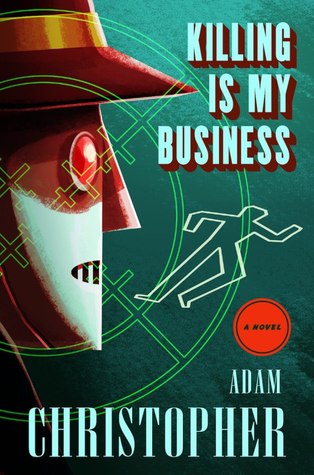 Another golden morning in a seedy town, and a new memory tape and assignment for intrepid PI-turned-hitman―and last robot left in working order―Raymond Electromatic. But his skills may be rustier than he remembered in Killing Is My Business, the latest in Christopher’s robot noir oeuvre, hot on the heels of the acclaimed Made to Kill.
***
ADAM CHRISTOPHER is a novelist and comic writer. In 2010, as an editor, Christopher won a Sir Julius Vogel award, New Zealand’s highest science fiction honor. His debut novel, Empire State, was SciFiNow‘s Book of the Year and a Financial Times Book of the Year for 2012. In 2013, he was nominated for the Sir Julius Vogel award for Best New Talent, with Empire State shortlisted for Best Novel. His other novels include The Age Atomic and The Burning Dark.
Excerpted from Killing Is My Business by Adam Christopher (Tor Books, 2017). Reprinted with permission from the publisher.
1
Listen to this:
Vaughan Delaney was a planner for the city of Los Angeles. He occupied a position high enough up the ladder that entitled him to an office at an equally high altitude in a tall building downtown that was home to a number of other local government desks. The office came with a salary that was high for a city employee but nothing to write a favorite uncle about, and a view that was simply to die for.
Vaughan Delaney was forty-two years old and he liked suits that were a light blue-gray in color. He carried a buckskin briefcase that wasn’t so much battered as nicely worn in. On his head he liked to position a fedora that was several shades darker than his suit. The hat had a brim that looked at first glance to be a little wide for the kind of hat that a city planner would wear, but Vaughan Delaney did not break the rules, neither in his job nor in his private life. He had a position a lot of people envied, along with the life that went along with it, and he stuck rigidly within the boundaries of both.
Actually, that wasn’t quite true. Because the one thing that didn’t fit Vaughan Delaney was his car.
His car was a 1957 Plymouth Fury, a mobile work of art in red and white with enough chrome to blind oncoming traffic on the bright and sunny mornings that were not uncommon in this part of California. The machine had fins like you wouldn’t believe and when the brake lights lit you’d think they were rocket motors. It was the kind of car you could fly to the moon in, only when you got to the moon you’d cast one eye on the fuel gauge and you’d pat the wheel with your kidskin-gloved hand, admiring the fuel economy as you pointed the scarlet hood off somewhere toward Jupiter and pressed the loud pedal.
It was a great car and it was in perfect shape. Factory fresh. It was getting on for ten years old but Vaughan Delaney had looked after it well.
And, I had to admit, that car caught my optics. It wasn’t jealousy—I liked my own car well enough, a Buick that was a satisfying ride, functional and elegant and with a few optional extras you wouldn’t find outside a science laboratory.
No, what I had for the red Plymouth Fury was something else. Admiration, and admiration for Vaughan Delaney too. He was every element the city man but that car was a jackrabbit. Perhaps it was his mid-life crisis. Perhaps he was telling the city to go take a jump while he sat shuffling papers in his nice office with his sensible suit and practical hat. Look what I get to drive to the office in the morning, he said. Look what I get to drive out to lunch every Wednesday. Look what I get to drive home in the evening. It was the kind of car that people would lean out of the office windows to take a look at, and Vaughan Delaney did every bit to help, the way he parked the red-and-white lightning bolt right outside the office door.
Because Vaughan Delaney had reached a certain level within the city hierarchy that allowed him to pick his own secretary based on the color of her hair and the length of her skirt and he was not a man who had to walk very far from his car to his desk.
He was also a family man. When the Plymouth Fury wasn’t outside the office or being driven to lunch on Wednesdays it lived in a two-car garage that sat next to a modest but modern bungalow in Gray Lake. Next to the Fury was commonly parked a yellow vehicle that General Motors had shooed out the door without much of a fuss, a rectangular lozenge on wheels with whitewall tires shining and seat belt tight and the sense of humor removed for safety reasons.
This was not a car to take much of an interest in. It belonged to Vaughan Delaney’s wife. Her name was Cindy Delaney.
Cindy Delaney loved her husband and let him know by kissing him on the cheek each and every morning before her husband went to work. The children loved him too. There were two of those, a boy and a girl, and both of them had blond hair like their mother and they were both a decade shy of joining the army and both of them kissed their father on the cheek each and every morning like their mother did, the only difference being that Vaughan Delaney had to go down on one knee so they could smell his aftershave. Then he blasted off in the Plymouth Fury and the quiet street in Gray Lake was quiet once more until Cindy Delaney took the children to school in the yellow boat and then came back again twenty minutes later. Then she put on a housecoat to keep her dress clean and she drove a vacuum over the bungalow while her husband drove a desk down in the city.
They were a nice family. Middle class, middle income, middle ambition. The children would grow up and the boy would play football at high school with his parents watching and the girl would play flute in the school orchestra with her parents watching and all was right with the world.
I knew all of this because I’d been watching Vaughan Delaney for three weeks. I’d been to the street in Gray Lake and had sat in my car and I’d watched life in and around the bungalow. I’d been to the office building downtown and had sat in my car and watched the Plymouth Fury come in for landing and Vaughan Delaney hop, skip, and jump up the stairs into the building and then waltz down the same steps some eight hours later.
Vaughan Delaney looked like a swell guy with a good job and a nice car and a happy family.
It was just a shame that he had to die.
The Ray Electromatic Mysteries Series Giveaway
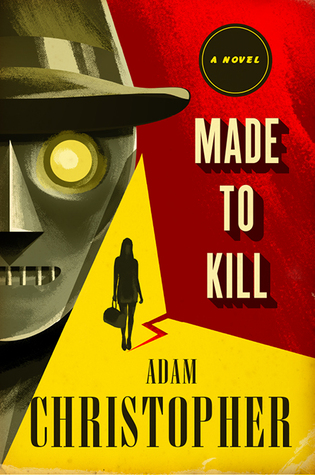
Interested in checking out The Ray Electromatic Mysteries? While Killing Is My Business can be read as a standalone, with our giveaway you won’t have to worry about missing out on the first book because thanks to the awesome folks at Tor we have both novels of the series up for grabs. Two winners will be chosen to win a set which includes one trade paperback copy of Made To Kill and one hardcover copy of Killing Is My Business. The giveaway is open to residents of the US and Canada. To enter all you have to do is send an email to bibliosanctum@gmail.com with your Name and valid Mailing Address using the subject line “RAY ELECTROMATIC” by 11:59pm Eastern time on Wednesday, August 2, 2017.
Only one entry per household, please. The winners will be randomly selected when the giveaway ends and then be notified by email. All information will only be used for the purposes of contacting the winner and sending them their prize. Once the giveaway ends all entry emails will be deleted.
So what are you waiting for? Enter to win! Good luck!
Waiting on Wednesday 07/26/17
Posted on July 26, 2017 15 Comments
“Waiting On Wednesday” is a weekly meme hosted by Breaking the Spine that lets us feature upcoming releases that we can’t wait to get our hands on!
Mogsy’s Pick
The Disappearance of Winter’s Daughter by Michael J. Sullivan (December 1, 2017 by Riyria Enterprises LLC)
Michael J. Sullivan may have have just released the newest novel in his Legends of the Lost Empire series, but that doesn’t mean that’s all we’re going to be seeing from him this year. Come winter, he’ll once again be self-publishing another Royce and Hadrian adventure in the fourth installment of The Riyria Chronicles, which is a series of standalone novels starring this beloved duo.
 “Gabriel Winter’s daughter is dead or captive. He seeks revenge. Now it’s up to Riyria to turn the rivers of Rochelle red.
Desperate for money, the Duke of Rochelle broke with tradition and married Jenny Winter, a wealthy whiskey merchant’s daughter from Colnora. When the unpopular duchess disappears, her father is certain she’s dead by her husband’s hand. Seeking retribution, Gabriel Winter knows just who to hire…the man responsible for waging war with an entire city during Colnora’s Summer of Terror.
Ride once again with Royce and Hadrian as they travel to a mysterious old-world city filled with noble families claiming descent from Imperial aristocracy. Riyria’s job appears easy: Find out what happened to the missing woman, and if she’s alive, bring her safely home; if not, find those responsible and make them pay with their lives. But nothing is ever simple in the crowded, narrow, mist-filled streets of Rochelle, where more than one ancient legend lurks.”
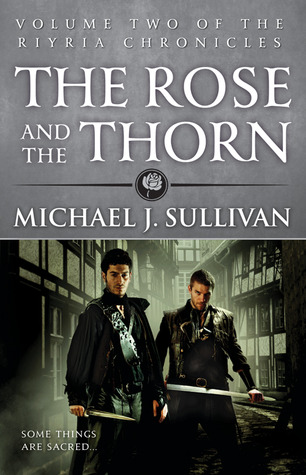
Other books in the Riyria Chronicles sequence (first two published by Orbit):



 The BiblioSanctum