Book Review: Evocation by S.T. Gibson
Posted on June 15, 2024 7 Comments
I received a review copy from the publisher. This does not affect the contents of my review and all opinions are my own.

Mogsy’s Rating: 4 of 5 stars
Genre: Urban Fantasy
Series: Book 1 of The Summoner’s Circle
Publisher: Angry Robot (May 28, 2024)
Length: 301 pages
Author Information: Website
S.T. Gibson whisks readers off to an enigmatic world of the mystical occult in Evocation, and I was so ready to dive headfirst into this gorgeous book! The story takes us down into its tangled web of magic and secrets, focusing on the complex relationships and lives of our three main characters.
In his public life, David is a successful prosecutor, but within the hidden community of the paranormal, he is also known for his unique gift of contacting the spirits. Unfortunately though, he may have tapped into something bigger than he bargained for in his latest séance, uncovering a curse that has been hanging over his family for generations. Enter Rhys, David’s former lover and a talented sorcerer in his own right. However, following their messy breakup, the two men have barely spoken to each other, and things have only gotten worse between them with Rhys’s subsequent marriage to Moira, an astrologist and medium.
But now, facing an insurmountable threat, David is going to have to swallow his pride and reach out to his old friend and his new wife for help. Reluctantly, Rhys and Moira answer the call, meeting David at his family’s opulent estate called Beacon Hill house, where they immediately feel the presence of something oppressive and malignant. Working together with their specialized skills, the three of them embark on an investigation into the dark forces at play. But as they delve deeper into the mysteries of the house, dangerous secrets about David’s ancestry are revealed, leaving them with little time to save his life.
Believe it or not though, it’s the character relationships in Evocation that really take center stage, despite the high stakes plot. From the very first page, the intricate dynamics between David, Rhys, and Moira evolve constantly as they are forced to confront their shared history, leading to moments of deep connection but also lingering resentment. But faced with a common goal, their personal and collective struggles ultimately result in emotional bonding and a better understanding of each other, eventually opening the story up to an exploration of polyamory.
In fact, if I had to pick on one thing about this novel, it would be its handling of this aspect of the characters’ relationships. In particular, the insta-closeness between Moira and David, who were initially at each other’s throats, was a little too sudden and convenient, and I wasn’t entirely convinced of the slapdash magical explanation. I think Gibson also did Moira dirty in some ways. She seemed to serve more as a plot device than a fully realized character, frequently stepping in to be the mediator whenever David and Rhys were bickering like a couple of bratty kids, then being sidelined as a passive and compliant observer when they decided to rekindle their romance with little input from her.
I also would have preferred heavier emphasis on the paranormal elements of the story over the romantic connections, but thankfully the author also breaks ground for plenty of growth in the areas of character development and world-building. Evocation introduces an intriguing and promising glimpse into its world of the arcane, and the city of Boston where it all takes place serves as an ideal setting for a burgeoning paranormal series.
Lately, I feel urban fantasy is a genre practically begging for a kick in the pants, and it looks like S.T. Gibson is here to give one to it! In the end, I have a feeling we’re merely scratching the surface with Evocation, and I’m curious and excited to see where the next book of The Summoner’s Circle will take us.


Audiobook Review: Michael Crichton and James Patterson
Posted on June 11, 2024 10 Comments
I received a review copy from the publisher. This does not affect the contents of my review and all opinions are my own.
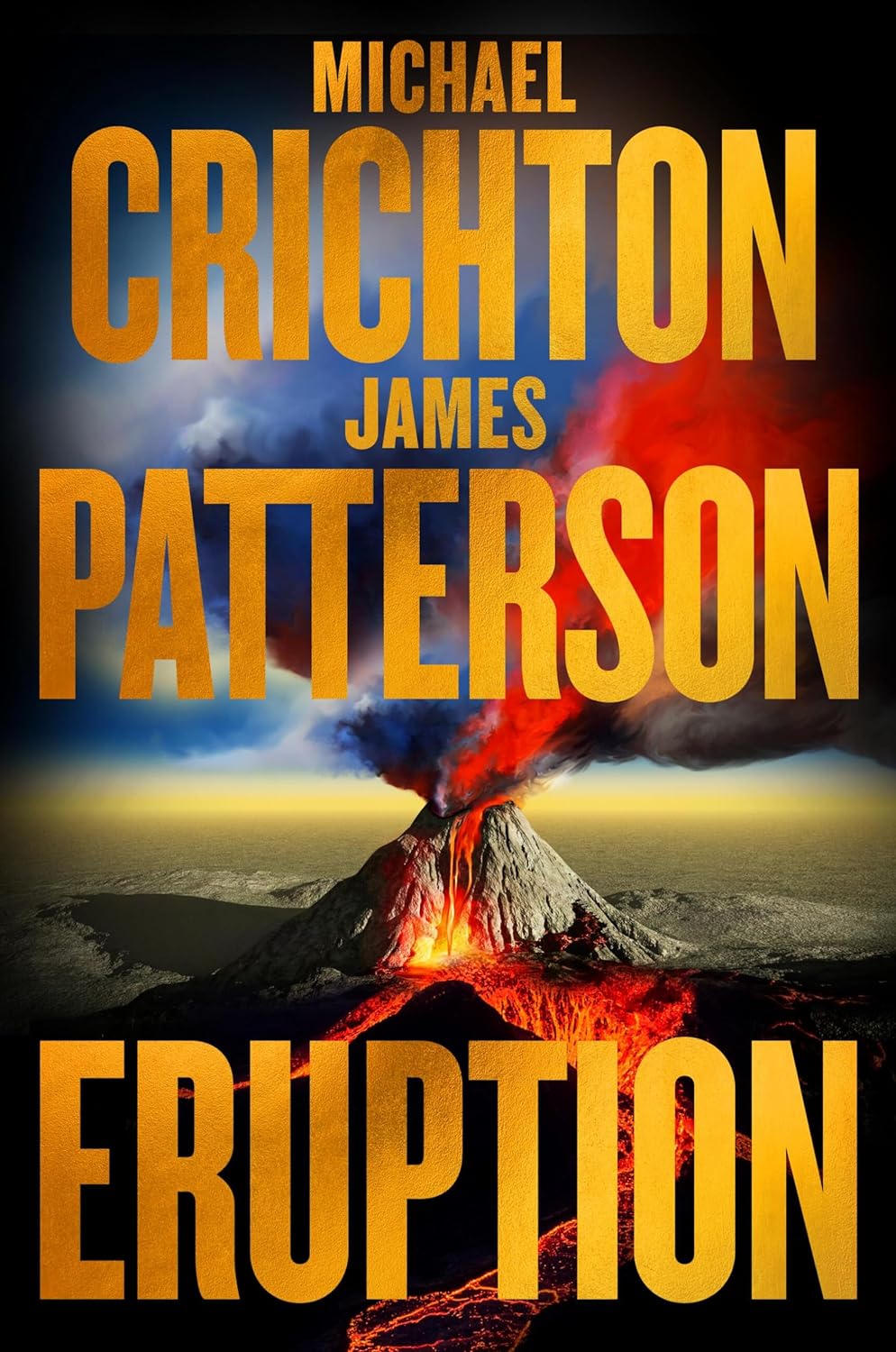 Eruption by Michael Crichton and James Patterson
Mogsy’s Rating: 3 of 5 stars
Genre: Thriller
Series: Stand Alone
Publisher: Hachette Audio (June 3, 2024)
Length: 10 hours 31 minutes
Narrator: Scott Brick
What can I say but Eruption is exactly what you would expect from an unfinished manuscript resurrected from the depths of the late Michael Crichton’s hard drive. Don’t expect the same caliber as his blockbuster novels like Jurassic Park, Sphere, or Timeline (my personal favorite), despite—or perhaps even because of—James Patterson’s collaborative efforts. The science was patchy, plot was a bit slapdash, and pacing was hit-or-miss. That said, I enjoyed it for the popcorn entertainment it provided.
In typical fashion, this thriller starts off with a mystery that leaves the team at the Hilo Botanical Gardens in Hawaii completely bewildered. The garden’s precious banyan trees have inexplicably withered to black seemingly overnight, and the whole place is shut down by the authorities without warning, leaving park biologist Rachel with no answers. Fast-forward about a decade to Mauna Loa, where scientists have set up nearby to study the volcano’s activity. Led by John “Mac” MacGregor, the team has growing concerns about recent ground tremors as well as the steam rising from the caldera. It appears Mauna Loa may be on the verge of eruption, and when it inevitably happens, the impact will be violent and devastating.
But as Mac prepares for worst case scenario, another threat reveals itself. As if the potential disaster caused by the impending eruption of Mauna Loa isn’t bad enough, for decades the military has been storing huge amounts of a radioactive defoliating agent in the underground tunnels of Hawaii. When the colossal volcano blows, the lava flow into these holes would damage the containers holding this poison, releasing it into the world where it would kill all the plants on earth the same way it did those banyan trees in the opening sequence.
So, there you have it. Eruption reads like a natural disaster movie, sort of like Dante’s Peak but set in Hawaii, with an added conspiracy element to raise the stakes. There are some highs, and there are also certainly some lows. There’s the fact that this project has both Crichton and Patterson attached to it, but there’s really no telling where one author’s contribution begins and ends. If I had to hazard a guess though, Crichton is probably responsible for the bulk of the research into volcanoes and geology, while Patterson filled in most of the story and characters. That the distinction is noticeable enough tells you all you need to know about the book’s pacing and flow.
Still, to its credit, the plot was never boring. For better or worse, Eruption was written like it was meant for the big screen. With all the crackling tensions and action galore, you can practically see the CGI and feel the vibrations of digital surround sound rattling around in your mind. This book truly reads like a cinematic experience—and I mean that in a good way. However, on a more negative note, this also comes with some real cringers in the dialogue. No one actually speaks like this outside of a movie script, and likewise many of the characters are the kind of cookie cutter archetypes you meet in action flicks—two dimensional and predictable.
Yet despite these flaws, Eruption manages to stay fun and entertaining. That’s because impossible science, plot, and characters aside, I can deal with a few elements that strain credibility as long as I’m having a good time. Bottom line, even with the names of these two powerhouses on the cover, I can’t objectively call this a great book. But do I think it would make a great movie? Yes.

Book Review: Service Model by Adrian Tchaikovsky
Posted on June 8, 2024 10 Comments
I received a review copy from the publisher. This does not affect the contents of my review and all opinions are my own.
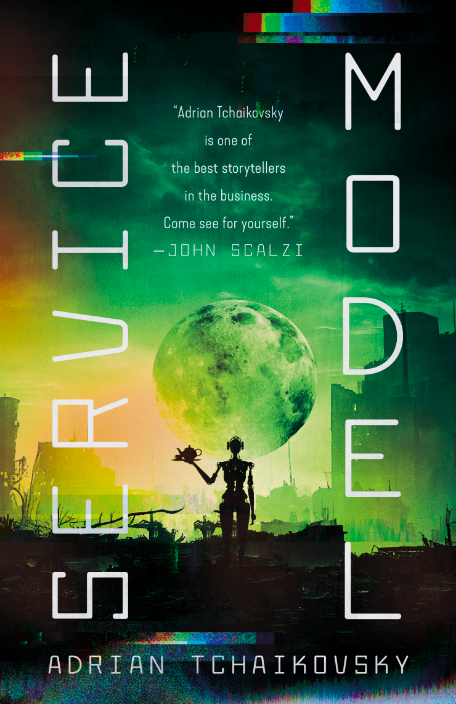 Service Model by Adrian Tchaikovsky
Mogsy’s Rating: 2.5 of 5 stars
Genre: Science Fiction
Series: Stand Alone
Publisher: Tordotcom (June 4, 2024)
Length: 384 pages
Author Information: Website
Unpopular opinion time! Sadly, as thoroughly as I’ve enjoyed Adrian Tchaikovsky’s fantasy novels, I’m afraid I’m just about done with his science fiction. I had high hopes that the humorously described Service Model would be the book to turn things around, but even with so much going for it, I’m personally not feeling the spark.
At the center of this tale is Charles, a robot who was meticulously programmed and designed to serve the aristocrats of the future. As such, his entire existence revolves around being the dutiful valet, completely devoid of emotion because feelings are deemed impractical and therefore pointless. All he needs is the drive to do his work, which he takes great pride in until, one day, Charles commits the ultimate sin for a robot: killing his human master.
But now that the unthinkable has happened, what else might he be capable of? Rebranded as “UnCharles”, our robot protagonist desperately looks to the outside world for a new purpose. He soon encounters a defective robot called The Wonk who becomes his traveling companion. Much to The Wonk’s chagrin, UnCharles harbors no desire to explore his newfound freedom; he simply wishes to find another human in need of his valet services. But as the two robotic travelers soon discover, the world has become a very different place. In the aftermath of a great sweeping apocalypse, it is now a wasteland devoid of much humanity, making UnCharles’ quest a lot more difficult.
To start, I think the central concept of a dystopian society that relies heavily on artificial intelligence and labor is an interesting one, though I’m not sure I’m on board with the execution. The story is neither here nor there in so many ways, starting with the humor hinted at in the blurb but which failed to completely materialize. Occasionally some wit would shine through in the form of satirical elements, but most of the time these felt forced. Then there are the references to literary classics and religion that feel similarly like they’re in a state of limbo—touched upon, but not explored deeply enough to have the philosophical impact the author was clearly going for.
And while I realize UnCharles is supposed to be frustrating by design, I could not get into his character at all. Supposedly incapable of feeling emotion, he nonetheless ponders his existence a lot, though his voice maintains an air of aloofness by keeping the reader at arm’s length. This inconsistency makes his motivations feel murky, resulting in a difficult time empathizing with his struggles or even feeling invested in his journey. Speaking of which, the plot structure presented in five distinct parts ostensibly illustrates the different stages of his trials, but only comes across disjointed, unevenly paced and, at times, even pretentious and a little bit preachy.
All that is to say, Service Model had potential, but it falls short of Adrian Tchaikovsky at his best. The novel’s struggle to find its footing left me wishing it had a more cohesive story and more impactful characters. Despite this, I look forward to the author’s future work but will be more cautious with my expectations.

Book Review: The Honey Witch b Sydney J. Shields
Posted on June 4, 2024 8 Comments
I received a review copy from the publisher. This does not affect the contents of my review and all opinions are my own.
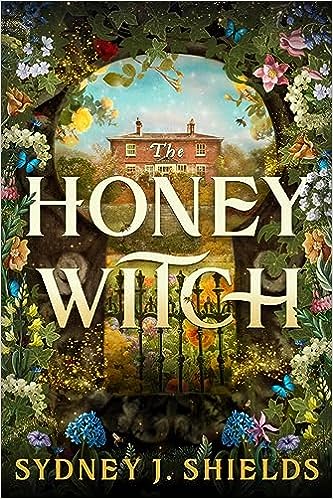 The Honey Witch by Sydney J. Shields
Mogsy’s Rating: 3 of 5 stars
Genre: Fantasy, Romance
Series: Stand Alone
Publisher: Redhook (May 14, 2024)
Length: 368 pages
Author Information: Website
Cozy romantasies are apparently all the rage these days, and The Honey Witch by Sydney J. Shields is the latest offering serving up a sweet tale about a young woman’s impossible choice between love and magic.
Readers are introduced to Marigold, who grew up in Bardshire surrounded by family including her parents, siblings, and a doting grandmother. Ever since she turned twenty-one, Marigold’s mother has been anxious to see her oldest daughter get married and start her own life, but our protagonist has other plans. After seeing the man of her dreams propose to another woman, Marigold wonders if fate holds another path for her—feelings which are confirmed when her grandmother Althea proposes an opportunity. Her home on the isle of Innisfree has always been protected and tended to by a Honey Witch, a role which Althea is getting too old to manage on her own. She is seeking a successor in her granddaughter, and Marigold knows in her heart she is meant to take on the Honey Witch mantle.
The catch? In order to receive the magic, Marigold will also need to accept that she will never fall in love. This curse is the cost of the power, but still stinging from fresh heartbreak, she readily makes the trade, against the wishes of her mother. Choice made, Marigold leaves for Innisfree with Althea, committed to her training which includes caring for the isle’s apiary, creating all kinds of miraculous healing potions with the revitalizing honey the bees make. There, she also meets new friends, August, a boy she knew from her childhood, and Lottie, his adopted sister. Despite Lottie’s initial surliness and adamant disbelief in magic, Marigold immediately feels drawn to the beautiful girl, and in time, the two warm up to each other. With the responsibility of keeping Innisfree safe resting on her shoulders, however, Marigold must resist their shared attraction, knowing that her curse will never let her find happiness.
If you’re looking for a page-turner, this probably isn’t going to be the book for you, nor the genre. That said, if you appreciate slow-burning narratives and a charming blend of romance and fantasy, The Honey Witch is an enchanting tale of generational curses, forbidden love, forever friendships, and self-discovery. Still, despite these interesting themes, the novel’s unhurried nature might try the patience of those accustomed to something more eventful and fast-paced plots.
At times, the story can also feel a little too idealistic, too saccharine, too twee—not to mention predictable and simplistic. But seeing as it’s Marigold’s journey that takes center stage, this straightforwardness might be enough. The Honey Witch explores the clash between the forces of love and the power of self-identity, the choices that one needs to make to be happy. Maybe it really doesn’t have to be more complicated than this, I probably would have enjoyed this book more had it included more meaningful conflict and higher stakes.
If you’re into cozy romance fantasy stories that intertwines love and magic, there are currently plenty of options to choose from, but The Honey Witch is one worth checking out. However, your mileage may vary depending on expectations for plot pacing and complexity. Admittedly, things here are on the slower and more simplistic side, but Marigold’s journey and choices may resonate more if you enjoy a good character study and slow-burn love story.
Novella Review: The Fireborne Blade by Charlotte Bond
Posted on May 30, 2024 8 Comments
I received a review copy from the publisher. This does not affect the contents of my review and all opinions are my own.
 The Fireborne Blade by Charlotte Bond
Mogsy’s Rating: 3.5 of 5 stars
Genre: Fantasy
Series: Book 1 of The Fireborne Blade
Publisher: Tordotcom (May 28, 2024)
Length: 192 pages
Author Information: Website
The Fireborne Blade by Charlotte Bond surprised me with its richness, considering it is a novella of modest length and the fact it delves into the familiar territory of dragon fantasy. That said, there were times I wished the story hadn’t been constrained by the page count because I wanted more, especially from the characters and the ending.
At its heart, the book is a tale about a knight and her quest. Maddileh is one of only a few women in her order, and she’s eager to prove her mettle. To do this, she’s set her sights on recovering a mythical sword called the Fireborne Blade, which now resides in the lair of a powerful dragon known as the White Lady. But Maddileh is not alone, accompanied by her squire Petros, a surly young mage she has reluctantly agreed to take into her service.
Together, they venture underground towards the White Lady’s hoard, finding more than they bargained for in the dark tunnels. But Maddileh is exceptionally stubborn and determined to get what she has come for despite the obstacles in her path. Petros also harbors a dark secret, one he is careful to keep from Maddileh lest it jeopardizes their mission, for he has his own reasons to seek the White Lady and retrieve the Fireborne Blade.
However, it’s the ending—especially its crazy twist—that really elevates this story. Without revealing any spoilers though, it’s also where I felt we could have used a little more attention on character relationships and plot development.
To be fair, the initial buildup was strong, creating an atmosphere of mystery and anticipation by revealing the past alongside the present. While we’re not getting many answers at this point, this obfuscating approach only made me even more intrigued. But once the surprise was revealed, the remainder of the book was a mad rush to the finish—great for momentum, but not so much for sticking the landing.
Ultimately, The Fireborne Blade falters where many novellas have also struggled before: in its brevity. Still, that isn’t necessarily a bad thing, and in this case, knowing that the release of the sequel The Bloodless Princes is only a few months away softens the blow greatly. I confess I’m hooked on the deceptively simple premise, the world building, and the character dynamics that have been established, and I’m looking forward to a fuller exploration of these elements in the next book.

Can’t Spell Treason Without Tea by Rebecca Thorne
Posted on May 26, 2024 9 Comments
I received a review copy from the publisher. This does not affect the contents of my review and all opinions are my own.
 Can’t Spell Treason Without Tea by Rebecca Thorne
Mogsy’s Rating: 3 of 5 stars
Genre: Fantasy, Romance
Series: Book 1 of Tomes & Tea
Publisher: Bramble (May 7, 2024)
Length: 352 pages
Author Information: Website
The indie published Can’t Spell Treason Without Tea caught my attention after its re-release from Bramble, especially once it started drawing frequent comparisons to the cozy slice-of-life fantasy Legends and Lattes.
Blending magic, romance, and a charming bookstore with a tea shop, the story follows two women, Reyna and Kianthe, who come from very different walks of life. Ever since she could remember, Reyna was taught that hard work was the way to achieve her goals. Tireless training eventually led her into the service of the ruthless Queen Tilaine, becoming one of her elite royal guards. At the palace, she meets Kianthe, known as the Arcandor, the title held by the most powerful mage in the land. Against all odds, the two of them fall in love, but must keep their relationship a secret due to their conflicting responsibilities which prevent them from building a future together.
However, in the aftermath of an assassination attempt, Reyna suddenly realizes she’s had enough of life under her cruel and uncaring monarch. Throwing caution to the wind, she and Kianthe escape into the countryside, determined to never look back. An opportunity now lies before them—one they’d never dared to dream before. They are now free to act on their own, to travel the world if they pleased. But Reyna and Kianthe decide to settle in the small town of Tawney perched on the edge of dragon country. There, they set their sights on an old barn which they plan to repurpose into a tea and bookshop where patrons can enjoy a hot brew with a good book. The locals are quick to embrace the idea, making the newcomers feel at home. But while the couple are busy building their dream, the queen’s spies have been busy combing the countryside looking for the Arcandor and her girlfriend the wayward guard.
What we end up with is a close reflection of the novel’s title—a cute and cozy, warm and welcoming, fun and slightly quirky read. It is definitely considered niche—some action is present, but it mostly takes a backseat. Much of the plot revolve around the love story between our two protagonists which unfolds against a backdrop of magic, intrigue and the quiet rhythms of everyday life in a small town. The novel isn’t going to be for everyone, but would be perfect for readers seeking solace in a sweet, whimsical romance rather than high stakes and epic battles.
Admittedly, this isn’t my usual genre, but I don’t mind indulging in a bit of cozy romantasy every now and then. There’s something enchanting and calming about the quiet magic of this book that drew me in. Plus, Reyna and Kianthe’s journey isn’t just about their romance; it’s also about self-discovery, sacrifice and striking the balance between love and duty. Was this an enthralling, can’t-put-it-down read? No, but to her credit, Rebecca Thorne’s writing and storytelling kept me interested even through the slower moving uneventful parts.
Bottom line, I might not have been the target audience for Can’t Spell Treason Without Tea, but it still enjoyed it for its warm and gentle escapism, its dash of comfy romance, and just a sprinkle of tricks and whimsy. I’ll probably need a break before I dive into my next romantasy, but I’ll definitely be penciling time to check out the sequel when it comes out.
Book Review: The Hungry Dark by Jen Williams
Posted on May 21, 2024 10 Comments
I received a review copy from the publisher. This does not affect the contents of my review and all opinions are my own.
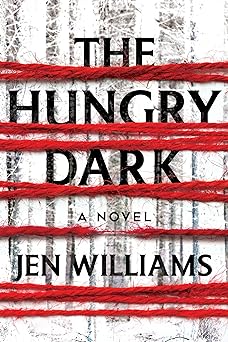 The Hungry Dark by Jen Williams
Mogsy’s Rating: 3.5 of 5 stars
Genre: Mystery, Thriller
Series: Stand Alone
Publisher: Crooked Lane Books (April 9, 2024)
Length: 352 pages
Author Information: Website
Jen Williams is an author who first came to my attention with her fantasy novels, but I have to say I’m thoroughly enjoying her recent foray into horror-tinged crime thrillers. The Hungry Dark is her latest work which once more serves as a testament to her versatility.
The book begins with an introduction to protagonist Ashley Whitelam, not your typical dodgy psychic. Sure, she may be a part of a family of con artists running sham seances, relying on an earpiece and her brother Aidan doing social media research to whisper details in her ear when performing her readings for the audience. But Ashley also has a secret. When she was a young girl, she could see shadowy “people” in the world around her that no one else knew were there. Calling them the Heedful Ones, Ashley learned to keep these visions a secret, especially after a traumatic event altered her family life forever. The ghostly figures stopped appearing, and Ashley kept a low profile in order to play her part in her father’s scams.
Eventually though, Ashley begins to chafe at the role, especially as the schemes become increasingly more questionable and ambitious. To drum up more publicity for their psychic business, Ashley’s father has volunteered her services to the local police, who are investigating a string of brutal killings dubbed the “Gingerbread House” murders due to the fact that all the victims are children found to have been generously fed with delicious treats before their deaths. Nothing was supposed to come out of it; the police were desperate enough and Ashley was simply running through the motions. But on her ride-along with the officers, Ashley catches sight of the Heedful Ones for the first time in years, which leads her to a discovery which blows up the case, landing her in the public eye.
Like it or not, Ashley has now become involved in the murder investigation, attracting both admiration and suspicion. She has also drawn the attention of an American podcaster, Freddie Miller, who tracks her down with an offer to team up on a true crime show about the Gingerbread House murders. As Ashley wrestles with how much she should reveal to Freddie, terrible memories begin to resurface, of an idyllic time spent in the mountains abruptly cut short by a deadly incident.
There is a lot happening here—one could even say too much, which might be this novel’s only drawback. Breaking the plot down into its major parts, we have no less than half a dozen threads to follow. First, we have the main storyline in the present, which focuses on Ashley and her family’s part of an active but tightknit group of charlatans running the psychic grift. Next, we have the Gingerbread House murders and the investigation. Then an element of romance is introduced once Freddie enters the picture. All the while, we also have Ashley’s struggles with her overbearing father, an issue which frequently comes in conflict with her obligation to her family as well as her desire to achieve more independence. Flashbacks are used to fill out her backstory at Red Rigg House, where Ashley spent some time as a child in their underprivileged charity program, which ended in disaster. And then of course, there is the mystery of the Heedful Ones.
Once all these elements are thrown together, the result is a tense thriller full of twists. But in getting there, we encounter some pacing and balance issues. Each thread vies for the reader’s attention, and in the process, we have a few ideas that are left feeling incomplete or underdeveloped. The tension builds, but occasionally, it feels like we’re juggling too many balls at once. For instance, the atmosphere is great, but the setting isn’t quite as immersive as it could be. Similarly, character development falls short of its full potential from the crowded narrative. I loved Ashley’s journey, but her motivations felt elusive at times, and her interactions with family members often had a baffling quality.
Still, I found The Hungry Dark a compulsive and entertaining read—everything I could ever ask for in a thriller. Several times the book’s ambition would cause it to stumble under the weight of its own complexity, but the suspense and intrigue makes up for it. The tensions are palpable, and I loved the blending of mystery, horror, and supernatural elements. If you enjoy dark thrillers, this is a journey worth exploring.
Review: The Silverblood Promise by James Logan
Posted on May 17, 2024 16 Comments
I received a review copy from the publisher. This does not affect the contents of my review and all opinions are my own.
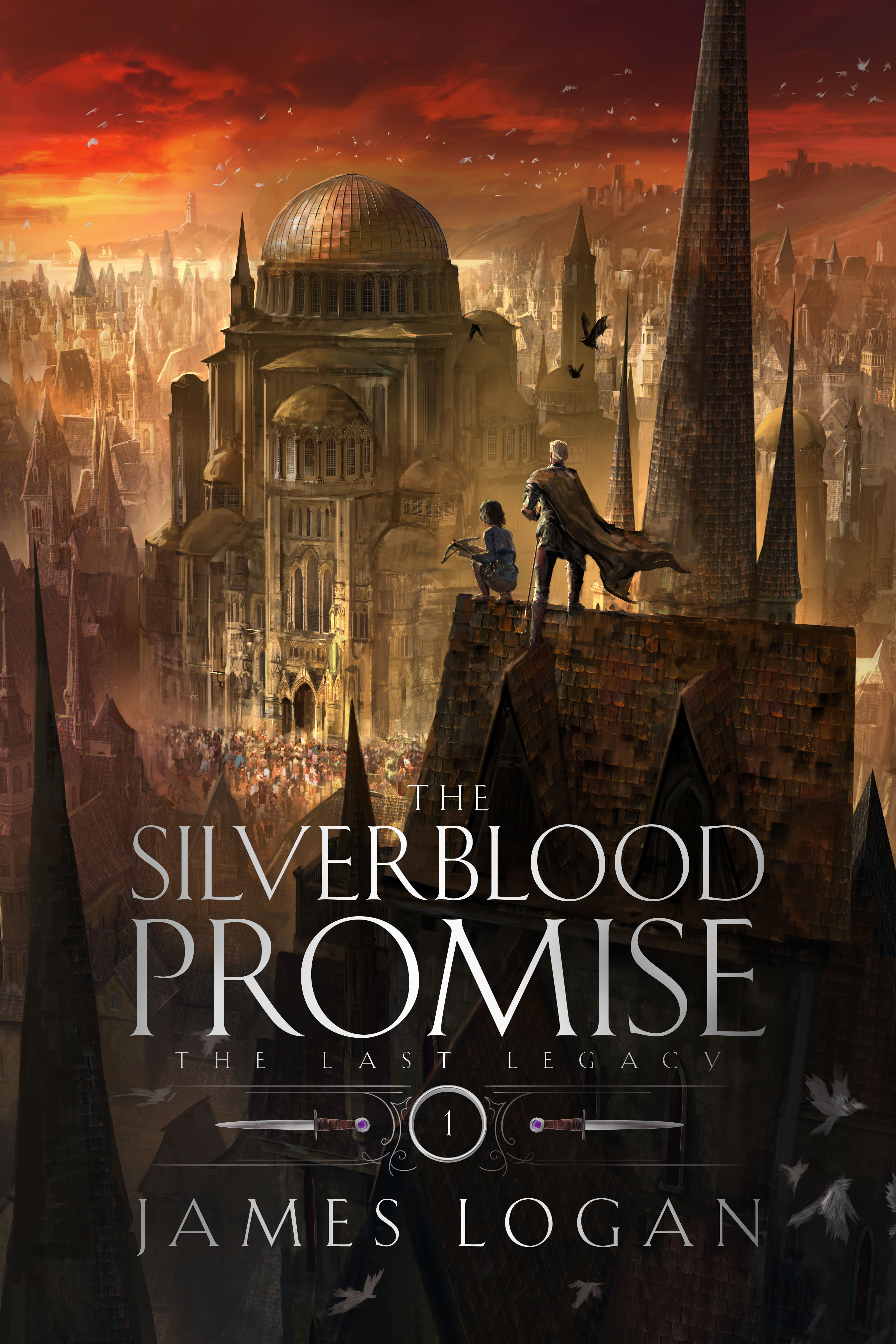 The Silverbood Promise by James Logan
Mogsy’s Rating: 5 of 5 stars
Genre: Fantasy
Series: Book 1 of The Last Legacy
Publisher: Tor (May 7, 2024)
Length: 528 pages
Author Information: Website
I have been on a quest for a new epic fantasy obsession ever since The Empire of the Wolf trilogy by Richard Swan concluded, and it looks like James Logan has kindly stepped in with The Silverblood Promise. I am absolutely amazed!
This debut novel is the opening volume to The Last Legacy series which transports readers to a world of thieves and merchants, nobles and lowlifes. The publisher blurb absolutely does not exaggerate or deceive when it describes this book being perfect for fans of Scott Lynch, Nicholas Eames, and Joe Abercrombie, as I happen to be a cheerleader for all three and felt completely at home in the city of Saphrona where the story takes place. We meet Lukan Gardova, the disgraced scion of a once-prominent noble family. Already beleaguered with financial problems, the Gardovas fell even further from grace with Lukan’s expulsion from the prestigious Academy after he accidentally kills a fellow student in an ill-conceived duel.
The incident led our protagonist down a path of drink and grift, estranged from what family he had left. But when Lukan receives word that his father has been brutally murdered, his life takes on a new purpose. Robbed of his chance at reconciliation, he decides instead to honor his father’s memory by solving the mystery of his death, starting with a cryptic message written in blood. The clue leads Lukan on a journey to a foreign land where he encounters an unlikely ally in Flea, a streetwise young girl who tries to pick his pocket. Together, they are drawn deeper into the web of political and supernatural intrigue as they unravel the secrets of Saphrona.
So many reasons why I loved this book! But it was the writing that pulled me in immediately. Logan’s style is extremely readable and easy on the eyes without sacrificing detail. Rich descriptions and flowing prose meant the pages just flew right by, and much of that also had to do with the snappy pacing which kept the plot driving forward.
My enjoyment was further enhanced by the loveable characters and witty banter. Conversations reveal histories and backstories without overwhelming readers with information, and even at the breakneck speed at which things move, there is always time for in-depth character development and exploration. Lukan is the “perfect imperfect hero”, a roguish scoundrel who’s perhaps a little bit full of himself, but still delightfully endearing. Flea, on the other hand, is his sassy companion, an audacious street urchin whose personality complements Lukan’s seamlessly. It’s a winning dynamic that might be tried and true, but the bond created between them feels genuine and organic, nonetheless.
Finally, there is the world-building. Saphrona comes to life with rich immersion, and although it may not be the most original backdrop with its heavy reliance on familiar genre tropes, the city was still a fascinating place to be, where every detail appeared well thought out and custom crafted. I found myself fully engaged with this captivating blend of magic, intrigue, and danger.
As the groundwork is laid for the next volume, I can’t deny my excitement for more. James Logan has served up an impressive and exhilarating debut in The Silverblood Promise, and there are still so many layers to peel back and discover. I look forward to continuing the series.

Book Review: The House That Horror Built by Christina Henry
Posted on May 15, 2024 13 Comments
received a review copy from the publisher. This does not affect the contents of my review and all opinions are my own.
 The House That Horror Built by Christina Henry
Mogsy’s Rating: 4 of 5 stars
Genre: Horror, Mystery
Series: Stand Alone
Publisher: Berkley (May 14, 2024)
Length: 320 pages
Author Information: Website
Christina Henry’s latest novel, The House That Horror Built, is perhaps her least unconventional in recent years. In spite of this, it worked for me. The story captures the tradition and spirit of the best horror movies, making this one of her more enjoyable books.
Set in Chicago amidst the pandemic, Harry Adams is struggling to get by with her fourteen-year-old son Gabe after all the restaurants closed in the city, taking away her waitressing job. Desperate for work, she applies to be a house cleaner three days a week at Bright Horses, a sprawling estate owned by Javier Castillo, a renowned horror film director. Secretly, Harry is a huge fan of his work, but decides to keep quiet to give the man his privacy. The filmmaker’s life has been plagued with scandal after his only son Michael became the main suspect in a young woman’s murder. However, before an arrest could occur, Michael vanished along with his mother. Abandoned by his family, Castillo chose to live in the mansion in solitude, away from the prying eyes of the media.
At first, the job goes well. Castillo may be a reticent and curt man, but as far as bosses go, he is fair and relatively undemanding. Harry’s primary duties are to keep the house immaculate and to clean his vast collection of horror movie props, which quickly becomes routine. But then, strange things begin to occur, especially surrounding a particular costume piece from Castillo’s most famous film. The costume’s mask seems to watch Harry with empty eyes, and sometimes she thinks she can see it move and hear voices. Afraid to lose her job, she keeps quiet, even though she suspects an otherworldly presence in the house and that her employer may be involved. But when Castillo begins to take an unsettling interest in Gabe, Harry’s protective instinct sets off every alarm system in her brain.
Unlike Henry’s more recent novels like her fairy tale retellings and over-the-top horror, The House That Horror Built feels more down-to-earth and familiar. For one, the setting and the characters’ pandemic reality is something that most of us can relate to—social distancing, financial woes, and emotional strain. In Harry’s case, she is struggling to find a job, pay her rent, and keep her son in school. Her troubles lend the story more authenticity, and while some may find all this a bummer, the rawness appealed to me because it helped ground the novel’s supernatural premise in the everyday.
I also observed how character development here was prioritized over heavy messaging (Good Girls Don’t Die, I’m looking at you). Everything about Harry’s personality from her no-nonsense determination to her resentfulness and mistrust is a product of her past—a strict and religious upbringing—revealed through flashbacks which enrich the narrative. On the other hand, things are a lot less clear when it comes to Javier Castillo. Questions surround the enigmatic director, leading the reader to wonder if there is more to his decision to live alone in a creepy old mansion surrounded by his weird horror movie props.
Last but not least, The House That Horror Built is equal parts horror and mystery, which is what I enjoyed most about the book. But while it may not be a 24/7 fright fest, there is still enough atmospheric tension to keep readers invested, and despite the classic haunted house motif, the plot invites readers to explore the genre beyond cheap thrills and simple scares.
Bottom line, I appreciated the fine balance between setting, character, and plot that I felt was lacking in the author’s last few novels. In The House that Horror Built, Christina Henry has managed to capture the energy behind the fascination for haunted house stories and the horror genre in general, and it’s a passion that feels genuine and fun.


Book Review: Indian Burial Ground by Nick Medina
Posted on May 10, 2024 21 Comments
I received a review copy from the publisher. This does not affect the contents of my review and all opinions are my own.
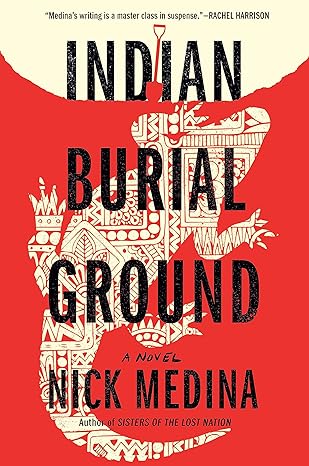 Indian Burial Ground by Nick Medina
Mogsy’s Rating: 4 of 5 stars
Genre: Horror
Series: Stand Alone
Publisher: Berkley (April 16, 2024)
Length: 384 pages
Author Information: Website
Indian Burial Ground is my first book by Nick Medina, but the world of horror fiction is no stranger to his works inspired by Native American history and steeped in folklore and mythology. After hearing amazing things about his debut novel Sisters of the Lost Nation, I just couldn’t pass up the chance to check this one out.
The story unfolds across two distinct timelines. In the present, Noemi Broussard is well on her way to a fresh start with a plan to move away from the reservation where she grew up, following in the footsteps of her uncle Louie who left years before. But just as everything seems to be working out, Noemi is hit with devastating news. Her boyfriend Roddy, with whom she was deeply in love, had apparently committed suicide. But it just didn’t make sense. They had been looking forward to spending their lives together, and Roddy was happy. Wasn’t he? Grief stricken, Noemi is convinced there is more to his death and returns to tribal lands to seek the truth.
After many years away, her uncle Louie has also returned to the reservation, but his reasons for coming back are rooted in the secrets of his past, which are revealed in the second timeline that takes place in the eighties. This thread follows Louie as an adolescent whose mother is struggling with alcoholism and whose aunt is a busy teen mom with a young daughter named Noemi, leaving him to take care of the little girl most days. From his experiences, we learn that sinister and unexplainable events have long been happening to the tribe, eventually resulting in an unsettled Louie leaving the reservation.
Dual timelines can be tricky, but in the right hands, a book employing this technique can be very powerful. In fact, I was initially skeptical that Indian Burial Ground could pull it off, with Noemi and Louie’s storylines tripping all over each other’s feet like awkward dance partners. Roddy’s suicide was an effective and immediate hook, and it was hard not to resent being thrown back into Louie’s past when I was much more interested in Noemi’s investigation in the present. Still, I was glad I stuck it out, because ultimately, it is Louie’s POV that impressed me and truly engaged.
Louie is a man haunted, not only by malignant forces targeting his tribe but also by those tearing his family apart—substance abuse, addiction, poverty—leaving him to hold everything together. Through the teenage Louie’s eyes, the author weaves the indigenous experience into the fabric of this story as his character grapples with demons both internal and external. Meanwhile, Noemi’s tale of heartbreak in the present day is no less poignant, for while her search for answers into Roddy’s death is lighter on the horror and urgency, reading more like a mystery, it still resonates. Through her POV, readers also get to witness the bond between uncle and niece, one forged through loss and hardship but also a shared determination to seek answers and solace.
I found too that I enjoyed Medina’s writing. Although I was mildly put off by the slow and uneven pacing at the start, the more I thought about it, the more this slow-burn approach made sense. Indian Burial Ground is about the characters—Noemi and Louie—and without taking the time explore each of them in depth, this novel would have quickly become overwhelming and disorienting. Despite a few hiccups from the complex narrative structure, in the end Medina managed to achieve a delicate balance in his exploration of the eternal struggle between good and evil.
Expect no easy answers. Indian Burial Ground is a haunting and unsettling work of horror that defies easy categorization, yet its magnetic quality is sure to draw readers into its depths to keep you turning the pages.


 The BiblioSanctum