Waiting on Wednesday 04/10/19
Posted on April 10, 2019 15 Comments

Waiting On Wednesday” is a weekly meme that first originated at Breaking the Spine but has since linked up with “Can’t Wait Wednesday” at Wishful Endings now that the original creator is unable to host it anymore. Either way, this fun feature is a chance to showcase the upcoming releases that we can’t wait to get our hands on!
Mogsy’s Pick
The Night Country by Melissa Albert (January 7, 2020 by Flatiron Books)
Sometimes I feel like I’m in the minority when it comes to Melissa Albert’s debut, The Hazel Wood, but I liked it a lot and I’m glad we’re finally getting more details on its sequel, though it appears it won’t be arriving for a while yet.
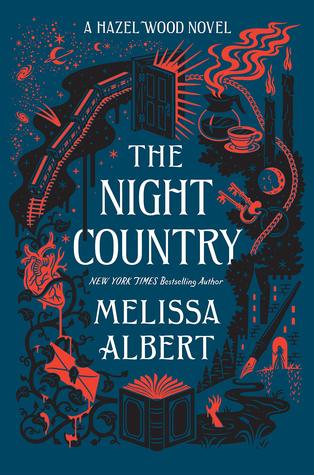 “Can you ever truly escape the Hazel Wood?
In the sequel to her New York Times bestselling, literary/commercial breakout, The Hazel Wood, Melissa Albert dives back into the menacing, mesmerizing world that captivated readers of the first book. Follow Alice Proserpine and Ellery Finch as they come to learn that The Hazel Wood was just the beginning of worlds beyond, “a place where stories and real life convene, where magic contains truth, and the world as it appears false, and where just about anything can happen, particularly in the pages of a good book” (The New York Times).”
Book Review: The True Queen by Zen Cho
Posted on April 9, 2019 18 Comments
I received a review copy from the publisher. This does not affect the contents of my review and all opinions are my own.

Mogsy’s Rating: 3.5 of 5 stars
Genre: Fantasy
Series: Book 2 of Sorcerer Royal
Publisher: Ace Books (March 12, 2019)
Length: 384 pages
Author Information: Website | Twitter
It has been three and a half years since I read Sorcerer to the Crown and I was initially a bit worried about how much I remembered of the story and whether it would impact my experience with this sequel. Happily, when the blurb to The True Queen became available, it appeared that the focus would be on a new set of characters.
Indeed, while a few familiar names from the first book will crop up every now and again, indubitably the stars of the show here are a pair of sisters named Muna and Sakti. The girls’ journey together first began off the coast of the island of Janda Baik, after a storm washed the two of them ashore with no memory of who they were. The powerful witch and protector of the island, Mak Genggang, found them and took them in. Sakti, endowed with magic, immediately came under the witch’s tutelage, although that relationship remained strained. Muna, meanwhile, is magic-less, but has a much more favorable opinion of Mak Genggang.
However, one day Sakti approaches Muna with irrefutable evidence that they have been cursed—in the middle of the former girl’s torso is a void that will keep spreading as she fades away. Desperate, the sisters take it upon themselves to identify who cast the curse, but instead they wind up nearly causing a diplomatic crisis. To smooth things over, Mak Genggang decides to send Sakti and Muna abroad to meet with Prunella Wythe, Britain’s new Sorcerer Royal, who has also opened a magical school for girls. There, they will present themselves as a pair of international students, but also search for more clues as to who cursed them. But unfortunately, the quickest way to their destination is through the dangerous realm of faerie, and while two girls departed Janda Baik, only Muna emerges safely on the other side in London and Sakti is feared lost forever.
Similar to the first book, The True Queen explores the themes of racism and oppression. Apparently, despite the fact it is a woman who currently holds the prestigious office of Sorcerer Royal, attitudes towards women wielding magic have not changed that much since we last visited this world in Sorcerer to the Crown. “Proper ladies” simply did not involve themselves with the thaumaturgical arts, and thus even Prunella, who has come so far since the previous novel with her newfound wealth and status, still has to fight hard to be heard. And of course, this time we also have the perspective of a foreigner newly arrived in Regency-era Britain. Overwhelmed by the strange rigid rules of this hierarchical society, Muna finds herself simultaneously vaunted and condescended to by the upper class, and even those with the best intentions are sometimes guilty of prejudgment or lack of sensitivity.
But in many ways, The True Queen is also a very different book than its predecessor. When it comes to the plot, I don’t know that it captured my attention with the same combination of unique aspects and magical allure as the first book did. Yes, the beginning sections intrigued me with the introduction of the vivid characters of Muna and Sakti and the fascinating story of how they ended up with Mak Genggang, followed by the kerfuffle in the faerie realm which resulted in Muna alone in England meeting with Prunella and the women of the magical school by herself. Likewise, the final chapters were hard to put down because of the drama and suspense surrounding the conclusion. Where I felt the story faltered, however, was everything in between. Pacing was part of the problem, which slowed as we switched tack from worrying about Sakti to focusing on the “fantasy of manners” elements of the world. In fact, one thing that really turned me off was the general lackadaisical attitude towards Sakti’s plight, and I was especially disappointed in Prunella and Henrietta’s dismissiveness and horrible bedside manner in response to Muna’s concerns. It’s also hard not to feel that Muna was the less interesting sister. From the start, it was clear Sakti was the more forceful personality, being more strong-willed and impulsive than her meeker and more pensive sibling. Even though Muna is the at the center of this story, she had a way of being overshadowed by the supporting characters.
Overall, The True Queen was a solid read, even if it didn’t quite reach the heights of Sorcerer to the Crown. Simply put, there were no surprises this time around in that I found many elements of the plot predictable and the central character was probably the least interesting to me. That said, I had a good time catching up with some of the wonderful people I met in the first book and it was a delight to be back in this world.


More on The BiblioSanctum:
Review of Sorcerer to the Crown (Book 1)
Audiobook Review: The Night Visitors by Carol Goodman
Posted on April 8, 2019 28 Comments
I received a review copy from the publisher. This does not affect the contents of my review and all opinions are my own.
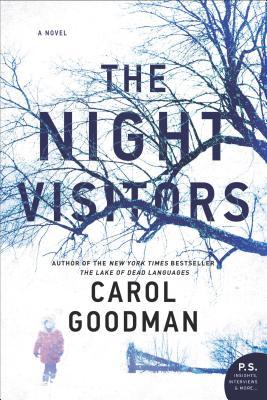 The Night Visitors by Carol Goodman
Mogsy’s Rating (Overall): 2.5 of 5 stars
Genre: Thriller, Suspense
Series: Stand Alone
Publisher: HarperAudio (March 26, 2019)
Length: 8 hrs
Author Information: Website | Twitter
Narrator: Jane Oppenheimer
Every once in a while I’ll take a break from my sci-fi and fantasy and satisfy my craving for a good thriller, so when I saw The Night Visitors by Carol Goodman and took in its synopsis and cover, I thought it would be perfect. You see, I have something of a weakness for snowbound thrillers. And for a while, things were going great and I thought I’d found another gem on my hands. Regrettably though, that was until the second half, when the story’s carefully constructed premise started falling apart with too many absurd twists and coincidences. There’s also a paranormal aspect, which I’m usually all for, except I didn’t feel it worked quite as well here.
The story opens late at night in a bus station, following Alice as she places a frantic phone call to a social services hotline requesting help to get her away from an abusive relationship. Traveling with her is ten-year-old Oren, whom Alice is desperate to protect. She tells the woman on the other end that she needs to go somewhere no one can find her, and receives instructions to go to Delphi, New York, where Alice is assured someone will be meeting her and her boy.
Enter Mattie, a fifty-something social worker whom the hotline calls to do the late-night pickup. With a winter storm rolling in, however, the original plan to bring Alice and Oren to a local shelter had to be abandoned. Instead, Mattie breaks protocol in favor of safety and brings them to her house in the middle of the woods where she lives alone. It is also the house her parents used to own, before they died along with Mattie’s little brother, who was the same age as Oren at the time, to accidental carbon monoxide poisoning. Or that’s what Mattie tells people, anyway. The truth is a lot more complicated, but she doesn’t need anyone digging into her past.
As it turns out though, Mattie’s not the only one keeping secrets. Alice herself is hiding a few of her own, and she hasn’t been entirely truthful to the social worker about what she’s running away from. Lately, she’s also been noticing something strange about Oren. Somehow, he seems to sense or know things before they happen, but as much as it scares her, Alice is reluctant to tell anyone for fear they’ll take the boy away from her.
I’ll give The Night Visitors this—I reviewed the audiobook and it was a quick listen; at no time was my listening bogged down by any lulls or boring bits. That said though, part of the problem was the utter craziness that happens in the second half of the novel, when the plot practically implodes on itself and the author completely drops the ball on the ending. The beginning on the other hand was interesting and suspenseful, slowly teasing the mystery as we alternated between Alice and Mattie’s POVs. As the story unfolded, it became clear that not all was at it seemed. In the end, I don’t know what I expected. Perhaps, with all the characters’ lies being so carefully and methodically revealed, I had thought we would get a more complex and satisfying conclusion. Instead, all that build-up led to very little payoff, with an ending that felt brute-forced and trite.
Also, normally I’d say a bit of paranormal activity spices up a good thriller. Not so much in this case. Again, it was an element that felt awkwardly shoehorned in and doesn’t feel organically connected to the rest of the plot. As well, I found it difficult to get feel enthusiastic about the idea because its implementation came across as lazy and didn’t seem all that well developed. Needless to say, if you’re looking for any answers or clarity, I wouldn’t hold your breath.
Finally, I had a hard time getting into any of the characters. A part of me understands that these kinds of thrillers and unlikeable characters usually go hand in hand, but at the same time, there’s only so much nastiness, ignorance, smugness, virtue signaling or judgmental self-righteousness I can take. That said though, I can appreciate how every character in this book is a flawed and unique individual. As the novel endeavors to point out, there is good and bad in everyone, and sadly, some people who have been hurt and damaged in the past end up going on to hurt and damage others.
Ultimately, this story is about Alice and Mattie both trying to break this vicious cycle by learning to open their hearts to each other—and in the end, that’s a message I can get behind. And quite honestly, The Night Visitors wasn’t all bad. I loved every moment early on as the story was meticulously laying down its foundations, but simply wished the second half hadn’t spiraled out of control the way it did. It’s passable if all you’re looking for is a standard thriller, but I just expected more from its early potential.
Audiobook Comments: Jane Oppenheimer did a perfectly fine job narrating, but the audiobook could have been improved with a second narrator. Not only would it have been less confusing when the story switched between the POVs, I think a narrator who sounded older would have been better suited to read Mattie’s chapters.

YA Weekend: Girls with Sharp Sticks by Suzanne Young
Posted on April 7, 2019 20 Comments

I received a review copy from the publisher. This does not affect the contents of my review and all opinions are my own.
 Girls with Sharp Sticks by Suzanne Young
Mogsy’s Rating: 4 of 5 stars
Genre: Young Adult, Science Fiction, Suspense
Series: Book 1 of Girls with Sharp Sticks
Publisher: Simon Pulse (March 19, 2019)
Length: 400 pages
Author Information: Website | Twitter
From the moment I picked up Girls with Sharp Sticks, I found myself drawn in by its spell and mysteries. Right away we’re thrust into a setting of what is ostensibly a school, except I was seriously weirded out by the major Stepford Wives vibes and surreal attitudes of its students. The young women in this all-girl elite boarding school are all beautiful, poised and well-behaved—unnaturally, painfully so. Their bizarre curriculum includes subjects and activities such as “Growing a Beautiful and Prosperous Garden”, while their report cards employ a scale to measure their level of obedience. The mostly male teaching staff have a creepy tendency to get too handsy and seem all too comfortable in taking advantage of the girls’ eagerness to please, hiding their true intentions behind patronizing smiles and empty warm words.
So, exactly just what the hell is going on at this so-called “Innovations Academy”? The need to find answers was what kept me turning the pages. The plot of Girls with Sharp Sticks follows Philomena (Mena to her friends), who is one of the dozen perfectly proper and physically flawless young ladies in her peer group at the school. The girls rarely get to leave the premises, except for the rare field trip where they are closely chaperoned. On one such outing, however, Mena manages to slip the notice of the academy guardian, chancing to meet a boy named Jackson while buying candy at a gas station. But their moment doesn’t last long before Guardian Bose catches Mena, berating her cruelly before violently dragging her back to the bus. From them on, she begins questioning the ways of the school and the behaviors of her teachers. Then when one of the girls is suddenly taken away for “Impulse Control Therapy”, Mena starts to fear for herself and her friends. What are the little “vitamins” the doctor dispenses to them each night? Why won’t their teachers allow them any interaction with the world outside the school? And why did Jackson look upon her with such confusion and horror when she told him what goes on inside its walls?
Gradually, the truth of Innovations Academy comes out as the story unfolds, in a way that almost sneaks up on you. Of course, the feelings of “wrongness” about Mena’s entire situation are present from the very first page, but they start off subtle—particularly because the reader takes their cues from the protagonist in response to the various scenarios. The genius is in the way Mena is written, and the progression of her character growth as her thinking and attitudes transform over time. She begins this tale as one of the academy’s top students, completely buying into their mission and methods. Instead of feeling frustrated with Mena though, I think this only made her a more likeable character and made it easier to sympathize with her—for even as when she was beating herself up over the gas station incident, I burned with indignation on her behalf, knowing that soon enough she will be looking back on this moment with a whole new perspective.
Indeed, despite the conditioning, Mena is a strong and tenacious girl with a curious streak that cannot be suppressed for long, no matter how hard the academy tries to control her life. It is only a matter of time before her eyes are opened and she realizes that not only are Innovations Academy’s methods unusual, the staff have also been lying to her and her friends about what they’ve been doing at the school. Speaking of which, one of the most notable strengths of this book is the bond between all the girls. While it was Jackson who first “awakens” Mena to the possibility that not all is at it seems, I was glad to see ultimately that his role was limited and that it was she and her friends who worked together to save themselves. At its heart, this story features a strong sense of female friendship and sisterhood, something we honestly don’t get to see enough in YA.
I also loved that Suzanne Young did not shy away from darker or more difficult themes, including physical violence or psychological manipulation and abuse. While this resulted in some distressing moments or scenes that made this book hard to read, the overall mood of eeriness and suspense created was very effective. There’s a dreadful anticipation in knowing that none of the girls are safe, that every time you turn the page is another potential for a bombshell twist that brings bad news for Mena and her friends. But if you feel angry, disturbed, or creeped out at anytime while reading this novel, then that means the author did her job right.
All in all, I had a great time with Girls with Sharp Sticks. I would take a look if you enjoy intense dystopian stories, but personally, what I loved best about this novel was the strong character relationships and reading about how these amazing young ladies banded together to support and protect each other. The ending was a little out of left field but not entirely all that shocking, considering all the other surprises in the plot. Regardless, this novel was absolutely worth the read and I look forward to Suzanne Young’s next installment in the series.

Audiobook Challenge 2019: 1st Quarter Update
Posted on April 6, 2019 16 Comments

Spring is upon us, and with it comes a quarterly update on what I’ve been listening to for the last three months in audiobook format. This time of the year often presents opportunities to enjoy even more audiobooks (not that a reason is ever required) as hours are spent spring cleaning, enjoying the outdoors, and finding ourselves in various other audiobook-friendly situations. Here’s a quick refresher on the challenge details and a look at my progress:
Challenge Details
- Runs January 1, 2019 – December 31, 2019. You can join at any time.
- The goal is to find a new love for audios or to outdo yourself by listening to more audios in 2019 than you did in 2018.
- Books must be in audio format (CD, MP3, etc.)
- ANY genres count.
- Re-reads and crossovers from other reading challenges are allowed.
- You do not have to be a book blogger to participate; you can track your progress on Goodreads, Facebook, LibraryThing, etc.
- If you’re a blogger grab the button and do a quick post about the challenge to help spread the word. If you’re not a blogger you can help by posting on Facebook or Tweeting about the challenge.
- Updates plus a giveaway will be posted twice during the year. The first update will be June 30, 2019, and the last update will take place on December 15, 2019.
Levels
- Newbie (I’ll give it a try) 1-5
- Weekend Warrior (I’m getting the hang of this) 5-10
- Stenographer (can listen while multitasking) 10-15
- Socially Awkward (Don’t talk to me) 15-20
- Binge Listener (Why read when someone can do it for you) 20-30
- My Precious (I had my earbuds surgically implanted) 30+
- Marathoner (Look Ma No Hands) 50+




My current tally sits at 12 audiobooks completed which is better than I thought I would be at this point in the year, but compared to my 2018 progress report for the same time frame last year (in which I completed 15), it would appear I am under-performing! I better step it up, especially if I want to go above and beyond my soft goal of My Precious and go for gold with Marathoner!
Friday Face-Off: Desert
Posted on April 5, 2019 33 Comments
Welcome to The Friday Face-Off, a weekly meme created by Books by Proxy! Each Friday, we will pit cover against cover while also taking the opportunity to showcase gorgeous artwork and feature some of our favorite book covers. If you want to join the fun, simply choose a book each Friday that fits that week’s predetermined theme, post and compare two or more different covers available for that book, then name your favorite. A list of future weeks’ themes are available at Lynn’s Book Blog.
This week’s theme is:
“Nomad is an island.”
~ a cover featuring a DESERT
Mogsy’s Pick:
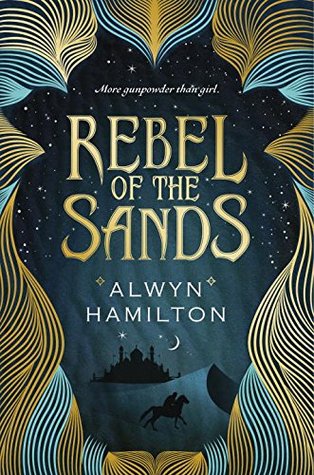
Rebel of the Sands by Alwyn Hamilton
I’ve long been a fan of western-fantasy settings, and Rebel of the Sands takes this one step further by combining it with an Arabian Nights feel, plunging readers into world of harsh sun and sand. Supernatural beings like the Djinn and magical horses fill these pages, as well as mortals endowed with special powers. These cases are explained in a very imaginative way, pulling in elements from legend and mixing them with the author’s own ideas.
But how do the novel’s covers measure up? Let’s take a look at them now:
From left to right, top to bottom:
Viking Books for Young Readers (2016) – Speak (2017)

Polish Edition (2017) – German Edition (2016) – Spanish Edition (2016)


French Edition (2016) – Romanian Edition (2018) – Serbain Edition (2016)


Winner:
There are some great covers for this book, and what really struck me were the subtle differences like the style of the border used in many of them. I find it amazing how that one feature can completely change the look and tone! Hence when choosing my winner this week, I considered everything from the color scheme and layout to the central image and art style, etc. and in the end, the Romanian Edition probably gets my vote for best all-round cover. I love the contrast between its bright border against that deep blue background, and the fact you can clearly see the silhouette of the girl on the horse, unlike some of the other covers. I also like the little touches, like the moon in the starry sky.
But what do you think? Which one is your favorite?
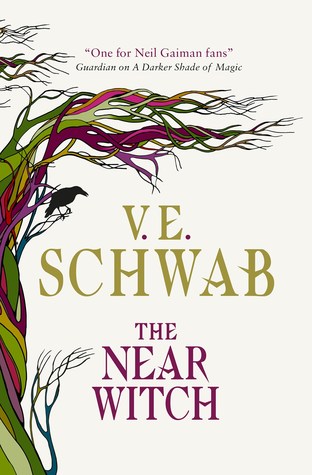
Book Review: The Near Witch by V.E. Schwab
Posted on April 4, 2019 34 Comments
I received a review copy from the publisher. This does not affect the contents of my review and all opinions are my own.
Mogsy’s Rating: 4 of 5 stars
Genre: Fantasy
Series: Book 1 of The Near Witch
Publisher: Titan Books (March 12, 2019)
Length: 354 pages
Author Information: Website | Twitter
When I heard that V.E. Schwab’s long out-of-print debut novel The Near Witch was going to be re-issued, my first thought was, “Oh hell yes, I’d read it!” even with the full understanding that things might be a little rough. Schwab may be an experience writer now, but debuts are debuts—most are like raw, uncut gems, their latent potential waiting to be released. I certainly wasn’t going to judge it by the same standards as I would apply to her later books.
What I didn’t expect, however, was how much I loved this. The prose was plain, the story was simple, but in that straightforwardness was also a refreshing sweetness and charm I haven’t seen a lot from the author’s newer works. In a way, The Near Witch reads very much like a traditional folk tale. Taking place in the sleepy little village of Near, the story follows Lexi, who lives with her mother and little sister Wren. Before her father died, he had taught her that witches are just like anyone else—there are good ones, bad ones, and most just wish to be left alone to their own lives. Unfortunately though, many of the other villagers hold on to more old-fashioned views, mistrusting the two elderly sisters who live on the edge of town. Whispers of witchcraft have long surrounded Magda and Dreska Thorne, but for the most part, the people of Near have tolerated their presence.
However, that was before the children started disappearing, called from their beds by a magical voice in the wind. Suspicions immediately fall upon the Thorne sisters, who are also accused of protecting a mysterious stranger who has just arrived in town. But Lexi has met this stranger, and knows he has nothing to do with the disappearances. Cole, as she called him, is just a youth hardly older than herself, and he has an idea of the real reason behind the missing children. Lexi wants to help him, but her efforts are prevented by her overprotective uncle Otto as well as some of her “friends” like Tyler who think proper girls should know their place and leave the search to the men. What none of them realize is that Near’s legends know no bounds or limits; an ancient force has awakened, and it won’t rest until a wrong has been righted.
As I said, there is nothing complicated about the plot to The Near Witch; in fact, Schwab places more emphasis on the atmosphere than the story or even the characters. But I think this, more than anything, is what gives the book that timeless allure, like a fairy tale or legend you can pick up five, ten, or twenty years from now and still have its setting and mood resonate with readers. This has allowed the novel some lenience, despite having many of the same flaws as typical debuts. For example, Lexi and Cole aren’t particularly well drawn, nor are many of the other townsfolk who read like clichéd archetypes. But because this falls into the expected pattern for a story resembling traditional folklore, a perceived weakness actually ends up becoming a strength.
So although The Near Witch might not be as complex or developed, I nevertheless found it to be more enjoyable than some of the author’s newer books. Its classic themes are familiar and relatable, like those of friendship, love, and redemption. It is also a story about a young woman wanting something more than what society has dictated for her, as well as her determination to show that she can and will succeed where those trying to suppress her have failed. While nothing new is presented here that thousands of Young Adult novels have not already covered, the beauty and pureness of the story’s ideas and emotions come through in their simplicity.
Also included at the end of this book is a heartbreaking little novella called The Ash-Born Boy, intended to be a prequel that reveals Cole’s origins. The fairy tale-like feel is even stronger in this one, given that it is so short, beguiling, and tragically dark. If you enjoyed Cole’s character in The Near Witch, then you’ll no doubt also love this story which adds even more depth to his personality and explores his troubled past.
In sum, there is nothing deep or earth-shattering about The Near Witch, but this magical 2011 debut by V.E. Schwab nonetheless managed to exceed all my expectations for it. Her writing was solid even then, deftly creating the timeless atmosphere and weaving in the folktale vibes I loved so much. All in all, a delightful and enjoyable read—like a nice, sweet treat.
Waiting on Wednesday 04/03/19
Posted on April 3, 2019 22 Comments
Waiting On Wednesday” is a weekly meme that first originated at Breaking the Spine but has since linked up with “Can’t Wait Wednesday” at Wishful Endings now that the original creator is unable to host it anymore. Either way, this fun feature is a chance to showcase the upcoming releases that we can’t wait to get our hands on!
Mogsy’s Pick
Shark Beach by Chris Jameson (May 28, 2019 by St. Martin’s Press)
There were a ton of new cover reveals this week, but you know what I’m most excited about? Killer sharks. Chris Jameson is coming out with his third shark book, and it’s the kind I would push to the top of my TBR just because I can’t get enough of these guilty pleasure reads.
 “A dream getaway is about to turn into a living nightmare. . .
Rick and Corinne Scully and their kids have visited Florida’s Captiva Island many times. This year, they’ve brought along their best friends, who can’t wait to finally experience the place the Scullys call Paradise on Earth.
But this vacation is turning out to be a lot different than planned. The Scullys never expected the rowdy college spring-breakers renting the house next door, or a hurricane that would sweep through the Gulf Coast, or the century-old shipwreck that washed up on the shore. They never knew about the military research being done at a nearby marine institute–and the test subjects that escaped during the hurricane. In the aftermath of the storm, the Scullys and their friends will try to salvage what’s left of their time at the beach. They believe it’s safe to go back in the water. . .but they’re dead wrong.”
Book Review: The Deepest Blue by Sarah Beth Durst + Giveaway
Posted on April 2, 2019 22 Comments
***The giveaway is now over! Thank you to everyone who entered!***
I received a review copy from the publisher. This does not affect the contents of my review and all opinions are my own.
 The Deepest Blue by Sarah Beth Durst
Mogsy’s Rating: 4 of 5 stars
Genre: Fantasy
Series: Tales of Renthia
Publisher: Harper Voyager (March 19, 2019)
Length: 368 pages
Author Information: Website | Twitter
Sarah Beth Durst’s The Queens of Renthia introduced readers to a world where nature and humankind coexist in a state of precarious balance. While life would cease to exist without the presence of the natural spirits, they also see humans as the invaders of their domain and would gladly see us all dead. If not for the protective powers of a Queen who holds control over all the spirits in the area, human settlements would be under constant threat of vicious attacks.
But that trilogy only focused on a very narrow slice of the world—the forests of Aratay, to be exact. And if you were anything like me, you probably also asked yourself the same questions after reading: is it like this everywhere else? And if there are forest spirits, does that mean there are also desert spirits, grassland spirits, ocean spirits?
Some of these answers, in part, can be found in The Deepest Blue, something of a spin-off off the original series. It can be read as a stand-alone, as this time, our focus is on a whole new set of characters. The novel transports us to the crystal blue shores of the island nation of Belene, home to our protagonist Mayara, a young woman about to be wed to her best friend and love of her life, Kelo. Surrounded by friends and family, she can hardly wait for the big day. Her only regret is that her older sister would not be there to witness her happiness, Elorna having perished in an accident eight years ago, while diving for shellfish. The family has never been the same since. Understanding better than most how dangerous the island and its surrounding waters can be, Mayara vows she would never take the love she and Kelo shares for granted, that they would make the most out of their new lives together.
However, that future may be snatched away before it has even begun. On the day of their wedding, a deadly storm sweeps through Belene, destroying homes and taking lives. Such a powerful destructive force could only have been caused by the ocean spirits, and Mayara fears she may be the reason for their sudden attack, for she has been hiding a secret, one known only to a very few. But now that most of Belene is destroyed and so many close to her are dead, she has no choice but to finally reveal it: she has the power to control the spirits. To save those she loves, Mayara must make a difficult choice—sacrifice herself and be sent to a lonely island where others like her tested, or spend a life on the run so that the spirits and their watchers, the Silent Ones, will never find her.
For those who have read The Queen of Blood, The Deepest Blue mirrors it in some ways. Both are about reluctant protagonists who come into their power to control spirits and must compete with other young women to become Queen. But the way things are on the islands is very different from the forests. Mayara finds herself in a fight for life, as only one woman can become Heir while the rest of them must die—a situation that is much bloodier and cutthroat than we are used to. In this sense, the comparisons in the synopsis to The Hunger Games are warranted, in terms of action, violence, and brutality.
Mayara, however, is a very different kind of heroine from a lot of these stories. As the last to arrive on the island, she has also received the least training. Knowing that her chances of survival are low, she decides on another tactic, reaching out to the competition in the hopes of making friends and allies. Consequently, The Deepest Blue became less about a tale of individual survival, instead transforming into one of sisterhood and cooperation against the elements. I was also pleasantly surprised by the inclusion of Kelo’s perspective. I don’t want to elaborate too much on his role for fear of spoiling the plot, but I did like how the romance in this book eschewed conventions by focusing on an already established relationship between a newlywed couple.
There was also more complexity to this story than I expected. Threads of political machinations and mystery are woven throughout, adding more intrigue to the premise. The ways of the islands are fascinating, and I loved that Durst expanded on the magic, spirits, and cultures of her world by taking us to this whole new setting. As much as I enjoyed the original trilogy set in the forests, there’s just something so alluring about Belene and its tropical islands and oceans, and the fact that this is the backdrop to so much vicious scheming and violence simply intensifies the suspense.
All told, The Deepest Blue was a most welcome addition to the world of Queens of Renthia, and I’m also thrilled because this book made me realize I was not quite ready to say goodbye to all the magic yet. Fans of the trilogy will be sure to love this one too, and while I highly recommend starting out with those books first, new readers can also jump right in and enjoy it on its own.

The Deepest Blue Giveaway
And now time for the giveaway! Since I enjoyed The Deepest Blue so much, I want to share the love with a copy I’m putting up for giveaway. With apologies to our international readers, due to the costs of shipping, this giveaway is open to residents of the US only. One winner will receive a hardcover copy of the book. To enter, all you have to do is send an email to bibliosanctum@gmail.com with your Name and valid Mailing Address using the subject line “THE DEEPEST BLUE” by 11:59pm Eastern time on Monday, April 8, 2019.
Only one entry per household, please. The winner will be randomly selected when the giveaway ends and then be notified by email. All information will only be used for the purposes of contacting the winner and sending them their prize. Once the giveaway ends all entry emails will be deleted.
So what are you waiting for? Enter to win! Good luck!
Dreams of the Dark Sky by Tiny LeCount Myers: Excerpt & Legacy of the Heavens Box Giveaway
Posted on April 1, 2019 15 Comments
Inspired by Scandinavian indigenous cultures, DREAMS OF THE DARK SKY takes place during the aftermath of a devastating clash between gods and men, where two unlikely allies—one immortal and one human—must band together to survive.
“My Finnish grandfather told me stories about fighting in World War II,” Myers says. “About hiding in the snowy forests for weeks and how it felt like he’d entered another world. My fascination with this other world hounded me until I began to write this series.”
A few years ago, Tina received a letter from her cousin Björn in Finland: “I am writing to you about your grandparent’s grave,” the letter began. “My father and uncles paid it the last time, but they are gone. Do you have any interest to come to Finland some time? The summer is best on the island as you probably remember. Your picture is on the wall with your grandfather and grandmother.”
Writing the series led Tina on an incredible journey to reconnect with her Finnish family and the land of her mother’s birth. Inspired by her family’s homeland, Tina set The Song of All and DREAMS OF THE DARK SKY in the forbidding fringes of the tundra, where years are marked by seasons of snow, and humans war with immortals in the name of their shared gods.
Dreams of the Dark Sky by Tina LeCount Myers
 In the aftermath of a devastating clash between gods and men, two unlikely allies?one immortal and one human?must band together to survive in the sequel to the epic fantasy debut The Song of All.
The war between men and immortals that raged across the frozen Northland of Davvieana has ended. For men, the balance of power between Believer and Brethren, between honoring the gods and honoring the sword, has shifted to favor priests over Hunters.
But it is the legacy of one man’s love for his son that shapes the lives of all who survived.
While Irjan, the once-legendary immortal hunter, has saved his son’s life, he cannot save Marnej from the men who will make him a killer, nor can he save the immortal girl he’d promised to protect from the secret of her birth.
Raised by Irjan among the immortals, Dárja has been trained to fight by a man who once hunted her kind. Prisoner among the humans, her hatred for them is challenged by the chance to give Irjan what he has always wanted?his son Marnej returned to him.
Together, Marnej and Dárja, human and immortal, must find a way to trust one another if they are to live long enough to learn the truth behind the secrets and lies that have forged their lives.
Excerpt from Dreams of the Dark Sky by Tina LeCount Myers, published by Night Shade Books Books. Copyright © 2019 by Tina LeCount Myers
Dreams of the Dark Sky is the second book of the Legacy of the Heavens.
The first, The Song of All, introduced readers to the worlds of the Jápmemeahttun and the Olmmoš.
First among those created by the gods, the Jápmemeahttun lived in harmony on the fringes of the tundra until their numbers grew so large that they overwhelmed their lands. As they struggled to survive, the gods took pity and gave them a gift. The Jápmemeahttun would live their lives in two halves: the first as female and the second as male, and as one soul prepared to leave the world, another prepared to give birth. The life force of the gods would pass through the old soul into the unborn, giving the baby life and turning the mother’s gender to male in the process. In this way, balance was soon restored to their population.
When the Olmmoš humans walked out of the east with their odd ways and their strange animals, the Jápmemeahttun welcomed them and taught them how to live upon the ice and snow and find light in the endless darkness. But over time, the humans grew wary of their guardians, whose lives seemed to stretch on forever. What started as an affinity between two peoples ended in enmity as the humans rebelled against the authority of those they called the Immortals.
For generations, battles between humans and Immortals raged on, until the Immortal Elders discovered the Song of All. Believed to be a gift from the gods, the Song of All acted as a veil to shield the Immortals from human eyes so the two tribes could live in the same world and never interact. This fragile peace held for almost a hundred seasons of snow, until the Brethren of Hunters began to seek out the reclusive Immortals to regain their wartime power, now challenged by the priestly Order of Believers.
Raised by the Brethren, Irjan had avenged his family, slain by rogue Immortals, by becoming the most skilled among the Hunters. He eventually grew weary of bloodshed, though, and fled to live a peaceful life as a farmer, husband, and father. But when he came upon his wife and infant son moments before they died, Irjan suspected the Brethren. Even as he mourned his wife’s death, Irjan tracked the Immortals deep into the snow-covered forest in the hope that their legendary powers would bring his infant son, Marnej, back to life.
The Jápmemeahttun life bringers Aillun and Djorn had journeyed together to their Origin to give birth. The inherent danger in this sacred ritual was compounded when they heard a human voice within the Song of All. As Aillun started to give birth and Djorn, the ancient warrior, began to die, Irjan ambushed them. Thrusting his infant son into the light emanating from the old Immortal’s body, Irjan brought Marnej back from the dead. But Aillun’s subsequent death left Irjan responsible for Dárja, the infant Immortal she had birthed.
Dávgon, the Brethren leader, dispatched his best hunters to bring back the traitor Irjan to serve the Brethren’s cause or forfeit his life for his earlier betrayal. Irjan, to elude his former comrades, set off for the Northland, where he had once safely traveled. But Irjan’s skills as a Hunter had not prepared him to care for two infants, and he was forced to rely upon the aid of strangers. Drawn into a Brethren trap, Irjan’s life was saved by
Kalek, an Immortal healer who had been heart-pledged to Aillun. Together, Irjan and Kalek protected the infant Dárja, but could not prevent the Brethren from kidnapping Marnej.
Kalek soon learned that Aillun had made Irjan Dárja’s guardian. Torn between his duty to his people and his lost love, Kalek brought Irjan to the Immortal Elders and what he thought was safety. The Elders knew what Irjan had not yet accepted—the human Hunter, in fact, had dual heritage, and possessed the unique ability to enter the Song of All as if he were a Jápmemeahttun. But his arrival among them bound the Elders to choose between protecting their kind from the humans and respecting Irjan’s right to live as one who had both human and Immortal blood. Their compromise to imprison Irjan temporarily staved off discontent.
While imprisoned, Irjan consoled himself with his friendship with Kalek and his responsibility for Dárja. However, he continued to harbor plans to rescue Marnej from the Brethren, who would turn his son into a killer. Irjan escaped at the first opportunity, forcing Kalek to choose between his new friendship and his tribe. Convinced by Irjan that his son’s freedom would serve the Immortals, Kalek fought alongside his friend until he was wounded. When it became clear there was no hope of rescuing his son, Irjan chose to save Kalek’s life, returning with him to the Northland, where he and Dárja were reunited. Irjan spent the next sixteen seasons of snow as a prisoner, teaching Dárja what he knew best—how to fight.
Dávgon, the Brethren leader, aware of Marnej’s Immortal blood and the unique abilities he possessed because of it, used Irjan’s now-grown son to track the Immortals and foment war between the two tribes. When Marnej entered the Song of All, the Immortal Elders realized there was no hope for peace. Dárja, who had grown into a skilled fighter, ardently supported the call to war. However, the revelation that she would never experience a fully Immortal life because of Irjan’s interference in her birth confirmed her fear that Irjan had always loved his son, Marnej, more than her. Determined to prove herself a true Immortal warrior, Dárja secretly joined the warrior ranks to confront the humans, unaware that Irjan had also joined as a last attempt at redemption.
When the Immortal warriors used the Song of All to attack the human soldiers in the Great Valley, Marnej pushed his way into the mêlée, anxious to demonstrate his loyalty to the Brethren. While Dárja fought her way through the human ranks, Irjan gave his life to protect his Immortal comrades when the tide turned against them. Decimated by the human victory in the Great Valley, the remaining Immortal warriors withdrew into the Song of All while Dárja was taken prisoner. At the Brethren’s fortress, Dárja and Marnej confronted their shared past and discovered, to their surprise, the potential of their tenuous future.
Part One
LOST TO THE SONG
CHAPTER ONE
Kalek picked at the meager meal of stewed rabbit and bitter greens. He ate out of habit, out of a healer’s instinct to sustain his body, but, more and more, he wondered why he bothered.
A suppressed giggle broke through the hushed atmosphere in the dining hall. Kalek looked up from his bowl. Two young nieddaš sat with their heads together. One had a hand over her mouth. Her shoulders shook with laughter. The boaris scattered about the dining hall continued to eat. The old showed no interest in the lives of the young.
Once a lively center for sharing meals, the dining hall had become cheerless in the moon cycle since the battle with the Olmmoš. It was impossible to enter a common area and not think of those who had died defending their kind in the last battle. The Jápmemeahttun had believed the power of the Song of All would preserve peace by keeping them safely hidden. But the Olmmoš could not live in peace, and Kalek cursed the day they had walked out of the eastern dawn. He had not been born yet, but he knew the songs from before, when their kind had thrived in balance with the world around them.
Look at us now, he thought. The few Taistelijan warriors who had survived the battle stood out among the nieddaš and the boaris. They were thankful to be alive, but they lived with the heavy burden of guilt. Indeed, it seemed that those who sought out healers, like himself, suffered less from an illness of the body and more from a sickness of the spirit. Increasingly, the old spent more time alone, listening to the Song of All, waiting for their time to end. They seemed to prefer the chorus of the wider world to the melancholy of their own immediate one. Yet, when called upon, they honored their duty as life bringers. They traveled to their Origins without complaint. Old and wise, they must have known that when their spirits left this world, new souls would likely not replace them.
But what alarmed Kalek most was not the pervasive sadness among the old, but the changes wrought among the young. Although the youngest still ran about playing innocent games, the older ones left childhood behind for hard work.
Wood for fires still needed to be chopped. Metal and leather still needed to be wrought. Animals still needed to be butchered. And fields still needed to be plowed. The survival of their kind depended on these tasks, which meant survival depended on the nieddaš, who were now the majority.
The necessary new duties had made many of the older and more capable nieddaš sullen and silent. They exhibited a harshness that had not existed before the battle. Still, when the time came for these nieddaš to return to their Origins and give birth, they struggled, restless and fearful, because what had once been a rite of passage had become, to their minds, a death sentence.
No one wanted to speak about what was happening, but none could ignore the fact that few nieddaš returned from birthing. Once, a nieddaš could expect to be a guide mother in the course of her life. Now she could only hope to be one. Kalek had seen the sidelong glances of those who still had no babe to love and nurture. And they all felt the palpable desperation as the songs of the guide mothers were sung less and less.
Despite his calling as a healer, Kalek found it hard to offer counsel to those nieddaš who came to see him. In their sad faces, he saw Aillun, his beloved first heart-pledge, who had traveled to her Origin what felt like a lifetime ago. Believing she could save them both from sorrow, Aillun had not shared the truth of the quickening within her. At the time, Kalek had told himself his wounded heart justified his harsh last words. But really it was his injured pride that had made him growl like a trapped bear. Later, though, when Aillun failed to return from her Origin, he would learn what real heartache was. He would not be the one to send these innocent nieddaš to their death in the Outside.
“You have pushed your food from one side of your bowl to the other many times, Kalek.”
Startled by the voice, Kalek looked up.
“Lighten your heart and be done with your meal,” Okta said.
Kalek dropped the wooden spoon. He looked deep into the eyes of his mentor. A milky whiteness grew in them now, but the ancient healer’s gaze was still sharp and penetrating. He could not lie to his mentor, his friend.
“What are we doing?” he asked, hopelessness flooding his question.
Okta raised his unruly eyebrows. “We are surviving. As we always have.”
Kalek’s despair turned his gut sour. “To what end, Okta? We are defeated.”
Okta patted his apprentice’s hand. This was by now an old conversation between them.
“Kalek, even in defeat, there can be life.”
The young healer shook his head, his focus on the bowl in front of him. “We are all just waiting to die.”
“It has always been so,” Okta said gently.
Kalek’s head shot up. His pale, feverish eyes bore into Okta just as they had the day of the battle, when Kalek had found Irjan’s body. Nothing in the young healer’s training had prepared him to see his friend and lover broken and bloodied. It did not matter that Irjan was part Olmmoš and had once hunted their kind. He had fought and died like a true Jápmemeahttun warrior. Then, as now, Okta knew that Kalek’s giant frame could bear much, but anguish threatened to crush his soul.
“Fine words meant to play with one’s thoughts,” Kalek said. “They are not an answer.”
Okta nodded his head, allowing the reproach to stand.
The old healer lifted his cup. He wished he could ease his apprentice’s pain. He wanted Kalek to regain his spirit, to see beyond the death of friends and comrades, and the death of those he had loved. Aillun first. Then Irjan. Okta drained his tea, then placed the cup down.
“There are no words I can offer you, Kalek, that will be sufficient,” he said. He stood and gathered his bowl and cup. “I will return to my chambers and then go out to gather herbs.”
The ancient healer did not wait for his apprentice to answer, and Kalek did not try to stop him.
The knock upon the apothecary door stopped Okta at the garden’s threshold. He considered ignoring it, longing to be outside where the rhythm of life pulsed, unchanged and welcoming. But a healer could not ignore someone in need. He backtracked through the crowded room filled with pungent herbs and distilling tinctures. He opened the door, surprised to see the Noaidi.
“Einár! This is unexpected. Are you feeling unwell?”
The Elder shook his head. “May I enter? I wish to speak with you.”
The formality of the Elder’s request placed Okta on guard. While the two shared a friendship that spanned ages, Einár was the head of the Council of Elders and the gods’ Oracle. For the last several seasons of snow they had not agreed on much, but in the vast span of their lifetimes, this was but a small matter.
“I have not seen much of you since our return,” Okta said, standing back to allow the Elder’s hunched frame to enter the apothecary. When did Einár become so thin? So frail? he wondered.
“My time now is mostly spent with the gods,” Einár said with a matter-of-factness that belied the onus of being the Noaidi. “I try to understand their wishes, and our future.”
Okta hesitated. “And . . . what do they say?”
Einár clasped his hands in front of him. The sleeves of his pale-green linen robe fell down across his gnarled knuckles. “They say many things, but I am not here to speak of the gods. I am here to speak to you of Dárja.”
Okta winced. The name cut him like a knife. His hand rose to his chest where the weight of responsibility rested heavy and immutable.
He was to blame for what had come to pass, at least in part. He had been angry and callous when he had last spoken to Dárja. He had told her she would always be a nieddaš. That she would never be a mother. Never be an almai. Never be a warrior. He had been blunt and brutal, and he had immediately regretted it.
Despite all his training as a healer, Okta had not understood what it meant to live a singular life. His had been a Jápmemeahttun life. He had been a nieddaš. He had given birth. He had handed his child to her guide mother, then embraced his life as an almai. When asked, he had become a warrior. He had experienced it all, as his kind was meant to. But Dárja was unique, and Okta had failed her. They had all failed her.
“I have heard her song,” Einár said.
The calm pronouncement set Okta back on his heels. He braced himself on the edge of his scarred work table. Disbelief clouded his thoughts, but his heart pounded.
Dárja had disappeared the day the Taistelijan had marched to battle. He did not doubt she had wanted to prove herself worthy to be a warrior. To prove him wrong. And he was wrong. He was wrong to keep his doubts about her future to himself for as long as he had. He could have helped her. They all could have helped her. But the truth remained hidden for too long, too painful to relive.
Okta met the Elder’s gaze. “She is alive, then?”
“Yes. I have heard her song.”
Okta’s elation made him eager to tell Kalek. The news would give the young almai the encouragement he needed. It would light the way back from the darkness that had consumed him.
Einár raised a hand to caution Okta. “There is more. I have also heard the song of Irjan’s son.”
Whatever hope had welled within in the ancient healer was dashed. “Marnej,” he muttered, remembering Irjan’s son, whose very existence had threatened what little peace remained to their kind. Silently, he blamed the boy, So much life lost. So many lives changed. And Marnej at the root of it all.
“I do not know what this means,” the Elder continued, “but I leave you to make the choices you feel you must.” He paused, then added, “The way you have always done.”
Okta staggered back at the impact of this judgment. He glanced at Einár, expecting to see condemnation. Deep folds shaded the Elder’s weary eyes. Okta’s shame bloomed hot. He had just quietly denounced the Olmmoš boy when he should have castigated himself. Blame rested with him, not Irjan’s son. Okta plopped down on the bench beside his work table. He was too old and he had seen too much to deny his attempt at playing a god. When Irjan had entered their lives, Okta had been adamant that, as half-Jápmemeahttun, Irjan deserved to live. But there was a part of him that now wondered if their kind might have been spared the recent tragedies had he just let the Taistelijan warriors track and kill Irjan in the very beginning.
“You have always listened to your heart, Okta,” Einár said. “Sometimes for the betterment of us all, and sometimes to our detriment. But we are so few now.” The Elder paused as if he chose his next words with care. “I am compelled to caution you. The actions of one will impact us all.”
Okta nodded.
The Elder withdrew from the apothecary, closing the door behind him. Okta sat, taking stock of the news. The knowledge that Dárja lived was both a profound joy and a subtle agony. Selfishly, he wanted to see her determined young face peer around his door again, if only to exonerate him for his part in her misery. But if that came to pass, he would once again have to cause her heartbreak. He would have to tell her of Irjan’s death on the battlefield.
Young. Headstrong. She will only see her part in it, Okta thought woefully.
He could not say Dárja had been wrong to blame Irjan for what had happened. Irjan’s actions had altered the course of all their lives. In trying to bring his son, Marnej, back from the gods’ embrace, Irjan had doomed the life bringers, Aillun and Djorn. The life force created by a boaris at death was meant to help the nieddaš give birth to her child and then allow her to transform to almai. Djorn did not have the power to sustain life for more than two souls. Marnej had been reborn, but Aillun died. And Dárja had been denied the life force she needed to mature fully as one of their kind.
When Irjan had pleaded to join the warriors leaving to fight the Olmmoš, Okta had recognized a man desperate for some kind of redemption. While he did not agree with the need for bloodshed, he respected Irjan’s desire to be a part of it. He had not talked Irjan out of fighting. Rather, he had helped him, and embraced him, and watched him ride into battle. His heart had ached for the man. Half Jápmemeahttun and half Olmmoš, Irjan had labored to do what was right and had suffered for love.
Kalek was right to agonize over how to tell Dárja this truth, he mused to himself. If she were to walk through his door right now . . . The thought disappeared almost as soon as it formed.
Okta leaned forward to rest his hands on his knees. The anticipation kindled by Einár’s news flickered briefly before reason snuffed it out. Dárja may be alive, but she could easily be a prisoner or pursued by the Brethren of Hunters, by Marnej even. Okta was certain that, despite the distant connection between Dárja and Marnej, if their songs were heard together, then it could only mean she was in danger. Marnej had been raised as an Olmmoš. Raised to be a Piijkij, like his father, he had sworn an oath to kill their kind. Marnej might be Irjan’s son, but he was also a Hunter.
Okta wanted to act. He wanted to do something. But Einár’s warning stung his conscience like summer nettles. In the past, Okta had sent Kalek out to meddle in the affairs of the Olmmoš, believing it to be the best course of action. And he knew if he told Kalek that Dárja’s song had been heard, his apprentice would rush into the Outside to try to find her. Kalek was as much a guide mother to the girl as Irjan, even if Irjan was her chosen biebmoeadni.
Okta wrestled with his thoughts. The reasonable part of his mind said it would be futile to send Kalek out to save Dárja. She could be dead within days. But the truth was that he could not bear the thought of losing Kalek. He had risked his apprentice’s life twice, believing the chance for peace was justified. But never again. Kalek was too dear to him and the future was now too uncertain to risk anything on some notion of pride.
Okta still sat with his hands upon his knees when Kalek entered the apothecary. If any misgivings persisted, they disappeared the instant he saw his apprentice. Framed by his pale, lank hair, the young almai’s doubt-etched brow overshadowed his face. If the gods possess pity they will place no more demands upon him, Okta thought, then silently promised, Nor will I.
“I thought you had left to collect herbs,” Kalek said, surprised to see Okta.
“Yes, yes. I became distracted and delayed,” the ancient healer said, staying within the bounds of truth.
Kalek passed by his mentor, briefly touching Okta’s shoulder. “Come, I will help you.”
Okta watched Kalek’s sure, fluid movement around the apothecary. How different their paths had been. He remained grateful that Kalek had not had to fight in the war. Too young for the ancient battles and too valuable for this last stand, Kalek had been spared. But even as he praised the gods for this small mercy, he knew that the young almai had not really been spared. To watch one’s kind slowly die over a lifetime might prove to be a greater cruelty than witnessing comrades killed in battle.
“Thank you, Kalek,” Okta finally said. “I much prefer your company to my own.”
A feeble smile graced the almai’s face. “That is only because you are so old and your own company so familiar.”
“True,” Okta agreed with a knowing laugh, “I find that, in your company, I need to bend less to pluck the right herbs.”
Kalek took the thin woolen cloak from its worn peg. He held it out to Okta, who stood. Kalek’s smile lingered, but it did not reach his eyes.
Legacy of the Heavens Box Giveaway
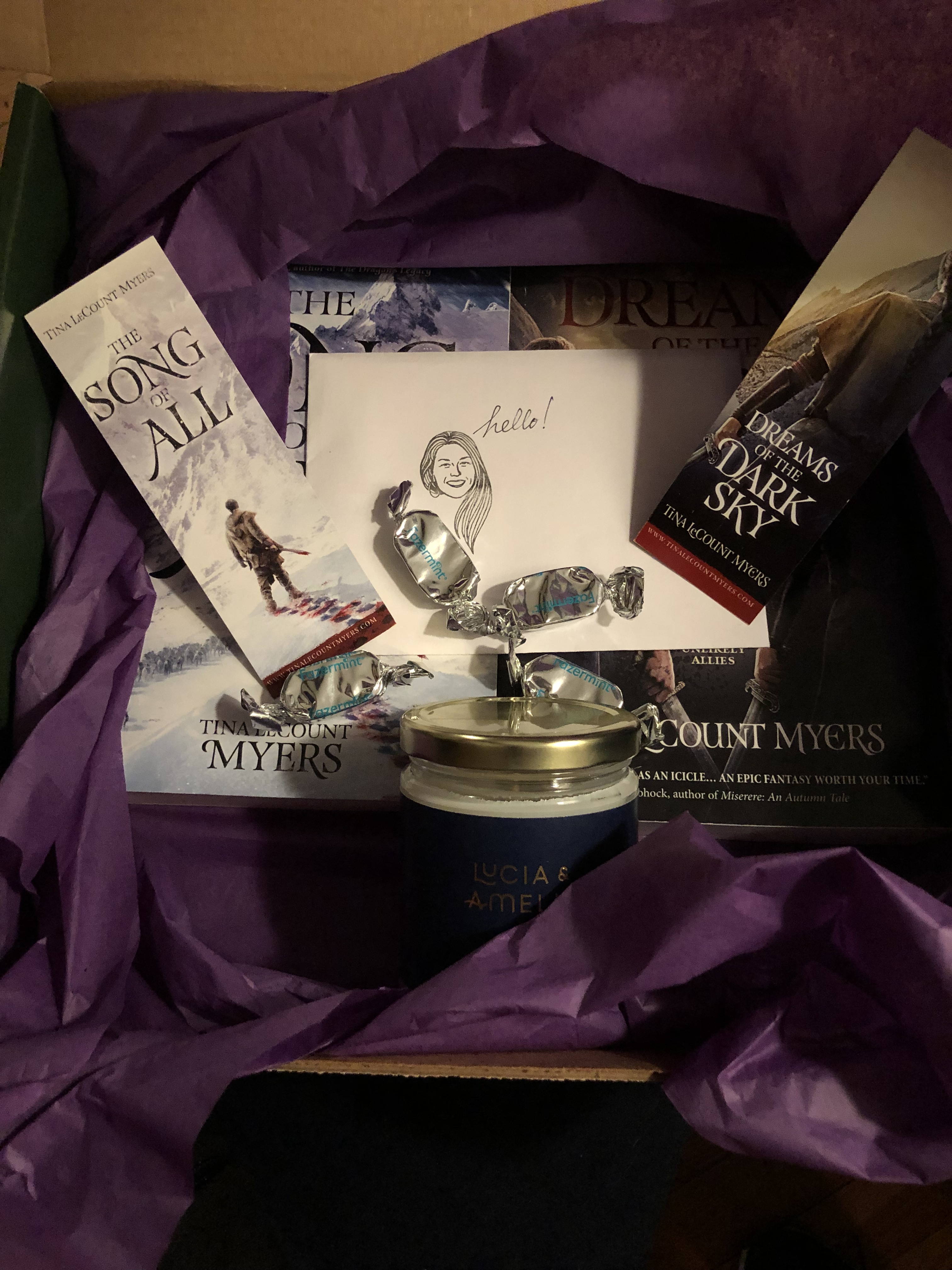
To celebrate the release of Dreams of the Dark Sky, Night Shade Books and Wunderkind PR partnered up to create these gorgeous Legacy of Heavens limited boxes, and they want to give you a chance to win one too. Inside the box you will find:
—one copy of THE SONG OF ALL (Book 1)
—one copy of DREAMS OF THE DARK SKY (Book 2)
—a special Tarot card and personal note from the author
—Special Finnish mint candy, a favorite of the author and a reminder of her grandfather
—a Luke Birch scented candle that evokes the Finnish Forests that inspired the books
Enter now by clicking this Rafflecopter link!
Open to residents of the US only. This giveaway will run until April 8. Good luck!


 The BiblioSanctum