Book Review: Ghoster by Jason Arnopp
Posted on October 22, 2019 26 Comments
I received a review copy from the publisher. This does not affect the contents of my review and all opinions are my own.
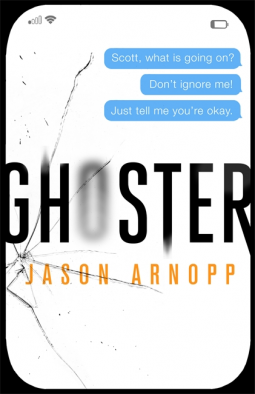
Mogsy’s Rating: 3.5 of 5 stars
Genre: Horror
Series: Stand Alone
Publisher: Orbit (October 22, 2019)
Length: 496 pages
Author Information: Website | Twitter
Like many readers who came to this novel, I am a huge fan of Jason Arnopp’s The Last Days of Jack Sparks so needless to say I could hardly wait to get my hands on Ghoster. Some of the early mixed reviews had me nervous though, so I went into it with my expectations in check. In some ways, I’m glad I did, because the book did not turn out the way I thought at all, and that was both a good and bad thing.
At the center of Ghoster is protagonist Kate Collins, a somewhat self-doubting paramedic who has an addiction to social media. Recently, she has made a conscious effort to put some distance between herself and her phone, and around the same time, she also started going out with a man named Scott Palmer. Sweet, charming, and handsome, he seemed like the perfect guy, except for the fact he hardly talks about himself and can be quite guarded about his life. Still, when Scott asks her to move in after just a short period of dating, Kate is ecstatic and agrees immediately, quitting her job, packing up all her belongings, and driving straight to Brighton where her new life awaited her.
But upon her arrival, she is surprised to find an empty house. No furniture, no electricity, no boyfriend. Scott also hasn’t been answering her calls or her texts. Soon, she discovers the reason why, as he appeared to have left behind his battered but still working cell phone, the only sign of him left in the entire place. Refusing to believe she has been ghosted, Kate convinces herself that something must have happened to Scott, and decides to unlock his phone and start digging into his life to find some answers. What she discovers, however, is devastating. Everything she thought she knew about the man she loved was a lie. Worse, the shock accompanying these new revelations is compounded by the strange atmosphere Kate has been getting from Scott’s apartment.
With all the lies and half-truths being flung around social media these days, one of the main takeaway messages from Ghoster is, just how do you know if a person is really who they say they are online? This book definitely a cautionary tale against the overuse of electronic devices and the danger of being too connected. However, I also think it serves as a great guide as to what not to do when you’re in a relationship! It’s simple, really—just do the opposite of everything Kate does. When a guy refuses to tell you important details about himself or talk about his family, warning signs should be blaring in your head. Also, out of all the movies in the world, he names as his favorite the one that just happens to be your favorite as well? And you’re really naive enough to buy that? Don’t even get me started about the part where she throws her whole life, her brains, and all her self-respect out the window the moment Scott asks her to move in. And when she finds the place empty, she just decides to settle in anyway like everything is normal? Any average person would have drawn the logical conclusion that they’ve been dumped, and move on. But oh no, not Kate. She continues to pine and obsess even though every sign is telling her to pull her head out of her ass and get out of that place.
I suppose that was the main issue I had with the novel. Kate is a horrible protagonist, one I couldn’t sympathize with no matter how hard I tried because everything she did seemed at odds with what common sense would dictate. There’s really no nice way to say this, so what the heck: she’s an airhead. What else would you call a person who actively creates problems for herself by making staggeringly dumb choices, and worse, never learning from those lessons and repeating the same mistakes? On some level, I understood that Arnopp wanted to make an example of her, but I didn’t like how everything about her personality was so off-putting. After all, Jack Sparks was unlikeable in the author’s last novel, but the character was at least funny, interesting, and displayed some semblance of intelligence.
But now on to the good parts, to the elements I really enjoyed about Ghoster, and I have to say most of them have to do with the actual story itself. Overall, the plot presents a good mystery, if you can ignore all the protagonist’s questionable choices to make it possible. There’s a thrill, for example, every time Kate discovered some new clue or disturbing little tidbit in Scott’s phone which would lead to more puzzles and secrets. And there were plenty of scenes that were genuinely creepy, especially those ghostly nighttime moments at Scott’s apartment, as well as the chilling twists revealed towards the end.
Overall, if only I could have gotten over my intense dislike of the protagonist, I think I could have found Ghoster immensely enjoyable. Of course, there were other minor issues, like some disjointed pacing and several situations that strained my ability to suspend my disbelief or were just downright bizarre, but Kate presented the biggest struggle. Still, in deciding how to rate this book, I chose to believe everything about her character was by design and ultimately went with my gut instinct based on how much I liked the novel. And by that measure, I found it quite entertaining. This book was not nearly as awesome as I wanted it to be, but I had fun with it nonetheless, and I will be looking forward to more by Jason Arnopp.


Book Review: The Vine Witch by Luanne G. Smith
Posted on October 21, 2019 22 Comments
I received a review copy from the publisher. This does not affect the contents of my review and all opinions are my own.
 The Vine Witch by Luanne G. Smith
Mogsy’s Rating: 3 of 5 stars
Genre: Fantasy, Historical Fiction
Series: Book 1 of The Vine Witch
Publisher: 47North (October 1, 2019)
Length: 263 pages
Author Information: Website | Twitter
The Vine Witch by Luanne G. Smith was a charming book—sure, not one that would likely linger too long in your mind or make an in indelible impression, but it was by no means a bad read. While the publisher blurb doesn’t reveal much about the story, I was intrigued by the setting of a vineyard nestled in the historical French countryside, as well as the idea of vine witches whose powers enable them to create the richest and most complex wines.
The book opens on the Chanceaux Valley, home to the Chateau Renard vineyard where our protagonist Elena Bourneanu lived with an old woman she calls her Grand-Mere. The Chateau has long been known for its remarkable, full-bodied wines and the secret to its success is Elena, a vine witch who users her spells to enhance the winemaking process. But prior to the story’s start, Elena ran afoul of a curse and had been transformed into a toad, leading to the ruin of Chateau Renard now that it was bereft of her magic.
Years later, Elena was able to return to her body, albeit with weakened powers. When she returns to the Chateau, however, she is dismayed to discover that Grand-Mere had sold it in her absence, and the vineyard now belongs to a handsome stranger named Jean-Paul Martel. Without Elena, the quality of the wine had gone down, yet to her frustration, Jean-Paul, who doesn’t believe in village superstition, refuses to allow her to use magic to restore it. But Elena knows something more is afoot, and recognizes a hex when she sees one, she’s also pretty sure she knows who was behind the curse that stole seven years of her life. But between hiding her identity and planning her revenge, Elena has plenty on her mind and did not foresee being a target of the anti-witch movement, nor did she expect that she and Jean-Paul would grow closer and develop feelings for each other.
The Vine Witch was good entertainment, though I have to say, I think I expected more. By that, I mean everything from the story to the world-building and the characters were too lightly sketched, and I chalk this up to this being the author’s debut, because it has all the telltale signs. Certainly the passion is there, but at times the prose was overly purple, trivial details were heavily described while more important elements were neglected, and there were paragraphs where lot was given when only a little was demanded so that the words practically tripped over themselves. A perfect example of this is the setting. Smith never really managed to establish a solid sense of the place, even though there were plenty of opportunities to do so. The culture and atmosphere of Chanceaux Valley only started to materialize late in the game, hence prior to that, I had only with the publisher’s description of turn-of-the-century France to point me in the right direction and help me imagine the context.
The same goes for the characters, who were relatable and interesting enough, but were still hard to pin down. I wanted more out of Elena’s personality and voice, especially given what was done to her, and yet those aspects of her character came across as somewhat distant and artificial. Speaking of which, the romance also felt forced, like everything between Elena and Jean-Paul was meant to be a foregone conclusion anyway, so why not just drop all pretenses and go through the motions. As you can imagine, that had a way of sapping all the anticipation and life out of the relationship.
Despite all my criticisms though, I can’t say I didn’t enjoy The Vine Witch. Although I had expected more from it, I also realize and appreciate the fact that it is a debut, and I think in spite of a few hiccups here and there, Luanne G. Smith has delivered an impressive historical fantasy with a solid premise. This book was also a quick read and could have used some polishing in places and beefing up in others, but I like to think just a teensy little bit more tweaking would have gotten the plot and character development to a good place. Quite honestly, the only thing missing was a little oomph, that extra secret ingredient to make the book more consequential and memorable, which I believe only comes with experience and more writing. Hence if Smith continues upon this path of growth, I definitely look forward to checking out she writes next.

YA Weekend: Angel Mage by Garth Nix
Posted on October 20, 2019 23 Comments

I received a review copy from the publisher. This does not affect the contents of my review and all opinions are my own.
Mogsy’s Rating: 3.5 of 5 stars
Genre: Young Adult, Fantasy
Series: Stand Alone
Publisher: Katherine Tegen Books (October 1, 2019)
Length: 560 pages
Author Information: Website | Twitter
Since this was my first time reading Garth Nix, I really had no idea what to expect. With the exception of his Old Kingdom series, his books have always given me the impression of being skewed towards younger, Middle Grade readers, which was why I was surprised at the maturity and richness of Angel Mage. I’m not just talking thematically, or the world-building either; even the writing style was very lush and complex, closely resembling the tone of literary classics.
And no wonder. For this novel, Nix was clearly inspired by Alexandre Dumas’ The Three Musketeers. However, the incredible world in which the story takes place feels highly original and unique, filled with a vast trove of magical lore to die for. After more than a hundred years of dormancy, an angelic mage named Liliath emerges from her resting place with the goal of being reunited with her archangel lover once again. In her day, she was a powerful icon maker, and was responsible for the Ash Blood plague which wiped out most of Ystara and transformed many of its victims into horrific monsters called beastlings. The cursed survivors were led to the neighboring capital of Sarance by Liliath where they thrived, but now their descendants are called the Refusers, unable to be touched by magic and shunned by the angels.
As Liliath builds support among the downtrodden Refusers, she also casts her influence outward to four angel-touched young people, all newly arrived in the city: Agnez is a skilled swordswoman and a cadet in the Queen’s Musketeers; Simeon is a promising doctor recently cast out by his institute; Henri is a Cardinal’s clerk who fell into the role by a stroke of fortune; and finally, Dorotea is a scholar and an icon maker of extraordinary talent. The four of them are the key to getting Liliath what she wants, even though they are unaware of their roles in her grand scheme. But as all of them become fast friends, drawn to each other by the hidden threads of fate, eventually they realize Liliath must be stopped and only they can prevent the chaos and destruction which would result from the angel mage’s obsessive quest.
In this fantasy world based on angelic magic and iconography, there’s a lot of background information and detail to get across, making this a very tricky and dense book. I’m not surprised to hear Nix is known for being a master at world building, as evidenced by the amount of thought and effort which must have gone into creating the setting for Angel Mage. In fact, he might have even gotten carried away with it—forgetting that while a complex and rich world is all fine and good, the story needs to be interesting too—because there were sections where I found my attention flagging as I struggled with the information deluge. I hate to say it, but I had to push myself through most of the first hundred pages, because the bulk of it was so tedious.
Thankfully, things improved as our four protagonists were introduced, as the writing style loosened up with their interactions and dialogue, making the story immensely more readable. Although I really enjoyed the idea of icon making and magic from the angels, it was the character development that won me over. Agnez, Henri, Simeon, and Dorotea were all so different, but together their personalities clicked perfectly, and it was convincing and realistic how quickly they became friends. I loved Simeon, a gentle giant who is passionate about healing, as well as flighty Henri who has big dreams but little know-how on how to reach them. And yet, the women were the ones who really stole the show here, with the assertive and hotheaded Agnez offering a counterpoint to the quiet and even-tempered Dorotea. Even Liliath was a powerhouse villainess—ruthless, determined, and uncompromising in her desire to be with her love again. She’s the most frightening sort of antagonist, and while I did not enjoy her POV nearly as much as the other four, it did add a fair amount of excitement and intensity to the overall narrative.
Still, Angel Mage is the kind of book that really demands your full attention, even if it’s not always that successful at keeping it. This can make following the story a little confusing, and there’s also a lot of filler. In general, I think the plot could have used a bit more energy and more even pacing, but that’s really the extent of my complaints.
All in all, I really enjoyed my first book by Garth Nix and would definitely be open to reading more by him in the future. Fans of his will probably eat this one up and fall in love with the characters and this gorgeously crafted world richly threaded with the undertones of a Dumas classic.
Mogsy’s Bookshelf Roundup: Stacking the Shelves & Recent Reads
Posted on October 19, 2019 52 Comments
Bookshelf Roundup is a feature I do every other weekend which fills the role of several blog memes, like Stacking the Shelves where I talk about the new books I’ve added to my library or received for review, as well as It’s Monday! What Are You Reading? where I round up what I’ve read since the last update and what I’m planning to read soon. Mostly it also serves as a recap post, so sometimes I’ll throw in stuff like reading challenge progress reports, book lists, and other random bookish thoughts or announcements.

Received for Review
My thanks to the publishers and authors for the following review copies received, and be sure to click the links to their Goodreads pages for more details and full descriptions!

After a brief dry spell, things are picking up again in my mailbox, with the arrival of some early 2020 ARCs. With thanks to Harper Voyager, I received a couple of these, first the very anticipated Race the Sands by Sarah Beth Durst. It was such a surprise when this showed up, but I’m very excited to read it. Another surprise arrival was Carved from Stone and Dream by T. Frohock, book five in her Los Nifilim sequence. I’ve very much enjoyed the author’s work in the past, but I sadly fell behind on this series so I’m going to have to do a little research to see if I can read this as a standalone. From the publisher also came a couple of finished copies, including The Blue Eye by Ausma Zehanat Khan, the third book in The Khorasan Archives. I’ve only read the first one, and I can’t believe this series is so far along already! Finally, I also received Escaping Exodus by Nicky Drayden, and this sounds like another strange one. I’d like to give it a try if I some time this fall.
Thank you to Titan Books, I also received Sherlock Holmes and the Christmas Demon by James Lovegrove. You know how I can’t resist anything to do with Sherlock Holmes, and this sounds like it would be a great one to read over the holidays.
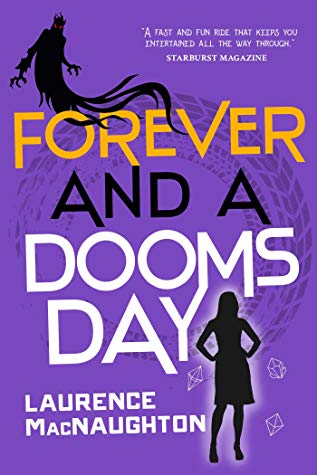
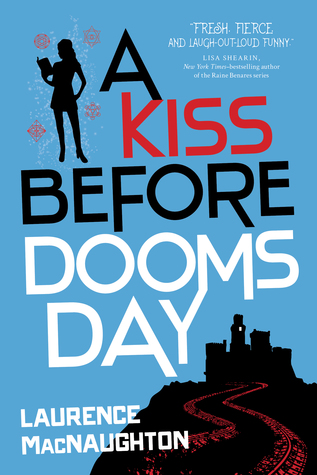
And with thanks to Pyr and Kaye Publicity, I also got my finished copy of Forever and a Doomsday by Laurence MacNaughton, yay! And in case you missed it, Laurence kindly wrote us a guest post earlier in the week, so be sure to check it out if you haven’t already, it’s a fun read. I can’t wait to check out his new book, the latest in the Dru Jasper series.

This was also a week of new discoveries. From Simon & Schuster, I received a new-to-me book earlier this month called White Elephant by Trish Harnetiaux, which is a Christmas mystery according to the publisher description. Another good one to check out over the holidays! From Subterranean Press I also received an ARC of Jane Goes North by Joe R. Lansdale, a road trip adventure. And from 47North and the kind folks at Wunderkind PR I also received a finished copy of The Vine Witch by Luanne G. Smith, which I’m looking forward to diving into real soon, if I haven’t already started by the time this post goes live.
Also thanks to Tachyon Press for sending me the following ARCs: Sea Change by Nancy Kress, which looks really interesting and I’ve always wanted to read more by the author; as well as The Immortal Conquistador by Carrie Vaughn, a story that sounds linked to her Kitty Norville books. Last but not least, I received this gorgeous graphic novel from HarperCollins called Estranged: The Changeling King by Ethan M. Aldridge. It appears to be the second book in a series, and while it is geared towards Middle Grade readers, the illustrations are simply stunning and I find myself curious to take a look.

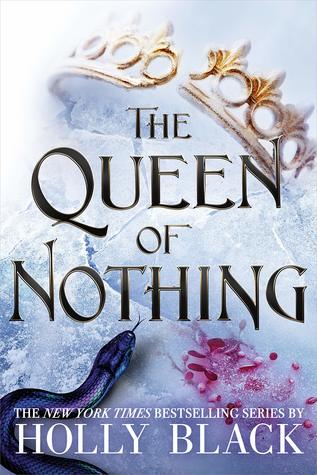
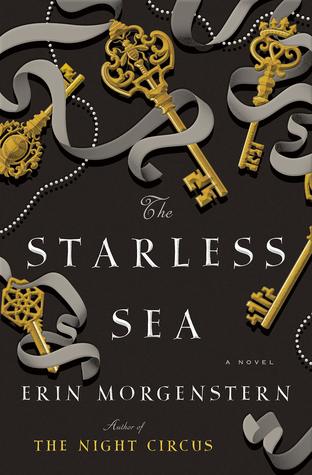




A huge digital haul this week, as I find myself gravitating more towards audio, especially. With thanks to Tantor Audio, I received listening copies of Walking to Aldebaran by Adrian Tchaikovsky. From Hachette Audio, I received the highly anticipated audiobook to The Queen of Nothing by Holly Black. From Penguin Random House Audio, I received The Starless Sea by Erin Morgenstern and from their YA imprint Listening Library I received A River of Royal Blood by Amanda Joy.
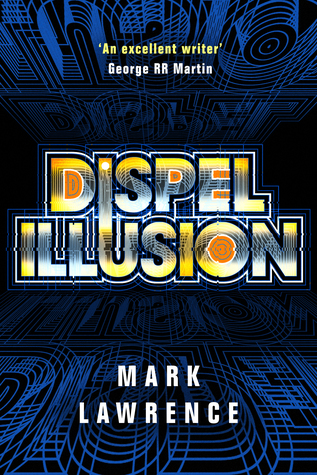
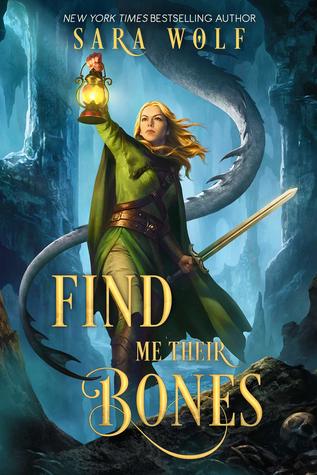
I was also sent a few exciting eARCs from authors and publishers. Dispel Illusion by Mark Lawrence is the third book in the Impossible Times series published by 47North and I can hardly wait to read it! And speaking of not being able to wait, the time has also finally come for The Last Sun sequel, The Hanged Man by J.D Edwards, cheers to Pyr Books and the team at Kaye Publicity. In my email earlier this week I was also ecstatic to find an invite from Entangled: Teen for Find Me Their Bones by Sara Wolf, the follow-up to the brilliant Bring Me Their Hearts.
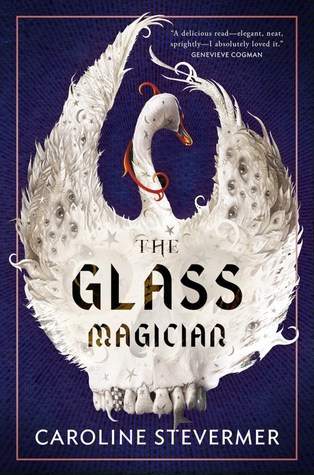
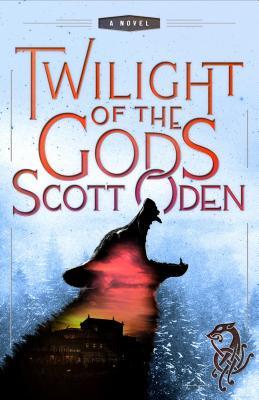
Oops, I also might have gone a little nuts on NetGalley and Edelweiss, but with all these eARCs to download right away, it was hard to resist. From Tor, I grabbed The Glass Magician by Caroline Stevermer, a book I recently featured for Waiting on Wednesday. I also loved the sound of The Return by Rachel Harrison, a horror thriller from Berkley about a group of friends who reunite after the return of them from a mysterious two-year disappearance. St. Martin’s Press also got me good with a trio of highly anticipated books on my wishlist: The God Game by Danny Tobey, Alone in the Wild by Kelley Armstrong, and Twilight of the Gods by Scott Oden!
Reviews
Below is a quick summary of my reviews posted since the last update. I was really trying to stack some horror reads for early October, but I didn’t have luck with many of my choices, as you can see. Thank goodness there were a couple good ones though.
The Twisted Ones by T. Kingfisher (4.5 of 5 stars)
Dark Pattern by Andrew Mayne (4 of 5 stars)
The True Bastards by Jonathan French (4 of 5 stars)
The Beautiful by Renée Ahdieh (4 of 5 stars)
Violet by Scott Thomas (3.5 of 5 stars)
Imaginary Friend by Stephen Chbosky (2.5 of 5 stars)
The Tenth Girl by Sara Faring (2 of 5 stars)
The Monster of Elendhaven by Jennifer Giesbrecht (2 of 5 stars)
Roundup Highlights:

Interviews and Guest Posts
A shout out to the authors who stopped by The BiblioSanctum!
Guest Post: “7 Secrets to Making Fascinating Monsters” by Laurence MacNaughton

What I’ve Read Since the Last Update
Here’s what I’ve managed to “unstack” from the TBR since the last update. More reviews coming soon!



Have you heard of or read any of the books featured this week? What caught your eye? Any new discoveries? I hope you found something interesting for a future read! Let me know what you plan on checking out. Until next time, see you next Roundup!
Friday Face-Off: Scream
Posted on October 18, 2019 30 Comments
Welcome to The Friday Face-Off, a weekly meme created by Books by Proxy! Each Friday, we will pit cover against cover while also taking the opportunity to showcase gorgeous artwork and feature some of our favorite book covers. If you want to join the fun, simply choose a book each Friday that fits that week’s predetermined theme, post and compare two or more different covers available for that book, then name your favorite. A list of future weeks’ themes are available at Lynn’s Book Blog.
This week’s theme is:
“It’s your favorite scary movie, remember? He had on the white mask, he stalked the babysitters.”
~ a cover featuring a SCREAM
Mogsy’s Pick:
A Clockwork Orange by Anthony Burgess
Halloween is almost here! To celebrate, I’ll be featuring the classics on Friday Face-Off for the full month of October. This week, we’ll be shining the spotlight on the controversial dystopian satirical black comedy novel by Anthony Burgess. Here are some of the covers:
From left to right:
W. W. Norton & Company A (1986) – W. W. Norton & Company B (2012) – Penguin Essentials (2011)


Ballantine Books (1971) – Penguin Classics (2010) – Penguin Books (1998)


Spanish Edition (2008) – Polish Edition (2007) – Portuguese Edition (2004)


Turkish Edition (2013) – German Edition (1999) – Hungarin Edition (2016)


Lithuanian Edition (2007) – Swedish Edition (2004) – Indonesian Edition (2017)


Winner:
I deliberately left off any of the movie poster/tie-in covers this week, because clearly there are enough cool artistic covers to enjoy. My favorite this week is probably the Turkish Edition.
But what do you think? Which one is your favorite?
Book Review: Dark Pattern by Andrew Mayne
Posted on October 17, 2019 21 Comments
I received a review copy from the publisher. This does not affect the contents of my review and all opinions are my own.
Mogsy’s Rating: 4 of 5 stars
Genre: Mystery, Thriller
Series: Book 4 of The Naturalist
Publisher: Thomas & Mercer (October 15th 2019)
Length: 316 pages
Author Information: Website | Twitter
These Naturalist books tend to be “one day reads” for me, and Dark Pattern, which got devoured in two reading sessions over a matter of hours, was definitely no exception. I love this series so much, and I just knew this novel would be another unputdownable mystery, which is why I’m glad I had the foresight to clear my schedule to devote an entire afternoon to reading, because bloody hell, this one was addictive.
Once again, Dr. Theo Cray is on the case, though he’s had a lot more on his mind since the last time we saw him. If you have not caught up to this point in the series yet, please bear in mind this review may contain some spoilers for the previous books. While each novel features a self-contained story, the events in them do add up to affect the protagonist in a big way, as evidenced at the beginning of Dark Pattern, which sees Theo fretting over his exposure to a dangerous virus at the conclusion of Murder Theory. While his reputation for catching serial killers has all but destroyed his prospects in the educational and research fields, at least he still has his logical mind and moral compass—for the time being, anyway. And he’s going to need all his wits about him if he’s to solve his next big case, brought forth to him by a nursing professional concerned that a corrupt local hospital system may be shielding the activities of a serial killer nurse who is targeting patients.
Following this tip leads Theo to several families who have lost their children to routine hospital care, with the cause of death a mystery. The one common factor is a nurse who has worked with or around the children immediately prior to their deaths, and the pattern is enough to make Theo suspicious and take a closer look. But what he ends up uncovering is so much worse, including corrupt bureaucrats who knew something fishy was going on but refused to do anything, as well as the manipulation of patient statistics to hide the truth.
Gosh, the stuff you read in this book will send chills running down your spine, and what’s even more frightening is how much of the bad conditions are based on truth, if news you see on corruption in healthcare or my own experiences working in hospitals are anything to go by. Dark Pattern is up there as one of the darker novels in the series, both because of story’s themes and what happens to our main character. Being hospitalized is unpleasant enough as it is, but it’s also a place where people should be able to put themselves and their loved ones in the trust of healthcare workers who are supposed to help heal them. The plot’s premise of a serial killer stalking along the antiseptic halls looking for his prey among the ill, the old, and little helpless children made my skin crawl.
And then of course, we come to Theo. He’s been slowly losing it for a while now, pushing his luck (and limits) when it comes to how far he’s willing to go to solve a case. He continues this trend in Dark Pattern, but now his methods and actions have become even bolder and more extreme. While his heart is still in the right place, you can really tell Theo is well on his way down a slippery slope. While this concerns him, the irony is that he’s probably worried for all the wrong reasons, and without revealing too much about the ending, I have to say his lack of perspective and eventual loss of grip on the situation really surprised me.
Which brings me to the elephant in the room. Let’s just say I loved this book for the most part, and was all prepared to throw it a five star rating until the last few chapters happened. Again, without spoiling anything, I’ll just say that this section didn’t quite jive with everything that came before. The conclusion itself was rather underwhelming, and it also almost felt as if the author suddenly ran up against a hard deadline and had to rush through the rest of the book. I can’t deny this was a bit disappointing, though to tell the truth, this bizarre shift made me feel more confused than anything. This is because in a way, the end of Dark Pattern felt like a sort of “soft reset” for Dr. Theo Cray. It pretty much places the series at a place where the story and character can go in any number of new directions, so I suppose just about anything can happen now.
It gives me great hope for a fifth installment. While Dark Pattern didn’t exactly wow me with its ending, the rest of the book and its mystery plot was solid. I look forward to seeing where The Naturalist series will go next.

More on The BiblioSanctum:
Review of The Naturalist (Book 1)
Review of Looking Glass (Book 2)
Review of Murder Theory (Book 3)
Waiting on Wednesday 10/16/19
Posted on October 16, 2019 19 Comments

“Waiting On Wednesday” is a weekly meme that first originated at Breaking the Spine but has since linked up with “Can’t Wait Wednesday” at Wishful Endings now that the original creator is unable to host it anymore. Either way, this fun feature is a chance to showcase the upcoming releases that we can’t wait to get our hands on!
Mogsy’s Pick
The Last Human by Zack Jordan (March 24, 2020 by Del Rey)
As you know, I’m always on the lookout for my next favorite oddball sci-fi, and this one caught my eye earlier in the week.
 “The last human in the universe is on the run from a godlike intelligence in this rip-roaring debut space opera.
Sarya is the civilized galaxy’s worst nightmare: a Human.
Most days, Sarya doesn’t feel like the most terrifying creature in the galaxy.
Most days, she’s got other things on her mind. Like hiding her identity among the hundreds of alien species roaming the corridors of Watertower Station. Or making sure her adoptive mother doesn’t casually eviscerate one of their neighbors. Again.
And most days, she can almost accept that she’ll never know the truth–that she’ll never know why humanity was deemed too dangerous to exist. Or whether she really is–impossibly–the lone survivor of a species destroyed a millennium ago.
That is, until an encounter with a bounty hunter and a miles-long kinetic projectile leaves her life and her perspective shattered.
Thrown into the universe at the helm of a stolen ship–with the dubious assistance of a rebellious spacesuit, an android death enthusiast on his sixtieth lifetime, and a ball of fluff with an IQ in the thousands–Sarya begins to uncover an impossible truth.
What if humanity’s death and her own existence are simply two moves in a demented cosmic game, one played out by vast alien intellects? Stranger still, what if these mad gods are offering Sarya a seat at their table–and a second chance for humanity?
The Last Human is a sneakily brilliant, gleefully oddball space-opera debut–a masterful play on perspective, intelligence, and free will, wrapped in a rollicking journey through a strange and crowded galaxy.”
Book Review: The Twisted Ones by T. Kingfisher
Posted on October 15, 2019 34 Comments
I received a review copy from the publisher. This does not affect the contents of my review and all opinions are my own.
The Twisted Ones by T. Kingfisher
Mogsy’s Rating: 4.5 of 5 stars
Genre: Horror
Series: Stand Alone
Publisher: Saga Press (October 1, 2019)
Length: 400 pages
Author Information: Website | Twitter
The Twisted Ones was a fun novel featuring the perfect blend of humor and horror, with the first element provided mainly in the form of the main character’s incredibly infectious voice, while the second came via the setting’s creeptastic atmosphere. You’ve got an old house in the middle of the woods, filled with decaying trash and other ghastly things like scary baby dolls. Meanwhile, the locals also know better than to go wandering among the trees, for it is said the laws of reality work differently here, and unwary travelers might suddenly find themselves stumbling through a veil into another world. Not to mention, the woods is home to monsters—strange, grisly creatures made from dead bodies and grinning skulls.
But of course, being a newcomer, Mouse was unaware that any of this awaited her as she rolled up to her late grandmother’s house, at the behest of her father who wanted to see if anything could be salvaged from the property. One look, however, was enough to tell Mouse the answer. Dear old granny was a mean, miserable bitch in life (no, seriously, she was a real piece of work), and in her last days, seemed to have become quite the recluse and hoarder as well. The place is filled from top to bottom with useless junk, but being the dutiful daughter, Mouse decides to stick around and help clean it out. Together with her loyal coonhound Bongo, the two get ready to settle in for the long haul.
But soon, during her walks in the woods with Bongo, Mouse starts coming across impossible things, like a grassy hill where none was supposed to be, or odd stones carved with unnerving pictures and symbols. And then came the most frightening discovery of all—a gruesome effigy made of animal bone and body parts, hanging from a tree. Mouse knows she shouldn’t let her imagination get away from her, and yet she can’t help but feel the thing might have been alive—watching and waiting. Worse, among her grandmother’s cluttered belongings, Mouse finds an old journal that belonged to her step-grandfather. To anyone else, the old man’s writings would have sounded like the nonsensical ravings of a disturbed mind, but after seeing what she did in the woods, Mouse has reason to believe her step-grandfather must have been terrorized by the same horrors plaguing her now.
Be sure not to let the cheery, affable nature and tone of the narrator fool you into thinking this is a light and airy novel, because this one was downright CREEPY. In particular, there was a scene around halfway through that made me regret my decision to read this book after dark, as I ended up having a bit of trouble falling asleep that night, my attention drawn constantly to the window to make sure nothing was peering inside. Anyone who’s read The Twisted Ones will probably know exactly which scene I’m talking about.
But let’s back up and talk about how this book captured my attention and love immediately, starting with the first page when readers were introduced to Mouse, a middle-aged editor who just got out of a bad relationship and is in desperate need of a distraction. Right away, you knew this was a strong and independent lady who knew how to take care of herself, and who wouldn’t let a setback stop her for long. In the end though, what I adored most about Mouse, and what made her so relatable, was her easygoing and funny personality, and I lost track of the number of times where she said something that made me burst out laughing.
To be sure, finding this balance between fright and fun was the best surprise, and what I loved most about The Twisted Ones. And I guess seeing such a strong, vivacious and easygoing character like Mouse go to pieces with terror at the things she sees in the woods also somehow emphasized the novel’s horror for me.
Other aspects I enjoyed include the side characters, like Foxy and Tomas, and of course, who can forget sweet, goofy Bongo, who brought so much bounce and joy and to this story—to the point where I would insist horror fans who are also dog lovers must read this book. In terms of criticisms, I honestly can’t think of much, though I suppose if push comes to shove, I would say the ending might have been a tad on the weaker side due to some disjointedness.
Still, as you can probably tell, I had a great time with The Twisted Ones. This was my first experience with Ursula Vernon, who is writing here as T. Kingfisher, but it certainly wouldn’t be my last! Overall, I loved the mix of creepiness and humor, and after a string of horror books that failed to leave much of an impression this October, I’m also relieved and happy to finally read one that didn’t disappoint! Highly recommended if you’re looking for a spine-chilling read this season that’s also tremendously entertaining.

Guest Post: “7 Secrets to Making Fascinating Monsters” by Laurence MacNaughton
Posted on October 14, 2019 13 Comments
Today, we’re pleased to welcome back author Laurence MacNaughton to the BiblioSanctum to celebrate the release of Forever and a Doomsday, the fourth book in his Dru Jasper urban fantasy series! In this latest installment, our eponymous protagonist has found herself in possession of the powerful apocalypse scroll, an ancient artifact that can bring about the end of the world. To keep the scroll out of demonic hands, Dru and her friends must crack a millennia old mystery, follow its clues to a lost city in the netherworld, and unearth a crystal older than the Earth itself. I’ve been enjoying this series so much and I can’t wait to dive right back in to continue the adventure! In the meantime though, Laurence has so kindly written us a guest post on creating fascinating monsters, and what a fitting topic for October as we start ramping up for Halloween! We hope you enjoy his post, and be sure to check out the Dru Jasper series and Forever and a Doomsday, available on sale October 15!

7 SECRETS TO MAKING FASCINATING MONSTERS
by Laurence MacNaughton
What would fantasy, science fiction, and horror be like without monsters? A well-crafted monster not only scares us, but also fascinates us. It captures our curiosity. It makes us want to peer deeper into the darkness that should make us want to run away.
An interesting monster has to be more than just terrifying — it also has to make a twisted kind of sense. The more real a monster seems, the deeper it affects us, because it grows into something more complex. It may even reveal a darker truth about human nature in general, and by extension, you and me in particular.
So how do writers go about creating truly unforgettable monsters?
Every writer is different. But I like to start with the word itself: M-O-N-S-T-E-R. Believe it or not, those seven letters spell out everything you need to know to make your own monster.
M is for Mind
Let’s say you’re creating a monster for your own story or game. You probably have a hazy idea of what sort of monster you want to create.
First question: how smart is your monster? How well does it think?
Is it dangerously cunning? Self-aware? Or just a mindless monstrosity?
There is no right or wrong answer here. You could go any way you choose.
Dumb monsters are most frightening if they are also incredibly dangerous, and single-minded in their pursuit of the heroes. Think of Jaws, for example.
Smart monsters are terrifying when they outwit our heroes, learn from mistakes, and lay traps for those who underestimate them. Think of something more like Predator.
O is for Origin
Where does your monster come from? What is its origin story? There are generally three kinds of monster origins, and they can have a strong impact on the theme of your story:
Monsters from the past (such as prehistoric creatures) remind us that human beings are not necessarily the apex predator of the world. If there’s something bigger and badder out there trying to eat us for dinner, that strikes us with a primal fear.
Monsters from another world or another dimension (such as ghosts, demons, or aliens) remind us that the universe is bigger than we think. These sorts of monsters destroy our sense of security and make the normal world around us feel unsafe.
Monsters that we create (sometimes in a laboratory, sometimes by accident) remind us that we can’t control the world around us. It turns the advantages of our technology into our biggest enemy. That’s frightening on many levels.
N is for Need
Let’s face it: monsters that exist solely to kill the heroes are pretty uninspiring. Sure, they can be scary, but they are utterly forgettable. What if your monster has a need beyond mere bloodthirstiness?
What if it’s trying to guard its territory? What if it’s trying to find or build a new nest? Reproduce? Defend or feed its young? Destroy competition for limited resources? Rejoin others of its kind?
Figure out what your monster really needs, and suddenly it becomes a fascinating creature.
S is for Sketch
If you have any artistic skills at all, why not draw a picture of your monster for inspiration?
If not, sketch it out with words. Think about what your monster looks like. Visualize it in your mind. Picture it moving through different environments.
How large or small is it, exactly? Does it have an angular head, long legs, wings, or other unusual features? Describe it.
What covers its body: fur, leathery skin, armored plates? Is it an unusual color or texture?
What does this monster sound like? What does it smell like?
How does it move? Does it slither, scuttle, or creep?
Write all of these things down. But here’s a super secret ninja author trick: whatever you do, don’t reveal your entire monster to the reader until much later in the story. Provide only glimpses here and there to build the suspense. People fear the unknown.
T is for Take On
At some point, this monster is going to come into direct conflict with the heroes. How can they take it on? How can they fight it? Or, failing that, how can they escape?
What could hurt this monster? What could scare it off?
Take some time at this one. Brainstorm. Think outside the box. This will lead you to new and interesting story possibilities that will keep your readers guessing.
E is for Eat
Why do so many monsters have long, gnashing teeth? Because getting eaten is one of our most basic fears. A monster that tries to devour you is instantly terrifying.
What’s in your particular monster’s diet? Maybe it doesn’t eat people. Maybe it drinks blood. Maybe it devours human souls. Or maybe it feeds on fear. It’s up to you.
R is for Relationships
It might be strange to think of “monsters” and “relationships” in the same sentence, but stick with me here. Even monsters have some sort of relationship to others of their kind. Are they loners, or do they form a pack? Do they have some kind of hierarchy?
Does this monster belong to someone? Does it obey them? If so, to what extent?
Could this monster control or rule over someone or something else?
Any of these could give you new story ideas.

Making Monsters for the Dru Jasper Series
In my Dru Jasper urban fantasy series, every book sees the heroes (all with strange and unique magic powers) fighting to save the world from the coming apocalypse. The latest book, Forever and a Doomsday, squares them off against the worst threat they’ve ever faced: a horde of undead wraiths who can walk through walls and kill with a mere touch.
Here’s how I created them with my M-O-N-S-T-E-R method:
- M is for Mind
These wraiths aren’t some kind of mindless undead. They are (or were) some of the smartest and most powerful sorcerers on the planet. If they weren’t ghastly creatures of the night bent on destroying the world, they’d probably make fascinating dinner party guests. That crafty intelligence makes them formidable opponents.
- O is for Origin
These creatures actually chose to become undead, for their own nefarious purposes. I can’t give away their big secret, but suffice to say they come from beyond our world. That makes the heroes realize that there are plenty of important things they don’t know, which makes the situation much more dangerous.
- N is for Need
Although these wraiths can drain your soul with a mere touch, that’s not their ultimate goal. They’re actually trying to get their hands on a powerful magical artifact, the apocalypse scroll, which would give them the power to destroy the world. Since the heroes have it, the wraiths will pursue them relentlessly.
- S is for Sketch
Here’s what the heroes first see:
A slender, luminous figure slipped through the night. It didn’t walk so much as glide through the darkness, and the eerie movement made her skin crawl. As if sensing her gaze, it jerked its head to look straight at her. But there was something hideously wrong with its face. It had no eyes. Nothing but twin pools of impenetrable blackness.
- T is for Take On
How do you fight something that has no physical body? You can’t shoot it or punch it. In this book, the main character is a crystal sorceress, and must find a crystal that can affect them. (I won’t give away the answer, but here’s a hint: since the wraiths come from beyond this world, the crystal must, too.)
- E is for Eat
What do these wraiths “eat”? Your soul. Nuff said.
- R is for Relationships
These wraiths are actually a tightly-knit team of villains. Back when they were alive, they were radical movers and shakers of the 1960s, doing everything they could to make the world a better place. When all of their efforts crashed and burned, they became so disenchanted that they set a plan in motion to destroy the world, wipe the slate clean and start over. And they are perilously close to succeeding.
Your Turn: Make a Monster
Remember, take time to think about each element and brainstorm new ideas. You don’t necessarily have to do them in order, but you should think about all of the elements. And above all, have fun making your own monsters!
I often teach this method as a workshop at writing conferences. If you have any questions about it, or you would like a free copy of my monsters guide and worksheet, just contact me through my author website at http://www.LaurenceMacNaughton.com.
 ABOUT THE AUTHOR
Laurence MacNaughton is the author of more than a dozen novels, novellas, and short stories. He writes fast-paced books with spooky monsters, sweet romance, wry humor and outrageous car chases. His novels have been praised by Publishers Weekly, Booklist, Library Journal, and Kirkus Reviews. Laurence grew up in a 200-year-old haunted farmhouse and sold his first magazine article at age 19. Before he became a full-time writer, he worked as a professional prototype vehicle test driver. He lives in Colorado with his lovely wife and too many classic cars. Try his stories free at www.LaurenceMacNaughton.com
CONTACT
Website: https://laurencemacnaughton.com/
Goodreads: https://www.goodreads.com/author/show/6421258.Laurence_MacNaughton
Amazon: http://www.amazon.com/-/e/B008YIX5HA
Facebook: https://www.facebook.com/laurence.macnaughton
Twitter: https://twitter.com/LMacNaughton
YA Weekend Audio: The Tenth Girl by Sara Faring
Posted on October 13, 2019 16 Comments
I received a review copy from the publisher. This does not affect the contents of my review and all opinions are my own.
Mogsy’s Rating (Overall): 2 of 5 stars
Genre: Horror, Young Adult
Series: Stand Alone
Publisher: Macmillan Audio (September 24, 2019)
Length: 15 hrs and 35 mins
Author Information: Website | Twitter
Narrator: Frankie Corzo, Mark Sanderlin
I guess I’m just not having the best luck with my horror reads lately. The Tenth Girl was the latest to disappoint, and this one stings especially, considering how it started off leading me to believe I was going to fall in love with this book. Somewhere along the way though, everything started unraveling.
Labeled a gothic psychological thriller, The Tenth Girl follows 18-year-old protagonist Mavi who arrives at Carmela De Vaccaro’s elite finishing school for girls, to which she had given false information in order to gain a teaching job. Said to be cursed, the isolated boarding academy sits in an icy region of Patagonia which has seen much political unrest, resulting in the ousting of its local peoples. It is the 1970s, and Mavi herself has come to this remote part of the continent from her home of Buenos Aires following the death of her activist mother at the hands of the military regime, hoping to find some refuge in the mountains.
What she did not expect to find, however, was even more trouble. At the school, Mavi is introduced to its nine students, though if the whispers are true, there is a tenth girl who is missing, but everyone is tightlipped about that. Things are certainly creepy enough at Vaccaro’s without the disturbing rumors flying about, with its foreboding headmistress and dire warnings not to go wandering on the grounds at night. Whispers of phantoms and ghostly possession also plague the school halls, which have seen their fair share of tragedy and devastation. As Mavi learns more about the dreadful history of the academy, she also finds out about the mysterious Others through one of their members, a spirit boy named Angel.
One incredibly jarring thing about The Tenth Girl is its structure. The narration flips between perspectives, mainly those of Mavi and Angel, and the novel also appears to be told via more than one timeline, though seeing how that is one element of the ultimate surprise, I’m not going into too much detail about that. I think my biggest issue with this book is the ending. On the one hand, it had a great twist, one that should have been right up my alley due to certain elements I am unable to reveal. Unfortunately, though, I was not a fan of the way it was handled. Since I can’t really talk about it due to spoilers, I’ll say this: it felt like a copout, and I didn’t like the sudden shift in how it made readers view the world. All that delicious gothic atmosphere that I was enjoying? Completely destroyed.
The ending was also implemented in a way that felt out of place and broke any kind of connection I was having with the story up to that point, making me look back at the first three-quarters of the book with mistrust and more than a few eyerolls. Here’s the thing: twists that make me feel shocked and blindsided are fine, but twists that make me feel cheated and robbed are not. I bring this up because I suspect readers will fall into one of these two mindsets once they reach the end, and that will ultimately determine how you feel about this book.
And really, it’s just such a shame when looking back, because the author clearly has a good grasp of the gothic horror tradition, as evidenced by how well she created the perfect mood for her haunted school story. While billed as a thriller, the novel’s pacing is more of a slow-burn—which was exactly what the plot required. The characters were also intriguing, and I immediately took to Mavi and the heartbreaking history of her family, while the personalities and behaviors of the students, staff, and Others at the Vaccaro school added extra layers to the mysterious sense of the place. All this and more contributed to the fantastic historical setting, and if anything, that was what made the eventual bait-and-switch feel even more frustrating, adding to my regret.
Still, kudos to Sara Faring for taking such a bold risk here, with one of the most extreme and daring twists I’ve seen in a while. I certainly don’t resent the twist itself, and might have even enjoyed it had it been handled better, but I think that would have required a very different book. Ultimately, The Tenth Girl didn’t work too well for me, but I believe others might do better with it. So if you’re willing to take the chance, it could be worth a look.
Audiobook Comments: Of the two narrators for The Tenth Girl audiobook, Frankie Corzo probably did the better job reading as Mavi, while Mark Sanderlin voice sounds way too young for someone like Angel, hence his chapters were somewhat distracting and not as good.


 The BiblioSanctum