Book Review: The Faerie Morgana by Louisa Morgan
I received a review copy from the publisher. This does not affect the contents of my review and all opinions are my own.
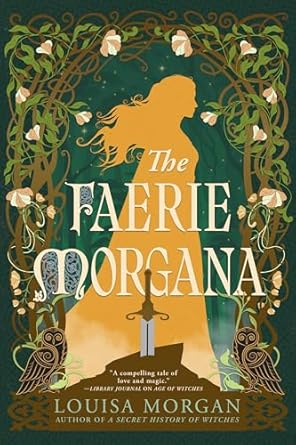 The Faerie Morgana by Louisa Morgan
Mogsy’s Rating: 4.5 of 5 stars
Genre: Fantasy, Historical Fiction
Series: Stand Alone
Publisher: Redhook (September 16, 2025)
Length: 528 pages
Author Information: Website | Twitter
I’ve always loved Louisa Morgan for the way she writes novels that weave together magic and historical fiction. Her stories often feature witchy themes even when they are grounded in real-world settings, which makes perfect sense for her to tackle the Arthurian legend in her latest book, The Faerie Morgana.
Our eponymous protagonist’s tale begins in the Lady’s Temple, where she had been sent as a young girl after the birth of her half-brother, Arthur. There, she comes under the tutelage of the Blackbird, a Merlin-like figure, and quickly develops a reputation for her extraordinary powers to heal and scry. Though many expect her to become one of the priestesses of the Nine, rumors fly that her uncanny abilities are the result of magic, or that she may even carry the blood of the Fae. That speculation earns her as much suspicion and envy as it does admiration, leaving Morgana with few friends. One exception is Braithe, a younger girl who arrives later as an acolyte and grows to see Morgana as her mentor and role model.
Eventually, Morgana’s role expands to Camelot. In the years since she last saw him, her younger half-brother Arthur has become a man and succeeded his father Uther Pendragon as king. When the time comes for him to marry, he calls upon Morgana, now a full-fledged priestess herself, to officiate the wedding. But when she arrives at the palace, with her loyal assistant Braithe by her side, both of them find themselves unsettled by the bride. Guinevere, a strikingly beautiful young noblewoman, seems to hold the entire court in a kind of spell, Arthur included. Morgana can’t shake the feeling that something is wrong, that there might be a more sinister edge to Guinevere’s captivating charm. But prophecy demands Arthur be protected, and if that means staying in Camelot to guard him from harm, Morgana and Braithe will do whatever it takes—even if the greatest threat comes from his own queen.
Most people familiar with the Arthurian legend will also know of Morgana, though her role has always been one of the murkiest. In countless interpretations over the centuries, she’s been cast as faerie, sorceress, and even a goddess. Sometimes she’s a benevolent force, other times she’s a villain. But for all her potential to be either good or evil, more often than not she’s sidelined while Arthur and his knights dominate the narrative. What I found so refreshing in The Faerie Morgana is how Louisa Morgan recenters and reimagines this mythological figure, giving off strong The Mists of Avalon vibes. The Morgana in this story is a fully fleshed out character whose strengths and flaws make her equally compelling. She’s obviously powerful, but that doesn’t shield her from very human faults like pride and arrogance. Neither is she immune to the effects of her ostracization by the other suspicious or envious women at the temple, making her deeply lonely, driving her to retreat behind a shell of aloofness out of self-preservation.
That’s why I loved her relationship with Braithe. Another outsider, Braithe could have easily secured her own acceptance into the social folds at the temple by also turning against Morgana, but of course she would have none of that. Remembering the kindness the older woman showed her when she first arrived, Braithe responds with fierce loyalty, and in turn Morgana makes her a trusted confidante. Their alliance eventually grows into a friendship and partnership, becoming one of the most enduring and memorable elements in the story.
As for the writing itself, Louisa Morgan’s prose is fantastic. This is my fifth novel by her, and there’s a reason why I keep coming back. Her style is artful but never pretentious, elegant but easy to read. Even the quieter moments feel purposeful, as everyday actions and conversations are still filled with meaning that deepen our understanding of the characters’ backstories, motivations, and connections. The atmosphere that she builds feels alive and immersive, giving genuine life to the Lady’s Temple on Avalon, gleaned from the many affectionate mentions of apples that grow on the island. Like I said, this is not a action-heavy story, with much of it unfolding through reflection and politicking, both at the temple and in the court of Camelot. However, the slower pacing was not a negative to me, as it gives readers a chance to settle into the characters. Only then could the tensions tighten around them gradually and naturally.
On the world-building front, I think Morgan assumes that Arthur’s story is so ingrained in our culture that readers will be able to fill in any blanks, because rather than weighing the book down with dense detail, she paints the setting with broad impressions, relying heavily on mood creation. There’s just enough to anchor readers to the world, an example being the glimpses we get into the superstitions surrounding the Fae. Ordinary people sought out the magic and ritual of the priestesses for all kinds of complicated reasons—protection, prophecy, or healing—and what I appreciated most was how these background tidbits never came in the form of lore dumps. Instead, history and myth came together seamlessly, allowing Morgan room to add her own interpretations and flourish.
All in all, The Faerie Morgana is a beautiful and thoughtfully written reimagining of the character. That said, I can also understand how it might not be to everyone’s tastes, especially since it does run kind of slow. But for those who enjoy mythic retellings with a historical touch, or character-driven fantasies entered on witchery and enchantresses, this could prove a rewarding read. Or, if you are new to Louisa Morgan’s work, you may wish to check out her books in general, for all of them tend to go hand-in-hand with this novel’s themes of history, magic, and strong unforgettable women.


 The BiblioSanctum
I love Arthurian tales and slow paced character led books so this sounds just about perfect. Thanks for sharing your thoughts
LikeLike
I love a good Arthurian tale.
LikeLike
So glad you loved this, I can’t wait to get started. And the fact that you mentioned The Mists of Avalon is a bonus😁
LikeLike
I keep saying I’ll try her books but have yet to. I’ll make my way to them eventually. This sounds good too.
LikeLike
That is quite the reimagination. And I do like historical fantasy like books
LikeLike
I have read a couple of her books and she’s a fine writer. This one sounds especially tempting – I nearly went for it, but decided I had too many books and now I’m regretting it! Thank you for a lovely review.
LikeLike
I have to agree with everything you wrote in your review. This was such a lovely read.
Lynn 😀
LikeLike
I can’t wait to try this one (and can’t believe I haven’t tried anything by the author yet 🙈). What you’ve said about history and mythology going together so seamlessly here makes it sound like a dream to me – I utterly adore novels that merge the two. I doubt I’ll mind the slower pace either tbh so hopefully I’ll get a chance to pick this up soon.
LikeLiked by 1 person