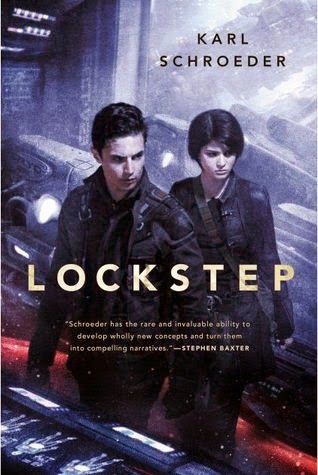
Book Review: Lockstep by Karl Schroeder
Genre: Science Fiction
Series: Book 1
Publisher: Tor (March 25, 2014)
Author Information: Website | Twitter
Mogsy’s Rating: 3 of 5 stars
My brain does not feel fully equipped to handle Lockstep. Obviously, this is not a criticism of the book; rather it is one on my limitations in spatial-temporal thinking. For you see, the whole book revolves around a fascinating but sometimes confusing concept of coordinated hibernation cycles. With no warp drives and light-years between colonized planets, it’s the most efficient way to keep a civilization going in a huge galaxy.
In this Lockstep system, worlds are carefully timed on a “sleep-and-wake” schedule, and this also allows travelers to lie dormant during long trips between planets. Whole populations can go into cold sleeps for decades while only waking for a few weeks, but even after many cycles it could feel like hardly any time has passed at all. So in essence, there’s “real time” and then there’s “Lockstep time”. The main character Toby experiences this the hard way, having gone to sleep after being lost in space, then waking up 14,000 years later in real time. But in Lockstep time however, only about four decades have passed.
I’ve been noticing a lot more books featuring wild and innovative ideas dealing with space and time in recent years, and I think it’s totally awesome! The concept behind the Lockstep Empire is one of the best and most original yet. In spite of this, the book is not without its problems and for me they mainly stem from the confusing execution of those ideas.
First of all, the Lockstep system by itself is not a very difficult one to grasp, but the book will keep throwing factors into the mix making the story a lot more complicated. Take for instance, worlds that don’t operate on the Lockstep schedule, or are set at different intervals. Or how about different characters in different contexts, popping up with their ages all over the place relative to Toby and his friends’. Whenever the author states how much time has passed (presumably in Lockstep time) or whenever a character goes to sleep and wakes up again during space travel, I would always wonder when I actually am.
The creative plot line and world building notwithstanding, I also only felt lukewarm towards the story. I was drawn by the ideas in this novel and the intrigue of Toby’s messed up family, but I was never made to feel truly excited about where the book was going. I also won’t deny this might have played into my overall uncertainty of the Lockstep premise. It pretty much mirrors my experience with hard sci-fi. While I don’t really consider myself a big fan, I wouldn’t mind hard sci-fi novels as long as they “hook” me in some way, making it easier for me to wrap my head around technobabble and the more complicated ideas. I think the same can be applied to Lockstep, but in this case the storytelling, while ambitious and inventive, just didn’t really do it for me.
To sum things up, this book has lots of great ideas and world building, worth reading just to be hit with the awesomeness of the Lockstep system and learn about its ins-and-outs. The story could have been written in a way to make it easier to understand, but the concept is still nothing short of incredible. My main issue with the book isn’t so much that I found the Lockstep system confusing (like I said, that’s my problem, not the book’s) but the fact the story itself did not excite me. I enjoyed it, but could it have been more? I think so. Still, not bad, not bad at all.


 The BiblioSanctum