Book Review: Libriomancer by Jim C. Hines
Posted on May 1, 2013 Leave a Comment
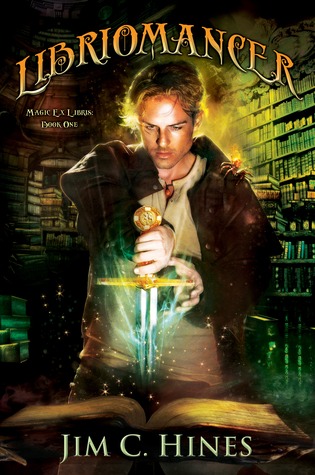
This was a book I had high hopes for, ever since finding out what it was about. At some point in our childhoods, I’m sure all of us bibliophiles have wished that the worlds in our favorite books were real, and wondered what it would be like to interact with with its characters and objects.
This book features a magic system that plays around with the general basis of that idea. The protagonist Isaac Vainio is a Libriomancer, a member of a secret organization who possesses the ability to reach inside books and pull out objects in their stories. One day Isaac is attacked by a group of vampires, and discovers that they have been targeting other magic users as well. Together with the dryad Lena, Isaac finds himself tasked with solving the mystery of the attacks as well as the kidnapping of Johannes Gutenberg, inventor of the movable-type printing press…and Libriomancer founder and leader.
First of all…ugh, why did it have to be vampires?
Seriously though, this was a good book. Even with the vampires. My issues with it, however, have more to do with my hangups with the Libriomancy magic system. Not to sound disparaging, because I don’t deny it’s a great idea and sounds awesome on paper (it’s what first attracted me to the book, remember) but the application of it here was just…messy.
Don’t get me wrong, I understand the challenges here. After all, the Libriomancers’ ability to reach into books and pull out objects has got to be like the most over-powered superpower ever. This story must have been a plotting nightmare with all the deux ex machina moments just waiting to happen. It just makes sense that logically with so many books in publication, someone somewhere sometime must have written something that would be able to get our hero and his friends out of any and all troublesome situations the bad guys throw at them.
Apparently, the solution to that is to put in rules. Rules like Libriomancers can only pull out smaller objects, no bigger than the size of the open book which is the magical “window” to the world of the book. Or that certain books with dangerous or disgustingly powerful objects are magically “locked” which prevent Libriomancers to bring them into existence. Hermione’s Time-Turner device in the Harry Potter series would be a perfect example.
As a result, every chapter you’ll get an info dump, Isaac guiding and explaining the nuts and bolts behind the Libriomancy magic system — what you can do and what you can’t do. It’s unfortunately very distracting, and I started to wonder after a while if I wouldn’t have preferred to put all that out of my mind and simply enjoyed the story, plot holes and all. I love cool magic systems, but Libriomancy just doesn’t seem to be one that lends itself to grow naturally in a reader’s mind. Like I said, great idea, but it’s not so fun when you’re always finding inconsistencies and then waiting for the narrator to explain them.
Other than that, this book wasn’t bad. I liked the main character, even though for a smart guy Isaac has a terrible habit of not thinking things through when he does them. He has a very single-minded way of looking at a problem and isn’t above threatening his hostages with remotely-activated exploding brain implants in order to get his way. Oh, and he’s constantly distracted by Lena and ogling her like a horny adolescent.
Okay, so I didn’t like those aspects of him so much. But what I did like was his sense of wonder and motivation to learn new things. When Isaac isn’t constantly distracted by Lena, he’s constantly distracted by his curiosity and desire to find out why or how things work, which makes him instantly relatable. His love for books comes through, and also reinforces his character and makes him seem more real. When he goes into a bookstore he claims the books “speak” to him, but the way he describes it makes me doubt Libriomancy has much to do with it; every book lover can tell you how walking between the shelves of a store or library and seeing all those books can make them feel giddy and happy. There’s no real magic in it, but I think it’s something magical nonetheless, and the author captured those emotions very well in his characterization of Isaac.
Anyway, if you enjoy books with plots that are fast-paced and constantly driven forward by a whole bunch of things happening at once, then Libriomancer definitely fits the bill. I’ll admit a lot of it was too convoluted and outrageous for me (and this coming from a diehard fan of The Dresden Files series) but if action-packed and bombastic urban fantasy stories are your thing, this book might be worth checking out.

Review Bites
Posted on April 26, 2013 Leave a Comment
I love writing reviews. I love discussing what I did and didn’t like about a book, but sometimes, I may not want to write out a full review on some of the books I’ve read. I may have a few thoughts I want to share on something all the same, but I may not feel like it’s worth posting every individual one considering the short length. I figured that a post compiling short reviews/thoughts of what I’ve recently read but don’t feel like doing a full review could work just as well. They’re fun sized.
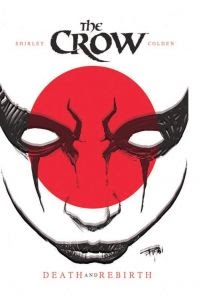
The Crow: Death and Rebirth by John Shirley
Jamie, an American student in Japan, searches for his girlfriend when she turns up missing. He finds her, but she’s different somehow. After she tells her father and Jamie that she never wants to see them again, Jamie begins investigating and starts to uncover some startling information. For his efforts, he’s killed, but comes back to avenge himself and his girlfriend. This wasn’t as bad as it could’ve been, but it wasn’t that great (to me) either. I enjoyed some of the new elements Shirley added to the Crow mythos, and I really liked some of the dialogue. But then parts of it started feeling really kitschy, and there’s one scene where I almost just closed the book and walked away because no one can be that utterly stupid.
Comics for the The Crow are usually hit or miss (mostly miss) for me. I’ve enjoyed many of the novels and, of course, the movie, but the comics and I often don’t get along. I can only give this a 2.5 at best because it just wasn’t really my cuppa, but it gets an A for not turning into the mess I feared it would be.


Polarity #1 by Max Bemis
One day, Artist Timothy Woods wanders into the streets naked from the waist down and raving like a lunatic. The next day, he’s admitted to the psych ward and put on meds. Once he’s better and released from the hospital, the art he’s created during his period of madness reaches critical success. However, because he’s “stable,” he also finds that he can’t create as he used to. Clarity also makes him numbingly aware of hipster hypocrisy and just how mundane things are around him. He doesn’t like the mild-mannered man he’s become on his medicine. He felt he was bold, provocative, and inspired before medication. The medicine only deflates him. He wonders if losing that part of himself is worth the “sanity.” He decides it isn’t and stops taking his medication. But not only did the medicine suppress what he felt was his true self, it also inhibited his latent super powers. Now, there are evils lurking, but what’s a real danger and what’s just a product of his illness?
I loved this book so much, and given the premise dealing with Timothy’s mental issue, it can make you a little afraid that this book will derail itself because the writer will either try too hard or they won’t try hard enough because this can be such a touchy, controversial topic. However, I think Bemis did a fair job, but I can only speak as someone who’s never dealt with a mental illness. I don’t feel like he overplayed or underplayed Timothy’s illness. He didn’t villanize him for making the decision to go off his meds. He did show how this is detrimental to Timothy’s stability and the relationships he maintains, but it wasn’t tsk-ing him. It also didn’t make him seem like he was weak for making the decision either which is another thing people who write about mental illness are typically guilty of. It’ll be interesting to see how Timothy navigates through the world and his own mind. I do hope in the end there’s some middle ground that allows him to be the person he’s meant to be while giving him peace of mind.

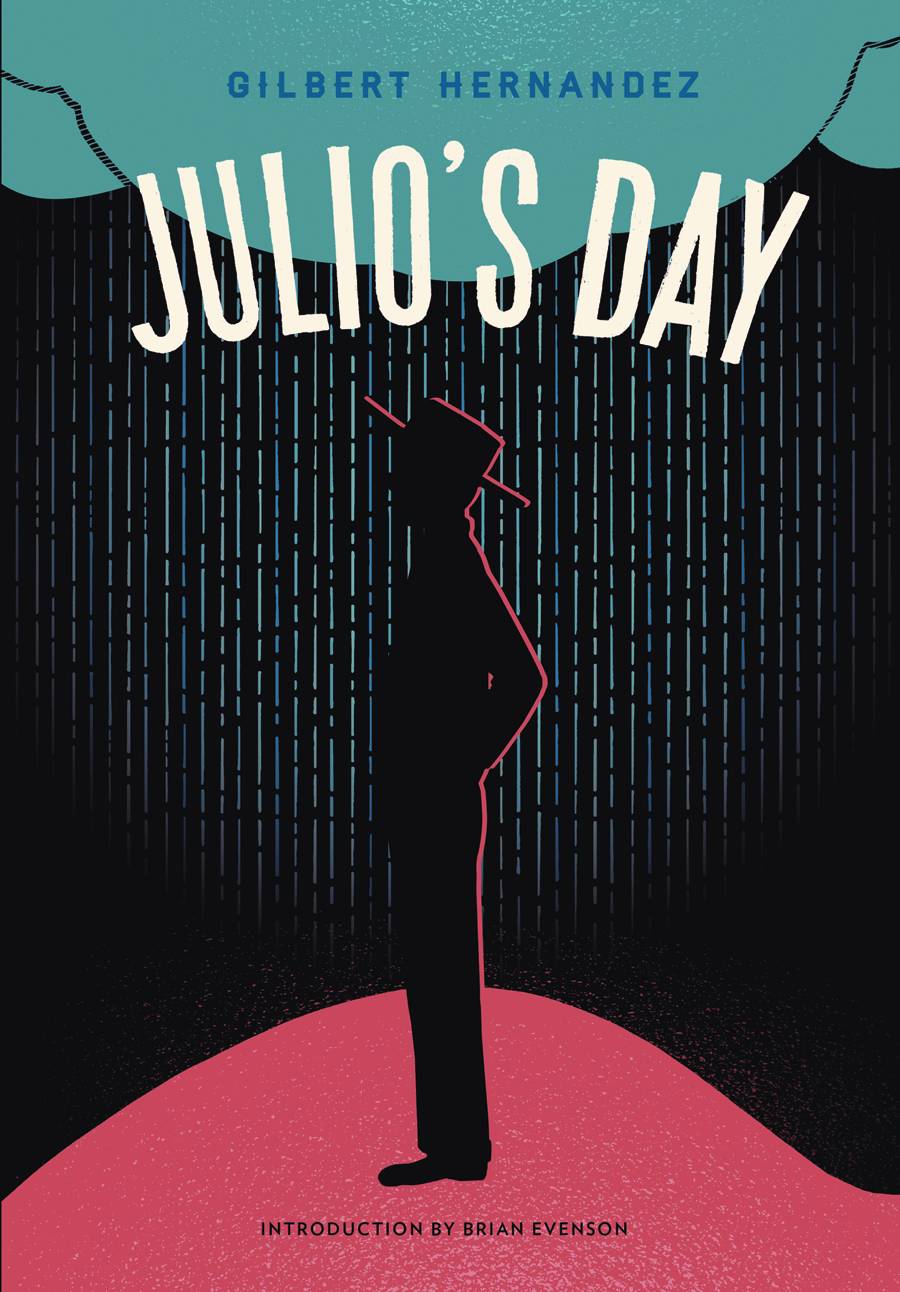
Julio’s Day by Gilbert Hernandez
This is a slice of life comic that opens up with the birth wails of Julio and ends with his death rattle 100 years later in the same house and in the same bed. Even though there are many iconic things that happen from 1900 to 2000, the comic kept the impact of such events insular, choosing to focus on the small scale impact of these events and how they did or didn’t affect Julio’s family. Things like the stock market crash happened and the family acknowledges it, but what does it mean to a family that’s already poor? What does it mean to a family already used to just getting by? This book also focuses on the people in their communities and how they impacted Julio and his family’s life, as well.
This story was filled with dark family secrets, loneliness, betrayal, mental health issues, racism, turning sexual tides, and many other things. While that seems so much for one graphic novel, the pains and joys in this story are told with such simplicity, often times without words or with only dialogue that says so much without the characters ever going into full details such as Julio’s sister telling him, “I don’t feel so sad when somebody dies, Julio, because they fly away to explore the stars and planets. When it’s our turn we join them in exploring the universe.” The art, the pacing, everything was just right for this story.

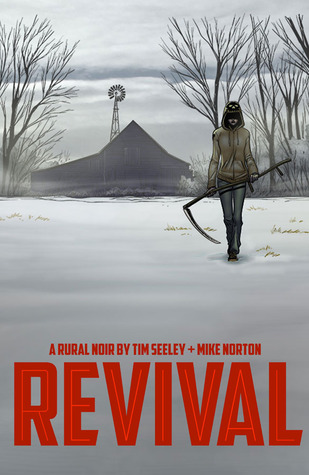
Revival, Volume One: You’re Among Friends by Tim Seeley
A one day “miracle” of sorts happens in a small Wisconsin town. The dead come back to life. No, they’re not plucky zombies who want your brains, and some of them are in better physical shape after coming back to life than before they’d died. However, not all of them are quite right, and the town has been quarantined until it can be decided if really was a miracle, a hoax, or some biological process that needs to be understood and tested because what would something like that mean for humanity. Then, a murder occurs, and everyone becomes a suspect–both the living and the revived. Dana Cypress, an officer in town, finds herself on the case.
Even though this is not a zombie story, it was refreshing to see a take on the dead, perfectly normal human beings that died, coming back to life without being ambling, shambling zombie or a lot of magic and dimensions and alternate realities somehow altering the course of life. I’m exaggerating, but you know what I mean. They’re just as confused as everyone else about what happened, and some of them aren’t quite sane anymore and feel cheated that they were robbed of death and can’t do anything that will end their own lives… almost… And one among them does seem to be a bit more special than the others and seems to have a purpose that hasn’t been revealed yet. And maybe that’s true of all of them. I just know at this point the story is dark-ish, complete with bible verses being quoted in creepy ways.

Book Review: The Blue Blazes by Chuck Wendig
Posted on April 24, 2013 Leave a Comment
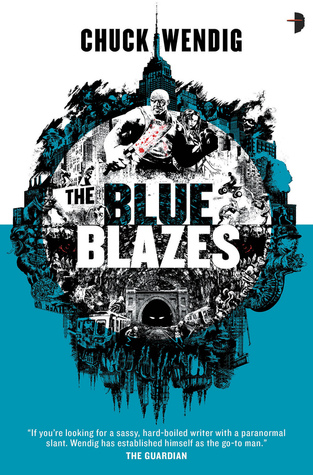 The Blue Blazes by Chuck Wendig
Okay, my first thought after reading this book: Chuck Wendig is awesome! Then, my second thought: Why on earth haven’t I heard about or read anything from this author before now? So, my thanks to Angry Robot for rectifying this, by providing me with an e-ARC of The Blue Blazes via NetGalley. The book’s expected publication date is May 28, 2013.
So what are the “Blue Blazes” anyway? In the book it’s one of the many slang names for a type of drug, a cerulean powder
that when rubbed onto your temples will not only give you one hell of a buzz, but it’ll also allow you to see through the “glamor” of
monsters living amongst the populace. The book is a tale of two Underworlds — a literal Underworld located beneath the depths of New York City where the Blue Blazes are actually mined, as well as a criminal underworld run by a cabal called the Organization which controls the drug.
Mookie Pearl is our main protagonist, a hulk of a man who used to work down in the mines but is now a loyal member of the Organization. Working for the mob is just a way of life, that is until a big secret about “The Boss” comes to light, leading to a power struggle which shakes up the foundations of all the gangs in the city. And as if that wasn’t bad enough, Mookie’s estranged daughter also becomes involved. Now, criminals and thugs he can handle. Same goes for the goblins and other dangerous creatures of the Underworld. But Nora Pearl can definitely give Mookie a run for his money.
The book is like your favorite action movie meets paranormal urban fantasy. It seriously doesn’t stop. Just when you think things are winding down, you get more. Mookie Pearl is all muscle and brawn, preferring to use his fists over his brains whenever he’s in a tight situation. I can’t really say he’s my type when it comes to fictional characters, but if you enjoy non-stop thrills and lots of brawling action, then he’s definitely your man.
I also have to say that I love Chuck Wendig’s wit and punchy writing style. Its almost staccato-like rhythm is perfect for the gritty nature of the story, and I was hooked within the first few minutes of reading. When it comes to dealing with points-of-view, however, I felt the book could have done with less jumping around from perspective to perspective. The scene changes seemed to occur very frequently. As with the prose, I feel that this was quite appropriate for the overall tone of the story, but it also made for some confusing moments where I had to figure out where I was.
Still, the best thing about this book has to be the world-building. Not something I would have expected AT ALL from an action-oriented urban fantasy novel like this, but I do love it when I’m surprised. What Chuck Wendig has created is just simply amazing. Through detailed descriptions, he’s painted an original and convincing picture of the secret Underworld below. For example, I loved the addition of “excerpts” from Underworld expert and cartographer John Atticus Oakes’ journal at the beginning of every chapter. The plot mostly drove me to keep reading, but admittedly, I was also motivated knowing I would be rewarded with more from Oakes. These little tidbits provided background information, complementing the storytelling by filling in the gaps or going into more detail about the life and lore of the Underworld.
The collection of horrifying creatures the author has created also bears mentioning. From the Gobbos to Snakefaces, each are described in such creative detail. Granted, I would not want to meet any of these in a dark alley at night, but I have to admire the imagination and ingenuity that went into coming up with these monsters and the places in which they live. The paranormal aspects, everything from the pigments and their, er, curious drug effects to the supernatural and magical ways of The Blue Blazes universe are unlike anything I’ve ever encountered in the genre.
Bottom line: despite my lack of connection to the main character and some issues I had with the constant scene shifts, these are just personal preferences. I think more important are the book’s strengths, such as the world-building which is exceptionally well done, rivaling some of my favorite epic fantasies. I really can’t praise this part of the book enough. Truly a surprising treasure trove of fresh and interesting ideas.

Graphic Novel Review: Superman – Red Son by Mark Millar
Posted on April 24, 2013 4 Comments

Superman: Red Son by Mark Millar
(A) I don’t like Superman.
(B) This is the best Superman story I’ve ever read.
Twelve hours. That’s all it would have taken to change the course of history and turn the Superman we have grown up with into someone entirely different – or is he that different after all? In Red Son, the capsule from Krypton lands in Russia instead of the United States and, after the boy’s powers manifest, he is taken and raised by Joseph Stalin himself. Superman grows up a communist but, while he appreciates his adoptive father’s ideals, he does not approve of the violent methods. Stalin is grooming him to rule in his stead – just as the people want – but Superman cares nothing for politics. He just wants to help people. I loved this idea because I originally thought that the major motivation behind Superman’s desire to help everyone was primarily instilled in him by Ma and Pa Kent. This implies that it truly is his nature. I adored the scene with Stalin’s jealous son Pyotr who rages at Superman’s compulsive need to fix everything.
When Stalin is murdered, Superman discovers that his super powers can’t save people from poverty. He realizes that the only way he can help everyone is to become president. He puts Russia in order and moves on to the entire world, with only the United States stubbornly refusing him. All the while, the brilliant Lex Luthor continually attempts to defeat Superman in new and interesting ways.
This is a what if? story, but one that doesn’t just skim over the details or throw characters into this alternate realm without good reason for their existence*. Several popular DC characters appear in this story and I was very impressed with their manifestations. I loved how much depth Millar goes into for all the characters, even if for some it is brief. Even though this was an alternate version of the characters, I learned far more about them all than I ever have in their main stories.
*The only character portrayal that really bothered me was Lois Lane – er Lois Luthor. The feisty, bull-headed reporter we know doesn’t really show her head here at all. Instead, we get Jean Grey without the Phoenix entity – a woman defined by the two important male figures in the story. Rather than being Superman’s girl, though they share that brief spark, she’s with Lex who doesn’t give a damn about her because he’s too busy being level 9 intelligence awesome. I would have liked to see Lois as a balancing force in Luthor’s life, but instead he discards her as his focus on Superman intensifies. At least he is polite enough to call her to let her know. And Lois just accepts this. While I appreciate her devotion and determination to stand by her man despite him having no obvious need for her, I just do not see this as Lois Lane and I don’t see any justification for her being with Luthor just because she isn’t with Superman in this incarnation.
I was also a bit concerned with Luthor’s sociopathic portrayal as it began as somewhat caricature-ish. I prefer the Animated Series Luthor who is ridiculously intelligent, but not unaware of emotions. To me, that Luthor simply chooses not to acknowledge emotions, but recognizes that he and others have them and is able to factor emotion into any equation. This Luthor seems oblivious; closer to a mad scientist archetype. But by the end of the book, I was content with where Luthor’s careful machinations ended up.
Otherwise, I loved the incarnations of Wonder Woman – the utter joy she expresses when she tells Superman that she’s happy to finally be talking to someone who can understand her and the sad realization when she comes to understand him. Batman – who’s parents death forges the same man, but this man isn’t merely a well funded crime fighter, and he’s willing to go to any length to bring down Superman and the oppressive communist regime. The Green Lantern Corp and the selection of Hal Jordan as recipient of the ring makes so much more sense than what I’ve known in the past.
And I loved poor, naïve Superman himself – yeah, you heard me. Millar takes the time to show us how smart Superman is, but makes it clear that reading a book really fast and retaining the knowledge does not equate with wisdom. Add to that his misguided idealism and Superman is a deadly force. He is so desperate to help everyone and fix everything that he doesn’t realize that we need be able to help ourselves. I love that Millar didn’t let Superman merely figure this out in the finale. It’s an issue that Superman himself raises and discusses with Diana, but ultimately fails to comprehend as he tightens his grip on humanity in desperate need to protect and fix us.
And oh gods when everything came full circle in the end? Just. Brilliant.
Book Review: The Elves of Cintra by Terry Brooks
Posted on April 24, 2013 4 Comments
The Elves of Cintra by Terry Brooks
This is the second book in the Genesis of Shannara series so expect spoilers if you have not read the first, Armageddon’s Children, which I reviewed here. The second thing to note is that I am not a previous fan of the Shannara series. When I first attempted to read it, I gave up due to boredom. My brother told me this series was really good, so I’m working my way through with an eye on possibly attempting the original Shannara books again.
The Elves of Cintra jumps right in where Armageddon’s Children left off, with the various groups all coming together and separating in new and interesting ways to pursue their now clear-ish quests. Logan Tom, now with the Ghosts, is searching for Hawk, with the once-men hot on their trail. Meanwhile, Hawk awakens in the presence of a magical being who cryptically explains his new status as the gypsy morph and his destiny to save everyone by taking them to the promised land. The elves Kirisin and Erisha, now joined by Kirisin’s sister Simralin, are still seeking the elfstones and trying to convince Erisha’s father, the king of the importance of their mission to move the Ellcrys to a safe location. They are aided by an old historian elf named Culph and they are joined by Angel Perez and her fae conscience, Ailie. Angel is still pursued by the demon Delloreen, now fully transformed into a wolf-lizard creature.
The previous book spent a lot of time introducing the characters and giving them all backstories that made it clear that every human had suffered horrible childhoods that have led them to their currently place in this dystopian world of mutation and violence. They are all survivors in their own way. At the end of the last book, everyone has been set on the quests mentioned above so now, we are reading about how they survive the various pitfalls they meet along the way. Despite the efforts made to define the characters, I have not yet come to care about many of them. The ones that died in this book were not overly memorable and I can’t say a I felt like their friends’ reactions to their deaths were well written enough for me to feel their loss.
A new character was introduced, Catalya, and she alone is the bright spark in the series. A survivor just like the others, she actually doesn’t get one of the melodramatic backstories. Her actions and personality in the face of danger and contempt make up for that loss and easily make her a favourite. When she teams up with one of the Ghosts on a rescue mission, things perked up a bit, but that part of the story continues in the sequel.
But what about the elves? The title implies that this is their story and their quest to find the elfstones and the Loden certainly seems important. But Erisha, Kirisin and Simralen are so unmemorable. Some of the elves they deal with on their journey are quite interesting, but they are not around nearly long enough.
I previously listened to the audiobook, but chose to read the hardcover to see if it affected my judgment. I can conclude that listening to an audiobook would definitely have made the tedium more tolerable, however, it’s much easier to skim over pages when actually reading. The Elves of Cintra did not impress me enough to care about the future of Shannara, but I’m still just interested enough to at least find out how this trilogy ends. Eventually.

Book Review: Overkill by Robert Buettner
Posted on April 20, 2013 Leave a Comment

Genre: Military Science Fiction
Series: Book 1 of Orphan’s Legacy
Publisher: Baen
Author Information: Website
Tiara’s Rating: 4 of 5 Stars
Narrator: MacLeod Andrews | Length: 9 hrs and 21 mins | Audiobook Publisher: Audible Studios | Whispersync Ready: Yes
I originally bought the book as an impulse buy from Audible because they kept taunting me with a deal on certain books. This was one of those books whose description was written in a way to capture the reader’s attention while still managing to be vaguely suspicious. I wasn’t sure if I liked the cover (recovering cover snob that I am), but I decided to give this a try, even if my brain did try to tell me that this was probably going to be Space Rambo. However, since this was my science fiction month and I wanted to round out my selection and adding to the fact that the reviews were mostly favorable, I decided to give it a chance. Surprisingly, it was an interesting listen.
Twenty three year old Jazen Parker agrees to go to a planet known colloquially as “Dead End” with a rich tycoon to hunt one of the deadliest animals in the universe. The payout from this job will help Parker to get a new identity and start his life anew without the threat of the former mercenary group he worked for since he was a teen or the bounty hunters who want to take him back to his home planet to answer for his “crime.” He was born illegally on his home planet, and even though that wasn’t his fault, he can still be punished for his parents’ crime.
It’s really hard to talk about this book without spoiling most of it. You think you’re going into the book just getting a straightforward sci-fi military story with lots of action, and you do get that. However, you also get a well crafted sci-fi story that won’t allow itself to be shoehorned into just another shoot-em-up story. This story explores human nature and the similarities and differences that could exist between two intelligent races by giving us chapters from the alien’s point of view. He finds much of human behavior complex and needless. His own race is at an apex where they are absolutely on top of the food chain on their home planet and don’t need many of the behaviors that humans possess. The longer he travels with his human companions the more he learns about things such as empathy and sacrifice, notions he doesn’t have in his own culture because individuals in his race live solitary lives. They’re firm believers in allowing an individual to meet his destiny alone.
We also learn more about this other race in the process. We learn about their loose society structure and how they’ve managed to thwart genocide by humans by pretending to be dumb creatures. As stated in the book: “Overall the human species tolerated dangers in nature. What they did not tolerate were rivals.” Even though they know they are more intelligent and capable than humans. Humans possess knowledge and skills that make them very dangerous, especially to a territorial, solitary species like his where teamwork is downright disrespectful because it means encroaching on each other’s boundaries. However solitary they are, there is a thread of unity between them, a way they exchange knowledge, history, and ideas among themselves. They’re stubborn about their worldview being the only view and humans are obviously delusional in their opinion until circumstances causes one of them to embark on a pivotal journey.
Humans in this book have conquered most of the known galaxy, becoming so numerous on some planets that it’s a crime to reproduce without consent. (And I don’t really understand why Parkers parent traveled to a planet where it’s a criminal offense to have Parker, but maybe they had no other choice.) It’s even mentioned that they have destroyed other intelligent species after being given resources they needed and have turned back to warring against each other, but with more dire consequences (such as slavery, even though it’s supposedly humane, is a fate for the conquered). Humans are detached from earth, most having never seen earth and know little of its history.
Humans not knowing about their history, even if they’ve never laid eyes on earth, pains me. Parker will sometimes gripe about how trueborns think earth is the cultural apex of the universe and how names like George Washington mean nothing to him. While I can understand the sentiment, there are no other cultures present since it seems that humans have wiped out any other intelligent species, and the culture Parker complains about is the same culture who opened up the universe to humans. Just as Parker’s home world should be just as important to trueborns because it the collective history of humanity. Why wouldn’t the history of earth and humans be some kind of required reading? I’m over thinking this thing.
I didn’t know if I was going to enjoy the narrator at first, but he did very well and I think his characterization of Parker is what really stood out to me. He really made him feel distinct and alive for me. He managed to capture the youth and battle weary aspects of Parker’s personality. Parker is young and naive about many things outside of battle like women, but he’s seen so much war and death as a legionnaire. And MacCleod Andrews did a great job of capturing that.
This was an excellent story. There were a few parts that seemed kind of mystifying (Parker’s parents’ decision on where to have him) and parts that seemed to be quickly cobbled to the story as it neared its end. However, Buettner is knowledgeable about military and made it work in a way that isn’t overwhelming for readers. He also knows how to make characters engaging, and I thought more than once he’d probably be a great writer for the Mass Effect series. I’ll be moving on to book two in this series soon, hopeful that some mysteries remaining are solved.

Book Review: Falling Free by Lois McMaster Bujold
Posted on April 18, 2013 Leave a Comment
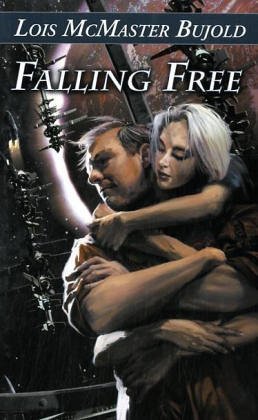 Falling Free by Lois McMaster Bujold
Genre: Science Fiction, Space Opera, Biopunk
Series: Book 4 of the Vorkosigan Saga
Author’s Information: Website
Tiara’s Rating: 3 of 5 stars
Leo Graf a talented engineer who finds himself pulled from his current station to a habitat operating in a system on the fringes of intergalactic law. Leo is chosen to teach welding to a group of special cases. He doesn’t learn how special until he reaches the habitat and witnesses just how loose and fast his employers have played with genetics. Soon, Leo finds himself placed in the center of a revolution, forcing him to confront the ambiguous morality that plagues the Cay habitat, forcing him to take a stand where he’d once only wanted to do his job and stay under the radar.
The quaddies (the experimental humanoids who are classified as “post fetal experimental tissue cultures”) are considered little more than inventory, and the company who funded the project to create them are equally as anxious to find a way to get rid of them once they’re proven to be obsolete. They don’t have standings as human beings. They shouldn’t exist and aren’t protected under intergalactic law. Leo, who has only worked with the quaddies for a few months, seems to be the only person who acknowledges that they are people despite their appearance. He hatches a plan to save them and allow them to live life on their terms. Leo’s plan to help the quaddies gain freedom is enormous in scope and seems a bit too ambitious, but the alternative is far worse. Read More
Princeless and Beyond: An Interview with Jeremy Whitley
Posted on April 17, 2013 3 Comments

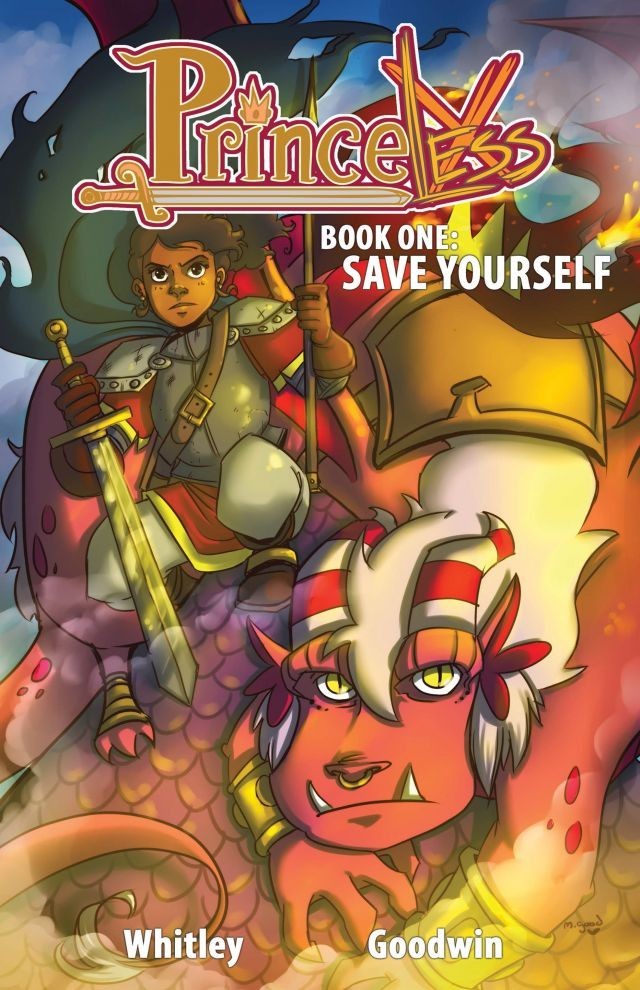 We’ve read Princeless Volume 1: Save Yourself almost every day since I picked it up at the beginning of the month, so when I told my daughters that I’d be interviewing the creator, Jeremy Whitley, they demanded participation. Izzy (4) was eager to learn about Jeremy’s daughter and proudly show off her hair, which is “poofy” just like Princess Adrienne’s. Ivy (7) cut right to the chase and asked Jeremy why he wrote Princeless.
“I wanted to write a book about a girl that was strong, smart and independent – like I want my daughter to be when she grows up.”
Sixteen year old Princess Adrienne Ashe is definitely all that and more. As a princess locked in a dragon-guarded tower, she decides to take her fate into her own hands and save herself rather than wait for some prince to do it for her. Having a strong female person of colour as the main protagonist is certainly a refreshing change, but I hadn’t expected Princeless to cover so many other issues common to the comic book industry, such as sexism and gender stereotyping. These problems were presented in a way that my girls could easily understand and discuss with me, which is exactly what Jeremy was aiming for. “I wanted to put it out there to get adults and kids talking.” The pervasive sexism and, to a slightly lesser extent, racism are issues that have always troubled Jeremy since he began collecting comics. He felt these were significant issues that Adrienne needed to talk about within the context of the story. Some critics complained that the commentary was inappropriate for a younger audience but Jeremy argues that kids can handle a lot more than we give them credit for. Obviously the Eisner Awards agreed, nominating Princeless in the Best Publication for Kids category. Issue #3, the one featuring the call to armor regarding sexism in the industry was nominated in the Best Single Issue category. Not that Jeremy intends for Princeless to be preachy. He promises that volume two of the series, illustrated by Emily C. Martin and available now, will lay off the commentary to allow more focus on the action, characters and story. Well, mostly, he says, sheepishly pointing out the parody cover of issue #2.
Jeremy has a lot in store for us with Princess Adrienne as she and her friends, Bedilia the blacksmith and Sparky the dragon continue their quest to rescue other princesses. It’s an all girls adventure that passes the Bechdel Test, even if he hadn’t purposely put together this female cast with the test in mind. “I didn’t want to create a book about girls with only one girl who may fall into the trap of still having to be rescued.” He cites the current incarnation of Wonder Woman as an example of this problem. Wonder Woman is mainly surrounded by males who’s focus is moving the plot forward instead of the female lead.
 |
| Illustrations by Emily C. Martin
Colours by Soojin Paek |
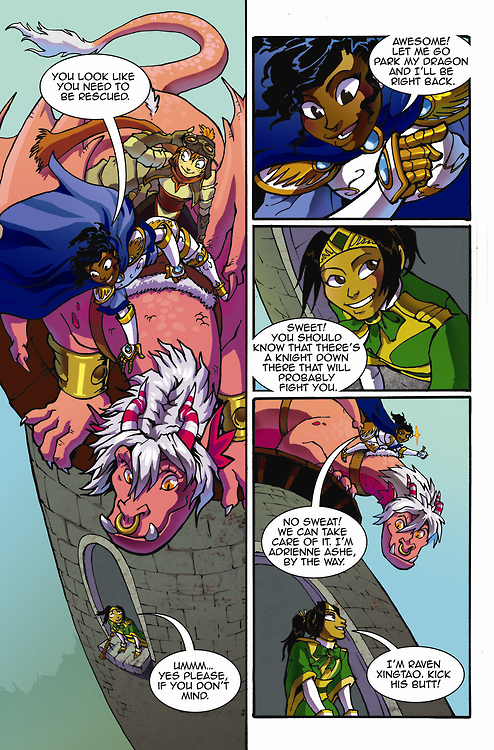
On Free Comic Book Day (May 4, 2013), we’ll meet Asian princess Raven Xingtao in a Princeless story called “Girls Who Fight Boys,” along side Jamal Igle’s Molly Danger. Like the other princesses, Raven is trapped in a tower awaiting rescue. Her tower is guarded by one of the knights hired to hunt for Adrienne’s “killer” who has no interest in fighting girls. While there are similarities in their plight, Raven offers a different perspective that will give Adrienne something to think about. “Adrienne doesn’t have a feel for the fact that not everyone wants what she does,” which tends to be an issue for headstrong people, Jeremy points out.
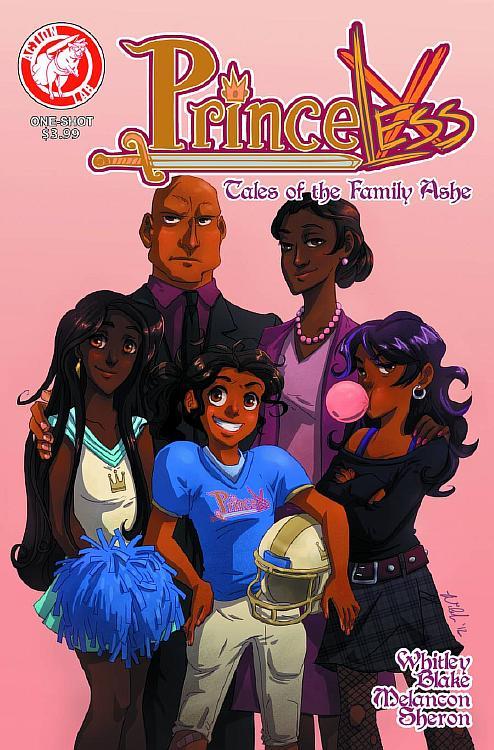
Jeremy hopes to do a story arc featuring Raven and Adrienne, but in the mean time, we’ll be seeing a lot more of Adrienne’s sisters in the main story, as well as in Tales of the Family Ashe. This one-shot will show “what makes them tick and give them a chance to shine.” It will also give some insight into the young King Ashe. Turns out he wasn’t always so curmudgeonly.
While Princeless is very much about breaking the gender stereotype for girls, it also touches on the problems boys have to deal with. Volume 1 features a short story on Prince Charm school and Adrienne happens to have a twin brother named Devin who is constantly reminded of his unkingly ways by his father.
“Devin is a smart kid with a lot of talent, it’s just not a talent his father is at all interested in. Devin is a poet, a designer, a thinker, a creator, and an excellent speaker. All of these would be excellent qualities for a king to have, but his father is interested in having someone that he knows can ride into battle and lead his troops.” [X]
Devin does not feature in Tales of the Family Ashe, but hopefully we will see much more of him some time in the future. Perhaps even in a Princeless cartoon…?
Jeremy recently put out feelers about the possibility of putting together a Kickstarter for a Princeless animated pilot. He would love to see this happen, not for the sake of vanity, but for the same reason he created the comic in the first place. Unfortunately, research and chatting with those who have gone through the process indicate that putting together a Kickstarter is a full time job that requires a “good chef to handle so many ingredients,” which puts the prospect a lot further into the future than Jeremy would like it to be.
Jeremy explains that he has always been fascinated by Lex Luthor and the two personas that have been presented over the years. There’s the Gene Hackman version “who is a crazy smart guy that does things sometimes for profit, sometimes just to be evil.” Then there is the Lex Luthor best portrayed in the animated series, voiced by Clancy Brown where he “may be evil, but is mainly a genius who doesn’t take well to guidance. He’s a self-made man who is irritated by the concept and existence of Superman.”
 |
| A Bibliosanctum exclusive! Cover concept
for Snow Illustrated by Jessi Sheron |
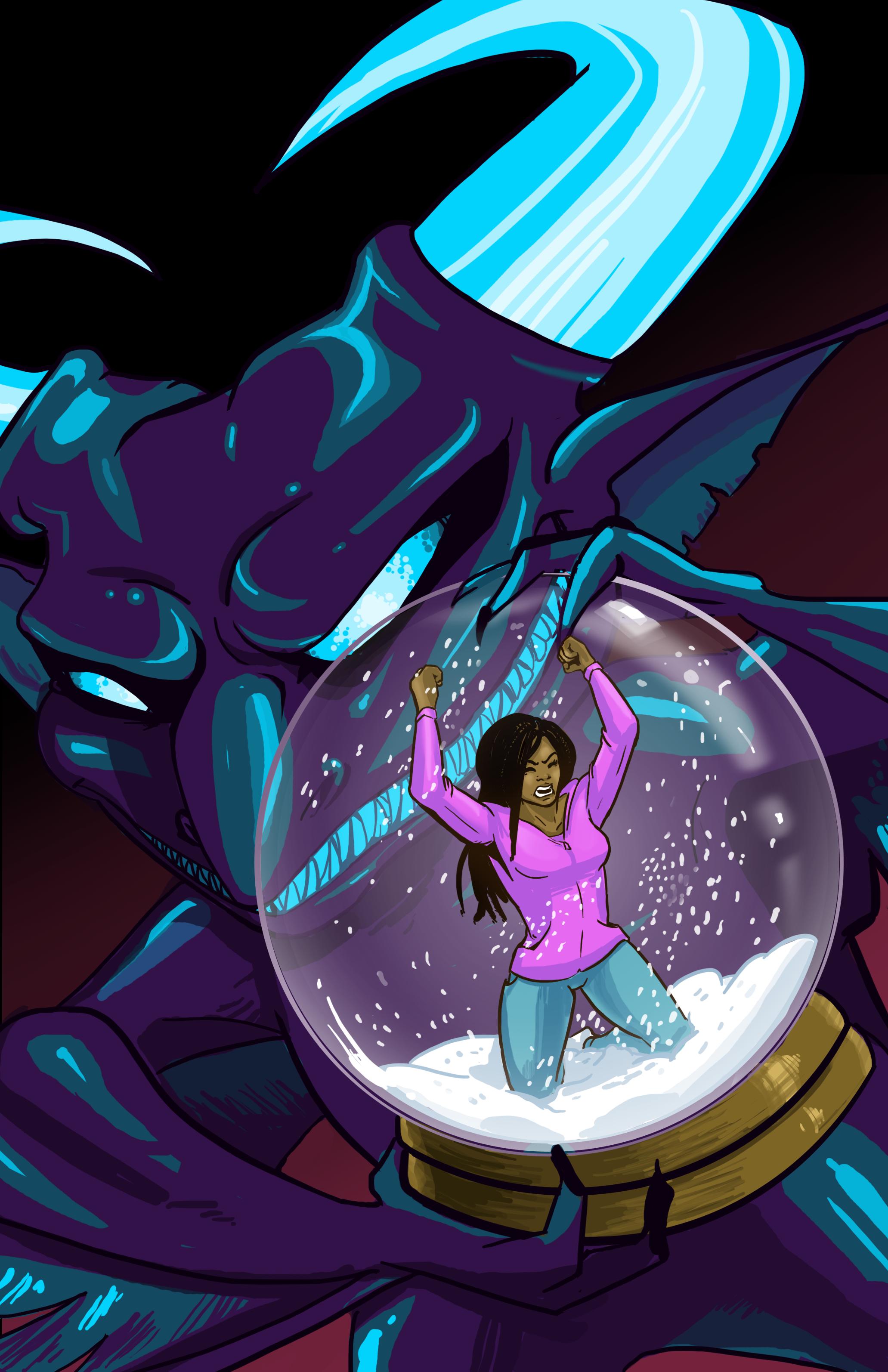
Jeremy’s worked with Action Lab Comics on an NFL Rush book and GlobWorld and is working with artist Jessi Sheron on a dark fantasy children’s book tentatively titled Snow. The main character is a normal young girl who wakes up to find everyone in her house gone and mythical, magical creatures have taken over. Her sister is some how significant to these creatures and the girl goes on a quest to find her.
It’s a pity that Jeremy hasn’t been approached by either of the “big two” publishers in the industry — yet. He is a huge Storm fan and would love to write a book where she features far more prominently than she current does. (We’re pretty big fans of Storm at The BiblioSanctum so excuse me while I put together a politely worded proposal to Marvel…)
And then there’s a secret script that he’s been passionately writing for some time that has yet to see the light of day…
Book Review: Awakening by Karen Sandler
Posted on April 9, 2013 Leave a Comment
Genre: Science Fiction, Biopunk, Young Adult
Series: Book 2 of the Tankborn Trilogy
Publisher: Tu Books (April 9, 2013)
Author Information: Twitter | Website
Tiara’s Rating: 3.5 out 5 stars
First, I wanted to thank Netgalley and the publisher for allowing me to read an advance reader copy of this book in exchange for an honest review.
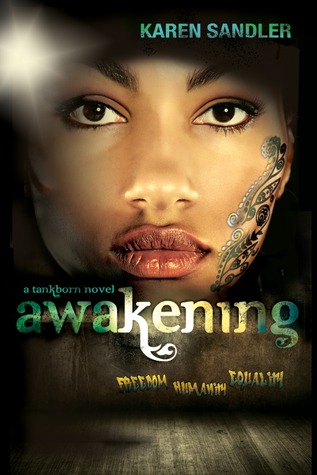
This book picks up some months after the events in Tankborn. Kayla is part of an underground movement working toward freeing GENs from the life of oppression. Kayla, along with her lowborn companion, travel from sector to sector retrieving and delivering information for the kinship (a network of trueborn, lowborn, and GENs working together). While Kayla believes her overall work is good, she wonders if the kinship is truly as dedicated to this cause as they say. Are they truly willing to risk so much for GENs? She knows that most members of the kinship, no matter their social rank, hold her in high regards, but she wonders if this because she’s proven herself. When they look at her, they see an individual. She’s not some insignificant GEN girl. Kayla also continues to struggle with her feelings for Devak, the trueborn boy whose grandfather (and prominent member of the kinship) she cared for in Tankborn. Read More
Audiobook Review: Fool Moon by Jim Butcher
Posted on April 5, 2013 8 Comments
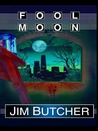
I’m not much of an audiobook person, but I need to do something with this Audible account. After unsuccessfully trying to listen to N.K. Jemisin’s The Killing Moon, due to not caring for the narrator’s voice, I decided to give Jim Butcher’s Fool Moon a chance. It’s narrated by James Marsters (yes, of the BtVS fame).
The second book in The Dresden Files takes place a bit after the events in Storm Front. After business slows down resulting in Harry taking some odd magical jobs here and there, Karrin Murphy contacts Harry for his help on a murder case. She takes him to a crime scene where one of Marcone’s men has been brutally murdered and strange paw prints are left at the scene. Add the fact similar murders have been taking place during and around the full moon for a few months, and you have a formula.
I’ve read the first book twice now, and even though I liked it, I hadn’t ventured any further in the series until now. I just get so bogged down with other books I want to read. I had to work out of town for two days, and I figured this would be the perfect read for my trip since I wouldn’t be able to do much book reading. I try not to listen to anything too heavy and this was the perfect audio book with it’s fast, easy pace. I found myself quickly caught up in the story.
I thought Butcher’s take on werewolves was refreshing, especially how he used “lycanthropes,” who aren’t really werewolves, but people born with the ability to tap into the spirit of rage. When they are under the power of the spirit, they are more aggressive, stronger, and they heal quickly. His four definitions of werewolves in the story gives them real weaknesses and strengths (other than the silver bullet bit, but it comes into play as well) with the werewolves we typically think of, called loup-garou, not being as common in Harry’s world as the other three types.
And Harry, good ol’ self-deprecating Harry. He had me arguing with him so much in this book. His sense of heroic honor seems to make him do the dumbest things and aptly illustrates the point in one of my favorite quotes about just how much dumb luck the good guys have. I’m sure I would’ve been much more annoyed with him if I’d been reading this instead of listening to it because I would’ve spent a ridiculous amount of time rereading and trying to make sense out of the Harry’s madness.
Regardless, I can’t help but like the guy, even when I wish I could reach my hands into the book and throttle him while screaming, “Why would you do that?” That means I care about the character. It’s only the characters I don’t want to suffer so much that I argue with. But I do have to give him credit for the really ingenious things he did do during the course of this story. Also, he half quoted Spider-Man when he went on his “Knowledge is Power. And Power comes with responsibility!” rant. How can I hate a man like that?
Also, I’m glad that Harry was able to understand that he shouldn’t withhold information about the supernatural from people like Murphy. They need that information to have a fighting chance. It’s not enough to say, “It’s dangerous,” and leave it at that, especially when Murphy’s job is to deal with the unknown. They may not use this information as intended, but he would be giving them the knowledge they need to try to stay alive. I’m not saying that he should spill everything he knows. He knows what’s pertinent and what’s not. How can he expect anyone, such as Murphy, to truly understand the gravity of the supernatural when he is only giving them half-information?
James Marsters is a wonderful narrator. True, I did balk a little at first, and I’m sorry for that. I was one of those people who got into the series because of the old Syfy show, and it’s pretty much branded into my mind that Harry is Paul Blackthorne. Marsters really brought the characters to life for me after we crossed that Blackthorne hurdle. He did his best to give each character a distinct personality and a distinct sound, even the women. I loved the voice, the clipped, immaculate pronunciation, he used for Tera. It was like someone who learned English as a second language and still doesn’t understand all the nuances of the English language, which I guess that would describe Tera to a “T.” I love his Murphy as well.
I heard one glaring mistake, though. When the lycanthropes captured Harry, during that moment when he was goading Parker, he called Parker by Marcone’s name. It wasn’t dialogue, just Harry’s narrating/thinking part. He said, “Instead Marcone spun in his heel, picked up a tire iron, and turned back to me…” He meant Parker spun on his heel. Marcone hadn’t even showed up yet at this point. But overall, Marsters’ narrating pretty much made this story for me. I’ve already decided that I’ll listen to the rest of the series, except for the book he didn’t narrate.



 The BiblioSanctum