Audiobook Review: Turn Coat by Jim Butcher
Posted on June 28, 2013 Leave a Comment
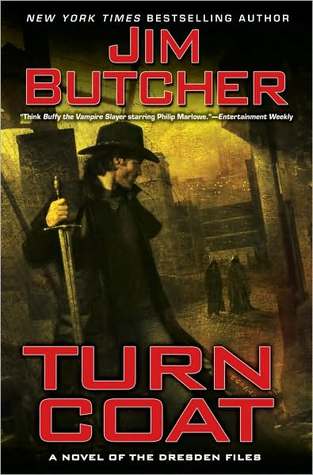
I seem to have developed a habit of reading the first book in a series then skipping a whole bunch to read from the series again. It worked well for me with Star Wars: A New Jedi Order and I can’t complain about my recent run with The Dresden Files.
So now, ten books after Storm Front, Harry has gained an apprentice, werewolf friends, a vampire brother, a warden girlfriend, fae connections, a pizza lordship and subsequent army and a promotion to the White Council. But Harry is still good old snarky, sarcastic, self-deprecating Harry and the man you can turn to and count on when you are in desperate need of help and can’t trust anyone else. Which is exactly what Morgan does when he’s framed for murdering a White Council Wizard. Harry agrees to help him, but doesn’t count on Morgan being trailed by a very powerful, very deadly skinwalker.
I’ve definitely missed a lot – White Court Vampire wars, teenagers becoming werewolves, a big fairy battle – but Butcher does a great job of filling me in on just enough details to make sure I wasn’t completely in the dark, without overloading me or giving away too much. I’d like to think that the balance works well for readers who have been with Harry all the way through. No one wants a full recap of the “previously on” every time they read a new book in the series.
One of the changes that definitely stuck out for me was the increased sexuality. Blame it on the damn vampires, who can’t seem to exist in an urban fantasy setting without bringing all their kink with them. Harry is a male with standard male urges, but they weren’t as prominent in the first book as they are now. At least Harry is a gentleman and apparently so is Butcher. There is a lot of look and appreciate, but no touchie touchie in the sexual interactions. As in, the sex doesn’t take over the plot as it does with certain unnamed urban fantasy writers who shall not be named and shall remain nameless.
It was fun meeting all the new characters and seeing how they interacted. Shout outs go to Mouse, Harry’s dog, who really held his own in all the scenes he appeared in. Man’s best friend brings me to the overall theme of relationships and especially loyalty that runs through this book (and perhaps the series?). Harry’s loyalty to those he cares about and those who put their trust in him remains stellar. Mouse and some of his other companions, like the stalwart Murphy, are unquestionable friends, but the loyalty of others – to Harry, to their respective ruling bodies, to each other is all over the place. At the heart is Morgan’s apparent betrayal and the fact that many of the Council members don’t believe he’s guilty, but are willing to let the steadfast warden take the fall for the greater good unless Harry can find the traitor in the ranks.
Since I’m unfamiliar with the players and the political machinations of the various councils and courts, nothing was overly predictable for me. It was nice to just sit back and enjoy the show. Credit also must go to James Marsters, the narrator of the audiobook, who really nailed Harry’s nonchalant attitude.

Wendy: Favourite Title
Posted on June 27, 2013 Leave a Comment
For my Listening Pleasure: Part 2
Posted on June 27, 2013 1 Comment
 |
| This post may or may not have just been an excuse to post a picture of Claudia Black on our blog. Image by Morhain-stef |
CLAUDIA BLACK: I know her skills as an actress from Farscape and other film and television work and I know her voice acting from Dragon Age and various other games. In all things, she has impressed me to no end, so I expected no less in her audiobook narrations. She did not let me down. In acting and voice acting, she had the advantage of the visuals to aid her performance. Her narrations prove that those are just icing on the cake. She is fully capable of weaving mere words on paper into an emotional adventure. She creates unique personalities for each of the characters not only different accents, but with nuance as well. And, while some narrators reserve emotion for only the characters’ spoken words, Black brings her all to everything, getting completely wrapped up in the moment and dragging the reader along with her for the excitement.
SIMON VANCE: Tiara recently listened to Medicus, read by Simon Vance and sang his praises. I hunted down his resume on Audible and found that he’s basically narrated all the things! At least, he’s narrated a LOT of the books I’ve got on my to-read pile and I am strongly considering that Audible account *just* for him since my library’s selection is so limited. I did listen to You Only Live Twice, though and can firmly second Tiara’s opinion. Early in my listening, she asked what I thought of him and I told her that there was no more Simon Vance. There was only James Bond and Tiger Tanaka. Here is a video of Vance discussing the best book he’s ever narrated, Interview with the Vampire. I’ve read the Anne Rice books he speaks of, but would definitely be interested in hearing them retold by Vance. It always increases the enjoyment of a product when you know the person delivering it enjoys it as much as you do.
HUMPHREY BOWER: Here’s what I had to say about Bower’s work on Shantaram: Bower almost literally brought every one of these characters to life. Slipping from Lin’s native Australian to a myriad of different Indian accents, European, Palestinian, Afghani and more – it was dizzying to imagine how Bower could possibly keep track! Yet he did, making each each character perfectly unique and memorable, bringing out all the beauty and flaws that Lin loved about each one of them
JOHN LEE: I have actually not gotten beyond a few chapters of the China Mieville books narrated by Lee, but that does not mean he is unworthy of praise. In fact, it may be that he is just too good that stopped me from being able to listen to the books. Normally, I listen to books at work. I’m a multitasker and it feels wrong for me to be listening to a book without doing something else. But I found Perdido Street Station and Kraken just too engrossing to concentrate on both my work and listening to Lee. I definitely want to listen to more by him, but for the moment, I plan to read Mieville’s books myself.
JAMES MARSTERS: Like Claudia Black, I was a fan of the actor first. In this case, I knew Marsters from Buffy the Vampire Slayer and admit to squeeing like a fangirl just a little bit when he slipped into a dirty cockney accent for one of the characters in Jim Butcher’s Turn Coat. Marsters made an excellent Harry Dresden, catching all the sarcasm, wit and self-deprecation perfectly.
Book Review: Ecstasy by Irvine Welsh
Posted on June 27, 2013 Leave a Comment
This book contains three stories that revolve around romance and ecstasy among other things.
Lorraine Goes to Livingston is the first story. It was titled a “Rave and Regency” romance. Famed regency romance novel writer Rebecca Navarro (who writes stories such as Lucy Goes to Liverpool and Yasmin Goes to Yeovil) has a stroke, which jolts her out of her dreamworld. When she actually takes a look at reality, she realizes that her husband is a prick who’s using her for her money, and he uses her money for all forms of debauchery. She, along with the help of a nurse — Lorraine, plan revenge on her dear husband.
This was my favorite story in the whole book. The next two stories are powerful, especially the one following this one, but this one held the most value to me. When you first meet Rebecca, you don’t really like her much, but you feel empathy for her. And Lorraine is one of those characters that you can relate to. She’s a single woman who has questions about her sexuality and wishes that everyone would stop trying to force love down her throat. Then, of course with this being your typical Irvine story, you have drug abuse, raves, and some bizarre, disgusting sex practices (bestiality and necrophilia for this particular story).
Fortune’s Always Hiding is the second story and is subtitled “A Corporate Drug Romance”. The story revolves around a woman, who was the unfortunate victim of a drug marketed in the 60’s, and a man, who’s obsessed with soccer (or fitba, as they commonly say ;Þ). The woman is hell-bent on revenge and the man is in love and would do anything for her.
Another powerful story revolving around revenge, but this time it’s against a big corporation who refuses to take responsibility for destroying people’s lives. They’ve given money, but they aren’t truly remorseful about their actions. I loved how Welsh jumped back and forth giving us tiny portions of what happened to the woman, Samantha. This one is my second favorite story in the book as well.
The Undefeated, an Acid House Romance, is about a jobless, drug dealer-slash-raver named Lloyd, and a unhappy, sexually frustrated housewife named Heather.
There’s not a lot that I can say for this story. Most of the story is spent following their everyday struggles and few pages are actually dedicated to their meeting up. Lloyd’s side of things didn’t interest me all that much. It was interesting at times, but most times, I found his commentary lacking. Heather’s side of things was quite fascinating though. It was just something about reading about her going from “good” Heather to “bad” Heather that really kept me reading her chapters.
It seems like I liked the stories in the order they were written. I loved the first and was only partially impressed by the last, even though, I did really love the hopeful ending we get at the end of the last story. Yeah, I’ll admit the characters aren’t all that drawn out, but this is only a 275 page book. What do you expect? Shrek’s analysis? A wonderful addition for people who collect Welsh’s off-beat works.

Mogsy: A Book That Makes You Sad
Posted on June 26, 2013 Leave a Comment
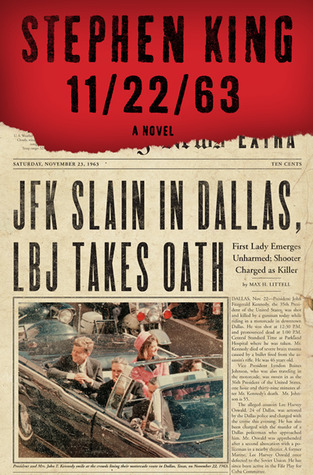
Can I take “Book that made me sad” to also mean “Book that made me bawl my friggin’ eyes out so hard that I couldn’t even see well enough to finish the last page”?
If so, this would be it. 11/22/63 isn’t really that sad per se, but the ending is gut-wrenchingly bittersweet. I found myself at the kitchen table the morning I finished this book sobbing so loudly my husband rushed in from the back of the house to ask me if anything was wrong.
“Uh, yeah,” I said. “Stephen King actually made me cry!”
Yup. Stephen King. Made me cry. I doubt he’d be the first one to come to mind when naming authors adept at pulling heartstrings, and in fact, I believe King has been criticized in the past for his awkward handling of scenes that involve any deep emotion or feeling. For example, you wouldn’t think romance would be his forte.
11/22/63 would prove that wrong. Obviously, the book isn’t a tearjerker romance (Note: it’s not horror either; personally I would say Thriller/Suspense). Still, I can’t deny those emotional factors made it even stronger, and ultimately it’s the love story in the end that stayed with me.
But the book is about so much more! Basically, it’s one giant “what if” scenario involving John F. Kennedy and his assassination by Lee Harvey Oswald that fateful day in 1963. It’s got aspects of time travel, alternate history, historical fiction, thrills and chills — honestly, it’s great. But I’d say the less you know about the story going in, the better the experience is going to be. It’s just one of those books!
Book Review: Seraphina by Rachel Hartman
Posted on June 25, 2013 1 Comment
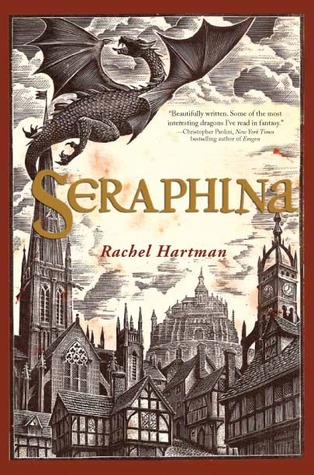
Know how I’ve always marveled and pondered the many ways authors handle the subject of dragons? Well, in Seraphina, they are intelligent, possess advanced technology, and have a magical ability that lets them take human form. The book takes place in a world where humans and dragonkind exist in a constant state of mistrust. After warring with the humans for time eternal, the leaders of the two races had finally come together to agree upon a peace treaty.
Now forty years have passed, and while dragons walk amongst humans at court and in their cities as scholars and ambassadors, bitter feelings still exist between the two sides. The tension reaches a fever pitch in the days before the dragonkind leader arrives to commemorate the treaty’s anniversary, and a human prince of Goredd is found dead, his head missing–presumably eaten by a dragon.
These events hold terrible implications for our protagonist Seraphina Dombegh, a half-dragon hybrid who has struggled to hide her secret for most of her life. Circumstances draw her into the murder investigation, and she finds herself working with handsome Prince Lucian, Captain of the Queen’s Guard, despite her position as the court musician’s assistant. With the day of the anniversary celebrations fast approaching, they have limited time to tease apart a dangerous conspiracy plot.
The world-building in this book is phenomenal; as in, a lot of thought seems to have been put into every aspect of the setting. For example, its rich history adds a lot to the story, and to a certain extent, the reader has to understand the significance of past events to fully appreciate the impact they have on the present. Then there is the complex religion, which encompasses a fair number of saints to which the people of Goredd look to guide them. The religious aspect certainly isn’t central to the book, but at the same time, it adds a layer of context to the story and characters, making them feel more refined.
Then there are the dragonkind and their culture. Let’s just say when it comes to emotional suppression and denial of their feelings, the dragons in Seraphina make the Vulcans on Star Trek look like cuddly puppies. The idea that they can look like humans is also very interesting, if not wholly original, but what I found amusing are the dragons’ general impressions on having to take human shape; I just wished there were more details on the magic involved during the actual changing process.
And speaking of magic, on the whole, the concept of it in this book is quite abstract. Seraphina, for instance, has to regularly “tend a garden” in her mind in order to control the debilitating visions that overtake her, thanks to the powers she inherited from her unusual parentage. If you’re anything like me, it’ll take some time to wrap your head around this bizarre idea, which really is more a part of Seraphina’s abilities than a metaphor, which I know it sounds like.
So why am I not absolutely crazy for this book, like I should be? Unfortunately, some books that by all rights I should adore are diminished in my eyes by the characteristics of the main protagonist, and this was the case for Seraphina. Try as I might, I just couldn’t connect with the eponymous heroine as I’m usually not a fan of the “wallflower-type” character. Granted, Seraphina has all the reasons in the world to be the way she is, but she’s still a bit too far on the meek side of things for my tastes. It’s true she displays moments of strength and determination, but then also wallowed in her self-pity one too many times for me to truly engage with her narrative.
Don’t get me wrong, this book was a wonderful read and I’m glad I picked it up, but being able to like the main character is a biggie for me, and it was that one thing that prevented me from giving it a higher rating. Overall, however, Seraphina is an impressive debut featuring excellent world-building and very imaginative elements. It’s classified as Young Adult, but a wider audience could definitely appreciate this.

Wendy’s Book Haul (aka Book Lootz!)
Posted on June 24, 2013 Leave a Comment
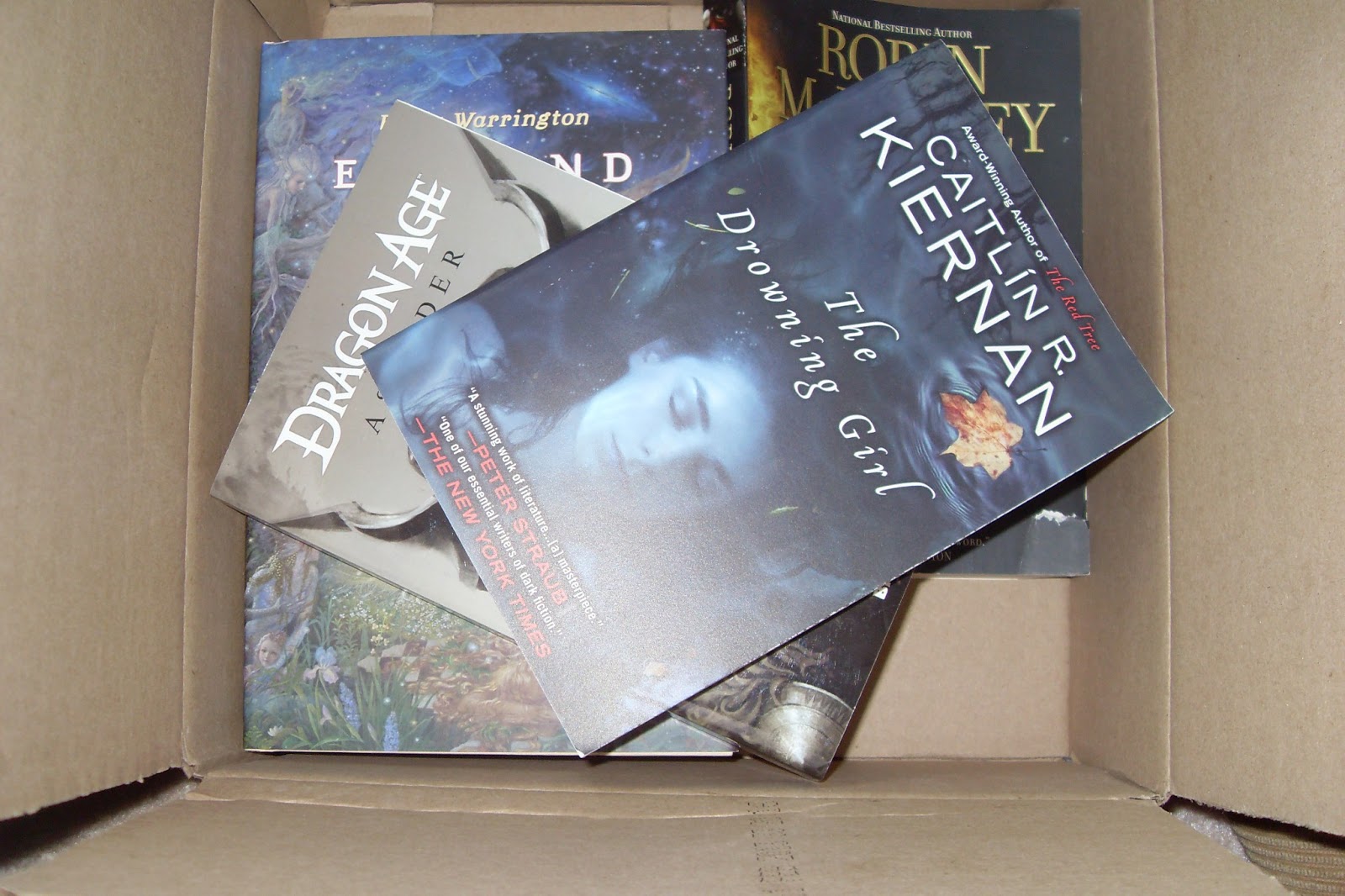
I told Mogsy that my latest BookCloseOuts order had arrived and she demanded visual evidence. So here it is!


Book Review: A Natural History of Dragons by Marie Brennan
Posted on June 24, 2013 3 Comments
A Natural History of Dragons: A Memoir by Lady Trent byMarie Brennan
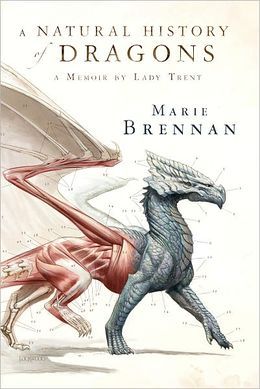
Wow, I really liked this book — everything from the story and the characters and the writing down to its stark yet elegant cover which first drew my eye to its spot sitting on a store bookshelf. I blame my background in the biological sciences, since it seems I can’t help but be intrigued by anything that looks like it has anatomical drawings on it.
As indicated by its title, the novel is told in the form of a memoir from the venerable Lady Trent, leading research and expert on the matter of dragons. But in the time her story takes place, she was known simply as Isabella Camherst, a newly married 19-year-old lady of Scirland in a society where women were still mostly restricted from taking up the scholarly pursuits. This book is an account of how her love for dragons and science manifested at a very young age, and how a serendipitous opportunity to join an expedition to study dragons changed her life.
How interesting could this book be, I initially thought to myself. Is this whole thing going to be about some fictional old lady waxing nostalgic about her life researching dragons? I think a part of me expected nothing but a collection of anecdotes. I also might have had it in my head that this was going to read like a fantasy version of something like Jane Goodall’s Through a Window, except with dragons instead of chimpanzees.
In the end, none of what I thought came even close, because there actually was a plot, and a pretty good one at that. I was surprised to see there was a thread of mystery woven into the story: something strange is afoot in the host village Isabella and her companions are staying in, and on top of that, the native species of rock-wyrm has become prone to attack humans, which isn’t their usual behavior. These are the questions that Isabella has to answer while their expedition is in the Vystrani Mountains.
Of course, there ended up being the anecdotes I’d been expecting too, but they mostly came near the beginning. I didn’t like these as much as I liked the main story about the expedition, but they did give pretty good insight into Isabella’s character and personality. I didn’t care much for some of her childhood experiences because often she came across as too much of a brat, but I did love the story of how she met her husband Jacob. It was such a sweet, awkwardly romantic scene that I swear my eyes practically started watering up along with Isabella’s when she burst into tears of happiness.
My favorite thing about the book, however, was its overall concept. I didn’t think I was going to take to the writing style, what with the stuffy narration from the get-go, but it actually came across in a very natural way that was nowhere near as distracting as I’d expected. What struck me is that you could also easily contrast the young, impetuous and excitable Isabella in the memoir to the older, more mellow and experienced Lady Trent who is “writing”, and still get the sense she retained all that determination and humor in her personality. I thought it was a cool way of presenting the novel, and Marie Brennan pulled it off perfectly.
Also, I’ve seen fantasy deal with the subject of dragons in many ways; sometimes they’re the monsters for the heroes to kill, sometimes they’re intelligent and have the ability to speak, forming partnerships with humans or even taking human shape, etc. However, I personally liked how this book tackled the matter by painting dragons as simply another kind of wild animal species, as well as the main character’s biologist/naturalist perspective to want to observe and study them. Like I said, perhaps it’s due to my own educational history and interest, but this aspect of the book really appealed to me.
This was just a great read all around, the experience made even better for me because it was such an unexpectedly pleasant surprise. To summarize: A very good book featuring an interesting concept, engrossing plot, and a refreshingly strong female protagonist.

Wendy: Favourite Female Character
Posted on June 23, 2013 Leave a Comment
I have several favourite female characters, two of whom have already appeared in Character Appreciation Posts. For the reading challenge, I opted for someone a little more unusual. In fact, Vergere is a Star Wars character that I mocked, initially, because really? She’s a Jedi chicken! How could I possibly take her seriously? Then I read Traitor and Vergere was transformed from a source of ridicule to a subject of respect, curiosity and maybe even some awe and adoration. She may have even surpassed my previous Jedi Masters, Kreia and Jolee Bindoo, taking the deconstruction of the force and the ways of the Sith and the Jedi to an entirely new level, as manifested in her pupil, Jacen Solo. She shreds her pupil to his core, separating him from everything that he is and pushing him towards uncertainty. In the end, he learns a truth about the force that I have always wished would be explored within the Star Wars realm. Vergere is identified most readily as Sith and therefore evil, but her actions and teachings spoke much louder than that simple definition.
Comic Review Bites
Posted on June 23, 2013 1 Comment

Mystery Society by Steve Niles and Fiona Staples
A sexy couple with the means and the motivation to solve some of the more unusual crimes are recruiting members for their new Mystery Society. Conveniently, a ghoul named Secret Skull and Jules Verne’s brain encased in a quirky robot body apply for the job. Add the atomic twins that Nick Mystery rescues from Area 51 and we have the makings of a really fun team.
Unfortunately, in spite of Fiona Staples’ fantastic artwork, this great concept falls flat with sub-par plotting, sub-par subplotting, a lack of mystery, an annoying antagonist and rather lame attempts at wit and humour. This comment is very negative, but I’d like to think that it’s a negative with a lean to the positive. As in, I can see a lot of potential for good old fashioned tongue-in cheek mystery wagon fun with this book, if it can stop trying so hard and just relax and enjoy itself.

 We3 by Grant Morrison and Frank Quitely
Three lost pets are turned into war machines but as prototypes, their phase of the test program is complete and WE3 are set for termination. Their chief handler disapproves of this and gives them the means to escape their fate. Out in the world, they deal with their hunters with brutal precision that reflects their individual natures but in their hearts and minds is a single word: “home.”
I think a true animal lover will find this book even more gut-wrenching than I did, but I can definitely appreciate the emotions attached to it, especially with the lost pet posters that begin each chapter.
This was recommended to me when I asked for a good Grant Morrison story. The story idea was really good and I liked that there was not a lot of dialogue and exposition. Morrison truly allowed the art to speak and Quitely delivered admirably. I loved the way the visuals begin from a pet’s eye view and I loved the unique splash pages, particularly the one that separated the page into a mosaic of frightening violence.

 X-Men: Magneto Testament by Greg Pak and Carmine Di Giandomenico
The best thing about this series is that it is not about a superhero/villain or mutant, but about a very human boy forced to become a man during the Holocaust. We’ve always known about Magneto’s past, but we’ve never seen it. Not like this. I kept wondering if and when his powers would manifest, as we’ve seen in various other incarnations of his story, but the harsh reality is … painful.. and educational.


 The BiblioSanctum