Book Review: The Lives of Tao by Wesley Chu
Posted on July 5, 2013 1 Comment
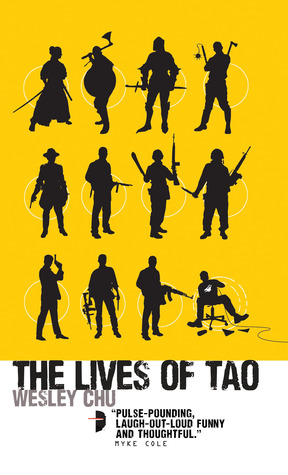
First, I would like to thank Netgalley and the publisher for allowing me to read this book in exchange for an honest review.
Roen Tan is an out-of-shape IT tech just trying to make it through the daily grind when he becomes the host of an advanced alien named Tao. When he finally becomes aware of Tao, Roen thinks he’s about to live the glamorous life of a super spy as Tao gives him knowledge beyond his measure and starts whipping him into shape with diet and exercise. Roen quickly learns that James Bond’s glamorous life is a complete fraud and that spy work is tedious, time-consuming, and nothing like a superhero movie. However, Roen does find himself with Tao’s help and begins to push past his safe boundaries.
The first thing you should know about me is I always root for the underdogs. I am a huge fan of unconventional heroes doing unconventional things, especially unconventional things they seem ill suited for. Roen fits all of those qualifications. Reading this story was like watching an awkward friend grow into a graceful swan. It was funny, endearing, and just a tad bit cute—all things considered. At the beginning of this story, Roen isn’t living more than he’s just existing. He wants a better life, but he’s not motivated to take the steps needed to achieve that until he becomes Tao’s new host.
Tao’s people have lived on earth long before humans were even conceived, and they’ve been working just as long to find a way off this rock. This has been a very slow process for them since their survival on Earth means they have to rely on host bodies to protect them and carry out the tasks necessary to their goals. As with any group trying to achieve a common goal, though, there’s dissension about how that goal should be achieved. For this reason, after many years of working together, Tao’s people split into two factions—the peaceful Prophus and the warlike Genjix.
Second thing you should know about it is that I love history, so I appreciated how Chu incorporated that into his story by having the Prophus and Genjix part of every pivotal moment of history and explaining a little bit about how their involvement shaped those moments. Tao, who is part of Prophus, admits that both sides have done some terrible things throughout history, but sometimes, you have to choose the lesser of two evils for the greater good. This is one of the things that Roen begins to struggle with as he becomes a better Prophus agent.
Roen made me laugh out loud and roll my eyes often at the same time. The character felt like the type of friend I’d call up and say, “Calm down, man. Breathe. Now, you go and be awesome, Roen.” He reminded me so much of someone I know who I could picture in Roen’s place doing the exact same things. Over the course of the story, he didn’t become some supreme super spy, but he grew as a person and as an agent. He came to terms with his new mission in life. Yeah, he did some amazing things during this, but through it all, Roen managed to continue to feel like an everyday person.
I loved Tao’s seriousness tinged with just a hint of humor, and I thought the story of his race and their struggle was interesting. Their role in history and the vast knowledge they possessed was a nice touch. Even though they seem to have all the elements there to be a super race, they’re still hindered by their divisiveness, vulnerability and lack of resources on a planet that they’re basically manipulating down this technological evolutionary path to aid their agenda. I wish I could’ve learned a little more about Tao’s people, but that’s such a small complaint for an otherwise fun book.
This was a wonderfully engaging story. The tone used felt very familiar, giving the story a very easygoing feel that kept me reading. It doesn’t seem to take itself too seriously, which was a welcomed break from all the grimdark I’d been reading lately.

Book Review: Robopocalypse by Daniel H. Wilson
Posted on July 3, 2013 2 Comments
Robopocalypse by Daniel H. Wilson
Robots determine that humanity is obsolete and must be cleansed. This is simple and common science fiction concept and one I have most recently been dealing with in Mass Effect. I spent a lot of time relating things back to the Morning War and Starchild and, most importantly, to Harbinger. Hell, this entire quote from the book might as well be Harbinger’s manifesto:
“I will murder you by the billions to give you immortality. I will set fire to your civilization to light your way forward. But know this: My species is not defined by your dying, but by your living.”
Had I read this at an earlier time in my life, the comparisons would have been to the Terminator saga or Bubblegum Crisis or Battlestar Galactica. As I said, the idea of our robot creations taking over for the sake of our salvation is not new and I can’t say this was a stunningly memorable entry into that theme.
One of the major problems I had with this book was its first person narrative. The chapters are retellings as documented by Cormac “Bright Boy” Wallace, a soldier in the New War against the machines. According to the story, at the request of the machines, out of respect for humanity’s resistance and resilience, surveillance footage was presented to Wallace that he may record the major events that led to the ultimate destruction of the machine leader. My suspension of disbelief had problems with the fact that there was surveillance to cover all aspects of the story told (even in the robot-free forest), and that Wallace was able to convey the emotions of the people as well. I would have preferred if the author had not bothered with the pretext of Cormac composing the stories of the heroes and allowed the heroes to tell the stories themselves.
That said, the format itself, sans Wallace being the one writing it, worked well enough, though I can’t say the characters were given much depth outside of the situations they were presented in. I appreciated that things didn’t dwell too much on getting to and from the various places and instead just focused specifically on the characters and exactly what actions made them heroes in the eyes of both humans and robots. Although, by the end of the book when there was a great distance to go and presumably there would have been hardships on the way, the format fell short. It became too easy to move from A to B to accomplish the goal.
Once again, the robot apocalypse concept is not new, but it was retold reasonably well enough to get the point across here. Robopocalypse covered many of the basics, including how humans will behave when faced with such odds, but it was, ultimately, a guide book: In case the robots get uppity, break glass.

Audiobook Review: The Way of Shadows by Brent Weeks
Posted on July 3, 2013 1 Comment
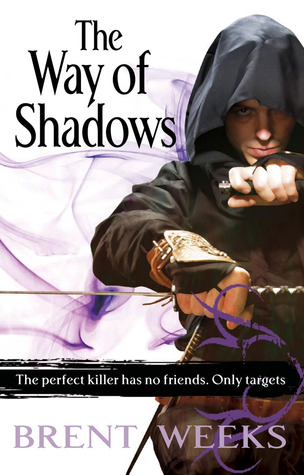
The Way of Shadows by Brent Weeks
This is the story of a young boy who discards his old life to become a not-so heartless assassin (aka wetboy), apprenticed to a heartless master assassin who eventually reveals that he was once like the young boy and more, but then love happened etc, mysterious past, etc., and finally, the inevitable fate of master and apprentice. Surrounding these two are several characters for the young boy to befriend, ensuring that he always fails the assassins’ number one rule of not caring about anyone. And finally, political machinations, a prophecy and foreign invasion to round out the background plot. Oh and some suddenly magic, but more on that later.
I wanted to like this book, based on the praise it has received, but as you may be able to tell by my tone, I was not unimpressed by the predictability and struggled to get through it over all. I listened to this as an audiobook book and although I wasn’t overly impressed with the narrator, I don’t fault him for being unable to make this book better through narration.
I assume I was meant to like the main character, Azoth, but I found his whining and hesitation tedious and I never did appreciate his motivation to apprentice to Master Durzo Blint in the first place. His downtrodden life was basic plotting and the boy lacked conviction. I also failed to understand why the leader of the group he belonged to found Azoth to be so special and talented that he wished to use him as an example of power. Basically, Azoth was set up by others to be more than the author ever let me see of him, before his transformation, or during. And after his transformation into a deadly assassin, he became so cliche, magically able to kill off a whole contingent of skilled soldiers all by himself to sort of save the day. At one point, Azoth “dies” – I’d warn you of spoilers here, but I did say this was a highly predictable book – and I found myself hoping that Weeks would surprise me and get rid of the annoying kid and just let me have more of Durzo. The mater wetboy was a very intriguing character and definitely the highlight of the book, especially when we get to learn little pieces of his past.
Somewhere along the way, magic shows up. A glowing sword choosing a master. Magi. Healers. A fireball or two. Immortality. Special “Talents.” It’s presence was enough for me to raise an eyebrow because the magic seemed to pop up from no where from time to time and serve no real purpose other than being magic, until the end when everyone was flinging it around like confetti.
Save for Master Blint, this book simply didn’t work for me.

Book Review: Abaddon’s Gate by James S.A. Corey
Posted on July 2, 2013 6 Comments
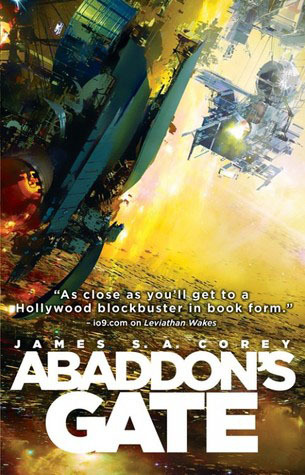
Abaddon’s Gate byJames S.A. Corey
Ever since I read Leviathan Wakes, I’ve become a fan and follower of the team behind the pseudonym James S.A. Corey — authors Daniel Abraham and Ty Franck. The Expanse series is the most fun I’ve had with a space opera in a long time, and from what I heard there may be more novels and short stories to come set in this universe. I sure hope so, and there’s also apparently a couple Star Wars novel projects by them in the works, which makes me fantastically excited.
Anyway, coming back to my thoughts on Abaddon’s Gate, this book is the third installment of Expanse, so as a caveat there may be mild spoilers in this review for the first two books in the series. The story continues with the adventures (and misadventures) of the crew of the Rocinante; things are never boring for Jim Holden and his team.
The mysterious proto-molecule that had been uncovered and released into the solar system has somehow created a massive ring structure just outside the orbit of Uranus. It appears to be a gate leading to a dark void on the other side, and the Rocinante finds itself joining a vast flotilla of science and military ships venturing out to study it. However, Holden’s involvement is no accident. Unseen forces and players have been pulling the strings behind the scenes to get him and his crew right where they’re supposed to be.
Admittedly, I thought Abaddon’s Gate was quite slow to start, but so far I’m finding that to be the pattern for all the books in this series. I likened the pacing of the first couple of books to a ride on a really tall roller coaster, where you spend a lot of time doing a slow climb to the apex before the excitement and thrills can truly begin in earnest. Using this metaphor, I would say that this book was about 75% chugging up the lift hill — the first three-quarters of it did not wow me at all, and at times even annoyed or frustrated me, but I recognized it all as the necessary story and character build-up.
The remainder of the book, however, was all good stuff — the roller coaster’s loops, dips, corkscrews, etc. so to speak. I could not put it down. I think I stayed up late and burned through the rest of the novel in an hour and a half at this point, when reading everything that came before probably took me three days. The last 25% was just so damn good, it warranted a rating bump by one whole star from me because of it.
One other comment I’d like to make pertains to the characters. The stories in these books are told through the points-of-view of multiple characters, each chapter focusing on the perspective of one person and alternative or cycling through the players. The names of these key players have changed up throughout the course of the series, with the exception of Holden, whose POV has remained a constant perspective in all three books. In spite of this, however, I can’t say that his character has ever truly grown on me; instead, my interest has always been bolstered by my enjoyment for the other POVs. For example, in Leviathan Wakes, it was Miller. He wasn’t in the next book, Caliban’s War, but there I had Chrisjen Avasarala, my favorite potty-mouthed UN politician.
In Abaddon’s Gate, however, I didn’t develop that kind of liking or connection for any one on the new players. Melba/Clarissa? Her character and story was kind of whacky, and felt a little forced and rushed. Bull? His POV was slightly better, but only because his character really stepped up during the book’s climax and final showdown. And Anna? I could not stand her self-righteous moralizing and idealistic naivete at all. Of course, all the characters are the way they are because they have their own roles to play; I understood that, but the lack of a good character for me to really get excited for was still mildly disappointing.
I want to end this review on a positive note, though, and the good news is that for anyone who has been following this series, Abaddon’s Gate as a sequel is definitely worth picking up. It continues the mysterious plot of the protomolecule and answers some questions while posing more others. The ending to this leaves so much potential. Whatever happens, I really hope we won’t have long to wait to find out.

Mogsy: Favorite Quote From A Favorite Book
Posted on July 2, 2013 Leave a Comment

“It’s a truism in policing that witnesses and statements are fine but nothing beats empirical physical evidence. Actually it isn’t a truism because most policemen think the word empirical is something to do with Darth Vader, but it damn well should be.”
July Book Club Read: The Drowning Girl
Posted on July 1, 2013 Leave a Comment

With the winners of the 2012 Nebula Award announced last month, members of the LeVar’s Rainbow Book Club selected The Drowning Girl by Caitlín R. Kiernan from the list of nominees.
India Morgan Phelps – Imp to her friends – is schizophrenic. Struggling with her perceptions of reality, Imp must uncover the truth about her encounters with creatures out of myth – or from something far, far stranger…
Cover Lover: The Dire Earth Cycle
Posted on July 1, 2013 Leave a Comment

I’m currently reading and loving The Darwin Elevator and Mogsy is already planning for book two this summer. This is a trilogy that began as a NaNoWriMo project and has now ended up on various summer reading hot lists! To add to our excitement, author Jason M. Hough announced on his website earlier last month that Simon Vance is going to be narrating the audiobooks! As you can tell, we’re pretty excited about this series. Here are the UK (my favourite) and US covers for the books that should definitely be on your to-read list for 2013.


Book Review: Firebrand by Gillian Philip
Posted on July 1, 2013 Leave a Comment
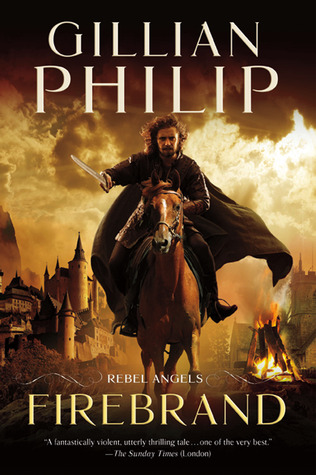
It’s been a while since I’ve come across such a difficult book to write about. Part of the issue involves the subject matter, themes, and ideas in Firebrand which all seem at variance with each other. This in turn gives me mixed feelings about the novel, because I struggle to even pin it down.
For example, at once it has the features of a historical fiction and yet also major elements of fantasy, specifically those pertaining to Celtic mythology. A big chunk of the book takes place in the Middle Ages, at the height of moral panic and mass hysteria over the devil and fear of witches. Unbeknownst to the humans, however, another world exists beyond the Veil, home to a race of beautiful immortals called the Sithe.
One of these beings is sixteen-year-old Seth, sent away from home by his insane mother Lilith who is adviser to the even more insane Sithe queen Kate. Seth grew up under the care of his father as a result, and became close to his older half-brother Conal. So when Conal is exiled to the other side of the Veil after a tiff with Kate, Seth follows voluntarily. The siblings are then forced to live amongst the mortals, attempting to hide their differences and Sithe powers in an atmosphere of danger, paranoia and superstition.
The book opens with a scene that tells the reader right away that the two of them have already failed. Caught up in a witch-hunt, Conal has been captured and is headed for the stake to be burned. I have to say it felt strange to have the climax of the novel presented to you in its first several pages, but it’s also quite effective. Seth is left with not many choices, and you are left wondering what he might do and how the brothers got into this mess in the first place. The rest of the book tells that story.
It’s entirely possible this is what made Firebrand feel so disjointed for me. At the same time, I also feel like there’s not enough context given throughout the novel, certain sections giving me that strange sense I’m missing out on huge chunks of the story even though I know I’m not. It feels like there’s an expectation for me to know everything that’s happening around these characters, and even though Seth is the narrator, I often have trouble following his train of thought as he moves from action to action. It’s like we’re not always there with him in his head, perceiving or understanding things the same way he does.
Also, despite the ages of the main characters and the particular themes in this novel, I would hesitate to really categorize this book as Young Adult. This is just another one of those aforementioned contradictions I spoke of, because despite the nature of the marketing material and blurbs I see covering the dust jacket of my hardcover, it just doesn’t read like YA. I can’t really put my finger on why, as I wouldn’t say it’s inappropriate for the young adult audience either. I suspect the immortality of the Sithe characters may have something to do with it, as I see a stark difference between them and typical YA protagonists when it comes to their attitudes, way of life, and beliefs.
Whatever it is, somehow I just don’t feel Firebrand fits the mold. For better or worse, I also think that about many other aspects of this novel. It was certainly a bit different, and the positive thing is I didn’t dislike it — in fact, I enjoyed reading this, but I don’t think I can say I really loved it either. I think if its story and themes were more cogent, my thoughts and opinions on this book might have ended up less ambiguous.


Audiobook Review: Path of Beasts by Lian Tanner
Posted on June 30, 2013 Leave a Comment
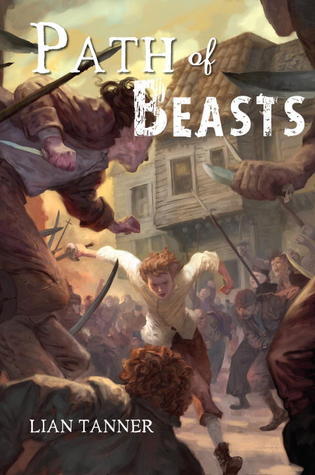
We return to the adventures of Goldie and Toadspit in this final installment of the series, which picks up right where we left them in City of Lies. The children return to Jewel after their harrowing escape from the kidnappers in Spoke to find that their enemy the Fugleman has taken over the city with his Blessed Guardians and an army of mercenaries.
It’s showdown time now, and the Keepers will have to devise a plan to protect the Museum of Dunt and the people of Jewel. The Fugleman, however, has brought in a giant cannon, and is bent on taking over the city and destroying everything Goldie holds dear. To make things worse, Goldie had not escaped from Spoke entirely unscathed; after the effects of “The Big Lie”, she holds in her head the personality and thoughts of a long-dead warrior princess. Day by day, Princess Frisia’s presence grows stronger, threatening to take over Goldie’s life.
And so, my journey with the Keepers Trilogy draws to a close, and with it, probably my last opportunity to enjoy Claudia Black’s wonderful narrating work for a while. Looks like she’s got a handful of other audiobooks under her belt, but I also hope she’ll do more in the future; with her voice and talent, I think she would be perfect for urban fantasy.
As for the book itself, it hurts me a little to say this, but I wasn’t as happy with it as I’d expected. It wasn’t that the story was bad or that it didn’t provide us with a satisfying ending to the trilogy. I just find myself viewing this book with an almost frustrating ambivalence, because I even now I’m trying to think of something–anything, good or bad, it doesn’t matter–to say about this book and I’m struggling.
It almost makes no sense for me to feel this way; after all, the story was great — the heroes overcome their trials and tribulations, honor prevails, everyone comes together in the end to save the city, and the bad guy is defeated while the good triumph, all that good stuff. It’s a children’s series after all, you know you’ll get a happy ending and nothing’s gonna come out of left field at you.
And maybe that’s what it is. Not that I have an issue with books for youngsters having happy endings, but the fact I pretty much knew everything was going to work out in the end. Which is perfectly fine; like I said, it’s how things should be, but I personally prefer more a little more uncertainty in my plot lines which is likely the main reason why I don’t usually pick up books targeted for middle-grade.
But on the whole, these have been really great books. I probably enjoyed them even more because I listened to them all on audio, but I certainly don’t regret my time with this trilogy one bit.
Feel free to also check out my reviews for other titles in this series:
Book 1: Museum of Thieves
Book 2: City of Lies





 The BiblioSanctum