Review Bites
Posted on July 11, 2013 2 Comments

Water Witches by Chris Bohjalian
Scottie Winston’s wife, sister-in-law, and daughter are all dowsers or “water witches,” meaning they can divine the location of water sources. He finds himself at odds with his family when he lobbies for a ski resort that wants to move into the drought stricken town and use the river to make snow for the resort.
This was an okay book. I was expecting a little more magical realism, but what I got was more of a conservative versus liberals, environmentalist versus non-environmentalist stuff. Not that there’s anything wrong with that, but I thought I would learn more about dowsing. Now there are some real juicy tidbits in this story like Patience’s belief that a man can’t be a dowser because only women are connected to fluid and to the earth. But mostly it was just a book about differing political/environmental stances.

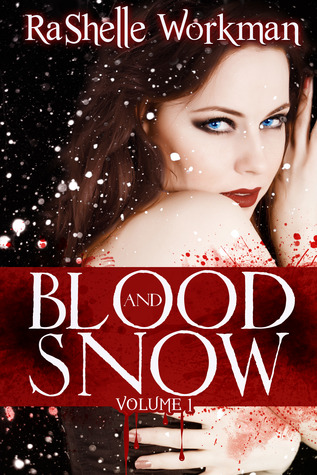
Blood and Snow by RaShelle Workman
The vampire queen choses a new host body every thousand years. She’s chosen Snow White, a girl who’s spent most of her life being teased about her fairytale name, to be that girl. Snow White is bitten by The Hunter and becomes a being that’s neither human nor vampire.
Ugh, from the seven close male, rich friends living nearby to just EVERYTHING, I was annoyed by this. I know many people enjoyed this, but I’m not sure this story is for me. I think I’ve just moved beyond the phase where I would’ve really appreciated something like this. It managed to do every single thing I hate about some YA novels, but the premise was interesting, which is about its only saving grace right now with me. I’m putting the rest of these books (novellas really) on the bottom of my TBR pile where I will wait for the day I feel compelled to continue this story. Hopefully, later parts will make me forgive this part because it has potential, but this was not it for me.

The Last Werewolf by Glen Duncan
Jake is the world’s last werewolf, and he just turned 201-years-old. Don’t let the years fool you, though. Jake has aged well over the years. Sex and a good diet will do that for a werewolf. However, after finding that he’s the last werewolf after hunters killed the only other remaining wolf, Jake begins to think about how lonely life is and maybe the time of the wolf is over. He decides that he’ll choose his own death. However, there are people who are intent on keeping Jake alive for differing reasons.
I thought the book was well written. But it was a real struggle to get through for me. I had pretty much had to force myself to finish this because I hate quitting books, especially when they’re not technically terrible. The language and style was exceptional, but I found myself spending so much of the book saying, “Can we get to the point, Jake?” which is so rare for because I tend to love rambling and wordiness in books. Jake is like that guy who gets caught up in his own romantic ruminations and obviously likes the sound of his own voice, and you just groan, roll your eyes, and start tapping your watch. I was just tired of him, literally worn out from reading all his thoughts, by the 8th chapter, and after that, the story would get good, but then pull back. I don’t know what this book was trying to do to me. With that being said, I don’t know if I’ll be reading the second book or not right now.

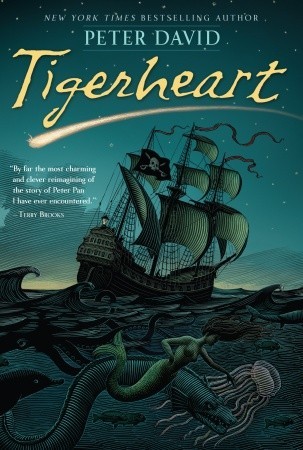
Tigerheart by Peter David
This is a retelling of Peter Pan, called The Boy in this story. Actually, this is the story of Paul Dear, a young boy who desperately wants to go to Anyplace (Neverland) to find something to help his mother who is miserable after the death of his one week old sister. However, his story is strongly tied to The Boy and Anyplace since he needs both to achieve his goals, and in some part of himself, Paul believes that he may actually be The Boy or some manifestation of him.
This was an audiobook listen narrated by Simon Vance. Yeah, you know I love the guy. Even though I’d listened to one book he narrated before this. This book made me realize how consistent and talented he was with his reading, and it helps that he was reading an imaginative retelling, which I love. I enjoyed this book more than I thought I would. I was a little apprehensive at first that I might find it too juvenile for my tastes, but that wasn’t the case at all. Peter David managed to make this book feel like a child who is on the cusp of adulthood. It was both naïve and worldy, innocent and experienced. It was truly an amazing, whimsical story with tones of darkness.
Mom Note: I wouldn’t necessarily recommend this for younger children even if the tone, wording, and pacing “feels right” for younger children. This book is about children and told in that genial tone reserved for children’s books. It’s not necessarily a story that’s “bad” for younger audiences, but they wouldn’t understand the nuances in the story that require some level of maturity to already have been achieved. Examples of this include when the narrator mentions that Paul, being a child, would not understand a woman’s figure or why they might not have wanted to be as “round in the hips” as Fiddlefix (Tinkerbell) or when the narrator notes that The Boy shares with grown men the inability to decide if he wants the significant non-mother female figure in his life, Gwennie (Wendy), to be his mother or his lifemate or when the narrator refers to maturity as “the destruction.” So, for any parent/guardian/adult figure thinking this might be great for a younger audience, it’s not. It’s a book about children, but it’s not necessarily a book for children. I’d say early teens, maybe even kids as young as 11-12, would better handle a book like this one.

Mogsy: A Book That Makes You Happy
Posted on July 11, 2013 Leave a Comment
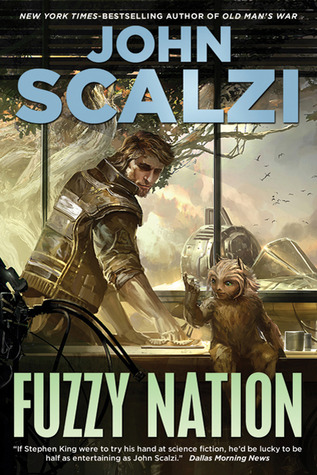
John Scalzi’s books generally make me happy. I can always count on them to make me laugh (the man can write gruesome death scenes at the hands of merciless aliens and still make them heeeelarious) and they often end well.
A re-imagining of H. Beam Piper’s Little Fuzzy, Scalzi’s Fuzzy Nation stars Jack Holloway the independent contractor who discovers a rich seam of valuable jewels on Zarathustra, but then discovers the planet may be home to a race of sentient “fuzzys”. These creatures are tiny, furry, cuddly, and ridiculously adorable…how can anyone not feel happy after reading this?!
Book Review: The Raven Boys by Maggie Stiefvater
Posted on July 10, 2013 5 Comments
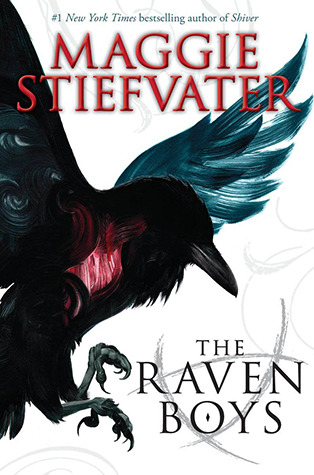
The Raven Boys by Maggie Stiefvater
Every now and then, a book attacks me and holds on tight and when I finish with it, it refuses to let me go. That’s the case with the first book in the Raven Cycle by Maggie Stiefvater, whom I declare to be my new favourite author. I came to this conclusion not far in, primarily because of her unique way of moulding her characters and settings, bringing everything literally to life. (Yes I know what “literally” means. I use it within the context of the story and the magic of Cabeswater.)
I’ve written off some authors because they obsess with describing everything with pretty metaphors that leave the plot behind. Here, the plot and characters are swept along in a river of descriptions that don’t so much use adjectives or comparisons, but exclusions – descriptions of what the character is not – or things they do or collect that define them. And most often, their actions, gestures and reactions. Because of this, her characters and places always give me a sense of movement, or in the case of Ronan, movement that could come at any moment. By far my favourite character, Ronan is a bundle of venom, poised like a sharp-clawed cat about to strike at any moment. Yet, Stiefvater also gives him the perfect amount of vulnerability and harsh truth to make him more than just the bitter character that should be detested or pitied.
Sometimes I got so wrapped up in her depictions that when I shook myself from their hypnotic power, I was afraid that I’d been carried away and missed what was going on. But nope. Everything was still clear and enticing and as the mystery deepened, I was pulled right along with it.
This is the story of Blue Sargent, a young adult with the ability to strengthen the psychic powers of the women around her, but lacking in those abilities herself. From a very young age, her fate – her curse – was revealed to her: true love’s kiss would bring the death of that person. (Sorry Disney.) Blue does not stress over this destiny until she meets Gansey’s spirit on the Corpse Road, and later meets Gansey himself, who turns out to be one of the dreaded Raven Boys of Aglionby Academy.
This is a young adult book and before I scare some of you away with the seemingly obvious sickly sweet romance plot, allow me to assure you that this is anything but the case. First of all, I really liked the maturity with which Steifvater presents the young adults in the book. The writing style is respectful of the teens Stiefvater writes about, as well as those who might be reading, while still appealing to me as an adult.
Secondly, there’s Gansey himself. He’s a young man born into generations of privilege to the point that he doesn’t understand how his offers of money to those less fortunate can be taken as deeply offensive. He has a good heart and his mind functions on a strong sense of right and wrong and of concrete evidence, even when dealing with the unknown, such as his obsession. Somewhere along the way, I equated Gansey to Bruce Wayne (sorry, Gansey) for the way he gathers those in need to him and they all look to him for command, if not support, and how he can shift into his rich boy persona to handle a situation, but his true self is the one obsessed with finding ley lines and the secret of a dead king.
Gansey and Blue are destined to meet, obviously, but I loved the way everything wrapped together. Nothing was extraneous or added to mislead. And when new elements popped up, they were shocking, culminating in a tense ending. Or rather, the beginning. This is the first in a the Raven Cycle and the end of The Raven Boys works like a fantastic door, opening onto all sorts of new mysteries that I’m really excited to find out about. But as if I needed more motivation, the very last line ensured that I will be grabbing book 2 as soon as I can.

Kickstarter Goodies: Hollow World
Posted on July 10, 2013 Leave a Comment
 |
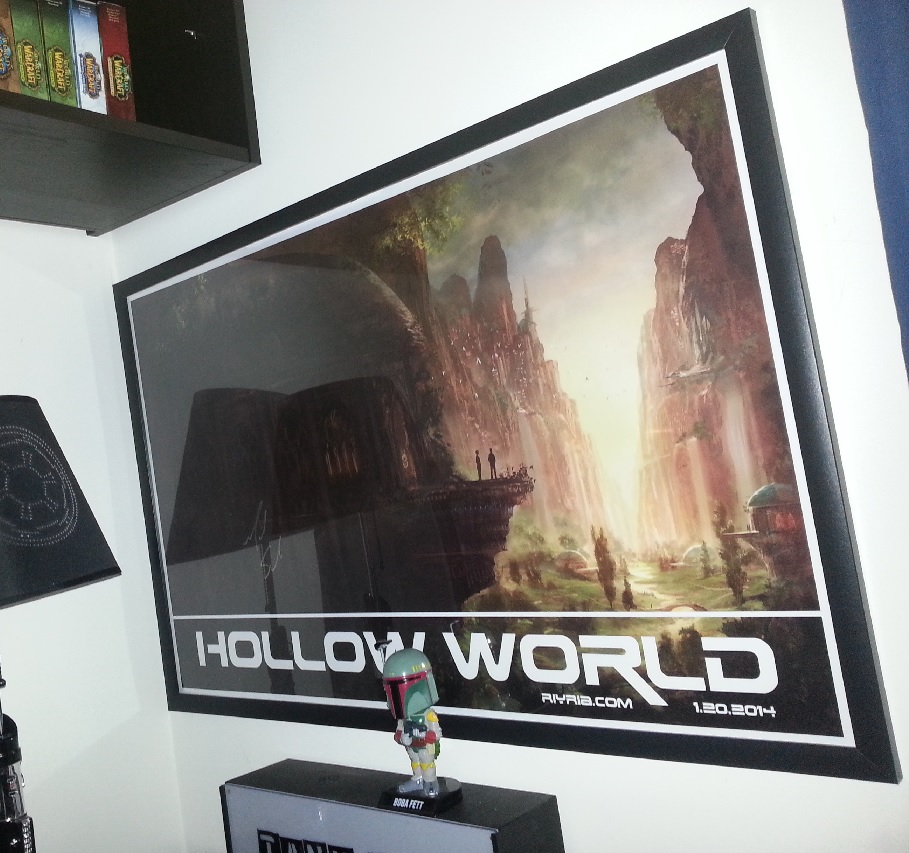
| Hollow World art by Marc Simonetti |
As you know, I’m always looking out for interesting and/or promising fiction projects on Kickstarter to back. Earlier this year in March, one of my favorite fantasy authors Michael J. Sullivan decided to crowdfund his science fiction fantasy cross-genre novel Hollow World, so naturally I pledged my support. Ultimately, the project was not only fully funded, but the Kickstarter campaign ended up being a resounding success as well, at more than 1000% funded.
Yesterday, the stretch bonuses and other goodies starting coming in, and I just wanted to share. First is a signed 24″ x 36″ poster of the gorgeous image above. Luckily, my work requires that I always have a bunch of frames just lying around, so I quickly slapped that baby into one of them and hung it up by my own personal nook in the gamer cave. My Boba Fett bobble-head stands guard over it now.
Then there are the bookmarks — 6 all together, and all of them signed on the back as well.

Given the vast numbers of posters and bookmarks sent out to Hollow World backers, I imagine poor Mr. Sullivan’s writing hand must be cramping something fierce by now. But I love my Kickstarter goodies, and I can’t wait to read this book!
Cover Lover: Becky Cloonan
Posted on July 10, 2013 Leave a Comment

The sure sign of a good book or graphic novel cover is when it immediately makes me click the buy button. That’s what happened during my recent Comixology raid when I stumbled onto Becky Cloonan‘s haunting and beautiful trilogy. This is Cloonan’s first self-published project. I’m glad I judged it by its cover!

Audiobook Review: American Gods by Neil Gaiman
Posted on July 10, 2013 1 Comment

It has long been a shameful secret of mine that I’ve never read a Neil Gaiman novel. Sure, I’ve read his Sandman comics and a few of his short stories, but somehow, the opportunity to read a full-length novel of his has never come up, despite the fact that books like American Gods and Neverwhere have been sitting in my Kindle gathering metaphorical dust for like, oh, I don’t know…the past two or three years.
That’s why this summer I made it a point to lose my Neil Gaiman virginity, and decided to give the honor to American Gods first of all because it is considered one of his “classics”, and second of all because the Tenth Anniversary Edition of the book I owned also had the added benefit of an audiobook Whispersync bundle deal, which I’d picked up as well. As it turned out, this worked out for the best.
And now I have the hefty task of actually trying to describe what American Gods is about. The book begins with the introduction of Shadow, a man coming up on the end of his three-year prison sentence and looking forward to get back to his life. Days before his release, however, he gets news that his beloved wife was killed in a car accident, along with his best friend. Freed from prison now but with his life in tatters, Shadow agrees to work for a mysterious stranger he meets on the way home, a man who calls himself “Mr. Wednesday”.
Shadow travels across America with Wednesday, meeting his new boss’ unusual friends and colleagues, and here’s where things start to get cryptic and mystical. Wednesday and his peers turn out to be incarnations of the Old Gods of ancient mythology, whose powers are waned since the rise of modern life and the technological era, these aspects themselves manifesting as the American “New Gods”. Everything Shadow thought he knew has been turned upside down. Nothing is as it seems; legends and myths are real, secrets are everywhere, everything is connected…and war is coming.
You ever read a book where you know very early on that it’s not the kind for you, but you end up enjoying it a lot anyway, because it’s just so beautifully written and profound? This was definitely one of those for me. I’d known what I was in for, of course; like I said, I’ve had some experience with Neil Gaiman’s style of writing and know that his stuff is often allusive and metaphysical, surreal and abstract in nature.
In other words, totally not my thing at all. And thematically, the book turned out to be exactly as I’d expected. By all rights, I shouldn’t have liked it, but I did. Wow. And now I finally understand the reason it’s considered a contemporary masterpiece, and why Mr. Gaiman has so many fans.
Recall how I said I also had an Audible copy of American Gods, and that’s actually how I read this novel, going back and forth between the ebook and the audiobook. I wanted to bring this up because I feel the excellent production quality of the latter definitely bears mentioning. Sometimes, great voice actors can bring the words to life, and that can also certainly make me enjoy a book much more than I normally would. The Tenth Anniversary version I had included a full cast featuring excellent narrators, which made it all the more engrossing, not to mention Neil Gaiman himself narrated some sections of the novel as well as the foreword, afterword, and other extras.
This edition is also the newly updated and expanded version with the author’s preferred text, so I definitely appreciated the chance to read this book in a state that’s closer to what it’s meant to be. One thing I think everyone agrees about Neil Gaiman is that you can count on him to be original and innovative, and the uniqueness of the themes and ideas in American Gods unquestionably reflects that. The extras included in this version really tied everything together and provided a lot of insight into this intellectual work of art — because yes, after having experienced this book, I definitely consider it art.

Comic Review: Nightwing, Vol. 1: Traps and Trapezes by Kyle Higgins
Posted on July 9, 2013 Leave a Comment
Nightwing, Vol. 1: Traps and Trapezes by Kyle Higgins

Comic Review: Batman, Vol. 1: The Court of Owls by Scott Snyder
Posted on July 9, 2013 Leave a Comment
Batman, Vol. 1: The Court of Owls by Scott Snyder
He can no longer profess to know the city more intimately than anyone else after the Owls are revealed to him. The Owls push him to the brink of his mental and physical capabilities, believing him to be broken once he escapes. Batman may have won a small battle against them, but there’s still the war to consider. Per usual, Batman loses himself in this one-man stand against injustice that he doesn’t seem to realize or care how his actions are affecting those around him. The way he treated Dick near the end of the story just broke my heart a little, especially since there’s almost nothing Dick wouldn’t do for him. However, I know that will pan out to be part of some great Batman scheme no one knew about in the end.
Everything about this made me draw parallels against Batman R.I.P., even down to the feelings it brought out for me, but I did enjoy this story. I never get tired of stories that push Batman to his limits and try to deal with the fine line of madness that he often seems to tread.

Book Review: Under the Empyrean Sky by Chuck Wendig
Posted on July 9, 2013 1 Comment
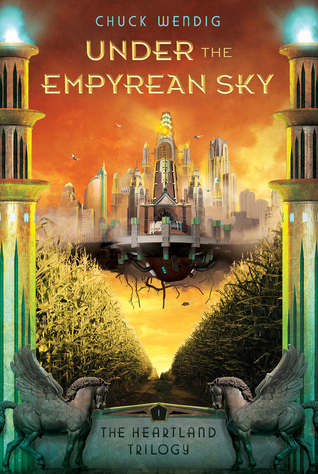
Under the Empyrean Sky byChuck Wendig
Expected Date of Publication: July 30, 2013.
This was an e-ARC I received from the publisher via NetGalley in exchange for an honest review. I thought it was really fantastic, but honestly, I’m also a little lost as to how to talk about it. To understand, I guess you have to be at least a little familiar with Chuck Wendig and his writing. If you’re not, then you’re in for a treat…or a shock. Or both.
I only just became a fan of the author myself, having recently read The Blue Blazes (my review here) and Blackbirds (my review here). I liked them a lot, and especially adored the latter. But already, I knew enough to be skeptical when I saw that this was a Young Adult novel. Based on the books I’ve read by him, let’s just say YA is pretty much the last thing to come to mind when I think about Chuck Wendig. Instead, I think “dark, twisted and gritty”, “intensely violent”, and “slick snappy one-liners often delivered in a terrible ear-shrivelingly foul manner”.
I had to wonder, Is he going to be dialing it back for this? My guess was that he would have to, for a YA novel. And if that’s the case, how much? Is this still going to read like a book by the Chuck Wendig I know and love? The answer, thankfully, was yes. The story here is definitely all Wendig, but just imagine it tweaked a bit around the edges to make it more appealing to the YA reading audience.
The book begins by introducing us to 17-year-old Cael McAvoy and his life in the Heartland. The Heartland is interesting — imagine a dystopian Midwest-type setting where a particularly aggressive species of corn has taken over, creating an ocean of corn as far as the eye can see. As the leader of his scavenging team, Cael captains a small airboat over the cornfields day after day, scrounging for valuables and useful materials to sell.
But it’s never enough. The Empyrean government oversees life in the Heartland, literally looking down on all of them from above in their luxurious sky flotillas, while people like Cael and his friends and family are struggling to survive. Heartlanders have to deal with poor working conditions, disease, a corrupt mayor and the oppressive government, but Cael has pretty much accepted this as the way things are…until Obligation Day comes and Cael stands to lose the love of his life.
As you can see, this book has all the trappings of a YA novel, with its dystopian world and teen protagonists. It also involves an authoritarian ceremony where the Empyreans pick the Heartlanders mates for them, resulting in uncertainty for the young lovers Cael and his girlfriend Gwennie. The book even hints at a blossoming love triangle.
But while it certainly has the feel of a YA novel, to me it also doesn’t. And here’s where I struggle to find the words to explain why I feel this way, because on some level I think someone not already familiar with Chuck Wendig or his books will be completely blindsided by this book — which could be good. To his fans and readers open to different takes on YA fiction, this will definitely be a refreshing change. I’ve always felt that Chuck Wendig’s books have a “presence” about them, and it exists here as well. It’s reflected in the dialogue, the characters, and the plot, which retains some of its grittiness and what makes Wendig’s books so great. Under the Empyrean Sky might be YA, but I’d still say it’s geared more towards “older YA”. Speaking of which, Wendig does have a hilarious way with words that makes swearing almost seem like a separate art form — so while foul language generally doesn’t bother me one bit, do beware if it does bother you, especially since some of it is on the vulgar side.
The thing I loved best, though, is the world building. The story in this book takes its time and in my opinion doesn’t really start picking up speed until the halfway point, but that’s because so much of the first half is dedicated to bringing the Heartland to life and describing the hardships of its people. I love books like this and The Blue Blazes where Chuck Wendig really gets to show off his talent for creating unique and highly detailed settings, because he’s so obviously good at coming up with all these awesome ideas. Two words: piss-blizzards — or the stifling yellow corn pollen wind storms that plague the Heartland, I love it.
Really, my only criticism is that I wish Cael was a little more likeable. It helps, especially in a YA novel. But honestly, I really struggled to be sympathetic to Cael’s character, at least in the beginning, since he often came off as immature, bossy and a bit of a jerk even to his friends. He also tended to be driven by his angry impulses and hormones, but then again, as they say, “Boys will be boys”. Thankfully, I did start liking Cael (or at the very least, got more used to him) enough that I was staunchly rooting for him and his team by the end of the book. And that’s the important thing.

Book Review: Ender’s World by Orson Scott Card
Posted on July 9, 2013 Leave a Comment
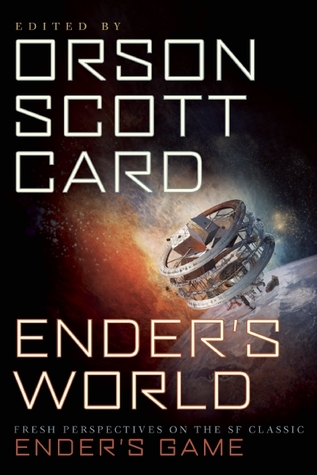
Ender’s World: Fresh Perspectives on the SF Classic Ender’s Game by Orson Scott Card
Ender’s World is a collection of essays on Orson Scott Card’s classic, Ender’s Game, which also features Q&As with fans, answered by Card himself. The introduction is written by Card and over those pages, he carefully analyzes and explains what the story of Ender’s Game and the character of Ender Wiggins mean and mean to him. He notes that none of this was in his head when he first wrote the short story decades ago. He just wrote what felt right, but as time passed and the book rose to its well-earned critical acclaim, his introduction shows just how much he cares for the character and the world he created. The collected works in this book identify people who have come to care for Ender and his Game as well, but for differing reasons. The variance in authors, from military strategist to TV show creator and more, indicates that Ender’s Game is a book that transcends the realm of science fiction and speaks to people of all walks of life.
My favourite essay was the first, “How It Should Have Ended,” where Eric James Stone laments that Ender’s story went on beyond his victory against the buggers to reveal a deeply depressed Ender who sought atonement in the sequels. In Stone’s first reading, he determined, like many, that the hero’s story should end with the victory parade. But when he read the book the second time and attempted to stop where he felt it should have ended, he realized he couldn’t. Because he realized that this story wasn’t just about a kid beating the odds stacked against him to create an elite team of soldiers, tricked into defeating a deadly enemy by willingly, but unwittingly sacrificing human lives – it’s a story about Ender Wiggins. A hero. A soldier. A child.
This is a theme that played strongly for me with Ender’s Game and its sequel, Speaker for the Dead because of my appreciation for Joseph Campbell’s The Hero With a Thousand Faces. I’m the person who forces herself to sit through the “Return to the Shire” at the end of Return of the King and loves Peter Jackson for including it even though, yes, it was pretty boring. But I will argue tooth and nail that it was necessary to show the path of the hero. There is no true victory celebration for a hero because the battle for him or her is always a Pyrrhic one. They might save their home and the people they love, but they sacrifice their souls to do so, leaving them no home to return to.
This is even more tragic for Ender because he is a child. He not only loses his home, but his childhood.
transformation of our children into heroes.”
Before I turn this into my own essay about what Ender’s Game means to me, let me simply recommend this book to any fan of the Ender saga. You may not enjoy or agree with all the points expressed, but hopefully you’ll appreciate just how deeply this story has reached for some and why.
With the movie coming out soon, it becomes that much more relevant and gives me high hopes for how true to the book the film will be. It is clear from his introduction that Ender is Card’s baby and he wouldn’t allow his beloved on to the big screen without his supervision and the utmost care and dedication from those to whom he hands Ender over to.
With thanks to NetGalley for providing the opportunity to read and review this book.



 The BiblioSanctum