Comic Review: Dragon Age: Until We Sleep by David Gaider
Posted on July 18, 2013 2 Comments
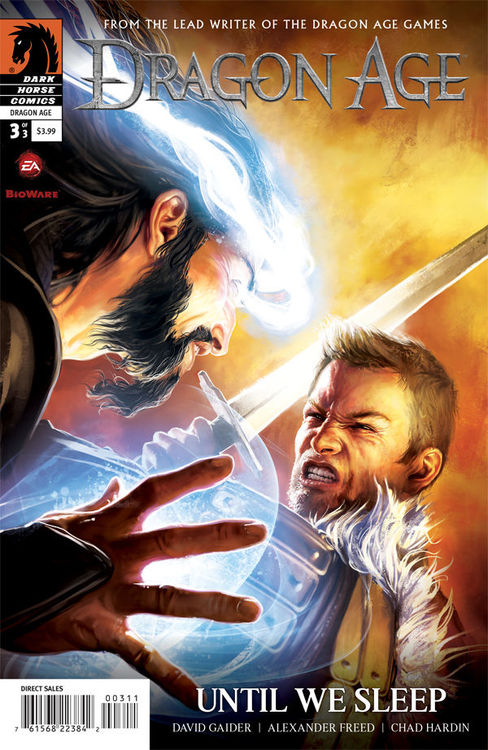
Dragon Age Volume 3: Until We Sleep by David Gaider
In the final volume of the trilogy, Dragon Age‘s King Alistair Theirin continues the search for his father Maric, accompanied by the pirate queen Isabela and the storytelling dwarf merchant, Varric. They are aided by the Tevinter mage, Maevaris, as they track down the evil Titus who has captured Maric for the dragon’s blood that runs within the Theirin veins.
I love this story. I hate this story.
There are so many secrets revealed, ideas introduced and of course the presence of some of my beloved characters from Dragon Age:Origins and Dragon Age II. But even with the combined twelve issues, including Dragon Age: The Silent Grove and Dragon Age Volume 2: Those Who Speak, there was simply not enough room to fit everything in. In other words, despite the excellent artwork, I really wish this had been written as a novel instead.
Gaider does such a fabulous job with character development in his novels but, while the characters here had some powerful moments, I felt that the page limitation of the comic book format didn’t allow the writing to go far enough with them. Moreover, the time that was spent with them seemed to cut into the plotting, causing the adventure to skim along like point form notes. I was disappointed with how abruptly certain elements, such as Yavana, the witch of the wilds, and the Qunari, were handled.
I wanted more, dammit!
Yet, I am reasonably content with what I learned from the series and appreciate that the conclusion brought closure to the mystery of Maric’s disappearance and his promise to Flemeth. It also gave some interesting insight into Isabela, the character some would write off as merely a sex-crazed thief, and answered a question about Varric and his beloved Bianca thanks to a trip into the glorious Fade.
And even though I’m claiming disappointment with the format, there was still enough here for my imagination to set to work on my headcanon. And damn Gaider and his bittersweet endings. I’ll just be quietly sobbing in the corner while I wait for Dragon Age: Inquisition.

Character Appreciation Post: Nahadoth
Posted on July 17, 2013 5 Comments
 |
| Nahadoth by sorskc |
Who is Nahadoth?
Nahadoth is the first born of the Three gods of The Hundred Thousand Kingdoms. He is chaos and darkness incarnate; a true weapon of mass destruction that would consume all if he could. But when we first meet him, he is only a fraction of himself, imprisoned within mortal flesh by day, bound to the whims of the ruling mortals.
“The Nightlord cannot be controlled, child. He can only be unleashed. And you asked him not to kill.”
“Face like the moon, pale and somehow wavering. I could get the gist of his features, but none of it stuck in my mind beyond an impression of astonishing beauty. His long, long hair wafted around him like black smoke, its tendrils curling and moving of their own volition.”
Nahadoth oozes sexuality and seduction as much as he does darkness, violence and chaos. He inspires these kind of thoughts and reaction GIFs, but, while I appreciated the tastefully done erotic moments, I loved more the tenderness, the pain, the loss, the loneliness, the heartache.
“…and when I lift my head to scream out my fury, a million stars turn black and die. No one can see them, but they are my tears.”
The rage and violence had their place too, but it was the moments spent as a father to Sieh, and the moments of peace that Yeine coaxed out of him that had that much more meaning for me. The image I hold in my head is of him comforting her through her tears or letting her fall asleep on his shoulders.
Mogsy’s Book Haul
Posted on July 17, 2013 Leave a Comment
Okay, I’ve pretty much given up on trying to control my to-read list or limit my book acquisition by now. To be fair, it’s been an incredible summer for reading, lots of books popping up on my radar and catching my eye and such. Actually, I think I’ve been pretty good with sticking to my current batch of books in my summer reading list so far, even though I’ve stuck in a couple impromptu additions here and there.
But of course, in true bibliophilic style, I’m already planning my next batch of books.
Speaking of which, I made a pretty big change in my reading habits recently. For the longest time, I have been predominantly an ebook reader, but earlier this year saw a few ARCs coming in to me as hardcopies, so I’ve slowly made the shift to picking up physical books again. Admittedly, I do miss buying hardcovers and seeing them looking all pretty and lined up on the shelves, and what do you know, BookCloseouts is all too happy to oblige me, ain’t I lucky.

Eyes to See and Thieftaker are two books I have on my TBR, so I was pretty happy to find them both at bargain prices. And for a couple of bucks, I couldn’t resist The Rogue since I already have the first book of the Traitor Spy trilogy.
Emperor of Thorns was a complete surprise that the post left on my doorstep yesterday. The book won’t be out until next month, but I had put in my name when the author said the publisher was calling for US book bloggers interested in reviewing it, and I guess fortune and Jorg Ancrath has smiled upon me. I was still so shocked at what I saw when I opened the package that I almost dropped the damn book. Really looking forward to reading this next.
And finally, in celebrating my return to reading dead-tree books, The Thousand Names was a totally indulgent present to myself. AND IT’S FREAKIN’ AMAZING SO FAR. I’m already almost done the book with only about 100 pages to go and I’m already pretty confident in saying it’s going to be a 5 star read from me. Up there amongst my top reads of 2013.
eARCs currently reading or to review include:


I really really really need to ban myself from requesting any more books from NetGalley until I catch up a bit on my reading list. We’ll see how long until I crack.
Book Review: Mockingbird by Chuck Wendig
Posted on July 17, 2013 3 Comments

I can’t get enough of Miriam Black. I just can’t. I thought the initial delight of discovering this twisted and refreshingly candid series would have worn off a bit by now, but it hasn’t. If anything, I think I’m finally starting to sense of who Miriam is and the direction in which these books are going. Or that might just be wishful thinking. Regardless, I’m still having a blast.
Some time has passed since we last left Miriam and Louis in Blackbirds (book one of the series, my review here). For the sake of their relationship, Miriam has attempted to settle down, living in a double-wide trailer and working as a check-out girl at a local grocery store. No more drifting around the country, and no more utilizing her morbid ability to see and how and when someone is going to die simply by making skin-on-skin contact with them. For Miriam, it means a new life filled with lots of tedium, grin-and-bear-it moments, and constantly wearing gloves.
But a girl can only take so much. Fed up, Miriam packs up and gets ready to hit the road when Louis tells her about Katey, a contact of his who is convinced she is dying and wants to pay Miriam to confirm her suspicions. Eager to be herself again, Miriam readily accepts the job, which is how she finds herself dropped off at a prestigious boarding school for troubled girls where Katey is employed as a teacher. Very soon, Miriam finds herself caught up in much more than she bargained for, when she encounters Lauren, a student at the school whom Miriam’s death visions tell her will die brutally at the hands of a crazed serial killer.
With Mockingbird, I think I feel a little more confident in describing the Miriam Black books as less of a traditional Urban Fantasy series, and more of a Thriller-Suspense with paranormal elements. Given the dark nature of Miriam’s power, I would throw in a bit of horror, too. There are some intensely graphic and frightening scenes in this book worthy of the goriest slasher flicks, and if you’re anything like me, at certain points while reading you’ll likely find yourself squirming in your seat in an uncomfortable-yet-not-too-entirely-unpleasant kind of way.
Though, that’s sort of what I’ve come to expect with Chuck Wendig. His writing and stories can make you desperately want to turn the page and be scared to do so at the same time. His characters and dialogue can induce me to laugh my ass off yet at once make me feel like a terrible person. And I love every minute of it. Why do people go and watch scary movies anyway? On a certain level, we do it for the express purpose of being terrified out of our wits. Similarly, that was why I was so eager to pick up this second installment of Miriam Black — I wanted what I got out of Blackbirds the first time around, to again be shocked, scandalized and enthralled by Wendig’s particular brand of dark humor and suspense. I was not disappointed.
Mockingbird also gave us a better look at who Miriam is as a person. I mentioned in my review of the first book that I know deep down beneath that snarky rough exterior she is good person with a good heart, and here I think we see that a little more in her determination to help the schoolgirls and her refusal to simply walk away from the situation. The origins of her mysterious power are still largely unexplained, but we do get a bit of that too. The best part, though, is this book provided a lot of insight into Miriam’s past, like her childhood and her relationship with her mother, which gave me a better idea of how she became the way she is.
Overall, a very suspenseful and chilling novel which I could barely put down. As a special treat, I bought the Whispersync Kindle/Audible bundle so I was able to listen to parts of this in audiobook format too. The narrator Emily Beresford is fantastic as Miriam Black, her talent coming through especially when she sings the “Mockingbird” song, the serial killer’s rendition of the folk song “Wicked Polly”. The song earwormed itself into my head for days, which I have to say made the book even more memorable and creepy.

Book Review: The Darwin Elevator by Jason M. Hough
Posted on July 16, 2013 Leave a Comment
 The Darwin Elevator byJason M. Hough
Expected Date of Publication: July 30, 2013
Wow, what a pleasant surprise this was. My thanks to NetGalley and Del Rey for providing me with an e-ARC of The Darwin Elevator in exchange for an honest review. Loved this book! I don’t think I’ve had this much fun with a new sci-fi novel since James S.A. Corey’s Leviathan Wakes.
The book takes place in mid-23rd century Darwin, Australia. The city is home to the last bastion of humanity, thanks to an alien plague that’s wiped out most of the planet, turning its victims into mindless, savage “subhumans” or “SUBS”. The unknown aliens were also responsible for the presence of a giant space elevator that keeps Darwin enveloped in an invisible plague-suppressing Aura. So too, one other effect of the great Darwin Elevator is a clear division of classes, with the privileged “Orbitals” living high up on one end of it, and the less fortunate masses living down below.
Skyler is the head of one of the many scavenger teams that operate out of Darwin, but he and his specially handpicked crew have the distinct advantage of being immune to the plague, allowing them to travel beyond the Aura without the aid of vac-suits or fear of infection. Their immunity, however, does not protect them against the violence of the infected, so it is disconcerting to all when the elevator begins to experience power instabilities, and even worse — cases of SUBS are being reported within the Aura, which everyone had thought was too secure to ever fail. Amidst conspiracies and the rising class tensions, Skyler is unwittingly pulled into a conflict whose result could determine the fate of humanity.
With all the talk of aliens, I first thought I should be settling in for a rollicking space opera, but as it turns out, the story is mostly all earthbound (for now, at least). Despite that, the book still has all the good stuff, just without the space. It’s intense. It’s dramatic. It’s sweeping. And most important of all, it’s fun. Throw in plenty of action and adventure and also some of that post-apocalyptic goodness, and you have this book. The descriptions of the abandoned, desolate and crumbling landscapes outside the Aura put me in mind of games like the Fallout series, just without the radioactivity. You really get the feeling like a subhuman can jump out and attack at any second. It’s fantastic.
Another thing that made me like this book so much was the pacing of the story, the way it teased me into these “not-quite-there” action-suspense sequences at the beginning (that almost got me all frustrated!) before coming down seriously hard with the gun-fighting and battle scenes for real. Basically, things really heat up around the midway point, and they don’t slow down from there.
For a sci-fi novel, this book was also very easy to follow. Even with all the advanced science fiction elements and alien technology, it wasn’t hard for me to grasp the concepts and picture the descriptions in my head. I’m always a fan of books that can do this without bogging the story down with all the techno-lingo. Thanks to very natural and sometimes humorous dialogue, the characters are also very likeable, and even the disgusting perverted pig of an antagonist is someone you’ll love to hate.
All in all, just a really impressive debut. I really wish I’d gotten to this sooner. Can’t wait to find out what happens in the next book, Jason M. Hough is going straight onto my list of new science fiction authors to watch.
Note: Just found out that The Darwin Elevator started life out as a NaNoWriMo project! Even more cool!

Kickstarter Goodies: Arena Mode
Posted on July 15, 2013 Leave a Comment
Keeping my eye out for interesting fiction projects on Kickstarter is something I like to do a lot, and early this year I backed a few promising novels. Seems like July is a great month for all the rewards and other stretch goals to be coming in, because I have another goodies post to share today.
This time, it’s Arena Mode, a science fiction novel by Blake Northcott featuring superheroes as well as original artwork by Marvel and DC artists! Needless to say, the project was a great success.
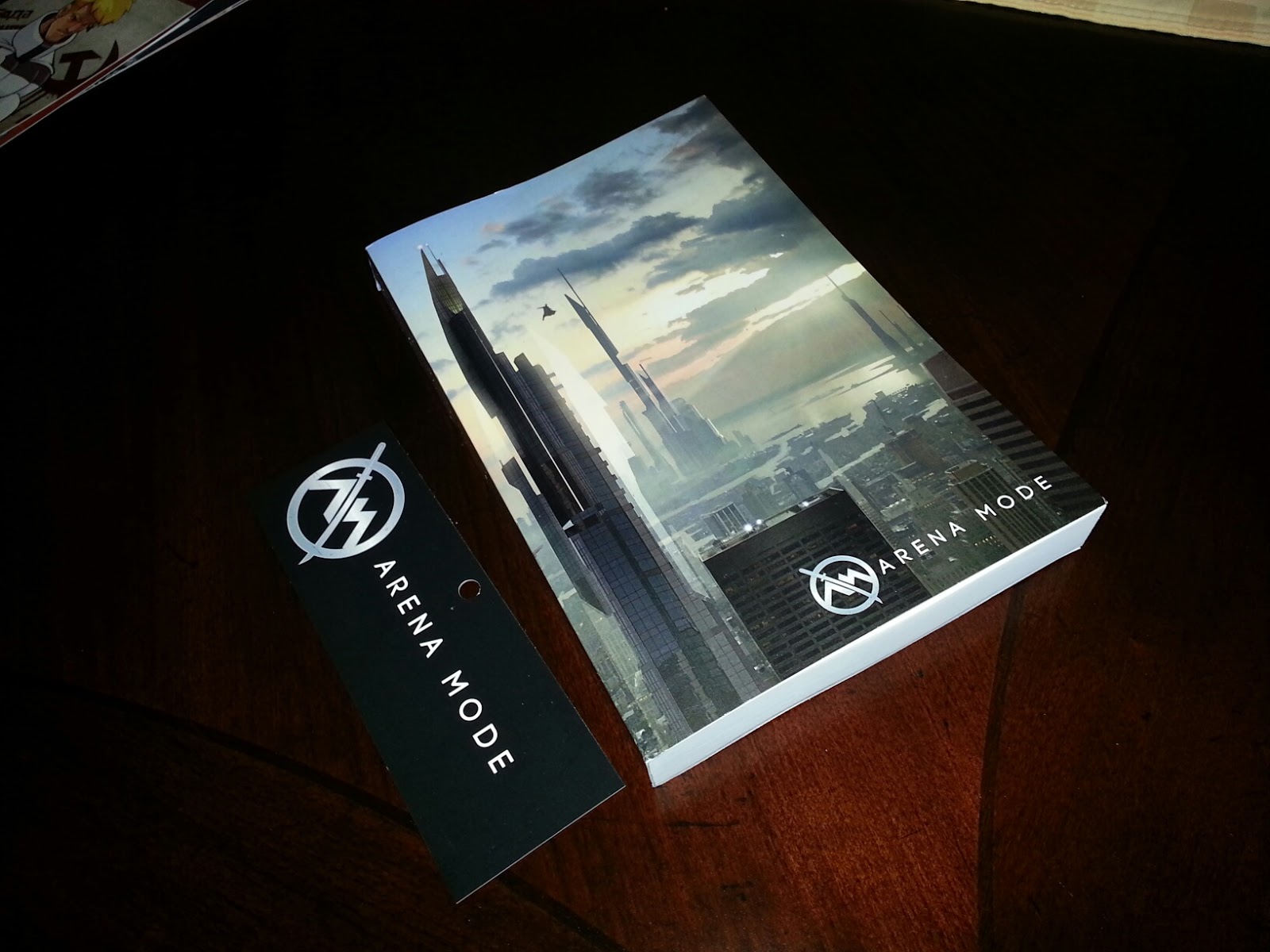
I’d received the ebook already, but the actual signed and numbered trade paperback showed up on my doorstep this weekend. Shiny! I am 741/750!
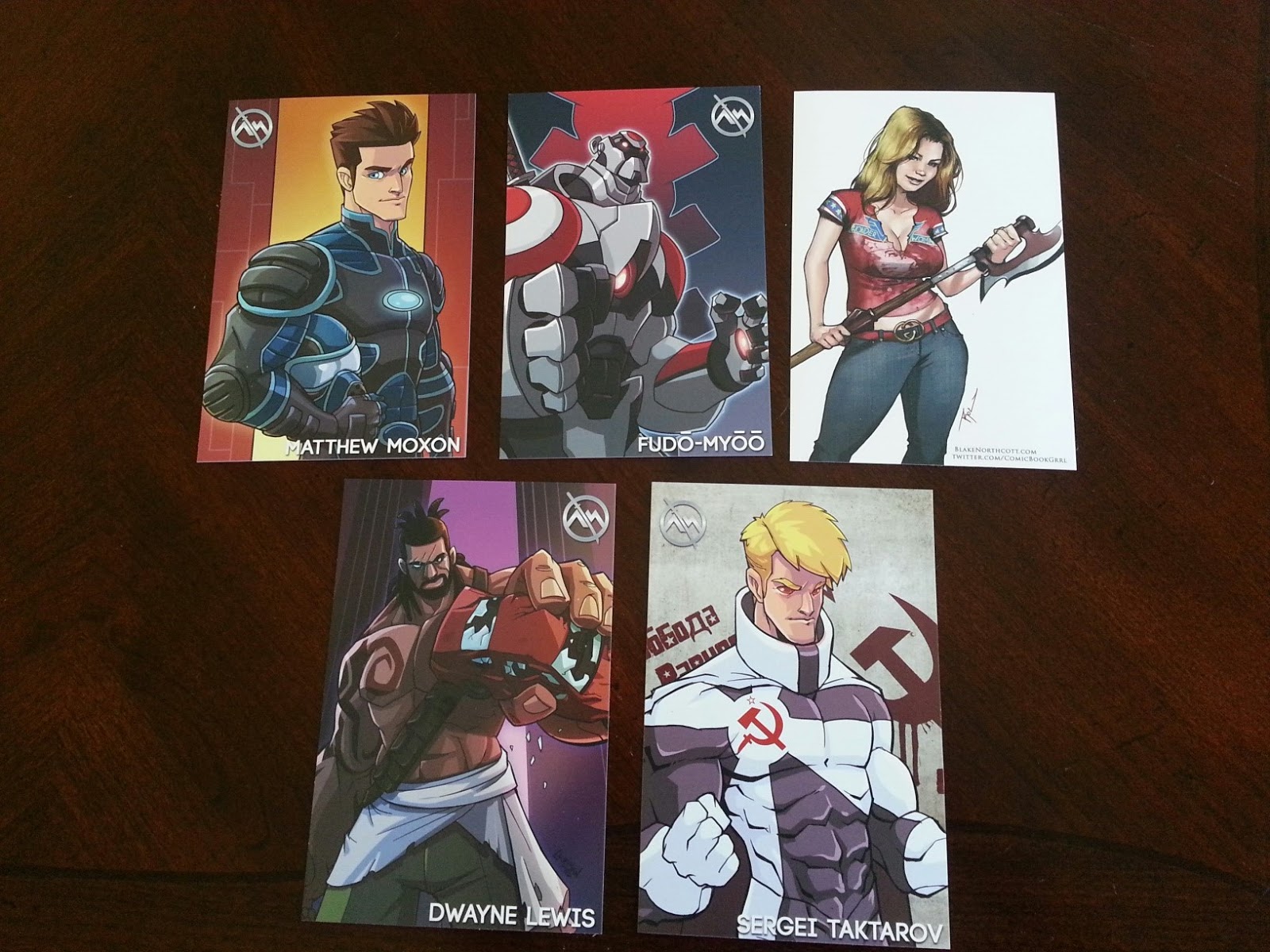
In the package were also the 4″ x 6″ cards featuring the original art of the superhuman characters fighting in The Arena. They are gorgeous. So looking forward to reading this book!
Book Review: The Monsters in Your Neighborhood by Jesse Petersen
Posted on July 15, 2013 Leave a Comment
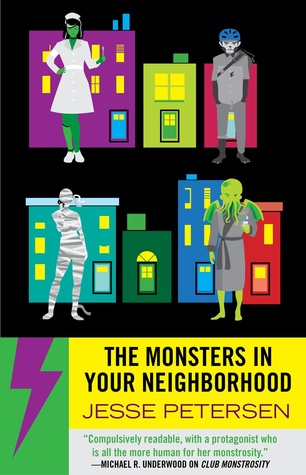 The Monsters in Your Neighborhood byJesse Petersen
Expected Date of Publication: July 29, 2013
If you ever find yourself with some time on a lazy afternoon, in the mood for a book that’s light, funny and just a little silly, I highly recommend the Monstrosity series by Jesse Petersen. They’re super quick reads and are like pure fluffy cotton candy for the brain. Anyway, I would like to thank NetGalley and the publisher for providing me with a review copy of this book in exchange for an honest review.
This one is actually a follow-up to Club Monstrosity (see my review here), in which we were first introduced to the motley crew of monsters who meets twice a week in a church basement for their Monstofelldosis Anonymous support group. After the events of that first book, however, the topics of their meetings have understandably shifted from more touchy-feely subjects to war planning and preparations for their fight against the descendent of fiction’s most famous monster hunter and his family, the Van Helsings.
The old gang is back — minus the few we lost in the first book, of course, but there are a couple new additions to the cast as well. Speaking of which, why, yes that is indeed Cthulhu you see on the right side of the cover. I admit my inner Lovecraftian horror fan danced a little jig in glee at the appearance of Patrick, even if the thought of an Old One cavorting with the likes of Natalie, Alec, Kai et al. is more than a bit surreal.
This was a cute story, very funny, and quite similar in nature to the first book, except with more casual swearing than I think I remember. If you’re in the mood for a “popcorn book” or something to lift your spirits or give yourself a break from the stress, this does the trick. It’s told in a very good-humored, teasing way, and doesn’t take itself too seriously.
Thrusting the issue of social media into the lives of these characters, some of whom are hundreds if not thousands of years old, is also a nice touch. Dracula with an iPhone still cracks me up, though I think the image of Igor watching Sex and the City might give him a run for his money. Like I’ve said before in past reviews, it always fascinates me to see authors tackle re-tellings or satirical takes on fairy tales and classic literature, and putting a light spin on movie monsters ranks up there on my list of interesting ideas.
Comic Review: Star Wars: In the Shadow of Yavin by Brian Wood and Carlos D’Anda
Posted on July 14, 2013 Leave a Comment
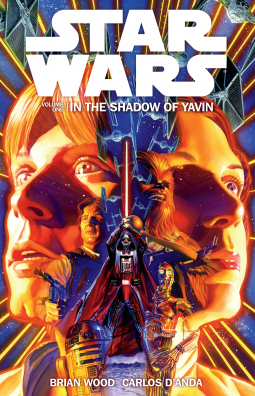
Star Wars, Volume 1: In the Shadow of Yavin by Brian Wood
With thanks to NetGalley and Darkhorse Comics for the opportunity to read an advance copy of this graphic novel in exchange for an honest review.
The Star Wars universe has become so vast that if you want to look up something on Wookieepedia, you should set aside at least an hour of your time to allow for the multitude of side-clicking you’re inevitably going to end up doing within each entry. Expanded Universe (EU) stories extend into the distant past and the distant future and everything in between, but it seems that the legacy is returning to its roots with a series of new stories focusing on Han, Leia and Luke, directly following A New Hope. I’m looking forward to the upcoming Razor’s Edge, and in the mean time, enjoyed this new comic series.
The most impressive aspect of this story is that it dives right into the fact that both Luke and Leia just watched their lives and the people they loved catastrophically destroyed. Things like that tend to weigh on you, particularly Leia, who was forced to watch the destruction of her entire planet shortly after hours of rigorous torture at the hands of Darth Vader.
This focuses heavily on the fact that Leia has not been allowed, nor allowed herself the time to deal because the situation is still dire. The destruction of the Death Star has only increased pressure on the Rebel Alliance and her role as a leader means she is constantly working and constantly needing to prove herself. The pressure rises even more when Mon Mothma tasks her with forming and leading a black ops team of pilots. Their purpose: find a new location for the Rebel base and root out the traitor in their midst. Leia herself gets to fly the sleek new X-Wings, revealing yet another of her skills.
Luke doesn’t feature as prominently as expected, though he and Wedge are part of the team. Luke is played up a bit more as the cocky kid we saw in A New Hope, rather than the more subdued and stoic Luke that starts to develop in The Empire Strikes Back. His attitude reminds us that he is barely twenty years old, so his actions are somewhat understandable. But that means that Leia is the same age, revealing the stark contrast of maturity and responsibility between them. I would have liked to see far more that conflict, but instead, we get the more simplistic love triangle plot device that plays out weakly for all involved.
Meanwhile, the fallout from Yavin has affected others as well. Namely, Darth Vader, whom the Emperor is pretty mad at for letting a wee X-Wing blow up an entire space station. Vader has been demoted to supervising the construction of the second Death Star and spends a lot of time mulling over the name “Skywalker” and what he sensed from the pilot that destroyed the Death Star.
And last, but certainly not least, is Han Solo. Joining up with the Rebels has tagged him and Chewie, their career as neutral smuggler and leaving them no other options but to continue working with the Alliance. Mon Mothma has entrusted him with a significant amount of credits to broker a deal with a contact. Is Han worthy of that trust? Hmmm….
Overall, I liked the elements of the characters and story that are introduced. There is a lot of potential for interesting intrigue and character development, with some reasonably good gun and dogfights tossed in for good measure.
Book Review: Ascension: A Tangled Axon Novel by Jacqueline Koyanagi
Posted on July 13, 2013 2 Comments
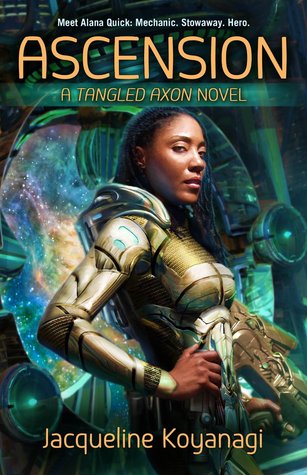 Ascension: A Tangled Axon Novel by Jacqueline Koyanagi
With thanks to NetGalley and Masque Books for the opportunity to read an advance copy of this book in exchange for an honest review.
Alana Quick is a sky surgeon, as evident by her long locs. She loves ships as one loves a significant other and has lost a few of the latter because she places her work first and foremost in her life. But she’s never actually left her homeworld in one. There is little money in her line of work, but she loves it too much to ever consider doing anything else and she refuses to sell out to Transliminal, the reigning corporation that offers promises of magic and money – and the potential cure for Alana and her Aunt Lai’s debilitating muscle disease.
When a ship arrives seeking Alana’s sister Nova, Alana obeys the ship’s summons and leaps on the opportunity to stow away in hopes of proving herself worthy of joining the ship’s crew. Captain Tev is understandably mad about this, but since they still need her sister, Tev allows Alana to remain on board. A catastrophic event following their retrieval of Nova turns ship and all onboard into hunted criminals who must get to the heart of Transliminal to both clear their name and achieve their initial goals.
In her bio, Koyanagi describes a desire to write books featuring atypical heroes and social structures. One review complained about the dearth of male characters. This isn’t Y: The Last Man, Vol. 1: Unmanned where all but one male has died off. There are male characters, they just don’t have prominent roles in the story. Fiction presents an opportunity for writers to venture far beyond the stereotypes and prejudices of reality, yet so often, we keep seeing white male-centric books with the occasional, lovingly described token people of another race and/or gender. Although I’d prefer to see greater equality over all, I can definitely forgive a writer who chooses to defy the standards and present a female dominated world without needing an explanation for it.
In keeping with Koyanagi’s atypical protagonist, Alana and several other characters are queer, but I was more intrigued by the incorporation of Alana’s disease. Considering her line of work and how reliant she is on her body as much as her mind, the cost of her medication, her desire to get treatment for herself and her aunt and the limited supply of medication adds an interesting twist to how the crew reacts to her needs, and the constant pain make her work difficult at times.
There were certain elements of the story, particularly the Tangled Axon and her crew, that reminded me of series like Sol Bianca and Firefly, so I wasn’t surprised by one of the big reveals. I did like the way everything forged together, particularly with Nova. This is Alana’s story, told from her PoV, but, considering the title of the book, Nova’s part to play is pretty significant. Koyanagi drops hints at this through long speeches from Nova that perhaps could have been more subtly strung throughout the story.
This is also a love story, as hinted at in the blurb. Alana’s attraction to Captain Tev is rivaled only by her attraction to the Tangled Axon and since Tev loves her ship just as much, it’s not hard to see where things are going. The path there is a bit long, but it allows for a lot of character development as Alana attempts to learn about her new crew.
The love story, the ascension, the quest – all come together in an ending that perhaps tries too hard to preach its point with all the shiny, but this is only a minor complaint and not enough for me to dislike the author for wanting to deliver her messages with a little bit of soul glow.
Koyanagi develops an interesting world. Each planet has unique traits that she describes with care. However, there is little overall to explain some of the elements of the world, such as “the breach” or how all this came to be. The latter didn’t bother me too much, though. If this takes place far into human future, I don’t think it completely necessary to dwell on exposition as to how everything came to be as it is, especially if that history does not really influence the story. And if this is just a galaxy far away and long ago, then even better.
As for the main character, I can’t say that I really liked her as a person, but I did find her interesting and very human. I like that she makes a lot of irresponsible mistakes and wasn’t simply accepted into the crew just because her skills proved her worthy. I like the way her obsession with engineering helps her to overcome her constant pain and she’s never defined by or limited because of it.
There are a lot of really great ideas in this book and I definitely appreciate the refreshing take on certain elements within the genre. This was a very ambitious undertaking for a first novel. There is room for improvement in terms of pacing and extraneous wording in descriptions, but overall, a worthy addition to the science fiction universe.
Book Review: The Human Division by John Scalzi
Posted on July 12, 2013 1 Comment
 The Human Division byJohn Scalzi
Back when I first started getting into reading more sci-fi, John Scalzi’s Old Man’s War series was a great starting point. The books had just the right mix of space travel, aliens and futuristic technology, but were still light enough not to intimidate a relative newcomer to the genre. Now they still rank among some of my favorite books of all time.
So when I found out about Scalzi’s new serialized novel based on the Old Man’s War universe, I became all excited and got set to pick up the new episodes every week from January to April 2013. Unfortunately, I discovered that I am very impatient when it comes to having to wait to find out what happens next, and I’m as bad with books as I am with TV shows when it comes to keeping up with weekly installments. For the latter, I’d much rather buy the complete DVD/Blu-ray box set with all the extras at the end of the season and do a marathon all at once, so I essentially decided to do the literary equivalent with The Human Division.
It will help to have read the previous books in the series, especially The Last Colony, since what happens in The Human Division is the direct result of the drastic events that occur the end of that novel. As such, this review may contain minor spoilers for the books that came before.
For a couple hundred years, the Colonial Union has happily taken advantage of Earth, keeping the planet’s population in the dark while farming it aggressively for colonists and soldiers in the name of human expansion across a hostile universe. Last we saw, John Perry has basically blown the cover off that whole operation. Thanks to him, the people of Earth now know the truth.
Angry and betrayed, Earth considers an invitation from a political alliance made up of 400 alien races — also known as the Conclave, bitter rivals of the Colonial Union. The CU, currently aware of their precarious position, begins to play things more carefully, making every possible effort in politics and diplomacy. An unknown entity, however, may be sabotaging all their efforts.
Being a serialized novel, this was a great mix of thirteen narratives which all come together to tell an overarching story. Some served to push the plot forward while focusing on the main characters, while others acted more as filler but were still invaluable in providing the necessary background information required to follow the story. Like any anthology-type book, there were some episodes I liked more than others, but on the whole they were all very entertaining and enjoyable.
Some highlights for me include Episode 1: The B-Team, the story which serves as an introduction to our main characters, Ambassador Abumwe, Captain Coloma, Hart Schmidt, and Harry Wilson. Wilson, of course, I was glad to see because he’s someone we first met in Old Man’s War, one of John Perry’s friends in the group they’d dubbed the “Old Farts”, so it was nice to be able to catch up with him. This story was also one hell of a start.
Also Episode 2: Walk the Plank, which a one-off short told in transcript form and was a punch in the gut. This just goes to show while John Scalzi’s a funny guy and a delight to read, his stuff’s not all fun and games; he’s also very capable of writing poignant scenes that can fill you with dread. Walk The Plank also reaffirmed my decision to read this novel only after it was complete, as it was a drastic shift from the first episode and I would have been left very confused that week.
Then there were the episodes like #7, The Dog King which were lighter, more humorous and closer to what I expect when I think of Scalzi’s works. There were also pleasant surprises like Episode 10: This Must be the Place which I found heartwarming and quite meaningful. And of course, the final episode Earth Below, Sky Above which was all action all craziness, and had me on the edge of my seat. John Scalzi gets to flex all his writing talents with this diverse collection of stories.
Basically, if you’ve followed the Old Man’s War series up to this point, you really can’t afford to miss this. It continues the story, but the serialization format also made this an incredible experience. Admittedly, I had initial doubts about it, fearing that the novel being presented as individual episodes would make it feel too disjointed, but that was not the case at all. In fact, I actually really liked it. Either I’m just not as bad as I thought at handling serial novels, or John Scalzi is simply really good at pulling this off. It’s probably both.
Like I said, you can get the full-length novel now which includes all the episodes as well as a couple extras, and personally, I so much prefer reading it this way. It appears Scalzi’s been signed on for a second season too, so I’m ecstatic that the adventures in the universe of Old Man’s War will continue.



 The BiblioSanctum