Are We There Yet? (a sort of Eye of the World review)
Posted on August 11, 2013 1 Comment
 The Eye of the World by Robert Jordan
Two stars for effort, worldbuilding and potential, especially knowing that Brandon Sanderson takes over in the end, but, having finally gotten through Eye of the World (audiobook really helped), I understand why I put it back on the library shelves, along with The Sword of Shannara, when I was a teen.
Review done, let’s move on to commentary about a problem I’m seeing a lot in epic fantasy: epicness for the sake of epicness. I think it’s a disease some authors have. That is, writing these huge stories within these massive worlds with all sorts of characters. That isn’t necessarily a bad thing. Eye of the World develops some pretty strong lore and (vaguely) interesting characters, but after a while, I started to wonder how much of the story was actually necessary.
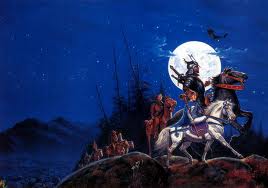 |
| Are we there yet? Perhaps we should stop at another tavern. |
As far as epic fantasy goes, I’ve read and loved The Lord of the Rings and The Hobbit before it, but don’t ask me to read them again. I was quite happy with the movies and not at all troubled by what was edited out. Die hard fans might complain about the lack of Tom Bombadil, but I’m okay with that because he really wasn’t that integral to plot and/or character development (No, he wasn’t. Stop it.). When thinking about an Eye of the World movie saga, I can see alllll the scenes that could be excised with no real loss to the story — because did we really need to visit yet another tavern??
Game of Thrones is another prime example of an author that has lost his way in his epic fantasy. I can’t stop praising HBO for sifting through the detritus to bring only the meat, without ever losing the heart of GRRM’s original story and I’m looking forward to how they end the TV show far more than I am looking forward to whatever GRRM eventually plans to do. Assuming he has greater plans than just fanboying over himself.
Back to Eye of the World for a moment. I said the book had some (vaguely) interesting characters. Actually, the only character I care about is Moiraine. I could do with a few less of the younger ones on this fellowship. Half the time, I can’t even tell them apart. I suppose that’s convenient if any of them were to die, but I can’t really say the deadly and dangerous events in the story have filled me with enough dread to actually believe anyone was going to be hurt in any interesting way. I mentioned Brandon Sanderson above, and frankly, he’s about the only thing that would encourage me to read on any time soon because I am fond of his characterization and know that he will do a good job of making the characters more likable and memorable than they currently are.
Oh you’re just bitter, you might say, and you’d probably be right. But having recently read and loved what Ursula K. Le Guin could accomplish in under 200 words, my meh-ness grows over epic fantasy that is epic just because the author does not know how to trim the fat.

Book Revew: The Isle of Blood by Rick Yancey
Posted on August 10, 2013 Leave a Comment
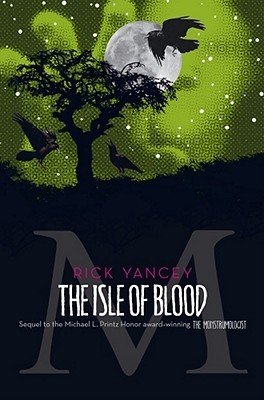 The Isle of Blood by Rick Yancey
Genre: YA horror paranormal
Series: Book 3 of The Monstrumologist
Publisher: Simon & Schuster Books for Young Readers
Date of Publication: September 13, 2011
Author information: Website | Twitter
After having positive experiences with both the first two books in The Monstrumologist series, I eagerly anticipated getting my hands on the third book. This probably explains why I wasn’t entirely prepared for my disappointed reaction when I finished. Don’t get me wrong; on it’s own and outside any biases or pre-conceived notions, this book is a solid horror novel for young adults. But compared to the The Monstrumologist (my review here) and even The Curse of the Wendigo (my review here), I have to say it fell quite a bit short.
The book starts off in a similar way as the others, teasing the next horrifying monster that our characters will encounter next. In this case, it’s news clippings and reports about “red rain” and bloody raw meat falling from the sky. These incidents and the disgusting nidus, nests made of human parts and poisonous sputum, are the only evidence of the creature known as “the Faceless One of a Thousand Faces” or Typhoeus magnificum. For monster hunters like Pellinore Warthrop, it is considered the “Holy Grail of Monstrumology.”
When a mysterious package shows up at the monstrumologist’s door, our protagonist and narrator Will Henry witnesses firsthand how exposure to its gruesome contents rapidly turn the hapless courier who delivered it into a mindless, rotting horror. Dr. Warthrop, recognizing what’s inside the package as a nidus, takes Will Henry on a race to follow the trail and track down the magnificum.
I didn’t think this book was as impressive as its predecessors, for a couple reasons. Firstly, I’m not sure if this is merely a byproduct of Will Henry growing up over the course of the series to become a teenager in this novel, but this was the first time I actually found his character annoying. By design, he was moody, whiny and childish. I also sensed a shift in his narration style to become more abstract and ineffective, especially since we have so many more scenes in this book involving flashbacks, dreams, and delirious visions.
Secondly, my favorite character Dr. Pellinore Warthrop was largely absent for a big chunk of the story. Interesting things happen when he’s around, so when he’s not, all we’re left with is Will Henry being mopey and feeling sorry for himself. While I can understand that this book is supposed to a deeper exploration into the relationship between the two of them, I can’t help but think there had to be a better way to accomplish this. The inaction in the first part of the book was a letdown compared to the action and suspense I’d grown used to from this series, and really only the opening and the ending managed to come close.
On the bright side, I thought this was the most humorous out of the three books so far, with more light moments than I expected to balance out the depressing and melodramatic. While I considered this a positive point, The Isle of Blood just had a very different feel from rest of the series, with many departures from what I thought was the norm for these books. Like I said, it wasn’t bad, but I can’t deny I was expecting something maybe a little more fast-paced and entertaining, and a little less subdued.

Book Review: Ex-Communication by Peter Clines
Posted on August 9, 2013 2 Comments
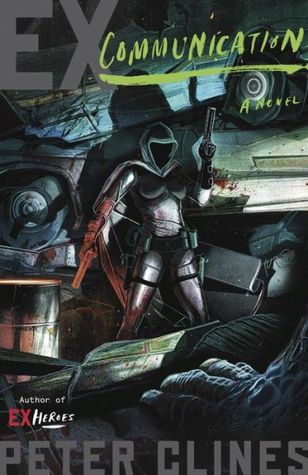
Ex-Communication byPeter Clines
Superheroes, zombies, and Hollywood — you really can’t go wrong with this combination. This third book in the Ex-Heroes series is just as fun and entertaining as the first two. A big thank you goes to LibraryThing and their Early Reviewers program, which is where I received a copy of this book in exchange for an honest review.
Since this is a sequel, be aware that there may be possible spoilers here for the previous books Ex-Heroes and Ex-Patriots if you haven’t read them yet. It is definitely best to read this series in order, as our superhero main characters and their community of survivors have come a long way. It has been years since the zombie plague decimated humanity, but St. George formerly the Mighty Dragon and his remaining fellow powered teammates have created a safe haven for the remnants of the population.
Still, many dangers still lurk beyond the walls. The hordes of ex-humans have become a new weapon for an enemy known as Legion, who uses the dead as pawns in his attacks against the superheroes. Things are not all well within the walls either, as dissension spreads amongst the survivors and Zzzap’s behavior becomes more erratic. The zombie plague has changed the rules about life and death, but even then the heroes are surprised when a couple of faces they thought long departed also show up at the Mount. Featuring the return of an old hero and the arrival of a new one as well, this third Ex-Heroes book definitely goes all out.
Certainly, if you enjoy reading “superhero fiction”, this series would be a great choice. The inclusion of the zombie apocalypse injects a new twist into the subgenre too — because it’s not enough that our heroes already have their hands full keeping order in a modern day world, they have to do it in the middle of a planet overrun with undead as well! I just love how ideas like that continue to make these books interesting and fun to ponder.
And naturally, it’s the ensemble cast and their unique powers that define a superhero book. This installment allowed me to catch up with St. George, Stealth, Cerberus, Zzzap and Freedom. As always, I continue to find myself entertained by their individual personalities, quirks and hangups. In some ways, reading about how the heroes’ attitudes and morals clash with each other is even more fun than seeing them use their powers to fight.
If anything, I felt the book could have done with less action scenes at the beginning. One might think “superheroes vs. the undead” would be something no one would tire of, like, ever — but you’d be surprised. After all, there’s only so many ways you can describe a superhero crushing a zombie’s skull, and even in the opening sequence I was tempted to start skimming. However, the book picks up when it starts filling in the events of the present as well as in the past, the latter achieved through chapters that leave the “NOW” and go back to “THEN”. These brief looks into the past give the reader the necessary background information to appreciate the story all the more.
I’m happy to see the series will continue. Peter Clines has provided me so much entertainment over the last couple of years with these books, I’d hate to see them end. Post-apocalyptic survival, fast-paced action, superheroes saving the world from evil and monstrous villains — you’ll find that all here.

The Clockwork Carnival
Posted on August 8, 2013 Leave a Comment
Once Upon A Time is hosting a very special steampunk event this month and you don’t want to miss it! Not sure what steampunk is all about? This is definitely your chance to find out! Check out The Clockwork Carnival for reviews, interviews, giveaways and more!
Book Review: A Matter of Temperance by Ichabod Temperance
Posted on August 8, 2013 Leave a Comment
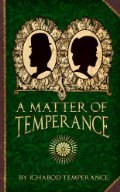
A Matter of Temperance by Ichabod Temperance
This is my first official adventure into the steampunk genre and it was definitely an enjoyable start. Ichabod Temperance is a young American inventor, whose first big claim to fame are his “Green Beauties,” a pair of goggles gifted to the famous Professor Plumtartt. Meanwhile, the professor, who is famous for the invention of Sol Furnaces, has also managed to harness the powers of the strange comet that recently passed over the earth. Or has he? Serendipitously, a freak accident at Plumtartt’s factory results in his daughter, Persephone, gaining strange new powers, just in time to fight off the monstrous creatures that have broken through to our world from another realm.
So begins round-the-world adventure, told in the alternating POVs of Ichabod and Persephone. Initially, the two are separate, but its not long before they join forces to fight the great evil that has been unleashed. The writing for Persephone’s chapters is a bit more solid, while Ichabod’s is more whimsical, each reflecting their particular character, but they blend well together, even when duplicating scenes, where we get to witness an event from both unique points of view.
Apparently, this began as a back and forth story adventure between two friends, which is a process dear to my heart. I’ve witnessed or participated in many such online collaborative storytelling and I love the idea that this particular story has been published to share with a larger audience. I’m sure there are some inside jokes that most readers will never know, but they were subtle and the overall tongue-in-cheek humour ensures that the story is fun for any adventure lover.
There were a few editing quirks – tense changes, inconsistent use of capitalization, grammar – but nothing to take away from the amusement, charm and excitement.


Want more steampunk? New to the genre? Visit Once Upon A Time’s Clockwork Carnival 2013 for all sorts of steampunk goodies.
Building A Broken Empire: An Interview with Mark Lawrence
Posted on August 7, 2013 Leave a Comment

In just a few short years, Mark Lawrence has gone from being a debut author to a dominant name in fantasy fiction. His latest book Emperor of Thorns, which released in the US earlier this week, is the breathtaking conclusion to The Broken Empire trilogy, a series of books that has taken the genre by storm (see our review of Emperor of Thorns here!)
One of the things we really admire about Mark is his openness and constant connection with his fans. In turn, we as readers have enjoyed the emotional journey on which his books have taken us. It is thus a great pleasure and honor that we were able to talk a little with Mark about himself and his writing, and share our questions and his answers with you here at The BiblioSanctum.
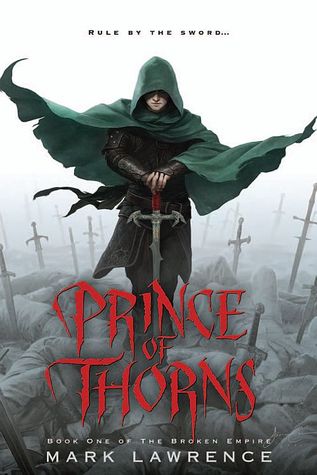 |
| “There’s something brittle in me that will break before it bends.” – Jorg Ancrath |
The BiblioSanctum: In the trilogy, Jorg grows from a young boy to become a 20-year-old in EMPEROR OF THORNS, very formative years for a character. Fantasy features a lot of main characters who age and mature throughout a series, but Jorg’s brutal history certainly sets him apart in making growing up a much different and more difficult process for him. Were there any challenges or highlights for you as you were writing Jorg’s journey from boy to man?
Mark Lawrence: We see Jorg at age six, age twenty and quite a few ages in between. I didn’t find any difficulty in maturing him – I just had a vision/model of him in my head and wrote that. It helped that he was always intelligent and confident beyond his years so the only real growth he had to make was emotional.
The challenges and highlights are the same thing for me and are always whether I can make the strong emotion that certain sections of the books generate in me come through the page. I don’t plan my story so I’m taken by surprise and shocked as often as the reader is. If the turn of events hits me hard, I want it to hit the reader hard too. That’s the writing challenge. It’s difficult to arrange letters on a page so that someone years later and far away both in geography and background will find their heart beating faster or punch the air or blink away a tear.
The BiblioSanctum: The world of The Broken Empire has a medieval fantasy feel, but there’s also an intriguing twist to its history that introduces some genre-bending elements into the series. Without getting too spoilery for readers new to these books, was this aspect of the setting intentional or was it something that worked its way into the storytelling as you went along?
Mark Lawrence: The setting, like everything else, grew with the story. The first hint of the twist that I got was when I typed out the first hint of a twist. I don’t sit down knowing what I’m going to write.
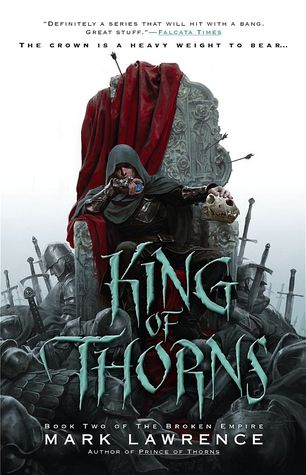 |
| “A dark time comes. My time. If it offends you. Stop me.” – Jorg Ancrath |
The BiblioSanctum: In your EMPEROR OF THORNS afterword, you were very firm in informing readers that the character’s story ends with this book. What are some of the factors that led to that decision and how does it feel to be wrapping up Jorg’s story? What are your future writing plans now?
Mark Lawrence: The main reason is simply that the best story I could find to write ended on the last page of book 3.
Secondary reasons include the fact I signed up for a trilogy. I told the readers it was a trilogy. And I didn’t want to be the guy who started stringing it out once it looked like being successful.
I’m happy with the decision (at least now!). I think there’s a power in knowing when to end things. It’s a bit like knowing when enough is enough, when the joke stops being funny, when it’s time to leave, when to stop speaking etc. As I said in the afterword, I would very much rather people remember wanting more when Jorg’s tale ended, rather than just remembering which of the dozen books they finally gave up on as Jorg became a caricature retreading old ground for the umpteenth time.
The BiblioSanctum: With EMPEROR OF THORNS completing The Broken Empire trilogy, you’ve gone from new author to seasoned writer in the last few years. What has the journey been like for you? How has life changed?
Mark Lawrence: It’s been swift. I’ve gone from having no books out to having a completed trilogy out in a touch under two years. Life hasn’t changed very much at all really, excepting that I spend more time writing now, and because my very limited spare time has not increased that means I spend almost no time doing the stuff I listed on my author bio when I started. My life is still dominated by caring for my very disabled youngest daughter. My day job is still the next biggest call on my time, and my writing still gets slotted in around those things. The big change I guess is that I now spend a lot (too much probably) of time on twitter and facebook etc keeping in touch with readers.
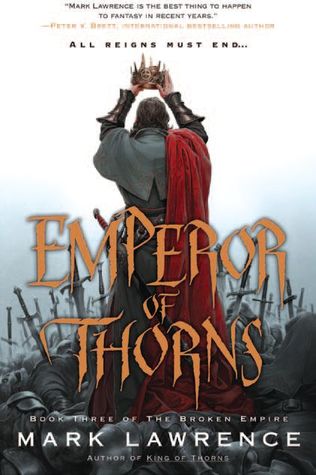 |
| “Every man has his thorns, not of him, but in him, deep as bones.” – Jorg Ancrath |
The BiblioSanctum: What kind of things fuel your creative fires? Where or when do your best ideas come to you? On the flip side, do you ever have moments when you just need a break from writing, and in those cases, what do you do to zone out?
Mark Lawrence: I think the biggest source of fuel for my creative engine is boredom, or at least a vacant mind. I tend to get my best ideas when I’m cycling to work, or digging the garden, or sawing logs, or staring into space. When my mind empties then ideas bubble up to fill it. The more interesting and fun my life is the less I have to say.
I never really find I need a break, but I do manage to fit in the odd film or book. PC/console gaming sadly is something I just haven’t been able to make time for recently.
The BiblioSanctum: We loved your recent blog post about what THE BROKEN EMPIRE means to you, and your hope that it meant something to your readers. We also appreciate your constant interaction with fans through Twitter and your blog, with fun contests, advice on writing, sharing fanart and more. What’s the best part about interacting with your fans?
Mark Lawrence: That’s hard to say. I’ve ‘met’ some great people over the past two years. With my caring duties I can’t go to conventions or signings, but chatting on the internet is a good substitute. I love reading reviews where people have really connected with my work, and one of the best things has been the competitions where I get to see so much creativity and skill on display, often in areas where I’m lacking myself. It’s also been rewarding to have been able to raise so much money for the charity that runs children’s hospices (including one that my daughter uses). But I guess in the end the best part is that some of those fans have become friends.
Book Review: Glamour in Glass by Mary Robinette Kowal
Posted on August 6, 2013 Leave a Comment
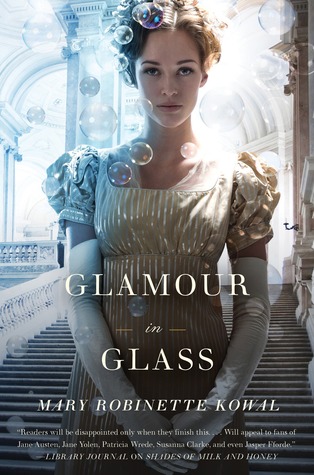
Glamour in Glass byMary Robinette Kowal
I think 2013 has seen me branching out into more sub-genres of fantasy than any other year, thanks to participating in events like the Worlds Without End’s Women of Genre Fiction Reading Challenge. Once, Mary Robinette Kowal fell into the category of “An author I’ve never read before, but would really like to” and so the book I chose for the challenge was 2012 Nebula Award nominated Glamour in Glass.
Someone once told me that when writing a review, it helps to think about what makes a book different and why readers should care. For this one, the thing that struck me right away was the setting. But while I may have read fantasy fiction aplenty that takes place in this time period, this is the first time I’ve actually ventured into something with strong elements of Regency romance, complete with the stylistic conventions that bring to mind the works of Jane Austen. This is also the first time I’ve ever heard the term “Fantasy of manners”. Hooray for discovering new things!
It wasn’t until after I picked up Glamour in Glass that I discovered it was actually the second book of a sequence called the Glamourist Histories. Normally, I dislike reading books in a series out of order, more out of a fear that I’d get lost than anything. That’s why I was happy to learn that you don’t have to read the first book Shades of Milk and Honey to follow the story and understand what’s going on. The magic system in this book, called Glamour weaving and described with textile-related metaphors, was sufficiently explained and the general idea of it is easy to pick up. I also quickly got that our main characters, Jane and Vincent, were newly married since the last book, and now they’re looking forward to settling down to a life of nuptial bliss and doing Glamour together.
However, at the start of this book is also the period following the abdication of Napoleon. While Jane and Vincent are on their honeymoon in Belgium, the deposed emperor escapes exile and makes his return to France, leaving the newlyweds with no easy way to return to England.
Certainly, this book was somewhat of a departure from the kind of fantasy I usually read and the experience was very new and different for me. The language and characters’ mannerisms are definitely in keeping with the time period, which I have to admit was delightful and yet frustrating at the same time. Mostly, the frustrations come from the narrator Jane and the way she dwells on issues for a long time and perceives every little indignity as a personal slight to her, especially those pertaining to marriage and her husband.
I find this still bothers me even when taking into account the era in which these books take place, a time when men and women’s statuses vastly differ, so I’m not holding that against Jane. Instead, my dissatisfaction of her character stems from from her relationship with Vincent and how often their marriage feels “off”. First of all, a big chunk of the novel’s conflict is the result of a breakdown of communication between the two of them. I’ve seen this trope commonly used in romances, but I’m personally not a fan of it.
Also, despite being madly in love, the two of them don’t seem to know each other very well. Awkwardly, Jane is still constantly discovering new things about her husband that surprises her or makes her doubt him, and I also found myself questioning why she so often feels the need to seek permission or approval from him for every little decision. I have to assume their courtship mustn’t have lasted very long, but perhaps this is where I need to pick up Shades of Milk and Honey to find out.
Speaking of the first book, I do intend to go back and read it. Despite my problems with the main character, I thought this book was well-written and contains interesting ideas. I can’t really talk about some of the issues in it without giving away too many spoilers, but suffice to say the emotional reactions of the characters are very well-described, deep, and most importantly, realistic and believable. I also love the idea of Glamour magic, which is just abstract enough to give one the sense that it’s so much more than can be put into words. I’m looking forward to learning more details about Glamour in the first book, as well as in future installments of this series.

Character Appreciation Post: Ororo “Storm” Munroe from Marvel Comics
Posted on August 6, 2013 Leave a Comment

“Storms, Wolverine, have a myriad of colorations. No less than people. So long as I remain true to myself… I see no reason to apologize for how I appear to others.” – Storm, Uncanny X-Men #246
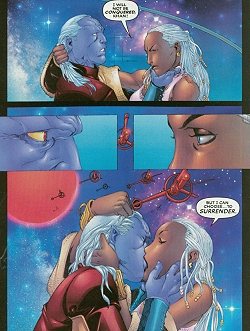
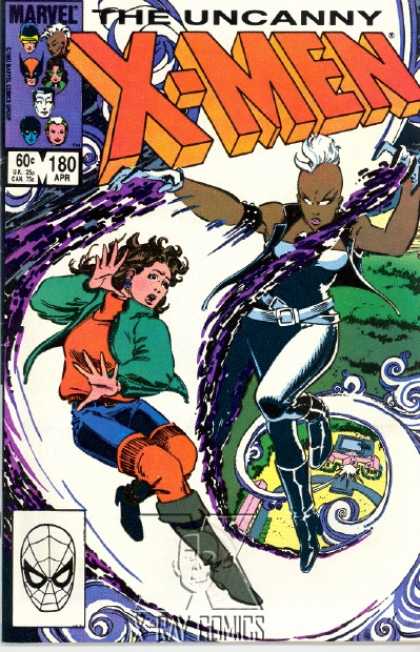
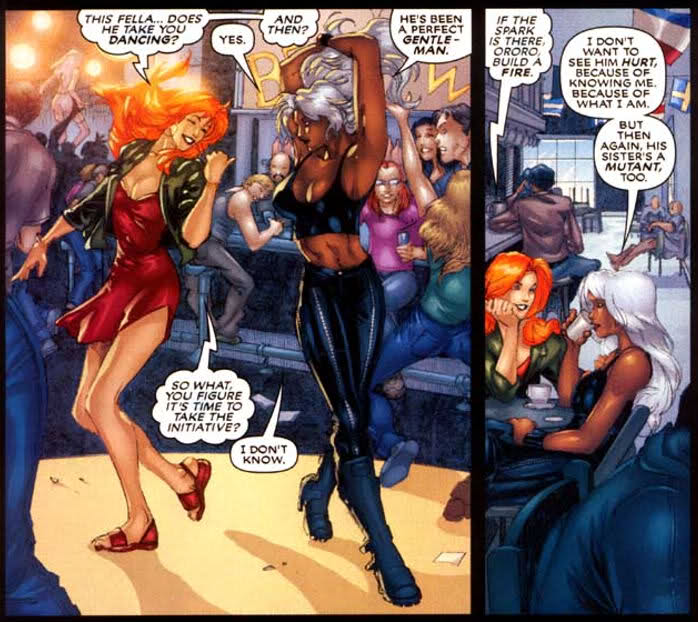
She is Ororo “Storm” Munroe, a mutant in the Marvelverse with the ability to manipulate the weather. She is most notably known as being the empathetic co-leader/leader of the X-Men and (ex?) queen of Wakanda. And while Ororo does carry herself with much poise and class, her background is varied and some of it troubled, leading to her cultivating the indomitable strength and will that she possesses instead of crumbling under the pressure.Orphaned at a young age, she spent much of her early years fending for herself living as a child thief and then later she served as a “goddess” for a village. She learned street skills that would later aid her even when she accepted Professor Xavier’s invitation to join his X-Men. Throughout her years, she has been many things for many people from a surrogate mother to a most hated opponent. And while she has stumbled from time to time, Ororo has never lost a sense of who she is as a woman and as a hero.A Song I Associate With Her
Tan Dun, For the World
Why I Love Her
And if you say, “Of course you like Storm. You’re a black woman,” I will find you and I will cut you. No bullshit.

An Interview with Ascension Author Jacqueline Koyanagi
Posted on August 5, 2013 Leave a Comment

The first thing that struck me about Ascension: A Tangled Axon Novel was the cover. It’s rare to see a person of colour – and a female at that – as the main protagonist in a science fiction/fantasy story. But in reading the book, I learned that there was far more to Alana Quick. And a lot more to her inspirational creator, Jacqueline Koyanagi.
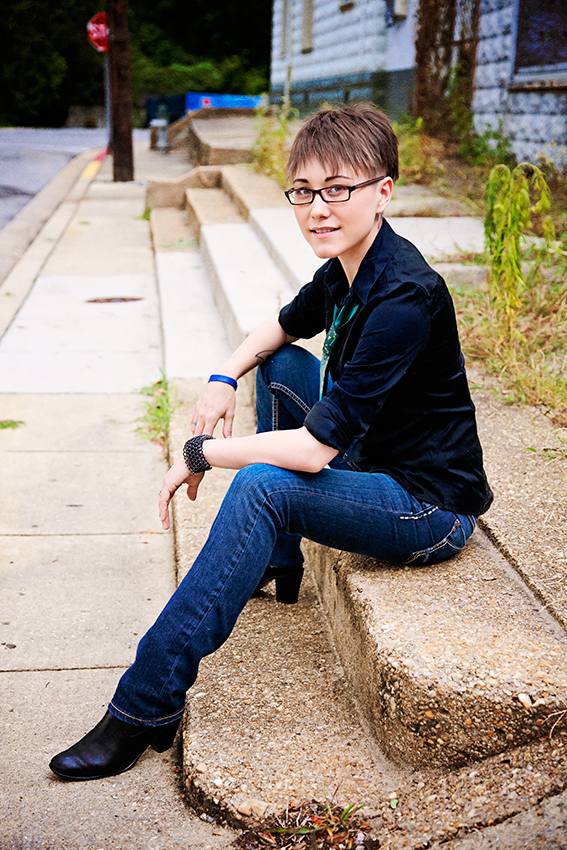 |
| Jacqueline Koyanagi Photo by Vasilion Photography |
Beyond that, Alana’s chronic illness features heavily in her story. Between my own illness and those of several people I’ve been close to over the years, I’m intimately familiar with the toll invisible disabilities can take on a person’s life. In some cases, nothing goes untouched by its influence: eating, walking, working, even just showering.
The combination of chronic illness and poverty can mean pushing oneself to be productive through the pain. I wanted to feature a character whose chronic pain is deeply integrated into her day-to-day life, so much so that she has long since learned how to function in spite of it. When survival is at stake—obtaining food, medication, additional work—sometimes you have no choice but to push through the symptoms.
Alana is a character who lives at the junction of practical skill and intuition. Most of Alana’s life is, by necessity, focused on tangible, physical matters, from managing her illness to the mechanical aspects of her work as a sky surgeon. I wanted to give her something more than that, some driving passion that helped her push through to the next day; her connection to the Tangled Axon is her tether when her body rebels.
W: I love the idea that Alana isn’t the typical soldier or captain in a typical sci fi story. She’s a sky surgeon who has never even left the ground. Where did you get the idea to make this her occupation?
JK: Actually, it started with the idea of the Tangled Axon and its engine room. I knew I wanted to tell a story in which this ship was the setting, and I wanted the protagonist to be someone who would have an intimate connection to the spirit of the ship.
W: Were there aspects of Alana’s adventures and interactions that reflected real moments in your life?
JK: Mostly her experiences with her chronic illness. While the symptoms of my own illness are different from Alana’s, they certainly impair my day-to-day functioning. I channeled some of that into Alana’s story, particularly her determination to keep going regardless of what her body was telling her. It’s a stubbornness both I and many other chronically ill people I’ve known share.
There’s a little of me in many of the characters I write, I’m sure. Tev’s demeanor is probably the closest to my own for better or worse, and Marre’s circumstances are a metaphorical reflection on the long-term effects of psychological trauma, which is deeply connected to my own history and that of several people I’ve known.
Of course, another obvious corollary to my life is the non-monogamous nature of the relationships on the Tangled Axon, since I’m polyamorous as well. That said, the relationships in the novel aren’t direct mirrors of any of my own relationships.
W: Why was it so important to you to tell this story? What message did you want to deliver to your readers and to the science fiction genre in general?
Ascension is, at its heart, a story about eudaimonia. I chose a narrow focus for that reason: Alana’s story, her perspective, her desires. We see what’s relevant to Alana, and nothing more. When Alana lived in her home city, she was overwhelmed and overshadowed by the noise and oppression of the larger world. The Tangled Axon comes into her life, and she sees an opportunity to find a place for herself for the first time.
The ship is the main setting because that is the way Alana conceptualizes her reality: the Axon and its crew become her world, and everything else is incidental.
Beyond the aforementioned roles of disability and diverse relationships, gender obviously loomed large in this book. The common trope is that, while the world is populated by more than one gender, stories are often overwhelmed by male characters. Male protagonists, male antagonists, male background characters, with—at most, if we’re lucky—two or three women thrown in, usually orbiting the men. Even when a protagonist is a woman, we often see her surrounded by men, heavily influenced by the actions and desires of the men around her.
I deliberately inverted the trope, and this was important to me: I wanted to tell a story in which women just happened to dominate the protagonist’s experiences regardless of what the broader population looked like.
Depicting characters with diverse qualities was less about any one message and more about doing it for its own sake.
W: Who are your favourite authors? What are your favourite books? How have they influenced you as a writer?
JK: I’m going to have to go with Catherynne Valente for her soulful approaches to myth, Caitlin Kiernan for the way she depicted mental illness in The Drowning Girl, and China Mieville for his gorgeous worldbuilding.
W: If you could ask any one of your favourite authors a question about their characters and worlds, what would you ask them?
JK: I’d probably want to listen to Valente talk about the birth of Palimpsest, which remains one of my favorite novels for its unusual characters and surreality. I also have a bit of a thing for Palimpsest’s Casimira, so I’d be interested in learning more about where she came from in the development process.
W: What do you love about genre fiction? What do you hate? What would you like to see in the future of the genre?
JK: This is probably a cliché, but I love that SF/F is limitless in its potential. I’d like to see more authors capitalize on this in terms of gender and sexuality, though I think we do have some great voices accomplishing this right now. It’s an exciting time for genre fiction.
W: Describe your writing process. What gets you into a writing frame of mind?
JK: I choose a scent for each project I’m working on and use that to trigger the necessary mindset when I sit down to work. I’ll usually review my work from the previous day to create a sense of continuity, then get lost in the protagonist’s world and forget to eat.
W: What are your future writing plans?
JK: I’m currently working on a new novel that has a much darker mood. It’s more solidly science fiction than Ascension, though mythic elements certainly made their way into the worldbuilding as well. Most of my stories sit somewhere between science fiction and fantasy because I have a hard time conceptualizing a world primarily dominated by ingenuity or magic—both are relevant to me, so both appear in most of my writing in one way or another.
W: Any advice for aspiring writers?
JK: Keep at it.
W: Tell me a little about Helix Chainmaille. It’s beautiful and it seems to have snuck into the story in its own unique and personal way! How long have you been designing the jewelry?
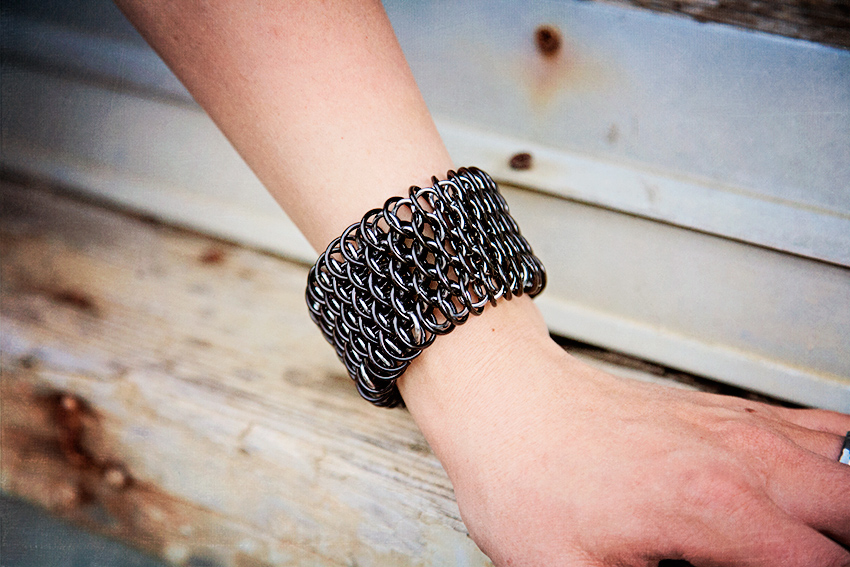 |
| Helix Chainmaille | Photo by Vasilion Photography |
W: Anything else you’d like to add?
JK: Thank you for taking the time to review Ascension and talk to me. It’s been a pleasure!
Book Review: The Golem and The Jinni by Helene Wecker
Posted on August 3, 2013 Leave a Comment
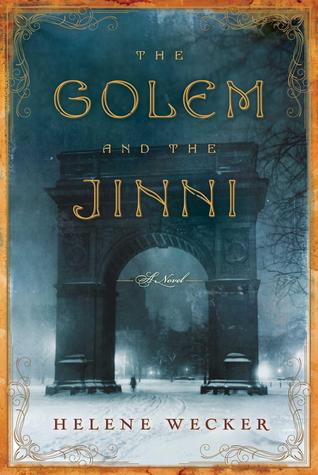
The Golem and the Jinni by Helene Wecker
I absolutely adored this. Magical realism at its finest! And even though it wasn’t exactly what I had expected, I can’t really say that I minded. Otherwise, as a character so deftly put it in this book, I would be like “a man who complains that someone stole the eggs from his henhouse and replaced them with rubies.”
This fantasy novel is also a touching and meaningful immigrant tale at its heart, combining religion and mythology to tell a story of two supernatural creatures who find themselves in New York City in 1899. Chava is a magically-crafted clay golem, brought to life to serve a husband who dies at sea while on the voyage from Poland. When the ship reaches NYC, she is left directionless and without a master. Ahmad is a jinni, released accidentally after being trapped in a copper flask for hundreds of years. Though freed from the vessel, he finds himself still bound to the physical world by a band of iron around his wrist, placed there by the wizard who imprisoned him so long ago.
The story plays out like a fairy tale for adults, complete with elements like love and villains. It is filled with wonderful, fully-realized characters which hooked me from the start. The multiple narratives paint an enchanting picture of the bustling and culturally rich setting of turn-of-the-century New York, where immigrants from so many places around the world settled in the hopes of finding a better life. In this milieu, the golem and the jinni become two more faces in the crowd trying to seek a new beginning in America. Despite being creatures of lore, their struggles and aspirations make them feel entirely too human.
Both the golem and the jinni face questions and obstacles that deal with the notion of freedom versus subjugation; how the two characters approach these issues and choose to deal with them is what forms the basis for this story and makes it so interesting. In this novel, everyone you meet will guard their secrets and hold mysteries in their past. As you read on, the fun is in watching all these histories unfold and the connections start to form.
Just simply a beautiful book, and a great choice if you’re in the mood for some literary fantasy.



 The BiblioSanctum