Book Review: Countdown City by Ben H. Winters
Posted on August 19, 2013 Leave a Comment
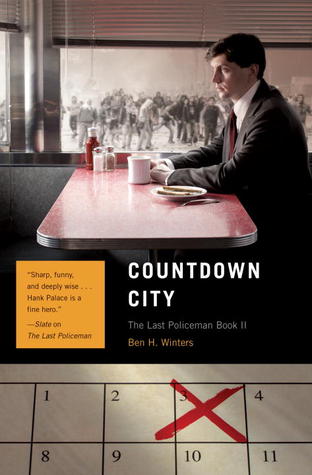
Countdown City by Ben H. Winters
Genre: Sci-Fi Apocalyptic, Police Procedural
Series: Book 2 of The Last Policeman
Publisher: Quirk Books
Date of Publication: July 16, 2013
Author Information: Website | Twitter
What would you do if the world was going to end in a little less than three months?
Being a wimp, I’d probably hide in the basement closet with a comforter over my head, praying that it’s all a bad dream. Most likely I’d be depressed and wouldn’t be able to go about my everyday life like everything was normal. I definitely wouldn’t be like Hank Palace, the main character of this novel, because even with an asteroid hurtling through space towards earth threatening to wipe out all life on the planet, he’s still out there patrolling the streets trying to be the best damn policeman he can be.
Not that Hank’s even a policeman anymore; he’s been relieved of his duty, after what’s left of law enforcement in the country went through some major restructuring. In the time between Countdown City and the previous book The Last Policeman (my review here), things have gotten worse. Even the last vestiges of institution and pockets of civilization are starting to break down, with electricity gone now and water about to be next.
Hank, though, is still on the job, taking on a missing-persons case to find the husband of Martha Cavatone, the woman who used to be his babysitter. Much like he was in the last book, he becomes rabidly obsessed with the case, but is this merely due to his personal connection to Martha? Or it this just Hank’s own version of hiding in the basement under the covers? I get the feeling that beneath his focused exterior, he’s just as crazy with panic as everyone else. To me, this made him a very interesting breed of unreliable narrator.
Once again, I’m just floored by Winter’s interpretation of a pre-apocalyptic America. While I’ve read tons of apocalyptic novels, most of these take place after the destructive event has already happened, or they take place just before. Very rarely do you see a book like this where everyone knows the end is coming, but the catch is that it’s not coming for a while yet, and the world has to suffer through this plodding march towards doom like watching a slow death.
In circumstances like these, anything can happen, really. But the author makes it so realistic, showing a wide variety of human reactions to the killer asteroid. There’s Hank, who immerses himself in work, and there are also people like his sister, who still believes there’s hope and joins a commune. As you’d expect, there are also those who just lose it and commit suicide (thus giving us the basis of the first book) as well as a significant portion of the population that goes “Bucket List” (which forms an interesting theory for this book). As Hank notes, cases that seemed mundane under normal circumstances take on a whole different meaning in these new times, because there’s no such thing as “normal circumstances” anymore.
A police procedural set against a backdrop like this takes on a brand new twist – and I think this is the key to why I enjoyed this sequel even more than its predecessor. The Last Policeman had a good story, but I felt the details of the case Hank worked on in that book had very little to do with the social climate or the situation with the asteroid. This book, however, has those elements all over his missing-persons investigation. It made the impending armageddon an integral part of the case rather than just the background. Clock’s ticking and it’s getting real now, and this book really makes you feel it.

Audiobook Review: Black Feathers by Joseph D’Lacey
Posted on August 18, 2013 Leave a Comment
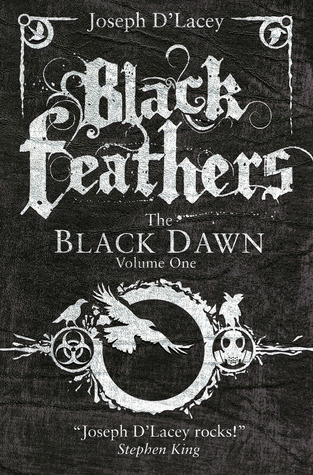
Black Feathers by Joseph D’Lacey
This was an audiobook read, narrated by the magnificent Simon Vance.
The birth of Gordon Black signifies the end of the world. Year after year following his birth, the world slides into more and more poverty and destruction. People call it the Black Dawn and the Crowman becomes its symbol. Whether the Crowman is a harbinger of the final end or the saviour of the world, no one is certain, but when the Ward goes after a teenaged Gordon, they are certain that the Crowman must be stopped by any means and that Gordon, tasked by his family to find the Crowman, must be captured. Meanwhile, in the post-apocalyptic future where life has reverted back to a time before technology with remnants of the old world buried, a young girl named Megan is summoned to take her place as the first ever female Keeper. Her task? To write the Crowman’s story.
This book is a cautionary tale (that occasionally gets a bit too preachy in its warnings against our reliance on technology and modern comforts and convenience, etc) and is told in a very unique way with very interesting characters. Gordon’s journey is intriguing, and I liked the way Megan’s role is worked in, with her seeing the events of the past in order to record the dark and painful tale of the Crowman.
The Crowman himself is a fascinating character. Is he a creature of good? Is he evil? Throughout the book, we get glimpses of his development and his influences on the world, but we’re never quite sure of his purpose and how he will decide the world’s fate. Is the world’s fate a decision for him to make? Or is the Crowman simply just doing his part in an incomprehensible cycle?
I was not overly fond of the Ward. The Ward represents the ruling party who wish to maintain control throughout the chaos and the Crowman is a threat to their hold on everything. They are Big Bad Corporations, The Man, Big Brother and every other example of oppressive regimes that we’ve seen in the past. Personally, I would have enjoyed their part more if they weren’t represented in such a heavy handed manner. In a time of chaos, it is understandable that there are those who try to control and take advantage. But those trying to maintain order and fairness, such as not allowing people to hoard food while others starve, is not necessarily evil. I would have liked it if the purpose of the Ward was as ambiguous as that of the Crowman.
Overall, I enjoyed Black Feathers. It was very good, but there’s a “but” floating around in my head somewhere that I’ve yet to put my finger on… Whatever that may be, for better or for worse, the book has stayed on my mind since finishing it, and I definitely approve of a book that keeps me thinking long after I’ve finished reading the last page.

Book Review: Masque of the Red Death by Bethany Griffin
Posted on August 18, 2013 Leave a Comment
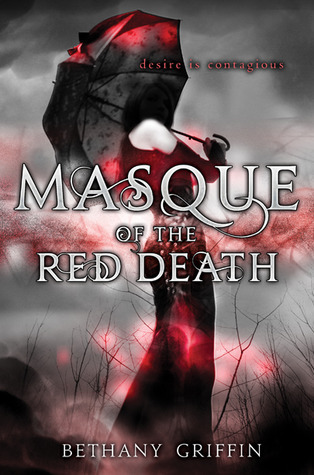
Masque of the Red Death by Bethany Griffin
Genre: Young Adult Fantasy; Dystopia; Steampunk
Series: Book 1 of Masque of the Red Death
Publisher: Greenwillow Books
Date of Publication: April 24, 2012
Author Information: Website | Twitter
Never have I felt so broken up over writing a review for a book that ultimately ended up not being my cup of tea. It’s tough, seeing asMasque of the Red Death is a Young Adult dystopian novel inspired by the Edgar Allan Poe short story of the same name, and so it is at once creative, original and highly ambitious — which all happen to be qualities I admire in a book. It had some good ideas, and so I wanted to like this, tried hard to like it, but in the end there simply were too many issues that prevented me from getting on board.
The book is set in a gothic, post-apocalyptic rendition of the late 1800s, with a dash of steampunk mixed in for good measure. 17-year-old Araby Worth lives life amongst the elite thanks to her father’s illustrious career as a scientist, while the poor are left to fend for themselves in a city ridden with plague and death. Those who have the means to afford them buy the elaborate porcelain masks which help prevent the contagion, but the dictator Prince Prospero has a iron hold over their production. Still grieving the death of her twin brother which she believes is her fault, Araby wants to help change the way things are by working towards making salvation from the disease available to all.
I’m torn over these details. On the one hand, I’m completely in love with the setting, and my one regret is wanting to know a lot more about the history and background than the book was able to give me. I also think the main character had a lot of potential, but for some reason Araby feels pretty much devoid of any personality. If I had to guess, I would say it’s the writing style; told in first-person present tense, the narration could have been a lot more powerful, but instead it came across very clipped as I was bombarded with simple short sentences that often described everything Araby saw in front of her eyes but sadly not what was going on inside her head. As such, I couldn’t get a sense of who she was at all.
Even now, there are so many blank spots in my mental picture of her as a character, since a lot of her motivations and behaviors just didn’t match up. Her father, for example, whom she thinks is cold, aloof and uncaring, is actually in my opinion a sweet, kind and rather cool dad! I mean, here’s a man who takes his morose teenage daughter for walks just to get her out of the house and on a whim would buy her nice things like books. Then there’s Araby, one of those girls who contemplates betraying her parents for a boy she’s only known for a grand total of like five minutes. I’m just shaking my head.
Which brings me to another thing that bothered me — the dreaded love triangle. It would be nice if I had any interest at all in either romantic option, but behind door number one is Elliott, the prince’s nephew who seeks to fuel a rebellion by convincing Araby to join him by his side. Meanwhile, behind door number two is William, the handsome porter with the awesome tattoos who works at the club Araby frequents and whom she is drawn to. One guy is arrogant, the other is dull, and both are patronizing to the extreme. It’s really tough for me to get into a book when the romantic drama takes up such a huge part of the story, especially when I think the heroine is deserving of so much more than what she’s offered.
I feel like I’m being too harsh in this review, but even after putting my YA-reading hat on and embracing the romance, I just couldn’t get into this book. I think it had some great ideas, but I feel like we’ve only scratched the surface on a lot of them, much like how I think Araby’s character could have been much better developed. While this book was a quick read, I can’t help but think maybe a little more detail could have gone a long way into fleshing out the story and making it more satisfying.


Want more steampunk? New to the genre? Visit Once Upon A Time’s Clockwork Carnival 2013 for all sorts of steampunk goodies.
Mogsy’s Book Haul
Posted on August 17, 2013 Leave a Comment
I always love welcoming new books to my library, and the last couple of weeks saw some new arrivals from various sources!
In the physical book pile:

The Crimson Shield – won from a giveaway the author Stephen Deas (writing as Nathan Hawke) was hosting on his blog and on Twitter, so I was pretty psyched out of my mind when my copy arrived safe and sound from its long journey across the Atlantic. What a bold choice it is to leave all writing including title and author information off the front cover, but I can’t deny that the result is quite dramatic and effective. Can’t wait to read this book.
Countdown City – from LibraryThing’s Early Reviewers program, the second book of the Last Policeman series. I read the first book earlier this year and was really looking forward to seeing what would happen next, so I pretty much devoured this sequel. Look for the review in a couple days!
Skulk – an ARC I received from Strange Chemistry, and it’s one of those books that make me really happy I check out YA. I meant to review this closer to its release date, and only picked it up to read a chapter or two just to see what it’s all about. I ended up finishing the book in a couple sittings because I couldn’t help it; it was pretty addictive. My review should be up closer to October when the book comes out!
Love Minus Eighty – oh man. Oh frickin’ man. My deepest gratitude to My Shelf Confessions for hosting the giveaway of this book, which is how I got my copy. I’d been falling to pieces lately pining to read this, and I was floored when I got the email saying I actually won. Currently in the middle of this and I can’t even being to describe how captivated I am by it right now.
Now on to the digital pile:


Looks like I didn’t do quite as well on the self-restraint front this week with NetGalley:
The Troop – looked interested from the NG newsletter they sent out.
Warrior of the West – invite from Atria to review the second book in the King Arthur Trilogy after I reviewed the first.
Letters from a Murderer – from Angry Robot’s mystery and crime friction imprint, this one looked like something I’d enjoy.
Ebooks I purchased:
Stormdancer – a friend of mine has offered me an opportunity to read the second book, but whether or not that pans out I wanted to read book one first before the sequel comes out. Plus, the description on this looked cool, and I’ve heard some great things.
Angelfall – an interesting looking YA book I came across while browsing Amazon’s own publishing titles, which got some pretty good comments and reviews. For a few bucks I picked up both the ebook and the audiobook Whispersync bundle.
The Mister Trophy – recommended to me by a Goodreads friend who told me to check this author and series out if I enjoy urban fantasy. It’s a short read and it could be had for a couple of bucks, so I thought, why not!
Book Review: The Exodus Towers by Jason M. Hough
Posted on August 17, 2013 Leave a Comment
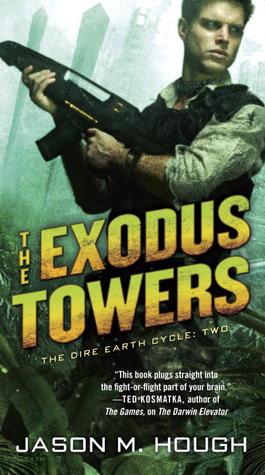
The Exodus Towers by Jason M. Hough
Genre: Science Fiction, Post-Apocalyptic
Series: The Dire Earth Cycle #2
Publisher: Del Rey Books
Date of Publication: August 27, 2013
Author Info: www.jasonmhough.com
With thanks to NetGalley and Del Rey for the opportunity to read an advance copy of this book in exchange for an honest review.
The Exodus Towers takes up shortly after The Darwin Elevator. The “traitors” are now separated from Darwin, Australia after the discovery of a second alien elevator in Belem, Brazil. Skyler Luiken and the colonists are working to set up, well, a colony, using the new alien towers and their transportable auras. Tania Sharma and her crew are supporting them from above and desperately trying to keep Russell Blackfield from finding out about the colony, while still maintaining the food for air and water trade with him. Meanwhile, Sam Rinn and Kelly Adelaide are still imprisoned by Blackfield within Nightcliff.
From the first image of a girl dancing among the ghosts of desolation, I was hooked. Things quickly picked up from there, moving along at a spiralling pace that introduces some intriguing new characters, eager to stake a claim in the aftermath of Neil Platz’s death and Blackfield’s anarchy. The Jacobites take on a greater role and Skyler learns that he isn’t as unique as he thought.
And all the while, the mystery of the aliens and their purpose continues to loom over them, now with a clock ticking down, if Tania’s calculations on the “Builders’” schedule is correct.
For the first half of the book, my thoughts went off the rails because of how much was happening. I hate to use typical review buzz words, but I’m going to have to fling out “action-packed” and “edge of your seat” to describe the suspense, drama and excitement as I hopelessly devolved into subhuman squeals, flails and tears. I may have even uttered a loud “**** YEAH!” at one point.
Fortunately, before my review completely deteriorated into “lakjdflajf!!!,” with me huddled in the corner desperately reading The Plague Forge, impatiently awaiting news about when The Dire Earth Cycle is going to be made into movies, the second half of the book settled down and allowed my nerves to do the same.
Time is a big factor, with the Builders’ scheduled to – do something – in two years from where the book begins. After the initial action, events skip quickly through the more mundane aspects of taking control of Nightcliff and setting up the colony. This part of the book might seem dull to some, but, as I said, time is a factor and I appreciate the way Hough worked all of this preparation in under the continued, ominous mystery of the Builders. Are the Builders malevolent or benevolent? Their SUBS disease has wiped out/converted 90% of human life on earth, while their elevators and aura towers are protecting the rest. WHAT THE HELL DO THEY WANT???
*ahem* Sorry.
Also during this time, the characters and their relationships change significantly and sometimes surprisingly. Certain relationships that seemed to have been forged in The Darwin Elevator have not ended up where I expected – and I love that! I might be disappointed that I don’t get what I thought were OTPs, but I love that Hough hasn’t taken the obvious routes.
I am really happy to spend more time with Sam, one of my favourite characters from the previous book. She’s a rough and tumble woman of Amazonian height who can hold her own against any man. She began as a dangerously subordinate member of Skyler’s crew, but she really impressed me after Jake’s death, showing a side of herself that isn’t just about the typical bluff and bluster. This continues in Towers, where she gets to display intelligence, leadership and compassion. Meanwhile, Hough continues to reveal that his other lead characters are not perfect and sometimes, aren’t even likable.
One thing I really want to praise is the diversity of Hough’s survivors. Too often, post-apocalyptic stories forget that the rest of the world exists. It’s ironic that the survivors have all been sequestered into one small pocket on the bottom of the world, yet Hough has made it clear that, when the crisis hit, everyone from everywhere attempted to make their way to Darwin. That means that the one million remaining humans are a true cross-section of the billions of people that used to live on the planet, and it does not feel like tokenism when we meet characters from various cultures, some of whom don’t even speak English.
Click here for more on The Dire Earth Cycle, including an interview with author Jason M. Hough.

Book Review: Children of Fire by Drew Karpyshyn
Posted on August 16, 2013 Leave a Comment
 Children of Fire byDrew Karpyshyn
Genre: Epic Fantasy
Series: Book 1 (so far)
Publisher: Del Rey
Expected Date of Publication: August 27, 2013
Author Information: Website | Twitter
I’d looked forward to this novel for a long time, ever since last year when Drew Karpyshyn announced he was leaving BioWare to focus on his own original book project. Having very much enjoyed his work in video games in the past, including the novels that spawned out of the Mass Effect and Star Wars: The Old Republic universes, I was disappointed to see him go but was also very curious as to what he was working on.
Turned out, it was Children of Fire, the first book of his idea for a new epic fantasy series, and it sounded something he’d been cooking in his head for long time. After years of reading his Star Wars and video game tie-in novels, I was very interested in seeing what Drew can do with his very own story and characters. My thanks to the publisher and NetGalley for providing me with this e-ARC.
About the book:
Long ago, a great warrior called Daemron was was chosen by the gods to lead the war against the Chaos spawn. He was given three magical talismans to aid him in the fight — a crown, a ring, and a sword. Daemron, however, grew corrupted with their power and ended up turning against the gods. The savior of the world instead became its destroyer.
Daemron was thwarted in the end, banished to a plane beyond the Chaos Sea, sealed behind barrier called the Legacy. A religious cabal called The Order have been tasked to maintain this magical shield, protecting the world from the Chaos and its minions. The three magical talismans were hidden away or lost.
Now the Legacy weakens, and Daemron grows strong enough to cast his essence into the world. Across the land, four Chaos-touched children are born beneath a blood red moon, each embodying an aspect of Daemron himself. Though Keegan, Scythe, Vaaler, and Cassandra grow up in different places with different lives, their fates are intertwined — but whether it is their destiny to restore the Legacy or unleash the destroyer upon the world is yet unknown.
My thoughts:
I loved lots of things about this book, and on the top of that list was the sweeping, overarching feel of the story. The introduction including the details surrounding the four children’s origins was in my opinion the best part of the book. While all born of “suffering and strife”, the background and circumstances of each child were nonetheless unique and interesting.
The character development continues as we follow the four children, and we get glimpses into the major events of their lives as they grow up. But as we edged closer towards the present and more and more talk of fate and destiny crept into the picture, that’s when I hit a wall. I still enjoyed the story very much, but at this point everything began to feel a lot more run-of-the-mill and typical.
It is possible that I am just a bit more critical of the fantasy I read these days, especially if they come with the description of “innovative epic fantasy”, but I admit I expected a lot more from the characters and plot. Both bordered on the cut-and-dried and formulaic after while, which I felt was the main thing holding back the story. I know the concept of the Big-Damn-Hero-destined-to-save-the-world is one that’s tried and true, but it’s very in-your-face here and nowadays I crave a lot more out of my fantasy reads.
And maybe I’m just still not used to seeing the author’s writing outside of media adaptations, but while I love his “pulpy” style in Star Wars and game tie-in books, here it kind of feels out of place for the kind of story he wants to tell. I thought that more focus could have been placed on the setting and supporting characters too, to give the story as a whole more of an “epic” vibe, because I didn’t feel like I was getting enough of history and identity from this original world he’s establishing from scratch. The Danaan people and their cities come to mind, for example.
I also think some of the points I brought up above could do with the pacing. I think Drew Karpyshyn did a fantastic job presenting to us his main characters, considering there are four of them and that’s quite a few different perspectives to follow. Keegan gets the bulk of the attention, though, and I wished we could have seen more of of the others at different ages because it feels like a couple of them disappear for a long stretches at a time. When they resurface, sometimes years afterward, I don’t feel like I know them enough anymore to know if it only seems like dialogue feels forced, or if they are actually acting out of character.
Overall, this ended up being more of a fun read than a truly epic read, and became a lot better once I shifted my expectations accordingly. It felt like the book could have benefited from a little more structural editing to address pacing issues and plot and character development, but it was a great introduction to a brand new world of magic and fantasy lore. I’m a big fan of Drew Karpyshyn, and I’m glad he finally got the chance to bring his own ideas to life and share it with his readers.

Book Review: The Ocean at the End of the Lane by Neil Gaiman
Posted on August 15, 2013 Leave a Comment
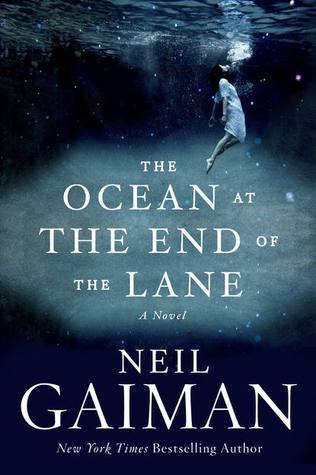
The Ocean at the End of the Lane by Neil Gaiman
As with the pattern of previous Neil Gaiman books I’ve read, Ocean features an average male protagonist who wouldn’t be particularly interesting, but for the magical realm he’s introduced to and the ensuing adventure. But, while the other books adhere firmly to this fairly specific pattern, Ocean quickly and mesmerizingly walks down the lane into an entirely different story. Well, not an entirely different story, but this time, the story of the man quickly becomes the story of the boy he once was and the women he met in the house at the end of the lane, including one Lettie Hempstock, a girl just a few years older than his seven years, who takes him to a pond, only to reveal an ocean.
Thus far, I’ve found Gaiman’s books to be dark but whimsical. Even the evil characters have a sense of humour and are quick with their wit, but Ocean was very melancholy and I felt connected with it far more deeply than I have the others. I thought Gaiman did an excellent job of telling the story through the eyes of a little boy who becomes bound to a frightening creature who can control his family with her desire to make them happy. The boy’s sense of hopelessness and fear and his bravery are palpable, making the story very engaging.
The men in Gaiman’s other books tend to annoy me with their refusal to believe in the magical things presented to them. Here, a child who adores books and takes so many cues from them, willingly accepts the unbelievable, both good and evil. And when he finds it in himself to fight, it feels far more real than the grown ups who suddenly realize their role as the hero. Perhaps it helps that this book doesn’t require the main character to valiantly save the girl; he has to fight to save himself.
I suspect that the men in Gaiman’s other works are loosely based on himself. Upon reading Ocean’s acknowledgements, I came to feel like this was far more personal to the author than anything else he’s written. That the little boy was far more himself than any other character he’s brought to life. He does state that the family in the story is nothing like his own and this really is a work of fiction, but his comment about the Hempstocks being with him all his life is what really struck me and made me appreciate Ocean all the more.
Book Review: Dragon’s Child by M.K. Hume
Posted on August 14, 2013 1 Comment
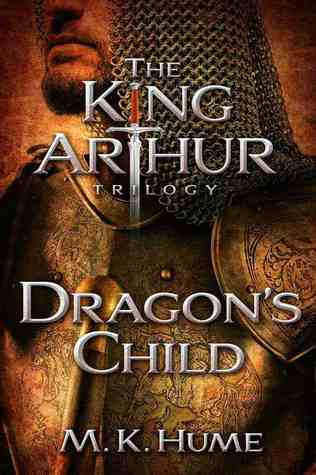
The King Arthur Trilogy Book One: Dragon’s Child by M.K. Hume
Genre: Historical Fiction, Arthurian Fantasy
Series: Book 1 of King Arthur
Publisher: Atria Books
Date of Publication: November 12, 2013
Author Information: Website | Twitter
Thank you to Atria Books for sending me an advanced copy of Dragon’s Child in exchange for an honest review! Originally published in 2009, a new edition of the paperback and ebook will be available later this fall, thus it was provided to me via Atria’s latest Galley Alley program. This book first caught my eye when I found out it was an Arthurian fantasy novel written by an expert on the subject. Like many, I’ve been exposed to my share of retellings and interpretations of the King Arthur mythos in fiction (there are a ton out there!), but I am most definitely not well-versed in the historical details. This made me curious as to how an academic authority on Arthurian literature would tackle the legend.
Not surprisingly, the novel turned out to be a story of Arthur (known here as Artorex) and his journey from a humble childhood to become the High King of the Britons. Artorex is presented to us as the reluctant hero, whose personal choice would have been to raise a family on his foster family’s farm and live out the rest of his days as a simple steward. Fate, however, has set him on another path.
I’ll admit that I found it difficult to get into the story at first. The introduction to the hero’s journey is a familiar one: the boy who everyone had initially dismissed suddenly discovers that he has a greater destiny. In the next few chapters, his skills are honed and he becomes stronger. He learns to fight, he learns to ride, and he gains all the experiences he will someday need to become a great leader. It was pretty standard, even as Arthurian legends go, and I had to suppress the temptation to skim this section, especially knowing that the real meat of the story had to be just beyond this point.
Thankfully, I was right and the book did get better. Much better, in fact, with the introduction of Gallia, Artorex’s first wife. That’s right, I did a double-take too when I saw that. M.K. Hume herself wrote in her Author’s Note explaining that she once came upon an evocative reference in an obscure text named Guinevere as Arthur’s second wife, but even though she could find no other material in her research that even hints at a first wife, the idea stuck. And I have to say, the fact whole epic trilogies can develop and evolve from tiny little tidbits like that is what fascinates me about historical fiction, and why I love the genre.
In this case, I really enjoyed the author’s take on Artorex’s childhood and teenage years, as well as her reasoning behind why she chose to tell his story the way she did. A lot of attention is given to these formative years, and I was surprised at how engaging the story became after getting past his boyhood training. Even though Hume used a third person omniscient point of view to narrate the story (which I normally dislike, because it tends to distract me from the main character), the focus always remained on Artorex, making his transformation from the boy known simply as Lump to King Artor of the Britons a very drawn-out but believable one.
In the end, I went from feeling luke-warm towards this novel to liking it quite a lot. The writing style can come off as a bit cumbersome at first if you’re not used to it, but I later felt it suited the book very well, giving a cold edge to some of the darker and more violent parts of the story. This first book ends with Artorex being crowned the High King, and the best part is knowing there is so much more to his legend, which I’m looking forward to continuing in the rest of this trilogy.
An Interview with M.L. Brennan, Author of Generation V
Posted on August 13, 2013 3 Comments
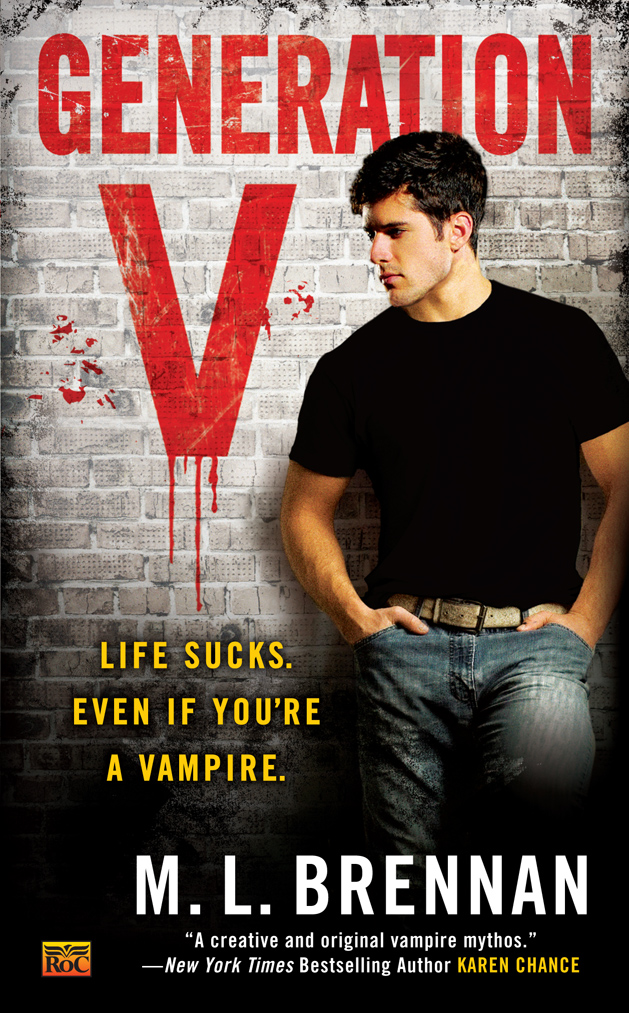 These days, books find their way onto my to-read list for any number of different reasons, but I like to think that coming upon Generation V was somewhat of a serendipitous fortune. M.L. Brennan was a name I first came across when I followed a few random links in my Twitter feed and came upon this post on her blog. My first thought was, “Damn, this author has great taste!”
And now, as they say, you know the rest of the story. I discovered that not only does M.L. Brennan read fantastic books, she’s also written her own fantastic urban fantasy debut, Generation V. It’s also incredibly apropos that that particular blog post should be the one I stumbled upon, because if I had to make my own list of “Authors Who Deserve More Recognition”, M.L. Brennan would be at the top of it.
Seriously, HOW did I not know about Generation V before?! Original, humorous, and highly entertaining, as you can see from my review, this book is a gem that deserves way more attention! To my absolute glee, M.L. agreed to be interviewed, and I hope you enjoy her answers as much I did!
Mogsy: GENERATION V stood out to me because of its many creative and fresh ideas. You take a lot of our notions of vampires in Urban Fantasy and turn those on their head. What inspired you to write about these unique vampires like Fortitude Scott and his family?
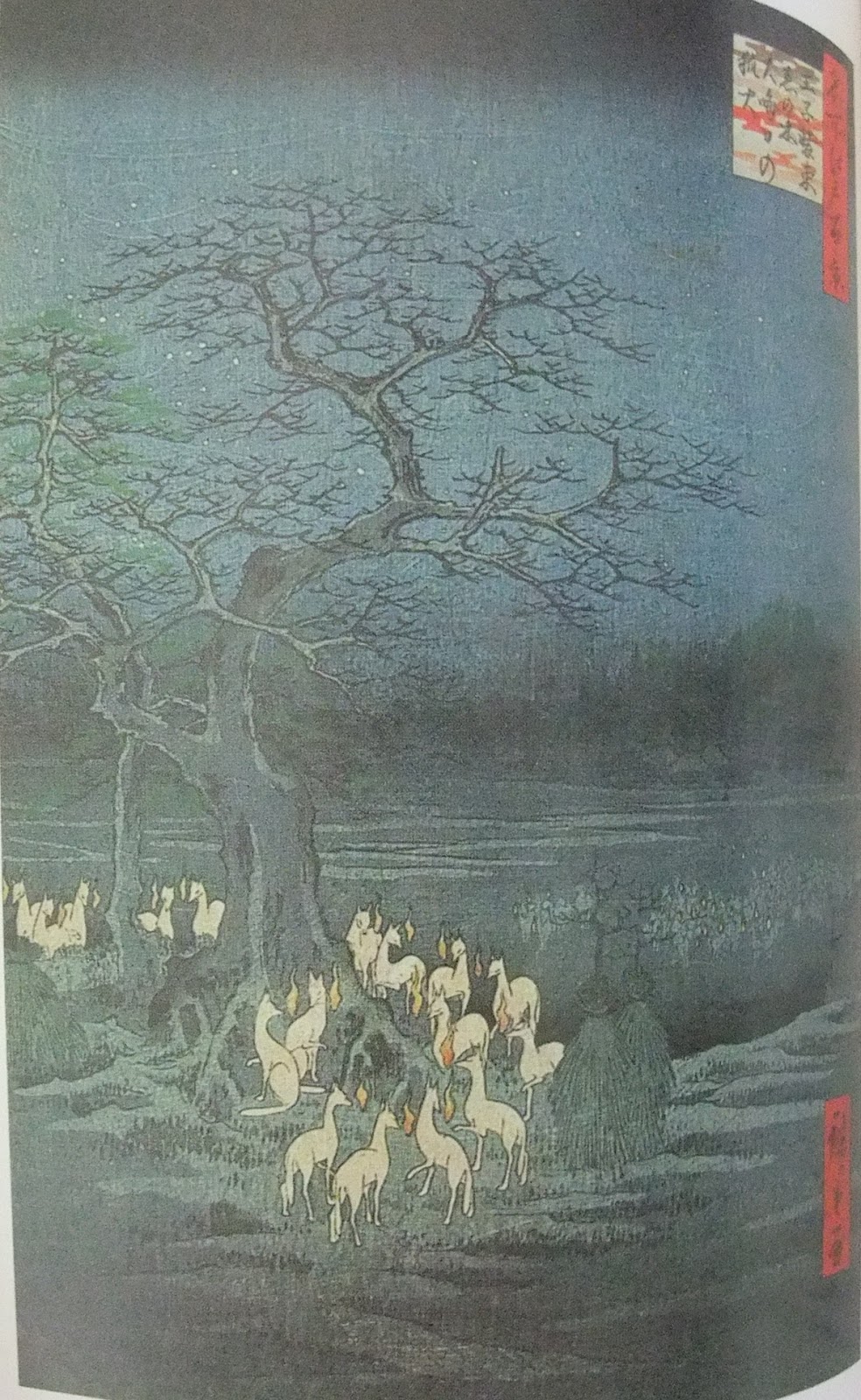 |
| “Fox Fires at New Year’s Eve” |
M.L. Brennan: I was one of those kids who loved mythology. When I was little it was mostly Greek, Roman, and Norse mythology (shout-out to Edith Hamilton here), but when I was older I became interested in folktales. What I find so fascinating about folktales are what they represent about the ideals and values of the culture that created them – what traits heroes have, how monsters are presented, and so on.
Mogsy: I know that you’ve written short works in other genres, but decided to branch out and to write the kind of book you love to read, which was how GENERATION V came about. What is it about Urban Fantasy that draws you in? What would you like to see more of from this genre in the future?
Mogsy: I also read that you live in a house that’s more than 100 years old! I can’t help but notice in the book that you include a lot of description, history, and culture of the Rhode Island and the New England area. Did your own personal environment play any role in shaping the setting of GENERATION V?
Setting the “home base” for the vampires in Newport, RI was also a lot of fun, because that’s a place that I’m very familiar with. I’ve spent a week there every summer since I was four, and I was lucky to live there on my own for a full year during my first year of college. Just about every location reference I make for Newport is absolutely real – you can visit the Thames Glass Company and the Newport Fudge Company, you can walk up the cobblestones on Thames Street, you can drink an Awful Awful from the Newport Creamery (which I highly recommend!), and you can even tour the mansion that I modeled Madeline’s home on – it’s Rosecliff.

 |
| Pictures of Rosecliff – inspiration for Madeline’s mansion |
M.L. Brennan: I can’t give too much away, but I’m really excited about this book!
Here’s a tidbit you’ll like – I reveal some more about the background of the kitsune in this book, along with some of their legends. You’ll also be seeing a lot more of one of the creatures that got a brief cameo in Generation V – in Iron Night they get fully fleshed out. And you’ll also be seeing a lot more of Prudence – and probably not in a way that you might’ve expected!
 |
| Book 2, coming out in early 2014 |
Mogsy: Of course, I was ecstatic to see there will be more books in this series and am hoping we’ll see the adventures of Fortitude continue for a while yet, but is there anything else on your plate at the moment or any future plans or ideas to write other stories?
M.L. Brennan: Right now I’m writing the third book Fortitude Scott book – I’m really hopeful that people like it, since I’ve got a lot of ideas for more books, and some of the plotlines that I’m building up just won’t be completely told by the end of book 3. But I do have a few other ideas on the back burner – even if I get contracted for more Fortitude Scott books, I’ll definitely be working on building up some other stuff. I have another Urban Fantasy idea, but I’ve also been a lifelong fan of SF, so that might happen at some point!
Mogsy: Is there anything else you would like to add, or anything else you would like to tell us about yourself or your book?
M.L. Brennan: Just how delighted and grateful I am that people have responded so positively to Generation V, and I hope that they enjoy following Fortitude Scott through Iron Night! And thank you again for the marvelous interview – this was such fun!
Thank you for the interview! For more information about M.L. Brennan:
Website | Twitter
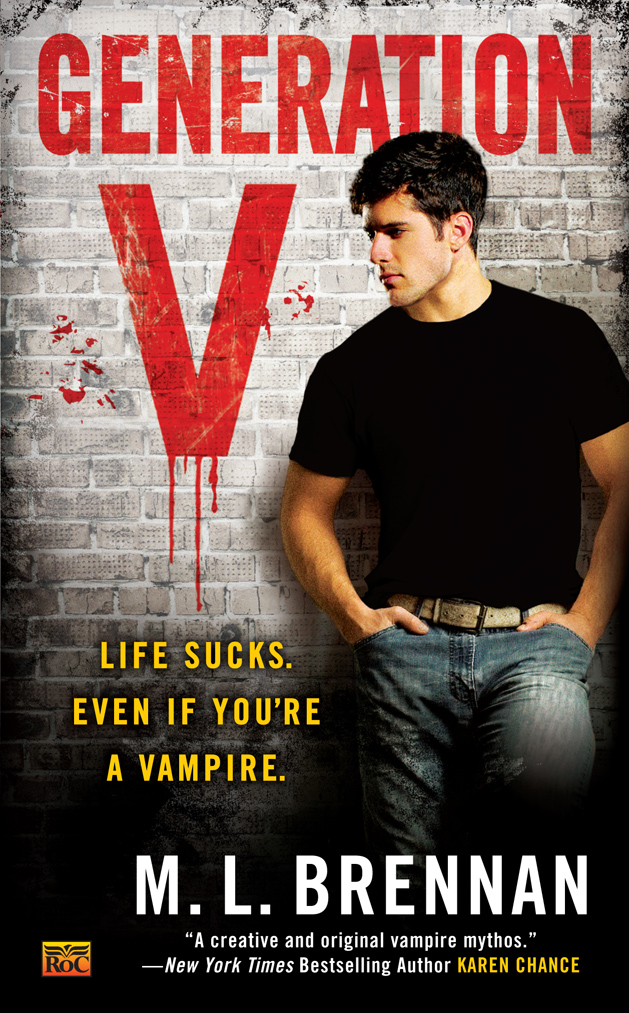
Book Review: Generation V by M.L. Brennan
Posted on August 12, 2013 3 Comments
Genre: Urban Fantasy
Series: Book 1 of American Vampire
Publisher: Roc Books
Date of Publication: May 7, 2013
Author Information: Website | Twitter
Urban fantasy is quickly becoming one of my favorite genres, and I’ve certainly been reading a lot of it this year. The problem with that, however, is that I’ve become a lot more picky, so these days for a UF series to catch my eye, its ideas or stories need to be very interesting and it has to offer something a little different. That’s why when the author of Generation V sent me a request for an honest review of her book, I very enthusiastically took her up on it. The book looked like it fit the bill for something more unique and original.
In that, I was definitely not disappointed. The book stars Fortitude Scott, who’s not your typical urban fantasy vampire because he’s, well, technically not even a full vampire yet. He’s still mostly human, a trait which Fort is trying desperately to hold on to in the face of his impending transition. Meanwhile, his full-vampire mother and older siblings look upon him as a constant source of exasperation and embarrassment. But then Luca, a new vampire, shows up in his town and Fort realizes that there are worse monsters than his family.
Several killings and abductions drive Fort to take action. Along with the kickass shapeshifting kitsune woman Suzume Hollis, they try to find a way to stop this ruthless vampire. The problem is, Fort doesn’t have much of a plan, not to mention the distraction that is his mess of a personal life. He’s broke, his girlfriend is cheating on him, and he’s on the verge of losing his job. The good news is, all that might not matter when he manages to track down Luca. In his mostly-human state, Fort realizes he is hopelessly outmatched and is probably going to get himself killed.
Have I ever mentioned how much I love an underdog? Fort is not like other urban fantasy heroes. He’s not strong, he doesn’t ooze sophistication or finesse like the rest of his vampire brethren in the genre, and he’s not particularly fashion-minded either. In fact, he’s kind of pathetic, albeit in a very adorable sort of way. The poor guy gets pushed around everywhere — at work by his boss, at home by his hipster roommate, and in his love life by his girlfriend Beth who manages to convince him that their relationship can benefit from her sleeping around with other people. At a point, he almost becomes too painful to read about, but the nice thing about underdog stories is that they always bounce back. But more on that later.
In the meantime I just have to say I also loved the kitsune fox shapeshifters in this novel. They feature prominently in Japanese folklore, and I thought their inclusion here was a nice twist on the usual shapeshifter-in-a-vampire-book idea. Werewolves are fine and good, but it’s also so much more interesting when an author works ideas based on mythology into their stories. Come to think of it, this may also be why I adore another one of my favorite UF series, the Mercy Thompson books by Patricia Briggs, which incorporates Native American myths on Coyote. It worked well there, and likewise, the kitsune also worked very well in Generation V.
Suzume Hollis, the bodyguard charged to keep an eye on Fort, is one of the kitsune. Her character is very intriguing. Although I think her attractiveness might have been overplayed a little, she also sets herself apart from a lot of female characters in urban fantasy by being mischievous, quirky, and sometimes just downright silly — like all trickster foxes ought to be. Usually, I find it’s often the male protagonist in an urban fantasy who does all the wisecracking, but Suzume can certainly hold her own on that front.
Speaking of which, I love M.L. Brennan’s sense of humor. I know I’ve described many an urban fantasy as “funny”, but very rarely do I actually forget myself and laugh out loud while reading — something I found myself doing several times during the course of this novel. Fort may be a doormat, but he definitely has a way with words.
To balance out all that humor, though, are also some pretty heavy themes in this book. There are some bold new takes on vampires like their nesting habits, the fact they aren’t immortal and that they actually age (even though the process is reeeaal sloooow), but it is the manner in which they procreate that takes the cake as one of the most fascinating and yet disturbing ways I’ve ever read. It’s pretty neat, though. And I love it when books make me feel like that.
One thing I think I would have liked to see more of is Fort’s growth over the course of the novel, because as it is he doesn’t find his backbone until almost the very end. As well, there are some aspects of the story or character motives that confused me or that I thought could be better explained or taken further, but this also just means a lot of potential for this series. I was happy to hear that there will be a book two, but not so happy when I discovered that I’ll have to wait until early next year for Iron Night. This is a great choice for urban fantasy fans looking for something fresh and fun.


 The BiblioSanctum