Book Review: The Golem and The Jinni by Helene Wecker
Posted on August 3, 2013 Leave a Comment
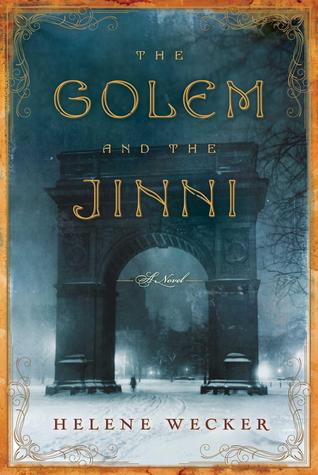
The Golem and the Jinni by Helene Wecker
I absolutely adored this. Magical realism at its finest! And even though it wasn’t exactly what I had expected, I can’t really say that I minded. Otherwise, as a character so deftly put it in this book, I would be like “a man who complains that someone stole the eggs from his henhouse and replaced them with rubies.”
This fantasy novel is also a touching and meaningful immigrant tale at its heart, combining religion and mythology to tell a story of two supernatural creatures who find themselves in New York City in 1899. Chava is a magically-crafted clay golem, brought to life to serve a husband who dies at sea while on the voyage from Poland. When the ship reaches NYC, she is left directionless and without a master. Ahmad is a jinni, released accidentally after being trapped in a copper flask for hundreds of years. Though freed from the vessel, he finds himself still bound to the physical world by a band of iron around his wrist, placed there by the wizard who imprisoned him so long ago.
The story plays out like a fairy tale for adults, complete with elements like love and villains. It is filled with wonderful, fully-realized characters which hooked me from the start. The multiple narratives paint an enchanting picture of the bustling and culturally rich setting of turn-of-the-century New York, where immigrants from so many places around the world settled in the hopes of finding a better life. In this milieu, the golem and the jinni become two more faces in the crowd trying to seek a new beginning in America. Despite being creatures of lore, their struggles and aspirations make them feel entirely too human.
Both the golem and the jinni face questions and obstacles that deal with the notion of freedom versus subjugation; how the two characters approach these issues and choose to deal with them is what forms the basis for this story and makes it so interesting. In this novel, everyone you meet will guard their secrets and hold mysteries in their past. As you read on, the fun is in watching all these histories unfold and the connections start to form.
Just simply a beautiful book, and a great choice if you’re in the mood for some literary fantasy.

Audiobook Review: Neverwhere by Neil Gaiman
Posted on August 2, 2013 Leave a Comment
This is the third Neil Gaiman book I’ve read and I’ve noticed a trend:
An average, unmemorable male protagonist with slightly/over-controlling girlfriend/recently turned fiancé crosses paths with an unusual human that turns out to be magical and leads the protagonist into a whole new world of magic that has always been there for those willing to see it. Apparently, this is such a common occurrence for Gaiman’s characters, that he’s even written instructions on what to do in such an occasion in A Wolf at the Door: And Other Retold Fairy Tales. Unfortunately, Richard, in this case, has never read those instructions, and, as with the other characters I’ve met in the other books, spends a frustratingly large amount of time in disbelief of the world unfolding around him. This reminded of Alif the Unseen, where the main character, an avid fantasy reader, stumbles into the same situation. The creature in question notes that North Americans in particular love science fiction and fantasy stories, but are the least likely to believe when presented with the reality of them.
In Neverwhere, Richard’s life is significantly altered when he stops to help a wounded girl. She is the Lady Door and she’s being hunted by some very dangerous men. She leads Richard to the London beneath where the people who slip through the cracks reside. Don’t be so quick to discount the street people wrapped in blankets, the story seems to say. All sorts of knowledge and magic could be wrapped up within their filthy coats and blankets.
Once Richard is forced from his dull life, the adventure becomes fairly typical and Richard works his way through various gauntlets to prove himself a hero in the end and change his perspective on life and on himself. Again, this is a similar theme in the other Gaiman books, however, each one does it in a unique way with very memorable supporting characters so, while the process might be similar, the journey is still fun and interesting each time.
This was an audiobook listen, and I was pleased to discover that it was narrated by Gaiman himself. Since beginning my foray into the wonderful world of audiobooks, I’ve wondered how much the narrators deal with the authors (not much or at all, it seems). Do they get the pronunciations right? Have they captured the author’s intent with the various characters and situations? For the most part, the answer seems to be yes to the latter, at least, but with Gaiman reading his own works, the answer is absolute

Mogsy’s Book Haul
Posted on August 2, 2013 Leave a Comment
Added a few more books to both my physical and digital library since my last book haul update! First, the mailbox pile:

Ex-Communication was a book I received from LibraryThing’s Early Reviewers, which I was very excited about! I very much enjoyed the two books that came before and just love this fun and action-filled series about superheroes and zombies.
Generation V was a review request, and my thanks to the author M.L. Brennan who kindly sent me a copy of her very awesome and original urban fantasy novel. Both Ex-Communication and Generation V were great! I think I devoured both these books within days after they arrived, so be sure to keep an eye out for the reviews in the coming weeks.
Atria Books also just had one of their Galley Alleys which was how I got sent a copy of Dragon’s Child, the first book of M.K. Hume’s The King Arthur trilogy. Originally published in 2009, the Atria paperback and ebook edition will be available later this year in the fall. It looks interesting, so I’ll probably get to it closer to the release.
Finally, I won an Amazon gift certificate last month for a review I wrote on Worlds Without End, so naturally, it went towards buying — what else — more books. That’s how I got Anthony Ryan’s Blood Song. I probably could have waited until later when I’ve whittled my summer reading list down some more to pick this up, but it just looked really good. I suppose I wanted it on hand in case the urge to pick it up and read it becomes overwhelming.
On to the digital pile:


I told myself I would try damn hard to hold myself back from requesting any more eARCs from NetGalley until I catch up a bit on my reading list, and so far I’ve been doing really well. Of course, it’s also a new month now, so we’ll see how that goes. On the other hand, I did get a few new ebook additions, and the two above are a couple of the highlights.
I was practically beside myself with happiness when I received Hollow World by Michael J. Sullivan. It’s not due for wider release until next year, but people who backed the Kickstarter campaign were able to get it first. Much respect to Mr. Sullivan, as the book was sent to readers in July like he originally promised, with only an hour to spare. I have to say it was a great way to end day, though, seeing that in my inbox.
And lastly, The Red Knight was a book that caught my eye when it was a Kindle SFF daily deal, and it seemed like a few of my friends on Goodreads had rated and reviewed it quite highly. For $1.99, I couldn’t pass it up, and from the description it looks like something I’d love to read.
Book Review: The Walking Dead: Rise of the Governor by Robert Kirkman
Posted on August 1, 2013 3 Comments

The Walking Dead: Rise of the Governor by Robert Kirkman
My rating: 3.5 of 5 stars
Yeah, my summer reading is in a funny cycle right now, and my current bender has been focused on The Walking Dead.
Anyhow, I pretty much have to cut this whole review for major spoilers, and it’s a little hard to talk about the story without talking about the biggest spoiler of them all in this book. So, I’ll just use this little quote from the book as a spoiler warning and for spoiler space:
As they drive off, each and every one of them–even Penny–glances back through the rear window at the little square sign receding into the distance behind them:
ALL DEAD
DO NOT ENTER
August Book Club Read: The Ocean at the End of the Lane
Posted on August 1, 2013 Leave a Comment
From this list of recommended summer reads, members of the LeVar’s Rainbow Book Club selected Neil Gaiman’s The Ocean at the End of the Lane for August.
A middle-aged man returns to his childhood home to attend a funeral. Although the house he lived in is long gone, he is drawn to the farm at the end of the road, where, when he was seven, he encountered a most remarkable girl, Lettie Hempstock, and her mother and grandmother. He hasn’t thought of Lettie in decades, and yet as he sits by the pond (a pond that she’d claimed was an ocean) behind the ramshackle old farmhouse, the unremembered past comes flooding back. And it is a past too strange, too frightening, too dangerous to have happened to anyone, let alone a small boy.
Book Review: The Walking Dead: Rise of the Governor by Robert Kirkman
Posted on August 1, 2013 Leave a Comment
The Walking Dead: Rise of the Governor by Robert Kirkman
My rating: 3.5 of 5 stars
Yeah, my summer reading is in a funny cycle right now, and my current bender has been focused on The Walking Dead.
Anyhow, I pretty much have to cut this whole review for major spoilers, and it’s a little hard to talk about the story without talking about the biggest spoiler of them all in this book. So, I’ll just use this little quote from the book as a spoiler warning and for spoiler space:
As they drive off, each and every one of them–even Penny–glances back through the rear window at the little square sign receding into the distance behind them:
ALL DEAD
DO NOT ENTER
Rise of the Governor is the first book in a trilogy that sets the foundation for Philip Blake’s reign as “governor” of Woodbury. The story begins with two brothers, Philip and Brian Blake, and Philip’s daughter, Penny. The brothers, Penny, and two of Philip’s friends, Bobby Marsh and Nick Parsons are hiding out from walkers in the affluent neighborhood Whiltshire Estates. The decision to hide in the neighborhood seemed the best idea at the time, but the gated community had been ravished hard and fast by the outbreak. They try to stick it out and fortify their position at Philip’s demand, but after a zombie kills one of Philip’s friends, they finally decide that it’s time to cut their losses and move on to Atlanta where they receive the Rick Grimes zombie horde welcome, which eventually leads to their departure and taking up residence in Woodbury.
Much of this book is told from the point-of-view of the brothers, and they couldn’t be more different if they tried. Brian is the oldest, but he’s frail and a bit sickly. Before the outbreak, he’d been living with their parents mourning another failed business venture and the loss of his Jamaican wife (seriously). He admires his brother’s toughness and dominance even though Philip is younger, but I didn’t really feel like Brian wanted to be an alpha male more than he wanted to be seen as someone who contributed something to their survival.
On the other hand, Philip is blessed with all the “good genes.” He’s tall and intimidating. He’s a manly man tempered with a little softness thanks to his daughter. He looks out for his brother, but think Brian is pretty useless. The only thing Philip really trusts Brian to do is look after his daughter, who is beginning to pull further and further into herself, during attacks. After the death of his wife, Philip’s main concern became Penny and doing whatever he needed to do in order to make sure she had everything she needed. He takes charge of their group, often making decision without much input from them (or still outright ignoring their suggestions). He has the presence of a leader, and if there’s one thing we’ve learned from the various leader types shown in the comic, on the show, and in this book, people are going to lean on the leader with an almost blind loyalty because of the high stress situation.
One of the enduring themes I’ve noticed with Kirkman and his leader-types is that many accept or put themselves in these positions, and eventually, the stress seems to work them over double time, as it should. It’s not an easy task to try to ensure the surivival of a group of people or make most of the decisions that could potentially get them killed. You have zombies to worry about, but you also have the pressure of everyone looking to you for answers, support, etc. It’s emotionally and physically exhausting, and the leaders suffer so much more for it. Some of them still try to rise above that. They try to adapt this new harder stance they have to take while still maintaining some sort of decency and fairness. However, some take the other road and decide that you have to be a monster to survive the monsters. Philip falls in this latter group.
We watch Philip tread further and further down away from his own humanity while reasoning he’s doing these things for his daughter’s safety. After his daughter’s death and return as a walker, he becomes downright vicious and insane. None of the these things are surprising. This is the Governor after all, and we know that he employs some brutal methods. At times, though, some of his behavior makes you wonder how he comes back from that insanity at all to be able to put up the facade of the Governor.
Answer: He doesn’t.
Philip Blake is not the Governor. Philip eventually forces the hand of his friend, Nick, who fatally shoots him. In turn, Brian murders Nick and holds his dying brother in his arms. Assuming the identity of his brother, Brian takes over the town of Woodbury from its current governor and begins preparations to take the town back from the walkers.
While I liked the little twist at the end, it’s also one of my chief complaints. Brian’s decision to take on his brother’s name at the end of the story didn’t really seem like the thing he’d do. The two brothers didn’t seem particularly close, even as they survived through that horror together. Brian sought Phillip’s approval, obviously, but beyond that I don’t really feel like Brian wanted whatever alpha male presence his brother possessed.
Maybe this is Brian’s way of dealing with the loss of his family. Maybe this broke him in some ways, even though he sees his actions following the death of his brother as sensible and strong, and there were a few instances in the book where he’d thought about wanting to do the “manly” things Phillip and his friends had done. He also mentioned early in the novel that his brother was changing for the worst and this change reverberated through him. Also, the book makes it a point that Brian is out of place in the world and doesn’t really know his calling. Apparently, the outbreak showed him his place in the world. So, I’m trying to look at it in that vein.
I had some other minor annoyances with the book. There were parts that I wished were fleshed out more, and there were some things that I felt were just unnecessary. While this is a decent foundational read even for those who aren’t familiar with the show or comics, readers jumping in from this point may find the world building lacking in some ways. Overall, however, I enjoyed this more than the comics. Also, I really appreciated this look at how the Governor came into power.

Book Review: A Wizard of Earthsea by Ursula K. Le Guin
Posted on July 31, 2013 1 Comment
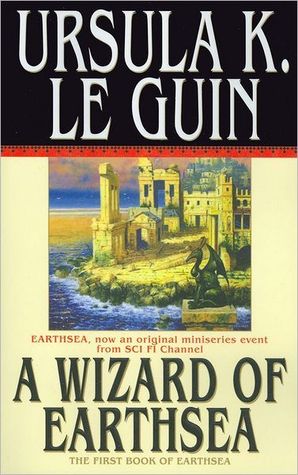
A Wizard of Earthsea by Ursula K. Le Guin
The book is called A Wizard of Earthsea and that’s exactly what it is about, no more and no less. It introduces Duny, a young boy who displays power that leads him to study with a local witch, draws the attention of a great mage, and then proceeds on to study to be a true wizard, but not before awakening a dark evil that will haunt him for many years.
This is the first book in Le Guin’s Earthsea saga. I’ve read other books that serve as an introduction to a main character and their world, but some of them have tried too hard to throw in extra details and events and characters to build that character and world. Le Guin skillfully weaves Duny’s life through a series of important moments and people in under 200 pages. I try to use the word “pithy” at least once a week, and it definitely suits the way Le Guin tells Duny’s story. Every character and plot device has a purpose in shaping the boy who will become one of the greatest mages known.
The dialogue is a bit unusual, but it works for the flow of the story. In fact, “flow” is another word I willuse to describe the book because everything moves smoothly, like a river flowing out to sea. Perhaps the title and the many journeys that Duny takes by boat have influenced that feeling, but that’s exactly what I imagined as I read through it. There were quiet, slow moving moments, like his time with the mage Ogion, or the more rushing moments of his battles with dragons and shadows. But everything stayed the course.
Duny himself is an interesting character. He begins as a typical young teenager full of curiosity and a thirst for knowledge, but we also see his strong sense of pride develop as his knowledge increases and we see the horrible results of that pride and how it all is integral to the wizard he’s meant to become.
A lot of fantasy books that exist within their own unique worlds preface with a map. This book doesn’t need one. There are a lot of places mentioned and visited in Duny’s travels, but I felt like I could create the map myself based on how clearly and concisely Le Guin took us from place to place. I also love the way magic works, with so much power placed on words – on names specifically.

Book Review: Watchmen and Philosophy: A Rorschach Test by Mark D. White
Posted on July 31, 2013 Leave a Comment
 Watchmen and Philosophy: A Rorschach Test edited by Mark D. White
This is my first venture into the Philosophy and Pop Culture series. I wasn’t disappointed with most of what I’d read. I was a little hesitant to read this at first because I thought these essays might’ve been just slapped together to appeal to an audience, but it was much more than that.
The topics span a range of ideas in philosophical context including feminism, virtue, homosexuality. As with any book that has multiple writers, the essays themselves were hit or miss.I enjoyed most of the essays on Rorschach and Ozymandias. There was a great essay about The Comedian and Nite Owl. The essays centering around Mr. Manhattan were a little bland, though.
These essays posed great questions for discussion such as: Would superheroes work in a real life setting? Could we really trust them to be objective creatures who didn’t give into personal biases? Or would they be whim to changing the rules to suit them since no ordinary man could challenge them and win?
I probably would’ve given it 4 stars, but I deducted for a couple of reasons.
First, the guy who wrote about homosexuality in Watchmen seemed like a poor candidate to touch on the subject. His view was very biased as a man who admitted that he was “sickened” by homosexuality and nothing about his argument was compelling. But he did manage to come off like that one guy who can’t be racist because he has “black friends.” Just replace “black friends” with “gay friends,” and you have this guy. He tried to be objective, but it came off very forced.
Secondly, while I enjoyed the essays on Ozymandias and Rorschach–and not so much Dr. Manhattan, I wished it’d touched more on some of the other characters. Most of the book was dominated by those three with Rorschach being a character who had roused Kant in the writers. It would’ve been nice to read other ideas about the other characters and their actions beside what virtue Nite Owl’s potbelly represents and a rambling essay about feminism that seemed to lose the plot.
Overall, a nice collection of essays. If you like Kant, you’ll probably love this. He comes up fairly often. If you’re looking for a well-rounded book that pays equal tribute to the characters, then you’re not going to find it here.

Book Review: Blood & Beauty by Sarah Dunant
Posted on July 27, 2013 Leave a Comment
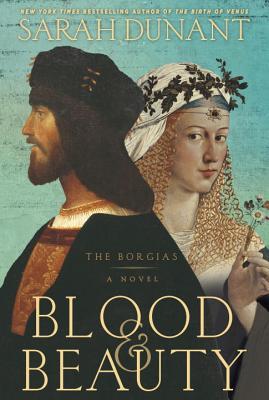
Blood & Beauty: The Borgias by Sarah Dunant
As you know, every once in a while I will find myself veering from my usual pattern of reading mostly sci-fi and fantasy and venture into the realm of historical fiction. I admittedly will do this for any interesting looking books about European royals or powerful families, especially those related to either the Tudors or the Borgias. Hence, this book.
Blood & Beauty focuses the Borgia family roughly between the years of 1492 when patriarch Rodrigo Borgia first began his papacy as Pope Alexander VI, and 1502 when his daughter Lucrezia Borgia married her third husband Alfonso d’Este, Duke of Ferrara. With scandals and rumors aplenty, this was an eventful decade for the notorious family, but also for the rest of Europe as well with their wars and ruthless politics.
First of all, I think that the author made a very brave choice when it came to using the third person omniscient point of view to narrate the story, even though there were both positive and negative sides to this. In getting to know the thoughts and feelings of all the characters in this novel, Sarah Dunant managed to convey the sweeping influence of the Borgias and acquaint us with practically everyone in the family. On the downside, because we don’t get to focus on any one POV for long, the connections the reader has with the characters also feel impersonal and distant.
This last point wasn’t much helped by the long sections of historical context and fact-dumping that were pervasive throughout the chapters, bogging down many parts of this book. This also made the novel feel more emphatic towards historical events rather than the characters, when I usually prefer it to be the other way around. On the other hand, this allowed us to see the bigger picture outside the personal dramas of the family, shedding light upon the political turmoil in other parts of Europe.
However, at times I felt like I was reading a dramatized history textbook. I would have preferred more emphasis on the characters; though, of all of them, Lucrezia did come across to me as the most well-rounded and fleshed-out Borgia. Still, Sarah Dunant pretty much played it safe with the rest when it comes to the exploration and interpretation of their personalities, and I wouldn’t have minded if she’d pushed it a bit further. I’m usually okay when historical fiction writers take liberties, as long as those liberties aren’t completely outlandish and are mentioned in an author’s note.
Anyway, no doubt this period of time was very interesting when it came to the Borgias, but history does show us that the fun doesn’t end there. It’s why I was glad to hear that Sarah Dunant’s already preparing a follow-up novel to this one. This is the first time I’ve read anything by her, and despite some minor issues I had with Blood & Beauty, I did enjoy it. I would be absolutely open to picking up the next book.

Book Review: The Crown Tower by Michael J. Sullivan
Posted on July 25, 2013 2 Comments
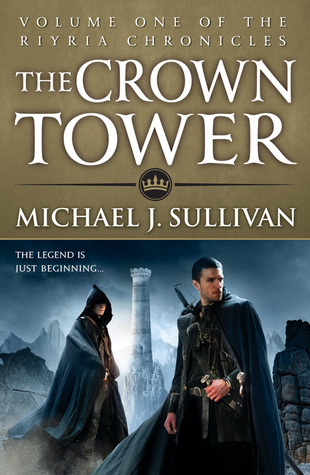 The Crown Tower byMichael J. Sullivan
Expected Date of Publication: August 6, 2013
A team, a partnership, working together…the Elves have word for it in the world of these books — they call it “Riyria”. If you’ve read Michael J. Sullivan’s excellent Riyria Revelations series already, you’ll know that Hadrian Blackwater and Royce Melborn weren’t always the dynamic duo we know and love, and that they certainly didn’t start off as friends. Now finally, with the story of The Crown Tower, we get to see how it all began.
I was honored to be able to read a pre-release copy of this book in exchange for an honest review. Thank you Orbit and NetGalley! Being quite the fan of Mr. Sullivan’s Riyria books and given the fact that Hadrian and Royce’s “origin story” was one that was hinted at throughout that entire series, being able to read this was one hell of a real treat.
The great thing is, even though The Crown Tower can be considered a prequel of sorts, it can also be read as a one-shot. We are introduced to Hadrian, a jaded and young directionless soldier returning home from the wilds of Calis after hearing about his father’s death. He agrees to meet with Arcadius, an old friend at the university who claims to have a message from Hadrian’s father before he died. Arcadius, however, inexplicably pairs Hadrian up with Royce, a depraved thief whose mistrust of everything and everyone is akin to that of a dog that has been kicked too often. The two men are sent on an incomprehensible task to steal a book…which sounds simple enough, if only they can learn to work together without killing each other first.
For newcomers to the world and characters of Riyria, this book will be a great starting point. Returning fans will probably be even more thrilled, as it basically has all the details about Hadrian and Royce’s first ever job together, and answers questions about how these two men — who arguably are complete polar opposites of each other — became a team. As an added bonus, we even get chapters focusing on Gwen, who ranks up there among my list of strongest female characters I’ve ever come across in fantasy fiction.
These are characters I’ve come to know well, and it’s just so great to be able to return to them again, even if it’s going back in time. My only regret is that Gwen’s sections feel a bit rushed and a little glossed over, though rationally I can kind of see why I found this to be the case. Her presence in this book is definitely required, but at the same time the main focus must remain on Hadrian and Royce’s quest. My excitement levels and hopes are lifted, however, for The Rose and the Thorn which is the follow-up to this, and it looks like it’ll have a lot more Gwen and maybe it’ll mean a deeper and more prominent role for her to play.
The thing I love about The Crown Tower is that it continues to read like all of the other Riyria novels in that they are fun, action-filled adventurous fantasy stories that have a traditional, straightforward and down-to-earth feel-good vibe. Hadrian and Royce are ever the source of good banter, even at this point where they still hate each other.
The book also has a feel of a puzzle piece that simply “fits”, falling into place and filling out the timeline of the Riyria books without feeling forced or tacked on, unlike certain prequels of certain franchises I won’t deign to mention here. You can tell with The Crown Tower as with all the books in the Riyria Revelations that the author has a grand plan, that everything happens for a reason and the presentation of it all is smooth and logical. The point is, I think this book would be great for any fan of fantasy, but if you’ve also read and loved the Riyria Revelations, this is a MUST-read.



 The BiblioSanctum