Book Review: The Exodus Towers by Jason M. Hough
Posted on September 2, 2013 Leave a Comment
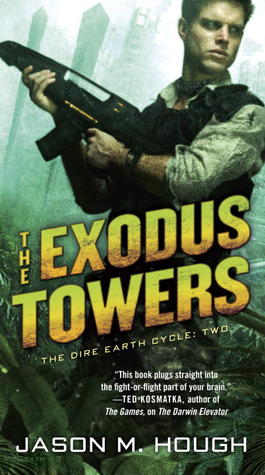 The Exodus Towers by Jason M. Hough
Genre: Science Fiction
Series: Book 2 of Dire Earth Cycle
Publisher: Del Rey
Date of Publication: August 27, 2013
Author Information: Website | Twitter
After hearing the praises my co-blogger Wendy had to sing about this book, I decided not to wait any longer and just had to see its awesomeness for myself. I’m so glad I did. At the same time, though, I’m also now hot and bothered over that crazy cliffhanger of an ending. Oh no, you did NOT just end there. I’m not kidding, I actually shouted that at the book, earning me a strange and slightly concerned look from my husband.
The story continues with mystery, action and good sci-fi thrills in this sequel to The Darwin Elevator, Jason M. Hough’s hit debut that came out earlier this summer. With the appearance of a second space elevator in Brazil, our protagonist Skyler and the brilliant Dr. Tania Sharma have set up a new colony at its base, using the movable alien towers around it to ward off the deadly subhuman plague. A sudden attack from a band of immune militants, however, halts progress and endangers the colonists. Cut off from contact, Skyler is left on his own to fight off the savage SUBs and to figure out a way take back the colony.
I have to say the second book of a trilogy is often tricky; a lot of times, they end up being labeled as “bridges” since the first book typically is an explosive introduction while the last book contains the grand finale, leaving little for the middle book to do than to tie the two together and ramp up to the conclusion. I’m happy to report this is not the case with The Exodus Towers. Personally, I find it even more gripping than the first book, with non-stop action that starts on page one and won’t let up.
At the same time, it also deftly manages to accomplish a prime goal of a second book — developing and evolving the main characters, establishing the world, and furthering the intrigue of the situation. In this story of survival in a land taken over by the wilderness and hordes of mindless, violent creatures, we get to experience this at both the personal level through the eyes of Skyler, as well as at a community level following the struggles of the colony.
In addition, new threats and new players are introduced to spice things up. The story is getting a little darker and more brutal, and in a time when humans should be banding together, everyone is instead even more unsure of whom to trust. The suspense is also building steadily, as more is gleaned about the mysterious alien Builders and their daunting technology. All in all, this book succeeded in revving up the momentum and raising the stakes. Can’t wait for the conclusion!
Note: Received eARC in exchange for an honest review. Thanks, NetGalley and Del Rey!

Be sure to check out our other articles about The Dire Earth Cycle here on The BiblioSanctum, including an interview with author Jason M. Hough!
Graphic Novel Review: My Little Pony: Friendship is Magic vol.2 by Heather Nuhfer
Posted on September 2, 2013 Leave a Comment
 My Little Pony: Friendship Is Magic Volume 2 by Heather Nuhfer
Publisher: IDW Publishing
Publication Date: September 24, 2013
With thanks to NetGalley and IDW Publishing for the opportunity to read and review this graphic novel in exchange for an honest review.
If you’re new to the new My Little Pony: Friendship is Magic, or are disturbed by all that talk of bronies, check out my review of volume one for an explanation of why you should be watching and/or reading this.
Volume two of the comic book series does not pick up where the last volume left off. Much like the show, the volumes contain completely separate story arcs, however, like the show, they do build on the overall lore being formed within the series.
In this case, the powers of Nightmare we met in season one are back, attacking Twilight Sparkle, Applejack, Rarity, Pinkie Pie, Rainbow Dash and Fluttershy in their dreams by presenting them with their greatest fears. Rarity succumbs to her fear and is kidnapped to the moon.
Princess Celestia and her sister Luna, come to Ponyville to help stop the bad guys, but Luna, formerly known as Nightmare Moon who destroyed Ponyville under the influence of Nightmare, is very uncertain about her contribution to the efforts. But true to form, the ponies put their faith in her and show her that friendship truly is magic as they set out to save Rarity.
 |
| Pinkie Pie by OcarniaofTimeLord |
I really enjoy reading MLP to my daughters (7 and 5) because I love doing the voices and they love hearing it. They both gave this volume two thumbs and two big toes up, however, I didn’t find this one quite as memorable as the previous volume, which the girls still quote regularly. There wasn’t quite enough of the ponies doing their thing, or maybe there just wasn’t enough Pinkie Pie. Pinkie Pie is like cowbell. You can never have enough.
Spike did get more airtime, though, since it is his beloved Rarity that’s been kidnapped and he must use his wits to rescue her and the other ponies. Meanwhile, Luna has to learn to forgive herself and accept the friendship of the others, rather than let Nightmare intimidate and guilt trip her.
My five year old has had trouble with nightmares, lately, so this was a perfectly timed encouragement for the “nightmares aren’t real,” mantra we’ve been working on.

September Book Club Read: Choose Your Own Eisner Adventure!
Posted on September 1, 2013 Leave a Comment
With the recent announcement of the Eisner Award winning comics, now is a great time for the LeVar’s Rainbow Book Club to catch up on the good stuff of 2013. Read something new or check out the next volume of a continuing series!
Or better yet, read them all!


Book Review: The Ocean at the End of the Lane by Neil Gaiman
Posted on September 1, 2013 Leave a Comment
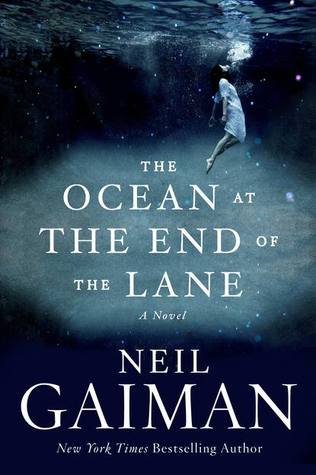 The Ocean at the End of the Lane by Neil Gaiman
Genre: Fantasy
Series: Stand-alone
Publisher: William Morrow
Date of Publication: June 18, 2013
Author Information: Website | Twitter
Returning to Sussex to attend a funeral, an unnamed middle-aged man visits the site of his childhood home, knowing that the house he grew up in no longer exists. But the farm at the end lane still stands and he is drawn to the pond in the back, a pond which an extraordinary girl named Lettie Hempstock once called an ocean. In this place, the man recalls a series of events in his past, of a dark time which began forty years earlier with the suicide of his family’s lodger in their stolen car.
This was only the second novel I’ve read by Neil Gaiman (I’m not counting his short stories or comics, etc.) but I knew enough to know about his knack for storytelling, and particularly his style of using allusion in doing so. This has made me wary about picking up his stuff, because I tend not to be drawn to stories that are more metaphysical and abstract.
Because fables and mythological motifs often feature so heavily in his work, I’ve come to view a lot of Gaiman’s stories as modern fairy tales. Ocean definitely has that vibe to it; as such, the book’s description as “terrifying” and “menacing” notwithstanding, I found it more whimsical and odd than anything else. While not a negative factor by any means, admittedly I did expect the book to be somewhat more emotionally stirring.
That said, while it’s not typically my kind of book, Ocean packs a pretty good punch, especially given its relatively short length. Gaiman has a way of making me care about his characters if not so much for his themes, and not to mention he also writes beautifully. Very few authors can do what he does to me with his prose, as in the case of this book where he uses such vivid imagery to paint fantastical landscapes and their creatures in my mind’s eye.

Mogsy’s Book Haul – YA Explosion Edition
Posted on August 31, 2013 Leave a Comment
As the title states, my library saw a ton of new YA additions in the last two weeks, thanks to a bunch of amazing sales. But that’s mostly ebooks, so first here are the physical books that have arrived since my last book haul post:

The Greyfriar – received for review. This book was delicious, a fine mix of steampunk, fantasy world-building, adventure and romance. I’ve already devoured and reviewed it, and you can see my thoughts here. And if interested, MyShelfConfessions is currently running a giveaway on the audiobook, and better hurry as it looks like it will only go for a couple more days. By the way, James Marsters is the narrator, yum yum.
Kinslayer – from publisher/giveaway. Glad I didn’t wait to read the first book because now I get to jump into this one right away!
A Study in Silks – won in a giveaway. Doesn’t its description sound fascinating? Steampunk, magic, murder and demons, that sounds good to me! Keep an eye out for my review of this in the coming month!
And now, ahem, on to the huge digital pile. Have I ever mentioned how much I love good ebook deals?




The City’s Son – Jo Fletcher Books brought this book to my attention, as the sequel just came out and I’m seeing a lot of buzz for it. The series looked cool, so I picked this up for $5.95 earlier this month. Any ebook that looks interesting and is ~$5 or less is pretty much an insta-buy, so it was just calling to me.
Blackwood – congratulations to Strange Chemistry, Angry Robot’s YA imprint, for celebrating their first birthday last week! To celebrate, they’ve dropped the prices on a handful of their first titles to $1.99 ($1.39 in some cases, like Blackwood, woot!) and this was a book I picked up…
Katya’s World – …and so was this…
The Assassin’s Curse – …and also this. Sigh!
The Bone Season – I’ve heard some amazing things about this book and its author 21-year-old Samantha Shannon, whom some have already heralded as “the next J.K. Rowling.” Curiosity got the better of me, and $4.99 seems a good price to satisfy it.
Crown of Midnight – sequel to the first book Throne of Glass, which I already have. $5.99 for a book that just came out this week is not bad at all.
The Rise of Renegade X and The Trials of Renegade X – both sent in a e-bundle this week from the author Chelsea Campbell because I pledged in her Kickstarter campaign to publish the second Renegade X book. Really looking forward to reading this YA superhero series!
Monsters – third book of the Ashes Trilogy and I’m mad to find out how it all ends. Got this one from Netgalley, because I’m an NG addict, and I need help.
Dreams and Shadows – finally for some books that aren’t YA, this one had been on my wishlist for a while and when I saw it for $1.99 last week I quickly snapped it up.
Devil Said Bang – fourth in Richard Kadrey’s Sandman Slim series, whose books periodically go on sale and I pick them up whenever I see them. That’s why I got this when I saw it for $2.99 a couple weeks ago, even though I’ve only just finished reading the second.
Audiobook Review: METAtropolis
Posted on August 30, 2013 1 Comment
Metatropolis by various authors
Genre: Science Fiction, Dystopian Future
METAtropolis is a collection of short stories by several science fiction authors who decided that, rather than simply doing a collection of stories based on a specific theme, they would create a world together, and write stories within that world. I really liked this concept, as well as the fact that three of the audiobook narrators are actors from Battlestar Galactica, one of my favourite television shows.
John Scalzi is the editor of the book and introduces each story. He also wrote the only short story within the book that I truly enjoyed. His story, wonderfully narrated by Alessandro Juliani, employed Scalzi’s usual sense of humour and, as he explains, fills the gap in the METAtropolis left by the other authors because it is a story about people who actually live reasonably happily within the major cities. The story somewhat addresses something that really bothered me when I started reading this. I realized that I couldn’t recall any depiction of humanity’s future that doesn’t feature a dystopia where our flaws and hubris have destroyed everything, or a utopia that is too inhuman to be true and must be destroyed. METAtropolis made me realize just how little we think of humanity and our future.
METAtropolis is a typical world where the less fortunate and the disillusioned live outside the gated communities of the rich, thinking up ways to bring anarchy to the lives of the better off. There is no shortage of lecturing the reader in various ways over how human nature has led to this current state of affairs and, outside of Scalzi’s story, we get to be privy to the greed and desperation of not-quite starving people who seek to survive and to balance the scales through overzealous protests.
As I said, I only found Scalzi’s entry to be interesting, with memorable characters and events. As his story takes place within the same world, he didn’t neglect the anarchists in his account, but he did turn their beliefs upside down a bit by not merely making them the downtrodden who must obviously be good in comparison to the rich people who must obviously be bad because of their blissful ignorance.
Overall, a surprisingly disappointing read, with the other stories being rather uninspiring and sometimes annoying in their preachiness. The narrations were mostly good, but not good enough to elevate the stories.

Book Review: Children of Fire by Drew Karpyshyn
Posted on August 29, 2013 2 Comments
Children of Fire by Drew Karpyshyn
Genre: Epic Fantasy
Publisher: Del Rey
Date of Publication: August 27, 2013
Author Info: www.drewkarpyshyn.com
With thanks to NetGalley and Del Rey Books for the opportunity to read an advanced copy of this book in exchange for an honest review.
Four unique children are born under a portent omen, each touched by Chaos in some way. Initially, the story moves through the lives of all four, leaping through time as they grow and deal with varied situations that shape them towards their destiny. Their paths cross in various ways until they reach adulthood and then dark forces are unleashed…
I’ve played the Bioware games Karpyshyn has been heavily involved in as a writer and I have read one of his Star Wars books, as well as his Mass Effect books. With those, I found that his writing was not as strong as the ideas and characters behind it and concluded that Karpyshyn works best when his ideas and characters can be visually brought to life. Perhaps he’d do a better job with the comic book stories.
However, Children of Fire is Karpyshyn’s first novel of his own creation, and I’m always curious to see what a creator can do when freed from the constraints of an established franchise. So far, I’m very pleased. I don’t feel this book is a strong entry into the epic fantasy genre, however, it has a lot of potential.
Actually, considering how I feel about epic fantasy classics like Eye of the World, Children of Fire is very good. The characters are strong, unique and memorable, and there’s little time wasted on too much exposition. I was worried at first, with the format of travelling through the children’s lives as they aged, but Karpyshyn did a good job of telling only what was needed at each given point in their lives.
There are some typical fantasy tropes used, such as talismans, chosen ones, dark lords, fellowships and seemingly evil ruling bodies. I liked the latter two items though, because they did not quite follow the conventional ‘rules.’ When the four children cross paths, their interaction is not predictable, and the Order, who seeks out people who wield Chaos magic, does so for a good reason.
I did enjoy the magical aspect of the story. There is a lot of lore behind it and varying opinions on those with magical abilities, but I liked that Karpyshyn doesn’t use the magic as a crutch to easily get his characters out of situations. In fact, the moments when magic is used serves to advance the plot and develop the characters themselves.


Audiobook Review: The Atrocity Archives by Charles Stross
Posted on August 29, 2013 Leave a Comment
 The Atrocity Archives by Charles Stross
Series: Laundry Files
Genre: Science Fiction, Occult
There is a list floating around Tumblr of Bioware voice actors who have narrated audiobooks. Having fallen in love with Fenris’ voice in Dragon Age II, I decided that The Atrocity Archives, read by Gideon Emery, was a necessary listen from Audible. Not that I blindly listen to an audiobook just because I want to hear sexy sweet nothings in my ear all day. The book’s blurb actually sounded interesting – though it certainly helped my enjoyment to believe that the character of Bob Howard looks exactly like Fenris, if Fenris happened to be moonlighting as a snarky IT guy who works for The Laundry.
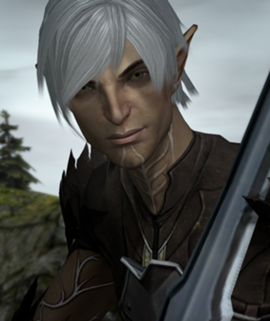 |
| Bob. |
Bob Howard is an employee at the Laundry Files, a bureaucratic organization that covertly monitors and deals with occult activities and the connections between other dimensions. He normally spends his day doing typical, mundane IT guy things, such as sorting through the messes Fred from accounting has made of his computer. Once or twice, he’s been sent out into the field, but after an unfortunate incident during an IT/Occult training course, Bob’s actions bring him to the attention of the Counter Possession Unit and leads him into doing a lot more out-of-office work.
I really liked that Bob is not a stereotypical, introverted nerd tossed into field work where he can skillfully display his incompetence in a mock attempt at playing a geeky James Bond. Bob might need to brush up on protocol and procedure, such as what not to do when a gorgeous redheaded scientist is kidnapped, but otherwise, Bob is quite capable of handling himself in the field and is a unique character unto himself.
For the first half, both Emery and the story kept me very entertained. Emery did an excellent job of making sure Bob’s attitude didn’t go over the edge and into the realm of unlikable characters and I loved the way Stross seamlessly worked in the occult aspects, solidly grounding them in reality through science and technology. There were a lot of technical references, but they were delivered with wit and sarcasm to make them amusing, and explained succinctly enough to make them accessible to someone as clueless about such technology as I am.
Unfortunately, this changes in the second half, once the Atrocity Archives are discovered and the plot thickens. At this point, explanations start to take over the story as Stross works in all sorts of details about Hitler’s obsession with the occult. It is all relevant to the plot, but where previous explanations were pithy, amusing and interesting, these were tiresome, interruptive wiki entries that slowed down what should have been the action part of the novel.
Because of this, a series that I initially expected to continue with became disappointing, though not so much so that I wouldn’t allow Fenris to seduce me into reading more books in the series.


Waiting On Wednesday 8/28/13
Posted on August 28, 2013 Leave a Comment
“Waiting On Wednesday” is a weekly meme hosted by Breaking the Spine that lets us feature upcoming releases that we can’t wait to get our hands on!
Autumn Bones by Jacqueline Carey – October 1, 2013 (Roc Books)
The books in Carey’s Kushiel Universe are some of my favorites ever, so I was psyched to read her new urban fantasy series. Autumn Bones is the second book of Agent of Hel.
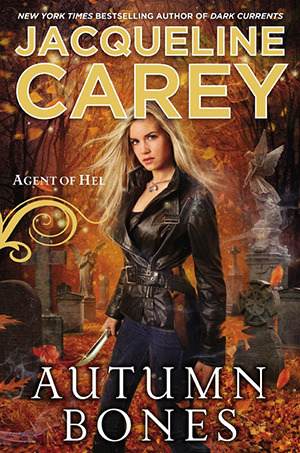
“Fathered by an incubus, raised by a mortal mother, and liaison to the Pemkowet Police Department, Daisy Johanssen pulled the community together after a summer tragedy befell the resort town she calls home. Things are back to normal—as normal as it gets for a town famous for its supernatural tourism, and presided over by the reclusive Norse goddess Hel.
Not only has Daisy now gained respect as Hel’s enforcer, she’s dating Sinclair Palmer, a nice, seemingly normal human guy. Not too shabby for the daughter of a demon. Unfortunately, Sinclair has a secret. And it’s a big one.
He’s descended from Obeah sorcerers and they want him back. If he doesn’t return to Jamaica to take up his rightful role in the family, they’ll unleash spirit magic that could have dire consequences for the town. It’s Daisy’s job to stop it, and she’s going to need a lot of help. But time is running out, the dead are growing restless, and one mistake could cost Daisy everything.”

“Now that the ley lines around Cabeswater have been woken, nothing for Ronan, Gansey, Blue, and Adam will be the same. Ronan, for one, is falling more and more deeply into his dreams, and his dreams are intruding more and more into waking life. Meanwhile, some very sinister people are looking for some of the same pieces of the Cabeswater puzzle that Gansey is after…”


 The BiblioSanctum