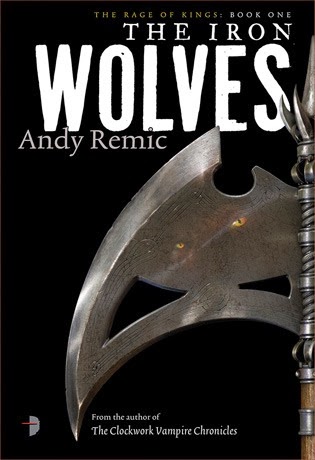
Book Review: The Iron Wolves by Andy Remic
Posted on December 20, 2013 Leave a Comment
Genre: Epic Fantasy
Series: Book 1 of The Rage of Kings
Publisher: Angry Robot
Date of Publication: December 31, 2013
Author Information: Website | Twitter
I have not had the pleasure of reading Andy Remic’s Clockwork Vampire Chronicles yet, but hearing about how those books have earned the author the nickname “Tarantino of epic fantasy” has gotten me mighty curious. Being compared to the great QT is high praise indeed! How then could I possibly say no to The Iron Wolves?
This book has it all: bloody fight scenes and explosive battles, psychopathic villains and twisted, gritty anti-heroes. Oh, and mud-orcs. Mustn’t forget the mud-orcs. Needless to say, I am happy to report that Andy Remic’s title is well-deserved; we’re talking no-holds-barred dark fantasy, of the faint-of-heart-need-not-apply variety. We’re talking graphic violence, explicit sex scenes, and a truly astounding number of decapitations within these blood-soaked pages.
If this sounds like your kind of novel, then you’re in for a real treat. Andy Remic has taken the classic “gather your party and go forth on a quest of epic proportions” objective, and so generously wrapped it all up for us in a nice grim package. To stop an invading army of horrors, the great general Dalgoram sets out across the land to reunite his band of veteran warriors for one last stand. Having been estranged for years, the members of the Iron Wolves have all either fallen on hard times or have turned to lives of deviance and corruption. But together again, they find they can transform their shared curse into something so much more.
By the way, my description of “twisted, gritty anti-heroes” was in no way an exaggeration. With perhaps the exception of the old man Dalgoran, I was hard pressed to name a single admirable soul in this group of vile, despicable Iron Wolves. But that’s what I signed up for so I can’t complain too much, especially since Remic delivers exactly what was promised. The only downside I could see to this is finding enough to set some of these characters apart, which gets a little difficult when almost all of them are defined by broken pasts, foul mouths and violent tendencies.
Also as I’ve noted before, at times a novel’s “epicness” can be something of a double-edged sword, as it can do a number on pacing. This story stumbles a bit due to the sheer size of the cast and their multiple points of view, especially when a couple more Iron Wolves are still being added to the mix at about two-thirds of the way through the book. As maniacal as they are, I wish we’d gotten a chance to know Zastarte and Trista a bit better, though I think this will mean a much smoother ride for the next installment now that the scene has been set and all the introductions have been made.
Speaking of which, I’m excited about book two, and if you’d seen that ending, you would be too. I have to say I felt the final showdown scene was over way too quickly, though this probably had less to do with the pacing and more to do with how much I enjoyed the climax and conclusion. Andy Remic is in his element when it comes to writing big battles and fight scenes, and he graces this book with a lot of them. It would be easy but disingenuous to brush them all off as an excuse to provide gratuitous violence, because I actually found many of the scenes of war and fighting to flow and fit exceedingly well within the context of the story.
After all, this is The Iron Wolves, folks. A great choice for readers looking for a stronger, headier kick to their heroic fantasy, just remember to steel yourselves for the unlimited energy and madness this book will unleash upon your lives!

Panels: Fables vol.1: Legends in Exile
Posted on December 20, 2013 Leave a Comment

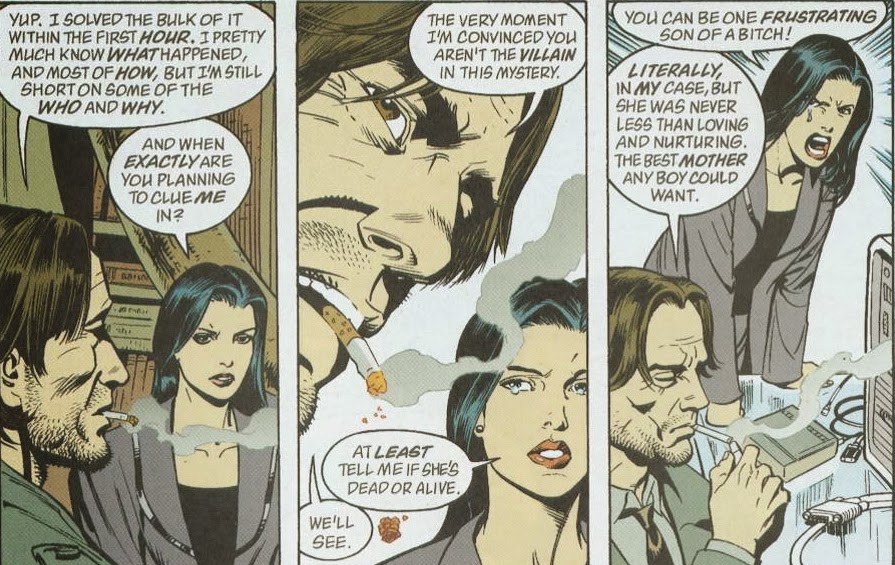
Wolf and Snow chat about her sister’s violent disappearance in
Audiobook Review: Throne of Glass by Sarah J. Maas
Posted on December 19, 2013 6 Comments
 Throne of Glass by Sarah J. Maas
Genre: Young Adult Fantasy
Series: Book 1 of Throne of Glass
Publisher: Audible Inc.
Date of Publication: November 5, 2013 (audiobook)
Author Information: Website | Twitter
It’s not often that a book catches me off guard, but this one sure did. Sometimes, the mood for a particular type of story or experience will strike me out of the blue, making me seek out the sort of book that will satisfy the hankering. At the time, what I felt like reading was a traditional young adult fantasy, complete with action and intrigue, a kickass heroine, a thrilling love triangles and all that goodness. I was pretty confident that Throne of Glass was going to deliver all that and more when I first settled back with the audiobook, and yet nothing could have prepared me for the way it swept me off my feet.
A year into her imprisonment and forced labor at the salt mines of Endovier, convicted assassin Celaena Sardothien is hauled before the Crown Prince and offered a chance to reclaim her freedom. The conditions Prince Dorian offers her are simple: act as his champion in the king’s upcoming competition to find a royal assassin, win, serve the kingdom for four years, and then she will be free.
However, the trials set up to prepare Celaena for the competition are challenging and brutal, and her opponents are all hardened, dangerous men. Chaol Westguard, the guard captain overseeing her training, pushes her hard and keeps her isolated from much of the court activities. Still, she cannot help but be drawn to him, much as she is drawn to the prince. Things get more interesting — and unsettling — when one by one, the other champions turn up dead, savagely ripped apart by someone or something unnatural. Celaena fears the killer will come for her next, ending her hopes before she will even have the chance to win her freedom.
I admit, I was a bit worried when I first met Celaena. I can take sassy, confident and badass young adult heroines, but what gets on my nerves is arrogance. And Celaena happens to have it in abundance. It’s not that her vanity is uncalled for; in fact, she’s quite the talented young woman, having all the looks, the smarts, the moves. But I could have done without her proclaiming her greatness every chance she gets.
Obviously, something changed my opinion of her at a later point, otherwise I wouldn’t have enjoyed this book so much. But more on that later because first praise needs to go to the narrator Elizabeth Evans whose voice work was exceptional, perhaps doing the job too well. Her delivery of Celaena’s lines were all spot on, nailing all the boastfulness and arrogance of her character. It’s really amazing how a good narrator can bring out the full gamut of a protagonist’s personality, for better or worse.
Definitely for the better, once I eventually warmed towards Celaena. Beneath the arrogance lies a lot more than I’d given her credit for, a much greater complexity. She’s really not as invincible as she thinks she is, and deep down I think she knows this. It cast her determination and her strength in a whole different light for me, and in time I grew to like her and want to see her succeed. I’m still not completely sold on the love triangle between her, Prince Dorian and the Chaol Westfall, but at least I desperately wanted to see her win the king’s competition.
And speaking of the competition, what a complete 180 it did on my emotions! Here I was, thinking that it’s just like the fantasy version of a reality-TV-show-type game where the champion with the worst performance gets booted out and goes home each week. That’s how it started off, but by the end I was completely enthralled, especially over the final duel scene. It’s good that audiobooks don’t allow you to easily flip forward to the end of a chapter to find out what happens like you do with a book, or else I would have been sorely tempted to spoil the outcome for myself. It was just that intense.
Like I said, I really didn’t expect this book to be this gripping and full of surprises. The beginning of it led me think it was going to be an average book, but gradually it built up both the story and the characters to make this one close to a five-star read.

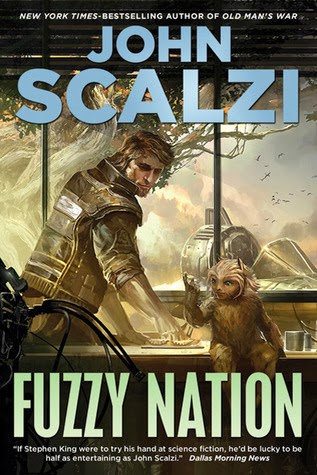
Audiobook Review: Fuzzy Nation by John Scalzi
Posted on December 19, 2013 Leave a Comment
Genre: Science Fiction
Narrator: Wil Wheaton
Publisher: Tor Books
Publication Date: May 2011
Author Info: whatever.scalzi.com
Wendy’s Rating: 4 of 5 stars: Scalzi’s approach to science fiction is so refreshing and fun and he perfectly captures human nature at its best and worst.
I’m three books into my love affair with John Scalzi’s writing. He is clearly a master of snark, which his main characters wield with deadly precision. And who better to narrate the book than Wil Wheaton who does a great job of capturing the masterful way Scalzi uses tone to deliver his characters and their message.
Things are perhaps a little too perfect for Scalzi’s characters. They always seem to get the huge win in the end as a result of their mostly well-orchestrated plans and ability to adapt to any situation. I suppose this could get tedious after a while if it truly is a constant in his books, but for now I’m content with the all-loose-ends-tied-up results where the little guys win as a result of the characters actions. I’m even okay with the neon sign moral that appears in the epilogue of each book.
In this case, the little guys are actual little guys. Fuzzy cat-sort-of creatures that befriend Jack Holloway on the planet where he and his dog have just discovered a huge vein of sunstones, which are going to make Jack and the company he is/was contracted to, very, very rich. It becomes a case of big corporation against possibly sentient creatures and Jack, the disbarred lawyer with questionable motives.
While Jack is not a likable character and by no means tries to be a likable person, the fuzzies are, and before long, unsurprisingly, their survival became very important to me. I did not, however, expect to spend most of their fight for survival inside a courtroom when the story became Law & Order in space. That’s not a complaint. Scalzi’s approach to science fiction is so refreshing and fun and and he perfectly captures human nature at its best and worst.

Novella Review: Apocalyptic Montessa and Nuclear Lulu
Posted on December 18, 2013 Leave a Comment
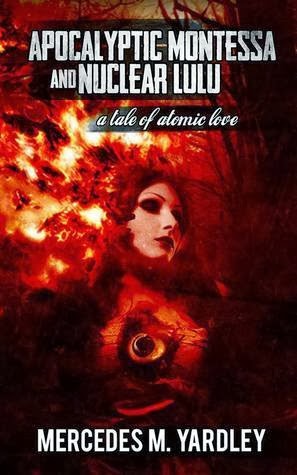 Apocalyptic Montessa and Nuclear Lulu: A Tale of Atomic Love by Mercedes M. Yardley
Genre: Horror, Paranormal
Series: Stand Alone
Publisher: Ragnarok Publications
Date of Publication: September 7, 2013
Author Information: Website | Twitter
Ragnarok Publications is a publisher newly founded in 2013, but I’d heard of them prior to receiving a copy of Apocalyptic Montessa and Nuclear Lulu: A Tale of Atomic Love. These are the amazing folks behind the Kaiju Rising: Age of Monsters anthology Kickstarter, which was successfully funded this fall and quite possibly one of the coolest projects I’ve ever backed! It was thus an honor and a pleasure to be offered a chance to read and review their inaugural title by Mercedes M. Yardley.

Book Review: I Am Satan by Tim Hawken
Posted on December 18, 2013 1 Comment
Genre: Fantasy, Horror
Series: Book 2 of the Hellbound Trilogy
Publisher: Rethink Press Limited
Date of Publication: June 25, 2012
Author Information: Website | Twitter
I’m not sure if I mentioned this in my review of the last book, but I really enjoy when authors explore theological themes and make old religious ideas feel fresh and exciting in their books. I think my interest in theology and religious themes stem from my background. It also may have a little something with me being a history geek as well. When writing heavy religious themes, especially when adding many unique elements, I often find that I think the writer is either trying too hard or not trying hard enough. I can be very particular about this, and for that reason, that’s why I’m pleased that this series has continued to entertain me.
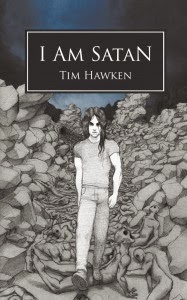
I Am Satan is the continuation of Michael’s journey through Hell, the second book in Tim Hawken’s Hellbound trilogy. After the events of the last book, Michael is now Hell’s new caretaker, and he is not pleased. This displeasure doesn’t just come from his new role as Satan, even though it is part of the reason. In the last book, Michael learned some harrowing truths about God, Satan, and how he fit into this master plan. These new truths, along with his primary motivation (love) compel him to vow that he’ll get his revenge by building an army.
This book was more of a slow burn for me than the last one. In the first book, there was so much being introduced and so much going on as Michael and Satan traveled around Hell. There was much more mirth in the beginning of that book mostly because of Satan (the old Satan, I should say). The last part of the first book sort mellowed more into introspection, and that same feeling continues in this book. Now, that’s not to say that there isn’t any action or that this book is only thought-provoking prose. There’s plenty of action to be had, but in a way, it feels like the story ripens as Michael matures in his journey.
Even with all the knowledge Michael gained in the last book, this book reinforces that there is still more for him to learn. There was more emphasis on Michael’s learning process and exploring the idea of things like time, destiny (which I really liked Hawken’s take on that) and emotions, which is spun in refreshing ways that can give a reader pause to think about these things. I appreciated that Michael didn’t suddenly become this super being with all this unfathomable power just because he’s the new Satan.
Michael is set to rebel against his fate and create his own by amassing knowledge. In the last book, he’d made great strides with learning how to control things such as the elements. There are still many things he has to learn in order to challenge what he’s expected to do and take the fight to heaven, however. Then, there’s the added fact that Michael’s thirst for revenge, the fact that he’s holding hard and fast to hatred, is starting to shape him physically into something sinister, a demon. In Hellbound,going to Heaven is presented as a choice for Hell’s denizens which is a twist on the universal reconciliation idea. For some people, though, they decide to wallow in their sins, and they eventually become the avatar of the sin they hold to firmly.
Michael is starting down that path, but feels it will be worth it to save his love and forge his own destiny.As I stated in my last review, destiny is seen as something that isn’t linear. There could be many possible ways for a person to achieve their ending fate. This second book took that a step further and played with the idea that there are many final outcomes that could be achieved in a innumerable amount of ways with some outcomes being more likely than others. It doesn’t state that destiny doesn’t exist more so than it’s tempered with many external and internal factors.
With that in mind, Michael does have a clear goal for what he wants to achieve, how he wants to challenge his “fate,” but the road to achieving this is full of funny twists and turns.
Michael isn’t the only person who keeps this story running. There’s a colorful cast of characters that you’ll love and hate who help to round out Michael’s journey. Hawken added a few of The Bible’s more infamous characters to the story, and he even toyed around with some elements of The Divine Comedy, which I think I was expecting this to be some take on that poem originally and it turned out to be much more than that.
Hawken’s writing can invoke very vivid imagery, especially if you’re a highly visual person who can easily get lost in descriptions and ideas. The prose definitely pops. There were parts of the story that felt a bit too convenient and tidy in the midst of what was going on, but that didn’t dampen my enjoyment of the book. I think this was a strong follow-up to the first book, and I’ll be bumping the last book, Deicide, higher on TBR pile because I have to see how this all ends.

Waiting on Wednesday 12/18/13
Posted on December 18, 2013 Leave a Comment

“Waiting On Wednesday” is a weekly meme hosted by Breaking the Spine that lets us feature upcoming releases that we can’t wait to get our hands on!
The Crimson Campaign by Brian McClellan: February 18, 2013 (Orbit)
The highly anticipated second book of The Power Mage series, sequel to Promise of Blood that I really enjoyed earlier this year. Check out that gorgeous cover.
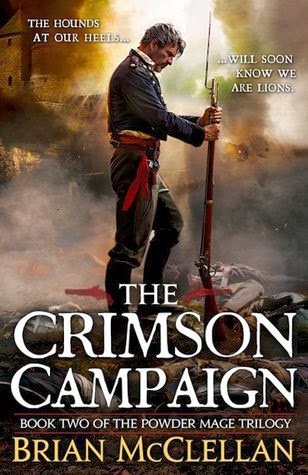
‘The hounds at our heels will soon know we are lions’ Tamas’s invasion of Kez ends in disaster when a Kez counter-offensive leaves him cut off behind enemy lines with only a fraction of his army, no supplies, and no hope of reinforcements. Drastically outnumbered and pursued by the enemy’s best, he must lead his men on a reckless march through northern Kez to safety, and back over the mountains so that he can defend his country from an angry god. In Adro, Inspector Adamat only wants to rescue his wife. To do so he must track down and confront the evil Lord Vetas. He has questions for Vetas concerning his enigmatic master, but the answers might come too quickly. With Tamas and his powder cabal presumed dead, Taniel Two-shot finds himself alongside the god-chef Mihali as the last line of defence against Kresimir’s advancing army. Tamas’s generals bicker among themselves, the brigades lose ground every day beneath the Kez onslaught, and Kresimir wants the head of the man who shot him in the eye.”
Book Review: The Cormorant by Chuck Wendig
Posted on December 17, 2013 5 Comments
Genre: Urban Fantasy, Paranormal
Series: Book 3 of Miriam Black
Publisher: Angry Robot
Date of Publication: December 31, 2013
Author Information: Website | Twitter
I just can’t resist Miriam Black. Come to think of it, that might be how I start all my reviews for the books in this series. What can I say, though? It’s true. These books are so addictive, and I couldn’t put off reading The Cormorant any longer, knowing I had the eARC burning a hole in my ereader. I desperately needed my Miriam Black fix.
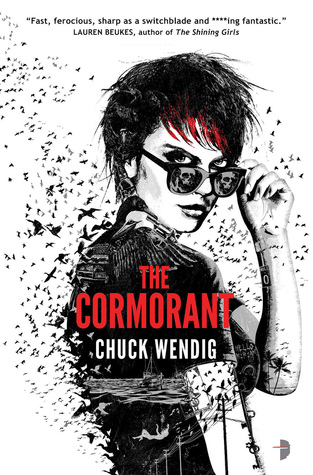
Our heroine with the freaky ability to foresee people’s deaths is back. And she has been busy experimenting with her powers, after finding out the one way to prevent a person from dying is to take the life of another, because Death will not be denied. But then someone is not at all pleased with the way Miriam is messing around with fate…
Miriam is lured to Florida by a rich businessman offering her an obscene amount of money just to find out how he dies. The death vision she sees, however, is of a brutal murder of the man in a year’s time, committed by a mystery killer with a bloody message written just for her. Someone clearly has it in for Miriam. Now everyone she has interacted with is in danger, including her own estranged mother, but how do you fight an enemy who knows your every move and is always two steps ahead?
The sheer awesomeness of this book is going to be hard to convey without getting into spoilers, but know that if you’ve been following the series all along the plot of this one is going to blow you away. It goes without saying, if you enjoyed Blackbirds and Mockingbird, you will love The Cormorant too because the nature of the character and story is as twisted as always. Furthermore, we get a nice beefing up of Miriam’s history, with a further look into her mysterious abilities as well as the appearance of her mother Evelyn Black. Finally, we get to watch the fireworks as the two women meet again for the first time in many years.
And still, Miriam remains the foul-mouthed spitfire I know and love. In her own words, “Rare is the other human who doesn’t mind being dragged over the deepening lines of impropriety while talking to Miriam Black.” I couldn’t have said it better myself. I would never want to be trapped in the same small space with Miriam when she goes off, but boy, she’s always a riot to read about. She’s a woman with a way with words, but also a bigger heart than she would probably like to admit.
Books that play around with time jumps and framing are also tough to pull off, but Chuck Wendig does it here perfectly, switching to flashbacks and other perspectives at the most appropriate moments, emphasizing the suspense when it is most required. Reading this one was like a roller coaster ride, except there are no dips, only highs and loop-de-loops. Between the outrageous things Miriam says and finding all about the creepy villain in this book, my butt alternated from being perched on the edge of my seat one moment to being laughed off the next. Yeah, let’s just put it that way.
The Cormorant is probably the best and my favorite Miriam Black book yet; I absolutely loved it, from beginning to end. Fans need to pick this one up too, and if you haven’t read this series yet, what are you waiting for? Miriam is totally awesome; I highly recommend this!

Book Review: The Abominable by Dan Simmons
Posted on December 16, 2013 Leave a Comment
Genre: Historical Fiction Horror
Series: Stand Alone
Publisher: Little, Brown and Company
Date of Publication: October 22, 2013
Author Information: Website
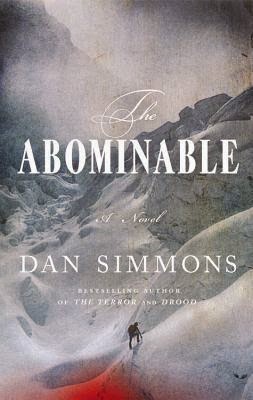
Dan Simmons has always been hit or miss for me, but I have to say his historical-horror novel The Terror about Franklin’s lost expedition to the arctic remains one of my all time favorite books ever. While his newest novel The Abominable may not be a follow up, it certainly can be considered a companion piece; the fact that both books seem to share the same vein made me hopeful that Simmons will blow me away again.

YA Weekend: Planesrunner by Ian McDonald
Posted on December 15, 2013 2 Comments
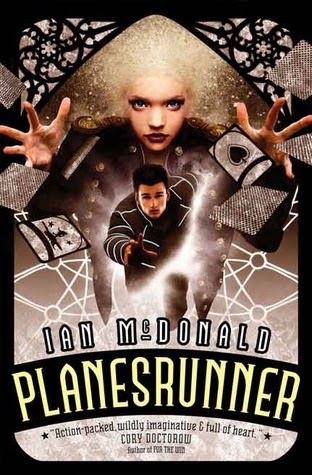
Genre: Young Adult Science Fiction Fantasy
Series: Book 1 of Everness
Publisher: Pyr (US ed.)
Date of Publication: December 6, 2011
Author Information: Website | Twitter
Add Ian McDonald’s Planesrunner to the list of the most interesting and well-written young adult novels I’ve read this year. With the third book coming out soon, I’d initially picked this up to get caught up with the series, but in doing so I also finally discovered why so many readers have been raving about Everness. Adventurous and fun but also fresh and clever, if you’re looking for a YA offering that’s a little different but has a great story at the same time, consider checking this one out.


 The BiblioSanctum