Tough Traveling: Invisible Colleges (Or Hard-to-Reach/Difficult to Gain Admission)
Posted on June 5, 2014 Leave a Comment


The Thursday feature “Tough Traveling” is the brainchild of Nathan of Review Barn, who has come up with the excellent idea of making a new list each week based on the most common tropes in fantasy, as seen in The Tough Guide to Fantasyland by Diana Wynn Jones. Nathan has invited anyone who is interested to come play along, so be sure to check out the first link for more information. Compulsive list-maker that I am, I’m very excited to take part!
This week’s tour topic is: Invisible Colleges
Invisible College is used for training WIZARDS and usually occupies a prim site in some major CITY…
But Nathan has taken pity on this week and made things a bit easier, opening up the topic to any school in fantasy that is difficult to reach or gain entrance to. Thank you, Nathan! Because I was starting to get a little nervous here…
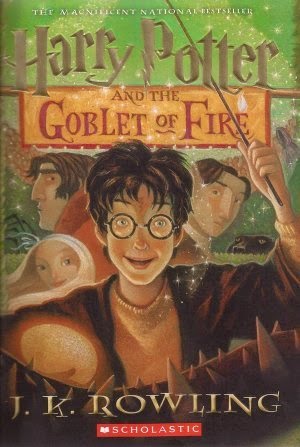 Harry Potter and the Goblet of Fire by J.K. Rowling
Let’s see how many weeks the Harry Potter books will show up in these Tough Traveling posts! Again I’m choosing another book from the series I haven’t done yet though, because while obviously Hogwarts is the obvious one here, I picked Goblet specifically since it’s the first book to also feature students from other wizarding schools around the world. Who can forget Krum from the Durmstrang Institute or Fleur from the Beauxbatons Academy of Magic, competitors at the Tri Wizard Tournament. Just like Hogwarts, I assume these wizarding schools are also cloaked in some way or are located in some remote place.
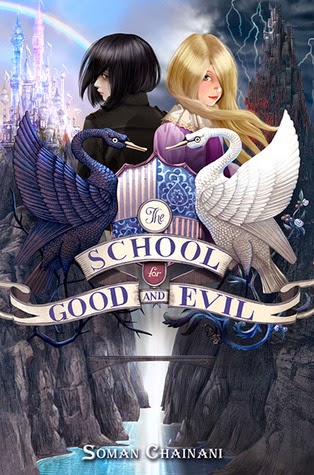 The School for Good and Evil by Soman Chainani
Every child in Gavaldon knows the story of the School for Good and Evil. Two children are kidnapped from their homes every four years, never to be seen again. One child is always beautiful and good, the other one an outcast and strange. They say a mysterious schoolmaster takes them to this fabled and magical place where storybook heroes and villains are made. The “good” kid gets to take classes in Princess/Prince Etiquette and Animal Communication while the “bad” kid gets dumped in classes like Uglification, Death Curses and Henchmen Training. (Review)
 Academ’s Fury by Jim Butcher
The Academy is the foremost school in Alera. To attend, prospective students would have to be able to afford the fees or find a patron who would support them. In the first book, Furies of Calderon, the main character Tavi’s life’s dream was to study here, and in the end is granted a scholarship. In Academ’s Fury, Tavi learns the lesson of “Be Careful What You Wish For” when he realizes the cruel and petty ways at the Academy, but he’s stuck here for now.

The Rithmatist by Brandon Sanderson
Continuing with the theme of “protagonists who desperately want to get into a particular school of magic but can’t”, we have sixteen-year-old Joel Saxon who more than anything wants to be a Rithmatist — but because a tragedy made him miss his inception ceremony, that path is closed to him forever. Being the son of the school’s chalkmaker, Joel was still able to attend the prestigious Armedius Academy, but he must watch with envy from afar as the chosen Rithmatist students get to study the magical art of creating chalk-drawn lines, circles and figures called Chalklings. (Review)
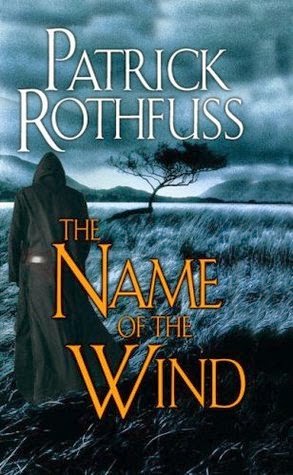 The Name of the Wind by Patrick Rothfuss
“The University! I had come to think of it in the same way most children think of the Fae court, a mythical place reserved for dreaming about. A school the size of a small town. Ten times ten thousand books. People who would know all the answers to any question I ever asked.” Well, Kvothe does eventually get his wish and attends the University, under extraordinary circumstances — his young age was factor, and the University ended up paying him to attend rather than the other way around. So, maybe GETTING in for him wasn’t an issue, but STAYING in certain was. He constantly had money issues and struggled to pay tuition, and he was always on the verge of being kicked out due to his penchant for getting into trouble.
Book Review: Annihilation by Jeff VanderMeer
Posted on June 4, 2014 3 Comments

Annihilation by Jeff VanderMeer
Genre: Science Fiction, Horror
Series: Book 1 of Southern Reach
Publisher: FSG Originals (February 4, 2014)
Author Information: Website | Twitter
Mogsy’s Rating: 4.5 of 5 stars
This is the first time I’ve ever read anything by Jeff VanderMeer, and I’ll admit at first I had my misgivings. I’d picked up this book because of the great things I’ve heard about it, and also because the premise sounded fascinating. However, VanderMeer is also best known for his contributions to “New Weird”, a literary genre that’s been hit or miss with me – but mostly miss. Still, I looked at the modest page count of Annihilation and figured, what the hey. Even if it didn’t tickle my fancy, at least it would be a quick read.
Man, and am I glad I gave this one a shot.
Yes, the story is weird and a bit surreal – two descriptive terms for a book that would normally make me take off for the hills – but what I didn’t expect was how thoroughly atmospheric and intense it was. If Annihilation were to be made into a movie (actually, I believe that’s already in the plans), my dream director for it would be Ridley Scott because I think his particular approach would be perfect for the overall tone and visual requirements of this novel. It’s got those Alien or Prometheus vibes.
And really, I say Annihilation is “weird” but it’s really not that weird. I mean, I was able to follow along, so there’s hope for me yet. Still, how to explain this utterly unique and uncanny novel to the uninitiated (geez, that’s way too many “U” words in a sentence)? You don’t even get names for any of the characters. The story is narrated by a woman simply known as “The Biologist”. She goes on an expedition to a place called Area X with the other members of her team, the Psychologist, the Anthropologist, and the Surveyor, to see what they can find in this chunk of land that has been cut off from the rest of the continent for decades. I think this idea of a scientific mission was a big part of the appeal for me; Anthropology and Biology are fields that fascinate me, and I’m all about stories about treks into the wilderness for the sake of science.
The team also has the task to find out what happened to the expeditions that came before, and here’s where thing get a little eerie. All those involved in the previous eleven attempts to investigate Area X have ended up dead in some way. With the second expedition, all the members committed suicide. Everyone in the third died because they turned on each other with their guns. Members of the eleventh expedition, the one that came before the Biologist’s, came home from Area X as ghosts of their former selves before all dying of cancer several months later. What we find out later on is that the Biologist’s husband was one of them.
This book is strange and unsettling, which satisfied my appetite for horror. But while I’d been prepared to be a little creeped out, given what I knew of the plot from the description, what I didn’t expect was the feeling of heart-wrenching melancholy that came over me as I was reading about the Biologist’s memories of her husband. There’s a tragic, haunted quality to her narration during these parts, and the lonely and isolated environment that is Area X merely served to emphasize this. Knowing that the character is a rather quiet, antisocial and withdrawn woman, the sincerity and forthrightness of her confessions touched me, but at the same time it was also a source of anxiety. Why would she be telling us all this unless she believed something awful and unthinkable was about to happen? An ominous air of mystery surrounds this story like a shroud and its secrets are revealed only bit by bit, compounding the reader’s feeling of dread as the plot line advances towards the conclusion.
Truly, I am surprised by this book. And seriously impressed. I took to VanderMeer’s writing faster and more comfortably than I expected, but then he also makes it easy with his elegant prose. I was right that this was a quick read, and it was even quicker because I enjoyed it so much. Now I’m really looking forward to picking up Authority, the second book of the Southern Reach trilogy.

Waiting on Wednesday 06/04/14
Posted on June 4, 2014 Leave a Comment
“Waiting On Wednesday” is a weekly meme hosted by Breaking the Spine that lets us feature upcoming releases that we can’t wait to get our hands on!

The flames of civil war sweep across the Shima Imperium. With their plans to renew the Kazumitsu dynasty foiled, the Lotus Guild unleash their deadliest creation—a mechanical goliath known as the Earthcrusher, intended to unite the shattered Empire under a yoke of fear. With the Tiger Clan and their puppet Daimyo Hiro in tow, the Guild marches toward a battle for absolute dominion over the Isles.
A BROKEN REBELLION
Yukiko and Buruu are forced to take leadership of the Kagé rebellion, gathering new allies and old friends in an effort to unite the country against the chi-mongers. But the ghosts of Buruu’s past stand between them and the army they need, and Kin’s betrayal has destroyed all trust among their allies. When a new foe joins the war tearing the Imperium apart, it will be all the pair can do to muster the strength to fight, let alone win.
A FINAL BATTLE
The traitor Kin walks the halls of Guild power, his destiny only a bloody knife-stroke away. Hana and Yoshi struggle to find their place in a world now looking to them as heroes. Secret cabals within the Lotus Guild claw and struggle; one toward darkness, the other toward light. And as the earth splits asunder, as armies destroy each other for rule over an empire of lifeless ash and the final secret about blood lotus is revealed, the people of Shima will learn one last, horrifying truth.
There is nothing a mother won’t do to keep her children by her side.
Nothing.”
Comic Review Bites
Posted on June 3, 2014 Leave a Comment

The last volume ended with a stand-off that seemed to spell certain doom for our protagonists. I expected to step into the aftermath of this, but instead, Vaughan went backward, giving us the little human moments that make this little dysfunctional family so wonderfully endearing. From playing board games to arguments to questionable coping mechanisms, I adore the way Vaughan makes these out of this world creatures exactly like you and I. It’s impossible not to empathize with someone or some thing in this book, and it’s easy to get caught up in those moments—only to remember that certain doom is most likely heading their way. As future baby Hazel continues to narrate the story of her parents’ forbidden love, the dark reminder that this story will have a bittersweet ending still hovers quietly over every moment.
Alternate review: OH MY FEEEEEELS!!!


Max Brooks has given us a new spin on the zombie apocalypse with World War Z (the book, not the movie, which didn’t give us much of a new spin at all). In this comic, he does so again. Unlike WWZ, the “subdead” are front and centre in very gory detail, but there is something notably missing: the humans. That is, the humans as the main characters, whose adventures we usually follow as they try to survive. Instead, we have a very interesting twist: a pair of female vampires. Apex predators who have lived through decades, watching humanity grow and change and feeding on us all the while. Now that this plague has taken over, they are no longer bound to many of the rules they once were. But as the pair revel in this new world order, they are blissfully unaware of one simple fact: their food supply is dwindling.
With thanks to NetGalley and Image Comics for the opportunity to read an advanced copy of this graphic novel in exchange for an honest review.

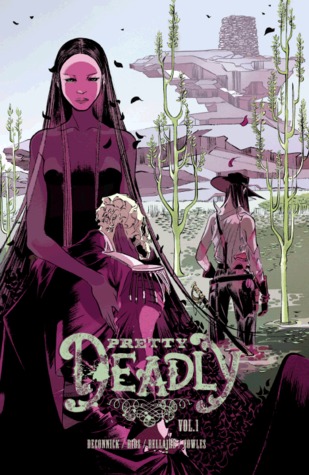
This is a dark, western fairy tale of sorts about a love triangle gone wrong—as is to be expected when a beautiful woman has Death’s love child and that love child becomes a deadly assassin intent on hunting down the man who caused all the pain in the first place, who is busy trying to protect a little girl who…. Um… Let’s go back a bit. The first part of the story builds an ethereal mystery surrounding this love triangle and a little girl in a vulture mask, her companion, Fox, and the deadly women who are hunting them. There are a few other characters who become involved, and at about half way, when the major twist is revealed in a stunning moment, I really started to like this book. With that revelation, the pacing of the story picked up significantly, with all the mystery more or less solved as everyone rushes toward Death. This rush made the ending falter, with little time taken for the reader to get used to new direction, or time for the characters to make anything of themselves. Perhaps this will come in further issues, but for the moment, I felt the second half of the story was a let down simply because it moved too quickly.
With thanks to NetGalley and Image Comics for the opportunity to read an advanced copy of this graphic novel in exchange for an honest review.


There are a few major storylines from the ‘80s X-Men that I missed out on. With the movie now in theatres, it was time to catch up on one of the more iconic ones. I was disappointed to discover that this collection is not entirely focused on the Days of Future Past storyline. Instead, it opens with Jean Grey’s funeral (the very first one!), with Scott basically going through flashbacks of the X-Men and his love for Jean. The Days of Future Past story does not take place until the second or third issue in the collection, and is surprisingly not very long. But the important thing is that it establishes where human hate of mutants can and will lead if the X-Men don’t do their job well. It’s an interesting storyline, but I think the impact is lost for me because of the brevity. While I knew all the characters, there wasn’t enough time to appreciate them within this timeline and therefore mourn their losses when I knew the events would be remedied a few panels later. That said, sentinels and the anti-mutant sentiment certainly did become a major issue for the X-Men after this, so the impact of the theme made it worth the read.

Gotham Central Volume 1: In the Line of Duty
Gary Oldman ordered Ben McKenzie to do his homework when he was cast as Jim Gordon in the upcoming Gotham tv series, so it’s only fair that I do my homework too. While Gotham is considered to be losely based on this graphic novel series, the show will take place at the beginning of Gordon’s career, with Bruce Wayne and many other villains as children—meaning, there will be no Batman. Gotham Central takes place after Jim’s retirement and focuses on the various cops in the precinct and how they handle crime fighting under the shadow of a man they can’t admit exists. Some of them aren’t particularly happy that he does exist, and I love the balance between their animosity and their realization that, considering the utter crazy of their opponents, at times Batman is a necessary evil. The story does not rely on Batman’s existence, though, and he appears only briefly. There are many other crimes that don’t necessarily involve mentally deranged costumed freaks. There is a level of crime procedural drama involved, and, while the particular cases might not be all that inspired, it’s the GCPD themselves that make this story really work.


You’ve probably heard this story before: Coloured men who want to fight for their country, for their freedom, who are treated as less than garbage, but persevere to become the best of the best. We’ve seen this story told many times, in many different forms, from the Tuskegee Airmen, to the The United States Colored Troops. But that doesn’t mean the that the story of men who fought and died for the freedom of a country that hated them is any less important.
I loved the choice of black and white artwork. There are some brutal scenes, typical of horrific events during a war, but the stark contrast of black and white makes the scenes more powerful and vivid than full colour.

Book Review: Thief’s Magic by Trudi Canavan
Posted on June 2, 2014 1 Comment
 Thief’s Magic by Trudi Canavan
Genre: Fantasy
Series: Book 1 of Millennium’s Rule
Publisher: Orbit (May 13, 2014)
Author Information: Website | Twitter
Mogsy’s Rating: 4 of 5 stars
I was very excited when I first heard about Trudi Canavan’s Thief’s Magic, and doubly more so when I discovered it was going to be an introduction to a brand new universe we’ve never seen before. I’m not completely unfamiliar with the author’s work, having read The Magician’s Guild, book one of her Black Magician trilogy, but knowing that she has two series and a couple more novellas based in that world of Kyralia which I haven’t even yet come close to finishing, I was glad to have a fresh start in Millennium’s Rule.
Magic and magic users seem to feature strongly in Canavan’s books, and that’s no exception here. At the beginning of this novel we meet Tyen, a young archaeology student (though calling what he and his professor and fellow students do “Archaelogy” might be a bit of stretch…they’re more like tomb robbers) who discovers a sentient book while excavating an ancient tomb. The book can read the minds of anyone who makes physical contact, communicating through text appearing on the pages. Calling herself Vella, the book claims to have once been a sorcerer-woman, until she was transformed into her current form by one of the greatest sorcerers of history. She has been gathering and storing information through the ages ever since. Sensing bad things to come if Vella were to ever fall into the wrong hands, Tyen decides to keep her to himself for now, but as we all know, a secret this big is always bound to come out sooner or later.
Meanwhile in another world, a dyer’s daughter named Rielle harbors a secret of her own. From a young age, she has had the ability to sense magic – and hence the potential to use it. However, Rielle’s society could not be any more different from Tyen’s, where magic is used freely (and some might say TOO freely) to power their fantastical machines. Instead, the priests of Rielle’s world teach that to use magic is the equivalent to stealing from the Angels themselves. Anyone caught committing this crime is published severely then cast out from the city to live out the rest of their lives in a prison. Rielle is therefore all too happy to just keep her head down, hoping to also to do what her family wants of her and find a prospective husband. But then she meets and falls in love with a local artist named Izare, which is patently NOT what her parents had in mind. Oh, hello, Forbidden Love.
What do these two plot lines have to do with each other? Very little, actually. Reading Thief’s Magic felt essentially like reading two-books-in-one. The novel’s structure can be a little jarring if you’re not expecting it. We first start with Part I which follows Tyen’s story, and several chapters after that Part II begins with Rielle’s. The novel continues like this, alternating back and forth between their narratives. Actually getting the hang of this perspective-jumping isn’t all that difficult, but Canavan likes to tease, and she seems to have this knack for choosing the most suspenseful moments to make the switch between characters. Often, I would find myself pulled away into Rielle’s story just as I was getting completely drawn into Tyen’s, or vice versa. This format was both simultaneously addicting and frustrating, though I have to admit I kind of liked it.
When it comes down to it, I’m just completely hooked by these two characters and their respective worlds. Both Tyen and Rielle are written very well, even though occasionally their naiveté would grate on my nerves. However, their decisions – misguided as they are sometimes – always led to interesting things happening. I’m fascinated by the differences in their cultures and how each of them view magic. I love that their own personal conflicts take them on completely disparate adventures, so that the individual challenges they face differ profoundly as well. I’m especially intrigued by Rielle and her struggles in a society where unauthorized use of magic is treated as the greatest sin, where women like her have very little choice and practically no future when they are discovered to possess magical abilities.
I don’t know if Tyen and Rielle’s paths will ever cross, though something tells me that they will – but that particularly story is not for this book to tell. At this point, I feel I’ve been given enough information to formulate a tenuous theory on how the two characters’ worlds are linked, but for the most part we don’t get too many answers on that front. I really enjoyed following both story lines, but if you’re the kind of reader who prefers self-contained story arcs or at least some closure at the end of a novel, you won’t really find it here. It’s a factor to think about, though I already know I will be picking up the next book in spite of it. Thief’s Magic may have all the hallmarks of a “Book One”, but Canavan has crafted a very fine beginning (technically, TWO very fine beginnings) and I want to find out what happens to both Tyen and Rielle.

YA Weekend: Graceling by Kristin Cashore
Posted on June 1, 2014 Leave a Comment
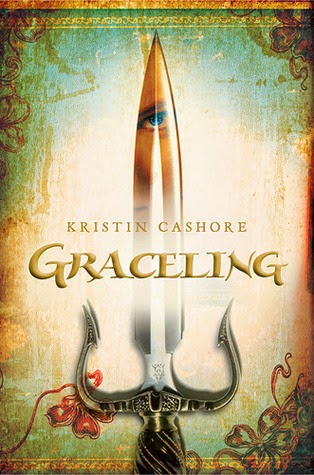
Graceling by Kristin Cashore
Genre: Young Adult, Fantasy
Series: Book 1 of Graceling Ream
Publisher: Harcourt (October 1, 2008)
Author Information: Website
Mogsy’s Rating: 3.5 of 5 stars
The Graceling audiobook came highly recommended to me and I can see why … it gets the full cast treatment! If you’re confident that you can get through the different narrators and music without getting too distracted, this can be great. I’ve had the pleasure of listening to nearly a couple hundred audiobooks to date, and probably only a handful of those have been completely full cast. I admit it took me a few chapters to adjust to this wonderful feature.
Regardless, I thought it was the perfect kind of story to get a full cast narration, with such a wide variety of characters and rich personalities. The title Graceling refers to the rare individuals in this world who are born with an extreme skill or talent. A “grace” can be completely random and … really, anything at all! It’s possible to be graced with something as awesome as reading minds or as mundane as cooking. At the center of this novel is a young woman named Katsa, who was born with the grace of killing. Power like that usually doesn’t go unnoticed, and her uncle the crafty king Randa has made her his personal enforcer and thug ever since finding out.
Then Katsa meets Prince Po, a graceling apparently gifted with the incredible skill of combat, and she thinks she’s found a kindred spirit. But as it turns out, there is a lot more to both their graces than meets the eye, and it takes a harrowing adventure for them to find out the truth.
In so many ways this story reads like a dark fairy tale, complete with your cast of larger-than-life heroes and wicked villains. Still, it all really comes down to Po and Katsa. Their romance was sweet and endearing, even if very predictable. But with books like these, it’s always obvious from the start who will end up together — it’s the journey that counts. The unique combination of their personalities and the inevitable clashes that result are the elements which make this particular love story special, not to mention a lot more entertaining to follow, especially when you’re throwing in the complexities of their graces.
Though Graceling is technically Katsa’s story, it was Po that stole the show, with his down-to-earth personality. He is the perfect counterbalance to the aloof and sometimes bullheaded Katsa, who is a flawed but also engaging character. It’s hard not to feel sympathetic towards her even when she is being her recalcitrant self, insisting on punching her way through her troubles. Mainly it’s because that defiance is so often a symptom of her desire to do good, even when she’s not sure how go about it. As someone raised to be a brute and nothing more than a tool to hurt people, it’s not surprising that Katsa can at times come off as a bit immature and difficult to relate to, but that’s the beauty of her characterization.
Graceling was a good book, but does it break the mold when compared to other works in its category? Probably not. But there are a couple things that make it stand out, the magical elements being one of them. I like the idea of gracelings and the fact graces can be either a blessing or a curse, though the book makes it seem like it is often the latter.
I’ll also be the first to admit to being totally jaded when it comes to romance in the YA genre, but if you’re thinking of reading Graceling for the romantic aspects, it’s definitely not a bad choice. Nicely developed with tastefully written love scenes, the romance scored some major points with me, and I give credit as well to the two voice actors playing Katsa and Po in the audiobook, who did a fantastic job capturing the emotions behind the relationship. Now if only that little jingle that plays between the scenes wasn’t so god-awfully cheesy. But you could do worse.

Mogsy’s Book Haul – For Review, Purchased, and Goodies From Balticon
Posted on May 31, 2014 Leave a Comment
I’m putting up an impromptu Book Haul post this week — a few review books came in and I also made several purchases, most of which came from Balticon which took place over Memorial Day weekend.

Flight of the Golden Harpy – harpies! An underrated and underused creature of fantasy for sure. That was enough pique my interest in this book, my thanks to Tor for a copy of this ARC.
The Boost – another review book from Tor, this techno-sociological novel sounds fascinating and seems my kind of sci-fi novel, not to mention a nice change of pace from my usual reads.
Cibola Burn – speaking of sci-fi, I was ecstatic to receive this for review from Orbit! I love The Expanse series and have been gobbling each book as they come out, and I’m so pumped for book four.
The Three – easily one of my top books of 2014, as you can see from my review here. The Three was released earlier this month and obviously I just had to have a beautiful hard cover copy to call my own.
This year was my first Balticon, and my first convention in years, actually. There hasn’t been much con action since a year or so before my daughter was born, so this was a great event for the entire family, being the perfect size and a very friendly and intimate environment. I got to meet a bunch of writers and get my books signed, from authors Brandon Sanderson (who was the Guest of Honor — and like the nicest guy ever), Jon Sprunk, Tom Doyle, Jo Walton, and others. 2013 Compton Crook Award winner of last year’s Balticon Myke Cole also signed my Shadow Ops trilogy and EVEN MY BABY. My daughter was surprisingly calm considering someone was scribbling on her knee, actually. Two years old and showing an affinity towards authors already, that’s my girl.
Here are a couple cool new acquisitions from the con I wanted to feature:
Among Others – I have a copy of My Real Children by Jo Walton that I have to get to, but I couldn’t resist also picking up a copy of the award winning Among Others to get signed as well. Ms. Walton told me she wasn’t too fond of the cover to this, but I think the color’s actually quite eye-catching.
Firstborn/Defending Elysium – at one of the autograph sessions for Brandon Sanderson, the vendor still had about a dozen or so of these convention-exclusion tête-bêche hardcover editions featuring the two short stories previously released online. So excited that I was able to snag a copy!
And yes, we actually have a few books from the digital pile:
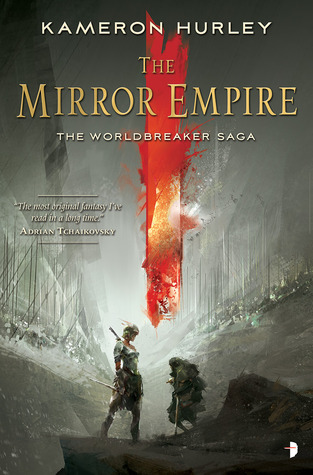
The Mirror Empire – this book is so drool-worthy! Ideally, I had wanted to read Kameron Hurley’s Bel Dame Apocrypha series first before even thinking about hitting up this book, but dammit, I have the willpower of a bendy straw! I caved and requested this from NetGalley.
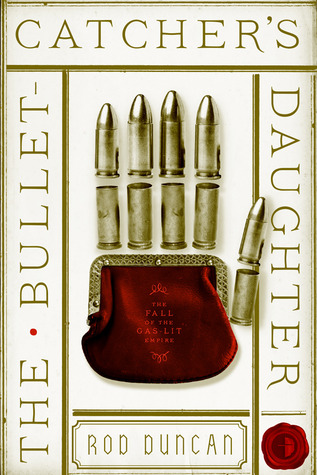
The Bullet-Catcher’s Daughter – looks like it’s Angry Robot week! Another one of their books I’m really looking forward to, which I also got via NetGalley. This one just sounds so cool!
Skin Game – Dresden Files audiobook. Enough said. I love the audio versions of this series, not least because of narrator James Marsters. The voice of James Marsters IS Harry Dresden, and there is absolutely no doubt about that in my mind.
Book Review: Prince of Fools by Mark Lawrence
Posted on May 30, 2014 2 Comments

Prince of Fools by Mark Lawrence
Genre: Fantasy
Series: Book 1 of The Red Queen’s War
Publisher: Ace (June 3, 2014)
Author Information: Website | Twitter
Mogsy’s Rating: 4.5 of 5 stars
I am glad we’ve not heard the last of Mark Lawrence’s Broken Empire, even if Jorg’s chapter of the saga has concluded. As far as endings go, that was a necessary and felicitous curtain call, even though I couldn’t be happier with the way things played out. But of course, that doesn’t mean I’ve had enough of this brilliant dark world.
Regarding his latest novel, Mark Lawrence has stated that what did not want to do was give us Jorg Ancrath again but in new clothes. Well, Mr. Lawrence, you can rest easy about that. I don’t think anyone can mistake that wicked, tortured young psychopath we first met in Prince of Thorns with his new protagonist in Prince of Fools.
Courage is overrated, as a character like the glib but glorious Prince Jalan can attest. A self-confessed liar, coward and cheat, our main character is also a bit of a rakish playboy, with an easy charm to him that makes him instantly endearing, for all his foibles. See? Nothing like Jorg. But the two of them are contemporaries, if you are wondering where The Red Queen’s War fits in relation to the original trilogy. As such, I don’t think fans of The Broken Empire will find much of a problem settling in. We even get to meet Jorg and his Brothers, albeit very briefly, in an unforgettable scene. Despite the mostly new faces though, Mark Lawrence has no trouble convincing me I am back in the haunted, post-apocalyptic milieu with which I first fell in love. As strange as it sounds, given the kind of place we’re talking about, it was a bit like coming back home.
But while the writing style and setting may be instantly recognizable, we have a story here that is altogether very different. And yet, even the slippery Prince Jal can’t avoid running afoul of the dark sorcery that is rife in the Broken Empire. Finding his fate magically bound to that of an escaped slave named Snorri ver Snaggason, the two strike up a partnership in order to try to break the spell. We had an inkling of the Broken Empire’s vastness back in Jorg’s story arc, and here we are given the chance to explore even further as Jal and the Norseman’s journey takes them to the frigid and icebound north, towards Snorri’s homeland.
The two encounter many dangers along the way, including necromancy and other unseen malevolent forces. There is no escaping the Dead King, whose plans run far deeper than anyone can expect. Nightmarish beings called the Unborn are raised and fed by the stolen potential of lost infants, sent to carry out his bidding. Gruesome, disturbing elements such as these serve to push Prince of Fools into Horror territory.
And yet there is also a glimmer of optimism, a thread of light that I can easily pick out amidst the doom and gloom, making me feel that this book is actually “less grimdark” than the original trilogy. Prince Jalan, who assures us he has little ambition – beyond getting drunk, winning bets and seducing women – is really more of a hero than he gives himself credit for. I see a young man who wants to be more than just “that prince who is tenth in line for the throne”, even if he doesn’t care to admit that to himself.
The idea of the unlikely hero is not a new one, certainly, but the difference is Mark Lawrence actually makes me believe that Jalan has it in him. Jal’s growing friendship with Snorri also brings to light a hidden side of him, and vice versa; I think the two of them play off each other perfectly. The story displays the classic quest narrative, one that is very character driven. Forced to work together, the relationship dynamics between this pair of disparate and conflicting personalities is what makes this dark adventure shine.
There is no doubt this is a Mark Lawrence novel – pick it up and you will immediately see the hallmarks of his storytelling and writing style which made The Broken Empire trilogy such a incredibly addictive read, replete with his darkly droll humor and very quotable dialogue. Fans won’t be disappointed. But rest assured Prince of Fools is also a one-of-a-kind tale featuring a very different protagonist. Jal has immense potential, and if this is what Lawrence can achieve with his character in just one book, I can’t wait to see what’s next.
Tough Traveling: Immortals
Posted on May 29, 2014 2 Comments
The Thursday feature “Tough Traveling” is the brainchild of Nathan of Review Barn, who has come up with the excellent idea of making a new list each week based on the most common tropes in fantasy, as seen in The Tough Guide to Fantasyland by Diana Wynn Jones. Nathan has invited anyone who is interested to come play along, so be sure to check out the first link for more information. Compulsive list-maker that I am, I’m very excited to take part!
This week’s tour topic is: Immortals
IMMORTALS are fairly common in Fantasyland. There are three kinds:
1. GODDESSES AND GODS, who exist forever unless people stop believing in them.
2. ELVES or DARK LORDS, who live forever unless someone kills them.
3. Humans who are
a) Cursed and have to spend Eternity drearily Questing and/or hating everything.
b) MAGIC USERS. These generally find plenty of occupy the long years and mostly have a rather good time.
It’s feast or famine with these Tough Traveling weeks! We could probably go on forever with books featuring immortals, but to keep this post to a reasonable length and because time is limited, I thought I might be cool if I split up my list using the categories outlined above and feature just a couple books (hopefully one obvious choice, and one not-so-obvious choice) for each.
American Gods by Neil Gaiman
The following two entries are specifically for “Gods who exist forever unless people stop believing in them.” Well, that’s pretty much the central premise of this book, the idea that gods and other mythological creatures exist due to the sheer force of spiritual belief or mental discipline. From Odin to leprechauns, immortality was achieved when immigrants to the US brought with them their beliefs, though as that belief began to wane thanks to obsession with technology and new fads so did the power of the mythological beings. (Review)
 Thief’s Covenant by Ari Marmell
The minor god Olgun doesn’t actually have a physical body, but he definitely still counts in this category (and I also love these books so much, I never miss an opportunity to talk about them). Instead, he hitches a ride in the protagonist Widdershins’ head because she is his last worshiper. They need each other, as Olgun can augment many of Widdershins’ abilities and help her get out of tough jams, and Widdershins being his last believer is also the only reason Olgun still has a presence in this world. (Review)
 The Fellowship of the Ring by J.R.R. Tolkien
The obvious choice and most well-known example for immortal ELVES, it would be remiss if I didn’t include them. Exactly as the examples states, Tolkien’s elves in world of Middle-earth are immune to disease and do not experience physical aging, though they can still be killed by violence or by wasting away when they lose their will to live. Otherwise, they’re essentially immortal.
Shadow and Bone by Leigh Bardugo
My entry for immortal DARK LORD is the Darkling from Bardugo’s Grisha trilogy. At first, all we know of the Darkling is that he is the charming, handsome and mysterious leader of the Grisha, but then he is eventually revealed as main antagonist. Turns out all the Darklings who held leadership in the past were all one and the same man – he is an ancient powerful force that has existed since the beginning. (Review)
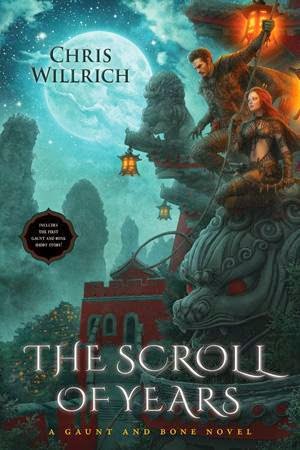
The Scroll of Years by Chris Willrich
Hmm, cursed humans. Well, Imago Bone isn’t exactly what I’d call “dreary”. In fact, as a thief and scoundrel, he lives a pretty merry and exciting existence adventuring with his lover Persimmon Gaunt. But he has been touched in some way with immortality. I don’t know how precisely, since I’ve never read the short stories, but the book’s description states “A thief in his ninth decade who is double-cursed”, Imago has not aged in nearly seventy years. Cursed? Check. Immortal? Sounds like it to me. Questing? Always. (Review)
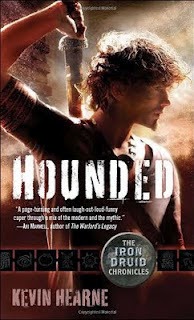
Hounded by Kevin Hearne
Here’s my example for a human MAGIC USER who finds plenty to occupy their long years and mostly have a good time. Uh yeah, that pretty much describes Atticus O’Sullivan to a T. The guy definitely knows how to have fun, and at the moment this two-thousand year old druid’s idea of fun is setting up shop in Tempe, Arizona with his talking dog, selling herbal tea to college students and New Age types. Plus, he gets his kicks looking and acting like a frat boy. (Review)
Book Review: The Voices by F.R. Tallis
Posted on May 28, 2014 1 Comment

Genre: Horror
Series: Stand Alone
Publisher: Pan Macmillan (May 8, 2014)
Author Information: Website
Mogsy’s Rating: 4 of 5 stars
To some, The Voices is going to be just another haunted house ghost story. To others, it will be one of the most terrifying books you’ll ever read. I’ll admit I came very close to not reading this, simply because the novel’s description made it sound much too scary. As a parent of a toddler, I had a feeling this one might cut to close for comfort and give me nightmares. But true to form, in the end I just couldn’t resist a good horror.
The year is 1976, the hottest summer in the United Kingdom since records began, and Christopher Norton and his wife Laura and baby girl Faye had just moved into their a grand old Victorian era home in the desirable neighborhood of Hampstead. A composer by trade, Christopher spends much of his time in his attic studio recording music, and before long he starts to hear strange voices on his tapes. Around the same time, Laura beings to notice knocking sounds from the baby monitor and baby Faye seemingly to babble at something unseen…
Haunted houses have long been a horror fan favorite, and whether you love it or hate it, they’re here to stay. The reason why certain tropes tend to stick around is because they’re so effective – if you can’t feel safe in your own home, then where can you? – and though I’ve read plenty of books and seen many more movies based around this idea, I don’t seem to be tired of it yet. It’s interesting because the narrative structure of The Voices actually reminds me so much of watching a movie, with regards to the use of familiar themes or the way particular events have a very cinematic quality to them. The book is also intensely atmospheric, heightening the creep factor and delicious sense of dread.
In truth, The Voices is a rather uncomplicated novel. But the author, being a clinical psychologist, knows just what to say to make you squirm. Tallis builds his story around a very believable, very flawed couple, giving them a depth of emotion not often found in characters in this genre. Christopher and Laura might not be parents of the year, but their thoughts and reactions towards the strange happenings in their house are so realistic you just can’t help but feel a connection. There were a couple scenes that really shook me up, because 1) they involved a baby, and 2) I know how awful it feels to worry for your child. There were things here straight out of my worst nightmare.
But the haunting is also just one single aspect of The Voices, a piece of a larger story with a complex web of relationship dynamics. I liked that there was more substance to this novel than just the horror elements, and in fact, my only complaint is that these minor plot threads weren’t more cohesive and connected to the overall picture. There were a lot of other things going on with Christopher and Laura’s lives outside their creepy old house, and while I got the feeling they were all relevant to the story, I just couldn’t figure out how. A little more direction would have probably made for a tidier conclusion, but I was still overall very impressed at the well-roundedness of the novel.
If you’re in the mood for a good ghost story or a classic haunting, The Voices is a very good choice. It’s one of the more memorable and chilling horror novels I’ve read of this type, and a genuinely freaked me out in more than a couple instances.


 The BiblioSanctum