Book Review: The Shadow Master by Craig Cormick
Posted on June 13, 2014 2 Comments
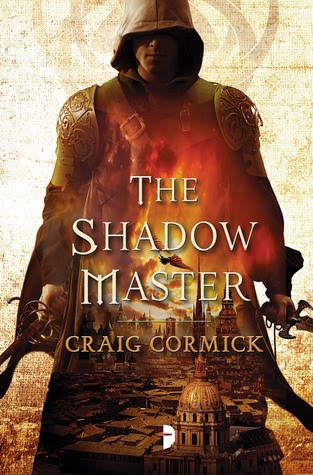
The Shadow Master by Craig Cormick
Genre: Fantasy
Series: Book 1
Publisher: Angry Robot (June 24, 2014)
Author Information: Website
Mogsy’s Rating: 2.5 of 5 stars
I wish I could write a more positive review for this book, I really do. The Shadow Master has so much going for it, including a setting resembling an alternate-history Renaissance Italy, with just a touch of that steampunk flavor with its clockwork inventions and automatons. We also mustn’t forget the biggie for me – a plot thread about a pair of star-crossed lovers separated by the warring between their families. I do get a kick out of Forbidden Love. This book just seemed made for me, and indeed I liked a lot of its separate parts. I’m just not sure how well I liked the whole.
If the book’s description didn’t make you think it already, then I’m sure its epigraph “A plague a’ both your houses!” certainly would – the basic plot is very much reminiscent of Romeo and Juliet. However, this is not a romance. In fact, one of my biggest disappointments was not feeling any connection at all between the two young lovers: Lucia, daughter of the Duke of House Lorraine and Lorenzo, whose loyalties lies with the House Medici.
With the two families at each other’s throats, the future of Lucia and Lorenzo’s relationship hangs in the balance, but without first being convinced of their bond, I found it hard to stay interested. Their love story, which should have served as the starting point and foundation of the novel, didn’t initially captivate me, and as a result the rest of the story failed to deliver the desired impact.
But as I’d alluded to, there were quite a few things I enjoyed about this book. I enjoyed the appearance of several historical figures including Galileo and Leonardo Da Vinci, even though they weren’t contemporaries, but their “war of the wits” gave the Medici vs. Lorraine battle a certain fantastical flare. Both are reluctant geniuses caught in the conflict between the Houses, receiving pressure from their leaders to design and build magical inventions that would give their side the advantage. The city is also threatened by plague, a problem literally at its doorstep as hordes of the sick and dying amass outside the gates. The first half of this book was quite engaging for these reasons.
Around the 60% mark, however, events of the story suddenly made a turn for the confusing. Kidnappings and assassination attempts and negotiations become entangled in mystical machines, madmen and ancients. The events were so jumbled and disconnected that I’m still a bit uncertain as to what really happened.
I think the language and the author’s writing style might have also made following the story a little more difficult. I didn’t click with some of the dialogue between characters spoken in riddles, and at times the prose also had a tendency to feel overly embellished with the use of euphemisms, especially during moments of intensity. Torture scenes or sex scenes were made incredibly awkward by terms like “serpent of sin”, “tower of ivory”, “fountain of relief”, “cave of wonders” and “mountains of the goddess”. There was speculation between me and another blogger that some of these were done purposely for the sake of satire, which I admit was something that hadn’t occurred to me. It’s possible, I suppose, though if that’s the case it’s not presented in a very obvious manner.
If the last half had been tightened up and more clear and consistent, I might have enjoyed The Shadow Master a bit more, but as it is, the book feels slightly unfinished and rushed. I had pretty high hopes, but in the end this one just didn’t work very well for me.

A review copy of this book was provided to me by the publisher via NetGalley in exchange for an honest review. My thanks to Angry Robot Books!
Tough Traveling: Large Man
Posted on June 12, 2014 3 Comments


The Thursday feature “Tough Traveling” is the brainchild of Nathan of Review Barn, who has come up with the excellent idea of making a new list each week based on the most common tropes in fantasy, as seen in The Tough Guide to Fantasyland by Diana Wynn Jones. Nathan has invited anyone who is interested to come play along, so be sure to check out the first link for more information. Compulsive list-maker that I am, I’m very excited to take part!
This week’s tour topic is: Large Man
LARGE MAN…He is very calm, very strong, and not at all stupid. In some cases he will have been a BLACKSMITH, which accounts for the ease with which he severs the chains in the Galley.
Okay, so I was completely stuck for the theme for this week. I tried googling for ideas. And let’s just say, I hope no one else made the same mistake I did with the search term “fantasy large men”. Yeah, I don’t recommend that at all. You would not believe the results that came up. Not what I had in mind.
So I’m afraid I’m going to have a rather weak list this week. The thing is, the LARGE MAN (who is also sometimes a blacksmith) feels like it has come up a lot in the books I read, but I can never remember, as this character is so often in the background, “just some guy” the main characters happen to meet, who might not even be named. A few on my list are going to be more prominent and better known large men instead, even if they don’t really fit the description.
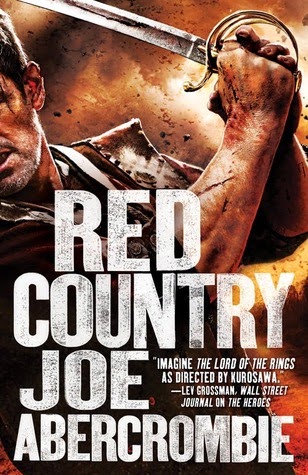 Red Country by Joe Abercrombie
Lamb is Shy South’s cowardly old stepfather, a big man but also quiet and taciturn. The two come back from town one day to find their farm burned to their ground, and Shy’s two young siblings Ro and Pit stolen away. Their journey to get the children brings out a whole new side in Lamb, and we discover he has actually been hiding a bloody past of his own. If you’ve read The First Law trilogy before this, you’re in for a treat!

A Song of Ice and Fire by George R.R. Martin
Martin’s series is peppered with freakishly large men (and women, in the case of Brienne of Tarth). We have the Clegane brothers, Ser Gregor and Sandor who are both huge and heavily muscled, the former who is nicked name “The Mountain” because of his enormous stature. We also have Hodor, of course. Well over seven feet tall, it has even been suggested by Osha that he might have some giant’s blood in him.

Harry Potter by J.K. Rowling
Speaking of giant’s blood, we move on to a character who actually is half-giant. Rubeus Hagrid is the son of a human and a giantess, and at age six he was able to pick up his father and put him on top of the dresser if he annoyed him. Plus, every one of these Tough Traveling posts requires Harry Potter, so glad I was able to get it in for this week.
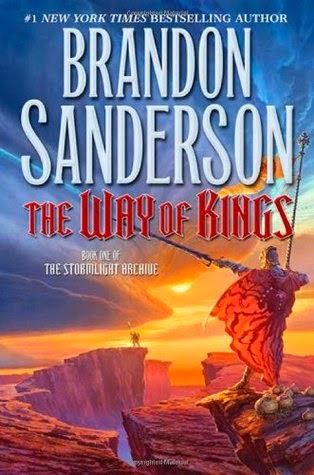
The Way of Kings by Brandon Sanderson
The Horneater called Rock is Kaladin’s fellow bridgeman in Sadeas’ army whose real name is so hard to pronounce that everyone just calls him by the nickname. He is also a large man. He is described as nearly seven feet tall with thick limbs and a powerful torso. Despite his size, others around him are generally not intimidated by him because of his jovial nature. He is quick to laugh and is well-liked. He likes to cook and refuses to fight because being a soldier is not considered reputable in his culture.
 The Broken Empire by Mark Lawrence
Prince Honorous Jorg Ancrath travels with his band of gritty brutes, with Brother Rike being notably one of the larger and more blood thirsty members of his gang. There’s even a great quote about his size: “Most men have at least one redeeming feature. Finding one for Brother Rike requires a stretch. Is ‘big’ a redeeming feature?”
Book Review: The Forever Watch by David Ramirez
Posted on June 11, 2014 Leave a Comment

The Forever Watch by David Ramirez
Genre: Science Fiction
Series: Stand Alone
Publisher: Thomas Dunne (April 22, 2014)
Author Information: Website
Mogsy’s Rating: 2.5 of 5 stars
I don’t DNF books. I’m sure that is in large part due to my obsessive completionist nature. I’m still trying to learn to let go, because as everyone so wisely says, life is too short for books you don’t enjoy. But I just can’t help it. And here’s what I think is another reason for my perseverance: Hope. HOPE that the book will get better, HOPE that the story will eventually pick up, HOPE that I’ll finally be able to connect with the characters. After all, it’s happened before. There’s a good handful of books in my 4 or 5 star pile including a couple on my Favorites shelf that I wouldn’t have had the pleasure of experiencing, if I’d gone with the instinct to put them down. Sometimes, my stubbornness pays off.
A lot of the times though, it doesn’t. The Forever Watch was one such book. I had high hopes for it, because even though it got off to a slow start, the ideas and world building it in were phenomenal and when the story started picking up around the 10% mark I thought to myself, “Helloooo, now we’re cooking with gas!”
But just as suddenly as things picked up, they slowed way down again. It happened again around the halfway point. And again around 75%. Every time I thought I was finally getting somewhere with this book, the story would plunge me right back into the usual meandering, aimless pace.
It was disappointing. And even more so because of the incredible foundation laid out for us in the first part of the novel. The planet Earth has died and been abandoned, so our story takes place on a generational ship called the Noah, traveling on a centuries-long journey towards Canaan, humanity’s new hope for a home. The society on the Noah is strictly regulated with highly advanced technology, with programs like forced retirements, mandatory breeding duty for women, and designated Keepers to raise children. Everyone is highly specialized for their roles on the ship, and certain individuals are gifted with powers or implants, giving them abilities like telekinesis or super strength. Every angle of this highly intriguing dystopian society felt impressively detailed and well thought out.
But even though the world building was simply amazing, The Forever Watch faltered for me in other areas. Hana Dempsey, the novel’s main character has just completed her breeding duties, waking up from a nine-months-long induced sleep. Breeders are placed in this state for the whole duration of their pregnancy and never get to see their babies, but while Hana was aware of this, what she did not expect is the secret loss she feels now, yearning for the child she would never know. At first, I thought the narrative would continue exploring this heartbreaking thread, but then it switches tack, introducing Leonard Barrens, with whom Hana has a very special relationship. A police officer running an investigation into the violent death of his mentor, Barrens turns to her for help, and just like that the matter of her baby was relegated to the background, and doesn’t come back again until much later in the book. It was a bit maddening.
Still, I can never resist a good murder mystery and a hunt for a serial killer, in this case dubbed “Mincemeat”. But The Forever Watch isn’t your usual murder mystery either, since it doesn’t have that same dramatic tension. Granted, the book had a few surprises that hooked me in, but otherwise the plot could barely hold my attention from all the scientific jargon and unnecessary exposition which was all white noise distracting me from the main story. I felt no connection to either Hana or Barrens whose personalities were as sterile and rigid as their social environment – which might have been by design, but either way it did nothing for me. Consequently, I also didn’t care much for their romantic relationship.
The Forever Watch therefore gets high marks from me for innovation and world building, but unfortunately I am not too fond of the story or its execution. There were some great moments, but they were few and far between, not enough to generate any sustained momentum. Admittedly, the revelation at the end about Mincemeat and how everything was linked together was pretty mind-blowing, but because I place so much importance on storytelling and character development, the inconsistent pacing and my ambivalence towards Hana and Barrens ultimately made me less excited about the final outcome. I think other readers may find lots to like about this book, but in the end it just wasn’t for me.
A review copy of this book was provided to me by the publisher via NetGalley in exchange for an honest review. My thanks to Thomas Dunne Books!
Waiting on Wednesday 06/11/14
Posted on June 11, 2014 2 Comments
“Waiting On Wednesday” is a weekly meme hosted by Breaking the Spine that lets us feature upcoming releases that we can’t wait to get our hands on!
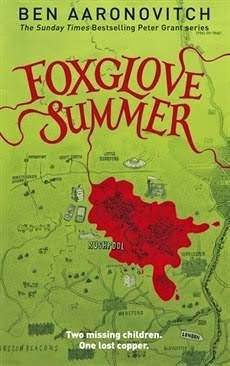 “In the fifth of his bestselling series Ben Aaronovitch takes Peter Grant out of whatever comfort zone he might have found and takes him out of London – to a small village in Herefordshire where the local police are reluctant to admit that there might be a supernatural element to the disappearance of some local children. But while you can take the London copper out of London you can’t take the London out of the copper.Travelling west with Beverley Brook Peter soon finds himself caught up in a deep mystery and having to tackle local cops and local gods. And what’s more all the shops are closed by 4pm…”
Book Review: The Girl With All The Gifts by M.R. Carey
Posted on June 10, 2014 3 Comments
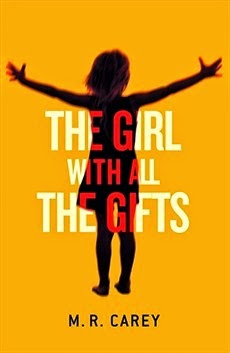
The Girl with All The Gifts by M.R. Carey
Genre: Horror, Science Fiction
Series: Stand Alone
Publisher: Orbit (June 10, 2014)
Author Information: Website | Twitter
Mogsy’s Rating: 5 of 5 stars
I confess, I’m not very good when it comes to pulling information out of book descriptions. But all I know is, when I first heard about The Girl with All The Gifts, it piqued my interest right away. Here you have a story about a bright young girl named Melanie, who for some reason everyone seems deathly afraid of. Being held at gun-point while being strapped into a wheelchair just to go to class? Judging by level of paranoia with which she’s treated, you’d think little Melanie was Hannibal Lecter. The book jacket may be a little scarce on details, but there’s definitely something strange going on.
So it really shouldn’t have surprised me when this book turned out to be Horror, and yet it did. Finding out about the genre, however, just made me even more excited to read it. And just when I thought things couldn’t get any better, OH HELLO, THEY DO!
By now, I gather it’s pretty safe to explain why I had myself a personal little freak-out when it hit me just what I was in for with this story. After all, the revelation comes very early on in the novel and is hardly a spoiler, not to mention the book has been out in the UK for months now and the cat is out of the bag. But avert your eyes now if you would prefer to know absolutely ZIP about the book going in. Anyway, my excitement levels exploded when I grew even more when I realized that The Girl with All The Gifts…has zombies.
And I haven’t even gotten to the best part yet. What makes this a great zombie book – a great book, PERIOD – is the science. Ah, gotta love science. Like I always say, if you want to see some scary stuff, look no further than Mother Nature. Heck, some of the most frightening, bone-chilling things I’ve ever seen in film aren’t in horror movies, but are in those dang Planet Earth documentaries. Who could forget the “Jungles” episode and the importance of fungi as illustrated by the life cycle of Ophiocordyceps unilatertalis? Oh, the sheer horror of watching the parasite take over an ant’s brain before the fruiting body explodes out of the back of its victim’s head, all while Sir David Attenborough goes on calmly narrating in those smooth, dulcet tones. That sequence was beyond traumatizing – but also fascinating. I remember being obsessed with the idea, thinking to myself, holy crap, someone pleeeeease write a zombie book based around this!
Well, even though the video game The Last of Us might have done it first, M.R. Carey ended up granting me my wish. And he does it in such a spectacular way, wrapping this fantastic idea around a story filled with mystery, action, and lots of gut-wrenching heartbreak. The Girl with All The Gifts is everything I look for in a zombie book – tight, energetic pacing with all the savagery, suspense and tension – but it’s also so much more. For me, this book is the next step in zombie fiction, delivering on the survival and post-apocalyptic elements we all know and love, while pushing the envelope with new ideas and deep characterization.
Due to its nature, it’s not surprising that the zombie-apocalypse survival subgenre tends to feature ruthlessness and characters with hard hearts who show no pity. But seeing the themes of mercy and compassion enter into the equation here is a nice change of pace. A lot of this is due to Melanie. If you also guessed from the description that there’s something different about her character, you’d be correct. Melanie is definitely a special little girl, and she’s part of what makes this book such an exceptional, atypical zombie novel and such a joy for me to read.
Even though I can probably go on for another couple pages about why I loved this book, I really don’t want to give too much away. There are lots of surprises, including an unpredictable ending that truly stunned me. I loved this book to pieces. Haunting, powerful and poignant, The Girl with All The Gifts is a novel I would recommend high and without reservation.

A review copy of this book was provided to me by the publisher in exchange for an honest review. My thanks to Orbit Books!
Book Review: The Boost by Stephen Baker
Posted on June 9, 2014 Leave a Comment

Genre: Science Fiction
Series: Stand Alone
Publisher: Tor (May 20, 2014)
Author Information: Website | Twitter
Mogsy’s Rating: 3 of 5 stars
This book is an interesting look into our not too distant future, perhaps one that is more plausible than we think. Mobile devices have already led to wearables, miniature electronic devices that act as an extension of our minds and bodies. Implants, therefore, are just the next logical step. Called “boosts”, these implants are processors that integrate with the “wet brains” in our heads, allowing us to do incredible things such as record memories for posterity, visit a virtual ballgame while your physical body is lounging in your living room, or even fire up an app to improve the taste of the food you’re eating.
But what happens when so much of the human experience is controlled by a computer, which in turn could be controlled by another person, a corporation, or even a government? In this downright Orwellian scenario envisioned by Stephen Baker, China has become the world leader in this boost technology, though Chinese implants are not subject to the same strict privacy laws as the chips negotiated for use in America. Yet, just days before a national upgrade, US software developer Ralf Alvare notices something troubling in the incoming update – an open gate which would render American chips as vulnerable to surveillance and invasive manipulation as the Chinese chips.
I found myself enjoying the premise of the novel, especially since the issue relating to the regulation of personal information is a pretty hot topic right now, as it pertains to laws regarding the collection, storage or use by governments and other organizations. The themes become even more relevant, considering our society’s love for new and shiny gadgets, and technological advances don’t seem to be slowing down any time soon. The Boost can be viewed as a cautionary tale, perhaps – a warning of what might come to be if we let ourselves relinquish control to our obsession with new tech.
Baker does a good job making his scenario fascinating and believable. In a world where most people are “boosted”, things like telephones, newspapers and even street signs have become relics of bygone era. Even more interesting to note is the attitude towards those who have opted against the implant. Known as “wild”, these people who solely rely on their wet brains to do their thinking and experiencing aren’t looked upon with disdain so much as pity. But really, who should be pitying whom? That was the question I kept asking. In almost all the cases where a boosted character has lost their access to their chip, they become lost, despondent and miserable. Having depended on their implants for so long, they cannot even do simple math in their heads or remember the most basic information. While I don’t recommend being a Luddite, it’s hard to miss the message about the dangers of relying too much on technology. You never know when you’ll be without it, or if it’ll be compromised.
Admittedly, I went into this novel expecting a high-octane techno-thriller, but I was wrong about that. It was probably never meant to be one, though I think I would have liked it more if it had been written in that style. Instead, I found the book lacking a bit in suspense and dramatic intensity, and the pacing also faltered in places due in part to constant insertions of back stories and exposition. In the end, I think I found the novel’s concepts to be way more exciting than the actual plot.
Still, The Boost was an entertaining read. The energy levels were just a couple notches shy of where I would have liked them to be, but otherwise I enjoyed this book. It could change the way you look at technology, and if at first the idea of a boost in your head sounds like a good idea, you might want to think again.

A review copy of this book was provided to me by the publisher in exchange for an honest review. My thanks to Tor Books!
Posted on June 9, 2014 Leave a Comment
“We can never be gods, after all—but we can become something less than human with frightening ease.”
— The Hundred Thousand Kingdoms , N.K. Jemisin
Book Review: Naamah’s Blessing by Jacqueline Carey
Posted on June 8, 2014 1 Comment
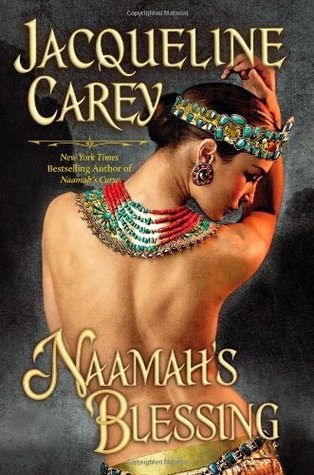
Naamah’s Blessing by Jacqueline Carey
Genre: Fantasy, Erotica
Series: Moirin’s Trilogy #3, Kushiel’s Legacy #9
Publisher: Grand Central Publishing
Publication Date: June 2011
Author Info: www.jacquelinecarey.com
Wendy’s Rating: 3 of 5 stars
Politics and intrigue are always at the heart of d’Angeline adventures and this ninth and final book in Carey’s Kushiel series is no different. Our protagonist, Moirin Mac Fainche and her husband, Bao, are now united, heart and soul, with Bao no longer resisting the soulspark that binds the two together. With their adventures in the east at an end, they have returned to Terre d’Ange, following Moirin’s dream of the deceased queen and her former lover, Jehane, who fears for her young daughter, Desiree. This is not the Terre d’Ange of Phedre no Delauney’s time. Ruled by an apathetic king who grows more and more despondent as his personal losses, including Jehane, increase.
Moirin’s position as both a d’Angeline of noble heritage, as well as a Maughuin Donn, the mysterious bear witches from across the Straits, she is feared by some and respected by others, which puts her at the centre of the political intrigue when King Daniel’s appoints her and Bao as his daughter’s oathsworn protectors. When news of the prince’s death strikes Daniel, a usurper goes after the throne through little Desiree. But Jehanne’s dreams inform Moirin that the prince is indeed not dead, sending her and Bao and some unlikely allies across the seas to Terra Nova.
Overall, I have enjoyed Moirin’s story and character, though I can’t say I’ve been overly impressed with either. While I don’t want to compare her to the series’ first heroine, Phedre no Delauney (and thankfully, Moirin does not spend much of this book comparing herself to Phedre, as she did in the last one), it’s hard not to in order to determine why Moirin fails to interest me. First of all, Moirin has traveled around the world, as led by her diadh-anam, the soulspark within her. Her decisions all belong to her great bear goddess, as she follows along with her destiny, never once resisting or questioning for very long. If she goes against any oaths she makes or uses powers inappropriately, she risks losing her diadh-anam, as well as Bao, whom she brought back to life with her powers. This pretty much means that nothing she does is going to risk those losses, even though the plot often places her within such predicaments. Every time the situation escalates to a point where Moirin fears this will come to pass, there’s always something – usually divine intervention, that gets her out of it. And the climactic moment in this book is most certainly evidence of that.
Not that divine intervention and magic has played a small part in the previous books, but in those cases, Phedre, and later her foster son, Imriel, acted of their own accord. The gods might have offered approval, but the decisions Phedre and Imriel made were their own, driven by their desires, as well as duty and honour and the need for closure. Moirin has little agency beyond what she is literally bound to do by her soulspark. She still has her desires and a sense of duty and honour, but, her greater motivation always seems to be doing what her soulspark and bear goddess tell her to. I found this to be the downfall of the character and the story, making them less appealing to me.
As mentioned, this book takes us to Terra Nova in the west, thereby completing what has ended up being an epic tour of Carey’s world. I do appreciate the way she blends the reality and mythology of our world, altering it just enough to make it her own. However, despite the vast divinities represented, it becomes evident that only the gods of Terre d’Ange (which are considered the youngest) and now the Maghuin Donn seem to hold sway. If the gods of the other cultures make our protagonists aware of their presence or their powers, Moirin is usually able to prove her gods superior. Or the other gods are silent, allowing Moirin to prove to the people the power of her gods. I would have liked to see more balance in this.
Overall, an interesting story still, nicely wrapping up elements from the first book in Moirin’s trilogy, but, like Imriel’s trilogy, this is not a story that will stay with me as Phedre’s did.

YA Weekend: Monument 14 by Emmy Laybourne
Posted on June 7, 2014 Leave a Comment

Genre: Young Adult, Science Fiction
Series: Book 1 of Monument 14
Publisher: Feiwel & Friends (June 5, 2012)
Author Information: Website | Twitter
Mogsy’s Rating: 3 of 5 stars
A little bit like Lord of the Flies meets The Breakfast Club meets The Mist, Monument 14 is about a group of children holed up in a superstore after a freak hailstorm causes a chemical leak from the nearby weapons manufacturing site, leading to contamination of the whole town.
On the surface, this book seemed like it had a lot of potential. Books featuring kids in stressful, survival situations always seem more chilling and disturbing to me than books starring their adult counterparts. Children, after all, are the picture of ultimate innocence; in an ideal world we wish to protect them from all the troubles and anxieties of adulthood. Even most adults would be ill-prepared to handle a sudden disaster, so I can’t even imagine how much worse the burden of responsibility would be to a teenager. Without strong guidance and a lack of organization, it’s not surprising how quickly a group situation can devolve.
The kids in this book range from ages 5 to 17, all stranded passengers from a couple of school buses that were wrecked by the severe storm. Naturally, a hierarchy of leadership develops, with the older teens taking care of the young’uns. The dynamics are made more interesting by the differences not only in the characters’ ages, but also in their personalities, backgrounds and upbringing. Unfortunately, this does mean that almost everyone is pigeonholed into rather predictable and clichéd stereotypes. Main protagonist and narrator Dean is the “booker”, a quiet and somewhat awkward late-bloomer who has long harbored a secret love for Astrid, the popular and perfect hot girl. Astrid however is the girlfriend of Jake, the football jock. Among the high-schoolers, there’s also the bully/bad boy Brayden, the solemn and live-by-the-book Boy Scout Niko, who happens to have a thing for the kind and motherly Josie. The roles are cast, and the stage is set for some serious teenage drama.
The younger kids actually proved more intriguing and to have more well-rounded personalities. A couple of them genuinely surprised me, displaying a level of maturity and problem solving skills that even surpassed some of the teenagers’. In fact, I think one of the book’s main weaknesses is its gradual divergence from the “we’re all in this together” theme towards a greater emphasis on the relationships and soap-opera aspects of the older kids. The story was a lot more engaging at the beginning when the whole group dealt with the challenges of surviving together, addressing issues like mob mentality, who should be in charge, and how to explain the situation to the elementary children who are frightened and don’t understand why they can’t go home. Once the focus shifted to become more about “who’s crushing on whom”, the book became more typical and less special in my eyes.
While I loved the premise, another strike against this book is the whole reason why Dean and the other kids are trapped in the superstore. The explanation given – that the chemical leak is a gas causing different reactions based on the exposed victim’s blood type – is a bit weak and unconvincing. Victims with O-type blood will become mindless violent savages, while another type would break out in boils and blisters, while yet another type would experience no outward signs but may suffer infertility and reproductive difficulties, etc. Leaving aside how such an absurd model of symptoms made me want to bash my head against the wall, the theory of the chemical disaster did not feel that well thought out. It felt like the author needed a reason to put the kids in this particular jam, and seized upon the first idea to come to mind without fleshing it out, giving it more logic or detail. Perhaps that’s why the book also threw in the extreme weather and a massive disaster on the east coast, just to make the situation bigger and severe than it is.
As expected, Monument 14 also left off on a cliffhanger (these days, I’d be shocked if a YA novel didn’t). Still, it’s a strong start, with a great idea to work with, and just a tad wobbly on the execution. I haven’t decided if I want to continue with the series yet. Looks like it’ll be another short, quick read, so if the opportunity arises, I may take it.

Book Review: The Crimson Campaign by Brian McClellan
Posted on June 6, 2014 1 Comment
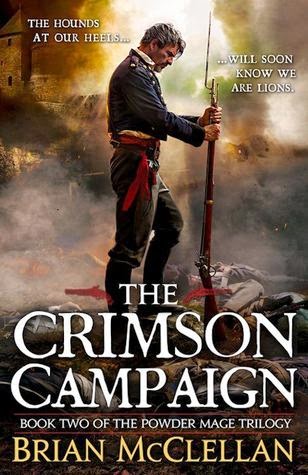
The Crimson Campaign by Brian McClellan
Genre: Fantasy
Series: Book 2 of The Powder Mage Trilogy
Publisher: Orbit (May 6, 2014)
Author Information: Website | Twitter
Mogsy’s Rating: 4 of 5 stars
I find myself thoroughly enjoying the Powder Mage series. Brian McClellan’s star continues to rise, following up last year’s debut Promise of Blood with a strong sequel. While there were some parts I thought he did better in the first book, others that were better in the second, overall I can’t be happier with the direction this trilogy is taking.
The book starts out by easing readers back into the setting. With the help of an angry god, the Kez invasion into Adran territory is in full swing, after crushing Tamas’ ambitious strike. Stranded behind enemy lines with only a small remnant of his army left to aid him, the indomitable field marshal begins to lead his soldiers back across the mountains to warn and defend his country. Meanwhile back in Adro, Inspector Adamat is frantic with desperation and fear for the fate of his wife and son, held captive by the depraved Lord Vetas.
In yet another part of the world, Tamas’ son Taniel recovers from his injuries sustained in the pitched battle at the end of book one. While both Tamas and Adamat’s plot lines are marked by their very clear and concise goals, Taniel’s journey is a bit more complicated – but this also makes his character and story the most compelling, and more on that later.
But first, this “catch up” period at the beginning of the novel admittedly made for a slightly disjointed and slower start. However, I don’t think The Crimson Campaign is alone when it comes to this; I find many sequels – and especially middle books of a trilogy – have to manage this balancing act of setting up the stage for the next phase of the story while still trying to hold the reader’s attention and keep the momentum going. McClellan established a particular wide scope to begin with, following multiple characters all in separate parts of the world, so he had his work cut out for him. Considering everything that was happening, I think he did an impressive job. And once the story found its stride around the halfway point, I have to say there were no more issues with pacing.
Like I’d mentioned earlier, Taniel was the one who really shone in this one (and I find this interesting, since Adamat was my favorite in the first book, and I have to wonder if the third will be Tamas’ turn). Both Tamas and Adamat had story lines that followed a logical progression – the former had to make his way back to Adro, while the latter needed to rescue his family – and while they were engaging in their own way, neither had the ups and downs that made Taniel’s chapters so unpredictable and gripping.
The young powder mage first had to deal with the shock of awakening from a coma. Then struggle through a drug addiction that was the result of emotional trauma. Then come to terms with the news that his father might be dead. Then he had to go and get tangled up in the politics and infighting of the army. It was one big roller coaster ride with Taniel, and every turn had me wondering what would happen next. I loved everything about his story, which includes a deepening relationship between him and the mysterious woman Ka-poel, his ever loyal companion. I’m also intrigued by the changes in Taniel as a result of what happened to him at the end of Promise of Blood. This books hints at much greater and more intense developments to come on that front.
Another thing I would expect from a sequel is more world-building, and character development. In this, The Crimson Campaign did not disappoint. I’m still blown away by the hierarchy of magic users in his Powder Mage universe, and McClellan made sure to expand our knowledge of Marked, Privileged, and Knacked powers alike. I also noticed much more “screen time” in here for the female characters. Vlora, Nila and Ka-poel were all characters I wanted to learn more about, and I got my wish here. I was especially thrilled about Nila, who didn’t get much attention in Promise of Blood, but a huge bombshell dropped about her at the end of this book has me very excited about the future of her role.
What more can I say but, bring on The Autumn Republic! Something tells me that the third and final book of the trilogy will have just as much energy and impact, if not more. It’s so great to see this series going strong, and the way things are going I can only see things ending with a bang.



 The BiblioSanctum