Comic Stack 04/08/15 – 5 Manga Recommendations

ComicStack

I said I would be back to my #1s. This week, but I had a load of fun with my comic graphic novel recommendations that I thought I’d give you a few manga recommendations to follow up on that! I read a ton of manga, so don’t think this is my complete list by far. I tried to present manga that felt very new reader friendly while (like with my comic picks) are great for us old timers as well. I’ll save two of my favorites (Bleach and Death Note) for another post.

AOT13Attack on Titan by Hajime Isayama

I don’t normally jump on too many bandwagons because I always end up being the one person who doesn’t like something as much as anyone else. It took me a while to actually watch and start reading Attack on Titan, but when I did. I was very glad that I did. This is a show/manga that is mostly new reader/watcher friendly. The manga centers on the last of humanity that has hidden behind impenetrable walls after being attacked by titans (beings who appear to be colossal humans). Titans eat any humans they encounter, even though they don’t seem to need them for sustenance. After 100 years of safety, their walls are breached and human are again facing nearly impossible foes. What I love about Attack on Titan, aside from the dystopian horror aspect is that this manga is about teamwork. You usually have your own golden child who’s going to save them all, and you do have your character who’s obviously chosen. However, nothing he does matters if he doesn’t learn to trust and work with his team, who took the same oath he did to save humanity. You can read my first two reviews here and here.  (I also appreciate Hajime’s Isayama’s stance on one of his character’s gender or rather the fact that he refuses to gender this character and it has some of fandom on edge.)

BRBattle Royale by Koushun Takami

I have loved Battle Royale forever. It started as a movie. Then, it became a novel. Finally, it became a manga. And I love every single one of them. Battle Royale follows a group of teenagers who are randomly selected by the Japanese government for a “game” called The Program. They are shipped to a private location, given a pack of supplies, and told to kill one another. If they refuse, after three days, a collar detonates instantly killing them. You have people who refuse and commit suicide (or become examples with their collars), you have those who try to stick together only to have paranoia tear them apart, and you have those who play the game and play it well. I’m not going into the whole The Hunger Games ripped this off this because that’s not how I feel. Many stories have used this same idea. Remember Stephen King’s The Long Walk? What about The Running Man?  Lord of the Flies, anyone? These arguments are pointless, okay. This is just a really great, horrific story.

Gunslinger GirlGunslinger Girl by Yu Aida

Henrietta, a very young girl, survives a devastating attack on her family and is rescued by a “welfare agency.” They repair her, giving her robotic implements and erase her memories. She is an assassin trained to do whatever they need, but they didn’t count on not being able to overcome her humanity. Love still beats in her heart, and love threatens to bring her back. And for a person who’s been trained not to feel, especially not love, her world starts to be become an emotional battle.

BCBlack Cat by Kentaro Yabuki

Black Cat is one of those books that’s fun despite the premise. I used to read this in Shonen Jump. XIII (now called Train Heartnet) is a former assassin who works as a bounty hunter barely making it by with a group of his friends. He left the Chronos, so he could live life on his own terms and find the other former Chronos member who killed his best friend. Along the way, he manages to pick up such a colorful cast of friends like a girl who change her hands into various objects or a detective who has one psychic eye. And yes, it has some scenes that will leave you like: “What the hell just happened, Train?” It’s an easy book to follow and get into it. One that I often recommend for new readers.

DeadmanDeadman Wonderland by Jinsei Kataoka

The story starts with a devastating earthquake hitting Japan, leaving most of Tokyo underwater. Ten years later, 14-year-old Igarashi Ganta is joking around with his friends in class when a mysterious “Red Man” appears and kills everyone in Ganta’s class–except him. Ganta passes out in the classroom, but later regains consciousness to find out that he is the sole suspect in his classmates’ murders, which he is convicted of and sentenced to death. Ganta is sent to Deadman Wonderland, a privately owned prison that uses its inmates to entertain the public. It’s purpose is to gain money to rebuild Tokyo. Supposedly. Ganta is placed in a collar (that he later learns emits poison that can only be counteracted by “candy”) and finds himself thrust in this bizarre prison life where inmates are mutilated and killed for the enjoyment of others. The public, however, believes that these “games” are staged. Ganta learns that he is one of few prisoners who can manipulate his blood as a weapon, which makes him valued and starts to leave questions open to why Ganta really ended up in prison.

Waiting on Wednesday 04/08/15

“Waiting On Wednesday” is a weekly meme hosted by Breaking the Spine that lets us feature upcoming releases that we can’t wait to get our hands on!

Mogsy’s Pick:

Alive by Scott Sigler: July 14, 2015 (Del Rey)

Del Rey seems to have a lot of good stuff coming out this year, especially in the vein of Young Adult/Adult crossover spec fic like the Red Rising series or Joe Abercrombie’s Shattered Sea.  Now we have Alive by Scott Sigler, an author whose adult horror novels like Nocturnal and the Infected series have been on my to-read list for a while but haven’t had a chance to read yet. He’s tackling the YA genre in this sci-fi dystopian survival horror adventure, and for someone who has never read Sigler, I’m hoping this might be a good place to start.

Alive“For fans of The Hunger Games, Divergent, and Red Rising comes a gripping sci-fi adventure in which a group of teenagers wake up in a mysterious corridor with no knowledge of who they are or how they got trapped. Their only hope lies with an indomitable young woman who must lead them not only to answers but to survival.
 
“I open my eyes to darkness. Total darkness. I hear my own breathing, but nothing else. I lift my head . . . it thumps against something solid and unmoving. There is a board right in front of my face. No, not a board . . . a lid.”
 
A teenage girl awakens to find herself trapped in a coffin. She has no idea who she is, where she is, or how she got there. Fighting her way free brings little relief—she discovers only a room lined with caskets and a handful of equally mystified survivors. Beyond their room lies a corridor filled with bones and dust, but no people . . . and no answers.
 
She knows only one thing about herself—her name, M. Savage, which was engraved on the foot of her coffin—yet she finds herself in charge. She is not the biggest among them, or the boldest, but for some reason the others trust her. Now, if they’re to have any chance, she must get them to trust each other.
 
Whatever the truth is, she is determined to find it and confront it. If she has to lead, she will make sure they survive. Maybe there’s a way out, a rational explanation, and a fighting chance against the dangers to come. Or maybe a reality they cannot comprehend lies just beyond the next turn.”

Audiobook Review: The Once and Future King by T.H. White

Once and Future KingThe Once and Future King by T.H. White

Genre: Fantasy, Mythology

Series: Books 1-5 of The Once and Future King

Publisher: Voyager (1996; first published in 1958)

Tiara’s Rating: 3 of 5 stars

Narrator: Neville Jason | Length: 33 hrs and 3 mins | Audiobook Publisher: Naxos Audiobooks | Whispersync Ready: No

I’ve been participating in the Popsugar 2015 Reading Challenge. While mapping out my reads for the challenge, one of the objectives read, “A book by an author who had your same initials.” My initials are T.W. and a quick Google search led me to T.H. White whose literary claim to fame was writing a fantasy book called The Once and Future King. Further investigation revealed this book is actually an omnibus of novels centered around Arthurian legend. The first book is famous for being the foundation of a Disney movie, with which it shared its name, called The Sword in the Stone. This collection of books follow King Arthur’s journey from orphaned squire to legendary king to betrayed lover to his ultimate demise.

I’m a big history nerd and a big myth nerd, so it stands to reason that I’m a big mythic legend nerd.  Admittedly, though, Arthurian legend is pretty low on legends I want to read. It’s not that I don’t enjoy it, but King Arthur’s stories are one of those that are done to death, especially the Lancelot and Guinevere aspect of Arthur’s story. I’ve given each book a rating with an overall rating at the end.

I‘m sure EVERYONE knows the story of Arthur, but if you’re not familiar with it and may read this eventually, stop right here! THERE’S NOTHING MENTIONED THAT ISN’T ALREADY COMMON KNOWLEDGE, BUT YOUR MILEAGE MAY VARY. USE CAUTION!

SwordThe Sword in the Stone
Length: 9hrs and 40 minutes

The King is dead,” he said. “Long live the King.”

Wart (Arthur) lives as the adopted son to a lord named Sir Ector and as an adopted brother to Ector’s son, Kay. Ector raises the children side by side and gives Wart every opportunity that he gives Kay including their “eddication” (education). However, Kay is destined for knighthood while the ambiguous nature of Wart’s background will never allow him to rise above the station of Kay’s squire. After their former tutor is locked away for showing a wound “that was believed to be where she sat down, and to have been caused by sitting on some armour at a picnic by mistake.” Merlyn becomes the boys’ tutor. Merlyn “lives backward” in time and has knowledge about the future, including the  tragedy that will become Wart’s story. Merlyn takes special interest in Wart whom he uses his magic to turn into various animals to learn life lessons.

Six years later, King Uther Pendragon has died without an heir. This has plummeted the nation into chaos, but an anvil with a stone in it has appeared in front of a church in England with the insription: “Whoso Pulleth Out This Sword of the Stone and Anvil, is Rightwise King Born of All England.” Men from around the country travel to London to participate in a tournament to attempt to pull the sword from the anvil. Kay forgets his sword for the tilting field and sends Wart (now his squire) to retreive it. Unable to enter the locked in, Arthur pulls the sword from the anvil.

There’s a certain sense of nostalgia here for me since the animated movie The Sword in the Stone is close to my heart. I can remember watching that movie on repeat as a child. I thought this was mostly a cute story, but if you think the story is going to stay this light and fluffy, it’s not.

758dc-new3stars

WitchThe Witch in the Wood (Also known as The Queen of Air and Darkness)
Length: 13 hrs and 5 mins (combined with The Ill-Made Knight)

Indeed, they did love her. Perhaps we all give the best of our hearts uncritically—to those who hardly think about us in return.

This book is where Arthur’s story starts to take a darker turn, and plays on the ideas that the sins of the father revisit the son. This book follows Arthur as he begins to think of ways to unite the people, which brings about a lot of philosophical debate tinged with humor about war between Arthur, Kay, and Merlyn. This is the story that introduces us to Arthur’s round table and his reasoning for deciding to make it round (to foster camaraderie between his knights by making them all appear equal at a round table rather than at a traditional table where a knight might feel his seat is further away from the head and therefore an insinuation that he wasn’t as good as those before him).

However, largely this book follows Arthur’s Gaelic half-sister–the queen of Orkney, sister to Morgan Le Fay, and a witch herself, Morgeuse–and her sons (eventual knights of the round table), Gawain, Gaheris, Gareth, and Agravain. Morguese’s husband, King Lot, wages a failed campaign against the young Arthur. Morguese and her sons play a large role in the eventual downfall of Arthur. This book gives a glimpse of the people the young boys will become in time and the dark machinations of their mother whose attention they clamor desperately for. Arthur isn’t aware of who his mother is, even if he’s now aware that his father is the deceased king Uther Pendragon. When he meets Morguese and her sons, he doesn’t know that they share a mother, and well, she is a really beautiful woman. I have such a soft spot for books where characters have so many psychological issues with the loved ones in their lives that shaped them, so my rating of this part is largely due to the Orkney clan.

66235-new3-5stars

Ill Made The Ill-Made Knight
Length: 13 hrs and 5 mins (combined with The Witch in the Wood)

He would not call himself Sir Lancelot. He would call himself the Chevalier Mal Fet—the Ill-Made Knight.So far as he could see—and he felt that there must be some reason for it somewhere—the boy’s face was as ugly as a monster’s in the King’s menagerie.

This story begins the downfall of Arthur. Readers learn a great deal about Lancelot the son of a French king who decides from a very young age to dub himself Chevalier mal fet–The Ill-Made Knight because Lancelot is supposedly ugly, looking more like an ape than a man, which is very unusual in Arthurian lore for him not to be some handsome, shining prince like Jaime Lannister. Lancelot trains from a very young age to become one of Arthur’s knights after he begins to hero worship Arthur after a meeting where he’s decided he already loves the King and he will be everything the king wants him to be. He strives to be the best, and he wants Arthur’s attentions for himself (not like that… what kind of book do you think these are?). For this reason, Lancelot loathes Guinevere at first  because she commands Arthur’s attention. Arthur seeing that the two people closest to him are unable to get along has Guinevere assist Lancelot in falconing.

Despite his appearance, Guinevere acquiesces that he isn’t attractive in any conventional way, but she see his looks as more interesting than appalling. Lancelot only begins to fall for the Queen after he insults her and sees the real harm he’s done. It’s here where the book explains that Lancelot can’t care about things unless he’s done some grievance. Then, he feels he has to atone for his grievance, which leads to a love affair between the two. Lancelot still loves both his king and now, his queen, which puts in him constantly in odds with himself. He takes on quests to avoid her, but we know how fate goes.

This book didn’t make me like Lancelot at all. Not even a little bit. It’s not even actually like he was a “good” person. It made me despise Gawaine for the most part, too, who is known to fly into rages and harm/kill even women, but somehow he’s still considered chivalrous. I also hated the way that White wrote Guinevere and just women in particular, straddling them with unnecessary pettiness, blaming them for their “downfalls,” which surely was their own fault and worthy of the extreme violence bestowed on them.

The only thing I really liked about this was the obvious conflict in all parties involved in the love triangle. All these characters love one another–Lancelot loves the King and the Queen, and they both love him in turn. They also love each other in their own way. Arthur isn’t blind. Even without knowing what Merlyn has told him, he knows Lancelot loves his wife (and vice versa), but he cares deeply for both. I appreciated that White tried to give this some complexity because it’s not always as simple as “YOU CHEATED ON ME! YOU GOTTA GO!” Sometimes, very complex and conflicting feelings come into play during such situations.

2ba48-new2-5stars

CandleThe Candle in the Wind
Length: 10hrs and 15 mins (combined with The Book of Merlyn)

This is where it all comes crashing down. Agravaine hates Lancelot and Mordred hates his father, the King (child of the incest mentioned earlier). The conspire together to tell the king of Lancelot and Guinevere’s transgressions. Everyone knows of the transgressions, but once publicly acknowledged, Arthur will have to have Lancelot killed and Guinevere burned at the stake. Once Mordred has brought their transgressions to public, Lancelot flees and promises to rescue Guinevere.

He does rescue Guinevere from the pyre, but not before accidentally killing Gareth and Gaheris, brothers to Gawaine and Agravain, in the battle. The lovers flee, but their actions continue a course of events that lead to Mordred and Arthur meeting each other in an ill-fated battle. Sadly, their battle could’ve been avoided and would’ve been avoided, but a miscommunication ended in the death of Mordred and Arthur being mortally wounded and sent to Avalon (where he probably died, but could have possibly been healed, as well).

I think I appreciated this book most of all because it just so tragic. And it wasn’t just tragic because of the actions of Arthur having to sentence his closest friend and his wife to death, but the fact that this isn’t something anyone wanted to happen aside from Gawaine wanting revenge for his brothers’ deaths and understandably so. It was just the whole implication of the matter. It was a tragedy that felt avoidable and unavoidable at the same time. Nothing was beautiful and everything hurt in this book.

ab28c-new4stars
Book of MerlynThe Book of Merlyn
Length: 10hrs and 15 mins (combined with The Candle in the Wind)

I’m not going to say a lot about this book because this book was somewhat unnecessary, in my opinion. The 4th book was the perfect ending.  This book seems to rehash many things from the earlier books as well as mentioning how Guinevere went on to live and die in a covent. Lancelot lived as a hermit. His last miracle to the world releasing a scent of Heaven upon his death. Mostly, though this book seemed to be a philosophical look at the recurring theme that might isn’t always right as once believed by the kings and lords. If there’s anything that I can praise this book for is that it does take a more philosophical look at war and Arthur’s moral standings.

48642-new2stars

This series is narrated by Neville Jason who is an excellent narrator and is very accomplished in the narration field. He’s written and read a biographical piece about Marcel Proust after reading Proust’s serial novel Remembrance of Things Past (also known as In Search of Lost Time). He had a way with emphasizing the humor aspects of the book that I might not have found quite as amusing if I’d only read the book. These books are not Whispersync ready, but I managed to manually keep up between the book and audiobook (I didn’t read much of the book without the narration because it was Jason was such an excellent narrator), which is how I spotted some of the racial slurs used in this book. The narrator substituted those words for different words during his reading, thankfully.

I have some overall issues with these books. Some of that I attribute to reading so late in life and it not being as magical to me as it might’ve been if I were much younger, and some of it I attribute to the fact that I’m just not comfortable with some of these things (such as the the weird way White wrote women which seem to be part amazement and part condescending, and admittedly, the racial slurs used in the book were usually to show how crass a character was, but still kind of took away from the enjoyment of lighthearted parts). However, stating as I have with other books that have some problems, I accept that these books were written in a time when things like this were accepted and were considered comical, but that doesn’t mean that I have to be okay with it and overlook it in this day and age just because the author might not have “known better.”

I see this series is often recommended for children, and I do and don’t agree with that. The Sword in the Stone is largely okay, and I believe there is an abridged version for children. Later books in this series, while still infused with some of the childish humor, contain some themes (not necessarily all detailed) that parents may not want to tackle with their children just yet such as rape, sexual situations, and animal cruelty/torture. I don’t know if the later books have an abridged version for children like The Sword in the Stone, but I’d advised any parent wanting to use this series to introduce Arthur to their kids to be vigilant about it.

I’ve had friends who swear by these books because they read them when they were young, and I can’t take that from them. I have books that I read as a young child that I still love to this day that has made other people who’ve recently read them turn their nose up. This was an interesting take on Arthurian lore, but I was expecting something a bit more. However, I do plan to take a second trip to Camelot with Marion Zimmer Bradley’s The Mist of Avalon.

73660-new3stars

Top Ten Tuesday: Top Ten Characters You’d Like To Check In With

toptentues

Top Ten Tuesday is an original feature/weekly meme created by The Broke and the Bookish. They created the meme because they love lists. Who doesn’t love lists? They wanted to share these list with fellow booklovers and ask that we share in return to connect with our fellow book lovers. To learn more about participating in the challenge, stop by their page dedicated to it and dive in!

This week’s topic: Top Ten Characters You’d Like To Check In With

With a little clarification quoted from the site:

Top Ten Characters You’d Like To Check In With (meaning, the book or series is over and you so just wish you could peek in on the “life” you imagine they are leading years down the line after the story ends). Does this prompt make sense?? It makes sense in my head! Let me know and I can clarify haha

Tiara’s Picks

I did something a little different with my picks. All my picks feature couples, would-be couples, friends, families, and people whose lives have shaped by one person even if they don’t know one another (but I feel they will soon). I have an interest in learning to what happened to them as a duo or how their lives may eventually converge.

NONE OF THESE ARE PARTICULARLY SPOILERISH, BUT I WILL THROW UP A SPOILER WARNING JUST IN CASE SINCE THIS TOPIC DOES DEAL WITH CHARACTERS AFTER THEIR STORIES END!

latheGeorge and Heather from the Lathe of Heaven by Ursula K. Le Guin. What I loved about the love story in this book is that it didn’t overshadow the story taking place. Heather serves as more than just the love interest in George’s story, and their romance is unconventional and cautious. In fact, romance may be a strong word to even call what happens between those two. The way this book ended made me hopeful for the Heather and George romance, and it made me wonder, “Where are they now?”

943402Oskar and Eli from Let the Right One In by John Ajvide Lindqvist. This is another very unconventional friendship/almost-romance between a young vampire named Eli and a young boy named, Oskar. This is a very dark and uncomfortable story. When I first read it I hailed it as one of the best vampire stories I’d read in years because it didn’t even try to be pretty. Oskar and Eli’s love/friendship is based on a very symbiotic premise, but it’s also dangerous for both parties, and my mind run wilds thinking about the trouble they’re likely getting into, but how they do really care for one another in their twisted way.

Acrobatic DualityKim and Alana from Tamara Vardomskaya’s Acrobatic Duality, which is about a pair of acrobatic partner who are perfectly matched in gymnastics, but they have a secret. Their bodies belonged to to two other people, but they can actually remember being one conscious person at some point. Their thoughts are shared. They always know what the other is thinking or going to do. No one will be honest with them about, but by the end of the story Kim and Alana have decided they will not continue the charade. I find myself wondering if they were able to finally become individuals, if they found out more about the girl they used to be, if they find out about the girls whose bodies they possess. This was a Tor short story that can be read for free on the site or via Kindle.

StationElevenKirsten Raymonde and Jeevan Chaudhary from Station Eleven by Emily St. John Mandel. These two don’t know each other personally, but the night Arthur Leander died, Jeevan was the man who consoled Kirsten who was just a child at the time. In the post-flu ravaged world, their footsteps seem to be bringing them closer and closer after twenty years. Part of me knows they may never actually meet again, but they’re so close to that point that it could happen, and despite Kirsten being young when the flu first happened she holds many memories about that particular moment.

OMLLogan and Baby Banner from Mark Millar’s Old Man Logan. This takes place in an alternate Marvel timeline fifty years in the future. The supervillains formed a coup putting aside their differences and masterfully executing a plan that leaves many of the world’s superheroes dead.  The ones who do manage to survive go into hiding to survive. There’s one exception to this story—Logan. He doesn’t live in hiding, and he’s taken a vow to never unsheathe his claws again, which we know doesn’t happen. The Hulk was one deciding factor in the war, and he sided with the villains. After a series of events that leads to Logan having to face down the Banners including Hulk, She-Hulk, and their offspring. Logan leaves one alive–the baby. Who he straps to his back and decides they’re about to make a better future. Very bittersweet. (Note: Just read they’re expected to publish another book for this which had been rumored on and off for years in 2016. I’m excited, but scared that it’s going to ruin what I loved about this comic.)

Graphic Novel Review: In Real Life by Cory Doctorow and Jen Wang

In Real LifeIn Real Life by Cory Doctorow and Jen Wang

Genre: Gaming, Fantasy, Young Adult, Economics, Social Studies

Publisher: First Second (October 2014)

Author Info: craphound.com

Artist Info: jenwang.net

This is a graphic novel about gaming and economics, as it states in the long intro that perhaps delved more deeply into these topics than the actual comic does. In Real Life also claims to explore the role of gender in gaming. It stars a young girl named Anda who, along with others in her class, are invited to join a guild in the multiple online roleplaying game, Coarse Gold. The stipulation is that she must choose to play as a female character. When Anda enters the game, we learn why through a player named Lucy, who has had to work her ass off to prove herself worthy within an industry largely dominated by men.

First off, as a gamer — as a woman gamer — this bothered me. Oh yes there are gender-based issues in gaming, but I am and know many other women who play these games and play as female characters and can hold their own just fine against any other player, man or woman. Lucy’s experience is very limited and poorly representative of the current state of the industry. Worse, it’s glossed over in favour of the economics plotline — which itself glosses over a whole lot.

Through Lucy, Anda gets involved in a gold farmer assassination project wherein they are paid by real people to eliminate the players who farm in-game currency in exchange for real money. This is a very real thing that has been going on in online games for years. By allowing players to purchase in-game currency in exchange for real currency, the economics of the game itself are disrupted.

The problem is that this is only mentioned in passing. If you’re not an online gamer, you’re not likely to understand just how this is problematic, and Doctorow really doesn’t bother to give you much detail. If you’re a gamer, you most likely do know about gold selling, have probably been spammed by gold sellers, or perhaps have even purchased gold yourself. Perhaps you do know how gold selling affects gameplay and in-game economics, in which case, you can skip to the next Important Message: Gold Sellers Are People Too.

Many of the people who spend hours upon hours grinding away at boring tasks in order to earn in-game currency to be sold to players are doing so for ridiculously low wages. They are most often Asian. In some cases, they are criminals tasked with this chore, sometimes students, sometimes gamers who wish to support their hobbies. But they are most certainly, people (well, most of them are. In Real Life once again only mildly touches on the automated “bot” programs.) In her adventures, Anda befriends one of them and learns the reality of his life and tries to help him, which of course causes more trouble. Then she manages to save his world with some more superficial storytelling, and proves herself worthy of the project she was initially tasked with — a project whose purpose was, I think, something about playing as a female character, but to what end? I know not.

I was given this book by a non-gamer friend who thought I’d appreciate more than she did, but it’s failed to work for either of us. This should have given her insight into some elements of online gaming culture, but instead, it left her confused by vague concepts. It should have tugged at my heartstrings as a gamer by making me more aware of the intricacies of gold selling and gender issues, but thanks to the same vagueness that plagued my non-gamer friend, were just annoyances for me.

Ah well. At least the art was fantastic.
fd91d-new2stars

Interview with Seth Skorkowsky, Author of Dämoren and Hounacier

Seth SkorkowskyLast year I read and reviewed a book called Dämoren, an urban fantasy/horror novel about a character named Matt Hollis and his magical sentient gunblade. I was blown away by the author Seth Skorkowsky’s world building and fresh take on angels & demons, so when I heard about the sequel Hounacier from Ragnarok Publications, I jumped right in.

Hounacier greatly expanded the world of the Valducan series with a story that explored the spiritual traditions of voodoo through the eyes of another knight, Malcolm Romero (see the review). While reading it I knew I wanted to find out even more — so I went straight to the source! Seth kindly agreed to chat with me about his series. Enjoy the interview!

* * *

Hello Seth, and welcome to The BiblioSanctum!

Seth:  Thank you very much for having me.

70e86-damorenTo start off, how would you describe the Valducan series to the uninitiated?

Seth: The Valducan series follows an order of modern-day knights that hunt demons. When someone is possessed with a demon, they take the form of a monster, such as a werewolf, oni, wendigo, etc., and the only true way to kill them is with a holy weapon, which each knight is bonded to a unique weapon.  They’re a lot of action with some horror thrown in for flavor.  I usually describe it as a mixture of Hellboy, Supernatural, and Hellsing.

I love that the series is centered around the idea of sentient holy weapons. What inspired you to write these books?

Seth:  Originally I had two separate ideas. The first was that the classic monsters of old were really demonic possessions, and that mortal weapons like silver bullets could only kill the host’s body, while the demonic spirit just moved on to another.  The second idea was how to make a magic gun.  Magic swords have been a staple to stories for centuries and I wanted a modern variant. The trick was figuring out how the magic moves from the gun to the bullet. Eventually, I realized that those ideas fit together really well and the rest just grew from there.

What kind of research did you do? What was the coolest or most fascinating thing you came across while researching for Dämoren or Hounacier?

Seth:  For Dämoren I did a lot of research on folklore monsters and 19th century handguns.  With Hounacier I spent most of my research time on Voodoo. I really wanted to be more authentic and respectful toward it than how its normally treated.  I knew my perceptions of it had been skewed by Hollywood myth, but didn’t realize how much until I started digging.

The books Dämoren and Hounacier are both named for the holy weapons wielded by their main characters. There are many more of these fantastical weapons featured in this series, all with some very interesting names! Where do you get the ideas for them?

Seth:  The majority of the names are rooted in real words. Dämoren is based on the German word ‘Dämon’, which means demon.  Hounacier is a mixture of ‘Houngan’, which is a Voodoo priest, and ‘-mancer’, like necromancer.  Some of the weapons, like Feuertod, are literal translations (That means “Death by Fire”).  Others, like Ibenus, are completely made up.

I love the fact that the holy weapons and their owners have a very special bond. Do you personally have a favorite weapon from your books, one you would choose to bond to if you could?

Seth:  My favorite is Dämoren.  She was the first and became the most special for me.  Many of the other weapons have some pretty cool abilities, but I’ll always love her the most.

HounacierThe main protagonist of Dämoren is Matt Hollis while the second book Hounacier follows the story of another Valducan knight named Malcolm Romero. Why did you decide to switch characters for the sequel, and what made you choose Malcolm?

Seth:  I decided to switch characters to keep it fresh.  Matt’s big mystery about himself is solved by the end of the first book and I didn’t want to keep re-hashing the same story over and over. There’s a lot of characters and each one has their own strengths and weaknesses, and focusing solely on Matt would get boring.

Originally, I’d planned to make the second book Ibenus, and follow Allan Havlock.  Hounacier was originally going to be Book Three.  But a few weeks after finishing Dämoren, my wife and I went to New Orleans and I had a stroke of inspiration.  So I just had to follow along with it and make Hounacier the second one.

Now that I’ve picked your brain about your books, I’d love to know more about you, the author! Did you always want to be a writer?

Seth:  When I was younger I really wanted to be a writer, and my 8th Grade English teacher even helped me submit some stories for publication. Then in high school I got distracted with girls and punk rock. I became very involved in debate and public speaking. Everyone told me that I had a great radio voice, so I went off to school to go into broadcasting. It wasn’t until after college, and deciding that I didn’t actually want a career in radio, that I picked up writing again.

Which authors or books have been your greatest influences?

Seth:  Probably the biggest influence was Clive Barker.  I love his prose, and despite his reputation as a horror author, the bulk of his work is fantasy.  Imagica was the first time a book really blew me away. After him I would say William Gibson.  His ability to describe things is simply incredible.  Virtual Light is a standby audio book on my iPod.  I’ve listened to it more times than I’ll ever admit.

What are your hobbies, or favorite pastimes for when you want to have fun or take a break from writing?

Seth:  Tabletop role-playing games have been a major part of my life for years.  We still play once a month, usually Dungeons & Dragons or Cyberpunk2020. Renaissance fairs are also a huge part of who I am. I used to work them in college, performing or selling in shops, but now I just go to have fun.  Lastly travel. The world is such an amazing place and I love experiencing the history and culture of different parts of it.

Wrapping up, are there any other projects you’re working on currently or in the near future that you’d like to share, either writing or non-writing related? Will there be more Valducan books?

Mountain of DaggersSeth:  I just released a series of pulpy sword & sorcery adventures titled Mountain of Daggers, which follows a thief/assassin called the Black Raven.  While they’re different short stories, they’re linear, so it’s like a Season One. The second book, Sea of Quills will be coming out this October.

I’m currently writing the third Valducan novel, Ibenus.  But I’m also working on several short stories that take place in that world prior to the events in Dämoren.  The first of those will be coming out later this year.

Definitely looking forward to those. Thank you so much for the interview!

Seth: My pleasure.  Thanks for having me.

*** For more information about Seth Skorkowsky and his books, please visit his website at http://skorkowsky.com! ***

Book Review: Vision in Silver by Anne Bishop

A review copy of this book was provided to me by the publisher in exchange for an honest review.

Vision in SilverVision in Silver by Anne Bishop

Genre: Urban Fantasy

Series: Book 3 of The Others

Publisher: Roc (March 3, 2015)

Author Information: Website

Mogsy’s Rating: 4.5 of 5 stars

More and more, I’m understanding why these books are so universally loved by urban fantasy readers. I suppose I’m a bit of a late convert; I certainly enjoyed the first two novels of The Others, but I don’t think the addiction really started to creep up on me until this latest installment. I found it difficult to put down at times.

Part of it is the fact that all the seeds planted in the previous books are finally starting to come to fruition. No more messing around, things just got REAL with the Cassandra sangue and the Humans First and Last (HFL) movement. I’m so glad I decided to catch up with Murder of Crows before tackling this one, because my experience with Vision in Silver would not have been so enjoyable otherwise. So if you’re thinking about picking up this series, definitely start from the beginning with Written in Red – and not least because you wouldn’t want to spoil anything for yourself, not when it comes to The Others.

This book continues two major plot threads that have been brewing for a while: 1) the fate of the blood prophets who were confined to compounds and then freed, and 2) the rise of the HFL and their increasingly aggressive resistance against the Others. Both have dire repercussions for the humans and terra indigene living across Thaisia.

With Meg Corbyn’s help, the Others of Lakeside Courtyard are trying to put together a plan to integrate the freed blood prophets into their new communities, helping them deal with the drastic changes to their lives and the uncontrollable urge to cut themselves. The details about the girls’ previous lives at the compound under the Controller just got even more terrible in this book. After what I read in Murder of Crows it’s hard to imagine that things could get any worse, but there you go. Meg may have escaped on her own, but she’s not immune from the effects either; now Simon Wolfgard is even more protective of her, making sure that her own efforts don’t put her even more at risk.

It’s the HFL storyline that wins, though. This whole ugly situation with anti-Others movement was a lit powder keg just waiting to blow, and the moment has finally come. It also makes you wonder, just who are the monsters here, really? Granted, the Others of the Lakeside Courtyard under the rule of Simon Wolfgard are more benevolent than your average terra indigene, but thus far this series has been painting them as the beasts that they are, the savage predators of humankind. But the depravity of the acts committed by some of the humans in this book are just despicable, not to mention the sheer stupidity of the HFL for even thinking about messing with the Others. THEY HAVE CONTROL OVER THE NATURAL WORLD, PEOPLE! If the elementals want to cause a huge storm or make the waves rise up to sink your ship to the bottom of a lake, they have their ways. For time eternal, humans and the terra indigene have existed side by side but only out of necessity; the former may have developed some useful and advanced technologies over the ages, but it is the latter who control the natural resources. By seeking to upset this precarious balance, HFL is going to open themselves up to a whole world of hurt, and there have already been casualties from both sides. Something tells me that there will be lot more craziness before this is over (*munches popcorn*).

That said though, I think the series also took a step backwards when it comes to certain things, mainly when it comes to the portrayal of Meg’s character. I’ve always wondered why Meg is so special to everyone in Lakeside Courtyard. Yes, she’s a Cassandra sangue, a human-but-not-quite-human-and-therefore-not-prey blood prophet who has stolen the hearts of the Others by helping them a few times, but that still doesn’t really explain why they defer to her or bend over backwards to treat her like a queen – especially since that goes against everything we know about the Others’ nature. Meg is an idealized character, an observation that has been sitting in the back of my mind since the beginning of the series, but it’s a lot more noticeable in this book, enough to finally push me over the edge to question it. It says a lot too, that out of all the books, Meg’s POV was the most limited in this one but I didn’t really notice or even mind too much. It’s a minor flaw, but it bothered me enough that I had to mention it.

Am I really pumped up for the next book, though? Yes, a thousand times yes. I enjoyed Vision in Silver as much as I did the previous two books, but something about it just took it to the next level. Despite my dissatisfaction with Meg’s character, everything else was amazing. The story was superb, more engaging than ever before. The ending was also somewhat abrupt, which was torturous – I wanted more right away. I’m glad I’m all caught up with this series…but of course, that means I now join the waiting game for book four.

b5d53-4-5stars

Other reviews in this series:
Written in Red (Book 1)Murder of Crows (Book 2)

Book Review: Heir of Fire by Sarah J. Maas

Heir of FireHeir of Fire by Sarah J. Maas

Genre: Young Adult, Fantasy

Series: Book 3 of Throne of Glass

Publisher: Bloomsbury Children’s (September 2, 2014)

Author Information: Website | Twitter

Wendy’s Rating: 3 of 5 stars

I really enjoyed the first book in this series, Throne of Glass, but came away disappointed after the second, Crown of Midnight. A lot of my disappointment had to do with the main character, Celaena. I put up with her arrogance in the first book because it was balanced by many other elements, including her self-loathing. The second book delved into a cloying romance between herself and Chaol Westfall, the captain of the king’s guard. By the end of the book, Adarlan’s Assassin finally reveals in assassin-y skills in a scene to rival a Batman: Arkham game. Now, Celaena has become the Avatar, and, on top of more self-loathing, as heaped on by the tragedies she’s just lived through, and her returning memories, she gets to learn how to wield her firebending powers.

Throughout this series, Celaena has not been a likable character, though Maas is trying very, very hard to ensure that she is and offers all sorts of supporting characters who do like her. I don’t mind characters who are brash and arrogant and unlikable. I don’t like it when everything about them feels forced. In this case, Celaena just feels like too much of a Mary Sue for me, even, or perhaps especially, with the piles and piles of suffering and trauma Maas heaps onto her. I’m supposed to see a survivor, a woman who has lost so much and hurts deeply and struggles with guilt and with the responsibilities others place on her shoulders because they see in her their saviour.

All that is fine, but I get tired of hearing about it from Celaena, over and over and over and over again.

Thankfully, Maas has always allowed the other characters in this series to speak their mind, with many scenes written from their points of view. Prince Dorian, Chaol, and now, several new characters are introduced. They all have a stake in Celaena’s life and it is through their views of Celaena and her purpose, as well as their own, that I appreciate this story.

As I mentioned, Celaena is now a firebender and the titular heir of fire. She is on a mission as the King of Adarlan’s assassin, but Chaol’s true motives in sending her away was to bring her closer to the fae–her people. She is not actively seeking them out, but her nihilistic behaviour makes it easy for them to find her. Enter: Rowan, the brooding fae warrior, blood bound to a fae queen, who’s suffered much loss of his own. He is tasked with training Celaena in the use of her powers. Cue flaming “Eye of the Tiger” montage. A lot of time is spent with these two characters, and I know from the Goodreads and Tumblr posts, that the teasing regarding their potential romantic relationship has worked well. I admit, I kinda got caught up in that too, but appreciate that, after the lovey-dovey-fest that was book two, Maas allows for a little more maturity in the relationship between Rowan and Celaena, and I’m really pleased with where things end up by the end of this book.

Like I said, there are a lot more characters now and many of them get to tell the story through their point of view. Most notable among them are Aedion, the King’s general whom Prince Dorian and Captain Chaol have hated for some time, with what they thought was good reason. Now, Chaol’s sleuthing reveals some surprising depth to Aedion and his motivations.

There is also Manon Blackbeak, an heir to one of the many witch clans we learned about in book two. Manon is the only character that does not relate directly to Celaena in some way (for now, though the future connection seems fairly obvious), so her part plays out almost as a separate book altogether as she deals with the trials and pressures of her people as they prepare to serve the King of Adarlan as his soldiers.

Magic is also a thing unto itself, as Celaena learns to use hers, Dorian tries to hide his, and corruption stalks the fae.

While I am not getting as much out of this series as I initially did, I am still curious enough to find out what comes next. Not for Celaena, but for everyone else.

73660-new3stars

YA Weekend: An Ember in the Ashes by Sabaa Tahir

A review copy of this book was provided to me by the publisher in exchange for an honest review.

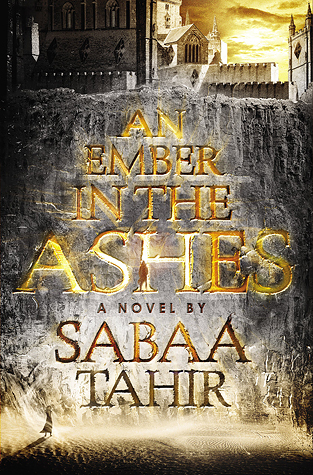
An Ember in the AshesAn Ember in the Ashes by Sabaa Tahir

Genre: Young Adult, Fantasy

Series: Book 1

Publisher: Razorbill (April 28, 2015)

Author Information: Website | Twitter

Mogsy’s Rating: 4 of 5 stars

An Ember in the Ashes was a great read, and so far probably one of my favorite “mainstream” Young Adult books this year. I can definitely understand the excitement surrounding it, and the book might actually live up to all the attention. That said, the novel is not without its flaws, ultimately falling prey to the many pitfalls of its genre. For a debut, though? I thought it was fantastic.

The book takes place in the heart of the ruthless Martial Empire, following the strife filled lives of two young people. Laia is a simple Scholar girl, forced to join the Resistance after her brother Darin, the only family she has left, is arrested by the military. In order to free Darin, she agrees to go undercover to spy on the Commandant of the empire’s military academy. Then there’s Elias Veturius, one of best soldiers to ever graduate from that academy. Deep down though, he wants nothing more than to escape from the empire and leave its brutal traditions behind forever.

The empire’s Augurs, however, have a different plan in mind. It has been foreseen that without an heir, the current Martial emperor’s line will end this year. The next ruler of the greatest empire this world has ever seen is to be chosen amongst the finest crop of the academy’s latest graduates – which means Elias is to be thrown into a series of competitions that will test his resolve and push him to his limits. Meanwhile, Laia is tasked by the Resistance to find out more about the process, plunging her into the cruel and unrestrained world of the Trials, binding her fate to Elias’s forever.

The plot is quite intriguing to say the least, in spite of the fact that we start things off with what appears to be the two most foolish protagonists on the planet. Elias, who is about to attempt the riskiest decision of his life by deserting, can’t even seem to muster up the ability to at least look innocent. Then there’s Laia, who keeps berating herself over and over again for being such a useless, weak coward. I’m sure it will come as a surprise to absolutely no one that when you say something enough times, you’ll actually start to believe it. Which is why, very quickly, Laia began to really get on my nerves.

But then the amount of character growth by the end of the book, at least for Elias, was astounding. Despite the book having two main protagonists, for me it was all about him. His chapters are more exciting, but more importantly, he has his beliefs plus the determination, strength and courage to stick by them. I’m also captivated by the relationships. A bizarre dynamic exists in Gens Veturius, with Elias’s grandfather General Quin as its patriarch, but it is his daughter, Elias’s mother, who holds the deadliest power. That’s because she’s also the military school’s Commandant. Yes, the very same one Laia was ordered to spy on.

As the Commandant, Keris Veturius is one of the best YA villains I’ve ever encountered. It’s rare that a bad guy actually becomes one of my favorite characters, but there’s a cold, well-crafted complexity to her that we don’t see a lot in this genre, and that immediately made her fascinating. Not only does she have total authority over all the Masks, she also possesses a disturbing tendency to just know things. Her relationship with Elias is also a curious subject. There’s certainly no love lost between mother and son, and in fact the Commandant seems repulsed by Elias. The relationship between Elias and his grandfather Quin on the other hand appears warmer and more genial, and you really have to wonder just what on earth happened to make this family so screwed up like this. We get some hints at the end, but there’s definitely a much bigger story there, and I have a feeling that it might have something to do with the identity of Elias’s father.

I also really like the character of Helene, Elias’s oldest and closest friend at the academy. I really wish she had been a point-of-view character; somehow I think I would have had enjoyed seeing through her eyes more than Laia’s. I think the dynamics between Elias and Helene are also more interesting, and I couldn’t have been more pleased with how their story played out, taking us along on an unpredictable ride full of twists and turns, wondering all the while how things are going to end for these two best friends. There are so much more I want to know about Helene, but unfortunately we don’t get a lot of information. No reason has been given yet as to why they only choose one woman per generation for the military school, for instance. But still, her relationship with Elias interests me, and I’m looking forward to see how that plot thread will resolve.

Now on to the novel’s weaknesses. For me, the big one was Laia. While Elias grew as a character, Laia continued to be infuriating as hell. She agrees to be a spy, jumping into this nigh impossible situation without any serious consideration, fueled only by her obnoxious bullheadedness. She makes a terrible spy too, by the way, and everyone knows this including herself. Yet she never actually makes the effort to find out how to be a better one, and if it weren’t for advice given to her by others she would have kept making the same mistakes again and again. The worst part is, she laments incessantly about how weak she thinks she is, and instead of making me sympathize with her, it just makes me angry. Through all this she never grows her own backbone, until literally the very last chapter when it’s too late for me to care. The rest of the book, it’s always her brother Darin’s voice in her head giving her encouragement instead of her own, Darin giving her a reason to take action instead of her own will. She shows very little growth in that sense, despite the brave face she tries to put on. Her chapters aren’t as interesting either, and mostly I just couldn’t wait until they were over so I could get back to Elias’s point of view.

Also, if I had to pick a few nits, firstly I wished the author had gone with different names for the world’s people rather than “Scholar” or “Martial”. It reminded me too much of Divergent, not exactly one of my favorite YA novels and certainly not a book I’d want to associate with this one. Secondly, there are some logical inconsistencies in the story (like if Blackcliff Academy was such a hotbed for Resistance spies, you’d think the military would have a better system in place to vet their slaves and servants. Of course, if they did, Laia’s incompetence would have never have gotten her through and there would be no story).

And thirdly, there is this bizarre love triangle. Actually, make that two love triangles. When the book started off with Elias and Helene, Laia and Keenan (another Resistance member), I was really hoping Sabaa Tahir would stay on this path with these two pairs and avoid having to resort to overused love geometrics. Alas, ultimately she decided to adhere to convention, and to my further dismay, instead of just having a single love triangle we end up with this two-girls-for-one-boy and two-boys-for-one-girl situation. A bit unnecessary, if you ask me.

So yes, there definitely are some punches you just have to roll with. But fortunately, they are small punches. The last few that I mentioned are insignificant to minor flaws, none of which are nearly as big as the issue I had with Laia’s character, which is probably the main reason I’m not embracing this book as wholeheartedly as I could be.

I really did enjoy this book though, and the fact that I’ve already written so much in this review is probably a good testament to how much I liked it. I found it quite addicting, especially Elias’s chapters and the terrible things he had to go through in the Trials. I admit, when I started the book I truly thought the results of the completion would be a foregone conclusion, but I was wrong – there are a lot of surprises and unexpected twists and turns in the search for the Martial’s new Emperor and Blood Shrike. With the way it ended, I can’t imagine there not being a sequel. Who knows what it’ll be and who knows when it’ll come out, but what I do know is that I’ll be checking it out for sure.

31a55-new4stars

Book Review: Hounacier by Seth Skorkowsky

A review copy of this book was provided to me by the publisher in exchange for an honest review.

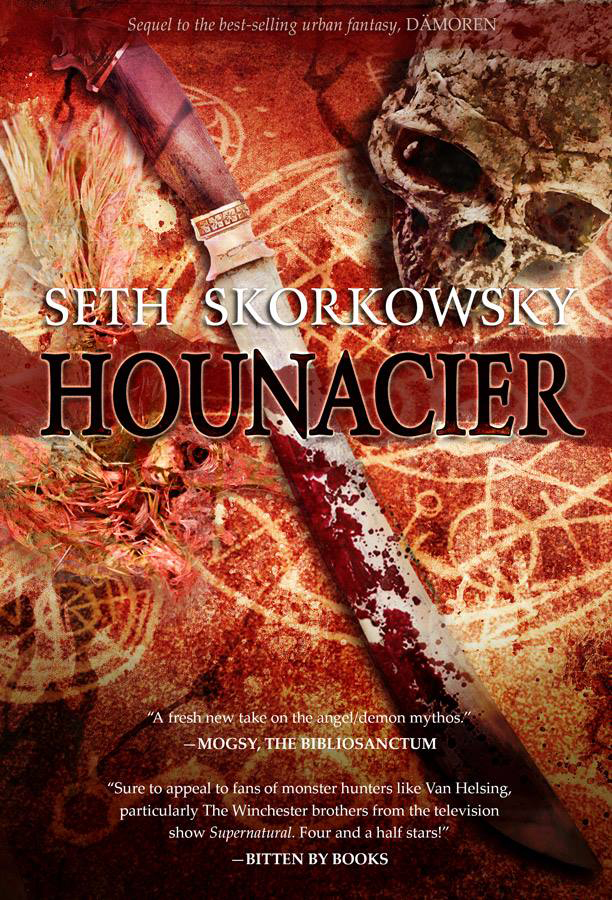
HounacierHounacier by Seth Skorkowsky

Genre: Urban Fantasy, Horror

Series: Book 2 of Valducan

Publisher: Ragnarok Publications (March 14, 2015)

Author Information: Website | Twitter

Mogsy’s Rating: 4 of 5 stars

Last year I discovered the awesome world of magic, demons, and sentient spirit-imbued weapons in Seth Skorkowsky’s Dämoren, so when I was offered a chance to read the sequel, I didn’t hesitate.

Hounacier builds on the first book, which introduced us to an order of modern-day knights called the Valducan. All the monsters or the world are actually human beings possessed by a demon, and the type of demon in turn determines the type of monster and the transformation into werewolf, ghoul, lamia, wendigo, etc. A Valducan knight makes it his or her life’s work hunting and killing these demons, with the help of a holy weapon which the knight is bonded to with their whole heart and soul.

Book two expands upon these themes, but the story is also very different. For one thing, we have a change in protagonist. While Dämoren follows the life of a rogue demon hunter named Matt Hollis, Hounacier instead features another Valducan knight named Malcolm Romero. Dämoren was a jet-setting action/adventure thriller that took us on an ass-kicking demon hunt across the globe, while Hounacier takes place mostly in New Orleans and the story reads more like a mystery. The pacing is thus slower, but this is a good thing because it also sets the book up nicely for a heavier and more macabre horror vibe.

This dark fantasy series just got even darker, which is how I like it! Eleven years after he faced his first demon and became apprenticed to a Voodoo priest, Malcolm receives news about the grisly murder of his mentor. Now he returns to New Orleans in order to catch the killer, armed with his holy weapon, a machete named Hounacier. As the investigation deepens and the details surrounding it becomes more disturbing, Malcolm finds himself betrayed. With his soul violated and his holy blade stolen from him, Malcolm is plunged into a nightmarish existence of violence and terrible dark magic. Seth Skorkowsky kept me on my toes the whole time, and it’s such an intense and brutal tale that I couldn’t even begin to guess how everything would turn out.

In many ways, the scope of Hounacier is smaller than that of its predecessor; we’re mainly in a single setting, there aren’t as many characters, and we also don’t see a big variety of demons in this book. Still, the narrower focus serves an advantage here, because it immerses us deeply into the culture and traditions of Voodoo magic. The author has clearly done a lot of research in order to make his portrayal of it as authentic and accurate as possible.

We also get to know the protagonist a lot better. Malcolm was a side character in Dämoren, one of the lead knights who gave Matt Hollis a hard time because the Valducan believed Matt was demon-touched. So in the first book, Malcolm was painted as this huge asshole and admittedly that’s how I remembered him too. Imagine my surprise then, when I read Hounacier and realized how much I liked him and sympathized with him. Malcolm is awesome – he’s interesting, deep, and conflicted, and this makes him an engaging character to follow. I think I ended up liking him even more than Matt Hollis. The powers granted to Malcolm by the mystical properties of his weapon are also unique and new. Matt Hollis may have his blood compasses, but Malcolm Romero has his magical tattoos, including one that can see through your soul to tell if you’re pure or tainted by a demon. Very cool stuff.

I would consider these Valducan books to be Urban Fantasy, but there’s also a great deal of Horror thrown into the mix. The horror element is even more prominent in Hounacier, as we follow the trail of a murderer and then come face-to-face with a werewolf demon. The werewolves here are the savage, psychotic and bloodthirsty variety, with the monster in control rather than the human. More than once, the terrifyingly gruesome scenes in here evoked a visceral reaction from me. If you like your UF dark, brutal and completely unflinching about the fact, then Valducan is the series for you.

One final thing I’m grateful to Mr. Skorkowsky for is that these books can be read as stand-alones. Hounacier has some connections to Dämoren, like Matt Hollis showing up near the end to team up with Malcolm, etc. but for the most part both novels are self-contained stories. Pick up either one (they’re both good!) and read away. Highly recommended.

*** Curious to know more? Be sure to stop by The BiblioSanctum next Monday for our interview with Seth Skorkowsky ***

4 stars

Other reviews in this series: Dämoren (Book 1)