YA Weekend: Lois Lane: Cloudy With a Chance of Destruction (Novella) by Gwenda Bond
Posted on May 3, 2015 6 Comments

 Lois Lane: Cloudy With a Chance of Destruction by Gwenda Bond
Genre: Young Adult, Leading Ladies
Series: Lois Lane
Publisher: Capstone (April 6, 2015)
Author’s Information: Twitter
Tiara’s Rating: 3 of 5 Stars
Lois Lane: Cloudy With a Chance of Destruction is a short story tying in with Gwenda Bond’s novel Lois Lane: Fallout, which was released May 1st. This story takes place right before Lois, who is an Army brat, and her family moves to Metropolis where she’ll set root to become the Lois Lane that you love and/or hate. In a high school chemistry class, Lois finds herself in the middle of a turbulent love affair of two of her teen classmates, Mike and Sophie. What love affair at that age isn’t turbulent?
Sophie has decided that she’s had enough of Mike and his stupidity and dumps him during their lab project, and Mike tries to cajole Sophie into taking him back because their grade counts based on group effort (and Sophie is apparently something of an honor student), which he’s not willing to make if she’s not willing to take him back. In an effort to win Sophie back, Mike decides to bring an “awe-inspiring” experiment to school the next day to impress Sophie. Lois’ current residence is full of scientists, including Mike’s dad, and she has a bad feeling about what he’s carrying around in the bag.
I know Young Adult books are all the rage right now, but I’m not fond of them at this age (used to love them when I was younger) and I’m very particular about the ones that I read. I’ll be the first to admit that I can be harsher on them than I should be. That’s not to say that I haven’t read Young Adult books that I absolutely adore, but they are few and far in between. However, this was a cute story. I loved the burgeoning attitudes of the Lois that I’ve come to love in the comics. However, this still wasn’t really for me, and that’s because of two words: Clark Kent.
He’s not called out by name, and Lois only knows him from message boards they both frequent. I’m not the biggest Superman fan in general for various reasons, but my personal reasons for not caring for the character are not the reasons why I disliked his place in this short story. I wanted to read a story where Clark doesn’t factor into Lois’ life. True, I love Lois and Clark as a couple in DC Universe when they become adults, but what made me excited about reading a story about a young Lois was seeing her develop outside of Clark. Even in this story, Clark is her go-to texting buddy about all things science instead of allowing her be the little investigative reporter that lives in her.
Clark has been allowed to live his life before and even after Lois. Sure, she eventually shows up in many of his stories, too. However, he’s been still allowed to shape himself without Lois while in this story Lois immediately runs to him for help. That turned me off to this short story and has made me decide that I’ll pass on the novel as well. I don’t want a story where Clark is her secret internet buddy that gives her the answers she needs. I want a story about Lois showing her true skill and wit without having to send texts to Clark for science help.
Despite that, I do recommend this for fans of Lois Lane who want a spin on her story and how she became the biggest force The Daily Planet has ever encountered. I found this highly imaginative, and I loved seeing Lois Lane snarking and being “in-your-face” when it came to Mike’s craziness and gross behavior. She also showed that she’s fearless and can come up with solutions on the fly. I’d probably be more excited for reading the novel if it wasn’t for that one annoyance.
 This short story was provided to me by Capstone through Netgalley in exchange for an honest review. All opinions expressed are my own.
YA Weekend: Shadow Scale by Rachel Hartman
Posted on May 2, 2015 23 Comments
A review copy of this book was provided to me by the publisher in exchange for an honest review. All opinions are my own.
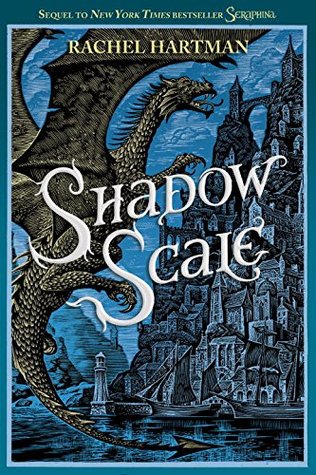 Shadow Scale by Rachel Hartman
Genre: Young Adult, Fantasy
Series: Book 2 of Seraphina
Publisher: Random House Chrildren’s Books (March 10, 2015)
Author Information: Website | Twitter
Mogsy’s Rating: 2.5 of 5 stars
I have to admit I went into Shadow Scale with no small amount of trepidation; from the ratings I’ve seen around the blogosphere, it seemed like most readers either loved it or hated it. I very rarely find myself skewing one way or the other though, so I wasn’t surprised when I finished this book and found my feelings lying somewhere in the middle. In other words, it wasn’t too bad. At the same time, it’s far from what I had in mind.
The book begins with a narrator recounting events of the first book in a historian-like tone, an introduction I appreciated a lot, actually. It’s been a while since I read Seraphina and the mini-recap was very helpful in refreshing my memory. For decades, the denizens of kingdom of Goredd have held an uneasy peace with the dragons of Tanamoot, but that period is soon coming to an end. As war looms on the horizon, our human-dragon protagonist Seraphina is asked to help Goredd. For as long as she could remember though, she’s hidden herself in the shadows, keeping the fact that she is a hybrid secret. But now, her very heritage is drawn into the conflict. No longer can she hide, as she is tasked to go on a quest across the kingdom to find other half-dragons like herself, for they may hold the secret to saving Goredd.
While Prince Kiggs and Princess Glisselda back home are preparing for the war, Seraphina embarks on this new adventure, pursued by enemies who want to stop her. More concerning, however, is a threat that unexpectedly arises – reports of a half dragon who can infiltrate the minds of others and take them over.
Book Review: Garden of Dreams & Desires by Kristen Painter
Posted on May 1, 2015 4 Comments
A review copy of this book was provided to me by the publisher in exchange for an honest review. All opinions are my own.
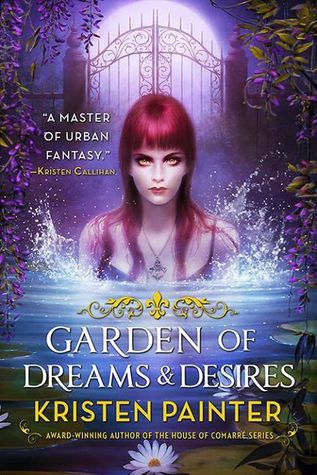 Garden of Dreams & Desires by Kristen Painter
Genre: Urban Fantasy
Series: Book 3 of Crescent City
Publisher: Orbit (April 7, 2015)
Author Information: Website | Twitter
Mogsy’s Rating: 3 of 5 stars
While this isn’t exactly what I had in mind for an ending, I have to say Garden of Dreams & Desires concludes the Crescent City trilogy nicely. What’s great is that this novel boasts its own story arc but still manages to resolve everything from the previous two installments, tying up any and all loose ends. That being said, there’s obviously a lot to pack into a little more than 300 pages or so, and I felt like I was being powered through the story at a breakneck pace.
We last left Harlow in a bit of a quandary. At the end of City of Eternal Night, she does something insanely stupid and ends up resurrecting the soul of her dead twin Ava Mae, using the magic of a lightning tree. Of course, with nowhere else for Ava Mae to go, her spirit immediately hitches a ride in Harlow’s body and takes over. Once again for the first half of the book, we have Augustine scrambling to do everything he can to help Harlow out of a problem of her own making.
Meanwhile, tourists have been disappearing in New Orleans, including the son of a prominent and bigoted senator who believes the Fae and Othernaturals are the ones responsible for the kidnappings. As Guardian of the city, Augustine has his hands full with the investigation into the missing tourists, trying to find the real kidnappers before the senator imposes sanctions on his people. But since he has fallen deeply for Harlow, he therefore decides to make her predicament his first priority, even though the fate of the entire supernatural population could be at stake. Oh the things we do for love.
Maybe it was the pacing, but something about this didn’t quite sit right with me. If you can’t tell already, my relationship with Harlow’s character has been a long and tumultuous journey. I disliked her strongly in the first book, but started to warm towards her in the second only to watch her naiveté strike her down again. Perhaps she and I were just never meant to be. There were some major improvements to her character in here, but the book’s pacing was just so fast that it felt like she was transformed overnight. I couldn’t understand anyone’s affection for her, let alone how Augustine could fall in love with her.
I enjoyed seeing how the story wrapped up, but the speed at which it happened diminished the experience somewhat. Harlow didn’t get enough time to develop properly, and neither did Senator Pellimento, the new baddie introduced in this book now that Branzino has been taken care of. Pellimento was sort of a paint-by-numbers villainess, her reasons for coming down hard on the Fae not very well explained other than the fact she hates them and is unwilling to consider the possibility that anyone else could be responsible for her son’s disappearance. In the end, it was the witches. That’s not really a spoiler since it’s mentioned right there in the book description, plus ultimately there was no mystery just because there was absolutely no room left in the story to set one up. The conclusion also tied things up too neatly and a little too quickly, casually taking care of the witches and Ava Mae in one fell swoop so that Augustine and Harlow can have their happy ending. Don’t get me wrong; I think the two of them are a good match and I’m glad things worked out for them, but wow, those last few chapters just blew right by.
If I have to hazard a guess as to why it feels so rushed, I would say it’s because in our interview with Kristen Painter, she revealed that she originally intended Crescent City to be a five book series, not three. Indeed, with all that happened in this book, it could easily have been two or even three installments. That could explain why the most important threads were tied up but some major questions are still left open, such as what will happen to Olivia and the consequences now of so many people knowing about the dangers of the lightning tree.
Garden of Dreams & Desires was a good read with thrills that will leave you exhilarated – and not least because it is so fast-paced that you won’t even have a chance to catch a breath. It’s a hectic novel which could have been better paced, but I also understand the challenge of having to work under certain restrictions and the author’s choices if that was the case. On a whole, I thought this series was very enjoyable. The first book was good and the second book was even better; City of Eternal Night was my favorite of the three books. Crescent City is a fascinating Fae-centric urban fantasy trilogy set in a very unique and vibrant portrayal of New Orleans, certainly worth checking out if that sounds like your cup of tea.
Other reviews in this series:
House of the Rising Sun (Book 1), City of Eternal Night (Book 2)
Tough Traveling: The Big City
Posted on April 30, 2015 19 Comments

The Thursday feature “Tough Traveling” is the brainchild of Nathan of Review Barn, who has come up with the excellent idea of making a new list each week based on the most common tropes in fantasy, as seen in (and inspired by) The Tough Guide to Fantasyland by Diana Wynn Jones. Nathan has invited anyone who is interested to come play along, so be sure to check out the first link for more information.
This week’s tour topic is: The Big City
There has to be somewhere in Fantasyland where everyone comes together. All roads lead to Rome after all. A place where traders prosper, politicians scheme, and criminals thrive.
Tiara’s Picks
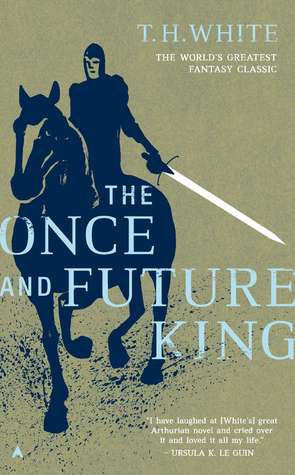 Camelot (The Once and Future King by T.H. White)
Camelot is the famed castle city ruled by King Arthur who is said to have dominion over not only Britain, but Norway, Ireland, Gaul, and Iceland after successfully repelling an attack from the Saxons. Camelot is the city where his round table was situated and where most scheming against him happened. Long live the king.
 King’s Landing (A Song of Ice and Fire series by George R.R. Martin)
What list would be complete without just about any of the major strongholds from this book, but at the heart of politics, trading, scheming, and the welfare of the entire kingdom of Westeros lies with King’s Landing, the home of its kings, who don’t seem to meet very happy fates.
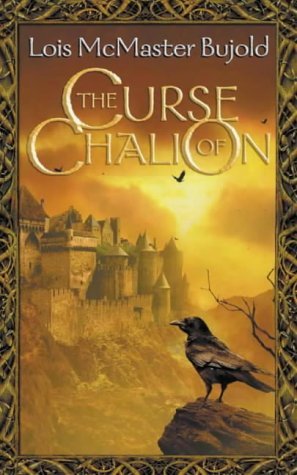 Cardegosse (The Curse of Chalion by Lois McMaster Bujold)
Lupe de Cazaril dreads going to the city of Cardegosse which is a cesspool of politics and political intrigue. After spending years in captivity with their enemies, the Roknari, Cazaril is terrified when they’re called to court in Cardegosse because the family who sold him to their enemy is part of the royal court. When he arrives in the city, he immediately finds himself embroiled in dangerous politics that force him to do something extreme, something he doesn’t feel like even their fickle gods will approve.
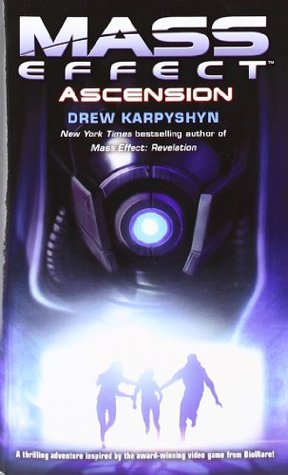 The Citadel (Mass Effect by Bioware) – Humans haven’t long been part of the intergalactic alien community, being seen by many of the older alien races as rash, ignorant, impulsive, and not nearly as useful as some of the other races. The Citadel acts as a hub where politics between the different alien races are conducted as well as providing a beautiful (on the surface) home for its many alien inhabitants including humans as well as having a governing body made of the major alien races to keep intergalactic peace.
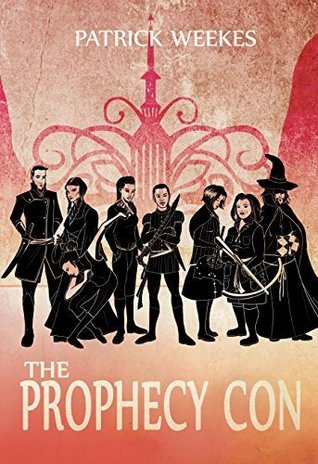
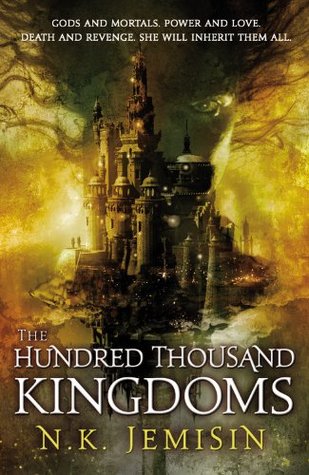
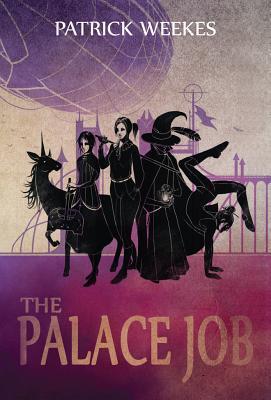 Heaven’s Spire (The Palace Job by Patrick Weekes)
Are you tired of me using examples from The Palace Job yet? Sorry, not sorry. Heaven’s Spire is a heavy fortress city that floats in the sky by means of magic. It described as a grand beautiful place and hub for all political scheming, especially against their enemies the Imperial.
 Tyrsis (Sword of Shannara by Terry Brooks)
And on this day mankind received a grim reminder… Sorry, I still can’t get that out of my mind when talking about Tyrsis’ impenetrable walls. Tyrsis is the capital of the country Callahorn, which will one day be ruled by Balinor Buckhannah and his billowing boon-filled cape of bravery. Tyrsis, while mostly peaceful, is a hub where various races converge for trading and politics. It’s described in the books as being one of the cities of man that sees many races and isn’t phased by it like many other smaller human cities and villages. Callahorn along with Tyrsis is nearly lost after political treachery.
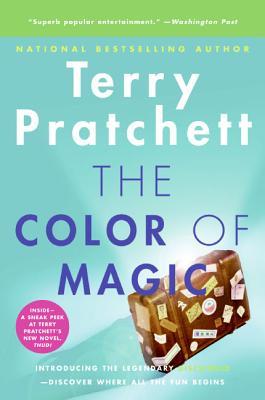 Ankh-Morpork (The Discworld Series by Terry Pratchett)
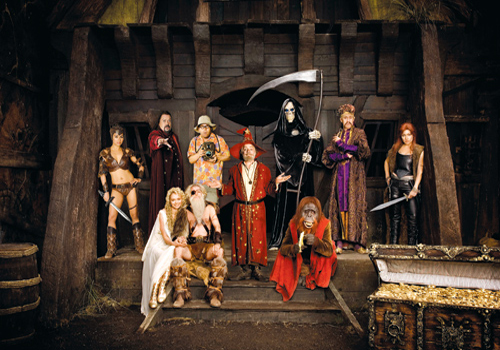
From what I can tell of Ankh-Morpork, it’s a metropolis of sorts that, much like our bustling modern cities, can’t be bothered with such things as dragon attacks. Vegetables still have to to delivered, okay. It’s corrupt, full of wonder, good food, magic, and a center of trade and politics. Many hilarious misadventures seem to take place in this city. Also, adding this pic gives me a reason to use this picture mainly because of Luggage (I’ll be watching the show soon).
Mogsy’s Picks:
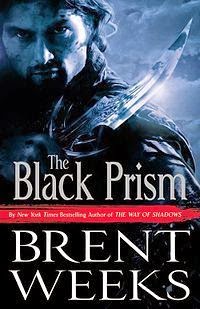 The Black Prism by Brent Weeks
When Gavin Guile discovers that he had fathered a secret son, he goes and retrieves the boy and brings him to the Chromeria to be trained in chromaturgy. As the central hub for the education as well as the seat government, the city is the heart of The Seven Satrapies and boasts tall towers and other large buildings constructed with luxin, the colorful material that mages use to draft.
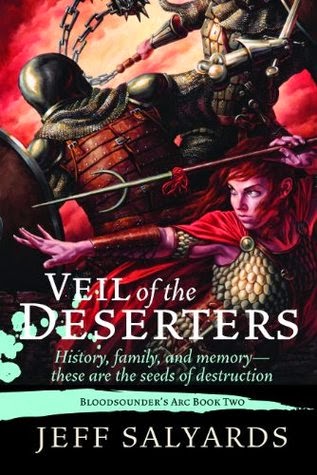 Veil of the Deserters by Jeff Salyards
Now that the Emperor Cynead has solidified his power, the next step is to demand loyalty from his followers. After spending a long time on the road, Braylar and his company of Syldoonian warriors (along with the scribe Arki tagging along) are recalled to the city to swear fealty. Arki finds himself amazed at the magnificent sights and sounds as soon as they step through the gates into the capital, moments before he is introduced to the brutality and ruthless scheming in this world of warrior politics.
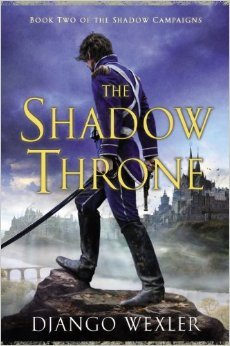 The Shadow Throne by Django Wexler
The war in Khandar is won, and Janus, Marcus and Winter return in haste to the capital as heroes. But all is not well in the city of Ohnlei. The king is on his deathbed, and the power-hungry Duke Orlanko is circling like a vulture around the young princess and heir, waiting to seize control. When revolution breaks out, the city’s streets run red with riots and bloody battles.
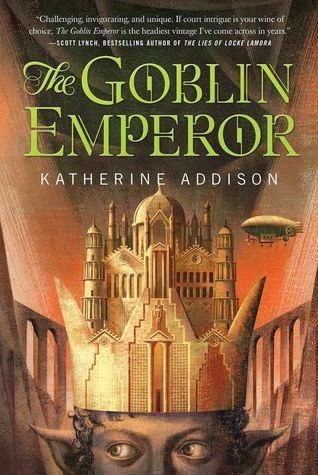 The Goblin Emperor by Katherine Addision
Maia, the youngest half-goblin son the the Elven emperor has lived his entire life as a cast-off, far away from the business and affairs of the The Untheileneise Court, the seat of the Elvish government. But when his father and three older brothers all perish in an airship accident, being the next in line in the royal succession Maia is plucked from exile and taken to the big city in order to take his rightful place on the throne.
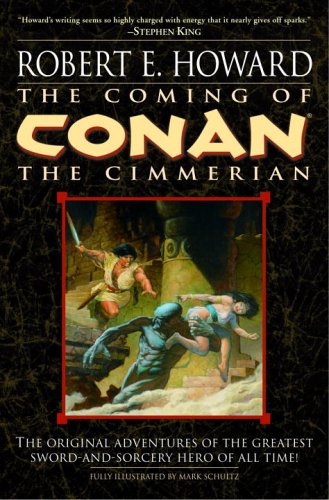 Conan the Cimmerian by Robert E. Howard
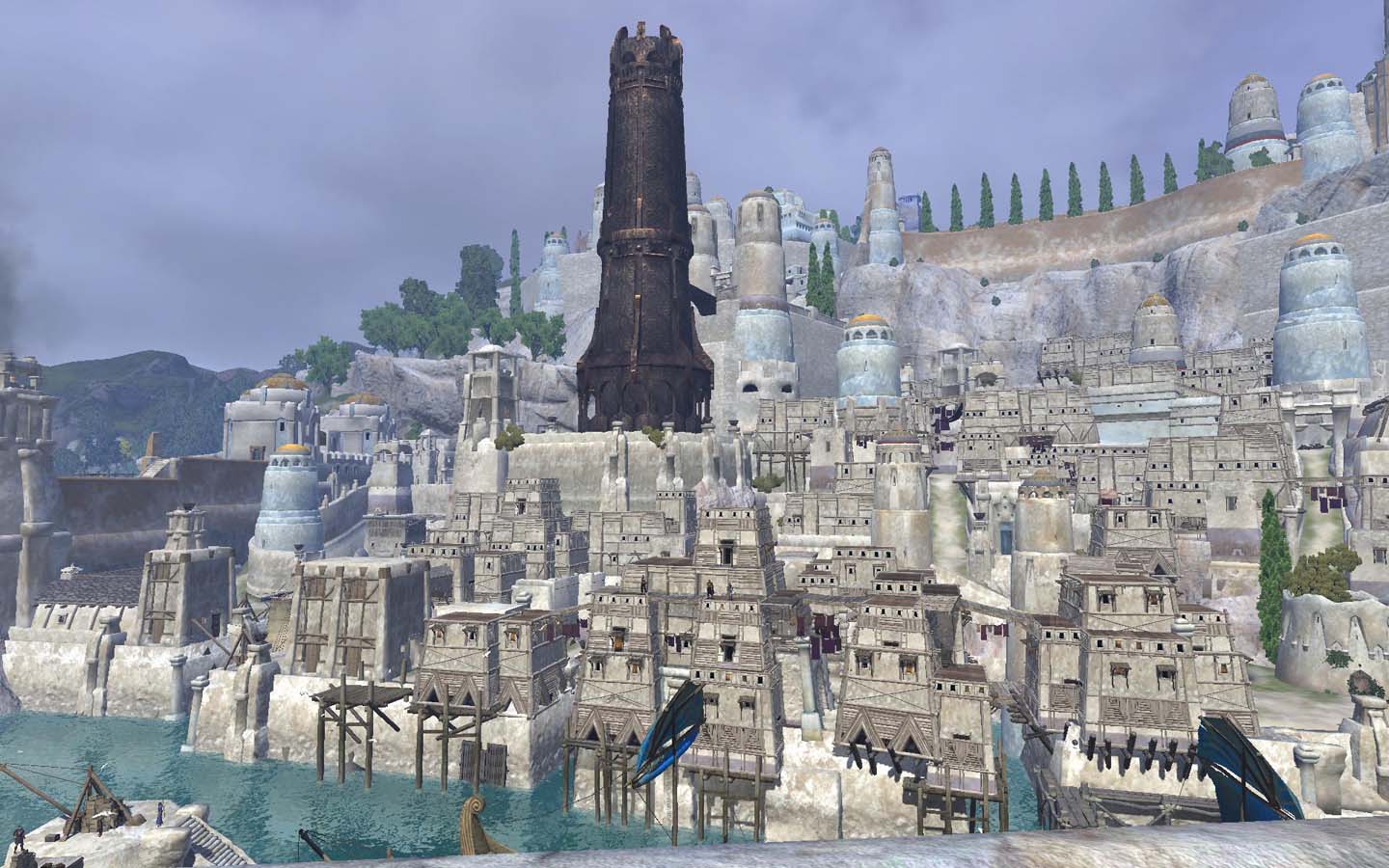
Conan may be a Cimmerian, but eventually he becomes the the king of Aquilonia, presiding from his throne in the sprawling, wondrous city of Tarantia. Lying on the Road of Kings, this great capital is the jewel of Aquilonia, the most prominent and powerful of the Hyborean kingdoms. Towers of blue and gold dominate the skyline, and many of its buildings are polished and shining, a dazzling sight to behold. A hub for much trade, it is said that virtually anything can be purchased in the markets of Tarantia. Funcom did a pretty good job rendering the city’s concept in Age of Conan:
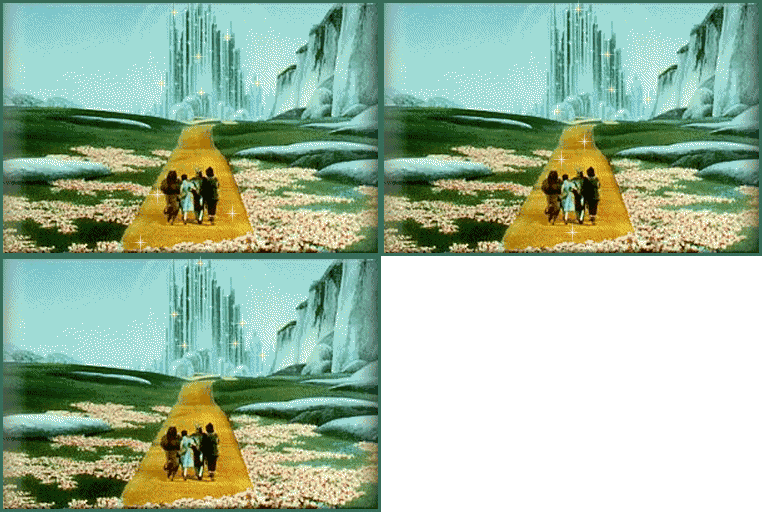
Wendy’s Pick
Is it Thursday already? Where did the time go? Sigh. I had big plans for this, but I see that my co-bloggers have things covers. Carry on then.
Comic Stack 04/29/15: Urban Fantasy Novels Turned Comics
Posted on April 29, 2015 8 Comments


After a hectic work week for me, I finally got some down time to spend catching up on some comics! This week I visit some familiar faces and one new face. This week’s comics are based on popular urban fantasy novels. I revisit the worlds (now with PICTURES!) of Mercy Thompson and Harry Dresden comics based on the first book of their respective series. I had a couple more I wanted to include, but I wanted to think about the other two a bit more first before I introduced them. The first comic I read based on a book was probably Anita Blake’s Guilty Pleasures. It’s been a while back. I remember enjoying it for the most part while snickering about how curly and fabulous everyone’s hair was. I’m sure I still have a shot of this awesome hair somewhere. Ah! Here we go.

With comics, you have to get to the heart of the matter, especially when dealing with comics based on books. Writers are forced to choose what’s important and can the rest while (hopefully) keeping their readers engaged in the story. However, I do think that urban fantasy can work better with the comic format than some other genres. So, how did these first issues fare against my sometimes discriminating tastes? Let’s find out.
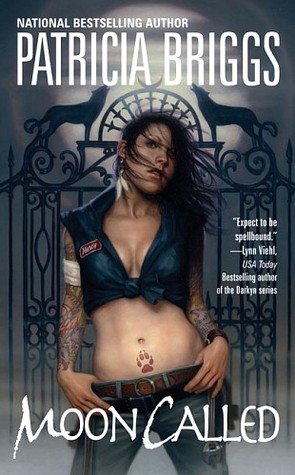
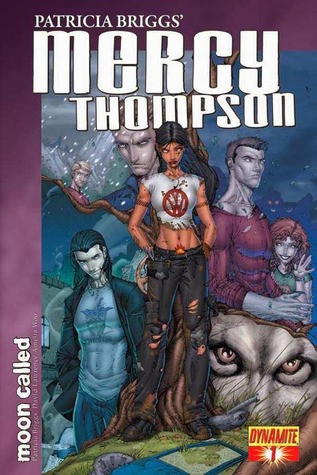 Moon Called #1 by Patricia Briggs, David Lawrence (writers), Amelia Woo (artist)
Publisher: Dynamite Entertainment
Genre: Urban Fantasy, Horror, Supernatural
Mercy Thompson is a walker, nearly the last of her kind. She has the power to turn into a coyote. Despite this, she still straddles the line between the magical world and the mundane world, not truly belonging to either. Enter Mac, a boy who is obviously a werewolf, but everything points to him being a clueless new werewolf. And he’s obviously on the run from something. Mercy doesn’t ask questions. She just gives him a job in her garage despite the fact that she knows trouble is likely to follow him.

I enjoyed this more than I thought I would. I always go into these comics a little skeptical that they can capture what makes me enjoy the novels. I think this particular book did a fabulous job, especially as a #1 to really get to the meat of what’s going on while providing the reader some cryptic things for readers to chew on that will be revealed during the course of the series. This book gave me a strong urge to reread the first book in this series, too. Typical of the genre, this spans over two volumes for one book (because seriously how else are they supposed to get as much of the story out as they can?), so I’ll be picking it up soon (and probably rereading the first book, too).
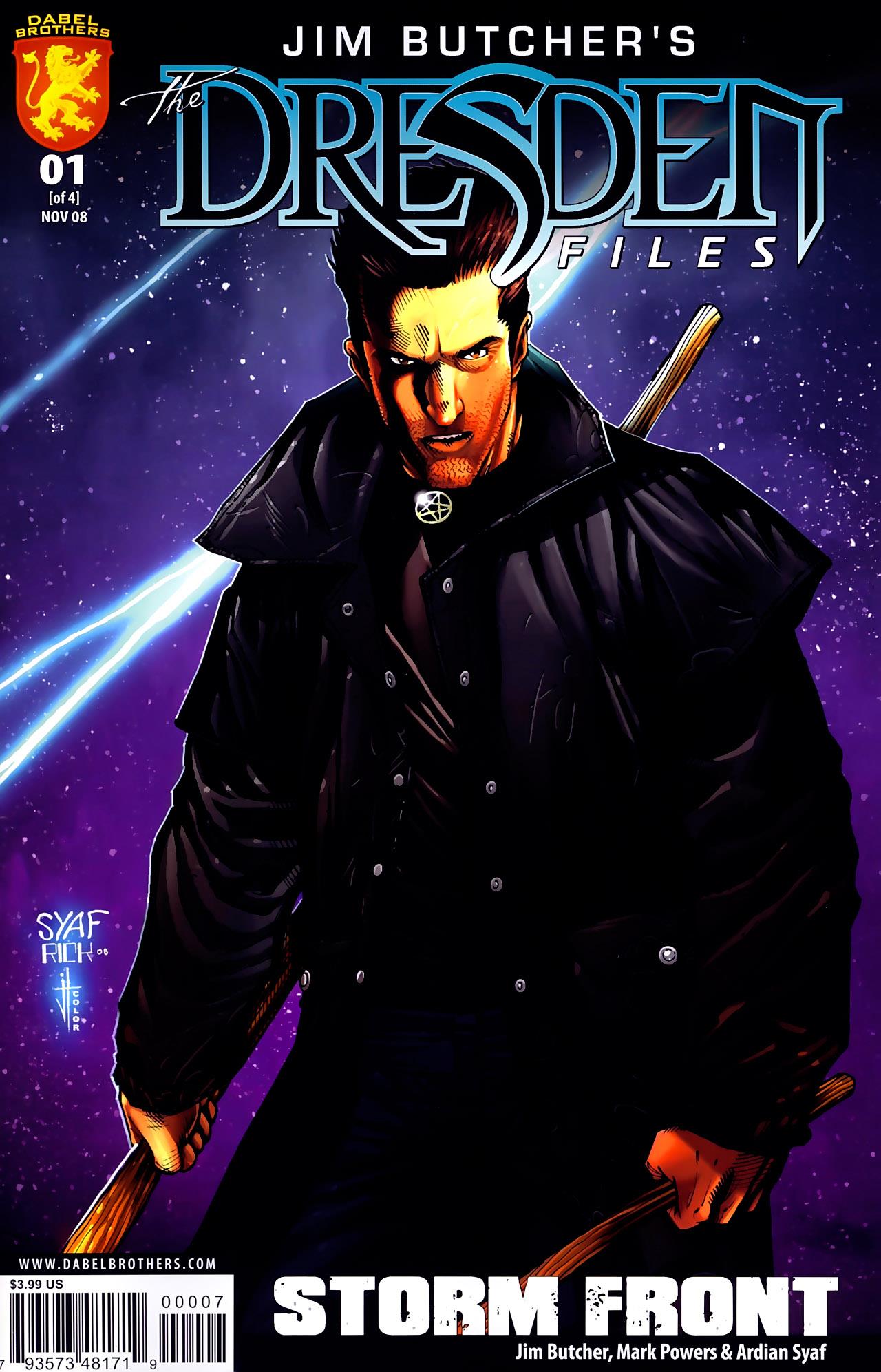 Storm Front #1 by Jim Butcher, Mark Powers (writers), Adrian Syaf (artist)
Publisher: Dynamite Entertainment
Genre: Urban Fantasy, Horror, Supernatural
Harry is called in by the police department on a case where two people’s hearts look as if they’ve literally exploded from their chests. Believing this couldn’t happen by ordinary means, Karrin Murphy tries to get an idea of what happened by allowing Harry to look at the scene. Harry also finds himself part of a mystery to find out what happened to a woman’s husband (a husband who dabbled in the arcane) while staying off a local mob boss’ (John Marcone) grid.
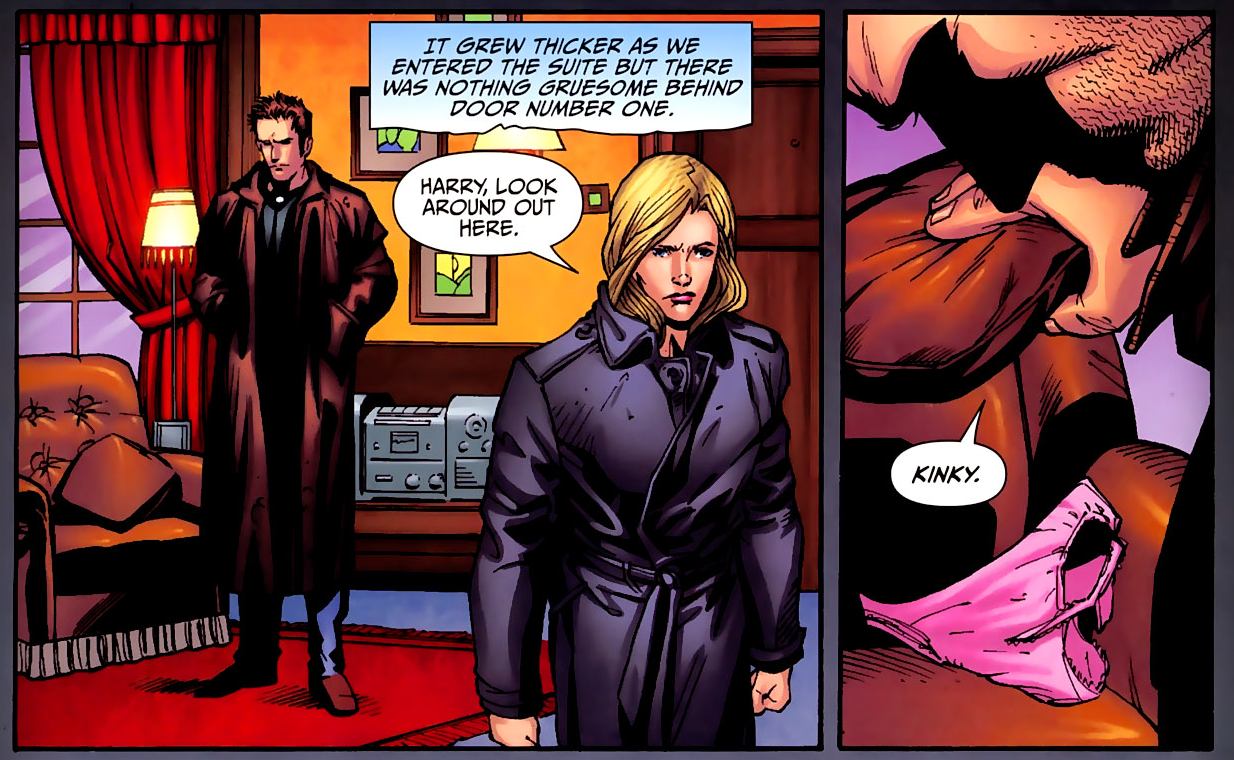
Honestly, it actually hasn’t been that long since I reread this novel, and while the details are familiar, my memory of this novel is pretty hazy. When I say the first Dresden book is pretty unremarkable for me, I mean it. I’ve read it twice and nothing ever really sticks from that book for me, and I fear the comic is going to be the same way. This isn’t a bad comic, but there’s just nothing special about it for me. Two things, though. Karrin definitely looks similar to how I see her in my mind, and the colorist seemed to forget midway through the page that Susan’s eyes were brown and that drove me nuts for the few pages I had left to read. I don’t think I’ll be reading the rest of this volume. I might just skip on over to Fool Moon instead.
Waiting on Wednesday 04/29/15
Posted on April 29, 2015 9 Comments

“Waiting On Wednesday” is a weekly meme hosted by Breaking the Spine that lets us feature upcoming releases that we can’t wait to get our hands on!
Mogsy’s Pick:
The Paradox by Charlie Fletcher: August 18, 2015 (Orbit)
I’m very excited for this! The first book The Oversight was an ARC that unexpected landed on my doorstep last year, and not knowing anything about it I nonetheless gave it a try. Well, I ended up loving it. It won me over with it many twists and turns and an incredibly atmospheric setting, and characters that stayed with me for a long time. I can’t wait to catch up with them in the sequel, which sounds just as lovely.
 “From HBO scriptwriter Charlie Fletcher comes a wildly original and hugely entertaining new fantasy series for a generation that has grown up with Harry Potter and Neil Gaiman.
The Last Hand of the Oversight still patrols the border between the natural and supranatural, holding a candle to the darkness. But this new Hand is unproven, its fresh members untrained, its veterans weary and battle-scarred. Their vulnerability brings new enemies into the city, and surprising new allies from across the sea.
But most surprising of all are new revelations about the Oversight’s past, revelations that will expose the true peril of the world in which Sharp and Sara are trapped — the secret of the Black Mirrors, and what lies beyond. And the catastrophic danger that will follow them home, if they ever manage to return.
The dark waters rise. The candles are guttering. But the light still remains.
For now…”
Tiara’s Pick:
Rat Queens, Vol. 2: The Far Reaching Tentacles of N’rygoth by Kurtis J. Wiebe: May 6, 2015 (Image Comics)
For my birthday last year, Wendy so graciously sent me a copy of the first volume which I enjoyed very much. It was a fun romp following an all female mercenary group who liked to drink, party, and cause general chaos. I managed to resist the temptation of having it pulled for me, but now I am pleased to learn that the second volume is right around the corner. Also, since I am a tentacles enthusiast (yeah, we exist), I know this is a must buy.
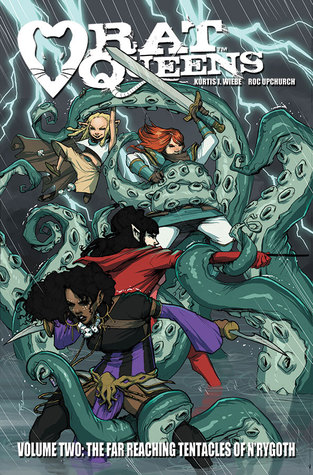
“This booze-soaked second volume of RAT QUEENS reveals a growing menace within the very walls of Palisade. And while Dee may have run from her past, the bloated, blood-feasting sky god N’rygoth never really lets his children stray too far. Collects RAT QUEENS #6-10.”
Book Review: The Affinities by Robert Charles Wilson
Posted on April 28, 2015 15 Comments
A review copy of this book was provided to me by the publisher in exchange for an honest review. All opinions are my own.
 The Affinities by Robert Charles Wilson
Genre: Science Fiction
Series: Stand Alone
Publisher: Tor (April 21, 2015)
Author Information: Website | Twitter
Mogsy’s Rating: 3 of 5 stars
My thoughts on The Affinities in a nutshell: Loved loved loved the idea, but not so keen on the execution. Social science fiction is an enjoyable subgenre for me, but when the socio-political part of that equation gets lost in the narrative, I confess having trouble getting into the story. Nevertheless, there are a lot of interesting themes in here, many of which can be gleaned from the general description of the novel itself.
The book begins with an introduction to our narrator, Adam Fisk. At loose ends with his life and career, one day he decides to sign up for Affinity testing, the newfangled social phenomenon that has taken the continent by storm. That decision will change his life forever. Adam’s results ends up qualifying him for entrance into the Tau Affinity, one of twenty-two exclusive social groups whose membership is determined by a complex battery of personality tests. Tau becomes Adam’s new family. His fellow members don’t need to know him to understand him or to be his friend; they’re all Tau too. It’s “Tau telepathy”, everybody just gets everybody else.
Yet as the years go by and Affinities become more entrenched in our societies, new problems start to manifest themselves. The people in the twenty-two Affinities are happy with their new friends and new lives, but what of the people who don’t want to join an Affinity or whose tests don’t qualify them for any of them? And because members within an Affinity are so adept at working with each other, it is inevitable that the bigger and more influential Affinities begin to accumulate real political and financial power – Affinities like Tau and Het, whose differences eventually lead them to war against each other.
It’s all very fascinating, and indeed, I enjoyed the first hundred pages or so of the book immensely. Alas, around the halfway mark is when things started unraveling. While I liked the concept of Affinities, we don’t get near enough of the science or technology behind it. I felt like I was expected to just roll with the punches, ignore the implausibilities and just move on, so to speak. Which would have been fine with me if the story had been more satisfying on the social commentary front. But it wasn’t either, not particularly. With regards to the book’s topics, it felt like the author was biting off more than he could chew, resulting in limited implementation of the main idea when its potential in fact demands so much more. While reading The Affinities, I frequently caught the sense of the story crying out, begging to be a lot bigger, but it nonetheless fails to break out of the superficial plot that confines it.
Granted, writing stories that explore human behavior is always tricky. What Wilson endeavored to do here is admirable, but in the end I think the concept he put forward was treated too simplistically. Perhaps this is because we only focus on a single affinity, Tau, and didn’t get to see much of what happens within the others. I didn’t feel much of the “affinity-sympathy” between members of Tau, and instead felt more of the differences between the people associated with Affinities versus those who were not. The first group unfortunately came across as a bunch of insouciant, promiscuous pot-smoking shallow snobs, while those against the Affinities were portrayed as stuffy, bigoted, corporate-machine-loving ignorant right-wingers (most notably illustrated by Adam’s family). I don’t think this was the point of the novel, but that was a strong impression it gave off. Our main protagonist is neither of these two extremes but ends up being a rather passive entity caught in the middle, which in some ways made his character even more irksome.
Perhaps what excited me most about this novel was its setting. Toronto is my hometown and I loved that Robert Charles Wilson (who resides there) did it plenty of justice by illustrating what a vibrant city it is, made up of diverse neighborhoods filled with diverse people. It is also Canada’s largest city and economic powerhouse. Arguably, its qualities make it the perfect milieu for stories like The Affinities to take place, because it has all the necessary ingredients.
In the end, I don’t want to sound overly critical or make you think that I didn’t enjoy the book, because I did. There is a very interesting story here; when I wasn’t frustrated by it, I actually really liked it,. Notably, the plot picked up again in Part Three as Tau wages war with their rival, Het Affinity. It becomes a more direct and intimate story at that point, bringing suspense and even a few thrills into the picture. Unfortunately though, whatever comment this book hoped to make about society was lost in the hustle and bustle. Still, there are many things this book does right, and it’s worth reading.








Interview with Ken Liu, Author of The Grace of Kings
Posted on April 27, 2015 14 Comments
 We’re thrilled today to bring you an interview with author Ken Liu. His first novel The Grace of Kings from Saga Press hit shelves earlier this month, and already it’s set to be one of my top reads of the year. Be sure to check out my review of the book and see what I loved about it.
But first, please join me in welcoming Ken to The BiblioSanctum. I had a great time talking to him about his new book, and I hope you’ll enjoy this interview.
* * *
Hello and welcome to the BiblioSanctum, Ken!
Ken Liu: Thanks for having me!
First of all, I want to congratulate you on the release of The Grace of Kings. Can you describe the book to your new and prospective readers?
 Ken Liu: At its heart, The Grace of Kings is a re-imagining of the Chu-Han Contention in a secondary world fantasy archipelago setting. It’s the story of two unlikely friends, a bandit and a duke, who join together to overthrow tyranny only to find themselves on opposite sides of a deadly rivalry over how to construct a more just society.
It’s also a book that constructs a new aesthetic: silkpunk, which shares with steampunk a fascination with technology roads not taken, but is distinguished by a visual style inspired by Chinese block prints and an emphasis on materials primarily of historic significance to East Asia—silk, bamboo, ox sinew, paper, writing brushes—as well as other organic building materials available to seafaring peoples like coconut, whalebone, fish scales, coral, etc. The result is a technology vocabulary that feels more organic and more inspired by biomechanics. For instance, the bamboo-and-silk airships compress and expand their gasbags to change the amount of lift and are powered by feathered oars. When illuminated at night, they pulsate and move like jellyfish through an empyrean sea. Similarly, artificial limbs described in the book draw their inspiration from the “wooden ox” of Zhuge Liang in Romance of the Three Kingdoms, being constructed from intricate wooden mechanisms powered by flexible ox sinew.
The book is reimagining of the events surrounding the rise and fall of the short-lived Qin Dynasty, which lasted only fifteen years before it gave way to the Han Dynasty. What about this period fascinates you?
Ken Liu: The Chu-Han Contention is a foundational narrative for Chinese literature in the same way that epics like the Iliad, the Odyssey, the Aeneid, and Beowulf are foundational narratives for Western literature. Being steeped in both traditions, I wanted to try to find a way to transpose a foundational narrative from one tradition into the framework of another.
The novel deliberately melds narrative conventions taken from these two very different traditions. There are wuxia-style flashback character introductions as well as Anglo-Saxon-style kennings, poems based on Tang Dynasty models as well as songs imitating Middle English lyrics, rhetorical devices taken from Greek and Latin epics as well as formal descriptions reminiscent of Ming Dynasty novels. The opening scene, for example, features an extended series of parallel sentences with repetitive structure to form a catalog, something familiar in old oral epics but not often seen in modern works. I wanted to give the reader something different from what they may be used to, something that should, after an initial period of adjustment, prove the right fit for the story I wanted to tell.
What kind of research did you do for the book? Did you come across anything in your researching that surprised or interested you?
Ken Liu: I read the source text, Sima Qian’s Records of the Grand Historian, carefully, noting interesting things he did with characterization and shifting points of view. Most of the research, however, involved studying theories of technology and the evolution of technology. W. Brian Arthur’s work in this regard was particularly edifying. Though this is a work of fantasy, much of the joy in it comes from imagining a novel technology vocabulary and implementing it in service of the story.
The Grace of Kings has been described as a mix of many elements, including the combination of Eastern Asian and Western influences, history and fantasy, magic and steampunk, etc. What was the driving force behind the decision to combine philosophies and traditions from such a variety of sources?
Ken Liu: I’ve always had trouble writing strictly within genre boundaries, and I don’t see fantasy and science fiction, for example, as particularly distinct from each other. For my first novel, I wanted to take some risks and try to create something that was a novel mix that represented the sort of fiction I wanted to read.
 The Grace of Kings is your first novel, but you’re already well known to the sci-fi and fantasy community for your award winning short stories. Did you experience any major differences between writing a novel versus in the short fiction format?
Ken Liu: Definitely. With short stories, it was possible to keep everything in my head, but with a novel I had to learn to take detailed notes and keep a wiki to track all the worldbuilding details and character traits and so on. It was a revelation how small decisions can have massive repercussions hundreds of pages later in the book.
When you were writing this book, did you have a solid idea of where the story was going to go when you started? Did the finished work end up how you’d envisioned it or were there any surprises along the way?
Ken Liu: Well, I knew the basic outline of the plot before I started, but along the way I discovered new characters and new technologies that didn’t exist in my head at all when I started. I love the sense of the story coming alive under your fingers to surprise you, and that happened with this novel multiple times.
So what’s next for Ken Liu? I know you probably can’t say much about it at this point, but is there anything you’d like to share about the sequel, or you know, just to tease what’s in store for us?
Ken Liu: The sequel takes place a few years after the end of TGOK, and I think readers will find that it shifts the focus quite a bit but continues the theme of developing a more just world. I can say for sure that there will be a lot of really cool silkpunk technology; indeed, to research some of them I almost injured myself…
Wow, sounds positively harrowing! I know I wouldn’t miss it for the world. Thank you so much for joining us today.
Ken Liu: A pleasure to chat with you!
*** For more information about Ken Liu and his work, please visit his website at http://kenliu.name! ***
Audiobook Review: The Palace Job by Patrick Weekes
Posted on April 26, 2015 3 Comments
The Palace Job by Patrick Weekes
Genre: Fantasy
Series: Rogues of the Republic #1
Publisher: Tyche Books Ltd (September 2012)
Author Info: Twitter
Narrator: Justine Eyre
Wendy’s Rating: 4 of 5 stars
Loch starts this story in prison, but she won’t be there long. She’s got a mission: to steal back the priceless elven manuscript that once belonged to her family, and now sits in a vault in the Heaven’s Spire, where the most powerful man in the republic resides. To achieve her goal, Loch must gather herself a team of unlikely con artists and convince them that this treasure is worth risking their life.
There’s the plot laid out, but once I met the players, I had trouble keeping my eyes on the prize. And frankly, I’m okay with that.
 First of all, let me lay down all the praise for Weekes’ ability to write people of colour like they are *GASP* people. Not foreign objects. Not magical creatures. Not a unique species that shouldn’t really exist in worlds filled with fae and dragons. Weekes isn’t afraid to deal with the racial and cultural differences of his various characters, but when race is a factor, it’s all within context. One of my biggest pet peeves is when writers feel the need to call out race (i.e. skin colour) all the time. It’s usually the only possible identifier for the character and has to be used every time the character is mentioned. “The black man picked up his gun,” or, “He admired the dark swarthy smoothness of her chocolatey skin.” (That said, I did have some trouble discerning the cultural differences that apparently made the other races unique. Everyone else seems to be default white?)
Weekes also answers that troublesome question of “How do you write strong female characters[TM] if you’re a guy??” Well, kids, you write women the same way you right everyone else: like they are human beings (cuz we actually are).
So back to the Job, where we have a team of wonderfully diverse characters, each bringing their unique skill to the heist. A reluctant death princess with a talking warhammer, an Imperial pacifist, a tinkerer, a cynical sorcerer, and a shapeshifting, mindspeaking, poetic unicorn, and the young virgin she pines for. Along with Loch and her loyal fellow soldier, Kail, this group might have bitten off more than they bargained for, especially with Justicar Pyvik hot on their trail. I have to give credit to the audiobook narrator, Justine Eyre, who masterfully brings all of them to life with their own unique accents and mannerisms–sometimes even voicing all the characters within a single scene. All of these characters are so well developed and so much fun, that after a while, I kept forgetting what we were really here for.
Which is a problem that might not entirely be the fault of me having too much fun listening to Kail’s mama jokes, or Ululenia’s fluttery fondness for her virgin. Initially, I liked the way Weekes would occasionally allow his words to skip a moment, letting the reader fill in a small blank. This usually occurred in humourous moments, such as dialogue being cut off when the speaker is kicked in the shins. But after awhile, I started to feel a little lost in terms of where everyone was and where they were going and when scenes changed and moved along from place to place. Weekes’ game writing profession shows through in the lack of clear descriptions and transitions, since he’s no longer working in a visual medium.
Still, I have a vivid imagination and could fill in the blanks well enough. it certainly wasn’t enough to deter my enjoyment of this book. It’s so pleasant to read fantasy that doesn’t take itself too seriously and can pay homage to the various tropes of the genre, even as it dances all over them. I definitely want more, and am already planning my Ululenia cosplay…


 The BiblioSanctum