Book Review: Brotherhood of the Wheel by R.S. Belcher & GIVEAWAY!
Posted on March 4, 2016 19 Comments
***The giveaway is now over, thank you to everyone who entered!***
A review copy was provided by the publisher in exchange for an honest review. All opinions are my own.
 The Brotherhood of the Wheel by R.S. Belcher
Mogsy’s Rating: 4 of 5 stars
Genre: Urban Fantasy
Series: Book 1 of The Brotherhood of the Wheel
Publisher: Tor (March 1, 2016)
Length: 384 pages
Author Information: Website | Twitter
Urban Fantasy is such an exciting genre right now because of books like The Brotherhood of the Wheel. While mythological creatures and vigilantes have long been a mainstay, R.S. Belcher has shaken up these conventions and breathed new life into UF by looking at a slice of American culture that arguably hasn’t gotten a lot of attention: Truckers. Motorcycle clubs. The U.S. Interstate Highway System.
Meet Jimmie Aussapile, an independent truck driver who lives a double life as a knight of an ancient order, protecting the country’s roads and its travelers from monsters—both the supernatural and the human kind. He and others like him are part of a brethren who call themselves the Brotherhood of the Wheel.
One night, Jimmie picks up a ghostly hitchhiker and follows her message to a number of unsolved missing person cases. Along with his new squire Heck Sinclair, the two men uncover a terrifying situation involving a supernatural serial killer known as the Pagan who has been using the highway system to prey on children since the mid-1900s. Meanwhile, Louisiana cop Lovina Marcou has been conducting her own investigations into a group of missing teenagers, leading her to creepy internet stories about abductions by the inhuman Black-Eyed Kids or BEKs. She eventually crosses paths with Jimmie and Heck, setting in motion a string of events that would pit them against a great evil that has been preparing to make its return into the world.
This is the third book I’ve read by R.S. Belcher, and damn, his storytelling just gets better and better. I found myself really digging the combination of urban fantasy and horror, and I think The Brotherhood of the Wheel would be perfect for readers who love the gritty stylings of Chuck Wendig, or the creepy and otherworldly stories of Joe Hill. I also love the blending of the modern and the ancient. On the one hand, we’re reaching back into history and referencing the Knights Templar to explain the origins of the Brethren, and on the other we’re pulling in elements influenced by internet memes and other online myths that go viral. This fantastic mashup comes together to create a very special kind of magic, bringing a rough and terrible kind of beauty to the places we wouldn’t typically associate with the spiritual or magical—like tunnels, trailer parks, or truck stops.
The characters, especially Jimmie, are really what makes this book stand out. This is the first volume of a new series, but it does take place in the same world as the author’s novel Nightwise, in which Jimmie actually makes his first appearance as a truck driver who gives protagonist Laytham Ballard hitch a ride in his rig. It was a small scene, but for those who have read the book, that intriguing introduction to Jimmie and the Brethren might have made a strong impression. I know it did for me, which was why I was really looking forward The Brotherhood of the Wheel, a novel that would explore his story and his order’s background. Just in case you’re wondering, both books can be indeed be read as standalones, as they’re the openers to two different and separate series, but I still thought it was really neat to read both and catch all the easter eggs and references they make to each other.
Anyway, as it turns out, Jimmie is quite a remarkable man. He’s a reminder that a hero can come in many shapes and sizes, even in the form of a gruff truck driver with a potbelly and bad, tobacco-stained teeth, wearing a hideous Squidbillies mesh baseball cap. By day, he’s a humble worker and a loving husband and father to his wife, daughter, and another baby on the way. Off the books, he’s chasing down murderers, sexual predators, and paranormal beasties that go bump in the night, often putting his job in jeopardy when he misses delivery schedules or deadlines. Unlike Laytham Ballard of Nightwise—who wasn’t an entirely likeable guy—Jimmie Aussapile is a completely different kind of protagonist, almost like a Peter Parker-like character who immediately appeals to the reader because he is willing to make personal sacrifices for the greater good. I also loved Heck, Lovina, and Max the Builder researcher who later joins the team, and together the four of them kick some seriously major ass. It’s impossible not to root for them, especially when they’re fighting against a most twisted and depraved antagonist.
This is probably my favorite book by the author so far and I’m intensely excited about the future of this series. It’s clear he has put a lot of careful planning into this world populated by all kinds of heroes and anti-heroes united as one to protect innocents from the malevolent forces of the occult. By combining modern technology, contemporary urban myths, and age-old folkloric legends, Belcher made me see “road magic” in a whole new light, and I can’t wait to see what he does next. The wheel turns, baby!



THE BROTHERHOOD OF THE WHEEL BOOK
+ TRUCKER HAT GIVEAWAY

Ready for something really cool? The publisher has very generously offered The BiblioSanctum an opportunity to host a giveaway for a hardcover copy of The Brotherhood of a Wheel AND this nifty trucker hat which is one of a limited number made specially for this book! Oh man, I already know I’m going to be insanely jealous of whoever wins this prize package. This giveaway is open to residents in the US and Canada. To enter, all you have to do is send an email to bibliosanctum@gmail.com with your Name and valid Mailing Address using the subject line “THE WHEEL TURNS” by 11:59pm Eastern time on Monday, March 14, 2016.
Only one entry per household, please. The winner will be randomly selected when the giveaway ends and then be notified by email. All information will only be used for the purposes of contacting the winner and sending them their prize. Once the giveaway ends all entry emails will be deleted.
So what are you waiting for? Enter to win! Good luck!

Mercy Thompson Reread: River Marked by Patricia Briggs & GIVEAWAY!
Posted on March 3, 2016 11 Comments
***The giveaway is now over, thanks to everyone who entered!***
Fire Touched is almost here! To celebrate, I’m very excited to be taking part in the Mercy Thompson Reread Blog Tour leading up to the publication of the ninth volume of the series. I was even more thrilled when I found out I would be covering my first choice of the available titles–the sixth book, River Marked. As one of my favorite Mercy Thompson books, this particular story has stayed closed to my heart even though it has been a few years since I first read it. Needless to say, I had a lot of fun revisiting it, and the second time around was just as awesome.
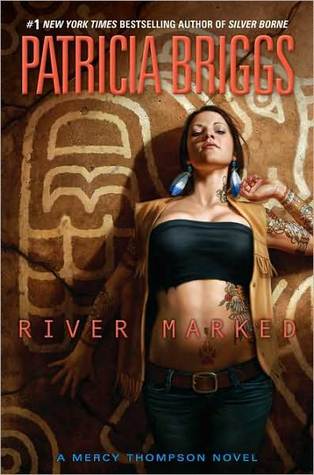
River Marked by Patricia Briggs
Genre: Urban Fantasy
Series: Book 6 of Mercy Thompson
Publisher: Ace (March 1, 2011)
First Read: February 2013
Reread: February 2016
If you haven’t met Mercedes “Mercy” Thompson yet, you’re in for a treat. She’s one of the coolest and most capable urban fantasy heroines I’ve ever encountered. As the owner of an auto-shop in the Tri-Cities area of Washington, she makes a living by fixing Volkswagens and rebuilding vintage cars for sale. In her private life though, she hangs out with vampires, werewolves and fae. Mercy herself happens to a Walker, able to shapeshift into a coyote at will, a power she inherited from her father who died before she was born.
Until now, she thought she was the only one of her kind. But in River Marked we find out this is not the case. After their wedding, Mercy and Adam, the alpha of the Columbia Basin werewolf pack, make their way into the wilderness for their honeymoon in a pimped out fae-borrowed trailer, hoping for some quality alone time in a nice quiet retreat. As usual though, nothing in Mercy’s life ever goes as planned. In the depths of the Columbia River, an ancient evil has awakened and is killing innocent people. Mercy also encounters other walkers for the first time, magical humans like her who can take the form of other animals.
Favorite Moments
~ There were so many great moments in this book, but nothing beats Mercy and Adam finally tying the knot. All their friends and family come together to throw them a “surprise wedding”, playing their roles marvelously as not to alert the bride and groom. As book weddings go, this was one of the best and most memorable. It manages to be sweet and romantic without following any of the conventions, and it’s also touching because it involves all of the couple’s loved ones. I think I like this wedding scene even more the second time around, though I still lament the fact that it was over way too quickly.
~ Honeymooning by camping on the banks of the Columbia River. I love this because it’s just so Mercy and Adam. I can’t picture these two staying at some cushy hotel. Plus, the circumstances were rife for plenty of cute moments. Adam can be overprotective of Mercy to the point of extreme, but there’s no question that he really loves her, and she loves him.
~ The otters. That is all.

~ The encounters with Coyote. In particular, there was one quiet, introspective conversation between him and Mercy by the river that revealed a lot about her roots, and answered many questions about her father. But watch out! They don’t call Coyote a trickster for nothing.
~ Mercy’s ill-fated trip to Walmart. Adam was right to be concerned. After all, you never know what can happen in one of their changing rooms…
~ The final showdown with the river devil itself, which made all the mystery and suspense worth it.
~ And of course, Mercy’s letter to Adam at the end of the book. All I can say is, wow. All the feels. Words cannot describe.
Why I love River Marked…
A lot of people I know who read Mercy Thompson say that River Marked is their least favorite of the series or that it is weaker than many of the other novels…but I can’t disagree more! Sure, it was a little slow to start, but once it the story grabbed me, it grabbed me hard. I felt the series needed this book desperately, for several reasons. First of all, Mercy and Adam get married, putting an end to the tensions and drama between Mercy and other potential suitors for her ONCE AND FOR ALL. I also understand that folks might be disappointed that we don’t get to see much of the supporting cast (because granted, they are part of what makes this series great) but personally, I liked that Mercy and Adam finally got to have their own adventure without interference from the wolf pack or vampires. For this reason, I also felt that River Marked contains the most “stand alone” story line of all the books.
Furthermore, River Marked is an important turning point for Mercy’s character growth. She went through some terrible things in the previous books, and this was a good story for her to look towards the future and start a new chapter in her life. She and Adam get to grow closer, adjusting to each other’s strengths and weaknesses, learning to live together and trust one another. As well, it was high time that her own powers were explored, and for the first time, we got a book completely devoted to Mercy’s heritage. Brigg’s inclusion of Native American mythology and their spiritual stories made this one a fascinating read (and reread)!
Have you read the Mercy Thompson series? Do you have favorite book? What did you think of River Marked? How excited are you for Fire Touched?

River Marked Giveaway
Interested in winning a copy of this book? For this blog tour, the publisher has very generously offered The BiblioSanctum an opportunity to host a giveaway of my chosen Mercy Thompson title! Here’s your chance to win one of two print copies of River Marked by Patricia Briggs. This giveaway is open to residents in the US. To enter, all you have to do is send an email to bibliosanctum@gmail.com with your Name and valid Mailing Address using the subject line “RIVER MARKED” by 11:59pm Eastern time on Sunday, March 13, 2016.
Only one entry per household, please. The two winners will be randomly selected when the giveaway ends and then be notified by email. All information will only be used for the purposes of contacting the winner and sending them their prize. Once the giveaway ends all entry emails will be deleted.
So what are you waiting for? Enter to win! Good luck!
Short & Sweet Novella Review: Blood Follows by Steven Erikson
Posted on March 2, 2016 6 Comments

 Blood Follows by Steven Erikson
Series: The Tales of Bauchelain and Korbal Broach #1
Genre: Fantasy, Novella
Publisher: Night Shade Books
TL;DR Review

Tiara’s Rating: 3.5 of 5 stars. It’s like The Addams Family but with only Gomez, Uncle Fester, and Lurch.

Coming on the heels of my first foray into the Malazan empire (Gardens of the Moon) is Blood Follows, a short novella revolving around events outside the main story. Blood Follows takes place in the town of Lamentable Moll in a region called Theft. Emancipor Reese has lost yet another job as yet another of his employers dies an ill-fated death. Mancy’s, as he’s called by his friends and wife, latest employer becomes the 11th victim to a serial killer stalking the streets of Moll. Having no recourse but to find another job as quickly as possibly–lest he face the wrath of his wife–Mancy answers a warded notice for a manservant to two eccentric necromancers, the scholarly Bauchelain and the large, quiet eunuch Korbal Broach.
I read this as a gateway story while I gear up to read Deadhouse Gates, which is the second book in this Malazan series. Bauchelain, Korbal Broach, and Mancy are only background characters in the main novels, as I understand, so reading about their misadventures before the rest of the novels doesn’t really break anything in the story. This novella proves to be much like Erikson’s main offering, but on a smaller scale. Despite the short length, the book introduces quite a few cast of characters. However, given the short nature of this story, they’re not explored with the same depth. In fact, you pretty much have to make up your own mental image of most of the characters in this novel aside from the three men mentioned. There are some characters who beg for a deeper exploration while some just fall totally flat. That may or may not be a problem depending on your approach to short stories.

Starring Korbal Broach as Uncle Fester and Bauchelain as Gomez.
The plot, while basic, is entertaining enough. The description for this book makes it sound much more dramatic than it actually is, such as saying there was chaos among the people when that’s hardly noted at all in the story. There were ghastly things going on in the story, but nothing ever really felt urgent. I didn’t feel the sense of tension in this story that it was trying to convey. In fact, the murders almost feel secondary to what’s going with the characters in the story, and one of the big reveals in this story just seemed pushed out there without even a real hint that this is what was going on. Mainly, the interest in the story comes from readers meeting the necromancers and their new manservant, and the witticism found throughout this story. The joking nature gives this a sort of dark humor feel which is wildly different from the mostly serious endeavor that is Gardens of the Moon, and for that, I found this story enjoyable.

- Decent place for people who are just wanting a taste of Malazan to start
- A lighter, fun romp in the Malazan Empire (okay, as light as one can get with the Malazan Empire anyway)

- Large cast of characters with barely any descriptors may be a turn off
- Doesn’t really conjure much dread despite it being a murderer on the loose
Waiting on Wednesday 03/02/16
Posted on March 2, 2016 18 Comments

“Waiting On Wednesday” is a weekly meme hosted by Breaking the Spine that lets us feature upcoming releases that we can’t wait to get our hands on!
Mogsy’s Pick:
Willful Child: Wrath of Betty by Steven Erikson: October 18, 2016 (Tor Books)
If you’re looking for a good Star Trek spoof — and a decidedly un-PC one at that — then Steven Erikson has got you covered. Wrath of Betty is the second book chronicling the voyages of the A.S.F. starship Willful Child. Its ongoing mission: to make you laugh, and maybe offend some delicate sensibilities along the way. I gotta say though, “BETTYYYYYYYYYYYYYYYYYYYYY!!!!!” doesn’t quite have the same ring to it.
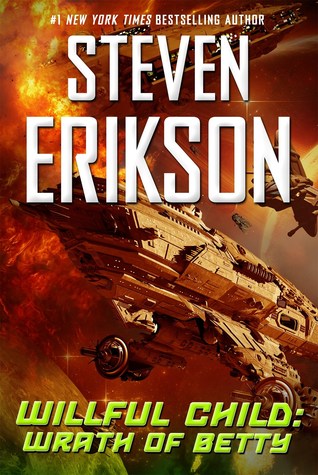 “From New York Times bestselling author Steven Erikson comes a new SF novel of devil-may-care, near calamitous, and downright chaotic adventures through the infinite vastness of interstellar space…
The continuing adventures of the starship A.S.F. Willful Child. Its ongoing mission: to seek out strange new worlds on which to plant the Terran flag, to subjugate and if necessary obliterate new life-forms, to boldly blow the…
And so we join the not-terribly-bright but exceedingly cock-sure Captain Hadrian Sawback and his motley crew on board the Starship Willful Child for a series of devil-may-care, near-calamitous and downright chaotic adventures through ‘the infinite vastness of interstellar space.’
The New York Times bestselling author of the acclaimed Malazan Book of the Fallen series has taken his lifelong passion for Star Trek and transformed it into a smart, inventive, and hugely entertaining spoof on the whole mankindexploring-space-for-the-good-of-all-species-but-trashing-stuff-with-a-lot-ofhigh-tech-gadgets-along-the-way, overblown adventure. The result is an SF novel that deftly parodies the genre while also paying fond homage to it.”
Book Review: The Last Days of Magic by Mark Tompkins
Posted on March 1, 2016 26 Comments
A review copy was provided by the publisher in exchange for an honest review. All opinions are my own.
 The Last Days of Magic by Mark Tompkins
Mogsy’s Rating: 4.5 of 5 stars
Genre: Fantasy, Historical Fiction
Series: Stand Alone
Publisher: Viking (March 1, 2016)
Length: 400 pages
Author Information: Website | Twitter
Diving into a debut novel is always a bit of a gamble, but it can also prove exciting and extremely rewarding—especially when a book ends up surprising me or blowing away all my expectations. These are the moments I live for and this is exactly what I felt with Mark Tompkin’s The Last Days of Magic, a breathtaking historical fantasy saga about mysticism and mythology through the ages.
I am absolutely in love with this novel and its premise, which posits that magic is real but merely forgotten, suppressed and denied. Today we dismiss the tales of the Sidhe as nothing but folklore and legend, but just a few centuries ago humans co-existed with all kinds of supernatural creatures, and in no other place was that bond stronger than in Ireland, the last bastion of magic against the encroaching powers of the Vatican Church. Much of island’s strength comes from the protection of its patron deity the Morrígna, a goddess whose three aspects come together to rule over the Celts and the Sidhe. One of Her aspects resides in the Otherworld as a source of power, while the other two—known as Aisling and Anya—are always reborn in the mortal realm as identical twin girls.
The book begins with the introduction to the last incarnations of the twins Aisling and Anya in the autumn of 1387. But just days before their ascendance ritual to become one with the Goddess, disaster strikes. Without the assurance of the Morrígna on their side, fears begin to rise and alliances start to break down, leading to a weakened Ireland and a fractured Middle Kingdom, which is the home of the Sidhe. Taking advantage of this instability, the Vatican prepares to rid the world of its last remnants of magic by using the forces of King Richard II of England to invade. Thus the story is as much about Aisling and Anya as it is about their protectors, and about Jordan, a mercenary turned Vatican commander who arrives on the shores of Ireland to find that the magic is not all as it seems.
When I’m promised epic historical fantasy, this is exactly the kind of book I’m looking for, pushing the boundaries of multiple genres by blending medieval history, Irish legends, and even Biblical elements. Other religions were mostly stamped out during the Christianization of Europe in the Middle Ages, which serves as the backdrop for The Last Days of Magic. But while this by itself has been a theme in many works of fiction about why real magic has passed from this world, what I find interesting here is foundation for the origins of all supernatural creatures. In this book, magical beings like the Fae (which are typically associated with paganism, earth spirits, and nature worship) also have their roots in Christianity, so that the Sidhe (faeries like the Skeaghshee, gnomes, pixies, fire sprites, leprechauns, dryads, etc.) along with the Elioud (banshees, imps, sirens, goblins, giants, etc.) are all branches of the Nephilim, offspring of humans and fallen angels. Tompkin’s portrayal of the trinity goddess Morrígna as Anann, Aisling and Anya to bring all Irish Fae and humans together adds even more layers to the land’s mysterious and ancient magical customs.
At first, all of this can be a little confusing, and the author’s somewhat pedagogical style also has a tendency to be distracting. He inserts a lot of historical detail, though this isn’t really a criticism since most of the time I find the information helpful and educational. Of more concern is probably the non-linear storytelling. While each chapter is labeled chronologically, within most of these sections are multiple time skips and flashbacks, and it took me several chapters to grow used to this rhythm. Once I got it down though, the story really took off.
Soon enough, this book had me completely captivated. In light of my observations about the writing, I was actually a little surprised at how quickly I took to the characters. I wouldn’t have thought Tompkin’s seemingly didactic style would translate all that well to deep and engaging characterization, but in truth his storytelling is remarkably expressive. There are a lot of players in this book, some fictional and some not, but they are all shaped very convincingly by the story’s events. This is especially true of Aisling, who had her entire worldview ripped away from her on the day she lost everything she loved. Her tale is a tragic one, but after a while Jordan also emerges as a more prominent figure. His role to seek knowledge goes a long way in transforming the narrative by giving it a more hopeful tone. I also enjoyed seeing how everything that happened in this story was placed in a historical context, including all the magically-infused scenarios—a testament to the amount of research that must have gone into the writing of this novel.
All that’s left to say is bravo! The Last Days of Magic is everything I want in a historical fantasy, offering a tale that sparks the imagination and explores the multilayered relationship between truth and myth. Mark Tompkins has created an incredible world filled with vivid characters, capturing the complex nature of faith, love, and conflicting loyalties. A stunning, evocative debut.

Book Review: Ex-Isle by Peter Clines
Posted on February 29, 2016 10 Comments
A review copy was provided by the publisher in exchange for an honest review. All opinions are my own.
Mogsy’s Rating: 4 of 5 stars
Genre: Horror, Sci-Fi Fantasy
Series: Book 5 of Ex-Heroes
Publisher: Broadway Books (February 2, 2016)
Length: 400 pages
Author Information: Website | Twitter
This is probably my favorite book of the series so far! Ex-Isle, the fifth book in the Ex-Heroes series (which I like to describe to others as “Superheroes meets The Walking Dead”) brings things back on track. I’ve never felt more energized about these books than I do now.
The story takes us back to the Mount, a film studio in Hollywood that the survivors of zombocalypse has converted into a fortress to keep out the hordes of undead. The people of Los Angeles have fared better than most, thanks to a small team of super-powered individuals on their side. St. George, a hero somewhat analogous to Superman, has helped protect everyone by establishing a safe haven where humanity can still work, play, farm and forage.
But then disaster strikes, destroying much of the Mount’s sources of food, forcing the heroes to consider riskier solutions to make up for the loss. In the end, a team including Danielle, Cesar and their powered suit of armor known as Cerberus (yes, my first thought was Iron Man too) head out to the outskirts in an effort to find more ways to produce food.
Meanwhile, Zzzap returns from a scouting trip with some big news: he has found a man-made island in the middle of the Pacific Ocean, constructed by cobbling together a bunch of boats (in his words, “It’s kind of like Waterworld. But, y’know, believable.”) Deciding that the Mount should offer whatever help they can provide, St. George accompanies Zzzap back to the island in a gesture of goodwill, bringing Corpse Girl along for the adventure. When the heroes arrive though, they find a less than friendly welcome; in fact, everyone on the island seems to think L.A. has been nuked along with the rest of the world, and no one believes that St. George is who he says he is. Worse, they all appear to be ruled by a paranoid Aquaman-type character named Maleko.
After reading Ex-Isle, I was excited and also relieved that the slump I experienced with the last book was only temporary. Ex-Purgatory was a strange book that took us briefly in a different direction, which didn’t work as well for me compared to the other novels in the series, so now I’m glad to see all my favorite zombie-fighting heroes in action again. There are two story threads running along here side-by-side, the one where Danielle and the others are in Eden helping out with the food situation, and then there’s the one with St. George, Zzzap and Corpse Girl in Lemuria, the island made of boats. Both are equally gripping and suspenseful, and I fell into the rollicking rhythm of the novel almost instantly.
What I loved most about this book is the unsettling sense of mystery that pervades both storylines. Up in Eden, the team of super soldiers who are supposed to be watching out for zombies are instead acting really strange, and people are getting suspicious. This story is made even better by Danielle, who is trying to figure out what’s going on, but her progress is agreatly hampered by her struggle with PTSD and her separation anxiety from the Cerberus armor. And speaking of Danielle, over the course of the series we’ve seen the books focus on the individual characters, exploring their personalities and backgrounds, but this is the first time I’ve truly felt that kind of character development take off. Don’t get me wrong, because I love this series; it’s humorous and entertaining, but admittedly, that tone has always made it hard to connect with the characters on a deeper level—especially when most of them can be seen as parodies of well-known Marvel and DC superheroes. However, Danielle in Ex-Isle became a genuinely interesting and sympathetic character, and in her I finally found the deeper connection I’ve been looking for in this series.
The storyline in Lemuria was also excellent fun. The suspense and mystery go into overdrive here, making you wonder every step of the way, “Just what is going on here?” The heroes have to deal with a new antagonist and all his dangerous and evilly underhanded tactics. Barry/Zzzap is hilarious as always, and Corpse Girl AKA Madelyn also gets to have a starring role, proving herself to be one of the more fascinating characters with bizarre “power”.
I also liked how this book was more structured. Peter Clines wrote in a note at the end that unlike the other volumes, he had to rush this one, and because of that, it was outlined to oblivion. It’s understandable why that didn’t work too well for him as a writer. Strangely though, it worked for me as a reader. I enjoyed how the story was more focused and streamlined, and the pacing was smoother because we had fewer flashbacks. Even though we didn’t get to see much of the other heroes—like Stealth or Captain Freedom—the characters that we did get to spend time with were better written and more developed.
Overall, this was a big winner for me. I feel like the series is finally hitting its stride, and that going forward, we’re going to be seeing even greater things. I’m so glad Clines is writing more of these books, and I can’t wait for the next one.
More on The BiblioSanctum:
Review of Ex-Communication (Book 3)
Review of Ex-Purgatory (Book 4)
Graphic Novel Review: Star Wars: Shattered Empire by Greg Rucka, Marco Checchetto, Phil Noto
Posted on February 29, 2016 6 Comments
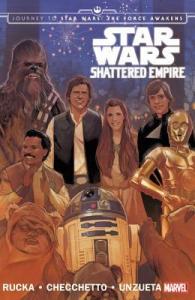 Star Wars: Shattered Empire by Greg Rucka, Marco Checchetto, Phil Noto
Genre: Space Opera, Science Fiction
Series: Journey to Star Wars: The Force Awakens
Publisher: Marvel Comics (November 2015)
Author Info: gregrucka.com
Artist Info: philnoto.tumblr.com
Artist Info: marvel.com/comics/creators/11748/marco_checchetto
Wendy’s Rating: 4 of 5 stars

If you go by what many fictional stories tell us, when the bad guy is defeated, you mourn your dead and then you throw a party. That’s not how reality works. Just ask the soldiers and civilians in Afghanistan and Iraq and so many other places where the war never ends, even when it’s over.
Of course, we don’t want our entertainment reflecting that reality. We don’t want to sit through Frodo moping around in the burning Shire, or Ender raging against that genocide he was tricked into causing. So what if this is the culmination of the heroes journey according to Joseph Campbell. We don’t want to see the sad parts.
Return of the Jedi ended with a party at Ewokville and we were all invited. Yub nub, bitches!

War’s over. Everybody go home.
But in Shattered Empire, Rucka reminds us of the harsh truth: the war isn’t over till the fat ewok sings (which we see hasn’t really happened 30 years later in TFA). And he also reminds us that the faces at the front aren’t the only heroes.
Shattered Empire drops us right outside the Emperor’s door as Han’s team struggles to collapse the shields around the Death Star and the pilots desperately try to protect the rebel ships from the trap they’ve flown into. On the ground, we meet Kes Dameron, but the focus of the series is above, on pilot Shara Bey.
Each issue features a mission starring one of the Star Wars faces we know, and Bey is swept along or volunteers. She is the quintessential soldier who does her job and does it well, and wants to fight the good fight, but she also struggles with her desire to leave it all behind and just go farming with her husband, Kes, and their young son, Poe, and the subsequent guilt that brings.
The stories themselves are a bit sparse, but I’m happy to fill in the blanks of Poe Dameron’s backstory, especially as it complements his story in Star Wars: Before the Awakening. I read the latter first and was particularly moved by Poe’s story because of how painfully bittersweet it is. We know Poe as the fun, passionate uber pilot, but these stories give him a bit more depth and sadness through his parents’ fears that everything they fought and people died for was for nothing. The series started with A New Hope, but, despite the ewok party, hope might not be enough. With all the flash and fanfare of TFA in the theatre, scratch the surface and you find a war that hasn’t ended, even after 30 years. Is there still hope? Is there still a point to hoping? Of course there is. The good guys always win, right?
 The collected edition also includes Princess Leia #1, where Leia finds herself without a home or a role in the rebellion and the few of her people that remain don’t think too highly of her ice queen persona. Why doesn’t she grieve, they wonder? As if everyone must grieve in the same way. Leia imposes herself on an Alderaanian pilot named Evaan with whom she wants to be friends, though the woman keeps herself at a carefully caustic subservient distance.
When I was younger, it never dawned on me that Leia might be a little messed up after watching her entire planet destroyed. She got over it and went on to be awesome, right? Now, I’m quite happy that books explore her PTSD or apparent lack thereof, such as Martha Wells’ Razor’s Edge.
And finally, there’s the 1977 original Marvel retelling of Star Wars: A New Hope where Luke Skywalker looks a lot like He-Man and stormtroopers are a lot more acrobatic.

Book Review: Kingfisher by Patricia A. McKillip
Posted on February 28, 2016 16 Comments
A review copy was provided by the publisher in exchange for an honest review. All opinions are my own.
 Kingfisher by Patricia A. McKillip
Mogsy’s Rating: 3.5 of 5 stars
Genre: Fantasy
Series: Stand Alone
Publisher: Ace (February 2, 2016)
Length: 352 pages
Author Information: Website
Kingfisher is not your everyday fantasy, nor is it the kind of book I usually enjoy. Blurring the lines between genres, this ethereal and strangely abstract tale should have stymied me on so many levels, so no one is more shocked than I am at how deeply it resonated with me. It shouldn’t have worked for me—and in truth, not every aspect of the story did—but I did find certain elements greatly appealing.
It helped too that I went into this book with no preconceptions and absolutely no clue what to expect at all. So I was surprised to discover early on that Kingfisher appears to be a retelling of—or at least, a story with many allusions to—the quest for the Holy Grail. It occurred to me then, that in spite of the popularity of stories about King Arthur and the knights of his court, I’ve not actually read much Arthurian fantasy. That being said, it doesn’t taken an expert to see that McKillip’s take on the genre is special, wildly inventive, and atypical of many others.
The beginning of the book can only be described as abrupt, introducing us to Pierce Oliver in a brief scene helping out a group of strangers with directions as they pass through his remote home town of Mistbegotten. He is immediately inspired by the men’s sophisticated bearing and mystical aura, much like how Percival in the legend was struck by the heroism of the knights after he encountered a band of them in the forest where he lived. Pierce/Percival then leaves home for a bit of soul-searching, after his mother reveals that his father is a knight in the King’s Court.
As Pierce travels to the kingdom of Severluna where King Arden holds his court, the tides are changing there as well. With magic on the rise, the king has called for all his knights to gather. An artifact of immense power has been brought to his attention, believed to hold the key to restoring Severluna’s glory. When Pierce arrives, he finds everyone in the kingdom preparing for the quest to find this legendary vessel, including the priestesses of Calluna who go against the king in believing that the lost artifact is destined for something else.
There’s almost a “magical realism” vibe to this story, though I use that description broadly; in parts, the world of Kingfisher veers so strongly into the realm of fantasy that the world can be seen as anything but natural or mundane. It should also come as no surprise that my favorite parts of this novel all had to do with the aforementioned allusions to the legends surrounding King Arthur and the Grail Quest. Retellings or so-called creative re-imaginings are always fascinating to me because of the potential for an author to take the story in a number of different directions, and here we have a somewhat offbeat mix of Medieval Fantasy meets Modern World. The source of inspiration behind Pierce Oliver’s personal journey is obvious, though there were many more references beyond that.
In fact, after a while it became difficult to separate myth from reality. I had a really hard time getting a bead on the nature of the setting, which sees characters using modern technology like cellphones on the one hand, but they also don’t seem to think knights, sorceresses, or magic are anything out of the ordinary on the other. By design or otherwise, the world-building is vague and has this almost dreamlike quality, and at many points I found myself wondering if we were still playing to the Arthurian tropes or leaving them completely behind for uncharted territory. There were also moments where I felt like I was in way over my head, especially where certain characters were concerned, like Carrie’s storyline and her role in the bitter feud between Todd Stillwater and the Kingfisher Inn.
And then there was the food. The mouth-wateringly, gorgeously, meticulously described food. Delicious as it all sounded, it felt incongruous and distracting, considering how everything else in the book—characters, world-building, etc.—lacked a similar level of detail.
These obstacles notwithstanding, I nevertheless found a lot to like about Kingfisher, and felt myself drawn to many parts of the story. This is the first book I’ve ever read by Patricia A. McKillip, and I am glad I’ve finally gotten to experience her beautiful and expressive style for myself. Admittedly there were moments where I struggled to connect with the characters in this surreal fantasy world that she has created, but still I just can’t help but love the astonishingly unique way she has transformed the classic King Arthur mythos.

*** Originally reviewed at The Speculative Herald ***
March/April/May Read-Along Schedule
Posted on February 27, 2016 8 Comments

Here at The Bibliosanctum, we enjoy interacting with others around reading and our busy mom lives. Read-Alongs provide a perfect opportunity for us to interact with other readers and dive into books on our backlist. For more information about any of these Read-Alongs or to see what else everyone is reading, please visit the SF/F Read-Alongs Goodreads group.
March
Continuing on to the second book, Lisa at Over the Effing Rainbow has organized a read-along for A Local Habitation by Seanan McGuire (October Daye #2). A group of us read the first book in January and had a fun time.
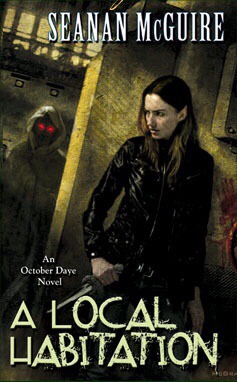 October “Toby” Daye is a changeling, the daughter of Amandine of the fae and a mortal man. Like her mother, she is gifted in blood magic, able to read what has happened to a person through a mere taste of blood. Toby is the only changeling who has earned knighthood, and she re-earns that position every day, undertaking assignments for her liege, Sylvester, the Duke of the Shadowed Hills.
Now Sylvester has asked her to go to the County of Tamed Lightning—otherwise known as Fremont, CA—to make sure that all is well with his niece, Countess January O’Leary, whom he has not been able to contact. It seems like a simple enough assignment—but when dealing with the realm of Faerie nothing is ever as simple as it seems. Toby soon discovers that someone has begun murdering people close to January, whose domain is a buffer between Sylvester’s realm and a scheming rival duchy. If Toby can’t find the killer soon, she may well become the next victim.

Week 1: Saturday 5th March, Chapters 1-8 hosted by Over The Effing Rainbow
Week 2: Saturday 12th March, Chapters 9-16 – hosted by Lynn’s Book Blog
Week 3: Saturday 19th March, Chapters 17-25 – hosted by Books By Proxy
Week 4: Saturday 26th March, Chapters 26-end – hosted by The Bibliosanctum
April
Coming up in April, I plan to knock another book off my TBR pile with The Lies of Locke Lamora by Scott Lynch (Gentlemen Bastards #1) read-along hosted by Imyril at OneMore.org. This one is still looking for hosts, so if you’re interested, be sure to visit the group and pitch in.
 In this stunning debut, author Scott Lynch delivers the wonderfully thrilling tale of an audacious criminal and his band of confidence tricksters. Set in a fantastic city pulsing with the lives of decadent nobles and daring thieves, here is a story of adventure, loyalty, and survival that is one part “Robin Hood”, one part Ocean’s Eleven, and entirely enthralling… An orphan’s life is harsh — and often short — in the island city of Camorr, built on the ruins of a mysterious alien race. But born with a quick wit and a gift for thieving, Locke Lamora has dodged both death and slavery, only to fall into the hands of an eyeless priest known as Chains — a man who is neither blind nor a priest.
A con artist of extraordinary talent, Chains passes his skills on to his carefully selected “family” of orphans — a group known as the Gentlemen Bastards. Under his tutelage, Locke grows to lead the Bastards, delightedly pulling off one outrageous confidence game after another. Soon he is infamous as the Thorn of Camorr, and no wealthy noble is safe from his sting.
Passing themselves off as petty thieves, the brilliant Locke and his tightly knit band of light-fingered brothers have fooled even the criminal underworld’s most feared ruler, Capa Barsavi. But there is someone in the shadows more powerful — and more ambitious — than Locke has yet imagined.
Known as the Gray King, he is slowly killing Capa Barsavi’s most trusted men — and using Locke as a pawn in his plot to take control of Camorr’s underworld. With a bloody coup under way threatening to destroy everyone and everything that holds meaning in his mercenary life, Locke vows to beat the Gray King at his own brutal game — or die trying…
Week 1: Thursday 7th April, Prologue & Book 1 – Ambition / Ch 1-3
Week 2: Thursday 14th April, Book 2 – Complication / Ch 4-6
Week 3: Thursday 20th April, Book 2 – Complications / Ch 7-8 & Book 3 – Revelation / Ch 9-11
Week 4: Thusday 27th April, Book 4 – Desperate Improvisation & Epilogue
May
Honestly, I don’t remember putting Between Two Thorns by Emma Newman (The Split Worlds #1) on my TBR pile, but it’s there. I go on blind book sprees and blackout, so it probably ended up there in one of those moments. LOL. This read-along is hosted by Lisa at Over the Effing Rainbow.
 The new season is starting and the Master of Ceremonies is missing. Max, an Arbiter of the Split Worlds Treaty, is assigned with the task of finding him with no one to help but a dislocated soul and a mad sorcerer.There is a witness but his memories have been bound by magical chains only the enemy can break. A rebellious woman trying to escape her family may prove to be the ally Max needs.
But can she be trusted? And why does she want to give up eternal youth and the life of privilege she’s been born into?
Week 1: Monday 9th May: Chapters 1-9, hosted by Over The Effing Rainbow
Week 2: Monday 16th May: Chapters 10-18, hosted by On Starships and Dragonwings
Week 3: Monday 23rd May: Chapters 19-25, hosted by OneMore.org
Week 4: Monday 30th May: Chapters 26-End, hosted by Lynn’s Books
Hope to see some of you participating!

Mogsy’s Bookshelf Roundup: Stacking the Shelves & Recent Reads
Posted on February 27, 2016 33 Comments
Bookshelf Roundup is a feature I do every other weekend which fills the role of several blog memes, like Stacking the Shelves where I talk about the new books I’ve added to my library or received for review, as well as It’s Monday! What Are You Reading? where I round up what I’ve read since the last update and what I’m planning to read soon. Mostly it also serves as a recap post, so sometimes I’ll throw in stuff like reading challenge progress reports, book lists, and other random bookish thoughts or announcements.

Received for Review
The last couple of weeks have been really great! While I’ve not closed myself off from review books all together, I’m happy to chime in with a lighter update today, pretty much ensuring that I can get to everything in my TBR in good time and give myself some wiggle room to read some of the interesting unsolicited arrivals. Speaking of which, I’d definitely like to check out a lot of the books received for review consideration this week. My thanks to the publishers!

The Demonists by Thomas E. Sniegoski – I was really excited to be offered a review copy of this. An urban fantasy/horror about an exorcism gone wrong and the unleashing of demons upon the world? It doesn’t get better than that! My thanks to Roc for the ARC. Be sure to keep an eye out for the review and a giveaway in early April!
Character, Driven by David Lubar – Contemporary YA isn’t my usual genre, but I love Tor Teen and will check out anything they pub. This coming-of-age book sounds like an interesting tale, starring a clever but awkward protagonist surviving high school and girls armed only with his quirky sense of humor. My thanks to the publisher!
The Immortals by Jordanna Max Brodsky – I’ve already reviewed the audio edition of this marvelous book, but last week this surprise hardcover also showed up in the mail. A big thanks to Orbit for totally making my day! I simply adored this one, so I’m overjoyed to have a finished copy.
Brotherhood of the Wheel by R.S. Belcher – R.S. Belcher is really going places! This week I was excited to receive a finished copy of his newest book, courtesy of Tor. I’ll also be taking part in the coverage for it early next month with a review and a fun giveaway! So stay tuned…
Black City Saint by Richard A. Knaak – A finished copy of this book also showed up last week, courtesy of the awesome folks at Pyr. Black City Saint is one of the books I’m hoping to make time for later this month! Really looking forward to checking it out.
Spear of Light by Brenda Cooper – Another surprise arrival, but I am super psyched about this one! Spear of Light is the follow up Cooper’s brilliant Edge of Dark, a book I really enjoyed last year — and I think it’s totally underrated. I’ve been waiting for this sequel for a long, long time. Thank you so much, Pyr Books!
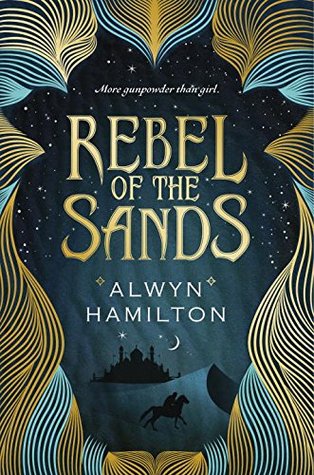


Rebel of the Sands by Alwyn Hamilton – I should have banned myself from requesting any more eARCs, after my last update which saw my digital review pile explode. But when I saw Rebel of the Sands being offered on Penguin’s First to Read, I just couldn’t help it! It’s on my most anticipated list for this spring, and I’m hoping it’s going to be great.
Calamity by Brandon Sanderson – The long awaited conclusion to the Reckoners series is finally here! Audible Studios was so kind as to send me the audiobook for review, which I’ve already finished because I can never wait that long to dive into anything by Brandon Sanderson. The review will be up soon.
HEX by Thomas Olde Heuvelt – This one also fills me with curiosity and excitement. I’ve already read more horror in 2016 than I had at this time in 2015, simply because there’s been so many great releases in the genre so far this year. The description of HEX caught my attention from the outset, and the original release in Dutch is already a bestseller garnering a lot of praise. There’s always the question of how well it’ll translate, but I am so looking forward to diving in. My thanks to Tor for sending me a NetGalley invite!
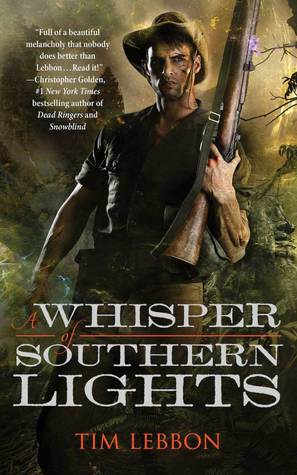
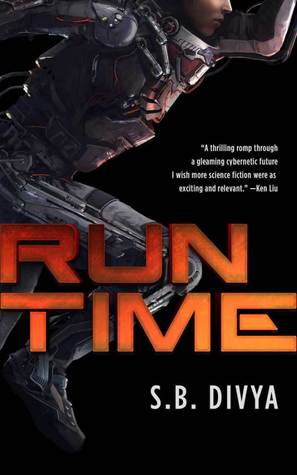
Return of Souls by Andy Remic, A Whisper of Southern Lights by Tim Lebbon, Runtime by S.B. Divya – More e-goodies in my inbox this week, with thanks to Tor.com! All their novellas look amazing, and these ones are no exception. Their stories sound so good, I don’t even know where to start.
Reviews
Here are all my reviews since the last update, gathered together and listed here for your convenience and viewing pleasure. The YA mini reviews have also been included.
Alcatraz vs. The Evil Librarians by Brandon Sanderson (5 of 5 stars)
The Immortals by Jordanna Max Brodsky (5 of 5 stars)
A Head Full of Ghosts by Paul Tremblay (4.5 of 5 stars)
The Scrivener’s Bones by Brandon Sanderson (4 of 5 stars)
Morning Star by Pierce Brown (4 of 5 stars)
Good Girls by Glen Hirshberg (3.5 of 5 stars)
Starborn by Lucy Hounsom (3.5 of 5 stars)
Son of the Morning by Mark Alder (3.5 of 5 stars)
Gathering Darkness by Morgan Rhodes (3 of 5 stars)
End of Days by Susan Ee (3 of 5 stars)
The Brimstone Deception (3 of 5 stars)
Unhooked by Lisa Maxwell (2.5 of 5 stars)
The Winner’s Crime (2.5 of 5 stars)
What I’ve Read Since the Last Update
I’m hoping to get the reviews of the following books written and posted soon (if they aren’t up already), but I do want to take the time to highlight The Last Days of Magic, which completely blew me away! Other reads that stood out include Dragon Hunters which I enjoyed a lot, more so than the first book. I also read Fire Touched, and to celebrate its release in early March I’ll be taking part in a Reread Blog Tour of the Mercy Thompson series – so watch for my part of that next week, and the special giveaway that will be featured with it! All in all, I’m feeling well on track.

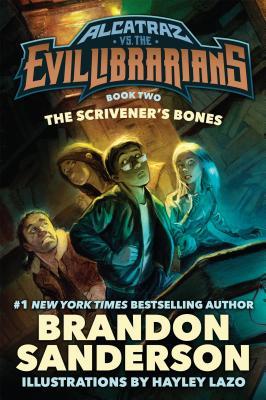
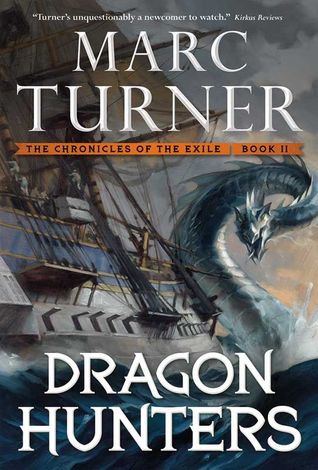

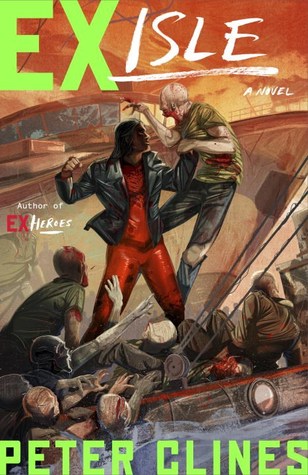
Have you heard of or read any of the books featured this week? What caught your eye? Any new discoveries? Nothing makes me happier than sharing my love for books, so let me know what you plan on checking out. I hope you found something interesting for a future read! Until next time, see you next Roundup! 🙂


 The BiblioSanctum