YA Weekend Audio: Sightwitch by Susan Dennard
Posted on February 3, 2018 15 Comments

I received a review copy from the publisher. This does not affect the contents of my review and all opinions are my own.
Mogsy’s Rating (Overall): 4 of 5 stars
Genre: Fantasy, Young Adult
Series: Book 0.5 of The Witchlands
Publisher: Listening Library (February 13, 2018)
Length: 7 hrs and 18 mins
Author Information: Website | Twitter
Narrators: Cassandra Campbell, Bahni Turpin, Saskia Maarleveld, full cast
I don’t know what it is about the Witchlands series, but both novels that are out thus far have received middling ratings from me when I reviewed them, and yet I just keep coming back for more! Still, if I had to guess, I would credit the simply sublime world Susan Dennard has created. Say what you will about her storytelling and characters, but the incredible imagination and effort that she has put into the world-building here is second to none. I probably would have continued the series anyway, so when I found out about this prequel novella which serves “as a set up to Bloodwitch as well as an expansion to the world”, I thought it would make sense to read it and learn more about the magic while waiting for the next novel installment.
Sightwitch takes place approximately a year before the main series starts, following a Sightwitch Sister named Ryber Fortiza (whom we first met aboard Prince Merik’s ship, if you’ve read Truthwitch). Told through a series of journal entries and other pieces of documents, her story will take us on an adventure into the mountain which houses the convent of her order, a close-knit sisterhood that worships the goddess Sirmaya.
They say Sightwitches are made, not born. Young acolytes serving at the temple are eventually called to receive the gift of Sirmaya, becoming blessed with her Sight. For years, Ryber’s mentors have told her that she is special, that one day she will be called under the mountain and become one of the greatest Sightwitches to have ever lived. But day after day, as others are called forth and not her, her hope begins to fade. As someone who always follows the rules, Ryber can’t seem to figure out what’s wrong or what more she could be doing to get her goddess to summon her.
Then one day, everything changes. Sirmaya still does not call upon Ryber, but she does call upon everyone else. Ryber’s threadsister Tanzi was the first to go beneath the mountain and not return, and after that, more are taken each day until Ryber is the only one left. Something is happening to the goddess, and it is now up to Ryber to seek the truth.
Despite being a minor character in the main series, Ryber has always been a fascinating figure. We also know relatively little about her, so a novella telling her story was a very welcome addition. Not only does it reveal a lot about our protagonist’s life before Truthwitch, it also tells the origin story of how she became a Sightwitch Sister. The presentation of the novel was a nice touch as well, with the journal entries giving insight into Ryber’s unique voice. The in-depth exploration into her character gave me a better understanding of her motivations, and I liked how I got to see the way she viewed herself and how others viewed her.
The other major highlight of Sightwitch is, of course, the scene detailing the first meeting between Ryber and Kullen, the threadbrother of Prince Merik. The young man had somehow found himself deep underground, lost and bedraggled with no memory of how he got there. Terrified of this dirty and scary looking stranger who seemed to have appeared out of nowhere, Ryber is reluctant to have anything to do with Kullen at first, but eventually she realizes they must work together in order to survive the many obstacles beneath the Sightsister mountain. Gradually, a friendship develops between them, and considering the limitations of the format and length of this novella, I felt this portrayal was done exceptionally well.
I also loved the magic in this. The world of The Witchlands is filled with many types of witches—individuals who possess the power to manipulate the forces and elements around them. These powers, called “witcheries”, can manifest in different ways, with some being rather straightforward (like an Airwitch’s ability to control wind and air currents) and others being quite complex and abstract (such as a Threadwitch’s power to allow him or her to read people’s emotions and see the literal ties that bind relationships). I’ve always felt that Sightwitch magic falls in the latter camp of being one of the more unique and complicated witcheries. The world-building is as exquisite as ever as we explore the mysteries of the Sight in Ryber’s story, learning the ways of the Sightwitch convent and the way Sisters are called forth to receive Sirmaya’s gift. With each chapter, our understanding of the Witchlands universe grows a little more.
What surprised me most about Sightwitch was how much I actually enjoyed it. Typically, I find most novellas to be too short for much story or character development, but in the case of Sightwitch, it worked well. There’s enough to feel a connection with the characters even if you are newcomer to this world, and the story was also relatively straightforward, so the more streamlined the better. I think overall this has given me a new enthusiasm for the series, and I look forward to seeing how everything will play out once we get back to the main novels.
Audiobook Comments: The Sightwitch audiobook is narrated by a full cast—a rare treat, especially for a relatively short piece like this. The voice actors and actresses were chosen well; everyone performed marvelously with varied accents, tones, feelings, and inflections. The only downside is that the print edition contains some art and illustrations so you’ll be missing out on those, but otherwise I would highly recommend the audio.


More on The BiblioSanctum:
Review of Truthwitch (Book 1)
Review of Windwitch (Book 2)
Friday Face-Off: Psychedelic
Posted on February 2, 2018 21 Comments
Welcome to The Friday Face-Off, a weekly meme created by Books by Proxy! Each Friday, we will pit cover against cover while also taking the opportunity to showcase gorgeous artwork and feature some of our favorite book covers. If you want to join the fun, simply choose a book each Friday that fits that week’s predetermined theme, post and compare two or more different covers available for that book, then name your favorite. A list of future weeks’ themes are available at Lynn’s Book Blog.
This week’s theme is:
“Lucy in the Sky with Diamonds”
~ a cover that is PSYCHEDELIC
Mogsy’s Pick:
The Hike by Drew Magary
For a psychedelic cover, I turned to a psychedelic book. I’m still pretty sure any attempt to summarize The Hike will sound like the mad ramblings of someone on a bad acid trip. The protagonist is Ben, a suburban middle-aged family man who takes a business trip up to rural Pennsylvania and books himself into his hotel. Before heading out to his dinner meeting though, he decides to explore around the area with a short hike. He sets off into the nearby woods, following a path he has chosen. Before long, he is beset upon by hulking man wearing the skinned-off face of a dog as a mask. Then there are more of them after him. Ben ends up running away, stumbling upon a campsite among the trees, and suddenly he is in his twenties again, staring into the face of his old college girlfriend. They sleep together and Ben wakes up. He’s back to his normal thirty-eight-year-old self again, with all his correct memories. But he’s still in the woods, and the girl is gone. All that’s left is a note at the empty camp which reads: “Stay on the path, or you will die.”
Oh, Ben stays on the path, all right. Along the way, he meets a talking crab, who lends him help. Then he’s kidnapped by a man-eating giantess named Fermona, who forces him to fight Rottweiler-men and dwarves in her gladiatorial arena. Soon, he is given a mission: to find someone known as The Producer, supposedly the creator of this crazy world he’s found himself in.
Let’s take a look at the covers:
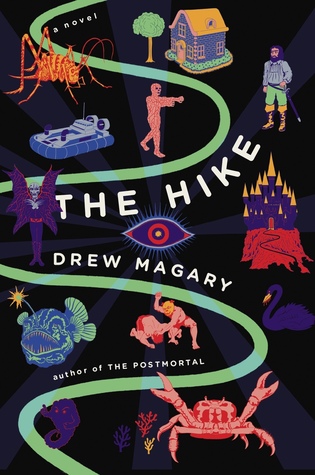
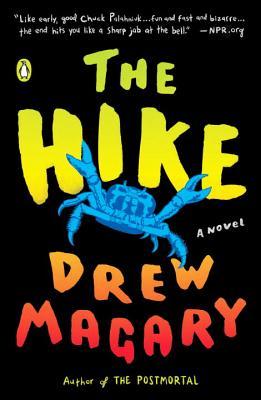
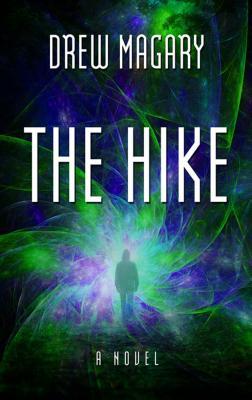
From left to right, top to bottom: Viking (2016) – Penguin Books (2017) – Thorndike Press (2017) – Chinese Edition (2017)

Winner:
Slim pickings this week, and I’m not really a fan of any of them so the winner is automatically the version I own, the Viking hardcover!
But what do you think? Which is your favorite?
Audiobook Review: The Gone World by Thomas Sweterlitsch
Posted on February 1, 2018 23 Comments
I received a review copy from the publisher. This does not affect the contents of my review and all opinions are my own.
 The Gone World by Thomas Sweterlitsch
Mogsy’s Rating (Overall): 3.5 of 5 stars
Genre: Science Fiction
Series: Stand Alone
Publisher: Penguin Audio (February 6, 2018)
Length: 13 hrs and 37 mins
Author Information: Website | Twitter
Narrator: Brittany Pressley
The Gone World follows protagonist Shannon Moss, who belongs to a top-secret division within the Naval Criminal Investigative Service. On paper, her job is to investigate any criminal activities involving members of the US Navy or Marine Corps, but behind the scenes, her duties involve a whole lot more, including traveling through time to search for clues in a myriad of possible futures. It’s dangerous work, and years ago she even lost her leg to frostbite while on an assignment exploring the wintry landscape of a future Earth.
Moss’s “own” time is 1997, the year she receives a case to track down a missing teenage girl named Marian whose mother and brother have been brutally murdered. The main suspect is a former Navy SEAL, who Moss discovers, with some shock, was part of the Naval Space Command program, stationed aboard a spaceship assumed lost on a classified mission. Knowing how the stresses of traveling through space and time can push a person to the edge, Moss suspects a deeper connection. Now she will need to jump ahead to a possible future Earth to see if Marian’s disappearance has made any ripples, so that Moss might trace the events backwards to discover what happened to the girl.
But for a while now, the NSC has also been aware of an event known as the Terminus, which will bring about the end of the world and all reality as we know it. The date of the Terminus, however, is not set; every time Moss makes the jump to the future and returns to the present, she receives news that the Terminus has moved up a few more years, drawing ever closer.
This novel is a sci-fi crime thriller with time travel thrown into the mix, so you just know the story will be a little wild. It can also be quite confusing—but again, that’s almost par for the course when it comes to time travel fiction. Everything is connected somehow, and as readers, we must keep track of the times Moss travels to the future, how long she stays, the people she talks to, and the information she gleans. Just to make it even more complicated, every time Moss jumps forward and comes back, the future she visits “blinks” out like it never happened (or maybe that should be “will never happen”?) and anyway, all her futures are possibilities only, not certainties. If your head isn’t exploding yet, there’s more: Echoes. These are individuals brought back from the possible futures, doubling someone already living. This aspect plays a big role in the story, so I won’t say more on the topic. The point though, is that The Gone World is a story of many different components, which Sweterlitsch juggles like a performer spinning plates on sticks, trying to keep them all up in the air and moving at once. If you’re not prepared to have your mind twisted, of if you’re in the mood for something lighter, then this is not a book for you.
This is also the second novel I’ve read by the author, so to some extent, I knew what I would be getting in terms of the tone of the story and writing style. In a word, it’s dark. Really dark. Like Sweterlitsch’s first novel Tomorrow and Tomorrow, we’re talking an extremely bleak worldview, where the threat of the Terminus is always present and encroaching on our minds. Some of Moss’s memories and her disturbing visions also have the quality of a nightmare, and the prose frequently utilizes imagery that is once painfully beautiful and viscerally horrifying.
As much as I enjoyed this novel though, there are a few caveats. The raw, gritty, and depressing mood aside, I’m not sure the book got its ultimate point across successfully. The story might have lost its hold on me at the end, crushed by the weight of its own ideas and growing a little too unwieldy for the plot structure to support. As well, I still have no idea how a lot of the science or the mechanics behind the technology in the novel really work; the author doesn’t make much of an effort to explain. One can argue all that is secondary to the main story, but I think it would have helped to get at least some background on the secret NSC space program and the history of how time travel was ultimately achieved.
But all in all, I enjoyed this. It’s smart, imaginative, and so edgy it could cut. I liked following our compelling protagonist, watching all the pieces come together (and sometimes get torn apart) against a backdrop of drama, action, and thrilling suspense. I would recommend this for time travel fiction fans and sci-fi mystery lovers, especially if you’re looking for a challenging, mind-bending read.
Audiobook Comments: Brittany Pressley was a wonderful narrator, successfully portraying a large cast of characters of different ages, different backgrounds, and different times. She used accents to great effect for several of them, creating a very immersive experience for the listener. She had a great voice for the book too, perfectly capturing its grim and dark tone.

Waiting on Wednesday 01/31/18
Posted on January 31, 2018 19 Comments

“Waiting On Wednesday” is a weekly meme that first originated at Breaking the Spine but has since linked up with “Can’t Wait Wednesday” at Wishful Endings now that the original creator is unable to host it anymore. Either way, this fun feature is a chance to showcase the upcoming releases that we can’t wait to get our hands on!
Mogsy’s Pick
The Winter of the Witch by Katherine Arden (August 14, 2018 by Del Rey)
Don’t you just love it when you finish a great book, then not have to wait for long for info about the sequel? I read The Girl in the Tower a couple months ago, and now the cover for The Winter of the Witch is already here. Very excited for this conclusion of the Winternight trilogy!
 One girl can make a difference…
Moscow has burned nearly to the ground, leaving its people searching for answers – and someone to hold accountable. Vasya finds herself on her own, amid a rabid mob that calls for her death, blaming her witchery for their misfortune.
Then a vengeful demon returns, renewed and stronger than ever, determined to spread chaos in his wake and never be chained again. Enlisting the hateful priest Konstantin as his servant, turmoil plagues the Muscovites and the magical creatures alike, and all find their fates resting on the shoulders of Vasya.
With an uncertain destiny ahead of her, Vasya learns surprising truths of her past as she desperately tries to save Russia, Morozko, and the magical world she treasures. But she may not be able to save them all…”
Book Review: Iron Gold by Pierce Brown
Posted on January 30, 2018 30 Comments
I received a review copy from the publisher. This does not affect the contents of my review and all opinions are my own.
Mogsy’s Rating: 3.5 of 5 stars
Genre: Science Fiction
Series: Book 4 of The Red Rising Saga
Publisher: Del Rey (January 16, 2018)
Length: 624 pages
Author Information: Website | Twitter
The Red Rising saga continues in a new series starting with Iron Gold, which takes place approximately ten years after the end of Morning Star. Darrow, a Red who infiltrated the Golds and won the hearts of his peers, has led a revolution that has turned the entire solar system upside down. Together, he and his allies seek to change the old ways, forming a new government which would give everyone—no matter their color—a voice.
While theoretically you could jump into Iron Gold without having read the original trilogy, I would still highly recommend starting from the beginning. There’s simply too much history in the previous three books, and it’d be best to first familiarize yourself with the characters in order to gain the full impact of this novel. Darrow returns, for one thing; he’s a little older and wiser now, but still fighting, always fighting. The Rising may have ushered in a new system of governance, but peace remains elusive as old prejudices and bitter grudges have led to constant war. Now the man called Reaper must take matters in his own hands, or see everything he has fought for fall apart.
For this new beginning, Pierce Brown also introduces multiple POVs. First of these is Lyria, a Red girl who was freed in the Rising, only to end up in a refugee camp where the conditions aren’t much better. After tragedy takes away what little she has left, Lyria seizes a chance to get off-planet, unaware that she would soon become a pawn at the center of a long-standing feud.
Meanwhile, Ephraim is an ex-soldier, angry and bitter with grief. He’s turned his back on his old life as a Son of Ares, starting a new one as a thief instead. Soon, his reputation catches the attention of a ruthless and powerful Duke, who hires Ephraim and his team to help him steal the most valuable thing in the galaxy.
And finally, we have Lysander au Lune, a Gold in exile. As grandson of the late Octavia and heir to the Sovereign, this young man clearly has a lot to sort out about his heritage. Traveling across the solar system with his mentor, Cassius, the two of them are determined to do the right thing for the planets and peoples forever changed by Darrow’s revolution.
Not gonna lie, I shamelessly played favorites with the POVs. The chance to catch up with Darrow and his old companions like Mustang and Sevro again was probably the highlight for me in Iron Gold, and I think I liked his perspective best, though I suspect much of that has to do with my personal bias for his character. I forgave many of his personality flaws and blind spots where his desire for peace are concerned, not to mention some of his monumentally stupid decisions, but hey, that’s because he’s the Darrow I know and love, and some things never change.
The other characters did not have that advantage, however, and admittedly, I probably placed higher expectations on the author to convince me to care about them. Not too surprisingly, the results were hit and miss. Lyria and Ephraim both took their time to grow on me, with Lyria’s chapters capturing my interest first, since her story was just so heartbreaking. Ephraim’s story, on the other hand, took a while to build, but once things took off, his chapters continued to gain momentum until the very end when his arc actually took over my full attention.
Unfortunately, the one POV that did absolutely nothing for me was Lysander’s. I just never found his plot very interesting, and his chapters especially paled when compared to the complexity and intrigue of the others. While my interest in the rest of the characters’ POVs ebbed and flowed, for Lysander it remained flat and unaffected, and I often found his chapters unbearably tedious and had to fight the temptation to skim them.
That’s the problem with multi-POV books, I find—namely, if there’s one that you can’t stand, it can drag down the whole experience. And that is also why I couldn’t bring myself to give this one a higher rating, not when I struggled with roughly a quarter of this book. Yes, I blame Lysander. And I also think Brown might still be finding his rhythm when it comes to balancing multiple POVs. I could tell he tried to give his characters equal attention, even if it meant sometimes switching to their POV when there’s nothing really worth talking about. As a result, we had uneven action and interest, and the occasional chapter consisting of mostly filler. These are by no means insurmountable obstacles, obviously, but they did impact the flow of the story, however slightly.
That said, I still had a great time with Iron Gold and I wouldn’t have missed it for the world. I really only had one complaint, and it just so happened to be one that affected my enjoyment in a major way. I loved Darrow, Lyria, and Ephraim, but try as I might, I couldn’t get into Lysander’s chapters, though I have a feeling his role will be leading to something big. I hope that I will find his story more compelling in the next book, because I definitely plan on continuing with the series. I love this world Pierce Brown has created, and it was fascinating to see how the people and the places have evolved. If you are a fan of the Red Rising trilogy, this is one you absolutely will have to read.
More on The BiblioSanctum:
Review of Red Rising (Book 1) by Mogsy
Review of Red Rising (Book 1) by Wendy
Review of Golden Son (Book 2) by Mogsy
Review of Morning Star (Book 3) by Mogsy
Book Review: Apart in the Dark by Ania Ahlborn
Posted on January 29, 2018 27 Comments
I received a review copy from the publisher. This does not affect the contents of my review and all opinions are my own.
 Apart in the Dark by Ania Ahlborn
Mogsy’s Rating: 4 of 5 stars
Genre: Horror
Series: N/A
Publisher: Gallery Books (January 16, 2018)
Length: 384 pages
Author Information: Website | Twitter
Last year, I had the pleasure of reading horror writer extraordinaire Ania Ahlborn for the very first time. I was glad I picked up The Devil Crept In, a novel about a boy who goes missing in the woods amidst a town with a terrible secret. It was legitimately one of only a handful of books to ever keep me up at night, and I vowed that I would read more Ahlborn the first chance I got.
That chance came with Apart in the Dark, an omnibus featuring a pair of the author’s horror novellas which were previously only available in digital format. Now, I’m not typically big on novellas, but I gladly made an exception in this case.
The Pretty Ones
The first story in this collection, The Pretty Ones, takes place in New York City during the sweltering summer of 1977—the year in which the Son of Sam conducted his infamous killing spree. Our protagonist is Nell Sullivan, an early twenty-something young woman employed at a call center for a major corporation. Quiet, awkward, and extremely self-conscious, Nell doesn’t feel like she fits in with the rest of the girls at work, who all seem to have perfect hair, perfect clothes, perfect lives. Silently, she may seethe at their bullying and cruel jabs, imagining torturing and killing them in the worst of ways, but the truth is, Nell desperately wants to be popular. She also can’t afford to lose her job, so when her supervisor tells her to try to open up and be more social, Nell takes the advice to heart.
However, her brother Barrett, who doesn’t speak and is completely dependent on Nell to support his aspiring writing career, thinks she’s wasting her time trying to make new friends. He believes the two of them can only depend on each other, having shared a traumatic childhood growing up with an abusive mother.
More than this I don’t want to say, because wow, there were a ton of cool twists and surprises packed in this novella which only clocks in at about 140 pages. As someone who both fascinated and frustrated me, Nell was a compelling character to follow. She’s strange, timid, unwilling to stick up for herself, and admittedly, at times her thoughts and actions could also come across as unbelievably cringey. That said, her personality traits are the result of her upbringing, and the descriptions of horrible things she and her brother went through were just heartbreaking. When you consider her past, it becomes easier to understand the disturbing thoughts that go through Nell’s head, and why she is the way she is.
Truth be told though, I don’t know if I would classify this story as true Horror, as it is not frightening or creepy in the traditional sense. And while there is an element of suspense, Ahlborn doesn’t exactly utilize it in an overly dramatic or exaggerated way. Instead, the story’s climax just kind of sneaks up on you, so that when the final revelation hits, you won’t even really see it coming. That’s the only explanation I could come up with for not figuring out the ending until late in the story, as I’m usually much quicker when it comes to these things.
I Call Upon Thee
Before I continue, first let me preface this next part of my review with a little confession: I hate dolls. Ever since I was a little girl walking in on my parents watching Child’s Play, I have been afraid of them. To this day, I cannot look upon the frozen smile and glassy eyes of a doll without getting the heebie-jeebies. So as you can imagine, this next story creeped me the hell out.
I Call Upon Thee follows Maggie Olsen, a college student who was raised in Savannah, Georgia in a big gorgeous house with her two older sisters. But something happened in that house when our protagonist was a child—something dark and unnatural—that made her decide to leave the moment she graduated high school and never look back. When she was nine years old, Maggie’s middle sister Brynn took her to the nearby cemetery to see where the town’s dead children were buried, and sitting on one of the ancient forgotten graves was a box containing a porcelain doll. Feeling sad for the little girl in that grave, Maggie made a promise to be friends, visiting the cemetery daily until the summer of 2005 when Maggie brought the doll home in order to protect it from the onslaught of Hurricane Katrina.
But that wasn’t the only thing she brought home. On the day she turned twelve, Maggie used her birthday money to buy a Ouija board, which she tried playing with her best friend during a sleepover party. Life for the Olsens was never the same after that. Tragedies struck one after another, until Maggie left for college and thought the past was finally behind her, but now a frantic phone call in the middle of the night has forced her back to Savannah to confront her old home and the darkness still living inside.
If the previous novella wasn’t scary enough for me, then this one definitely made up for it in spades. Reading it sent chills up my spine. Containing all the ingredients of a classic horror tale, I Call Upon Thee plays upon our childhood fears of the dark and things that lurk under our beds or in our closets. Of the strange sounds waking you up in the dead of night. Of the quick blurry shadows that you catch just out of the corner of your eye.
Also, since this was a longer novella, there were more opportunities for character and story development. I liked how the narrative slowly unraveled, gradually revealing all the secrets and terrible things that happened in Maggie’s past. And just when I thought things couldn’t get better, I reached the end and saw the Author’s Note. Here’s a tip: if you ever read this, make sure not to skip Ahlborn’s closing comments. Reading them only made the unease I felt over this story grow, and made me appreciate it even more.
In closing, I’d just like to say how much I enjoyed Apart in the Dark. While the two novellas within may share some themes, on the whole they are quite different, each offering a distinct horror experience. Both, however, are solidly written and utterly engrossing to read. If you’re curious about the work of Ania Ahlborn, this would be an excellent place to start.
YA Weekend Audio: The Language of Thorns by Leigh Bardugo
Posted on January 28, 2018 32 Comments
I received a review copy from the publisher. This does not affect the contents of my review and all opinions are my own.
 The Language of Thorns: Midnight Tales and Dangerous Magic by Leigh Bardugo
Mogsy’s Rating (Overall): 4 of 5 stars
Genre: Fantasy, Young Adult, Anthology
Series: Grishaverse
Publisher: Audible Studios (September 26, 2017)
Length: 6 hrs and 30 mins
Author Information: Website | Twitter
Narrator: Lauren Fortgang
Leigh Bardugo’s The Language of Thorns collects six short stories set in the “Grishaverse”, the world in which her novels like Shadow and Bone and Six of Crows take place. However, these tales are for the most part unrelated to either of those series—a point in this anthology’s favor, in my opinion—and therefore can be enjoyed on their own. It would be more accurate to think of these as fairy tale retellings, each self-contained and often involving their own message and lessons. Personally, I find this format more appealing, as I tend not to get as much out of “side stories” that are tied to (and hence feel “tacked on” to) existing characters and events from a main series.
Filled with dark undertones, many of these stories also call back to familiar classic fairy tales—but with a twist. An in-depth analysis and more of my thoughts on each story can be found below:
Ayama and the Thorn Wood
The king and queen of a small kingdom have two sons. The older one is handsome and well-loved, while the younger one was born monstrous and was hence locked away in a labyrinth beneath the castle soon after his birth. However, the beastly prince managed to escape, and is now terrorizing the village. Desperate, the king offers a large reward to anyone who can stop his monstrous son, and the call is answered by young girl named Ayama, whose family neglects her and treats her more like a servant than a daughter. With shades of Cinderella, Beauty and the Beast, and even 1001 Nights, this opening tale is a good example of the kind of stories you’ll find in this collection—magical, subversive, and adheres closely to the classic fairy tale three-part structure. I was immediately transported to another place and another time, my head filled with evocative images of children sitting rapt and cross-legged by the fireside as they listened to their elders tell them stories. There’s a good takeaway from this one too, a reminder that even the most unassuming lives have value and volumes to them.
The Too-Clever Fox
Even from birth, Koja the fox was showing everyone why he was the cleverest animal in all the forest, convincing his mother not to devour him, the scrawniest and scraggliest runt of the litter. Using his quick wit and silver tongue, he somehow always manages to squirm his way out of certain death. However, one day a hunter arrives at the forest, ruthlessly picking off all the woodland animals. Undeterred, Koja decides to pit his wits against the human, confident that he can help end the slaughter. A cautionary tale against hubris, this story is another twist on a popular archetype often found in fairy tales, that of the quintessential trickster. Koja, however, will find that plot twists are none too kind to clever foxes.
The Witch of Duva
The protagonist of this story is a woodcutter’s daughter named Nadya who comes from an area where young girls from the surrounding villages frequently go missing. When her mother dies, her father is quick to remarry Karina, a spiteful woman whom Nadya secretly suspects might be a witch. This one might be the darkest tale in the collection, which possibly explains why I liked it so much. Again, there are plenty of subversions and twists, and some truly disturbing themes and imagery found here too, even if they are portrayed rather subtly.
Little Knife
This is another story that follows the traditional structure of a classic fairy tale, featuring a greedy duke whose daughter Yeva is so beautiful that the very sight of her instantly causes one to become smitten. When it became time for Yeva to be married, her father decides to hold a competition so that the best man may win her hand. This is a good story for anyone who has ever wondered at the illogical choices made by the typical fairy tale princess character, or why they have to put up with all the crap. The ending to this one is Leigh Bardugo’s brilliant answer to those questions, and it’s just priceless.
The Soldier Prince
The Nutcracker gets a nice retelling in this story, but with elements from the Grishaverse to spice things up. Thematically, it reminded me very much of science fiction narratives about artificial intelligence, with messages about moral and philosophical issues that make us question what makes us human or gives us free choice. Bardugo does not manage to go quite as deep as that, however, though not for the lack of trying. Quite honestly, I felt this one of the more lackluster tales, at least when compared to the stronger offerings that came before.
When Water Sang Fire
Fans of The Little Mermaid will probably enjoy this one, since it draws heavily from that story and offers a different perspective on its villain. It follows a sildroher named Ulla, an outcast among her people on account of rumors that she is half human. Still, she is a talented singer, and together with her friend Signy, the two girls can give rise to wondrous creations through the mere power of their voices. Out of all the stories, When Water Sang Fire is probably the most complex (and it might also be the longest), which is ironic because it did little for me intellectually or emotionally. Personally, I preferred the earlier stories in this collection which held all the charm and magic of traditional fairy tales, whereas this one struck me as rather contrived and a little too “fanservice”. A shame that it ended up being one of my least favorite stories, for I would have preferred ending this otherwise excellent anthology on a higher note.
Still, as far as short story collections go, The Language of Thorns is very good one. I don’t often find myself recommending anthologies, but I will in this case, since I think this book would appeal to a wide range of readers, especially those who love fairy tale-inspired fiction and imaginative retellings. Perfect for both fans of the author’s Grishverse and newcomers alike.
Audiobook Comments: Having listened to all the books in the Grisha trilogy as well as the Six of Crows series in audio format, I am no stranger to the incredibly talented Lauren Fortgang. She’s capable of doing a huge range of voices and accents, and listening to her narrate this book genuinely felt like I was listening to a master storyteller tell creepy fairy tales around a campfire. I would definitely recommend The Language of Thorns in audio, with the only caveat being that actual book contains some art and illustrations, so I would opt for the print edition if you don’t want to miss out on those.
Mogsy’s Bookshelf Roundup: Stacking the Shelves & Recent Reads
Posted on January 27, 2018 38 Comments
Bookshelf Roundup is a feature I do every other weekend which fills the role of several blog memes, like Stacking the Shelves where I talk about the new books I’ve added to my library or received for review, as well as It’s Monday! What Are You Reading? where I round up what I’ve read since the last update and what I’m planning to read soon. Mostly it also serves as a recap post, so sometimes I’ll throw in stuff like reading challenge progress reports, book lists, and other random bookish thoughts or announcements.

Received for Review
Thank you to the publishers and authors for the following review copies received. For more details and full descriptions of the books, be sure to click the links to their Goodreads pages!

And away we go! Kicking us off are a couple of highly anticipated new arrivals from the amazing folks at Orbit: Olympus Bound by Jordanna Max Brodsky is the third and final book of the Greek mythology-inspired Olympus Bound trilogy, and I can’t wait to find out how things end. I’m also very excited for Blood of Assassins by R.J. Barker, the sequel to Age of Assassins which I read last year and completely adored.
Also thanks to Saga Press and the team at Wunderkind PR for this ARC of Pride and Prometheus by John Kessel, which sounds absolutely amazing. Gothic horror meets Regency romance in this novel described as a fusion of Pride and Prejudice and Frankenstein.

Thanks also to Gallery Books for sending me a copy of Apart in the Dark by Ania Ahlborn, an omnibus that collects the author’s horror novellas The Pretty Ones and I Call Upon Thee. I’m not a big reader of novellas, but I enjoyed Ahlborn’s The Devil Crept In so much last year that I’ll read anything of hers that I can get my hands on! So far I’m done the first story and about halfway through the second, and I’m enjoying myself (and thoroughly creeped out too).
Courtesy of St. Martin’s Press, I also received an ARC of Song of Blood & Stone by L. Penelope, an epic fantasy of magic and romance. By the way, if the cover looks a tad familiar, that’s because this book was a contestant in the Self-Published Fantasy Blog-Off a couple years ago. More SPFBO books are finding their way to traditional publishers, I love it.
Next up is a surprise arrival, with thanks to Subterranean Press for sending me an ARC of Rough Justice by Kelley Armstrong. Seeing something new from the author always puts a smile on my face. I wish I knew more about the book, but at this time all I know is that it’s inspired by Welsh lore and Mallt-y-Nos, the lone woman who rides with the Wild Hunt. I feel all tingly just thinking about it.

And finally, a trio of finished copies from Tor! Child of a Mad God by R.A. Salvatore is the start of a brand new epic fantasy series called The Coven. The Midnight Front by David Mack is an alternate history which blends magic and sorcerers with the events of World War II. And Shroud of Eternity by Terry Goodkind is the second book of the author’s new series following the formidable Nikki, known as “Death’s Mistress”. I read and enjoyed the first book last year, so I’m hoping I can find time this winter to read the sequel.

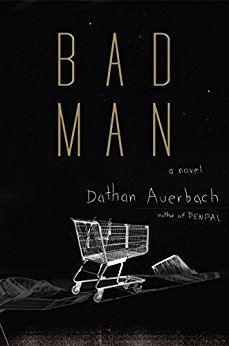
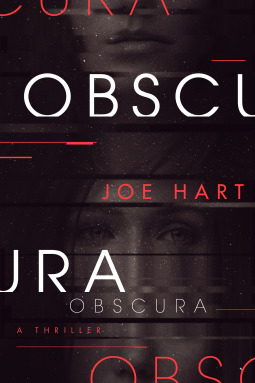


On to the digital pile! From Edelweiss, I grabbed Feeder by Patrick Weekes, who is of course the author of the fantastically fun Rogues of the Republic series. With thanks to Margaret K. McElderry Books for the chance to try more of his work. Earlier this week, I also spied Bad Man by Dathan Auerbach, a horror-thriller about a young boy who goes missing, and the brother who won’t stop looking for him. Looks like this book won’t be published until the summer, but nonetheless I would like to thank Doubleday Books for the early galley. From NetGalley, I also requested Obscura by Joe Hart after finding out about this sci-fi mystery-thriller from Tammy at Books, Bones and Buffy. With thanks to Thomas & Mercer for approving me so quickly!
Speaking of books I find out from other bloggers, I also added Art of War edited by Petros Triantafyllou to Goodreads after I saw it featured by Bob at Beauty in Ruins. Not even an hour later, I was contacted through the site by someone close to the project, who offered me a review copy. If you’re unfamiliar with this short story collection, I urge you to check it out. Produced by the people at Booknest.eu, this is a charity anthology which each author voluntarily signed up for, and all proceeds will go to Doctors Without Borders.
I also picked up a pretty big audiobook haul this week. First, with thanks to Audible Studios for an audio review copy of The Language of Thorns by Leigh Bardugo. I finally caved and decided to check this one out, and I’m glad I did! I typically tend to stay away from the random short fiction based on an author’s existing series or established characters (in this case, the Grishaverse), but this collection was nothing like I expected and I actually ended up enjoy it a lot.
From Penguin Random House Audio, I received The Gone World by Thomas Sweterlitsch, a sci-fi mystery involving time travel. I read one of the author’s cyberpunk titles a couple years ago and thought it was pretty cool, so I’m curious to see what this one will be like. From the publisher’s Listening Library list, I also received audio review copies of a couple of my highly anticipated YA novels: Tempests and Slaughter by Tamora Pierce is the start of a new series called The Numair Chronicles and I’m hoping to start listening to it soon. It’ll also be my first book by the author! About time, right? And last but not least, rounding up this book haul is Sightwitch by Susan Denard. This series and I have had our ups and downs, but for some reason, I just can’t seem to quit it! This book is actually a prequel novella, taking place about a year before Truthwitch. I would have preferred a sequel but, hey, I’ll take it.
Reviews
A quick summary of reviews I’ve posted since the last update:
The Defiant by Lesley Livingston (5 of 5 stars)
The Infernal Battalion by Django Wexler (4.5 of 5 stars)
The Lost Plot by Genevieve Cogman (4 of 5 stars)
The Chalk Man by C.J. Tudor (4 of 5 stars)
Mass Effect: Annihilation by N.K. Jemisin and Mac Walters (4 of 5 stars)
The Sky Is Yours by Chandler Klang Smith (3.5 of 5 stars)
Senlin Ascends by Josiah Bancroft (3.5 of 5 stars)
The Supernaturals by David L. Golemon (3 of 5 stars)
Blood and Sand by C.V. Wyk (2 of 5 stars)
Roundup Highlights:

What I’ve Read Since the Last Update
Here’s what I’ve “unstacked” from the TBR since my last roundup post. I’ve reviewed a few of these already, and the rest will be coming soon.
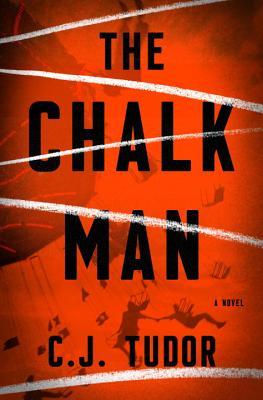


Have you heard of or read any of the books featured this week? What caught your eye? Any new discoveries? I hope you found something interesting for a future read! Let me know what you plan on checking out. Until next time, see you next Roundup!
Friday Face-Off: Grass
Posted on January 26, 2018 31 Comments
Welcome to The Friday Face-Off, a weekly meme created by Books by Proxy! Each Friday, we will pit cover against cover while also taking the opportunity to showcase gorgeous artwork and feature some of our favorite book covers. If you want to join the fun, simply choose a book each Friday that fits that week’s predetermined theme, post and compare two or more different covers available for that book, then name your favorite. A list of future weeks’ themes are available at Lynn’s Book Blog.
This week’s theme is:
“The grass is always greener on the other side of personal extinction”
~ a cover featuring GRASS
Mogsy’s Pick:
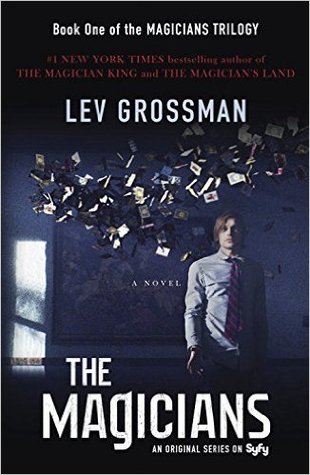
The Magicians by Lev Grossman
This was a book that annoyed me to no end, but interestingly enough I ended up enjoying the trilogy as a whole. The story follows disillusioned protagonist Quentin Coldwater, a high school student who never really grew out of his love for a series of novels he read as a kid about the adventures of five siblings in a magical land called Fillory. Compared to that, the real world couldn’t help but disappoint.
So imagine his excitement when he discovered that magic was real. And not only was it real, Quentin himself was identified as a promising young magician and invited to highly secret and exclusive school called the Brakebills College for Magical Pedagogy in upstate New York.
Here are some of the more interesting covers or the ones that fit this week’s theme:
From left to right, top to bottom:
Viking (2009) – Arrow (2009) – Plume (2015)
Polish (2010) – Dutch (2010) – Italian (2010)
Italian (2017) – Portuguese (2010) – Portuguese (2011)
Swedish (2011) – Bulgarian (2010) – Hungarian (2015)




Winner:
There are some really pretty covers going up against each other this week. My top three are probably the Arrow edition and the Hungarian edition, with the Portuguese edition (the 2010 version) coming in first place. What can I say, I just love shades of blue.
What do you think? Which one is your favorite?
Book Review: The Lost Plot by by Genevieve Cogman
Posted on January 25, 2018 32 Comments
I received a review copy from the publisher. This does not affect the contents of my review and all opinions are my own.
The Lost Plot by Genevieve Cogman
Mogsy’s Rating: 4 of 5 stars
Genre: Fantasy
Series: Book 4 of The Invisible Library
Publisher: Ace (January 9, 2018)
Length: 367 pages
Author Information: Website | Twitter
Now that the Invisible Library series has become firmly established, the storylines are just getting better and better. Thematically, The Lost Plot is more mysterious and adventurous, drawing heavily from Dragon vs. Fae politics, and there are also strong attempts to involve as many world-building elements as possible. That said though, I do feel this installment takes a step away from series arc that has been developing for the last three books; the plot of this one is a lot more “standalone” than the others, which might make it a good jumping on point for new readers, but of course I would still highly recommend starting from the beginning if you can.
The Lost Plot once again follows protagonist Irene Winters, an agent of the secret organization known as the Invisible Library whose members are tasked with traveling to alternate worlds to procure rare books (and yes, sometimes that means stealing them). When the book begins, Irene is offered a business proposal by a mysterious stranger. The would-be client, clearly a dragon, wishes to pay handsomely for her services to obtain a rare copy of Journey to the West, one of Chinese literature’s greatest classics. However, because of the Invisible Library’s official mandate to remain neutral in matters regarding the Dragons and the Fae, Irene’s first instinct is to decline.
Only, it turns out that not all Librarians are as responsible as she is when it comes to playing by the rules. From her contact, Irene finds out that one of her colleagues had accepted a similar deal to find the book from another dragon, and if this information were to get out, it could cause some serious conflict with the Fae and possibly spark an all-out war. Unable to walk away now, Irene turns to her apprentice Kai for help, and together they travel to an alternate world reminiscent of 1920’s New York to seek out the Librarian who has put all their futures in jeopardy.
The Lost Plot might be them most entertaining book of the series so far. It’s nice to see the story taking full advantage of its premise, making use of the interdimensional library aspect to transport readers to strange new worlds—or, in this case, exploring interesting historical periods. Anything is possible in this series, and this time, Irene and Kai’s adventures take them to a time of fedoras, Prohibition, and tommy gun-toting gangsters. The Roaring Twenties are one of the most iconic decades in American history, and you’ll find all its hallmarks in this novel, from the instantly recognizable fashion styles to the clandestine speakeasies and all that jazz. As if attempting to extract the Library from the middle of a long-standing Dragon vs. Faerie rivalry weren’t enough, our characters also find themselves having to deal with interfering police chiefs and greedy mob bosses who are all trying to get a slice of the action. From beginning to end, this book was non-stop and fast-paced fun.
I also liked how this novel featured a dragon-centric storyline, which of course raises some important questions about Kai’s role in the Library. The ending with the courtroom-like setting and suspense was almost more than I could bear. However, as someone who has followed this series since the beginning, I noticed too that the focus has shifted slightly away from the conflicts of the previous novels, with the scope widening to encompass the Invisible Library’s role and exploring its significance in this world. This was something I’d wanted for a long time, so I was quite happy to see The Lost Plot go down this path. That said, there are some trade-offs. Here you will find little development in the areas regarding Alberich or the mystery behind Irene’s parentage, for example, and for those answers, I suppose we’ll have to wait for a future sequel. Vale fans should also be forewarned that he does not feature much in this novel, a point to which I will admit to a twinge of disappointment myself, since I’ve grown to like his character a lot. But oh well, you win some, you lose some.
All in all, The Lost Plot was another exciting and satisfying sequel which reminds me once again why I’m glad to be reading this series. There’s a reason why I keep coming back for more. If you’ve been enjoying the mysteries of the Invisible Library and the interdimensional adventures of its agents thus far, then you’ll want to pick this one up too.
More on The BiblioSanctum:
Review of The Invisible Library (Book 1)
Review of The Masked City (Book 2)
Review of The Burning Page (Book 3)


 The BiblioSanctum