Guest Post: “Five Weird Books of the English West Country” by Aliya Whiteley
Posted on November 6, 2018 16 Comments
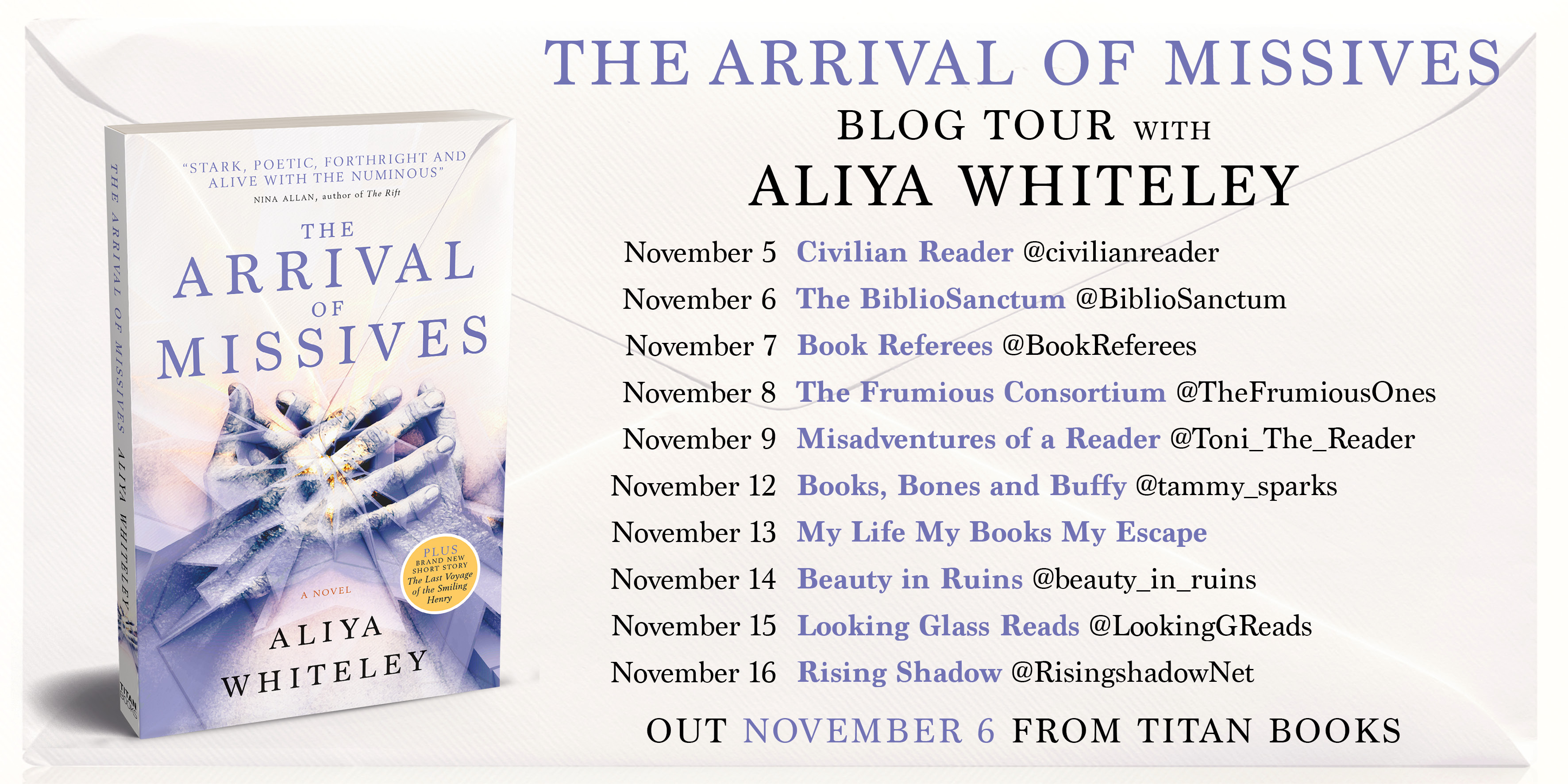
The BiblioSanctum is pleased to be a stop on the blog tour for The Arrival of Missives by Aliya Whiteley, described as a genre-defying tale of fate and free will, and how the choices we make in our lives affect us. The book has been widely praised in the UK where it was first published, and this fall Titan Books is pleased to be bringing it to US readers for the first time. It is being released today, available wherever books are sold. We hope you’ll enjoy this guest post by the author! Be sure to check out her book and also stop by the other blogs on the tour!

FIVE WEIRD BOOKS OF THE ENGLISH WEST COUNTRY
by Aliya Whiteley
I grew up in North Devon. It’s a part of the UK known as the West Country, deep in rural countryside with thick hedgerows sitting between the farmers’ fields and sheep dotted on the hillsides. In many ways it was idyllic, but there were also fears lurking amongst the quiet woods and small villages. When I started writing The Arrival of Missives, I remembered the way I felt when walking over the moors in the mist, or standing on a deserted shoreline on a rough, grey day. There was a sense that something strange could happen, and I soon found that I wasn’t alone in my thinking. Other authors have put the West Country’s weirdness on the page before, and here’s a look at five of my favourites:
1. Jamaica Inn by Daphne Du Maurier
An inn stands on Bodmin Moor, miles from anywhere. The owner of that inn is a man without morals, who commits terrible acts. He’s also the uncle of Mary Yellan, a young woman who has come to live at the inn without realising what she’s getting into.
The wildness of the weather and the cliffs of the Cornish coastline dominate Jamaica Inn. Du Maurier creates a hugely charismatic villain who uses those elements to his own advantage, preying on the unsuspecting. We fear for Mary, and admire her courage in an inhospitable place that offers her no easy escape.
2. A Maggot by John Fowles
There’s really no way to place A Maggot in a particular genre. There are elements of crime, literary fiction, science fiction and even horror. But it is deliberately disquieting because it does not want you to categorise it; this is a reading experience that you have to accept on its own terms.
A band of travellers make their way across Exmoor, Devon. An event takes place. The nature of that event will form the backdrop of an investigation that includes interviews and newspaper articles, attempting to find truth. To say any more is impossible.
3. Puffball by Fay Weldon
Imagine moving from your flat in the city to a fixer-upper in the heart of the countryside, thinking you’re going to live a quieter life in the clean air, only to discover your only neighbour is a very jealous witch. Mabs, the witch in question, resents the fertility of the young woman who has dared to move into her territory. So she rolls up her sleeves and sets out to ruin lives.
Puffball is very dark and very funny, and Fay Weldon’s characters are always so recognisable to me in their wants and fears.
4. The Hound of the Baskervilles by Arthur Conan Doyle
We associate Sherlock Holmes with Baker Street, London, but most of the action in this story takes place on Dartmoor, Devon, described brilliantly by Doctor Watson as he is driven to Baskerville Hall to investigate strange goings-on and a family curse. He writes that, “a tinge of melancholy lay upon the countryside… as we drove through drifts of rotting vegetation.” Whenever I visit Dartmoor I think of that tinge of melancholy.
5. An English Ghost Story by Kim Newman
Kim Newman understands that many people’s dream house, deep in the countryside with nobody nearby for miles around, can easily become the perfect location for a nightmare.
The Naremore family find a beautiful house in rural Somerset; it will come as no surprise from the title to find out that the house is haunted. But how this affects a family that have their own problems to begin with shows that our personalities can be influenced by our surroundings in strange ways.
These stories of ghosts and witches, supernatural animals and weird happenings, only add to the charm of the West Country, I think. I feel like I belong there, considering I’ve always loved a strange story too. I hope it inspires many more tales that make people want to visit it – not only for the green fields and blue sea, but also for the moors and mists, and the houses and inns that still hold their own secrets through the years.
 ABOUT THE AUTHOR
Aliya Whiteley was born in Devon, UK, in 1974. She writes novels, short stories and non-fiction and has been published in places such as The Guardian, Interzone, McSweeney’s Internet Tendency, Black Static, Strange Horizons, and anthologies such as Fox Spirit’s European Monsters and Lonely Planet’s Better than Fiction I and II. She has been nominated for the Pushcart Prize twice, and won the Drabblecast People’s Choice Award in 2007.
Her novella for Unsung Stories, The Beauty, was shortlisted for a Shirley Jackson Award and a Sabotage Award, and appeared on the Honors List for the James Tiptree Jr Award. Her writing is often violent, tender, terrifying and funny. It has garnered much critical praise and provoked discussion. Other published works of hers include a collection of short stories, a novel from Dog Horn Publishing, and a blackly comic crime novel from Macmillan. Further details can be found on her website and she tweets most days as @AliyaWhiteley.
#RRSciFiMonth Book Review: Occupy Me by Tricia Sullivan
Posted on November 5, 2018 30 Comments

I received a review copy from the publisher. This does not affect the contents of my review and all opinions are my own.

Mogsy’s Rating: 3.5 of 5 stars
Genre: Science Fiction
Series: Stand Alone
Publisher: Titan (September 4, 2018)
Length: 288 pages
Author Information: Website | Twitter
Occupy Me was probably one of the chanciest books I have ever attempted to read, knowing full well from the blurb and countless reviews how strange and bizarre it would be. I’ve made it no secret that I don’t always do well with “weird” books. But still, I decided to give it a try because I was in the mood for something a little outside of the box, and I was also curious to see what the science fiction literary awards circuit had been raving about.
And wow, what a trip this was. I’m not even sure how to describe the story, so I’m going to let the publisher description do most of the talking: “A woman with wings that exist in another dimension. A man trapped in his own body by a killer. A briefcase that is a door to hell. A conspiracy that reaches beyond our world.” Pearl is the woman with wings in question, an “angel” who works for a nebulous organization known as the Resistance. Posing undercover as a flight attendant, improving the world a little bit at a time with small incremental acts of kindness, she secretly hides an uncanny past and is determined to track down a killer responsible for pulling her out of her dimension and trapping her here on this earthly realm.
However, the killer is actually her prey wearing another man’s body. Dr. Sorle is not Dr. Sorle, for he has someone else living inside him. He is also in possession of an ordinary looking briefcase that is in fact an interdimensional gateway defying all the rules of time and space—an item which Pearl is in desperate need to get a hold of, for only then will she be able to unlock the mystery of herself and find her way home. But the briefcase isn’t going to yield its secrets freely, nor is Sorle willing to relinquish it that easily. Released from the Resistance, Pearl is forced to embark on her quest alone, chasing down this unpredictable madman and his freaky briefcase that can open into any number of dimensions, allowing all kinds of creatures to escape.
Obviously, if you’re looking for a coherent and straightforward story, you’re not really going to get that here. Occupy Me is mind-bendingly weird, there’s no doubt about that. Thing is, it’s not exactly weird in the “I’ve eaten a bunch of mushrooms and I’m all tripped out” kind of sense. I would say it’s more weird in the way that a lot of people find anime “weird”. The book is certainly contained in its own eccentric, quirky little world, and like all unfamiliar and odd things, it takes getting used to. The plot itself is actually quite easy to follow, and I enjoyed it immensely once I fell into the rhythm of not expecting anything to conform to reality. For me, I think that happened around the time a fucking pterosaur flew out of the briefcase.
Still, I’m not going to lie and say it was smooth sailing from there. I struggled plenty to wrap my head around a lot of the ideas and crazy concepts to spring forth from the hyper-imaginative mind of Tricia Sullivan, but I will say, it wasn’t as difficult as I thought it would be. While everything about the book was unusual, I also thought it was highly entertaining and even humorous in many places. Pearl is a hoot to follow with her unique personality and background, not to mention her forthright way with words. Never knowing what to expect around the next corner meant at no time did I find myself caught in a dull moment, and I always felt on guard trying to prepare myself for whatever strange surprise might pop up next.
Needless to say, it’s very difficult to recommend books like Occupy Me. Because they are so different and unusual, they may only appeal to a thin slice of the speculative fiction audience. All the same though, I feel that they also demand a certain level of admiration, if nothing else for being so boldly imaginative and fearless in defying genre expectations and convention. This novel is most certainly not for everyone, but if you’re looking to shake up your reading with something outside your comfort zone—something that might twist your mind and kick your imagination into high gear—then it might be worth a look.


YA Weekend: Empress of All Seasons by Emiko Jean
Posted on November 4, 2018 21 Comments

I received a review copy from the publisher. This does not affect the contents of my review and all opinions are my own.
 Empress of All Seasons by Emiko Jean
Mogsy’s Rating: 3 of 5 stars
Genre: Fantasy, Young Adult
Series: Book 1
Publisher: HMH Books for Young Readers (November 6, 2018)
Length: 384 pages
Author Information: Website | Twitter
Here’s another one for fans of Asian-inspired fantasy: Empress of All Seasons by Emiko Jean is set in a world reminiscent of feudal Japan with historical and supernatural elements. It is also a world where humans and yōkai live side by side—but not as equals. Whether you are a kappa demon or a near human-looking harionago or “hook girl”, all yōkai in Honoku are required to be registered and fitted with an unbreakable iron collar which would enslave them and keep their powers in check. The only free yōkai are those that live far away from the cities, hiding in little pocket communities in the wilderness. Mari, our protagonist, grew up in one such village with her clan the Animal Wives, a class of shapeshifting demons who can turn into beautiful women in order to seduce men and steal their fortunes.
Mari, however, was raised by her mother to follow a different path. Trained to fight and to survive, she has been groomed from childhood to become an empress and steal the treasures of the royal family itself. Each generation, a competition is held in the capital of Honoku to select the crown prince’s new bride. Hundreds of young women from clans across the empire would gather and attempt to conquer the challenges in the four enchanted rooms of the imperial palace, one for each of the seasons. Only one girl will prevail to marry the future emperor Taro, also known as the Cold Prince because of his utter detachment to anything to do with ruling, preferring to spend his time tinkering in his workshop. He especially despises the idea of being a prize, but is nonetheless drawn to Mari, who has arrived to enter the competition. Mari on her part is determined to win, but must contend with the difficulty of hiding her true nature while simultaneously trying to best all the other girls in the seasonal rooms. That’s because the rules strictly forbid yōkai from competing, and it would be an immediate death sentence if she is found out.
Well written and entertaining, it’s a shame the story wasn’t a little more original because then this book would have been even better. The first quarter was interesting, introducing readers to the mythology and background of the world, as well as the compelling role-reversal of warrior women competing to win a prince’s hand. But after that, the plot falls prey to the usual YA tropes. There was not much complexity to the parts where Mari had to survive the seasonal rooms. By and large, these sections played out exactly the way you would expect them to, with no surprises, and I’m somewhat disappointed we didn’t get more out of the rooms beyond a riddle and a scroll to retrieve. There’s also a case of instalove, which was especially annoying because of all the excessive hand-wringing and the “oh why oh why did not I see this coming?” later on in the story, and it’s like, well, maybe if you hadn’t thrown your heart at a guy/girl you’ve only known for all of five seconds, this might not have happened?
For better or worse though, this is the kind book where you really have to go through the motions before getting to the good parts. It’s not an ideal situation, but it also pays off in spades once you reach the point where the plot actually starts offering up more conflicts. In a way it felt like the second half of the book was an entirely different book all together, where the real meat of the story came in the aftermath of the competition, which turned out to be the gimmick. That said, some of the later parts of the story still felt scripted and contrived, but at least there were moments of unpredictability that kept things interesting.
This is also a book where the secondary characters far outshine the protagonists. Akira was the only perspective character I admired, the other two being Mari and Taro, whose voices were engaging enough but their personalities did not strike me as too different or special. Mari was not in fact as bold or dangerous as we were first led to believe, whereas Taro struck me as stiff and ineffectual, whose role was very limited and lacked any real kind of agency. On the other hand, Akira was written in a way that felt more alive and full of spirit. The Son of Nightmares was a wild card where anything could happen, and I also think his character went through the most changes. There were other side characters I enjoyed but a couple of them met untimely ends which rendered them somewhat pointless, and it was doubly frustrating because their deaths didn’t even elicit the intended emotional impact. A notable exception was Hanako, who only became more prominent after the first half of the story, and I found myself always looking forward to what further mischief she can do.
At the end of the day, do I think Empress of All Seasons worth reading? It depends. If you’re looking to read more Asian-inspired fantasy, this would be a good novel to add to your shelf. One of my favorite things about it was the handling of the supernatural elements, including the yōkai, who are an intrinsic part of this book’s world. Japanese culture is rich with legends and myth, and I loved how so much of it has been incorporated into the story. On the other hand, story-wise this is a very typical YA novel, and some may want to skip the mostly paint-by-numbers characters and tropey plot. Still, I experienced fun and excitement while reading this, even if it wasn’t always consistent, and I think it has potential.

#RRSciFiMonth YA Weekend Audio: Street Freaks by Terry Brooks
Posted on November 3, 2018 24 Comments
I received a review copy from the publisher. This does not affect the contents of my review and all opinions are my own.
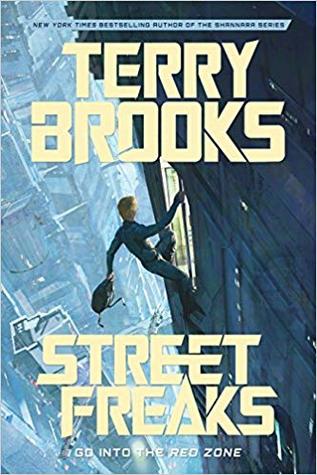
Mogsy’s Rating (Overall): 3 of 5 stars
Genre: Science Fiction, Young Adult
Series: Stand Alone
Publisher: Audible Studios (October 2, 2018)
Length: 11 hrs and 36 mins
Author Information: Website
Narrator: Simon Vance
Despite being the son of a wealthy renowned bioengineer, Ashton Collins is just your ordinary teenager. In fact, due to his strict and protective upbringing, Ash is probably much more sheltered than the average kid. But when he is ambushed in his home by a squadron of armed invaders, he finds himself on his own and without anyone to turn to. His only lifeline is a panicked message from his father right before the attack cut the feed, telling Ash to head to the Red Zone, located in the dangerous heart of Los Angeles, in order to find a group known as the Street Freaks.
Once in the Red Zone, Ash finds himself swallowed up by this futuristic dystopian mega-city, a world he knows next to nothing about. Luckily, the Street Freaks find him before he can get into too much trouble, inviting him into their circle. They’re a band of adolescent outcasts, including a young woman with super-strength, a boy with more robot than human parts, a synth created to be pleasure bot, and many others. Brought together by the street racing scene, the Freaks also run a vigilante-style operation on the side, and Ash’s photographic memory and near perfect recall are skills that immediately make him an asset. But Ash is also on a personal mission to find answers, like the identity of those responsible for the attack on his home. News of his father’s death also turns his world upside down, though not for a second does Ash believe it was a suicide as reported.
I confess, I’ve not been a big reader of Terry Brooks over the years, despite him being a huge name in fantasy fiction. That said, I know enough about his work to know Street Freaks is a bit of a departure for him, exploring the sci-fi dystopian landscape with a Young Adult bent. However, what I did not expect was how skewed it was towards younger readers, for it does not feel as though it carries much crossover appeal, unlike a lot of Brooks’ other work. While the characters are likeable, they’re still very much the teenagers they’re supposed to be—impulsive, snarky, somewhat hot-headed and volatile and oftentimes immature. For fans of the YA genre who are familiar with the typical YA character shenanigans, I don’t think this will pose much of a problem, but for readers expecting something more serious and hard-hitting, you may find that Street Freaks has little to offer beyond surface-scratching territory.
To its credit though, the book does reads like an action movie, the plot’s lack of depth be damned. The scenes of the street races were almost reminiscent of the podraces of Star Wars complete with roaring crowds and fiery explosions, and I can’t help but think Brooks might have been channeling a little from his time writing the novelization of The Phantom Menace. These types of action sequences, which bordered on blatantly gratuitous, were nonetheless entertaining and provided well-timed bursts of spirit and dynamism in between sections where the narrative attempted at discussing weightier topics, such as the ethics and social consequences of genetically or technologically enhancing humans.
But ultimately, Street Freaks ended up being a rather typical YA sci-fi dystopian—though I don’t want to paint that as too much of a negative. The book is a mystery adventure-thriller, but at its heart also explores important coming-of-age themes such as finding yourself and seeking acceptance. Brooks’ style trends towards being lighter and not too subtle, which worked well in this particular case. However, his tendency to tell-versus-show made the romance (yes, of course there’s a romance arc) feel forced and awkward, and not even listening to this in audio made it any less cringey, though happily, this was probably the worst of my complaints.
Bottom line, I won’t deny I wish Street Freaks had been more. Still, at the same time, it was also pretty much exactly as I expected, so I can’t say I was too disappointed. It’s certainly accessible enough for Terry Brooks fans coming from his fantasy, and to many, the fun and readability might be all that matters.
Audiobook Comments: I make it no secret that I am a huge fan of Simon Vance, who is one of the most talented and versatile audiobook narrators in the industry. However, my first impression was that his voice might have been too mature for this very YA tale, though in the end he managed a fine job of it in any case. A good narrator can sometimes compensate for some weaknesses in the writing, and I felt Vance fleshed out a lot of the characters by bringing them to life with his voice.
Friday Face-Off: Bonfire Night
Posted on November 2, 2018 36 Comments
Welcome to The Friday Face-Off, a weekly meme created by Books by Proxy! Each Friday, we will pit cover against cover while also taking the opportunity to showcase gorgeous artwork and feature some of our favorite book covers. If you want to join the fun, simply choose a book each Friday that fits that week’s predetermined theme, post and compare two or more different covers available for that book, then name your favorite. A list of future weeks’ themes are available at Lynn’s Book Blog.
This week’s theme is:
“Remember, remember the fifth of November”
~ a cover reminiscent of BONFIRE NIGHT
Mogsy’s Pick:
Days of Blood & Starlight by Laini Taylor
This week’s was a tricky one. Bonfire Night, also known as Guy Fawkes Night or Firework Night, is an annual celebration in Great Britain commemorating the foiling of the Gun Powder Plot on the 5th of November 1605, when Guy Fawkes was arrested while guarding explosives that had been planted beneath Parliament. And that’s pretty much the extent of my knowledge into this holiday, being a mostly culturally specific to the UK, though of course many other countries also have their own variations Bonfire Night, celebrating different traditions or on different dates of the year.
Anyway, I deferred to Lynn’s advice for this one, and went with a book cover depicting fires and fireworks, or in general anything that looked historical with big glittery celebrations. I’ve chosen Days of Blood & Starlight, the second book in Laini Taylor’s Daughter of Smoke & Bone trilogy, which perhaps apropos to today’s topic also features a tale of political conspiracies and secret plots. But mostly I had to bend the rules a little today, hence my changing of “inspired by” to “reminiscent of” Bonfire Night, since I could not come up with a book I’ve read directly related to the events of the Gun Powder Plot.
Let’s take a look at the covers:
From left to right:
Little, Brown Books for Young Readers HC (2012) – Hodder & Stoughton HC (2012) – Hodder Paperbacks (2013)


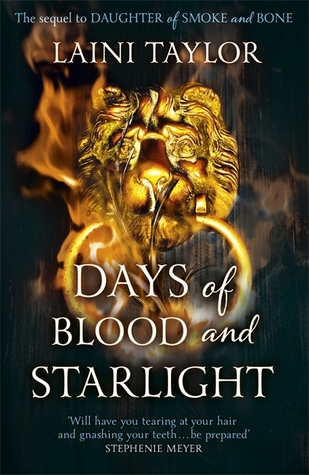
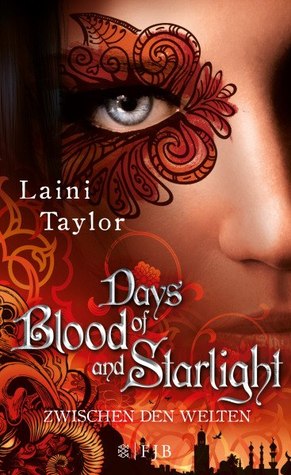
German Edition (2013) – Italian Edition (2013) – Portuguese Edition (2015)
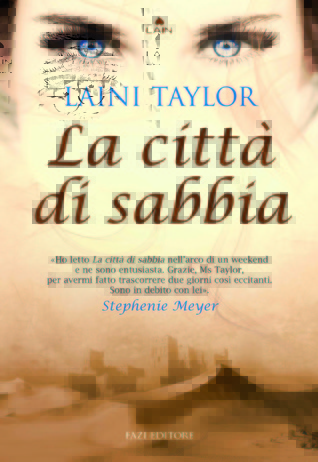
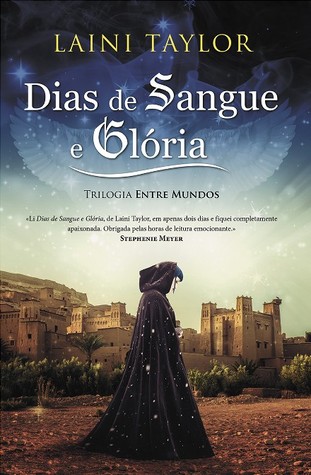
Hodder Tesco Exclusive (2013) – Italian Edition (2016) – Dutch Edition (2014)
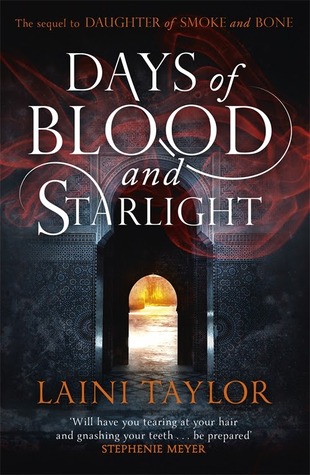

Czech Edition (2014) – Polish Edition (2013) – Hungarian Edition (2014)
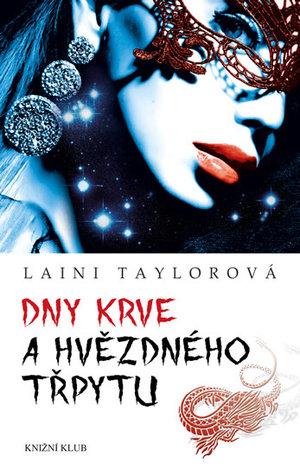

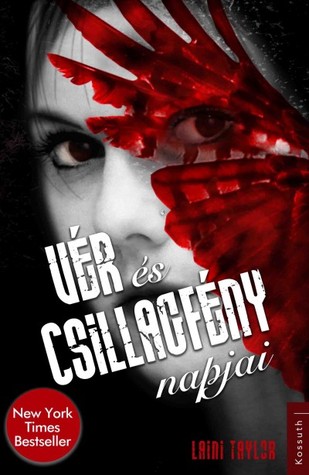
Serbian Edition (2017) – Chinese Edition (2013) – Korean Edition (2014)
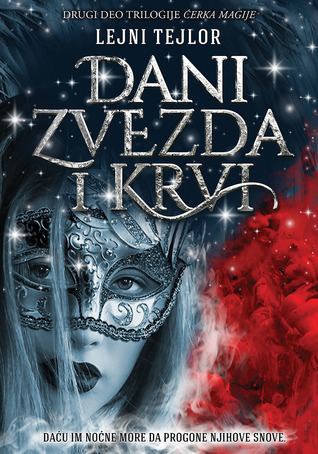
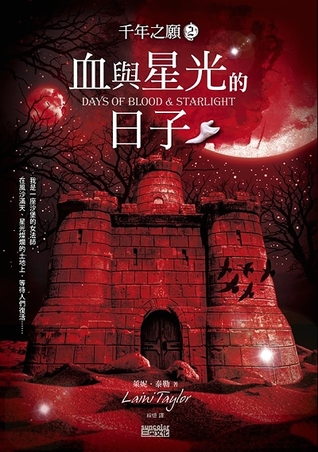
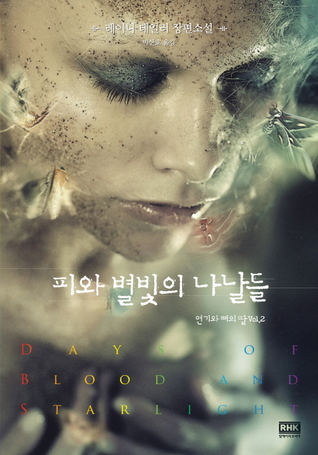
Winner:
I don’t think I’ve ever chosen a German edition winner before, but there’s just something so lovely about this one. The fiery colors contrasted with the girl’s icy blue glare gives this cover a certain intensity.
But what you do think? Which one is your favorite?
#RRSciFiMonth: Sci-Fi Month 2018 Introduction
Posted on November 1, 2018 35 Comments
You may have noticed the hashtag #RRSciFiMonth and its related images popping up all over the book blogosphere today. That’s because it’s November, which means it’s that time of the year again! Yep, it’s Sci-Fi Month. The BiblioSanctum has had such a great time being a part of this event in previous years that we’re participating again in 2018. This year, the hosts are Imyril of One More and Lisa of Dear Geek Place.
Starting today, we’ll be joining other bloggers, authors, and readers in a month-long celebration of everything science fiction. That doesn’t mean we’ll stop covering all our other favorite speculative fiction genres though! You will most definitely continue to see our usual fantasy reviews, weekly memes and features, spotlights, and all that other fun stuff. The only difference is, some of our reviews and posts will branch off from the usual to encompass the various mediums of science fiction.
This year, I’m not as on the ball with regards to planning, so I’m probably just going to play things by ear. I might use this opportunity to catch up with some science fiction books I missed. The great thing about Sci-Fi Month is that it’s a casual, low-pressure event. It has no deadlines, no specific challenges or quotas to meet–just a month of fun to enjoy, discuss, and share everything science fiction. The organizers have also arranged for some exciting features like giveaways and Twitter parties, so if this is something you want to be a part of, head on over to this Google form to sign up.
After that, grab the banner and button, and dive right in! Everyone is welcome, and you can join up anytime. Be sure to also follow the hashtag #RRSciFiMonth on Twitter so you won’t miss a thing.

Here at The BiblioSanctum, simply look for posts tagged with “SciFi November” or those that contain the SciFi Month images and hashtags to see how we’re getting involved. Come explore the wonders of science fiction with us, and to kick off the discussion, feel free to let us know:
How long have you been a fan of science fiction?
Why do you like sci-fi and what is your favorite thing about it?
What are your favorite books/games/films/TV shows in the genre?
What are your plans for Sci-Fi Month?
Waiting on Wednesday 10/31/18
Posted on October 31, 2018 19 Comments

Waiting On Wednesday” is a weekly meme that first originated at Breaking the Spine but has since linked up with “Can’t Wait Wednesday” at Wishful Endings now that the original creator is unable to host it anymore. Either way, this fun feature is a chance to showcase the upcoming releases that we can’t wait to get our hands on!
Mogsy’s Pick
The Hiding Place by C.J. Tudor (February 5, 2019 by Crown)
Happy Halloween! To put you in a hair-raising mood, today I’m featuring the upcoming novel from new talent C.J. Tudor, who made me squirm last year with her disturbing and bone-chilling psychological thriller debut, The Chalk Man. Note: the book will also be published in the UK but with a different title, The Taking of Annie Thorne.

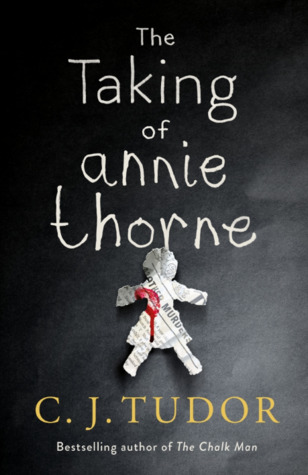
“The thrilling second novel from the author of The Chalk Man, about a teacher with a hidden agenda who returns to settle scores at a school he once attended, only to uncover a darker secret than he could have imagined.
Joe never wanted to come back to Arnhill. After the way things ended with his old gang–the betrayal, the suicide, the murder–and after what happened when his sister went missing, the last thing he wanted to do was return to his hometown. But Joe doesn’t have a choice. Because judging by what was done to that poor Morton kid, what happened all those years ago to Joe’s sister is happening again. And only Joe knows who is really at fault.
Lying his way into a teaching job at his former high school is the easy part. Facing off with former friends who are none too happy to have him back in town–while avoiding the enemies he’s made in the years since–is tougher. But the hardest part of all will be returning to that abandoned mine where it all went wrong and his life changed forever, and finally confronting the shocking, horrifying truth about Arnhill, his sister, and himself. Because for Joe, the worst moment of his life wasn’t the day his sister went missing.
It was the day she came back.
With the same virtuosic command of character and pacing she displayed in The Chalk Man, CJ Tudor has once again crafted an extraordinary novel that brilliantly blends harrowing psychological suspense, a devilishly puzzling mystery, and enough shocks and thrills to satisfy even the most seasoned reader.”
Book Review: Slender Man by Anonymous
Posted on October 30, 2018 23 Comments
I received a review copy from the publisher. This does not affect the contents of my review and all opinions are my own.
 Slender Man by Anonymous
Mogsy’s Rating: 3.5 of 5 stars
Genre: Horror, Young Adult
Series: Stand Alone
Publisher: Harper Voyager (October 23, 2018)
Length: 336 pages
Author Information: N/A
The origin of Slender Man as a creepypasta internet meme that gained traction on an online forum before becoming viral and exploding into a worldwide phenomenon has always fascinated me. It’s perhaps one of the best modern examples of how a legend or myth might come to life, its genesis and spread happening in real time for all to observe, especially following a series of violent related incidents widely covered by the media. The surreal nature of this now iconic horror figure is what immediately drew me to this book, simply titled Slender Man by an author whom, in a very meta touch, has been kept anonymous, which should clue you in as to the style and mood of story you’re in for…
In basic terms, Slender Man is an epistolary novel comprised of journal entries, emails, text messages, voice transcripts, and other forms of documentation surrounding the life of high school student Matt Barker, who is on a mission to discover the truth of what happened to his friend and classmate Lauren Bailey. The popular teen girl from Riley, an elite New York City high school, went out one night and never returned. Within hours, rumors were flying all over Riley speculating on her whereabouts, though secretly, Matt knows Lauren well enough to know the majority of them have no basis in fact. While the two teens never ran in the same circles at school, they have maintained a close friendship that neither of them advertised publicly, keeping most their correspondence through texts. Lauren had an obsession with dark subjects that, as far as Matt knew, he was the only one she ever shared with, sending with him gruesome stories and pictures that she found online that she thought were funny or interesting.
After days go by with no headway on the police investigation into the disappearance, Matt decides to take matters into his own hands, uncovering a series of strange photoshopped images on Lauren’s cloud drive, proving irrefutably that she was drawn to the legend of Slender Man. Given how the stories go—that any attention given to Slender Man is in fact a foolhardy way to summon the creature or draw its notice—Matt believes his friend is in serious danger, and the terrifying dreams he has almost nightly seem to confirm his bad feelings.
Due to its format, I suspect Slender Man will not be a book for everybody, and if you have struggled with epistolary novels in the past, it’s possible you may run into similar issues with this one. The style itself is limiting in certain situations, especially when the story calls for descriptive action. Often you end up with awkward moments where the character resorts to oral dictation and info-dumping, ludicrously stating out everything he/she is doing, and we have a few instances of this here where the forced narrative pulled me out of the immersion. One other thing to note is that the book is very Young Adult-oriented—which may end up being a disappointment to those who were hoping for a good scare out of this. Slender Man is at times deeply atmospheric and plays with your mind a bit, but for a horror novel, I did not find it scary or even that creepy. The characters’ personalities also fit in with the overall YA tone of the story, so expect a certain level of teen angst and other genre clichés like disdainful attitudes towards healthcare workers and law enforcement (or just adults in general).
Despite these caveats, I did have a good time reading the book. While the epistolary style does not always lend itself well to character development, I thought the author did a good job painting Matt Barker as a convincing and sympathetic figure, due to the fact his journal entries make up the bulk of the novel. Matt’s emotional state is strongly felt in these entries; we get a good depiction of his confusion, the genuine concern for Lauren, as well as the crushing sense of helplessness and fear as he realizes what he must do to save her. I also enjoyed the creative use of documentation to tell the story, not to mention the sheer variety of sources ranging from newspaper clippings to the Riley school letters sent out to faculty and parents, and even snippets from Whatsapp group chats and Reddit discussion forums. I thought they were a nice touch to give the situation a more “authentic” feel, and the eclectic mix also made this a super quick and addictive read.
All too soon, the book was over, and honestly, if I have one complaint about the ending, it’s that it felt rushed and the conclusion was left a little too open. But for a story of this nature about Slender Man, perhaps there was no other way around this issue. The character became a horror phenomenon precisely because of the mystery and ambiguity surrounding its motives, and the novel’s ending seems to reflect this limitless potential for speculation and the role of reader imagination. If you don’t mind the vagueness, then you’ll probably enjoy the enigma, and certainly the unknowns added greatly to the general atmosphere of the story, which was top-notch and was a counterpoint to some of the book’s minor weaknesses. Overall a fast and fun read if you’re looking for a bit of mood reading for the spooky season!
Audiobook Review: Dracul by Dacre Stoker & J.D. Barker
Posted on October 29, 2018 28 Comments
I received a review copy from the publisher. This does not affect the contents of my review and all opinions are my own.
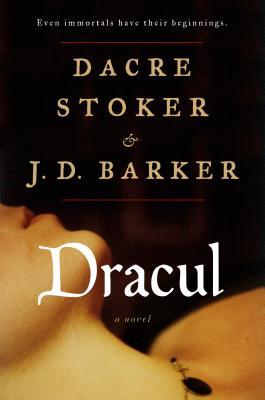 Dracul by Dacre Stoker & J.D. Barker
Mogsy’s Rating (Overall): 4 of 5 stars
Genre: Horror
Series: Stand Alone
Publisher: Penguin Audio (October 2, 2018)
Length: 16 hrs and 25 mins
Author Information: Dacre Stoker | J.D. Barker
Narrators: Various
If the darkly atmospheric and intricately woven tale of Dracul feels personal, that’s because it is. Described as the prequel to the classic 1897 Gothic horror novel Dracula, the novel is penned by the great-grand-nephew of Bram Stoker himself along with one of horror’s brightest voices tapped specifically by the family for this endeavor. Blending his famous ancestor’s true history with elements from his literary creation, Dacre Stoker and his co-author J.D. Barker have formulated and delivered on a concept that fans of the genre should find fascinating.
Our story begins in Ireland, where Bram Stoker was born and spent much of his sickly childhood. Many of his early years were spent ensconced and bedridden at home, cared for and doted on by Nanna Ellen, a young woman who is more than she appears. Intrigued by Ellen’s strange behavior, Bram and his sister Matilda decide to go sticking their noses into their nursemaid’s quarters, but instead of answers, they find even more questions. Soon afterwards, Ellen disappears, but the literal mark she has left on Bram’s life will always be with him. The scabs on his wrist might never heal, but whatever Ellen did to him, Bram has been as healthy as a horse ever since, his sickly days behind him forever.
Years later though, the Stoker siblings, now grown, are drawn into the mystery once again when Matilda returns from her studies in France to tell Bram that she has seen Ellen—and most bizarrely, their former nanny has not aged one bit, looking as young as they remembered her as children. After recruiting the help of their older brother Thornley, our characters embark on a supernatural journey that will cause them to question everything they knew about the old stories of Irish legends and monsters.
To understand this prequel, one must to an extent also understand the original. Spotting their parallels was a big part of my enjoyment, watching how the lines were blurred between reality and fiction. Emulating the Gothic atmosphere and suspense of the classic novel, Dracul is told in a mostly epistolary format, playing on the idea that before its publication, Dracula was divested of about a hundred pages which is said no living soul has ever seen. Using his great-grand-uncle’s notes from journals and other writings, Dacre Stoker sought to interpret these missing pages and piece together a picture of young Bram as a key figure placed in the context of his own literary work, and needless to say, this approach lent an authenticity to the narrative and the results were decidedly effective.
But the story also follows a second timeline of an older Bram, covered predominantly in the latter parts of the novel. The eerie and mysterious tone turns even darker and more disturbing as events shift gears to focus on Bram, Matilda, and Thornley as adults, alternating between their viewpoints. These multiple perspectives make for a compelling fast-paced read with an atmosphere which is in keeping with the original classic, yet at the same time, the story is also written in a cinematic style which would appeal to readers of modern-day horror and thrillers, proving you won’t have to be a mega-Dracula fan to enjoy this one.
For extra immersion, I would also highly recommend the audiobook for Dracul as read by a full cast consisting of Pete Bradbury as the narrator, Vikas Adam as Bram Stoker, Saskia Maarleveld as Matilda, Rachael Corkill as Thornley, Alana Kerr Collins as Ellen, and Allan Corduner as Arminius Vambéry. Of the narrators, I am most familiar with Vikas Adam, who did a phenomenal job giving voice to Bram, though the rest of the cast also delivered marvelous performances, making this moody tale come to life.

YA Weekend Audio: Shadow of the Fox by Julie Kagawa
Posted on October 28, 2018 21 Comments
I received a review copy from the publisher. This does not affect the contents of my review and all opinions are my own.
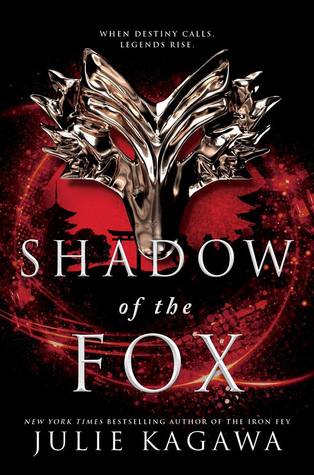 Shadow of the Fox by Julie Kagawa
Mogsy’s Rating (Overall): 4 of 5 stars
Genre: Fantasy, Young Adult
Series: Book 1 of Shadow of the Fox
Publisher: Harlequin Audio (October 2, 2018)
Length: 14 hrs and 45 mins
Author Information: Website | Twitter
Narrators: Joy Osmanski, Brian Nishii, Emily Woo Zeller
Julia Kagawa has come a ways in the few short years since Talon, a book I enjoyed but failed to give me much motivation to continue the series. Shadow of the Fox, on the other hand, started out on a strong note and never let up until it was over.
Taking place in a fantasy world inspired by history and culture of feudal Japan, the story is told through the eyes of three characters from very different walks of life. First we have Yumeko, a half-kitsune girl who was raised by monks at the Silent Winds temple. Her whole life, she has been taught she must hide her true nature or else she would be hunted down for her part yokai heritage. However, one day her home comes under attack by demons trying to steal a powerful scroll hidden in the temple. Yumeko, the only survivor of the massacre, manages to escape with the precious artifact, vowing to do all she can to transport it somewhere safe.
Almost right away, she encounters a lone samurai working on behalf of the mysterious Shadow Clan, who has also been tasked to retrieve the scroll for his masters. Kage Tatsumi is a demon hunter, who’s only following his orders. When he meets the girl named Yumeko who claims to have fled from the ruined temple and knows where the scroll has been taken for safekeeping, he has no choice but to follow her and keep her safe while she leads him to his goal (not knowing, of course, that what he seeks has been on her the entire time). Along the way, the two of them pick up another lone traveler, a ronin who offers them help navigating the treacherous road to the city, but ends up offering a lot more in the form of friendship and comic relief.
And finally, we have our third perspective, the ghost of a lowly palace maid who had the misfortune of working for her cruel and merciless mistress. Poor little Suki. Her role was mainly to show us the machinations behind the scenes, but I think many who read this book will also find her to be one of story’s most sympathetic characters.
Have I also mentioned how much I enjoy stories about kitsune? Lately, ever since M.L. Brennan’s Generation V series, my reading has been sorely lacking in fox shifters. Of course, Yumeko’s character was decidedly very un-foxlike, though her upbringing might provide some context for that. She’s cunning and witty, but far from the sly trickster I expected her to be. Ultimately though, I think her innocence and naivete helped to make her feel more genuine and believable, for this was someone who has spent her whole life literally cloistered in a temple raised by monks. Her personality was also a great counterpoint to Tatsumi’s damaged psyche, shaped by years of his harsh training and exposure to the ugly truths of the world. If anything is to melt that stern exterior, it would be Yumeko’s unconcealed goodness. The two of them may have been thrown together under some pretty thin circumstances, but I did like their chemistry and appreciated the fact that Kagawa didn’t foist a romance on them right away. In fact, only at the end do we get a real sense that both may be open to more, the way the best kinds of forbidden love stories tend to go.
The plot also took a lot of detours along the way, but rather than finding this distracting, I personally enjoyed how things took a turn towards a quest narrative. Like a roleplaying game campaign where a party of heroes must combine their knowledge and skills to solve a problem, these encounters allowed our characters to bond and cement their alliances. The stopover in the village with the graveyard full of hungry ghosts was a prime example, and while in retrospect, it might have been a totally cheesy and hackneyed way of doing it, I’m still glad we got to go on some of these “side quests” despite seeing why some would say they were completely unnecessary.
It kept the overall momentum of the story going, in any case. Peppered with plenty of mythological elements, this book would be a fascination for anyone with an interest in Far Eastern folklore or Japanese-inspired world-building. For a novel that takes us in so many directions, the plot was also surprisingly well-paced and a delight to follow. I won’t lie and say there weren’t a lot of the usual YA tropes in this, but at the same time I wasn’t too bothered by them and they were written well. In the end, Shadow of the Fox was an entertaining and rather straightforward tale of questing and friendship without putting on too many airs, which is more than I can say for a lot of my recent YA reads. It’s been a fun ride and I’m looking forward to more, especially given what happens in the shocking final scene of the epilogue. This time, I’m definitely motivated to pick up the next book.
Audiobook Comments: The three character POVs were read by three separate narrators, Joy Osmanski, Brian Nishii, and Emily Woo Zeller. I’ve always said audio is the best way to “read” YA and Shadow of the Fox is a good example of why, being an immersive experience for listeners who enjoy being completely transported to unique and evocative magical worlds.


 The BiblioSanctum