Guest Post: “Why Write About Ghosts?” by Ben Galley
Posted on December 10, 2018 14 Comments
 This fall, the BiblioSanctum is pleased to help spread the word about new and upcoming titles from Sigil Independent, a writing guild founded by a group of like-minded authors who believe in serious self-published fantasy for serious fantasy fans. Among their members, you will find many current and past Self-Published Fantasy Blog-Off (SPFBO) authors whose mission is to utilize traditionally published best practices in their work to ensure that audiences will receive nothing but the best possible self-published stories.
Today, we’d like to welcome back Ben Galley, who we’re excited to host again in celebration of the release of his new book Chasing Graves! In this grimdark tale of murder and twisted deceit, to rule the world is simple–all you need is to own more ghosts than any other. Here, the dead don’t rest in peace; instead, they live on as slaves for the rich, to be collected as currency. Needless to say, this is a ghost story unlike any other. To give us a bit of insight on his inspiration, Ben has very graciously written us a guest post, which we’re pleased to share with you today. We hope you enjoy it, and be sure to also check out Chasing Graves, which is out now!

WHY WRITE ABOUT GHOSTS?
by Ben Galley
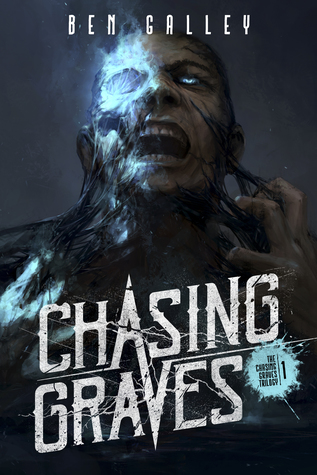 I have a habit of hunting down mythical beasts and putting them in my books. For the Emaneska Series, it was dragons and daemons. For the Scarlet Star, it was the elusive fae. The Heart of Stone featuring Task the golem, and now, with my new dark fantasy novel Chasing Graves, I’m courting with ghosts and spirits.
But why ghosts? Well, I also have a penchant for exploring aspects of humanity in my books. I find us bipedal creatures to be fascinating beasts, and no matter how outlandish the worlds in my books become, there will always be a human element driving the story. In Chasing Graves, I wanted to explore the human obsession with the beyond.
Ever since humans began to communicate, the question of what exists past the grave has always preoccupied us. We’ve provided answers such as religion, science, and myth, but whichever answer you prefer, it seems we’re not, as a species, quite able to accept the finality of death, or the irritation of not knowing. It’s why we have afterlives, heavens, and why we’ve been telling ghost stories for millennia. As such, it’s made them a subject matter that we can all associate with – as relatable as a thunderstorm. And as the books on writing craft inform me, that’s a fine place to start when writing a book.
Sprits, poltergeists, phantoms, shades, ghouls, spectres, spooks… whatever you call them, almost every culture in the world features some sort of ghostly apparition in their religions or mythologies. The concept of ghosts is thousands of years old. It even predates writing and literate societies. At first, we put stock in animism, the belief that objects held sprits, then ancestor worship, and ghost have been with us ever since. The shades or spirits of the deceased were known as gidim in ancient Sumeria and Mespotamia. The Hebrew Bible mentions ghosts and occultism in Deuteronomy. In 1 Samuel, King Saul has the Witch of Endor (not that Endor, sadly) summon a spirit for him. Ghosts appear in Homer’s Odyssey and Iliad, and by 5th century BC were known as haunting, frightening creatures. Plutarch, in the 1st century AD, described the haunting of the baths at Chaeronea. Good old Jesus even had to convince his disciples he wasn’t a ghost or spirit when he returned from the dead.
The Middle Ages introduced the concept of sin and purgatory, or an “in between”. During the Renaissance, ideas of necromancy and the occult abounded, carrying on into the Victorian period. Even now, in modern day, the paranormal still plays a large part in our lives. A Huffington Post/YouGov poll said 45% of people believe in ghosts. Why else would we still have mediums and spiritualism, or exorcisms? Let’s face it – we’ve always been a tad preoccupied with death and the beyond. I believe we always will be.
Out of all the cultures in history, the Ancient Egyptians were possibly the most obsessed with death and ghosts. Rather than fear it, they celebrated it. Believing they could take their belongings with them when they died, pharaohs started building their graves and preparing for the afterlife – or duat – as soon as they placed their backsides upon a throne.
Their mythology was also one of the first to introduce the ideas of karma, justice, order – or “maat”. To paraphrase Gladiator, it’s the notion that what you do in life echoes in eternity, and it’s a concept that still survives today. In Ancient Egyptian belief, maat was constantly under threat from the forces of disorder, so all of society was required to maintain it. I believe it was this lack of fear for death that contributed to a lasting, formative empire that lasted thirty dynasties and three thousand years. What more perfect a setting could I ask for Chasing Graves?
Another reason I chose to write about ghosts is that there is such a rich mine of lore to play with. It was a challenge to fit every aspect of it into Chasing Graves, as there are endless avenues for stories with all the material that exists in the world. But the more I looked into both ghost lore and Egyptian mythology, the more I found common themes that suited the human obsession I wanted to explore. For instance, take the common idea that spirits are often trapped between death and life in a kind of purgatory. Mix that with the Ancient Egyptian penchant for slavery, and a world is created where ghosts can be bound as slaves. Immortal, subservient workers, stuck between life and the promised afterlife. Instead of fearing death and its unknown, in Chasing Graves, death is right there in front of you, glowing blue or white and as cold as dry ice – common themes of ghost lore in both western and eastern cultures. Except, instead of haunting you, they’re polishing your ornaments.
Of course, I’m a dark fantasy author, so it’s not going to be all fun and games for these ghosts. Spirits are often a sign that the natural order has been disturbed, and are usually a product of unnatural deaths. As such, these slaves – or shades – had to be produced principally through murder. Therein lie the grimdark elements of this new trilogy. I borrowed from the Egyptians again on this one, and kept their love of order, but flipped justice on its head. In the vast city of Araxes, whomever owns the most shades rules, and it has bred a society that treats murder as a casual pastime or occupation. Enter my main character: Caltro Basalt. The poor sap very quickly finds himself on the wrong end of a knife on his first night in Araxes, and is thrown into its literally cutthroat society.
Writing Caltro as dead was a great opportunity to have an unusual protagonist, and write through a ghost’s eyes. Few ghost stories are told from the ghost’s perspective, and that was a great excuse to attempt it. The other side is a place we can’t imagine as live and kicking human beings, and mythology or religion doesn’t necessarily have all the answers. Do ghosts feel? Why are ghosts cold? Do ghosts have taste and smell? How do you punish a ghost? Is immortality a freedom or a curse? It was bags of fun to tackle these questions, especially in the sandals of an irascible, extremely inconvenienced locksmith, cut down in his prime.
If there’s one thing I realised when writing Chasing Graves, it’s that unlike dragons, werewolves, and elves, ghosts still refuse to cross completely over that line into mythology. The overwhelming consensus of science is that ghosts do not exist, and yet their existence remains impossible to falsify. Like the reaches of outer space, the ideas of ghosts and the beyond breed a deep obsession in us. It’s a mystery that fascinates me, and if I were to pick one reason why I chose to write about ghosts, it would be down to that fascination.
Thanks for reading.
ABOUT THE AUTHOR
 Ben Galley is an author of dark and epic fantasy books who currently hails from Victoria, Canada. Since publishing his debut The Written in 2010, Ben has released a range of award-winning fantasy novels, including the weird western Bloodrush and the epic standalone The Heart of Stone. He is also the author of the brand new Chasing Graves Trilogy.
When he isn’t conjuring up strange new stories or arguing the finer points of magic and dragons, Ben works as a self-publishing consultant, helping fellow authors from around the world to publish their books.
Ben enjoys exploring the Canadian wilds and sipping Scotch single malts, and will forever and always play a dark elf in The Elder Scrolls. One day he hopes to live in an epic treehouse in the mountains.
Ben can be found on Twitter or vlogging on YouTube @BenGalley, or loitering on Facebook and Instagram @BenGalleyAuthor. You can also get a free eBook copy of his epic fantasy The Written at www.bengalley.com.
YA Weekend: Little White Lies by Jennifer Lynn Barnes
Posted on December 9, 2018 9 Comments

I received a review copy from the publisher. This does not affect the contents of my review and all opinions are my own.
 Little White Lies by Jennifer Lynn Barnes
Mogsy’s Rating: 4 of 5 stars
Genre: Mystery, Young Adult
Series: Book 1 of Debutantes
Publisher: Freeform (November 6, 2018)
Length: 400 pages
Author Information: Website | Twitter
I knew when I picked up Little White Lies that it might be a little outside my wheelhouse, but what I didn’t anticipate was how much fun it was going to be. Set in the world of debutante balls and grand estates, this novel might as well be set on another planet for all I know about Southern high society, but Jennifer Lynn Barnes ushered me through this beguiling YA mystery with a certain kind of mastery and finesse I’ve found only in the most skilled of writers.
For as long as she can remember, Sawyer Taft’s world only consisted of herself and her mother. Eighteen years ago, pregnant with Sawyer, Ellie Taft was kicked out of the house and practically disowned by her high society family, presumably for the shame and scandal she brought upon them. Since then, the two have been eking out a living in your typical small Southern town, with no other contact with family since Ellie was cut off. As a result, Sawyer was raised with little to no knowledge of where she came from. Her mother hardly talked about her past, and certainly not anything about Sawyer’s father, whose identity has been kept a closely guarded secret from her daughter.
Then one day, a mysterious stranger shows up on Sawyer’s doorstep, introducing herself as Lillian Taft—her maternal grandmother. The stately woman has also brought our stunned protagonist an offer she can’t refuse: half a million dollars to spend the next nine months living on Lillian’s estate, at the end of which Sawyer will be presented at the debutante ball. Despite her initial misgivings, Sawyer knows she will accept. The money itself is incentive enough, solving all her financial problems, not to mention a real shot at going to college. However, Sawyer’s true motivation lies rooted in the realization that living in her grandmother’s world might mean finally learning the answer to the question that has dogged her all her life: who is her father?
What follows is an absurdly entertaining tale that is one-part twisted intrigue and mischief, and one-part fish-out-of-water story about an unassuming young auto-mechanic who suddenly finds herself thrown into a world of makeovers, dresses, and southern style etiquette. And of course, no story about high society would be complete without your fair share of secrets and scandals, so rest assured Sawyer stumbles upon quite a few of those in this novel too. It’s a little over-the-top, but not to the extent that it would turn me off.
Most of Little White Lies is told in flashback, with little snippets of the present preceding some chapters. In this way, readers are teased with the knowledge that something “big” has happened, and the plot gradually unfolds to describe exactly the series of events that take place before this huge bombshell. Other chapters are also preceded by cryptic messages from some strange tumblr-like website—yet another mystery to be solved. Needless to say, by the time everything falls into place, readers are guaranteed to be left wide-eyed by all the surprises, betrayals, and personal dramas the author has managed to weave into this addictive novel featuring a number of unpredictable plot threads.
Speaking of which, this was my first novel by Jennifer Lynn Barnes. Within the first ten chapters, I was thoroughly sold on her writing. She has a talent with words, which paired with a great sense of timing made it easy to become utterly absorbed with the story. Like I said, this is a society I’m totally unfamiliar with, but Barnes was able to create such a clear picture of the setting from the get-go, everything else about the culture and the people just came easy. And there are a lot of characters in this book. Thankfully though, you don’t need make a web diagram to keep track of all the names and relationships, because the author does such a fantastic job with characterization, giving every individual memorable dialogue and personalities. One of the biggest joys of this book for me was being able to discover this world alongside Sawyer, as well as getting to know all the people we meet along the way. There are some bitter rivalries and hostilities, but some pretty epic friendships too.
I was also caught off guard by the ending. Just when you think everything has been sorted out and put to bed, this book has a final surprise for us. You just never know what could happen next on this crazy wild ride. It bodes well for the sequel, and yes, I was thrilled to learn Little White Lies is the first book of a series. I look forward to more fun with Sawyer.


Mogsy’s Bookshelf Roundup: Stacking the Shelves & Recent Reads
Posted on December 8, 2018 32 Comments
Bookshelf Roundup is a feature I do every other weekend which fills the role of several blog memes, like Stacking the Shelves where I talk about the new books I’ve added to my library or received for review, as well as It’s Monday! What Are You Reading? where I round up what I’ve read since the last update and what I’m planning to read soon. Mostly it also serves as a recap post, so sometimes I’ll throw in stuff like reading challenge progress reports, book lists, and other random bookish thoughts or announcements.

Received for Review
My thanks to the publishers and authors for the following review copies received, and be sure to click the links to their Goodreads pages for more details and full descriptions!

My thanks to Titan Books for the following received: Mass Effect: Annihilation by Catherynne M. Valente is the newest official tie-in to the hit game about a mysterious mass murderer who is spreading a contagious virus aboard a colony ship heading to the Andromeda galaxy (can I also just take a moment to geek out about the fact Valente wrote a Mass Effect novel?) The publisher also sent along The Arrival of Missives by Aliya Whiteley as part of the blog tour which the BiblioSanctum participated in last month.
From the awesome team at Subterranean Press, I received Perfunctory Affection by Kim Harrison, a short novel described as a blend psychological suspense and urban fantasy from the author of the beloved Hollows series. I’ve always been curious about her work, so I might just give this one a try.
Also thanks to Ace and DAW Books for the following: Rowankind by Jacey Bedford is the third installment in the Rowankind series, the first book of which I read and loved. I’ll need to do a bit of catching up with the second book before I can read this one, but I’m looking forward to it. Holy Sister by Mark Lawrence is another third in a sequence, chronicling the next chapter in the life of Nona Grey in the Book of the Ancestor series, and I can’t wait to sink my teeth into this ARC. Rounding up this trio is Tales from Plexis by Julie E. Czerneda is an anthology featuring a collection of short stories set in the author’s Clan Chronicles universe.
With thanks to Tor Books, I also received a surprise copy of The Razor by J. Barton Mitchell, a sci-fi thriller about an engineer inmate who struggles to survive among the galaxy’s most dangerous criminals after a disaster at a labor camp on a prison planet. I might give this one a try if I have some extra time this month, because the premise sounds absolutely amazing.

With thanks to Tor Teen, I also received Dark Mind Rising by Julia Keller, sequel to The Dark Intercept which I’d meant to read earlier this year, but didn’t get the chance. There’s still time!
I’d also like to thank Holiday House, a new YA publisher I discovered after they sent me this gorgeous hardcover of Realm of Ruins by Hannah West. After a bit of research though, I found out this was actually a sequel, and something tells me this won’t make a good starting point, so I’m going to have to look up the first book.
My thanks to the team at Orbit, who were kind enough to send me a finished copy of Empire of Sand by Tasha Suri. This is a book I already read and reviewed, and you can check it out my thoughts here.
And a big thanks to Inkshares/Sword & Laser, from whom I received a finished copy of The Animal in Man by Joseph Asphahani, a dark fantasy set in a world where rival kingdoms of animal-human hybrids are forever locked in constant battle.
Last but not least, my thanks to Night Shade Books for the following anthologies: Black Moon: The Complete Tales of Jules de Grandin by Seabury Quinn is the fifth and final volume collecting the stories of the eponymous supernatural detective made famous in the pulp magazine Weird Tales, and Not One Of Us edited by Neil Clarke is a huge collection featuring stories by some of the biggest names in sci-fi writing about alien first contact and extraterrestrial life on Earth.


In the digital haul this week, I managed to knock a bunch of book off my NetGalley pile last month so I figured it wouldn’t hurt to request a few titles. From the Albert Whitman Company, I received Descendant of the Crane by Joan He which is described as a Chinese-inspired YA fantasy with all the intrigue of A Game of Thrones. I just LOVE that cover! From Crooked Lane Books, I received Little Darlings by Melanie Golding, and I blame Lynn’s Book Blog for turning me on to this one because I became intrigued by the story after I saw it featured over there. And it appears I’m still on my thriller kick, because I also grabbed The Hiding Place by C.J. Tudor, which I’m excited to read after being so impressed by her debut The Chalk Man. My thanks to Crown Publishing for approving my request.
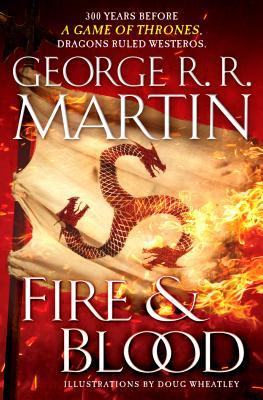
In case I’ll be doing some traveling this month over the holidays, I also grabbed a listening copy of Fire & Blood by George R.R. Martin with thanks to Penguin Random House Audio. The print version is probably best to have because of the visuals, but this also strikes me as having the amazing potential to be a good listen on long car rides, especially when read in the dulcet tones of narrator Simon Vance.
Reviews
A summary of reviews posted since the last update:
Outpost by W. Michael Gear (4.5 of 5 stars)
Breach by W.L. Goodwater (4 of 5 stars)
Harley Quinn: Mad Love by Paul Dini and Pat Cadigan (4 of 5 stars)
The Testament of Loki by Joanne M. Harris (3.5 of 5 stars)
Toxic by Lydia Kang (3.5 of 5 stars)
Redemption’s Blade by Adrian Tchaikovsky (3.5 of 5 stars)
Mage Against the Machine by Sean Barger (3 of 5 stars)
Roundup Highlights:

Interviews & Guest Posts
Here’s to the authors who stopped by The BiblioSanctum this week!
Guest Post: “Back to the Roots: The Unexplored Fantasy” by Daniel E. Olesen

What I’ve Read Since the Last Update
Here’s what I’ve managed to “unstack” from the TBR since the last update. More reviews coming soon!

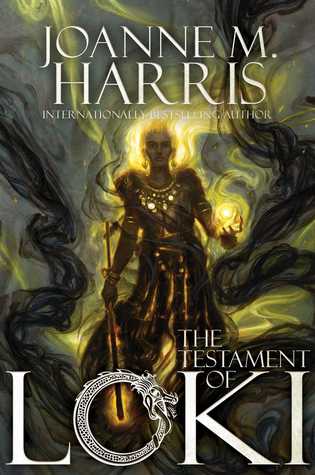
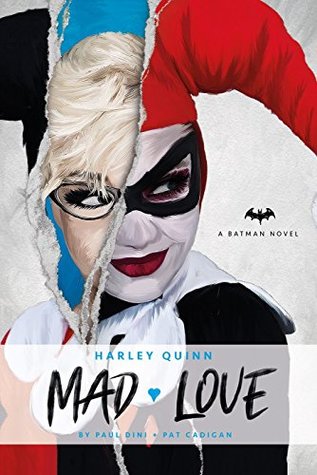

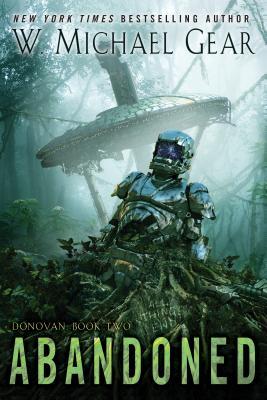
Have you heard of or read any of the books featured this week? What caught your eye? Any new discoveries? I hope you found something interesting for a future read! Let me know what you plan on checking out. Until next time, see you next Roundup!
Friday Face-Off: Hero
Posted on December 7, 2018 36 Comments
Welcome to The Friday Face-Off, a weekly meme created by Books by Proxy! Each Friday, we will pit cover against cover while also taking the opportunity to showcase gorgeous artwork and feature some of our favorite book covers. If you want to join the fun, simply choose a book each Friday that fits that week’s predetermined theme, post and compare two or more different covers available for that book, then name your favorite. A list of future weeks’ themes are available at Lynn’s Book Blog.
This week’s theme is:
“I am Aragorn son of Arathorn; and if by life or death I can save you, I will.”
~ a cover featuring a HERO
Mogsy’s Pick:
Stormdancer by Jay Kristoff
For this week’s topic, I’ve decided to feature the hero – or heroine, if you will – from the first book of Jay Kristoff’s The Lotus Wars, his YA trilogy set in a feudal Japanese-inspired steampunk fantasy world. At the beginning of Stormdancer, our protagonist Yukiko and her father are forced to capture an arashitora – a “storm tiger” or griffin – for their megalomaniacal Shogun. However, their expedition is interrupted by a great storm, causing Yukiko to become stranded and separated from the group. She is set upon by one of the very creatures she was tasked to hunt, and a very angry one at that.
Instead of tearing her to pieces though, the griffin, which Yukiko names Buruu, winds up bonding with the girl, and together, the unlikely pair rises up to challenge the rule of a tyrannical empire.
Here are the four covers being compared this week:
From left to right:
Thomas Dunne Books (2012) – Tor UK (2012)
Polish Edition (2013) – French Edition (2014)
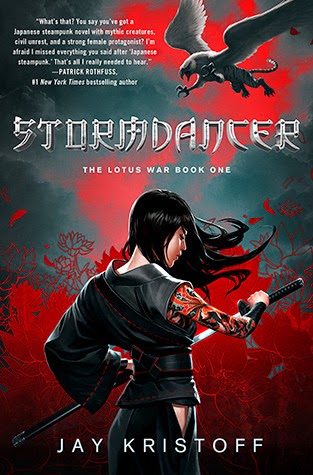
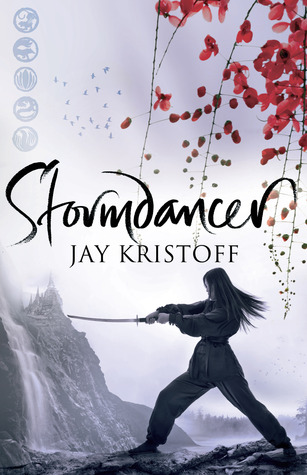
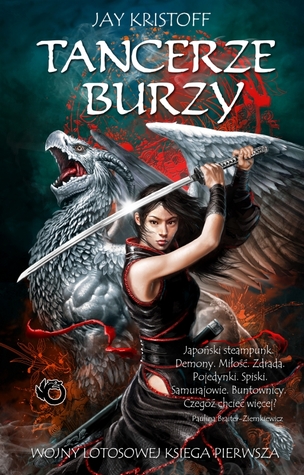
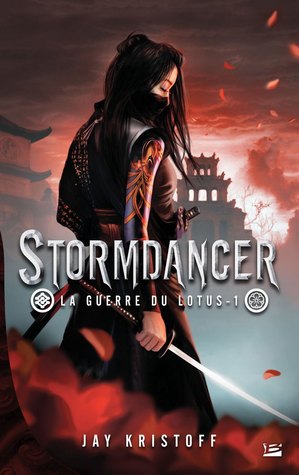
Winner:
I kind of love them all this week! In the end though, I have to say the Polish edition slightly edges out the other three. Just look at that detail. I would love to have this image as a poster.
But what do you think? Which one is your favorite?
Book Review: Mage Against the Machine by Shaun Barger
Posted on December 6, 2018 26 Comments
I received a review copy from the publisher. This does not affect the contents of my review and all opinions are my own.
Mage Against the Machine by Shaun Barger
Mogsy’s Rating: 3 of 5 stars
Genre: Science Fiction, Fantasy
Series: Book 1/Stand Alone
Publisher: Saga Press (October 30, 2018)
Length: 512 pages
Author Information: Website | Twitter
“Harry Potter meets The Terminator”—what could go wrong? Well, as we all know, even good ideas can fail if the execution is not that great. And this was my overall impression with Mage Against the Machine, which had the advantage of a solid concept behind its premise. The only problem was that the story took way too long to gain momentum and generate interest.
To its credit though, the book doesn’t waste time throwing the reader into the thick of things. The story opens in 2120, and our world has become a very different place. Humans are gone, dead, destroyed by a nuclear holocaust years ago—or that’s what Nikolai Strauss has been led to believe. A young wizard living in a sealed and magical dome, Nik has been completely oblivious to the realities happening on the other side of the Veils that conceal and protect mage-kind from the dangers of the wasteland. He’s entirely wrapped up in his own aspirations to become a full-fledged soldier in the Mage King’s army. Living in the shadow of his mother’s disreputable history, he feels he has to do more to prove himself, but when the massive chip on his shoulder gets him in trouble and causes him to go on the run, he is confronted with the truth which changes his outlook on everything.
Outside the dome, Nik meets Jem, a cybernetically enhanced ballerina-turned-soldier for the human resistance. As it turns out, humanity has not died out. Survivors like Jem have been living under the tyrannical rule of artificial intelligences called Synths, fighting for their lives and freedom. Now Nik has a decision to make. With the resistance barely hanging on, should he return to the safety of magic behind the Veils, or help Jem with her last-ditch—and long-shot—efforts to try to save the human race from extinction?
At times, it was really hard to determine what kind of book Mage Against the Machine wanted to be. The tone of the narrative did not feel too YA, though the juvenile behaviors and attitudes of the characters—Nikolai especially—sometimes made me think otherwise. It was extremely difficult to sympathize with Nik, for whom “belligerent and sulky” seemed to be a default setting. Since the publisher seems keen on the Harry Potter comparison, I’m going to draw parallels between Nik and Harry from Order of the Phoenix, in which the latter was a hot-headed, boiling cauldron of hormones severely in need of some anger management classes. This was essentially Nik, who was bitter and resentful to the point of irrationality, whose rage often got the better of him and was the cause of his own misfortunes and misery. This made it nearly impossible to feel sorry for him, let alone root for him.
Jem fared a little better, though for the first half of the book, her chapters were shockingly uneventful and tedious, considering she was the one living in the wasteland terrorized by murderous machines. In essence, this unbalanced pacing was the book’s main undoing; nothing of genuine importance happens until past the halfway mark, when our two characters finally encounter each other. After that, the story picks up—becoming quite enjoyable, in fact—though by this point, a lot of the damage has already been done and I could not justify giving this book more than a middling rating.
I will, however, give the author props for a few things I felt were done really well. Like I said, the second half of this book really shines, infusing the plot with genre-mashing goodness and the kind of thrilling action that keeps you turning the pages. It almost makes up for the lackluster beginning. I also liked the dynamic between Nik and Jem. No romance arc here, thankfully. Their relationship is actually a complicated one, full of nuances and conflict. They’re both looking out for the interests of their own people which causes no small amount of friction in their burgeoning friendship, leading to some tense moments later on when we get closer to the end of the novel.
Mage Against the Machine being a debut, I knew there was a real chance of running into a few hitches, especially with pacing. But boy, the first half could have really used another round of structural edits to shorten it by paring down some of the unnecessary drama. For me, the real story didn’t begin until Nikolai and Jem’s worlds finally collided, and I felt that this crucial turning point should have occurred much sooner than it did in this 500+ page novel. This flaw aside though, I do have to applaud Shaun Barger for attempting something truly original; the post-apocalyptic genre needs more ideas like this to keep things fun and fresh. It’ll be interesting to see what else he’ll bring to the table in the future with more time and experience.

Waiting on Wednesday 12/05/18
Posted on December 5, 2018 22 Comments

Waiting On Wednesday” is a weekly meme that first originated at Breaking the Spine but has since linked up with “Can’t Wait Wednesday” at Wishful Endings now that the original creator is unable to host it anymore. Either way, this fun feature is a chance to showcase the upcoming releases that we can’t wait to get our hands on!
Mogsy’s Pick
Gods of Jade and Shadow by Silvia Moreno-Garcia (August 6th, 2019 by Del Rey)
Let’s be real, after the awesomeness of Certain Dark Things and The Beautiful Ones, I’ll read anything Moreno-Garcia writes. Not that I would have needed much convincing to pick up her next book anyway, with the delectable sound of its Roaring Twenties meets Mayan mythology premise.
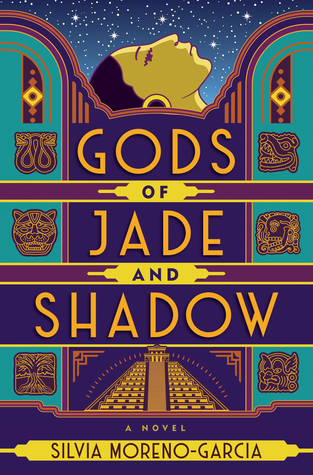 “Here we shall begin to tell a story: a tale of a throne lost, of monsters and magic. A tale of gods and of the shadow realm. But this, our story, it begins in our world, in the land of mortals.
It begins with a woman. For this story, it is her story. It begins with her.
The Jazz Age is in full swing, but Casiopea Tun is too busy cleaning the floors of her wealthy grandfather’s house to listen to any fast tunes. Nevertheless, she dreams of a life far from her dusty, small town in southern Mexico. A life she can call her own.
Yet this new life seems as distant as the stars, until the day she finds a curious wooden box in her grandfather’s room. She opens it–and accidentally frees the spirit of the Mayan God of Death, who requests her help in recovering his throne from his treacherous brother. Failure will mean Casiopea’s demise, but success could make her dreams come true.
In the company of the strangely alluring god and armed with her wits, Casiopea begins an adventure that will take her on a cross-country odyssey, from the jungles of Yucatán to the bright lights of Mexico City–and deep into the darkness of the Mayan underworld.”
Top Ten Tuesday: Top Ten Cozy/Wintry Reads
Posted on December 4, 2018 29 Comments

Top Ten Tuesday was created by The Broke and the Bookish, a weekly meme that now resides at That Artsy Reader Girl. The meme first came about because of a love of lists. Who doesn’t love lists? The original creators also wanted their lists to be shared with fellow book lovers and to ask that we in turn share ours with them and connect with other book bloggers. To learn more about participating, stop by their page dedicated to it and dive in!
This week’s topic:Top Ten Cozy/Wintry Reads
Cozy? Maybe not, but when the weather outside is frightful, these ten horror and thriller books with cold, wintry settings will make you glad you’re warm and safe inside reading.
 The Terror by Dan Simmons
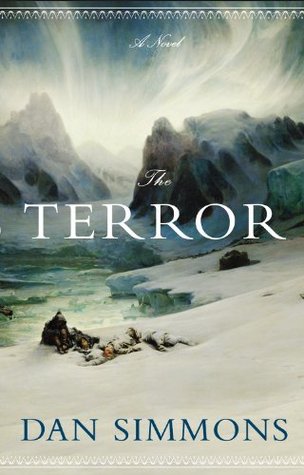
The most advanced scientific enterprise ever mounted, Sir John Franklin’s 1845 expedition in search of the fabled North-West Passage had every expectation of triumph.
But for almost two years his ships HMS Terror and Erebus have been trapped in the Arctic ice. Supplies of fuel and food are running low. Scurvy, starvation and even madness beging to take their toll. And yet the real threat isn’t from the constantly shifting, alien landscape, the flesh-numbing temperatures or being crushed by the unyielding, frozen ocean. No, the real threat is far more terrifying.
There is something out there in the frigid darkness. It stalks the ships and snatches men. It is a nameless thing. At once nowhere and everywhere, this terror has become the expedition’s nemesis…
 Ararat by Christopher Golden

Meryam and Adam take risks for a living. But neither is prepared for what lies in the legendary heights of Mount Ararat, Turkey.
First to reach a massive cave revealed by an avalanche, they discover the hole in the mountain’s heart is really an ancient ship, buried in time. A relic that some fervently believe is Noah’s Ark.
Deep in its recesses stands a coffin inscribed with mysterious symbols that no one in their team of scholars, archaeologists and filmmakers can identify. Inside is a twisted, horned cadaver. Outside a storm threatens to break.
As terror begins to infiltrate their every thought, is it the raging blizzard that chases them down the mountain – or something far worse?
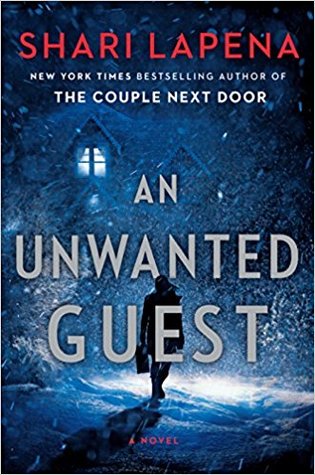 An Unwanted Guest by Shari Lapena
It’s winter in the Catskills and the weather outside is frightful, but Mitchell’s Inn is so delightful! The cozy lodge nestled deep in the woods is perfect for a relaxing–maybe even romantic–weekend away. The Inn boasts spacious old rooms with huge wood-burning fireplaces, a well-stocked wine cellar, and opportunities for cross-country skiing, snowshoeing, or just curling up with a book and someone you love.
So when the weather takes a turn for the worse, and a blizzard cuts off the electricity–and all contact with the outside world–the guests settle in for the long haul. The power’s down but they’ve got candles, blankets, and wood–a genuine rustic experience!
Soon, though, a body turns up–surely an accident. When a second body appears, they start to panic. Then they find a third body.
Within the snowed-in paradise, something–or someone–is picking off the guests one by one. They can’t leave, and with no cell service, there’s no prospect of getting the police in until the weather loosens its icy grip.
The weekend getaway has turned deadly. For some couples, it’s their first time away. For others, it will be their last. And there’s nothing they can do about it but huddle down and hope they can survive the storm.
 The White Road by Sarah Lotz

Adrenaline junkie Simon Newman sneaks onto private land to explore a dangerous cave in Wales with a strange man he’s met online. But Simon gets more than he bargained for when the expedition goes horribly wrong. Simon emerges, the only survivor, after a rainstorm trap the two in the cave. Simon thinks he’s had a lucky escape.
But his video of his near-death experience has just gone viral.
Suddenly Simon finds himself more famous than he could ever have imagined. Now he’s faced with an impossible task: he’s got to defy death once again, and film the entire thing. The whole world will be watching. There’s only on place on earth for him to pit himself against the elements: Mt Everest, the tallest mountain in the world.
But Everest is also one of the deadliest spots on the planet. Two hundred and eighty people have died trying to reach its peak.
And Simon’s luck is about to run out.
 Stranded by Bracken Macleod

In the spirit of John Carpenter’s The Thing and Jacob’s Ladder comes a terrifying, icebound thriller where nothing is quite what it seems.
Badly battered by an apocalyptic storm, the crew of the Arctic Promise find themselves in increasingly dire circumstances as they sail blindly into unfamiliar waters and an ominously thickening fog. Without functioning navigation or communication equipment, they are lost and completely alone. One by one, the men fall prey to a mysterious illness. Deckhand Noah Cabot is the only person unaffected by the strange force plaguing the ship and her crew, which does little to ease their growing distrust of him.
Dismissing Noah’s warnings of worsening conditions, the captain of the ship presses on until the sea freezes into ice and they can go no farther. When the men are ordered overboard in an attempt to break the ship free by hand, the fog clears, revealing a faint shape in the distance that may or may not be their destination. Noah leads the last of the able-bodied crew on a journey across the ice and into an uncertain future where they must fight for their lives against the elements, the ghosts of the past and, ultimately, themselves.
 The Wolf Road by Beth Lewis
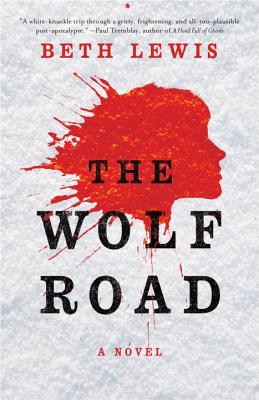
In the remote wilds of a ravaged land, Elka has been raised by a man who isn’t her father. Since finding her wandering in the woods when she was seven, he has taught her how to hunt, shoot, set snares and start fires–everything she needs to survive. All she knows of the world outside is gleaned from whispers of a cataclysmic event that turned the clock back on civilization by a hundred and fifty years and reduced governments and technology to shambles, leaving men at the mercy of the elements–and each other.
Everything changes when Elka learns that the man she has been calling father is harboring a terrible secret. Armed with nothing but her knife and her wiles, she decides to escape his clutches and sets out on a long journey to the frozen north in the hope of finding her long-lost parents.
But as the trail of blood and bodies grows in her path, Elka realizes that daddy won’t be letting his little girl go without a fight. If she’s going to survive, she’ll have to turn and confront not just him, but the truth about what he’s turned her into.
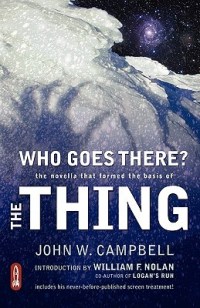 Who Goes There? by John W. Campbell

A distant, remote scientific expedition taking place at the North Pole is invaded by a space alien who has reawakened after lying dormant for centuries after a crash landing. A cunning, intelligent alien who can shape-shift, thereby assuming the personality and form of anything and anyone it destroys. Soon, it is among the men of the expedition, killing each in turn and replacing them by assuming their shape, lulling the scientists one by one into inattention (and trust) and eventually, their destruction. The shape-shifting, transformed alien can pass every effort at detection, and the expedition seems doomed until the scientists discover the secret vulnerability of the alien and are able to destroy it.
The story, hailed as “one of the finest science fiction novellas ever written” by the SF Writers of America, is best known to fans as THE THING, as it was the basis of Howard Hawks’ The Thing From Another World in 1951, and John Carpenter’s The Thing in 1982.
 Dreamcatcher by Stephen King
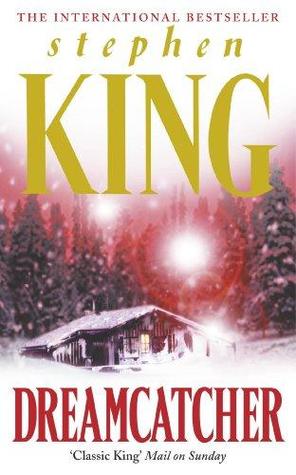
Once upon a time, in the haunted city of Derry (site of the classics It and Insomnia), four boys stood together and did a brave thing. Certainly a good thing, perhaps even a great thing. Something that changed them in ways they could never begin to understand.
Twenty-five years later, the boys are now men with separate lives and separate troubles. But the ties endure. Each hunting season the foursome reunite in the woods of Maine. This year, a stranger stumbles into their camp, disoriented, mumbling something about lights in the sky. His incoherent ravings prove to be disturbingly prescient.
Before long, these men will be plunged into a horrifying struggle with a creature from another world. Their only chance of survival is locked in their shared past — and in the Dreamcatcher.
Stephen King’s first full-length novel since Bag of Bones is, more than anything, a story of how men remember, and how they find their courage. Not since The Stand has King crafted a story of such astonishing range — and never before has he contended so frankly with the heart of darkness.
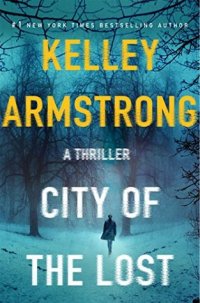 City of the Lost by Kelley Armstrong

Casey Duncan is a homicide detective with a secret: when she was in college, she killed a man. She was never caught, but he was the grandson of a mobster and she knows this crime will catch up to her. Casey’s best friend, Diana, is on the run from a violent, abusive ex-husband. When Diana’s husband finds her, and Casey herself is attacked shortly after, Casey knows it’s time for the two of them to disappear again.
Diana has heard of a domestic violence support town made for people like her, a town that takes in people on the run who want to shed their old lives. You must apply to live in Rockton and if you’re accepted, it means walking away entirely from your old life, living off the grid in the wilds of Canada: no cell phones, no Internet, no mail, no computers, very little electricity, and no way of getting in or out without the town council’s approval. As a murderer, Casey isn’t a good candidate, but she has something they want; she’s a homicide detective, and Rockton has just had its first real murder. She and Diana are in. However, soon after arriving, Casey realizes that the identity of a murderer isn’t the only secret Rockton is hiding – in fact, she starts to wonder if she and Diana might be in even more danger in Rockton than they were in their old lives.
An edgy, gripping crime novel from a bestselling urban fantasy writer, City of the Lost boldly announces a major new player in the crime fiction world.
 The Hunger by Alma Katsu
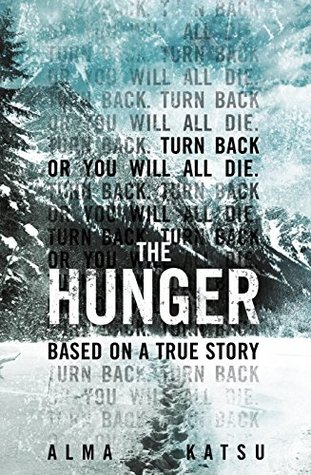
Evil is invisible, and it is everywhere.
Tamsen Donner must be a witch. That is the only way to explain the series of misfortunes that have plagued the wagon train known as the Donner Party. Depleted rations, bitter quarrels, and the mysterious death of a little boy have driven the pioneers to the brink of madness. They cannot escape the feeling that someone–or something–is stalking them. Whether it was a curse from the beautiful Tamsen, the choice to follow a disastrous experimental route West, or just plain bad luck–the 90 men, women, and children of the Donner Party are at the brink of one of the deadliest and most disastrous western adventures in American history.
While the ill-fated group struggles to survive in the treacherous mountain conditions–searing heat that turns the sand into bubbling stew; snows that freeze the oxen where they stand–evil begins to grow around them, and within them. As members of the party begin to disappear, they must ask themselves “What if there is something waiting in the mountains? Something disturbing and diseased…and very hungry?”
Book Review: Harley Quinn: Mad Love by Paul Dini & Pat Cadigan
Posted on December 3, 2018 28 Comments
I received a review copy from the publisher. This does not affect the contents of my review and all opinions are my own.
Harley Quinn: Mad Love by Paul Dini and Pat Cadigan
Mogsy’s Rating: 4 of 5 stars
Genre: Media Tie-in, Comics, Superheroes
Series: Stand Alone
Publisher: Titan Books (November 13, 2018)
Length: 336 pages
Author Information: Paul Dini | Pat Cadigan
My towering TBR and healthy skepticism for comic tie-ins be damned, as soon as I was sent a pitch for Harley Quinn: Mad Love I knew I had to read it. This beloved DC character has been a favorite of mine since my grade school days in the 90s, back when Batman: The Animated Series was pretty much a staple in every kid’s TV repertoire. But what really sold me was Paul Dini’s name on the cover, co-authoring with Pat Cadigan. As one of Harley Quinn’s original creators, Dini’s the only one I would trust to write the definitive origin story for the character.
Most fans are familiar with the broader details behind her transformation into the motley-clad femme fatale who is a frequent accomplice and love interest for the Joker. Before she became Harley Quinn, she was Dr. Harleen Quinzel, a brilliant young psychiatrist who fell in love with the Clown Prince of Crime while treating him at Arkham Asylum, eventually throwing away her promising career to help him escape. But who was she before the Joker, before Arkham, or even before the medical degree? In this novel, Dini and Cadigan take readers back to the very beginning, with a look at Harleen’s childhood growing up in a poor Brooklyn neighborhood as the daughter of a conman and his ex-surgeon wife.
A traumatic event introduced seven-year-old Harleen to death and violence, giving rise to her macabre sense of humor. From a very young age, she had also harbored a strong distrust for law enforcement figures, after witnessing the callous way a group of cops treated her father. This attitude followed her to college, which she attended on a gymnastics scholarship, and then to Gotham City, where she became disgusted with the people’s strange hero-worship of Batman. At Arkham, she sympathized with her patients’ hatred for the caped crusader, who was responsible for putting nearly all of them there in the first place. Of all the inmates, however, she was most fascinated by the Joker, and became obsessed with the idea of making him well. The rest, as they say, is history—though the exact events that took place and the words exchanged between them have always been a bit of a question mark. Until now.
As much as I adore Harley, her story has always struck me as one of the most tragic in the world of comics. Here was this bright, beautiful and talented young woman, who traded it all to be in a relationship where only one person is truly committed to the other. Meanwhile, the Joker, who keeps her close but treats her like garbage, never really seemed to care either way. Even as a child watching the cartoons, I sensed there was something deeply broken about her character, and I believe there’s a good reason for this perception. In all the different forms of media in which she has been portrayed, most either paint her as an oblivious flake or a crazed sexpot. Rarely is she ever given any kind of real agency, as mostly she’s there to play second fiddle to the Joker, to be kicked around and emotionally exploited.
That’s why I think this novel is different. In a way, her manipulation and victimization by the Joker will always be a character-defining element of Harley Quinn, but at the very least, the authors made a real attempt here to explore her personality and give her the autonomy she deserves. In this origin story, Harley’s a genuinely complex individual, not just a lovesick sidekick. The sections detailing her childhood show that the seeds of her deeply-rooted psychological issues were already planted there, long before she met the Joker. The book also takes great pains not to romanticize their relationship. Before Harley fell in love with the Joker, she fell in love with the idea of curing him, and it is this fixation that initially sends her down a dark path.
I guess one could say Harley’s story is a cautionary tale against caring too much. Reading this book, I was reminded of how much I enjoy the duo nature of her character, which is also why I’ll always have a soft spot for her original two-toned costume. She is both villain and victim, in a relationship that is a mixture of love and hate. And while her heart may be in the right place, all her actions are primarily driven by self-interest. The combination of her extreme ambition and her extreme sympathy to others was what ultimately led her to her downfall, and the fact that she severely underestimated the Joker’s abilities as a master manipulator. Knowing exactly what to say and what buttons to push, he was able to use Dr. Harleen Quinzel’s own traumatic past against her, bending her to his will in ways so subtle that even she, an expert in psychiatry, was unable to tell what he was doing to her, or realize what she was starting to become.
Granted, a lot of the story will be familiar if you’ve read the “Mad Love” Batman Adventures comic or have watched the 90s animated series, because then there will be several scenes in this novel you will instantly recognize. Still, the full story of Harley’s origins including her childhood background makes this one worth it, not to mention with the well-rounded treatment of her character by Paul Dini and Pat Cadigan, she actually feels like a real person with real agency in a story that’s all her own. For fans of Harley Quinn and comics in general, I can’t stress enough how much you need this book in your life.
Book Review: The Testament of Loki by Joanne M. Harris
Posted on December 2, 2018 13 Comments
I received a review copy from the publisher. This does not affect the contents of my review and all opinions are my own.
The Testament of Loki by Joanne M. Harris
Mogsy’s Rating: 3.5 of 5 stars
Genre: Fantasy
Series: Book 2 of Loki
Publisher: Saga Press (May 22, 2018)
Length: 272 pages
Author Information: Website | Twitter
The Testament of Loki is the sequel to The Gospel of Loki, shifting the eponymous trickster’s story in a new and unique direction that I honestly wasn’t expecting. Granted, it’s been a while since I read the first book, but I don’t recall things being quite so outlandish and kooky. I will say that I missed some of the grander, more sublime and solemn mythological aspects, though I still enjoyed this book because as luck would have it, I was in the perfect mood for a more cheerful, lighthearted read.
Following Ragnarok and the fall of Asgard, Loki has survived but finds himself trapped in a kind of purgatory, though of course, no prison can hold the wily god for long. Discovering a gateway to Earth through a mysterious link in a Norse mythology-themed video game, Loki escapes the netherworld by entering the mind of one the game’s players, a teenage girl named Jumps.
Confused at this turn of events but not about to let it spoil his good mood, Loki is delighted in the prospect of enjoying everything our modern world has to offer. However, his host has other plans. Almost immediately, Jumps rains on his parade, saying no to junk food or any kind of fun, driving him insane with stressful thoughts of school exams, body issues, social drama and romance—all things about which a Norse god would have very little understanding. Soon though, Loki discovers that he was not the only one to have escaped the netherworld. If he’d managed to hitch a ride in the mind of an earthly host, it means other Asgardians could have done so too.
This book was a quick read, and a lot of fun to boot. That said, I don’t know that everyone will feel the same way, especially if you had anticipated a novel similar in tone and style to The Gospel of Loki, which I felt was a more literary endeavor and even its humor was a little more sophisticated. This one almost feels juvenile, superficial and mainstream in comparison, appealing more to pop culture and the current obsession with Loki thanks to Marvel and Hollywood. Still, the result is a very innovative blend of mythology and urban fantasy, reimagining the Norse gods in a modern setting. Also, putting Loki in the body of a teenage girl might just be the greatest stroke of genius, as it presented so many opportunities for comic relief and other hijinks.
Fortunately, one thing that did not change too much from the first book was the voice of Loki, who’s as self-indulgent and vain as ever. Our protagonist’s relationship with Jumps is off to a hilarious start with his scandalized reaction to the fact that Thor is her favorite Norse god. Next comes the embarrassing dinner with the grandmother, and the disastrous English exam at school. However, there’s more to this book than simply throwing our unlikely partners into as many compromising scenarios as possible; as Loki gets to learn more about his host, he realizes Jumps is a troubled girl dealing with a lot of personal issues. To his credit, he does try to help—insofar as a trickster like him can offer any kind of useful assistance. Nevertheless, it’s interesting how the story deals with some of the more serious and emotional coming-of-age subjects that touch the lives of many young adults today.
The second half of the novel moves into a more abstract and metaphysical territory, and regrettably, I think this is where the plot started to lose me a bit. On the positive side, these sections greatly expanded the world-building, not to mention it also linked Loki and Jumps’ tale to the overarching epic storyline underlying the series, involving the ancient mysteries and powers tying everything together. Those revelations alone kept me reading even when the dream-like sequences went into high gear and threatened to overwhelm, mainly because they offered so much insight into the connections between the mythological world to our mortal realm.
All in all, The Testament of Loki was a decent sequel, entertaining and quirky enough to qualify for light reading, though occasionally there would be a few nuggets of wisdom to chew on. I think it’s worth picking up this if you enjoyed The Gospel of Loki or have any interest at all in the author’s Runemarks sequence.

More on The BiblioSanctum:
Review of The Gospel of Loki (Book 1)
Book Review: Redemption’s Blade by Adrian Tchaikovsky
Posted on December 1, 2018 15 Comments
I received a review copy from the publisher. This does not affect the contents of my review and all opinions are my own.
Redemption’s Blade by Adrian Tchaikovsky
Mogsy’s Rating: 3.5 of 5 stars
Genre: Fantasy
Series: Book 1 of After The War
Publisher: Solaris (July 31, 2018)
Length: 367 pages
Author Information: Website | Twitter
I was not exactly disappointed by Redemption’s Blade, but having gotten a sense of what Adrian Tchaikovsky is capable of, I think I might have expected a little more from this one. It is not, by any stretch of the imagination, a bad book or even a mediocre one. However, by its very nature, the novel’s premise does not lend itself well to being something to get all that excited about.
For you see, Redemption’s Blade is very much an “aftermath” story. Most fantasy readers are familiar with the idea of the epic battle, or the final showdown that inevitably occurs during the climax of a 1000-page tome or at the end of the long and winding multi-book series. Picture if you will though, a war-torn world where this grand event has not only happened already, but is now more than ten years into the past. Evil in the form of the renegade demigod known as the Kinslayer was defeated, his armies of monsters vanquished back to the foul depths from which they came.
Celestaine was one of the heroes among those who triumphed that day, as the one who personally slew the Kinslayer’s dragon and thus single-handedly removing the tyrant’s most powerful weapon from the field. The Kinslayer himself was soon dealt with after that, and Celestaine became an instant legend. But now, a decade after her victory, our protagonist finds herself jaded with life, struggling to find a reason to keep on fighting. Surprising everyone, she falls into a peacekeeping role of sorts, becoming a champion for the Yorughan, a race of warriors who were forced into the Kinslayer’s service but were left flightless and abandoned after their side was defeated.
The concept behind this novel is a good one, I’ll grant it that. Most classic quest narratives involve our heroes seeking to make the world a better place by removing a source of oppression and misery, which in a lot of cases is the main baddie, but Tchaikovsky has taken this fantasy trope and given in a little twist. What happens when the villain is dead and gone, and the world is still a sick, sad and miserable place? Who do you blame, and what do you fight? The point is, even when you win you can still lose—a lesson Celestaine learned the hard way, when she realizes that while she and others may have beaten the odds that day by defeating the Kinslayer, the world is not a Disney movie where everything reverts to sunshine and rainbows with the wave of a magic wand. To a great extent, this is what made these people’s predicament so tragic and real.
Celestaine, however, was not a character I felt all that interested in, even though I could sympathize with her situation and plight. Despite the author’s attempts to subvert character and genre tropes, his protagonist was still pigeonholed into that boilerplate role of reluctant hero, and there weren’t really any extra layers of complexity to make her stand out. I felt much the same about the story, which featured a relatively light and straightforward plot. In some ways, it reminded me of those old RPG cliché joke charts, in which our questing party must visit 3-4 main locations in order to save the world/galaxy before joining the threads together again for the lead-up to the conclusion, a type of narrative structure that adds a lot of padding but not much actual substance. That’s not to say I didn’t enjoy the filler-y bits—this being a Tchaikovsky novel after all, he does world-building and character interactions wonderfully—but again, they lacked the depth I’d expected.
I think my problem is that Children of Time was the first book I ever read by Adrian Tchaikovsky. I loved it to pieces, and in a way, that will always be the bar by which I will measure all his other books. Probably not fair, but it is what it is. It’s not that I didn’t have a good time with Redemption’s Blade. In fact, I thought the story was very readable, punctuated by fun and clever wit in spite of the bleak setting. It was also a delight to try something so new and different by the author, but I just know this is not his top form. All the same though, I’ll still look forward to reading his work.


 The BiblioSanctum