Book Review: Artifact Space by Miles Cameron
I received a review copy from the publisher. This does not affect the contents of my review and all opinions are my own.
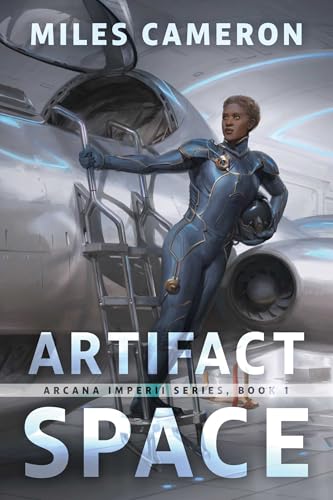 Artifact Space by Miles Cameron
Mogsy’s Rating: 3.5 of 5 stars
Genre: Science Fiction
Series: Book 1 of Arcana Imperii
Publisher: Saga Press (January 27, 2026)
Length: 528 pages
Author Information: Website | Twitter
Artifact Space was a book I felt genuinely excited about checking out. I already have a couple Miles Cameron books under my belt, mostly epic fantasy, but given his range as a writer, a science fiction novel felt like a natural next step. I was curious to see how his style would translate to a space opera setting. That said, military sci-fi being outside of my favorite corner of the genre, I wasn’t too surprised when I ended up struggling a bit.
The story follows a young woman named Marca Nbaro, who, despite growing up in the harsh conditions of an orphanage, has dreamed for years of one day being able to travel to the stars. And at long last, after countless hours of training and preparation, she finally has the chance to join the crew of the Athens, one of the massive Greatships involved in interstellar trade across the galaxy. Unfortunately though, getting aboard isn’t exactly legal. Marca had to spend the last of her resources forging her papers, which means that even if she manages to pull off her long-awaited escape, she’ll be at constant risk of being exposed.
Marca’s efforts pay off, however, when she is allowed onboard and made midshipman. Throwing herself into learning the ropes, she also tries to earn her place among the crew by adjusting to the realities of life on a Greatship run by a ruthless mercantile government. The primary mission of the Athens is the transport of a rare and immensely valuable material called xenoglas, which forms the backbone of human and alien trade. Crew schedules are tightly structured, and any mistakes are judged harshly, which only heightens Marca’s fears of being discovered and cast out. But even as she struggles to prove herself while keeping her head down, the ship becomes involved in an increasingly complicated web of trade politics and risky encounters, pushing Marca well beyond simply trying to get by unnoticed. Apparently, her past isn’t as easy to outrun as she’d hoped.
In a way, Artifact Space almost reads like a slice-of-life book, focusing on everyday moments of Marca’s life aboard the Athens as we follow her through the training routine and developing relationships with the other crew members. That’s not to say the story isn’t plot-driven or devoid of drama and action, because there’s plenty of those. Rather, we just work towards them more gently and slowly. Indeed, a high-stakes conflict does eventually emerge from a series of escalating developments that hint at bigger things in the background.
But while this setup is impressive, I think it’s also what caused the book to drag for me. One quirk I noticed is that although the Athens is a trading vessel, life onboard resembles more like the navy. There’s a lot of complex military-like jargon, heavy emphasis on ranks and hierarchies, as well as the logistics of operations and transport. Cameron clearly wants the reader to view these dynamics as an ecosystem and to understand how they function. The same goes for the political side of the story involving trade alliances and power structures. Of course, none of this is inherently bad, but I confess it didn’t always hold my interest. While I can appreciate this extreme level of detail, at times the minutiae can feel a little overwhelming and more methodical than I personally prefer.
My feelings are also mixed when it comes to Marca. As a protagonist, she’s clearly meant to be likeable, but emotionally, there was a distance. Character work was perhaps on the weaker side, as I often found it difficult to connect with her on a deeper level. For example, her reactions, especially when it came to attraction and romantic elements, didn’t feel fully developed or convincing. The camaraderie between the crew members added some warmth, but many of those relationships stayed fairly surface-level.
That said, the world-building is truly incredible. Just like in his fantasy and historical fiction, Cameron’s attention to detail pays off. The Greatships are a unique concept, giving off cool old-school-meets-futuristic-tech vibes. The setting feels well thought-out and lived in. Storytelling is consistent and shows plainly that it knows where it’s going and what kind of narrative it wants to be, even if it didn’t always line up with my own tastes.
In the end, Artifact Space is a solid start to a new series, but it doesn’t end on a cliffhanger and so also works perfectly well as a standalone. The scope of its wider world reminded me a little of The Expanse, while the more intimate, zoomed-in looks at daily life aboard the Athens even reminded me a little bit of The Wayfarers. Personally though, I do think experience or an appreciation for military sci-fi will help increase enjoyment. I didn’t love this, but I didn’t dislike it either, and I’m curious enough about where things are going that it’s likely I’ll be picking up the sequel.


 The BiblioSanctum
I’m not sure I’ve ever read Miles Cameron before. I can see why you were drawn to this, it sounds good on paper. But I’m not a huge fan of military SF either, so I might have a similar reaction.
LikeLiked by 1 person
I can’t believe that I still haven’t read this author! I don’t think this would be my best starting point as military SF isn’t really my go to.
Lynn 😀
LikeLike
Pingback: Guide Assessment: Artifact Area by Miles Cameron - The Home of WEBFILMBOOKS
Based on everything that you’ve said about this one I think I’ll put it on my maybe list. I want to try and get into the sci fi genre more but I dont know how I’ll find military sci fi 🤔 I like the combination of a large scope, strong worldbuilding and day to day details though. I hope you enjoy the sequel more and that the bonds grow stronger as the series progresses.
LikeLike
I never felt invested enough in this to finish it, which is disappointing as I love the author’s fantasy and historical work. Glad you… kinda liked it? The second one’s out already, but when’s the saga copy releasing? Also, I much prefer the Gollancz edition’s cover.
LikeLike
No idea he had written sci.fi too
LikeLike
Ooo – I can’t think how I’ve missed this one. I’m a HUGE fan of Cameron’s fantasy writing – no one else writes pitched battles better. And I also happen to enjoy both fantasy and sci fi where daily life is depicted in minute detail (though oddly enough – I don’t write like that!). So it sounds as if this one is tailor-made for me. Thank you for a superb review, Mogsy – I’ll go and track this down:)).
LikeLike
Not sure if this one would work for me but I’ll keep it in mind as I have really enjoyed a couple military sci-fi in the Honor Harrington series by David Weber. Probably very different from this one, but maybe similar enough to keep me interested.
LikeLike