Book Review: The Mad Scientist’s Daughter
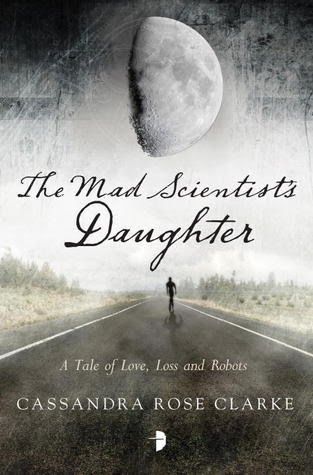
The Mad Scientist’s Daughter by Cassandra Rose Clarke
Genre: Science Fiction
Series: Stand alone
Publisher: Angry Robot (January 29, 2013)
Author Information: Website | Twitter
Mogsy’s Rating: 4 of 5 stars
The Mad Scientist’s Daughter ended up giving me all sorts of contradictory and inconsistent feelings. Even though I loved this novel, there were still a ton of things that drove me nuts about it, and yet I can’t help but suspect a lot of it was by design.
First of all, while I enjoyed this book, I also have to say it was also one of the most depressing stories I’ve ever read. Even though the tagline is “A tale of love, loss and robots”, I don’t actually think it was meant to be that depressing (in fact, it’s got a pretty happy ending) but here you have a main character who’s just so pitiful and tragic and even pathetic, I couldn’t even bring myself to hate her for her many, many flaws.
At its heart, The Mad Scientist’s Daughter is a deep analysis and portrayal of Caterina Novak, daughter of a brilliant yet a eccentric inventor and cybernetics expert, and we follow her character’s development from childhood to her adult years. Cat is five years old when she first meets Finn, the android her father brings home to be her tutor. But as Cat grows, she discovers Finn is different from other androids. With every year that passes their relationship becomes increasingly complicated, as Cat starts to see Finn as someone more than just a tutor and friend.
And yet, what Cat attributes to love for Finn, I see it more as an obsession. I wouldn’t really consider this book a love story or a true romance, and if it was meant to be, then it missed its mark completely. If you’re looking for romantic tension or chemistry between two characters, you’re not really going to find it here. For most of the book, Cat’s feelings are mostly one-sided, and for all the times we’re told Finn is sentient and one of a kind, the author still never manages to make him seem quite human enough.
So yeah, I pretty much just spent a lot of time feeling bad and really sorry for Cat. Like I said, depressing.
Still, the fact I am able to express any sympathy for her at all is an incredible achievement in itself. It’s like Cat is always in her own little world, with Finn being the only thing ever on her mind. She snaps at people, not understanding why they might not feel the same way about androids as she does. She marries a man (who turned out to be a grade-A dick but genuinely did love her) out of convenience. She donates to a charity that defends androids, but I’m not convinced she actually believes in the cause or if it’s more likely she’s driven by her guilt and Finn obsession.
By rights, such a self-absorbed and angst-ridden character should turn me right off, but somehow Cat manages to make me like her. Maybe it’s because we all know nobody’s perfect. Or that when it comes to that special someone, no one can help the way they feel. I felt Cat’s pain of loving someone she believed she could never have. I felt her helplessness of knowing she shouldn’t have those feelings but turning them off is also easier said than done. We’ve all been there. That I could relate to her made it easier to overlook her many faults.
Before this, I’d only read Cassandra Rose Clarke’s young adult novels and I was really keen to see what she could do with a longer, more mature story. In the end I was quite happy with the book The Mad Scientist’s Daughter turned out to be. It isn’t an exploration into the humanity of intelligent machines like Asimov’s Bicentennial Man or the movie A.I. Artificial Intelligence, or at least it isn’t its central focus; instead, the delineation of Cat’s personality takes center stage, and the plot takes a backseat to the dynamics in her relationships with Finn and, to a lesser extent, her mother and father. The premise is a cool idea, even if the story ultimately turned out to be a horribly heartbreaking one for me.



 The BiblioSanctum
Pingback: Angry Robot Backlist Boost: An Interview with Cassandra Rose Clarke | The BiblioSanctum
Pingback: #RRSciFiMonth Top 10 Science Fiction Novels Read This Year | The BiblioSanctum