Book Review: Warrior of the West by M.K. Hume
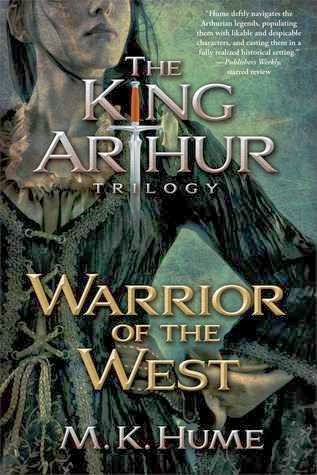
Genre: Historical Fiction, Fantasy
Series: Book 2 of King Arthur
Publisher: Atria
Date of Publication: January 7, 2014
Mogsy’s Rating: 4 of 5 stars – “Hume takes her expertise on the legend and history of King Arthur and weaves in her own personal imaginings, portraying many prominent figures of the mythos in unique, intriguing ways”
Of the many re-tellings and interpretations I’ve read based on the King Arthur mythos, I think M.K. Hume’s is probably the most “scholarly” version I’ve ever come across. As an expert on Arthurian literature writing the series as more of a historical fiction than a fantasy, the author clearly went to great lengths to find the most accurate accounts of Arthur’s reign. Still, she ultimately chose to tell the legends her way, and there are certainly no shortage of surprises here.
This is the second book of Hume’s King Arthur trilogy. The first book Dragon’s Child was about how Artor (Arthur) won his crown to become High King of the Britons, while Warrior of the West takes place approximately twelve years after that. The story almost feels like it is split into two parts, with the first half of the novel focusing on the war against Glamdring Ironfist and his army of Saxon invaders.
But while it was undoubtedly the right call for Hume to open the book with the excitement and conflict of a war campaign, I personally found the events of the second half of the novel more engaging. Having driven back his enemies, the rest of the book centers around Artor’s efforts to establish his throne and his need for a legitimate heir. This, of course, is where Wenhaver (Guenevere) comes in, and the interesting part begins.
I have to say this book’s characterization of Wenhaver is one of my favorite portrayals of King Arthur’s queen that I’ve ever encountered. Simply put, she’s a terrible, vicious person, little more than a spoiled child accustomed to using her beauty to get what she wants. In her afterword, Hume confesses that she has never much liked Guenevere or her character’s relevance as someone who could bring ruin to an entire kingdom for the love of another man, and yet could still retain her likeability as a person. I’ve never thought about it that way, but the fact that Guenevere and her part in the legend has always been heavily romanticized is true enough.
However, in this story Wenhaver is a vile, jealous and sadistic character who cheats on her husband out of spite. Hume also leaves the character of Lancelot out entirely, which makes sense because she is staying faithful to the older versions of the legend (Lancelot is thought to have been absorbed into the Arthurian tradition after he was introduced by the French romances). But while there’s no love lost between king and queen, Hume cultivates her character relationships in other places.
As a counterpoint to Wenhaver, we have Nimue, known commonly as the Lady of the Lake who enchants the heart of Merlin. Nimue is the polar opposite of Wenhaver, being a sweet, kindly and down-to-earth young woman — which again is an intriguing portrayal of a key figure that is very different and unique. I love the background Hume has written for Nimue, while still managing to tie in a lot of the elements from the more popular versions of the legend, including her relationship with Myrddion Merlinus.
In spite of this, the story also feels grounded in historical reality, which I’m sure is due largely to Hume’s research and academic expertise. The nature of the writing style also puts you right there, and is quite effective at emphasizing the brutality of the times. In some ways, the starkness of the prose makes the violence seem so much worse, making me feel a lot more squeamish. Indeed, the author does not spare us from the darker, bloodier side of forging a kingdom.
As you can see, the book veers off a great deal from the more “accepted” versions of the King Arthur legend, but that is also what I love best about it. The way Hume weaves her own personal imaginings into a framework which brings together myth and legend with historical accounts is what’s making this series stand out for me. It’s true that these novels lean further into historical fiction territory than fantasy, making them quite different than the type of books I’m currently reading now, but I’m definitely looking forward to checking out the conclusion of this trilogy.

4 of 5 stars
A review copy of this book was provided to me by the publisher via NetGalley in exchange for an honest review.


 The BiblioSanctum