Backlist Burndown: The Windup Girl by Paolo Bacigalupi

As book bloggers, sometimes we get so caught up reading review titles and new releases that we end up missing out on a lot previously published books. As a result, one of my goals this year is to take more time to catch up with my backlist, especially in my personal reading pile. And it seems I’m not the only one. Backlist Burndown is a new meme started by Lisa of Tenacious Reader. Every last Friday of the month, she’ll be posting a review of a backlist book and is inviting anyone interested to do the same. Of course, you can also review backlist books any day you want, as often you want, but be sure to watch for her post at the end of the month to link up!
This month, I’m reviewing…
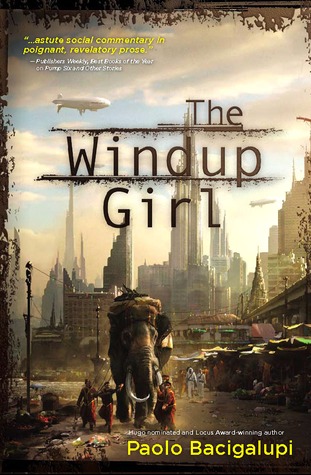 The Windup Girl by Paolo Bacigalupi
Genre: Science Fiction
Series: Stand Alone
Publisher: Night Shade (9/1/2009)
Author Information: Website | Twitter
Mogsy’s Rating: 3.5 of 5 stars
This was a great book. And the only reason I’m not rating it higher is because I’ve read better from Paolo Bacigalupi. If I had read this a few years ago, I think I would have enjoyed it unconditionally, but of course that’s not what happened. Instead, I read The Water Knife earlier this year and loved it, and as I usually do when I read an amazing new book by an author I’ve never read before, I went and picked up a bunch of Bacigalupi’s older titles. I decided to read The Windup Girl first, his multiple-award winning debut that shot him to stardom, and figured too that it was the perfect choice to review for Backlist Burndown.
The book takes place in 23rd century Thailand in a world ravaged by increasing temperatures and rising sea levels. Frequent disasters, both natural and manmade, cause widespread devastation to crops and human populations. Humanity is now dependent on biotechnology for food production, and megacorporations control the market using their own genetically modified seeds, which have all but replaced the natural order. The capital city of Bangkok only survives due to technology, and would be underwater if not for the levees that hold back the flood.
The story features multiple POVs. Major characters include Anderson Lake, a Calorie Man for the megacorp AgriGen, a sort of economic hitman sent to work undercover at a factory in Thailand. It is a front for his real mission, to search Bangkok’s street markets for produce thought to be extinct in order to discover the location of the Thai seedbank. Anderson leaves the running of the factory to his manager, Hock Seng, a Chinese refugee who was a businessman in his former life in Malaysia before being exiled from the country. Seng plots against Anderson, embezzling from the company while planning to steal secret designs and documents from his boss.
Then there’s Emiko, a “Windup Girl”. She is a genetically engineered being, and not human in the strictest sense, due to all the different modifications to her DNA. Windups are made to be docile slaves, programmed to obey. Abandoned by her Japanese master, Emiko lives a dangerous life in Thailand, because she would be destroyed if caught. She is forced to put up with sexual abuse and humiliation at the club where she works, in exchange for a measure of protection against the Thai government. She dreams of a day when she can finally buy her freedom and leave this place forever for a refuge in the north.
What I found interesting are the many similarities The Water Knife had to The Windup Girl. Bacigalupi seems to fancy writing dystopian science fiction about humans screwing up the future of the world. Both stories feature a shortage of vital resources, their supplies controlled by megacorporations or corrupt authorities. Both books even have a corporate hitman/mercenary-type character in a main role. So, perhaps comparisons between my experiences with his latest novel versus my experience with his first novel were going to be inevitable.
First, there’s the realistic premise, an important factor that makes all the difference. For me, dystopian novels tend to be more impactful when they take the form of cautionary tales or commentary on current issues, given how much easier it is to imagine them really happening. I also spent a part of my childhood in Bangkok, so reading this story also had a strong effect on me in more ways than one.
There are some unpleasant and difficult themes to deal with as well. Bacigalupi’s novels are certainly not happy stories. Characters in The Windup Girl live in a grim and very brutal world, and many are subject to discrimination, violence and other kinds of abuse. Emiko, the book’s titular character is especially subjected to the worst kind of treatment – rejected, beaten, raped, tortured, hated – all because of what she is and what she represents. Created to be nothing more than a toy for the wealthy, Emiko is helpless to control her situation or even her own actions because of her genetic modifications.
As well-written as this was, the author has certainly come a long way since his debut novel. The Windup Girl is a fascinating and engaging tale. Compared to The Water Knife though, it’s not nearly as well-plotted or polished. I sensed that Bacigalupi’s storytelling was still outpaced by his imagination at this point, in part due to the uneven pacing as well as the unexpected turn of events in the last quarter of the book. I can’t say I’m too fond of the last 100 or so pages; what should have been a ramp up to a killer conclusion instead had me fighting to keep my interest, but for all that, I still thought this was a great read.


 The BiblioSanctum
Didn’t I think about doing this? Eh, oh well, doing it all the time anyway 🙂
Sounds…ok
LikeLike
You do read a lot of backlist books already! I actually have to do a challenge, lol.
LikeLike
I think I’ll probably start with The Water Knife:-) Although I do have a copy of this. I love the fact that it’s set in Thailand, which is something you don’t see every day.
LikeLike
I would recommend that too. Though I did love the Thailand setting, for the themes in this book I though the place he chose was perfect. (And in the foreword, he said he was inspired by being in Asia while the whole SARS thing was going on!)
LikeLike
I like Dystopian novels, but sometimes the subject matter of the story – like, Megacorps controlling all because of their genetically modified seeds – hits a little too close to home for comfort. And a bit too plausible 😛
LikeLike
Both of PB’s books I’ve read so far are like this! His dystopian scenarios are scarily real!
LikeLike
I had heard mixed things about this, and loved Water Knife. Still can’t decide if I want to go back and read this one as I’m too worried I will set the bar too high.
LikeLike
I think that was part of my problem. Loved the Water Knife, so following up that one with his debut novel, I knew I was going to be comparing the two — unfair of me, perhaps, but can’t be helped!
LikeLike
Pingback: Mogsy’s Bookshelf Roundup: Stacking the Shelves and Recent Reads | The BiblioSanctum
I’ve heard from a lot of people that The Water Knife is Bacigalupi’s best book yet, so it’s understandable that his earlier work doesn’t quite measure up. One of the things that I really love about him is his environmentalism, so I’m glad to see you mention that. I actually discovered him in an environmental literature class in uni!
LikeLike
The Water Knife is a GREAT book…and it’s also his latest so he’s had plenty of novels under his belt by the time he wrote it. The storytelling and pacing definitely felt more polished. And yes, if you enjoy environmentalism themes, you’ll find this one intriguing!
LikeLike